Introduction
In the digital landscape of 2026, the phrase "the cloud is just someone else's computer" has taken on a heavy legal weight. For Canadian IT leaders, the location of that "computer" is now the difference between seamless operations and multi-million dollar compliance fines.
With the Consumer Privacy Protection Act (CPPA) and Quebec’s Law 25 now fully enforceable, the demand for a CIAM vendor that offers dedicated Canadian data centers has skyrocketed. It is no longer enough to have a "local pod" if the parent company is bound by foreign laws like the U.S. CLOUD Act, which can bypass local residency. True digital identity in Canada requires a "Sovereign Identity" approach—hosting data within the border, managed by entities that respect Canadian jurisdiction.
This is why choosing the best CIAM platform in Canada in 2026 requires more than a feature comparison table. It requires a sovereignty lens. It requires an understanding of Canadian privacy law. And frankly, it requires a bit of skepticism toward global vendors who say “trust us” without explaining which country’s laws apply when something goes wrong. In this blog, we will explain the importance of several key parameters, so it is easy to understand the how behind our top CIAM platform rankings as well.
Why Data Residency and Sovereignty in Canada Matter Now
In 2026, “Canada data residency” is not a government-only conversation, it is a boardroom conversation too. It is often the deciding factor between winning and losing enterprise contracts. It is a procurement checklist.
The Sovereignty Gap
Many global identity vendors host data in US-based cloud regions. Some offer Canadian data centers. However, if the parent company is subject to US jurisdiction, the US CLOUD Act can apply. That means US authorities may request data access regardless of where the data is physically stored. This creates what many Canadian privacy experts call a sovereignty gap.
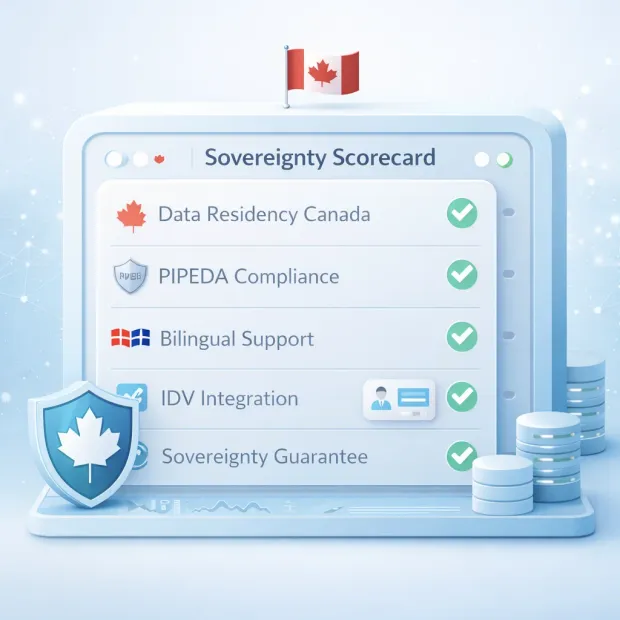
True data sovereignty Canada means two things. First, the data is physically stored in Canada. Second, it is governed exclusively under Canadian law. No silent foreign jurisdictional reach. No ambiguous legal exposure.
For industries like healthcare, financial services, public sector, and legal services, this distinction is critical. A misstep here is not just a compliance fine. It can be reputational damage that lingers for years. In highly regulated sectors, hosting Canadian customer identity data outside of Canada can disqualify you from entire markets.
The CPPA/Law 25 Era: Beyond PIPEDA
Achieving CPPA compliance in 2026 is no longer about publishing a privacy policy and hoping nobody reads it. It requires operational capability. While PIPEDA set the stage for privacy, in 2026 the CPPA introduced the massive fines (up to 5% of global revenue or $25M for the highest-tier offenses) and Law 25 has made PIAs mandatory.
Meaningful consent now requires granular explanations. Users must understand why their data is collected, how it is used, and whether it crosses borders. This is not buried in fine print. It must be accessible and clear.
Data portability is another emerging requirement. Under CPPA principles, individuals have increasing rights to transfer their data between platforms. Your CIAM platform must support structured exports and interoperability without months of custom engineering.
The right to erasure is equally critical. When a user requests deletion, you must delete identity data across systems, including logs, tokens, and downstream integrations. “We will delete your account within 90 days” is no longer acceptable language. Modern Canadian regulatory expectations demand timely, verifiable deletion.
If your CIAM platform does not support consent logging, audit trails, subject access workflows, and deletion orchestration, you are not compliant. You are improvising.
The PIA Mandate: Beyond "Check-the-Box" Compliance
Under Quebec’s Law 25, organizations are legally required to conduct a Privacy Impact Assessment (PIA) for any project involving the acquisition or development of information systems that process personal data. This is especially critical for cross-border data transfers. A modern Canadian CIAM platform like LoginRadius simplifies this by providing "compliance-by-design" documentation and automated reporting tools. Instead of starting a PIA from scratch, businesses can leverage the provider’s pre-built security posture and data-flow maps to prove to regulators that the sensitivity of the information is matched by equivalent, localized protection measures.
In 2026, a CIAM platform that doesn't help you automate your PIA is not a solution; it's a liability.
CIAM Vendor Evaluation Starts with a Map
When conducting a CIAM vendor evaluation, most architects look at features like MFA, Social Login, or Scalability. However, in 2026, the most critical feature is Geofencing. Many global identity providers claim to offer Canada data centers. But there is a catch: if the vendor is headquartered in a foreign jurisdiction, they may still be legally compelled to provide access to data stored in Toronto or Montreal to foreign intelligence agencies. This creates a "Sovereignty Gap." To achieve true Canada compliance, organizations are increasingly turning to home-grown champions or vendors with legally isolated Canadian subsidiaries.
Top CIAM Companies with Data Centers in Canada: The 2026 Power List
These companies are at the forefront of digital identity in Canada, providing robust infrastructure that keeps data within our borders.
1. LoginRadius (Vancouver, BC)
LoginRadius remains the dominant CIAM vendor for high-scale Canadian enterprises. They were among the first to offer a "Sovereign Cloud" deployment model.
-
Data Footprint: Multiple Canada data center regions (East and West) allowing for high-availability deployments.
-
Compliance: Fully aligned with CPPA and Law 25, offering automated "Right to be Forgotten" workflows that are essential for Quebec-based users.
-
Key Strengths: Their visual identity orchestration allows developers to build complex login journeys without touching a line of code. Their 'Sovereign Cloud' option is specifically designed for Law 25, utilizing physically isolated infrastructure within Montreal and Toronto.
2. 1Password (Toronto, ON)
Originally a password manager, 1Password has evolved into an Extended Access Management (XAM) powerhouse.
-
Infrastructure: They offer a dedicated .ca environment for business customers, ensuring that all metadata and vault info stays in a Canadian data center.
-
Compliance focus: Ideal for the "Human" side of Canada compliance, protecting against credential stuffing—the #1 cause of data breaches in 2026.
3. IDENTOS (Toronto, ON)
IDENTOS has become the "standard" for federated identity in the Canadian public sector, particularly in healthcare.
- Sovereign Focus: They power the health identity grids for several provinces, proving they can handle the most sensitive PII (Personally Identifiable Information) under strict provincial laws.
4. Bravura Security (Calgary, AB)
For enterprises needing a mix of IAM and IGA (Identity Governance), Bravura provides a massive footprint in Western Canada.
- Enterprise-Grade: They specialize in complex, hybrid environments where some data stays on-premise and some moves to a canada data center.
5. Agilicus (Kitchener, ON)
Agilicus is the "Zero Trust" disruptor. They focus on providing secure access to internal resources for a remote workforce without the need for a VPN.
- Localization: Their entire stack is built and hosted on Canadian soil, making them a favorite for local municipalities and defense contractors. As a 100% Canadian-owned entity, they offer a 'No CLOUD Act' guarantee that US-owned hyperscalers simply cannot match.
Critical Factors for CIAM Vendor Evaluation
If you are currently choosing a partner, use this 2026 checklist to ensure your digital identity Canada strategy is future-proof.
1. Jurisdictional Isolation
Do you have a signed Data Processing Agreement (DPA) that explicitly states you will challenge foreign data access requests (like those under the U.S. CLOUD Act) in a Canadian court first?
2. Consent Orchestration
Under CPPA, consent must be granular. Your CIAM vendor must provide a "Consent Dashboard" where users can toggle exactly what data is being shared and for what purpose.
3. Latency & Performance
Hosting in a Canada data center isn't just about the law; it's about speed. A login request traveling from Vancouver to a data center in Virginia and back adds 60-100ms of latency. Keeping it in-province drops that to sub-10ms.
4. Native Identity Verification
Does the platform integrate with Interac Verified or other Canadian-specific digital ID wallets? This is becoming a standard requirement for banking and government services.
The "Canada Compliance" Roadmap
Achieving compliance isn't a one-time setup; it’s an ongoing process.
-
Data Mapping: Identify all points where PII enters your system.
-
Regional Pinning: Configure your CIAM to ensure that "User A" (a Canadian resident) always has their data pinned to a Canadian data center.
-
Privacy by Design: Use your CIAM’s "Progressive Profiling" to only ask for data when absolutely necessary, minimizing your data liability.
Conclusion: Building Trust on Home Soil
In 2026, your customers are more "privacy-aware" than ever. They look for the "Data Hosted in Canada" badge as a sign of trust. By choosing a CIAM vendor with a strong local footprint and a deep understanding of Canada compliance, you aren't just checking a box for the legal department—you are building a competitive advantage.
Ready to simplify your residency requirements? Let’s discuss how you can migrate your existing identity data to a sovereign Canadian environment without a second of downtime.
FAQs
Q: Does the U.S. CLOUD Act affect my data in a Canadian data center?
A: If your CIAM vendor is a U.S.-based company, they may be legally required to provide data to U.S. authorities even if it is physically located in a Canadian data center. Choosing a Canadian-headquartered vendor or one with a "Sovereign" legal structure is the best way to mitigate this.
Q: Is Law 25 different from the federal CPPA?
A: Yes. Quebec’s Law 25 is generally stricter, requiring explicit "Impact Assessments" for any data transferred outside of the province. A CIAM vendor with a Montreal-based Canadian data center is often the best choice for businesses with heavy operations in Quebec.
Q: Can I migrate data from a US-based CIAM to a Canadian one?
A: Absolutely. Most modern CIAM platforms offer "Seamless Migration" tools that move users to the new Canadian data centers the next time they log in, ensuring zero friction for the end-user.
Q: Why is "Digital Identity Canada" a hot topic in 2026?
A: The federal government has accelerated the Pan-Canadian Trust Framework, moving toward a national digital ID. CIAM vendors that support these standards allow your customers to "Log in with their Government ID," increasing trust and reducing fraud.
Q: What are the fines for non-compliance with Canadian data laws?
A: Under the CPPA, organizations can face fines of up to 5% of global revenue or $25 million (whichever is greater) for serious contraventions. This makes the cost of a CIAM vendor evaluation small in comparison to the risk of a breach.
Q: Are there specific CIAM features required for Canada compliance?
A: Yes, features like "Consent Versioning" (tracking which privacy policy the user agreed to) and "Data Portability" (allowing users to download their data in a machine-readable format) are mandatory under 2026 laws.