Introduction
Every business wants to know its customers better. But asking for all of the information at signup can work against you. Imagine being on the receiving end: you are creating an account and are immediately seeing fields for your name, phone number, date of birth, location, job title, interests, communication preferences, and other personal details. You haven't even used the product yet, but you're already being asked to build a detailed profile.
Some customers will complete it. Others won't even bother. At the same time, stripping registration down to the bare minimum creates a different challenge. Businesses still need accurate customer information to personalize experiences, manage preferences, support customer journeys, and provide relevant services. Progressive profiling offers a more practical middle ground.
Instead of collecting a complete customer profile upfront, progressive profiling gathers information gradually as the relationship develops. Registration can begin with the attributes genuinely needed to create an account. Additional information is requested later, when there's a clear reason for it- a shipping address during checkout, preferences during account personalization, or company details when someone creates a business workspace.
For businesses using Customer Identity and Access Management (CIAM), progressive profiling can connect this gradual data collection with customer identity profiles, registration, consent, and other digital experiences. Done well, it reduces unnecessary signup friction while allowing customer profiles to become more useful over time.
But simply moving questions from signup to later screens isn't enough. The real challenge is deciding what to ask, when to ask it, and whether you need that information at all.
That's what separates thoughtful progressive profiling from a long registration form broken into smaller pieces.
What Is Progressive Profiling and How Does It Work?
Progressive profiling is the practice of collecting customer information gradually across multiple interactions instead of requesting every profile attribute during registration. Businesses start with the information needed for the immediate experience and enrich the customer profile later as additional data becomes relevant and important for their journey.
The idea is simple: a business rarely needs to know everything about a customer on day one.
An ecommerce site, for example, may initially need only an email address and an authentication method. A shipping address becomes necessary only when the customer places an order. Product preferences can be requested when they choose to personalize their experience. The profile grows alongside the relationship rather than being completed before the relationship has really started.
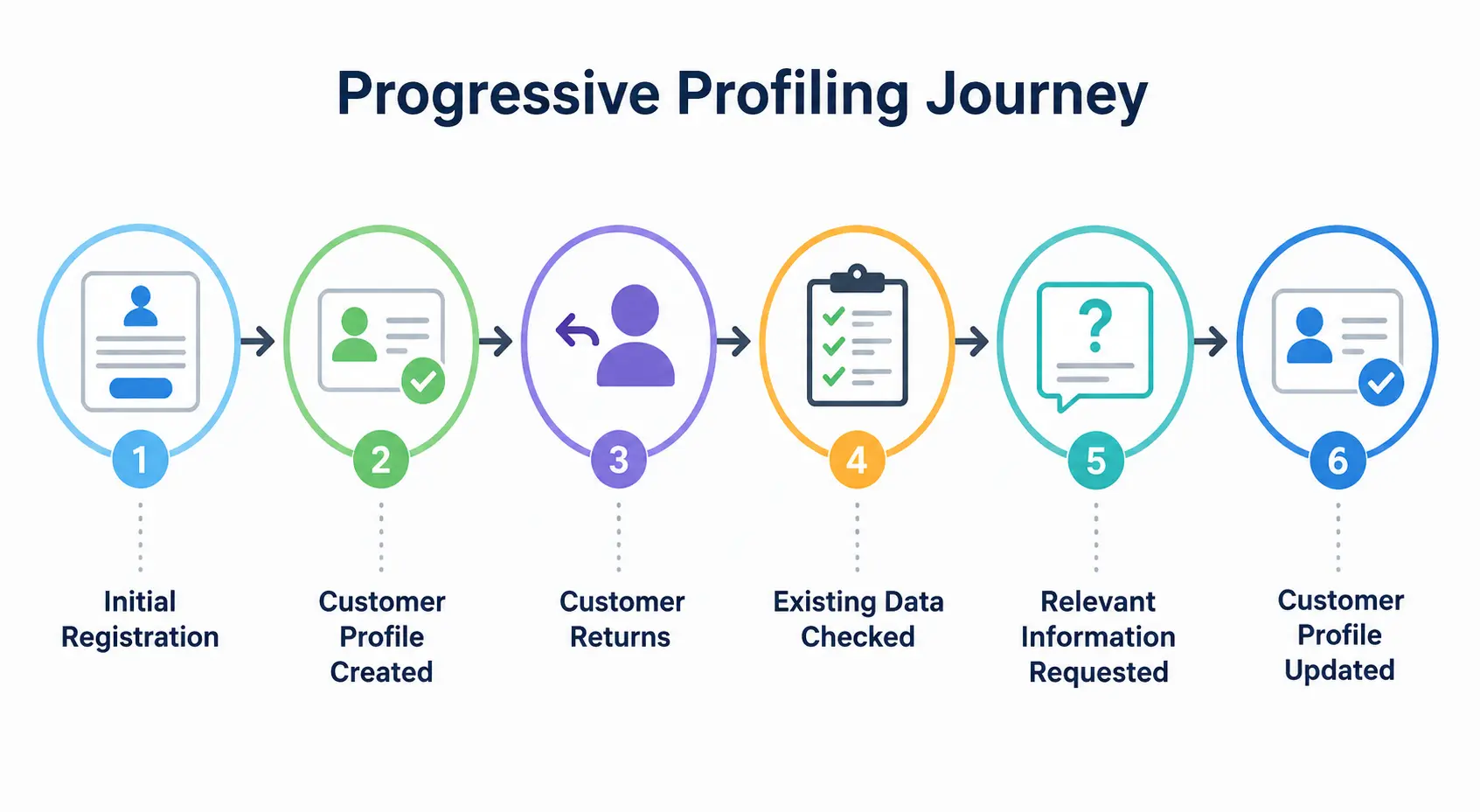
A typical progressive profiling journey might look like this:
| Customer Action | Information Requested | Reason |
|---|---|---|
| Account Registration | Email + password/passkey | Account creation |
| First Purchase | Shipping address | Product delivery |
| Loyalty Program Enrollment | Product preferences | Personalized offers |
| Premium Subscription Upgrade | Communication preferences | Relevant account updates |
| Annual Profile Review | Updated contact details | Data accuracy |
Before presenting another question, the system checks what is already known about the customer. If the required attribute exists and can appropriately be used, there is little reason to request it again. If something relevant is missing, the application can ask for it when the customer's current action provides a logical reason.
This is where dynamic or smart forms can help. Rather than showing every customer the same fields, a form can adapt based on information already available. But dynamic forms and progressive profiling aren't identical. Dynamic forms control what appears on a particular form; progressive profiling is the broader strategy of building the customer profile across interactions.
The goal isn't to eventually fill every available profile field. It's to collect useful information without creating unnecessary friction.
Use Customer Actions to Trigger Relevant Profile Requests
Progressive profiling doesn't have to depend only on repeat website visits. In a CIAM-driven journey, additional profile requests can be tied to meaningful customer actions.
A business might request another profile attribute after a customer's fifth login, when they access a particular area of an application, activate a feature, complete a purchase, upgrade an account, or reach another predefined point in the customer lifecycle.
That makes the timing more relevant. Instead of asking for information simply because another session has started, the business can request it when there is a clear reason for doing so.
Consider a subscription platform. Basic information may be enough to create an account. When the customer later activates a specific service, the platform can request the additional information required for that service. If another attribute becomes relevant after an upgrade, it can be collected then.
The profile becomes richer over time, while the initial registration experience stays focused on what is actually necessary.
| Trigger | Data Requested |
|---|---|
| First login | Name |
| Checkout | Address |
| Upgrade | Company |
| Loyalty join | Preferences |
Common Progressive Profiling Approaches
Progressive profiling can take different forms depending on the customer journey. Multi-step profiling divides data collection across registration or onboarding stages, allowing businesses to capture essential information first and defer nonessential fields.
Event-driven profiling goes further. Additional questions appear when a customer performs a relevant action, such as returning to an application, using a feature, reaching a particular account stage, or completing a transaction.
Businesses can also progressively request additional permissions where appropriate rather than asking for broad access upfront. The common principle is simple: collect information when there is a clear purpose for it, not simply because a form has space for another field.
Progressive Profiling vs. Traditional Profiling
Traditional profiling tends to front-load data collection. If a business thinks it might eventually need ten customer attributes, it may ask for all ten during registration.
Progressive profiling takes a different approach: collect what is necessary now and request the rest when or if it becomes relevant.
| Traditional Profiling | Progressive Profiling |
|---|---|
| Collects many attributes upfront | Starts with essential information |
| Often creates longer registration forms | Keeps initial registration focused |
| Requests information before it may be needed | Requests information when it becomes relevant |
| Often presents the same fields to everyone | Can adapt requests using existing profile data |
| Builds a fuller profile immediately | Enriches the profile over time |
This doesn't mean every registration should contain only one or two fields. Some businesses need additional information upfront for security, regulatory, eligibility, or service requirements.
The better question is: Does the customer need to provide this information right now?
If the answer is no, progressive profiling gives the business another opportunity to ask later.
What Customer Data Should You Collect Progressively?
Not every customer attribute belongs in the first registration form. But that doesn't mean every nonessential field should simply be moved to a later screen.
A better approach is to connect each request to a specific customer action or business need.
| Customer Journey Stage | Information That May Be Relevant | Why Ask Now? |
|---|---|---|
| Registration | Email/phone and required authentication data | Needed to create and secure the account |
| Profile Setup | Name, language, relevant preferences | Helps configure the account experience |
| Purchase or Checkout | Shipping and required billing information | Needed to complete the transaction |
| B2B Workspace Setup | Company, role, or organization details | Adds relevant business context |
| Loyalty Enrollment | Rewards and product preferences | Helps personalize the loyalty experience |
| Communication Setup | Channel preferences and applicable consent choices | Lets customers control how they are contacted |
| Ongoing Account Use | Missing or outdated information | Helps keep important profile data current |
These are examples, not a checklist. A streaming platform, retailer, financial service, and SaaS application will naturally need different information.
The deciding question should be: why does the business need this attribute at this particular point in the journey?
Required Now vs. Required Later vs. Optional Data
One practical way to design progressive profiling is to classify profile attributes into four groups.
Required now covers information genuinely necessary to create an account, appropriately secure it, meet an immediate requirement, or provide the service the customer is requesting.
Required later includes information that becomes necessary only when the customer takes a particular action. A shipping address is a straightforward example—it may not be needed to create an ecommerce account, but it becomes necessary when a physical order needs to be delivered.
Optional attributes can improve personalization or allow customers to configure their experience but aren't required to use the core service. Customers should be able to understand that providing them is a choice. Then there's the category teams sometimes overlook: unnecessary data.
If nobody can clearly explain why an attribute is being collected, how it will be used, or what customer or business need it supports, the better decision may be not to collect it at all.
That distinction keeps progressive profiling focused. The objective isn't to move every registration field somewhere else in the customer journey. It's to determine which information deserves to be collected in the first place and when asking for it actually makes sense.
How to Build a Progressive Profiling Strategy
Progressive profiling works best when businesses decide what information they need and when they actually need it. Asking fewer questions at registration doesn't help much if customers are hit with irrelevant requests immediately afterward.
Start with the customer journey. Identify the information required to create an account, then separate it from data that only becomes useful later. An email address and name, for example, may be enough for initial registration. Preferences, interests, company details, or other profile attributes can often wait until the customer reaches a point where providing them makes sense.
Prioritize fields based on purpose rather than simply building a long queue of questions. Ask whether each data point improves personalization, enables a feature, supports security, fulfills a regulatory requirement, or helps deliver a better experience. If there isn't a clear reason to collect it, reconsider whether it belongs in the profile at all.
Timing matters too. A customer who has just created an account has a very different relationship with a brand than someone who has logged in repeatedly, made a purchase, subscribed to a service, or started using a particular feature. Progressive profiling should reflect those differences.
A practical strategy therefore answers four questions: What information is essential upfront? What can wait? Which customer action should trigger the next request? And what value does the customer receive by providing that information?
The result is a profile that becomes richer naturally as the relationship develops, rather than a registration form trying to learn everything about the customer on day one.
A Simple Progressive Profiling Example
Consider an online retailer.
-
During registration, the customer provides an email address and authentication credentials.
-
When a purchase is made, the retailer collects shipping information.
-
Later, loyalty enrollment introduces preference collection for personalization.
The profile grows alongside the customer's relationship with the business rather than being collected all at once.
Progressive Profiling vs. Progressive Disclosure: What’s the Difference?
Progressive profiling and progressive disclosure are often confused because both aim to reduce friction by avoiding too much, too soon. But they solve different problems.
Progressive profiling controls when customer data is collected. Progressive disclosure controls when information, options, or interface elements are shown to the user.
Consider account registration. A business might ask only for an email address and authentication details at signup, then request company information later when the customer creates a business workspace. That's progressive profiling: the customer profile is being enriched over time.
Now imagine the registration screen initially shows only basic options, while advanced settings appear after the customer selects a particular account type. That's progressive disclosure—the interface reveals additional complexity only when it becomes relevant.
| Progressive Profiling | Progressive Disclosure | |
|---|---|---|
| Primary goal | Collect customer data gradually | Reduce visible interface complexity |
| Focus | Customer profile attributes | Information, fields, and UI elements |
| Timing | Often across multiple interactions | Often within a single interaction |
| Example | Ask for a shipping address during the first purchase | Reveal delivery options after the customer enters a location |
| Typical CIAM use | Registration and profile enrichment | Simplifying registration and account experiences |
The two approaches can work together. A business might wait until a particular service requires additional customer information progressive profiling and then present those required fields across a few relevant screens rather than displaying everything at once progressive disclosure.
But splitting a long registration form into several screens doesn't automatically make it progressive profiling. If every customer still has to provide all 20 attributes before creating an account, the business has changed how the form is displayed, not when the data is collected.
That distinction is useful when fixing customer journeys. If the interface feels overwhelming, progressive disclosure may help. If customers are being asked for information before there's a clear reason to provide it, progressive profiling addresses the deeper issue.
What Are the Benefits of Progressive Profiling?
The biggest advantage of progressive profiling isn't simply that registration forms become shorter. It's that businesses can collect customer information when it becomes useful, rather than forcing customers to provide everything before they've received much value.
Done well, that can improve both the customer experience and the quality of the customer profile.
Reduce Registration Friction
Every required field adds another task to signup. Some fields are necessary. Others are there because a team believes the information might be useful later. Progressive profiling separates the two.
Businesses can keep initial registration focused on the information required to create and secure the account, then request additional attributes during relevant later interactions. This gives customers a faster path to the product or service without forcing the organization to permanently settle for a minimal profile.
The goal isn't the shortest registration possible. It's removing questions that don't need to be answered yet.
Build Richer, More Accurate Customer Profiles
Collecting less information upfront doesn't mean customer profiles have to remain incomplete.
A profile might begin with basic account information and gradually include relevant contact details, preferences, organization information, or other attributes as the customer uses more services. Timing can improve accuracy too.
A customer entering a shipping address while placing an order has a clear reason to provide current information. Asking for that address months earlier during a basic account signup may produce information that is unnecessary or outdated by the time it is actually needed.
Progressive profiling can therefore improve profile quality, not just profile quantity.
Enable More Relevant Personalization
Personalization depends on knowing something useful about the customer.
Progressively collected preferences can help businesses tailor onboarding, recommendations, account experiences, or communications without demanding a detailed preference profile during the first interaction.
A SaaS application, for example, might ask about a customer's role when configuring onboarding. A retailer might learn product preferences when someone joins its loyalty program.
The important part is relevance. Customers shouldn't have to disclose large amounts of personal information simply to receive a usable experience. Ask for attributes that genuinely improve or enable something the customer is doing.
Improve Lead Qualification Without Increasing Initial Friction
Lead qualification often requires more information than customers are willing to provide during their first interaction. Progressive profiling removes that trade-off by collecting useful attributes gradually as the relationship develops.
Instead of asking for company size, role, interests, preferences, purchase intent, and other qualifying details upfront, businesses can start with only the information needed for registration. Additional attributes can be requested during later logins or relevant interactions.
As the profile becomes richer, marketing and sales teams gain more context for segmentation, lead scoring, personalization, and follow-up without making the initial form unnecessarily long. The result is better-qualified leads while keeping registration quick and reducing the risk that potential customers abandon the journey before creating an account.
Support First-Party Data Collection
Progressive profiling can also support a stronger first-party data strategy by allowing businesses to collect relevant information directly through customer interactions.
Instead of trying to capture a large dataset at signup, organizations can build customer profiles as the relationship develops. Customers may provide account details, preferences, communication choices, or other information when there is a clear reason to do so.
That doesn't make every data request appropriate. Businesses still need to consider purpose, transparency, consent where applicable, and whether the information needs to be collected at all.
That's an important boundary. Progressive profiling improves when data is collected; it doesn't remove the responsibility to decide whether that data should be collected in the first place.
How Does Progressive Profiling Support Customer Privacy?
Progressive profiling can support a more privacy-conscious approach to customer data because businesses don't have to collect every possible attribute during registration.
But there's an important distinction: collecting data gradually doesn't automatically make the collection privacy-friendly.
A business could ask for five unnecessary fields today and another five next month. The questions are spread out, but the underlying problem remains.
A stronger progressive profiling strategy combines gradual data collection with data minimization, transparency, appropriate consent, and customer control.
Collect Only What You Need
Every profile attribute should have a reason to exist. Before adding another question to a progressive profiling journey, ask what the information will be used for and whether it is necessary for that purpose. If a customer can use the service without providing an attribute, consider whether the field should be optional or collected at all.
This is where progressive profiling and data minimization can work together.
The goal isn't to eventually fill every field in the customer database. It's to collect information that is relevant to the customer's relationship with the business.
Be Clear About Why You're Asking
Timing helps customers understand a data request, but sometimes context alone isn't enough.
A shipping address during checkout has an obvious purpose. A request for someone's birthday, occupation, or personal preferences may not. When the reason isn't clear, explain it.
“Tell us your interests” gives the customer little context. “Choose the topics you'd like to see in your recommendations” makes the intended use much easier to understand.
Avoid vague explanations such as “to improve your experience” when you can tell customers specifically what the information supports.
Manage Consent and Customer Preferences Separately
Profile information and consent shouldn't be treated as the same thing. A customer providing an email address doesn't automatically mean that address can be used for every communication or purpose. Similarly, knowing a customer's interests doesn't necessarily establish permission to use that information everywhere.
Where consent is required or appropriate, businesses should maintain the customer's choices separately and allow relevant preferences to be updated or withdrawn.
This becomes especially important when customer identities span several applications or channels. Having an attribute in a unified profile doesn't mean every application should automatically have access to or use it.
Give Customers Control Over Their Information
Progressive profiling shouldn't be a one-way process where the profile keeps growing while the customer has no practical way to manage it.
Addresses change. Phone numbers are replaced. Job roles and preferences evolve.
Where appropriate, customers should be able to review and update relevant profile information. Businesses also need processes for handling applicable correction, deletion, retention, and consent changes.
A richer customer profile isn't necessarily a better one if half the information is outdated.
The better objective is a profile containing relevant, accurate, appropriately collected information that customers can understand and, where appropriate, control.
That keeps progressive profiling focused on useful customer identity data rather than data collection for its own sake.
Progressive Profiling Best Practices and Common Mistakes
Progressive profiling works when data collection feels connected to what the customer is already trying to do. It breaks down when businesses treat every empty profile field as something that needs to be filled.
A few practical rules can prevent that.
| Do | Avoid |
|---|---|
| Keep initial registration focused | Asking for everything upfront |
| Check existing customer data first | Asking the same question twice |
| Request information in context | Interrupting unrelated customer journeys |
| Explain why optional data is useful | Collecting information “just in case” |
| Allow optional questions to be skipped | Making every profile field mandatory |
| Keep important attributes current | Assuming old profile data is still accurate |
Keep Initial Registration Focused
Start with the information genuinely required to create and appropriately secure the account.
This doesn't mean every registration should contain only an email address. Some services need additional information for regulatory, security, eligibility, or operational reasons. Those fields belong there when they are actually required.
The mistake is allowing every internal team's future data needs to become today's signup requirements. If an attribute can reasonably wait until the customer reaches a relevant interaction, let it wait.
Don't Ask for Information You Already Have
A customer who has already provided their name, phone number, or another relevant attribute shouldn't have to keep entering it across different experiences.
Before displaying another question, check whether the information already exists, whether it is still reliable, and whether it can appropriately be used for the current purpose.
If the information may be outdated, asking the customer to confirm or update it is usually better than requesting it from scratch.
Repeated questions don't feel personalized. They make the customer wonder whether the business remembers anything at all.
Request Data and Permissions Only When Needed
Progressive profiling isn't limited to form fields. Where supported by the authentication and authorization flow, businesses can also avoid requesting unnecessary permissions upfront and request additional access when a customer uses a feature that requires it.
This follows the same principle as progressive data collection: don't ask for more than the current interaction requires. Customers have clearer context for why information or permission is being requested, while businesses avoid making initial registration unnecessarily intrusive.
Ask in Context
A missing profile field isn't automatically an invitation to ask another question. Timing matters.
Requesting a shipping address during checkout makes sense. Asking for it during an unrelated password reset doesn't. Similarly, a SaaS platform may have a good reason to ask someone's role while configuring onboarding, but very little reason to interrupt a routine login with the same question.
Here’s where teams usually go wrong: they optimize for the earliest opportunity to collect information rather than the most relevant one.
Progressive profiling should support the customer's task, not compete with it.
Keep Optional Questions Optional
If information isn't required to complete the customer's current action, consider allowing them to skip it. And don't immediately ask again.
Repeatedly presenting the same optional question at every login can turn a lightweight profiling strategy into persistent friction. If a customer chooses not to provide an attribute, the system should have sensible rules for whether and when the request appears again.
Progressive profiling isn't a long form chopped into smaller mandatory pieces.
Explain the Value of Additional Information
Some requests are self-explanatory. Others need context. If you're asking about preferences, interests, company information, or another optional attribute, tell customers what providing it enables.
Keep the explanation specific. “Choose your interests to personalize recommendations” is clearer than “Help us improve your experience.”
Customers don't need a paragraph beside every field. They do need enough information to understand why the question is there.
Keep Customer Profiles Current
Progressive profiling shouldn't focus only on empty fields. Existing information can become outdated. Customers move, switch companies, change phone numbers, and develop different preferences.
Identify attributes where freshness matters and give customers appropriate opportunities to confirm or update them.
This is also why 100% profile completion shouldn't become the goal. A smaller profile containing current, relevant information can be considerably more useful than a large profile filled with stale or unnecessary attributes.
The strongest progressive profiling strategy isn't the one that collects the most. It's the one that knows when to ask, when to wait, and when not to ask at all.
How Does CIAM Enable Progressive Profiling Across Customer Journeys?
Progressive profiling becomes more difficult when customers interact across websites, mobile apps, portals, and other digital services. If each application maintains its own customer record, users may be asked for information they have already provided elsewhere.
Customer Identity and Access Management (CIAM) can provide a consistent identity layer across those experiences. Registration creates the initial customer profile, authentication helps recognize returning customers, and relevant profile information can be updated as the relationship develops.
The journey can look something like this:
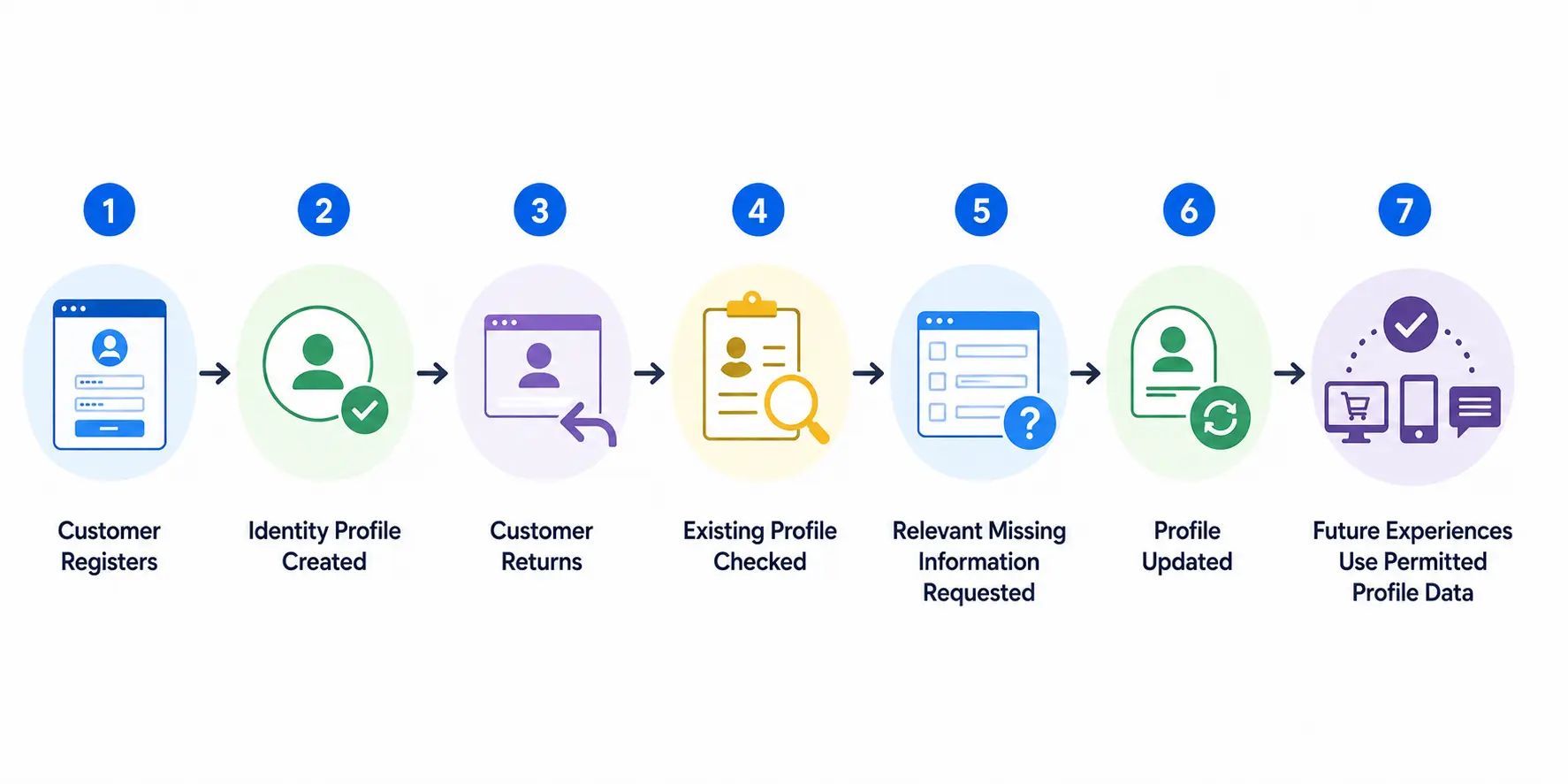
The important part isn't filling every missing field. It's giving applications enough identity context to decide whether another question is actually necessary.
Maintain a Unified Customer Profile
Progressive profiling depends on knowing what information already exists.
If a customer provides their name through one experience and another application asks for it again, the journey immediately feels disconnected. A unified customer profile helps authorized applications work from a more consistent view of relevant identity information.
As customers provide new attributes, those details can enrich the existing identity profile rather than creating separate versions of the same customer.
Access still matters. Having information in a customer profile doesn't mean every application should automatically be able to use it. Data access should remain aligned with appropriate permissions, purpose, and privacy requirements.
Enrich Profiles in Context
CIAM can connect customer identity with registration and account experiences so applications can recognize returning users before requesting additional information.
That makes contextual profile enrichment possible.
A customer completing the checkout might be asked for delivery information. Someone configuring a business account may be asked for relevant organization details. Another customer may already have everything needed and shouldn't see an additional profiling request at all.
This is a subtle but important point: successful progressive profiling sometimes means asking nothing.
The system already has enough information, and the customer can simply continue.
Connect Consent and Customer Preferences
As customer profiles become richer, businesses also need to keep profile attributes distinct from consent and communication preferences.
A customer's email address may exist in their identity profile, for example, while their choices about receiving particular communications need to be managed separately.
Connecting identity, profile information, and applicable consent or preference records can help businesses create more consistent experiences across customer journeys without treating every known attribute as universally usable.
Ultimately, CIAM gives progressive profiling a stronger foundation than a collection of disconnected smart forms. It helps businesses recognize customers, work with relevant existing information, and update profiles as relationships develop.
The goal remains straightforward: collect the information the experience needs without repeatedly asking customers to rebuild their identity.
How Do You Measure Progressive Profiling Success?
A progressive profiling strategy shouldn't be judged by how many profile fields are filled.
A profile can be 95% complete and still contain outdated, unnecessary, or low-quality information. Meanwhile, a smaller profile may contain exactly what the business needs to support the customer journey.
So measurement needs to consider both data quality and customer friction.
| KPI | What It Tells You |
|---|---|
| Registration completion rate | Whether customers successfully complete initial signup |
| Registration abandonment rate | Where customers leave the signup journey |
| Attribute completion rate | How often customers provide a requested profile attribute |
| Skip rate | Which optional questions customers frequently decline |
| Profile prompt abandonment | Whether profiling requests interrupt customer journeys |
| Data freshness | Whether important customer attributes remain current |
| Time to first value | How quickly customers reach the experience they registered for |
Profile completion can still be tracked, but it shouldn't become the headline metric.
For example, a high skip rate on one optional field doesn't necessarily mean the form design is poor. Customers may not understand why the information is being requested, the question may appear at the wrong moment, or the attribute may simply provide too little value to justify asking for it. That's useful information.
Look downstream as well. Shortening registration isn't much of a win if customers are hit with several mandatory profile questions immediately after their first login. Progressive profiling should reduce and redistribute data collection intelligently—not move the same friction to another screen.
Data quality deserves similar attention. If profile information drives personalization, account experiences, or other business processes, outdated attributes can create misleading results even when the profile appears complete.
The better measure of success is therefore not “How much customer data have we collected?”
It's “Are we collecting useful, current information at appropriate moments without making the customer journey harder?”
That question keeps progressive profiling focused on outcomes rather than database completeness.
Progressive Profiling Use Cases Across Industries
Progressive profiling works across industries because the principle isn't tied to a particular type of customer data. What changes is when information becomes necessary.
A retailer may need an address when a customer makes a purchase. A SaaS platform may need organization details during workspace setup. A travel provider may need traveler information only when someone books a trip.
The customer journey should determine the request.
| Industry | Progressive Profiling Use Case | When to Collect Additional Data |
|---|---|---|
| Retail & Ecommerce | Shipping details, loyalty information, product preferences | During checkout, loyalty enrollment, or personalization |
| SaaS | Company, role, use case, workspace preferences | During workspace setup or product onboarding |
| Financial Services | Additional identity or product-specific information | When required for a particular financial product or transaction |
| Healthcare | Relevant profile and service information | When the customer accesses a service that requires it |
| Travel & Hospitality | Traveler details, loyalty information, travel preferences | During booking, loyalty enrollment, or trip planning |
| Media & Entertainment | Content interests and viewing preferences | After customers begin exploring the service |
| Loyalty Programs | Rewards preferences and relevant interests | As customers enroll and engage with the program |
The important point is that progressive doesn't mean delayed by default.
Financial services and healthcare, for example, may need certain information upfront because of regulatory, security, eligibility, or service requirements. Progressive profiling shouldn't be used to postpone information that genuinely has to be collected.
The same applies at the other extreme. Just because a retailer can ask about product interests after the third login doesn't mean it should. If that information doesn't support a meaningful customer experience or business need, there's little value in collecting it.
Different industries will therefore build very different profiles.
What stays consistent is the decision behind each request: collect the information when the customer reaches a point where it is relevant, necessary, or clearly useful, not simply at the first opportunity available.
How LoginRadius Supports Progressive Profiling
Progressive profiling works best when customer data collection is connected to identity rather than scattered across unrelated forms and applications.
LoginRadius provides CIAM capabilities that help businesses manage customer registration and profile information across digital experiences. Instead of forcing every possible attribute into the first signup, businesses can design registration and profile experiences around the information their customer journeys actually require.
Start With Flexible Customer Registration
Different applications need different customer information. LoginRadius supports customizable registration experiences, allowing businesses to define the profile fields needed for their use case rather than relying on a fixed registration experience.
This gives teams room to keep initial registration focused and collect other relevant profile information through later customer interactions.
Manage Customer Profiles Beyond Signup
Customer identity doesn't stop at registration.
LoginRadius provides profile-management capabilities that allow customer information to be maintained as the relationship develops. Customers can update relevant profile information, while applications can work with customer identity data through the broader CIAM layer.
This is particularly useful when a business has multiple customer-facing applications and wants to avoid treating every interaction as a completely new identity journey.
Connect Identity With Consent and Preferences
Progressive profiling also needs to account for how customer information can be used.
LoginRadius supports consent and preference management alongside customer identity capabilities, helping businesses manage customer choices as part of their digital identity experiences.
That distinction matters. Collecting an attribute and having permission to use it for a particular purpose aren't necessarily the same thing.
Build Progressive Experiences Around CIAM
The real advantage of bringing progressive profiling into CIAM is consistency.
Registration, authentication, customer profiles, and consent don't have to operate as separate pieces of the customer journey. They can work around a common identity foundation, giving businesses more flexibility over when relevant customer information is requested and maintained.
The goal isn't a customer profile with every possible field completed.
It's a profile containing the right information for the experiences the customer actually uses.
For businesses trying to reduce signup friction while building useful customer profiles over time, LoginRadius provides the CIAM foundation needed to support that approach.
**Want to simplify registration without giving up valuable customer identity data? **Explore how LoginRadius can help you build secure, low-friction identity experiences and manage customer profiles as relationships grow.
Conclusion: Build Better Customer Profiles Without Adding Friction
Customers shouldn't have to provide extensive information before they can experience the value of a product or service. Progressive profiling gives businesses a better approach: start with what is necessary, then request additional information when the customer journey provides a clear reason to ask.
The goal isn't a 100% complete customer profile. It's a useful one—built with relevant, current information collected at appropriate moments.
With LoginRadius CIAM, businesses can connect registration, customer identity, profile management, and consent across digital experiences while keeping unnecessary signup friction out of the way.
Ready to turn registration into the beginning of the customer relationship—not a barrier to it? Book a demo with LoginRadius to simplify signup, manage customer profiles, and build better identity experiences as your customers engage and grow.
FAQs
Q: What is progressive profiling?
A: Progressive profiling is a strategy for collecting customer information gradually across multiple interactions instead of requesting everything during signup. It helps build useful profiles while reducing registration friction.
Q: How does progressive profiling work?
A: It uses existing customer profile data to determine what information is already known and what may be relevant to request later. New attributes are collected at appropriate points in the customer journey.
Q: What is an example of progressive profiling?
A: An ecommerce site might collect an email at registration, request a shipping address during checkout, and ask for product preferences when the customer joins its loyalty program.
Q: What is the difference between progressive profiling and progressive disclosure?
A: Progressive profiling determines when customer data is collected, often across multiple interactions. Progressive disclosure determines when information or UI elements are displayed to reduce interface complexity.
Q: What are the benefits of progressive profiling?
A: Progressive profiling can reduce signup friction, improve customer data quality, support personalization, and help businesses build richer customer profiles without asking for unnecessary information upfront.
Q: Is progressive profiling good for customer privacy?
A: It can support privacy-conscious data collection when combined with data minimization, transparency, appropriate consent, and customer control. Collecting data gradually alone doesn't automatically make it privacy-friendly.
Q: What data should businesses collect through progressive profiling?
A: Collect data that becomes relevant to a specific customer action or experience. Classify attributes as required now, required later, optional, or unnecessary rather than trying to complete every profile field.
Q: How does CIAM support progressive profiling?
A: CIAM can connect registration, authentication, customer profiles, consent, and digital experiences around a consistent identity. This helps businesses avoid duplicate requests and maintain relevant customer information over time.
Q: What is the difference between progressive profiling and traditional profiling?
A: Traditional profiling typically collects many customer attributes upfront. Progressive profiling starts with necessary information and enriches the profile later as additional attributes become relevant.
Q: What are common progressive profiling mistakes?
A: Common mistakes include asking too much too soon, repeating questions, making optional fields mandatory, collecting data without a clear purpose, and continuing to rely on outdated profile information.