Introduction
Modern login experiences look impressive on the surface.
Email and password. Social login. Passwordless links. Biometrics. A screen full of choices that promise speed and flexibility. And for a while, that promise holds. Conversion rates go up. Drop-offs go down. Everyone feels good.
Then something starts to crack.
The same customer shows up multiple times in your system. Their data fragments across profiles. Preferences don’t carry over. Security policies apply inconsistently. Marketing sees growth, but it feels inflated. Support tickets creep in with a familiar tone: “I can’t see my account anymore.”
This is the part most teams miss.
The problem isn’t authentication.
The problem is identity continuity.
When organizations add login methods without a strategy to connect them, they trade short-term convenience for long-term identity debt. And that debt compounds quietly until personalization breaks, analytics lose credibility, and trust erodes in places dashboards don’t immediately reveal.
Account linking exists to stop that spiral.
At its simplest, account linking ensures that one real person maps to one digital identity no matter how many ways they choose to sign in. But in practice, it does far more than clean up duplicate accounts. It stabilizes experience, restores data integrity, and creates a foundation where security, personalization, and scale can coexist.
LoginRadius recognized this early.
As a CIAM provider supporting billions of identities, we learned that login choice without identity unification doesn’t enhance consumer experience it undermines it. Account linking became a core capability, not an optional feature. Something that operates quietly in the background, but carries enormous strategic weight.
This blog explores why account linking has become essential in modern CIAM architectures, how LoginRadius approaches it differently, and what identity leaders should look for when evaluating solutions. And for those who want the complete framework including implementation paths and real-world models the downloadable datasheet goes deeper.
Why Multiple Login Options Create a Hidden Identity Problem
Offering multiple login options feels like progress. It signals flexibility. It reduces friction at the door. And initially, it works.
But identity systems don’t break at the door. They break behind it.
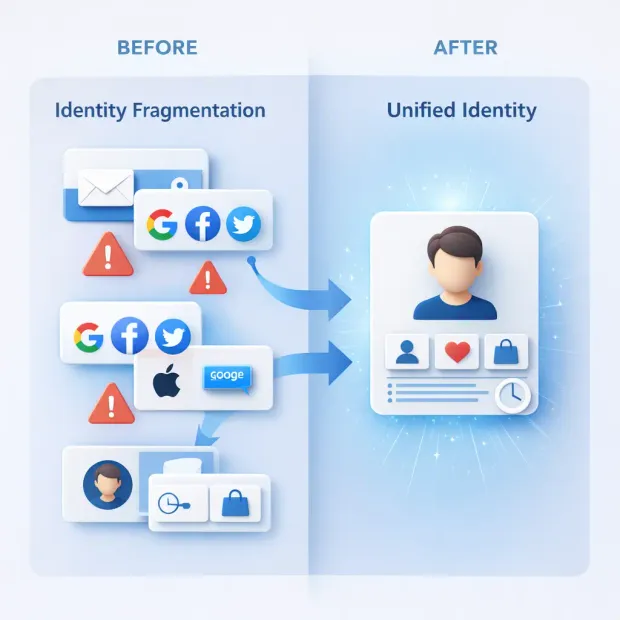
Here’s the uncomfortable reality most teams discover too late: every additional login method introduces a new way for the same person to fragment into multiple identities. Email and password creates one record. Google creates another. Apple on mobile creates a third. None of them talk to each other unless the system forces them to.
This is where teams usually go wrong. They treat authentication choice as a UX decision, not an identity architecture decision.
The result is quiet identity sprawl.
From the user’s perspective, this shows up as missing data. Preferences that don’t stick. Order history that appears and disappears. From the business side, the damage runs deeper. Analytics inflate. Attribution breaks. Customer lifetime value calculations drift away from reality.
And trust erodes in subtle ways. When users feel the system doesn’t “remember” them, even when they did everything right, confidence slips. They stop expecting consistency. That’s when experience starts to feel disposable.
Account linking exists to stop this erosion before it becomes visible damage.
What Account Linking Means Inside Customer Identity Management
Account linking isn’t a clean-up exercise. It isn’t a background job that merges duplicate records after the fact. In a modern CIAM solution, it operates as a real-time identity decision.
Let me make this simple.
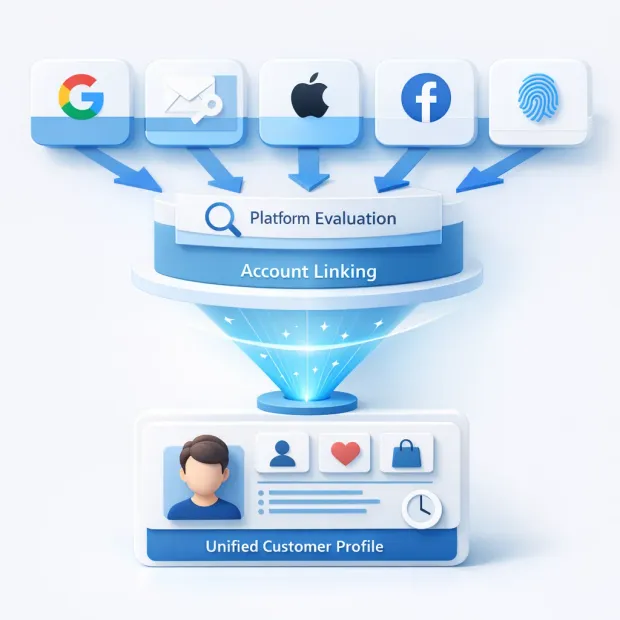
Account linking ensures that multiple authentication methods map back to a single, persistent identity. One person. One profile. Multiple ways in. Always the same outcome.
That distinction matters.
Without account linking, identity systems behave like credential stores. They ask, “Can you prove you own this login?” With account linking, identity systems ask a more important question: “Do we already know who you are?”
LoginRadius treats identity this way by design. When a user authenticates, the platform evaluates trusted identifiers and determines whether this login belongs to an existing profile. If it does, the system extends that identity rather than creating a new one.
The result is continuity.
Data updates persist across sessions. Security policies apply consistently. Personalization engines finally operate on complete context instead of partial snapshots.
That’s what real identity management looks like.
How LoginRadius Handles Account Linking at Scale
Account linking becomes fragile when implemented as an edge feature. It becomes reliable only when embedded into the identity core.
LoginRadius built account linking directly into its CIAM solution because scale leaves no room for manual correction. When platforms grow from thousands to millions of users, even small identity inconsistencies multiply fast.
Here’s where it gets interesting.
Every authentication event triggers an identity evaluation. The system checks whether the incoming login aligns with an existing verified identifier. If it does, LoginRadius links the login method to the existing profile instead of creating a parallel account.
This happens instantly. Quietly. Repeatedly.
And because linking occurs at the identity layer not the application layer security controls, access policies, and user data remain consistent across all linked logins.
For directors and identity architects, this matters more than UI polish. It’s the difference between identity that scales cleanly and identity that decays over time.
The Three Account Linking Models LoginRadius Supports
Account linking is not a one-size-fits-all capability. Different applications face different identity scenarios, and LoginRadius addresses this reality by supporting three distinct account linking models, each designed to handle a specific set of consumer behaviors without compromising experience or security.
The first model, Automatic Account Linking, handles the most common and predictable identity overlap. When a consumer logs in multiple times using different authentication methods, such as social login and email/password, but the email identifier remains the same, LoginRadius automatically associates those logins with a single consumer profile.
This process requires no action from the consumer and no additional configuration from the business. The system recognizes that the same email represents the same individual and links the accounts behind the scenes. For organizations, this eliminates duplicate identities at the point of entry. For consumers, it simply feels like the system remembers them.
The second model, Consumer-Initiated Account Linking, exists for scenarios where automatic linking alone is not sufficient. Consumers may use different email addresses across social platforms, or they may want explicit control over which accounts are connected.
LoginRadius enables consumers to link and unlink social accounts themselves, directly from their profile. This approach respects user choice while still maintaining a unified identity at the platform level. It also allows businesses to handle edge cases that fall outside automated rules, without forcing support intervention or backend cleanup.
The third model, API-Based Account Linking, provides flexibility for organizations that need to define their own linking logic. Through LoginRadius APIs, businesses can programmatically link or unlink consumer accounts based on custom workflows.
This model supports applications with complex requirements, where identity decisions must align with internal processes or application-specific logic. Rather than forcing identity into a rigid structure, LoginRadius allows account linking to adapt to the application’s needs.
Together, these three models ensure that account linking works across both simple and complex use cases, while maintaining a single consumer profile at the core.
Implementing Account Linking: JS Interface and REST APIs
LoginRadius approaches account linking with a clear understanding of how modern applications are built. Instead of forcing a single integration path, the platform offers two implementation methods that align with different development preferences and architectural needs.
The JS Interface enables account linking and unlinking directly through the LoginRadius JavaScript library. This method is well suited for client-side implementations where businesses want to provide consumers with a straightforward way to manage linked accounts.
The JS interface allows applications to integrate account linking functionality into the user experience without building custom logic from scratch. It simplifies implementation while ensuring that identity actions remain consistent with LoginRadius’ underlying CIAM architecture.
For organizations that require deeper control, LoginRadius provides REST APIs to manage account linking and unlinking. These APIs allow businesses to handle identity associations through client-side API calls, enabling more customized workflows.
API-based implementation supports applications that need tighter integration with backend systems or want to manage identity relationships programmatically. This approach gives teams the freedom to design account linking logic that fits their specific application structure, while still relying on LoginRadius to maintain the unified identity profile.
By supporting both JS-based and API-based implementations, LoginRadius ensures that account linking can be adopted without disrupting existing development practices.
How Account Linking Enhances Consumer Experience Without Adding Friction
Account linking improves consumer experience by removing confusion rather than adding steps. From the consumer’s perspective, the value is immediate and tangible even if the mechanism remains invisible.
Without account linking, consumers often encounter fragmented experiences: separate accounts tied to different login methods, missing data, or inconsistent access to their own information.
LoginRadius eliminates this friction by ensuring that consumers are always associated with the same profile, regardless of how they choose to log in. Whether a user signs in using email/password today and a social account tomorrow, their identity remains intact.
This consistency creates a smoother login experience. Consumers no longer need to remember which method they used previously or worry about losing access to their data.
At the same time, businesses benefit from integrated behavior insights. When multiple login methods map to a single identity, organizations gain a clearer understanding of consumer behavior across interactions.
Account linking also strengthens security without making the experience feel restrictive. By knowing which digital identities belong to the same physical individual, businesses can manage linked identities more effectively. Security policies apply consistently, and identity management becomes easier to maintain as applications grow.
The result is an experience that feels seamless to consumers while giving businesses greater control and visibility.

Why Account Linking Defines a Modern CIAM Solution
A CIAM solution must do more than authenticate users; it must manage identity in a way that scales with consumer behavior. Account linking plays a central role in making that possible.
Modern applications offer multiple authentication options because consumers expect choice. Without account linking, that choice leads to fragmented identities and disconnected data. LoginRadius addresses this by treating account linking as a foundational CIAM capability rather than an optional enhancement.
By maintaining a single consumer account across login methods, LoginRadius enables uninterrupted user experiences, simpler identity management, and an integrated view of consumer behavior. These elements form the backbone of an effective CIAM solution. They ensure that identity remains consistent, secure, and usable as applications evolve.
Account linking, in this context, becomes the mechanism that connects convenience with control. It allows businesses to support diverse login preferences while preserving the integrity of the consumer identity, an outcome that modern CIAM strategies cannot function without.
Conclusion
Identity systems don’t fail loudly.
They fail subtly.
A missed personalization opportunity here.
An inflated metric there.
A security policy applied in one place but not another.
Most of the time, the root cause traces back to the same issue: fragmented identity.
Account linking solves that problem at its source.
It ensures that the person behind the screen remains recognizable, regardless of device, channel, or login method. It restores continuity to the digital experience. It gives security teams a single surface to protect. It gives data teams a version of truth they can trust.
Most importantly, it aligns convenience with control something legacy identity systems never managed to do well.
A CIAM solution that treats account linking as an afterthought will always struggle to scale cleanly. A CIAM solution that builds identity unification into its core changes how the entire digital ecosystem performs.
That’s the difference LoginRadius brings.
Account linking by LoginRadius isn’t just about merging accounts. It’s about managing identity correctly in an environment where users expect flexibility, regulators demand precision, and businesses depend on first-party data more than ever.
If fragmented identities already show up in your metrics or if you want to prevent them before they do the next step isn’t another login option. It’s a unified identity strategy.
The Account Linking by LoginRadius datasheet lays out that strategy in detail. From models and benefits to implementation paths, it’s designed for leaders who want clarity, not theory.
If identity continuity matters to your growth, your security posture, and your customer experience, this is the asset worth downloading.
FAQs
Q: What is account linking in LoginRadius?
A: Account linking ensures a single consumer profile is maintained even when users log in using different methods such as email/password or social login. LoginRadius associates all login methods with one unified identity to prevent duplicate accounts.
Q: How does LoginRadius prevent multiple accounts for the same consumer?
A: LoginRadius automatically links accounts when the same email ID appears across login methods and also supports consumer-initiated and API-based linking. This ensures consumers are always recognized as the same user.
Q: Can consumers control which social accounts are linked?
A: Yes. LoginRadius allows consumers to link or unlink social accounts themselves through consumer-initiated account linking, giving them visibility and control over their connected identities.
Q: Why is account linking critical for a CIAM solution?
A: Account linking eliminates identity duplication, enables a unified view of consumer behavior, and supports a consistent login experience. These capabilities are essential for delivering a secure and effective CIAM solution at scale.