Introduction
Loyalty has become one of the most overused words in modern digital strategy and one of the most misunderstood. Every brand wants it. Every board asks about it. Yet only a small percentage of loyalty programs actually influence long-term customer behavior in a measurable way.
The reason is simple. Loyalty today no longer depends on rewards alone. It depends on whether a brand can recognize a customer instantly, remember their past interactions accurately, and respond consistently across every touchpoint. That level of recognition does not come from campaign logic. It comes from identity.
As consumer choice continues to expand, loyalty programs have evolved into a critical engagement mechanism. They offer customers recognition, value, and continuity in exchange for ongoing interaction. When executed correctly, they deepen relationships well beyond the buying moment and generate richer data that fuels smarter marketing initiatives.
But execution is where most loyalty strategies break.
Behind the scenes, many loyalty programs sit on fragmented technical foundations isolated from point-of-sale systems, disconnected from core customer profiles, and unable to scale as data volume increases. The result looks acceptable on the surface but weak underneath. Customers enroll. Rewards exist. Yet ROI remains inconsistent, and personalization stalls.
This is where identity changes the equation.
The LoginRadius Identity Platform approaches loyalty from an infrastructure perspective. It treats loyalty data as part of the customer identity itself not as an external system bolted on later.
By unifying customer data under a single identity and integrating loyalty interactions into that same account, LoginRadius enables loyalty programs that feel seamless to customers and measurable to the business.
This article explains why loyalty programs struggle even when customers like them, and how identity-driven architecture turns loyalty from a marketing experiment into a scalable growth system.
Why Loyalty Programs Fail Even When Customers Love Them
On the surface, many loyalty programs look successful. Enrollment numbers rise. Customers redeem rewards. Engagement metrics appear healthy. Yet when leaders examine long-term impact repeat purchases, lifetime value, marketing efficiency the results often disappoint.
That disconnect happens because customer enthusiasm does not automatically translate into operational effectiveness.
Loyalty programs generate value by collecting deeper engagement data and reinforcing recognition over time. The PDF highlights this clearly: loyalty programs help companies move beyond transactions, enhance customer experience, and collect richer data for future marketing initiatives.
But those benefits disappear when loyalty data cannot integrate properly with the rest of the business.
A common failure point is data silos. Loyalty activity often lives separately from point-of-sale systems, mobile applications, or customer profiles. Customers earn rewards in one channel and expect to redeem them in another. When systems fail to communicate, the experience fractures. Points go missing. Status becomes unclear. Trust erodes.
Another issue is identity inconsistency. Without a unified customer identity, the same person can exist multiple times across systems. Loyalty data attaches to partial profiles instead of a complete customer view. Marketing teams lose confidence in segmentation. Analytics teams struggle to measure effectiveness. Support teams inherit problems they cannot resolve cleanly.
Most importantly, ROI becomes difficult to defend. The PDF warns that companies can lose out on loyalty benefits and ROI when loyalty programs are not properly integrated with point-of-sale systems.
When loyalty data remains disconnected, leadership cannot clearly link engagement to revenue or long-term value.
Here’s where teams usually go wrong. They assume loyalty is a feature problem something to improve with better rewards or more creative campaigns. In reality, it is an identity problem.
Loyalty programs depend on recognition, continuity, and data integrity. Without those, even well-liked programs stall.
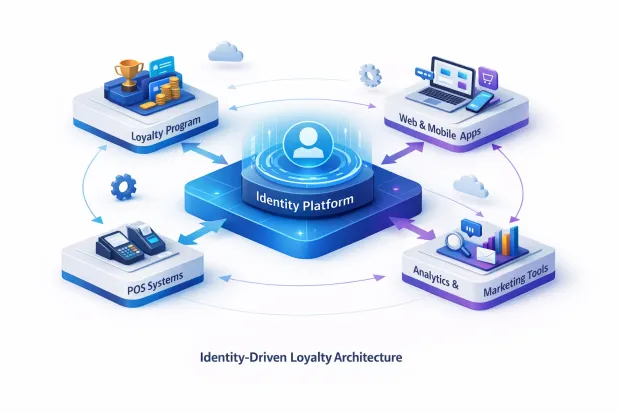
Identity-driven loyalty fixes this by anchoring every interaction to a single customer identity. When loyalty data integrates into the identity layer, journeys stay intact, data stays usable, and ROI becomes visible instead of theoretical.
That shift from fragmented systems to unified identity is what separates loyalty programs customers enjoy from loyalty programs businesses can rely on.
What Modern Loyalty Programs Are Really Built On
Loyalty programs used to revolve around incentives. Earn points. Redeem rewards. Repeat.
That model still exists but it no longer explains why some programs drive consistent ROI while others quietly bleed budget.
Modern loyalty programs succeed because they feel continuous. Customers move between web, mobile, in-store, and support channels without thinking about it. They expect their rewards, status, and recognition to move with them just as easily. The moment that continuity breaks, loyalty weakens.
That is why modern loyalty programs are built on identity, not just incentives.
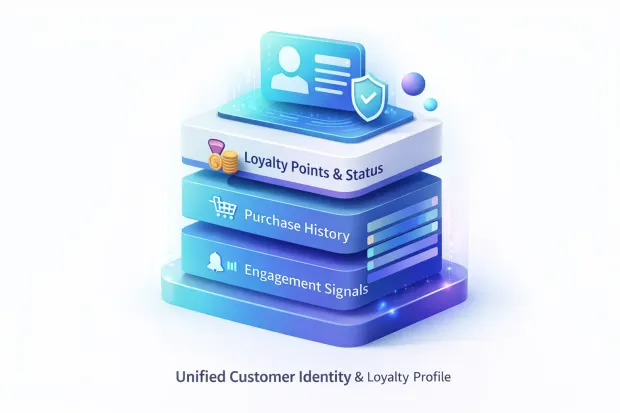
At the foundation sits a single, unified customer identity. Every interaction registration, purchase, reward redemption, profile update anchors to that identity instead of scattering across disconnected systems. This matters because loyalty generates more than transactional data. It generates behavioral signals, engagement patterns, and long-term relationship context.
The LoginRadius Identity Platform enables this by storing all customer data under one unified identity and then integrating loyalty programs directly into that same customer account. Customers can collect, track, and redeem rewards without friction because the system recognizes them consistently across channels.
Another critical pillar is centralized data integration. Modern loyalty programs do not rely on a single data source. They pull information from purchases, interactions, and engagement touchpoints. When these data points integrate automatically into a single account, loyalty stops behaving like a campaign and starts behaving like an ecosystem.
Finally, modern loyalty programs require seamless reward visibility. Customers do not tolerate uncertainty around their rewards. They want to see their progress, understand their value, and trust that redemption will work wherever they engage. Identity-first loyalty architectures make that possible because rewards stay attached to the customer not the channel.
In short, modern loyalty programs are built on identity continuity, data consolidation, and frictionless engagement. Without those elements, even generous rewards struggle to retain attention.
How the LoginRadius Identity Platform Powers Loyalty at Scale
Loyalty programs often start small. A limited audience. A simple rewards structure. Minimal integration.
The real challenge appears when the program grows when customer interactions multiply, data volume increases, and expectations rise.
This is where many loyalty initiatives break.
The LoginRadius Identity Platform addresses scale by design. Instead of treating loyalty as an external system that must constantly sync with identity data, LoginRadius places loyalty interactions inside the identity layer itself.
Customer data lives under a single, unified identity. Loyalty activity points earned, rewards redeemed, engagement signals integrates directly into the same customer account. As more data is collected, the profile scales naturally, without forcing teams to reconcile identities across systems.
This approach solves a common scaling problem: fragmentation. When loyalty platforms operate independently, every increase in volume multiplies complexity. Data duplication grows. Conflicts appear. Reporting loses accuracy. LoginRadius removes that friction by keeping loyalty data tied to the core identity record from the start.
Scale also depends on integration flexibility. The PDF highlights that loyalty data can feed into third-party analytics platforms through the LoginRadius Integrations stack.
That capability matters at scale because personalization, measurement, and optimization rarely live inside one tool. Identity becomes the hub, while analytics and marketing platforms act on clean, unified data.
For directors and integration leaders, this architecture reduces long-term operational cost. Instead of scaling reconciliation processes and custom connectors, teams scale a unified identity model that already understands loyalty behavior.
Loyalty at scale is not about handling more points. It is about handling more relationships without losing clarity or control. That is what the LoginRadius Identity Platform enables.
From Fragmented Data to a Single Customer Identity
Every loyalty program produces data. The problem is not the collection. The problem is fragmentation.
A single customer might interact through a website, a mobile app, a physical store, and a marketing campaign all within the same week. Each interaction creates valuable data. Without a unified identity, those data points drift apart and form silos.
Fragmentation creates immediate issues. Customers see inconsistent reward balances. Support teams struggle to resolve discrepancies. Marketing teams lose confidence in segmentation. Reporting turns into estimation.
LoginRadius resolves this by consolidating loyalty data points into one centralized customer identity. Instead of maintaining separate records across systems, the platform unifies them into a single customer account that represents the complete relationship.
This unified approach does more than clean up data. It changes how teams operate. Identity becomes the system of record for loyalty. Every reward, interaction, and purchase attaches to the same profile. Recognition becomes consistent. Measurement becomes reliable.
A surprising pattern many organizations discover is how much effort they previously spent reconciling customer data instead of improving the loyalty experience itself. When identity unification removes that burden, teams regain time and clarity.
Moving from fragmented data to a single customer identity is not a cosmetic improvement. It is the difference between reacting to loyalty issues and designing loyalty strategies with confidence.
Loyalty Data That Actually Fuels Personalization
Loyalty programs generate some of the most valuable customer data a business owns. Purchase behavior. Engagement frequency. Reward preferences. Channel usage.
Yet in many organizations, this data never reaches the teams that could use it best.
The PDF emphasizes that loyalty programs allow companies to collect richer data about customers and program effectiveness, which can then support further marketing initiatives.
The key word here is use.
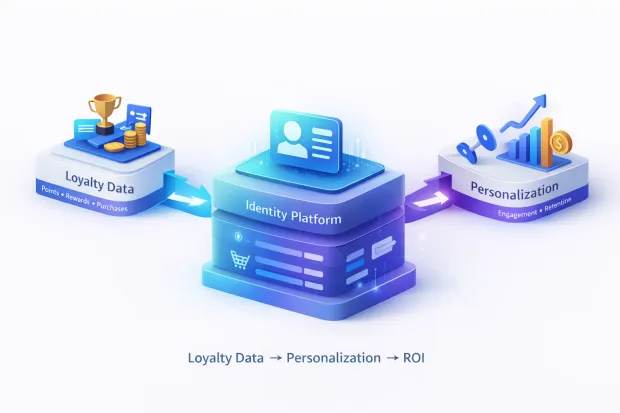
LoginRadius enables loyalty data to move beyond storage. Through the Integrations stack, loyalty data can flow into third-party analytics platforms where teams analyze, segment, and activate it.
This creates a direct path from loyalty engagement to personalization. Marketing teams can design campaigns based on actual behavior instead of assumptions. Offers reflect real purchase patterns. Messaging aligns with customer value, not generic tiers.
Personalization also improves because identity ensures context. Loyalty data attaches to a unified profile, so personalization decisions reflect the full customer journey not isolated moments. That continuity reduces noise and increases relevance.
At scale, this approach changes how loyalty programs justify investment. Instead of measuring success only through redemptions, teams can track how loyalty influences engagement, repeat purchases, and long-term customer value.
Loyalty data fuels personalization only when it stays connected to identity. LoginRadius ensures that the connection remains intact as data volume, channels, and complexity increase.
Secure, Scalable Loyalty Data Storage in the Cloud Directory
Loyalty only works when customers trust the system behind it. The moment rewards disappear, balances look inconsistent, or personal data feels mishandled, loyalty collapses faster than any discount can recover it. That is why secure data storage is not a supporting feature of loyalty programs, it is a prerequisite.
As loyalty programs mature, the amount of data they collect grows quickly. Purchase history, interaction data, reward balances, engagement signals, and profile attributes accumulate with every customer touchpoint. Storing that data across disconnected systems increases risk, complexity, and cost. It also increases the chances of data drift—where different systems tell different stories about the same customer.
The LoginRadius Cloud Directory addresses this problem by acting as a centralized, secure repository for all customer identity and loyalty data. Loyalty data does not sit in isolation. It lives alongside the core customer profile, governed by the same security controls and scalability standards.
This approach gives organizations three immediate advantages. First, it reduces fragmentation. Teams no longer manage multiple databases to understand customer behavior. Second, it improves data integrity.
When loyalty interactions write back to a single identity record, consistency becomes the default. Third, it supports growth. As more data flows in, the Cloud Directory scales without forcing architectural changes.
Security and scalability rarely coexist by accident. They require an intentional design choice. By storing loyalty data inside the LoginRadius Cloud Directory, organizations protect the trust that loyalty programs depend on while preparing for long-term expansion.
Key Business Benefits of CIAM-Powered Loyalty Programs
When loyalty programs integrate with a CIAM platform, the value extends far beyond smoother reward tracking. The business benefits compound across experience, data quality, and operational efficiency.
One of the most visible benefits is a seamless customer experience. Customers can earn, view, and redeem rewards without friction because the system recognizes them consistently across channels. That continuity reduces frustration and increases engagement. It also lowers support costs tied to missing points and account mismatches.
Another critical benefit is deeper customer insight. Loyalty programs generate rich data, but without identity unification, that data stays fragmented. LoginRadius brings loyalty interactions into the same customer account, making it easier to analyze purchase behavior and engagement patterns.
CIAM-powered loyalty programs also unlock more effective personalization. With loyalty data integrated into the identity layer, teams can feed large, reliable data sets into analytics platforms and create targeted marketing efforts based on actual behavior, not assumptions.
Finally, there is the benefit leaders care about most: ROI clarity. When loyalty data connects cleanly to customer identity and downstream systems, teams can measure impact with confidence. Loyalty stops feeling like a cost center and starts showing up as a growth lever.
These benefits do not come from adding more features to a loyalty platform. They come from fixing the foundation that loyalty depends on.
Industries Where Identity-Driven Loyalty Delivers the Biggest Impact
Identity-driven loyalty matters in every sector, but some industries feel the impact more immediately because of how frequently customers interact and how many systems touch the experience.
Consumer brands rely on repeat purchases and ongoing engagement. Loyalty programs work best when identity unifies online behavior, in-store transactions, and marketing interactions. Without that unification, customer loyalty programs struggle to maintain relevance across channels.
Travel depends heavily on recognition. Customers expect their preferences, rewards, and status to follow them from booking to check-in to post-trip engagement. Identity-driven loyalty ensures that rewards and recognition remain consistent across digital and physical touchpoints.
Hospitality operates on continuity. Guests return to brands where the experience feels familiar and rewarding. Loyalty programs in hospitality benefit directly from a unified identity that connects reservations, stays, and engagement history into one profile.
The PDF notes that LoginRadius has worked with consumer, travel, and hospitality brands to integrate loyalty programs and deliver stronger engagement experiences.
These industries illustrate a simple reality: the more complex the customer journey, the more valuable identity-driven loyalty becomes.
Why CIAM Is the Missing Layer in Loyalty Architecture
Most loyalty platforms focus on managing rewards. They track points, tiers, and redemptions. What they do not manage well is who the customer actually is across systems.
This gap creates the illusion of loyalty while hiding operational weaknesses. A loyalty tool might calculate points correctly, but if identity varies across channels, customers experience inconsistency. That inconsistency erodes trust.
CIAM fills this gap by providing a single source of truth for customer identity. Loyalty interactions attach to that identity instead of floating between disconnected systems. The LoginRadius Identity Platform makes this possible by storing customer data under a unified profile and integrating loyalty activity into the same account.
Once CIAM enters the architecture, loyalty becomes reliable. Recognition stays consistent. Data flows cleanly into analytics platforms. Marketing initiatives become more precise. Support teams gain clarity.
Looking to choose the right approach for loyalty architecture? Start by asking one question:
Where does customer identity live, and how many systems try to define it?
CIAM resolves that conflict. Loyalty platforms then do what they are supposed to do reward customers without carrying the burden of identity management.
Conclusion
Loyalty programs rarely fail because brands lack ideas. Most teams already invest heavily in rewards, tiers, and campaigns. What breaks loyalty over time is something far less visible: a fractured identity foundation that cannot keep pace with how customers actually interact.
When loyalty data lives outside the customer identity, every interaction becomes fragile. Rewards lag behind purchases. Profiles split across channels. Insights arrive too late or not at all. Teams spend more time explaining inconsistencies than improving engagement. And ROI despite strong enrollment numbers remains difficult to prove.
Identity changes that equation.
When loyalty programs anchor to a single, unified customer identity, everything stabilizes. Customers receive consistent recognition across channels. Loyalty activity accumulates in one place instead of scattering across systems.
Data flows cleanly into analytics and marketing platforms. Personalization stops guessing and starts responding. ROI becomes measurable because the inputs are finally trustworthy.
This is where LoginRadius draws a clear architectural line. By placing loyalty interactions inside the Identity Platform secured and scaled through the Cloud Directory, LoginRadius turns loyalty programs into durable systems, not short-term initiatives. Loyalty data becomes part of the customer profile. Integration replaces reconciliation. Growth no longer introduces chaos.
For directors and integration leaders, this distinction matters. Loyalty is no longer just a marketing lever. It becomes an identity-driven capability that supports long-term engagement, smarter decision-making, and sustainable returns.
The question is no longer whether to run a loyalty program, but whether the identity layer beneath it is strong enough to support the experience customers expect.
If loyalty is meant to create lasting relationships, identity cannot remain an afterthought. It must be the foundation.
Download the CIAM + Loyalty Programs Integration Use Case See how unified identity, seamless integration, and scalable data architecture turn loyalty programs into measurable growth engines.
FAQs
Q: Why do loyalty programs fail to deliver ROI even with high enrollment?
A: Most loyalty programs fail at the integration layer. When loyalty data does not connect with customer identity and POS systems, rewards fragment, data loses meaning, and ROI drops quickly.
Q: How does a customer identity platform improve loyalty programs?
A: A customer identity platform unifies all loyalty interactions under a single customer profile. This allows seamless reward tracking, consistent recognition across channels, and reliable data for personalization and analytics.
Q: What role does the Cloud Directory play in loyalty program success?
A: The Cloud Directory securely stores identity and loyalty data in one centralized location. This prevents data silos, supports scalability, and ensures loyalty programs remain consistent as customer interactions grow.
Q: Can loyalty data be used for personalized marketing initiatives?
A: Yes. Loyalty data integrated through the LoginRadius Identity Platform can feed directly into third-party analytics tools, enabling personalized campaigns based on real customer behavior and engagement patterns.