Introduction
Smartphones didn’t just change browsing habits. They rewired expectations.
People now treat their phone like a permanent access key. It’s always within reach, always on, always connected. That behavior has a direct consequence for identity teams: authentication can’t behave like it belongs to the desktop era. The old default “sign up with email, verify later, set a password, hope they come back” leaks conversion and creates security gaps at the same time.
Mobile access brings something else, too: better security opportunities. A phone number ties identity to a real-world device that users protect. That single shift changes how verification works, how recovery works, and how you build trust during onboarding without turning your registration flow into a form-filling marathon.
This is exactly where LoginRadius CIAM Phone Authentication fits.
It allows customers to register and log in using their mobile phone numbers instead of email addresses. It also requires mobile number verification using a One-Time Password (OTP).
That verification requirement is not an afterthought. It’s the foundation. After verification, users can choose how they want to log in going forward, either with a normal password or with an OTP for each session.
That combination matters for directors and authentication leaders because it solves the two problems that usually fight each other:
-
Growth teams push for fewer steps.
-
Security teams push for stronger proof.
Phone authentication implemented correctly inside a CIAM platform stops making those goals enemies.
Why Phone Authentication Has Become Essential in Modern CIAM Platforms
Email-based identity still exists. It still remains common. But it no longer reflects how users actually behave especially in mobile-first markets, consumer apps, and high-frequency digital services.
Phone authentication has become essential for a few reasons that show up in real adoption metrics and product behavior.
Mobile access is the default, not the “alternative”
Mobile devices now dominate how customers access services because the phone travels with them. Users don’t think, “I’ll log in when I’m at my desk.” They log in while commuting, shopping, traveling, or switching between apps. That “anywhere, anytime” expectation pushes teams toward authentication methods that feel native to mobile environments.
Phone numbers behave like durable identifiers
Email addresses change. People create multiple emails. Some emails exist purely for marketing sign-ups. In contrast, a phone number often stays stable for longer and users treat it as personal. That stability helps reduce duplicate accounts and identity fragmentation.
OTP verification increases identity assurance
Passwords prove knowledge. They don’t prove possession. OTP verification does something stronger: it confirms the user has access to the device and number used for registration. When you enforce OTP verification during onboarding, you don’t just “validate a field.” You establish device-linked trust early in the lifecycle.
CIAM needs phone-first flows to meet users where they are
A modern ciam platform needs to support mobile-first authentication flows without forcing teams to bolt on custom logic, third-party glue, or fragile workarounds. Phone authentication belongs inside the core identity layer because it affects registration, login, recovery, profile management, and even downstream engagement.
Want the complete platform-level view of how LoginRadius implements phone authentication and OTP-driven flows? Download the LoginRadius cIAM Phone Authentication datasheet and keep it handy for internal evaluation.
What Is LoginRadius CIAM Phone Authentication?
LoginRadius cIAM Phone Authentication is a capability within the LoginRadius CIAM platform that enables customers to register and log in using their mobile phone number as the username rather than an email address.
That sounds simple on the surface. The practical impact runs deeper.
When the phone number becomes the primary identifier, the entire identity lifecycle becomes more aligned with mobile behaviors:
-
Users can onboard quickly using something they know by heart.
-
Verification can happen instantly through OTP.
-
Recovery becomes less dependent on email inbox access.
-
Session preferences can match risk tolerance and user intent.
Mandatory verification during onboarding
LoginRadius enforces a clear security baseline: mobile number verification through OTP is mandatory under Phone Authentication. This prevents unverified identities from entering the system and reduces risk across the entire customer base.
Flexible login preferences after verification
After initial verification, users can choose their login preference:
-
Normal password login, or
-
OTP for each session (useful for stronger session-level assurance).
Directors like this model because it supports two common realities:
-
Some users want speed and familiarity.
-
Some environments demand stronger login proof per session.
You don’t have to pick one design philosophy and force it on every user.
Activation-based enablement
Phone Authentication is not enabled by default on the platform and requires activation on request. That design supports governance. Enterprises often roll out authentication changes in phases, tie them to risk reviews, or launch per application line. This aligns with controlled deployments instead of surprise changes to mission-critical flows.
How OTP Verification Works in LoginRadius Phone Authentication
OTP verification is not a side feature in LoginRadius Phone Authentication. It is the control layer that defines trust from the very first interaction.
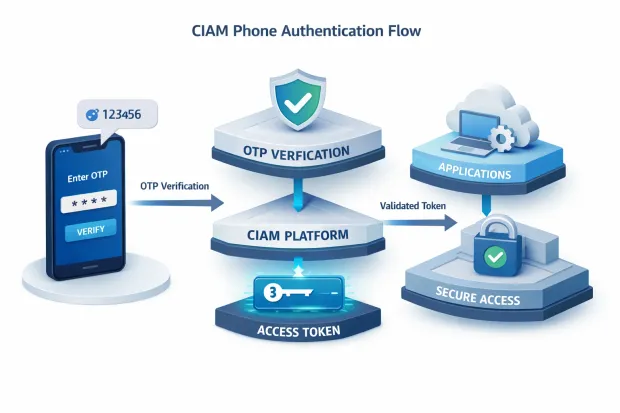
When a customer registers using a mobile phone number, LoginRadius enforces a mandatory OTP verification step. This is intentional. The platform does not treat phone numbers as “soft identifiers” that can be validated later. Ownership is proven immediately, before the account becomes active.
Here’s how it actually works in practice.
A user submits their phone number. The system sends a One-Time Password directly to that number. Until the OTP is verified, the account does not move forward. That single requirement eliminates a large class of identity risks: fake registrations, mistyped numbers, disposable identities before they ever enter the customer database.
What makes this implementation stand out is how LoginRadius removes friction from the verification step without loosening security. The platform supports auto-reading OTP messages from the phone, after acquiring the required user permissions.
That means users don’t have to switch apps, copy codes, or re-enter numbers. Verification happens almost invisibly, yet possession of the device is still confirmed.
This approach matters because OTP often gets blamed for poor user experience. In reality, friction comes from manual handling, not from the security model itself. Auto-read capability turns OTP verification into a confirmation step rather than a task.
Another critical detail: while Phone Authentication is optimized for mobile environments, it works seamlessly across both mobile and desktop applications. That ensures consistent identity behavior across channels, even when users switch devices.
In short, OTP verification in LoginRadius is not bolted on. It is engineered as the foundation of phone-based identity secure, fast, and difficult to misuse.
Phone Authentication Login Flows Supported by LoginRadius
A phone authentication feature only becomes enterprise-ready when it covers the entire authentication lifecycle, not just the first login. LoginRadius supports this through a well-defined set of login, recovery, and profile management flows, all exposed through platform APIs.
Phone Registration with OTP
The journey starts with registration. Users sign up using their mobile phone number, and OTP verification is required to activate the account. This ensures that every phone-based identity entering the system has already passed possession validation. There is no “verify later” loophole.
Phone Authentication with Password
After verification, LoginRadius does not force a single authentication pattern. Users can authenticate using their phone number and a password if that aligns better with the application’s UX or compliance needs. This flexibility helps enterprises migrate toward phone-first identity without disrupting existing login habits.
Phone Authentication with OTP (Passwordless Option)
For teams moving toward passwordless or reduced-password strategies, LoginRadius supports phone authentication using OTP for each login session. This provides stronger session-level assurance while keeping the login experience lightweight and familiar.
OTP-Based Password Reset
Account recovery is often where authentication systems break trust. LoginRadius includes OTP verification on the registered mobile phone to reset the account password. This keeps recovery tightly bound to the verified phone identity instead of relying on email inbox access.
Profile Search, Retrieval, and Updates
Operational teams also need control beyond login. LoginRadius supports searching and retrieving customer profiles using registered phone numbers, updating phone numbers, and managing security questions where applicable. These flows matter for support, compliance, and lifecycle management not just authentication.
Taken together, these flows show that Phone Authentication in LoginRadius is not a narrow feature. It is a complete identity interaction model built to survive real usage, real recovery scenarios, and real operational pressure.
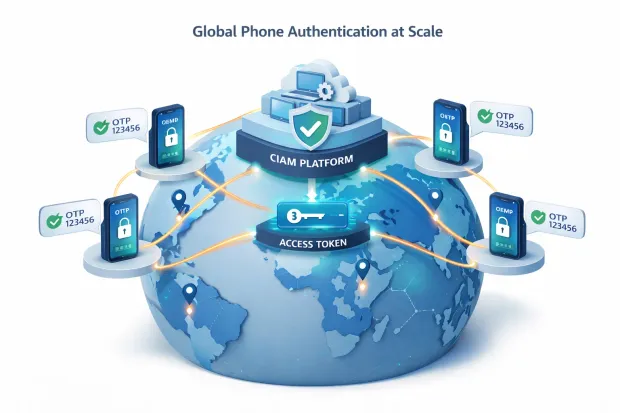
The Role of Access Tokens in Phone Authentication Workflows
Here’s where many phone authentication implementations quietly fall apart: OTP resend logic.
Resend endpoints are attractive attack surfaces. Without proper control, they get abused for brute-force attempts, SMS flooding, or denial-of-service patterns.LoginRadius addresses this by designing resend behavior around access tokens, not assumptions.
The platform supports two distinct resend paths:
-
Resend phone number verification OTP with an access token
-
Resend phone number verification OTP without an access token
This distinction exists for a reason.
During certain stages—such as initial registration or recovery—the user may not yet have an authenticated session. In those cases, resending an OTP without an access token is necessary. However, once a session or partial authentication state exists, requiring an access token adds an extra layer of control.
For directors and security leaders, this design signals maturity. It shows that LoginRadius does not treat OTP as a one-size-fits-all action. Instead, it aligns resend behavior with session context and authentication state.
Access tokens act as proof of session legitimacy, helping the platform validate that resend requests come from an expected flow rather than automated abuse. This reduces the attack surface without complicating the user journey.
In short, access tokens don’t just manage sessions here—they help keep phone authentication reliable under scale and stress.
Global-Scale Phone Authentication Without Geographic Restrictions
Authentication systems don’t get evaluated only on how they work in one region. They get judged on whether they scale globally without exceptions, workarounds, or regional forks.
LoginRadius cIAM Phone Authentication supports registering phone numbers and sending OTPs to any part of the world, with no geographic restrictions.
That capability has direct implications for enterprise growth.
It allows organizations to launch applications in new markets without redesigning authentication flows. It supports customer bases distributed across countries, telecom providers, and regulatory environments. And it removes one of the most common blockers in CIAM rollouts: “This works locally, but what about everywhere else?”
Global OTP delivery also ensures consistency. Users receive the same authentication experience regardless of location, which simplifies support, analytics, and security monitoring.
Combined with mobile-first design and mandatory OTP verification, this global reach positions Phone Authentication as a scalable foundation rather than a regional experiment.
Key Business and Security Benefits of CIAM Phone Authentication
Phone authentication delivers value only when it improves both conversion and control. Most solutions lean too far in one direction. LoginRadius cIAM Phone Authentication avoids that trap by design.
Frictionless onboarding without weak identity signals
Speed matters during registration. Every extra step costs trust. Phone authentication reduces friction because users don’t need to invent credentials or confirm inboxes later. They verify ownership instantly through otp verification, and the account becomes usable immediately.
The auto-read OTP capability (with user permission) takes this further. It removes manual entry, which is often where drop-offs occur. The result is faster onboarding that still enforces possession-based identity proof.
Stronger security tied to real-world devices
Passwords alone prove knowledge. They don’t prove control. Phone authentication ties the identity to a physical device that users actively protect. Mandatory OTP verification during registration establishes that link from the first interaction.
This dramatically reduces:
-
fake registrations
-
credential stuffing impact
-
weak recovery paths
Security improves without forcing users into complex MFA setups.
Reliable channel for engagement and recovery
A verified phone number creates a dependable communication path. LoginRadius highlights the ability to leverage mobile data for improved targeting and direct reach.
From a business perspective, this supports:
-
timely transactional communication
-
secure recovery via OTP
-
reduced reliance on email deliverability
From a security perspective, it keeps critical flows anchored to a verified identifier.
Consistent experience across mobile and desktop
Although optimized for mobile, LoginRadius Phone Authentication works seamlessly across mobile and desktop applications. That consistency simplifies governance and avoids fragmented identity behavior across channels.
APIs That Power LoginRadius Phone Authentication
Phone authentication only scales when developers can implement, monitor, and adapt it without custom glue. LoginRadius exposes Phone Authentication through a structured set of APIs that cover the full identity lifecycle.
These APIs are not limited to login. They support registration, recovery, verification, and profile operations.
Core authentication and verification APIs
LoginRadius provides APIs to:
-
register phone numbers with OTP
-
authenticate users by sending an OTP to the registered phone number
-
authenticate using phone number with password
-
authenticate using phone number with OTP
This flexibility allows teams to mix password-based and OTP-based flows based on user preference or risk tolerance.
Recovery and security management APIs
Account recovery remains a high-risk moment. LoginRadius includes APIs for:
-
OTP verification to reset account passwords
-
resetting passwords for phone authentication using OTP
These flows keep recovery tied to the verified phone number instead of shifting trust to secondary channels.
Resend and session-sensitive controls
OTP resend behavior is often abused. LoginRadius supports:
-
resending phone number verification OTP with an access token
-
resending phone number verification OTP without an access token
This allows resend logic to adapt to session context and authentication state, reducing abuse while maintaining usability.
Profile search and update APIs
Operational teams need visibility. LoginRadius supports:
-
searching and retrieving profiles using registered phone numbers
-
updating phone numbers and security questions (where applicable)
These APIs support customer support, compliance reviews, and lifecycle management—not just authentication.
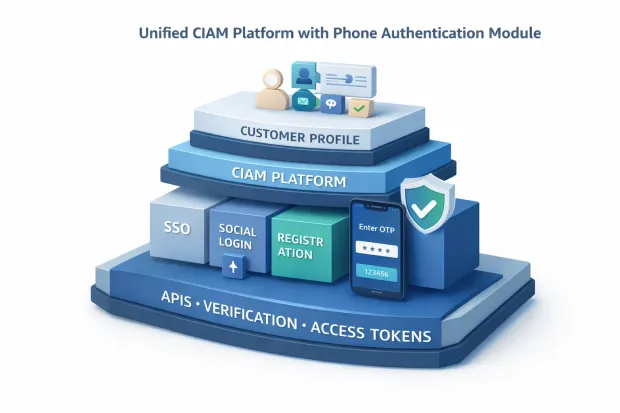
How Phone Authentication Fits into the Complete LoginRadius CIAM Platform
Phone authentication delivers its full value when it operates inside a complete identity platform. LoginRadius is a cloud-based Customer Identity and Access Management provider serving 3,000+ businesses with a monthly reach of over 1 billion users worldwide.
Within this platform, phone authentication acts as a core identity entry point, not an isolated feature.
Unified customer profiles
Every phone-based registration and login feeds into a centralized customer profile. This prevents identity silos and supports a single, consistent view of the customer across channels. Phone numbers don’t float independently; they become part of the unified identity record.
Platform-level security and scalability
Because Phone Authentication runs inside the LoginRadius CIAM platform, it benefits from the same cloud-based infrastructure, security controls, and scalability guarantees. Authentication traffic, OTP flows, and profile operations operate under the same reliability expectations as the rest of the platform.
Operational consistency across touchpoints
Whether users log in via mobile apps or desktop interfaces, phone authentication behaves consistently. That consistency simplifies analytics, access reviews, and support workflows. Teams don’t need separate logic for “mobile users” versus “web users.”
In short, Phone Authentication strengthens the platform instead of fragmenting it.
When Should Enterprises Choose Phone Authentication?
Phone authentication is not a universal replacement for every login model. It becomes the right choice when business goals, user behavior, and security posture align.
Enterprises typically prioritize phone authentication when they need:
Mobile-first onboarding and access
If your primary customer touchpoint is a mobile application or if a large portion of access happens on phones, phone authentication matches user behavior naturally.
Faster registration without weaker verification
Phone authentication shortens onboarding while still enforcing OTP-based possession checks. That balance appeals to teams trying to increase conversion without lowering security standards.
Stronger recovery and account control
OTP-based recovery tied to phone numbers reduces dependence on email access and lowers support overhead for account resets.
Global user reach
LoginRadius supports OTP delivery worldwide with no geographic restrictions. This makes phone authentication viable for international products without regional workarounds.
Flexible login strategies
Some users prefer passwords. Others prefer OTP per session. Phone authentication in LoginRadius supports both, allowing enterprises to adapt their authentication strategy without rebuilding flows.
If your identity roadmap includes mobile growth, global expansion, or reduced password dependence, phone authentication becomes less of a feature decision and more of a platform requirement.
Conclusion
Mobile-first behavior already rewrote the rules. Users don’t “go online” anymore they stay online, and their phone acts like their identity anchor.
That shift makes one thing clear for directors and authentication leaders: phone authentication now sits in the baseline stack for modern customer access, not in the “nice-to-have” pile.
Here’s the part most teams miss when they evaluate phone authentication: the value doesn’t come from swapping email for a phone number.
The value comes from what a strong ciam platform can enforce around that number verification, recovery, session control, and global delivery without turning the user experience into a series of hurdles.
LoginRadius CIAM Phone Authentication keeps that balance intact.
-
It lets customers register and log in using a mobile phone number as the username, which aligns with how people actually access digital services today.
-
It makes otp verification mandatory during onboarding, so every phone-based identity starts with ownership proof instead of hope.
-
It supports real-world preference and risk handling by allowing verified users to choose between password login and OTP per session.
-
It improves flow performance with OTP auto-read capability (with user permissions), which removes the most common friction point in OTP experiences.
-
It supports global scale by enabling OTP delivery worldwide with no geographic restrictions critical for growth and consistency across regions.
-
It also covers the operational details that decide whether a rollout stays stable: password resets via OTP, profile retrieval via registered phone numbers, and resend options that can run with an access token or without one depending on the user’s session state.
That last point matters more than most vendor pages admit. OTP systems get noisy when teams treat them like a single endpoint instead of a lifecycle. Resend abuse, inconsistent recovery, and weak session handling show up fast. A controlled approach built into the platform keeps phone authentication clean at scale.
If you’re planning your next authentication standard, don’t frame this as “email vs phone.” Frame it as: Do we want an onboarding and login layer that matches mobile behavior while strengthening verification from the first touchpoint? If the answer is yes, phone authentication belongs in the core, and LoginRadius gives you the CIAM-grade implementation to run it.
Now make the smart move: take the datasheet into your internal review. It packages the feature definition, the supported flows, and the function set in a form that security, product, and architecture teams can evaluate quickly without interpretation gaps.
Download the LoginRadius CIAM Phone Authentication datasheet and use it as your internal reference for rollout planning and platform evaluation.
FAQs
Q: Is phone authentication secure enough for enterprise-grade CIAM use cases?
A: Yes. LoginRadius enforces mandatory OTP verification during registration, tying each account to a verified mobile device and significantly reducing identity fraud risks.
Q: Does LoginRadius support both password-based and passwordless phone authentication?
A: Yes. After initial OTP verification, users can log in using a password or choose OTP-based authentication for each session, based on preference or security needs.
Q: How does LoginRadius prevent OTP abuse or resend attacks?
A: The platform supports resending OTPs with or without an access token, allowing resend behavior to align with session state and reducing misuse of OTP endpoints.
Q: Can LoginRadius Phone Authentication scale globally?
A: Absolutely. LoginRadius allows phone number registration and OTP delivery worldwide with no geographic restrictions, making it suitable for global applications.