Introduction
In media and entertainment, growth rarely dies because of bad content. It dies quietly in the onboarding flow.
A subscriber arrives curious. A form loads slowly. A password rule feels outdated. A verification step never arrives. And just like that, the user leaves. No complaint. No second chance.
That moment is where media and entertainment onboarding either earns loyalty or creates churn.
This industry operates under brutal conditions. Audiences expect instant access. They compare experiences subconsciously.
They abandon platforms without hesitation. When onboarding feels clumsy, insecure, or outdated, users don’t wait for improvement. They move on.
Here’s where teams usually go wrong: they treat onboarding as a UI problem. It isn’t.
Onboarding in entertainment and media is an identity problem.
LoginRadius decided to test this assumption instead of theorizing about it. We audited the sign-up and login journeys of 100+ media and entertainment brands across streaming platforms, digital publications, and subscription-based content services. The results exposed a pattern that explains why churn stays stubbornly high across the industry.
This blog breaks those findings down. More importantly, it introduces a media checklist that senior teams now use to evaluate whether their onboarding process actually supports growth or quietly works against it.
If you oversee digital strategy, subscriptions, identity, or platform growth, this is required reading.
Why Media & Entertainment Onboarding Is Quietly Failing
Most media platforms invest heavily in content pipelines, distribution, and monetization. Very few apply the same discipline to onboarding.
That gap shows up fast.
During our audit, we uncovered consistent issues across large and small brands alike. Not edge cases. Systemic flaws.
Unverified Accounts Are Still the Norm
Nearly 70% of entertainment brands failed to verify email addresses during sign-up.
That means fake accounts slip through easily. Fraud scales silently. Metrics inflate without delivering value. Teams celebrate growth that doesn’t exist.
Here’s where it gets interesting: many of these platforms believed verification “added friction.” In reality, it added clarity. Verification reduces fake accounts, lowers abuse, and strengthens downstream engagement.
Weak Passwords Remain Shockingly Common
Despite years of breaches, 80% of brands still accepted weak passwords. Even worse, only 30% enforced real password strength policies.
This isn’t a technical limitation. It’s a prioritization failure.
Password breaches continue not because security tools don’t exist but because onboarding flows still rely on outdated assumptions.
Bots Face Almost No Resistance
Only 2 out of 10 brands used CAPTCHA or bot protection during sign-up.
That leaves the door open for credential stuffing, scripted abuse, and fake account creation. For subscription businesses, this translates directly into lost revenue and distorted analytics.
Social Login Is Still Missing Where It Matters Most
About 30% of platforms offered no social login at all.
Instead, users had to create yet another account with yet another password. In an environment where users already manage dozens of logins, this decision alone causes massive drop-off.
Social login remains one of the simplest conversion levers in media and entertainment solutions and one of the most underused.
Passwordless Access Remains the Exception
Only a small fraction of brands supported magic links, passkeys, or biometric authentication.
That directly contradicts user behavior. 93% of users prefer biometric authentication, yet most platforms still force credentials users actively dislike.
Data Over-Collection Kills Conversion
One platform asked for so much information upfront that it felt closer to a census than a sign-up.
Every additional field reduced conversion by roughly 10%.
This pattern repeated across brands. Over-collection early. Drop-off later.
All of this leads to one conclusion: the onboarding process across media platforms still reflects legacy thinking, not modern user behavior.
Where Media & Entertainment Onboarding Quietly Loses Revenue
Here’s a pattern we’ve seen repeatedly across media and entertainment platforms: teams obsess over acquisition channels but ignore what happens once users arrive.
Paid traffic works.
Content works.
Campaigns perform.
Then, onboarding quietly undoes all that effort. The onboarding process becomes a bottleneck instead of a bridge.
When media and entertainment brands fail to onboard media users efficiently, they don’t just lose conversions they lose trust. And in entertainment and media, trust determines whether users subscribe, stay logged in, and return daily.
This is why a structured onboarding checklist matters more than another UX tweak.
A checklist that media teams can actually use creates discipline. It forces hard decisions: what belongs at sign-up, what can wait, and what should never block access to content.
Without this structure, onboarding becomes subjective, opinion-driven, and inconsistent across teams. That’s where churn starts creeping in.
The Media & Entertainment Onboarding Checklist That Fixes This
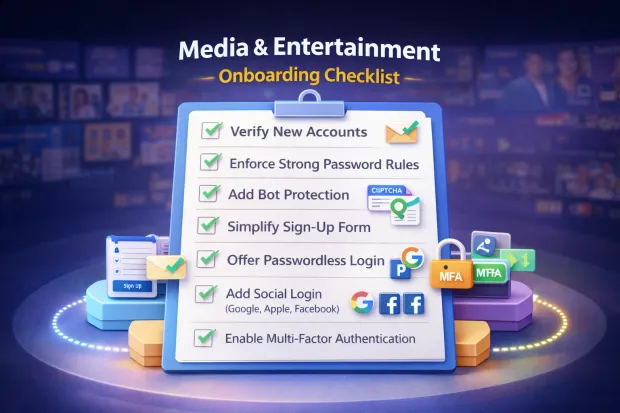
To correct these failures, LoginRadius distilled its findings into a Media & Entertainment onboarding checklist designed for real-world use.
This isn’t theory. It’s a practical media checklist built from what actually works across high-scale platforms.
Below is a working preview. The complete version is available for download later in this post.
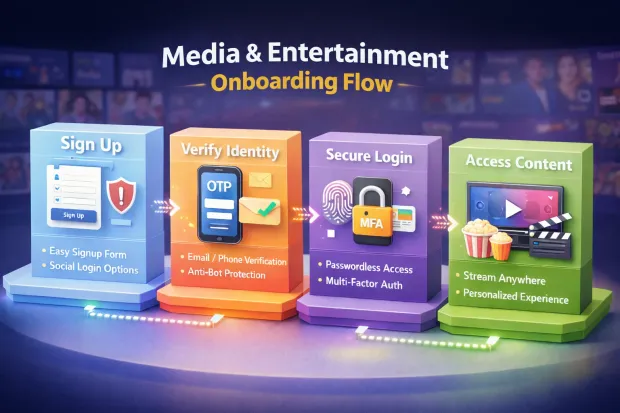
1. Verify New User Accounts by Default
Verification must be non-negotiable.
Email and phone verification using OTPs or magic links confirms identity ownership without disrupting the experience. Platforms that skip this step invite fraud and inflate their user base with low-quality accounts.
Verification protects revenue. It also strengthens trust from the first interaction.
2. Enforce Password Rules That Actually Protect Users
Weak passwords cannot exist in modern onboarding.
Reject common phrases. Block leaked credentials. Hash and salt every password using current standards.
This step alone removes a massive attack surface that many platforms still expose.
3. Add Bot Protection at Sign-Up and Login
CAPTCHA and bot detection tools stop abuse before it scales.
They protect sign-up integrity, prevent brute-force attacks, and reduce downstream moderation costs. There’s no upside to skipping this step.
4. Simplify the Sign-Up Form Ruthlessly
Only ask for what you need to start. Name. Email. Maybe phone. Everything else belongs later.
This is where progressive profiling matters. Collect additional data over time, once users see value and trust the platform. Platforms that do this consistently outperform those that front-load data requests.
5. Make Passwordless Login a First-Class Option
Passwordless access isn’t experimental anymore.
Magic links, passkeys, and biometric authentication remove friction at the moment users care most first access.
They also reduce support costs and credential-related risk. In media and entertainment, this directly supports binge behavior and repeat engagement.
6. Offer Social Login Where Users Expect It
Google, Apple, and Facebook account for more than 70% of social login usage among the platforms we reviewed.
Not offering them forces unnecessary friction.
Social login shortens onboarding time, reduces password fatigue, and improves conversion without sacrificing security.
7. Enable MFA Without Breaking the Experience
Multi-factor authentication doesn’t need to feel heavy.
Adaptive MFA allows low-risk access to remain seamless while stepping up security when context changes. SMS OTPs, TOTP apps, and push notifications all serve different user segments.
Security improves. Friction stays controlled.
8. Maintain Consistency Across Devices
Media consumption happens everywhere.
Phones. Tablets. Desktops. TVs.
Your onboarding experience must feel consistent across all of them. Users shouldn’t relearn access patterns every time they switch screens.
9. Build Compliance Into the Stack
GDPR, PCI DSS 4.0, ISO 27001—compliance doesn’t belong in a checklist at the end of implementation.
It belongs at the center of the identity architecture. Especially for global platforms.
10. Monitor and Test Continuously
Onboarding flows break quietly.
A slow API call. A UI regression. A failed redirect.
Regular monitoring catches these issues before they impact conversion. One broken click can cost thousands of subscribers.
Why Building Identity In-House Keeps Media Teams Stuck
Some teams still attempt to assemble identity features manually.
Email verification here. MFA there. Social login through another vendor. Monitoring via custom scripts.
This approach looks flexible early. It collapses at scale.
During peak events sports finals, season premieres, global launches—identity systems face their highest load. That’s the worst time to discover duct-taped integrations failing under pressure.
There’s a simpler option.
Use a platform that already supports:
-
Passkeys
-
Push MFA
-
SSO
-
Risk-based authentication
-
High-volume traffic without degradation
Identity shouldn’t consume engineering bandwidth meant for content innovation.
Why Directors and Senior Leaders Need a Media Onboarding Checklist
At the director level, onboarding stops being a UX discussion and becomes a business risk discussion.
Fraud, churn, inflated user metrics, and support costs all trace back to identity decisions made early. Without a shared media checklist, teams optimize locally while damaging the system globally.
Marketing pushes for fewer fields. Security pushes for more. Product compromises. Nobody wins.
A well-designed entertainment checklist aligns these teams. It defines what “good” looks like across security, conversion, and compliance. It removes guesswork.
That’s exactly why senior media leaders are now treating onboarding as infrastructure, not UI and why downloading a proven onboarding checklist saves months of internal debate.
How LoginRadius Supports Media & Entertainment at Scale
LoginRadius builds identity infrastructure specifically for media and entertainment solutions that demand speed, security, and scale.
Our platform supports 150K+ logins per second without degradation. That matters during live events and peak traffic windows.
Key capabilities include:
-
Passwordless authentication out of the box
-
Progressive profiling designed for subscriber journeys
-
Unified user profiles across devices and services
-
Managed compliance for global operations
We support over 3,000 brands, manage more than 1 billion identities, and process 5.7 billion API calls every month.
This isn’t theoretical performance. It’s production reality.
Download the Complete Media & Entertainment Onboarding Checklist
This article covers the framework.
The downloadable asset goes deeper.
It gives you a practical onboarding checklist that teams use to audit existing flows, identify friction points, and align identity strategy with subscriber growth.
Download the Media & Entertainment Onboarding Checklist
If onboarding affects conversion, retention, and revenue—and it does—this checklist belongs on your desk.
The Future of Media Onboarding Is Identity-First
Audiences won’t wait for fixes.
They expect access that feels instant, secure, and familiar. Platforms that deliver that experience grow. Platforms that don’t bleed subscribers quietly.
Strong onboarding doesn’t shout. It disappears.
And that’s exactly how it should feel.
FAQs
Q: What is a Media & Entertainment onboarding checklist?
A: A structured framework that defines how sign-up, login, and identity flows should function to improve conversion, security, and retention.
Q: Why does onboarding matter so much in media platforms?
A: Because friction at sign-up directly impacts subscriber growth and churn. Identity failures compound fast at scale.
Q: Should media platforms use social login?
A: Yes. Social login reduces friction and improves conversion without compromising security.
Q: How does LoginRadius support media onboarding?
A: By providing a unified CIAM platform purpose-built for scale, security, and frictionless access.