Introduction
Passwords are no longer the only weak point in authentication. The harder challenge is deciding when a login should be trusted, when it needs extra verification, and when it should be blocked outright.
Multi-factor authentication helps by requiring users to prove their identity with more than one factor. That added layer can stop many account takeover attempts, even when a password has already been compromised. But applying MFA to every login can create another problem: unnecessary friction. Customers get interrupted, support requests increase, and repeated prompts can train users to approve challenges without much thought.
Risk-based authentication takes a different approach. Instead of treating every login the same, it evaluates signals such as device familiarity, location, IP reputation, login behavior, and unusual travel patterns before deciding what happens next. A familiar customer signing in from a recognized device may continue without interruption.
The same account attempting access from a new device, an unexpected country, or a suspicious network may be asked for stronger verification or denied access completely.
Here’s where teams usually go wrong: they frame MFA and RBA as competing authentication methods. They are not. MFA verifies identity, while RBA helps determine when that additional verification is necessary. Used together, they form the basis of adaptive authentication, where security controls respond to the level of risk instead of forcing every customer through the same rigid journey.
So, which approach should your organization use? In most customer identity environments, the answer is not MFA or RBA. It is knowing how to combine both without weakening security or frustrating legitimate users.
This guide explains the difference between MFA and risk-based authentication, how each approach works, where they fall short, and how organizations can use them together to create safer, lower-friction login experiences.
MFA vs RBA: The Short Answer
Although both Multi-Factor Authentication (MFA) and Risk-Based Authentication (RBA) strengthen account security, they solve different problems.
MFA is an authentication method that asks users to verify their identity using two or more authentication factors, such as a password, a one-time passcode, a passkey, or a biometric scan. The goal is straightforward: make it harder for attackers to access an account using stolen credentials alone.
Risk-Based Authentication works differently. Instead of challenging every login, it first evaluates the context of the authentication attempt. Factors such as device recognition, IP reputation, geographic location, login history, impossible travel, and user behavior help determine whether the attempt appears legitimate or suspicious. Based on that risk assessment, the system can allow access, trigger MFA, request stronger authentication, or block the login entirely.
Let me make this simple. MFA answers the question, "Can this user prove their identity?" RBA answers, "Does this login look trustworthy enough to require additional verification?"
This distinction matters because modern customer authentication is no longer just about verifying identities. It's about making intelligent decisions before introducing friction. Challenging every customer with MFA can protect accounts, but it can also slow down sign-ins, increase abandonment, and contribute to MFA fatigue. On the other hand, relying solely on risk analysis without strong authentication may leave high-risk accounts exposed.
For most organizations, the strongest security strategy combines both approaches. Risk-Based Authentication evaluates the login first, while Multi-Factor Authentication is applied only when the calculated risk justifies additional verification. This adaptive approach improves security without disrupting every legitimate customer session.
| Feature | Multi-Factor Authentication (MFA) | Risk-Based Authentication (RBA) |
|---|---|---|
| Primary purpose | Verifies a user's identity | Evaluates the risk of a login attempt |
| How it works | Requires two or more authentication factors | Analyzes contextual and behavioral risk signals before making an access decision |
| Authentication prompts | Usually applied based on policy | Triggered only when elevated risk is detected |
| User experience | Can introduce friction during every protected login | Minimizes unnecessary authentication challenges |
| Security focus | Prevents unauthorized access through stronger identity verification | Detects suspicious login activity and adapts authentication requirements |
| Uses risk signals | No | Yes |
| Supports adaptive authentication | Limited on its own | Yes |
| Works alongside MFA | Yes | Yes—often triggers MFA when needed |
| Best suited for | Strengthening account authentication | Balancing security with a seamless customer experience |
The comparison isn't really about choosing one over the other. Organizations increasingly use RBA and MFA together to build adaptive authentication systems that protect customer accounts while reducing unnecessary login friction.
What Is Multi-Factor Authentication (MFA)?
Multi-Factor Authentication (MFA) is an authentication method that requires users to verify their identity using two or more independent authentication factors before access is granted. Instead of relying solely on a password, MFA combines different types of credentials to make it significantly more difficult for attackers to compromise an account—even if they already know the user's password.
Authentication factors generally fall into four categories:
-
Something you know: Passwords, PINs, or security questions.
-
Something you have: A mobile authenticator app, hardware security key, smartphone, or passkey stored on a trusted device.
-
Something you are: Biometrics such as fingerprints, facial recognition, or iris scans.
-
Something you do: Behavioral signals such as typing patterns or device interactions
A typical customer login might look familiar. A user enters their email address and password, then receives a push notification or one-time verification code to confirm the sign-in. Only after completing both steps is access granted. The additional verification helps ensure the person logging in is the legitimate account owner.
For years, this approach has been one of the most effective defenses against credential theft, password spraying, and credential stuffing attacks. Microsoft has consistently reported that enabling MFA can prevent the vast majority of automated account compromise attempts, making it a foundational control for protecting digital identities.
MFA doesn't evaluate whether a login actually looks suspicious—it simply follows the authentication policy you've configured. If your policy requires MFA for every login, every customer receives an authentication challenge regardless of whether they're signing in from their usual laptop at home or an unfamiliar device halfway across the world.
That static approach creates an unavoidable trade-off. Requiring MFA everywhere increases security, but it also introduces friction. Customers may abandon login attempts, authentication requests become routine, and repeated prompts can eventually lead to approval fatigue. In customer-facing applications where every extra step affects conversion and retention, those small interruptions add up quickly.
This doesn't mean MFA is flawed. Quite the opposite; it remains one of the most important layers of modern identity security. The limitation is that traditional MFA treats every authentication request the same. It verifies identity exceptionally well, but it doesn't determine whether additional verification is actually necessary. That's exactly the gap Risk-Based Authentication is designed to fill.
What Is Risk-Based Authentication (RBA)?
Risk-Based Authentication (RBA) is an authentication approach that evaluates the risk associated with every login attempt before deciding how the user should be authenticated. Instead of applying the same authentication requirements to everyone, RBA analyzes the context of each request and adjusts the security response based on the calculated level of risk.
Here's a simple example. Imagine you've logged into the same banking app from your personal phone every morning for the past six months. You're using your home Wi-Fi, the device is recognized, your login behavior matches previous sessions, and nothing appears unusual. From a security perspective, this is a low-risk authentication request. Asking for another verification code every single day adds little protection while creating unnecessary friction.
Now imagine that same account attempts to sign in ten minutes later from another country using an unknown browser connected through a suspicious IP address. Suddenly, the situation looks very different. The password might still be correct, but the surrounding signals suggest the login deserves closer scrutiny. Instead of allowing immediate access, the system can require MFA, ask for a passkey, request biometric verification, or block the attempt altogether.
That's the fundamental idea behind Risk-Based Authentication. It doesn't replace authentication—it decides how much authentication is appropriate for a particular situation.
A surprising pattern we've seen across modern identity platforms is that very few customer logins are equally risky. Some occur from trusted devices that customers use every day. Others originate from anonymous networks, unfamiliar locations, compromised credentials, or automated attack infrastructure. Treating every one of those scenarios the same doesn't improve security; it simply creates more work for legitimate users.
This is why RBA is often referred to as adaptive authentication or context-aware authentication. The authentication journey adapts to the level of confidence the system has in the login attempt. As risk increases, authentication requirements become stronger. When risk remains low, customers move through the login process with little or no interruption.
Risk-Based Authentication relies on a risk engine that continuously evaluates multiple contextual signals before assigning a risk score. These signals may include:
-
Device recognition and fingerprinting
-
Geographic location
-
IP reputation
-
Browser and operating system
-
Login history
-
Impossible travel detection
-
Time of access
-
User behavior
-
Threat intelligence feeds
Rather than looking at any single signal in isolation, the risk engine evaluates them together to determine whether the authentication request appears normal or suspicious. A login from a new device isn't automatically malicious. Likewise, a familiar location doesn't always guarantee the request is legitimate. The overall combination of signals provides a far more accurate picture of authentication risk.
In customer identity and access management (CIAM), this adaptive approach delivers two important benefits. Security teams can focus stronger authentication on genuinely suspicious login attempts, while legitimate customers enjoy faster, lower-friction access to applications and services. That balance has become increasingly important as organizations try to reduce account takeover attacks without introducing unnecessary barriers that affect customer satisfaction or conversion rates.
Although Risk-Based Authentication makes the authentication process significantly smarter, it isn't designed to replace Multi-Factor Authentication. Instead, it works alongside MFA by determining when additional verification should occur. Together, they form the foundation of adaptive authentication, allowing organizations to strengthen security while keeping the customer experience as seamless as possible.
How Risk-Based Authentication Works
Every login attempt leaves behind clues. The device being used, the network it's coming from, the user's location, previous login behavior—even the speed at which someone types or moves a mouse can help determine whether the person behind the keyboard is likely to be the legitimate account owner.
Risk-Based Authentication collects these signals before making an authentication decision. Instead of immediately granting access or automatically prompting for MFA, it first asks a different question: "How risky does this login appear?"
The answer comes from a risk engine that evaluates multiple contextual signals in real time. Rather than depending on a single indicator, the engine combines dozens of data points to calculate an overall risk score. This provides a much more accurate assessment than relying on passwords or one-time verification codes alone.
A typical authentication workflow looks something like this:
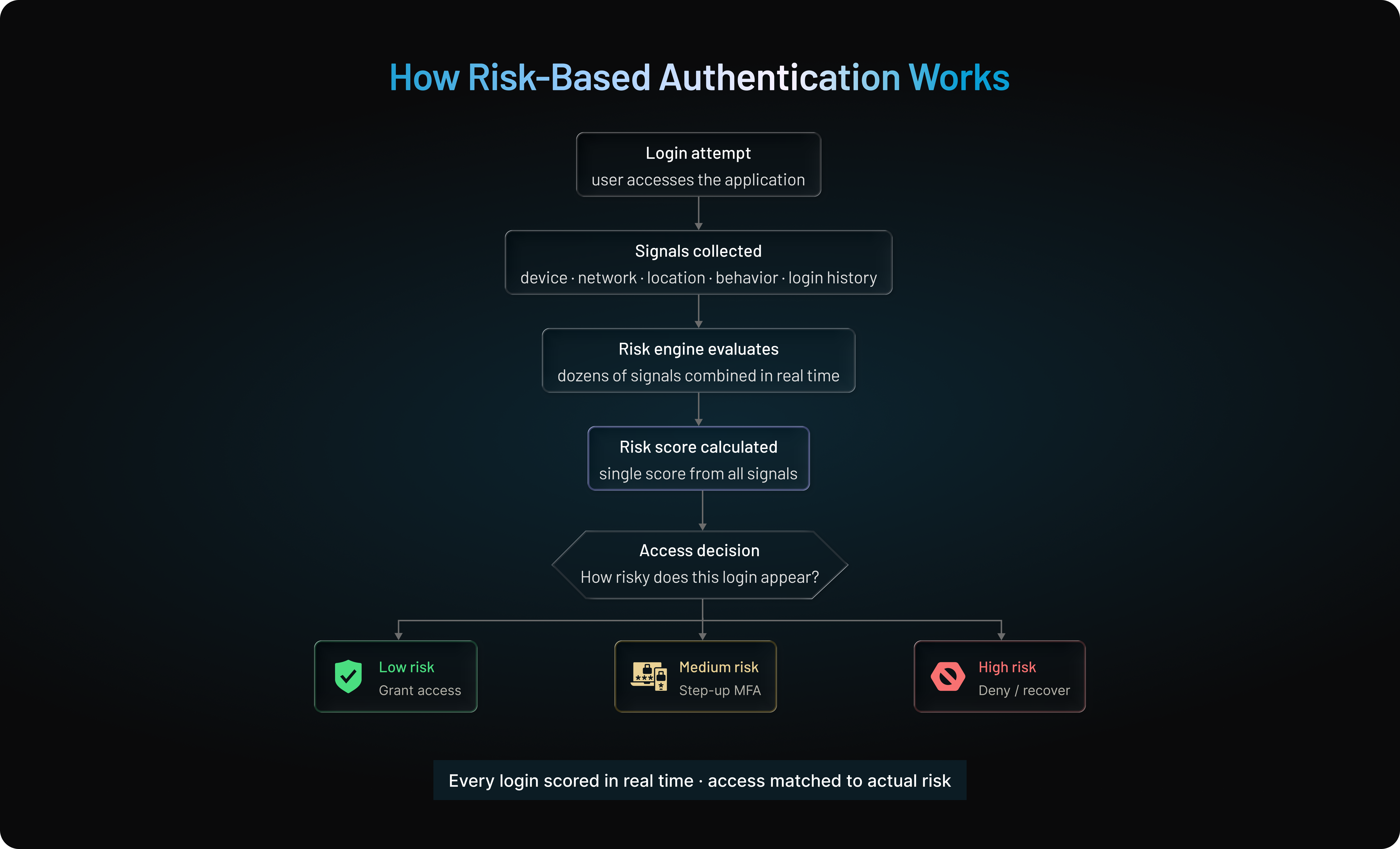
Two login attempts can use the same password and still receive completely different authentication outcomes.
Consider these examples:
| Login Scenario | Risk Level | Authentication Response |
|---|---|---|
| Returning customer using a recognized device on their home network | Low | Immediate access |
| Customer logging in from a new laptop while traveling | Medium | Request MFA or biometric verification |
| Login from an unfamiliar device through a known malicious IP address | High | Block access or require identity verification |
| Multiple failed login attempts followed by a successful password entry | High | Trigger additional authentication and fraud monitoring |
This adaptive decision-making is what separates Risk-Based Authentication from traditional authentication policies. Instead of assuming every login deserves the same level of scrutiny, the system adjusts its response based on the likelihood that the authentication request is genuine.
For customer-facing applications, the impact is significant. Legitimate users spend less time completing unnecessary authentication challenges, while attackers encounter stronger security controls precisely when their activity appears suspicious. That combination improves both security and customer experience something static authentication policies often struggle to achieve.
Of course, all of this depends on one thing: the quality of the risk signals being analyzed. The more accurately an identity platform can understand the context surrounding a login attempt, the better its authentication decisions become. That's why the next piece of the puzzle is understanding exactly which signals Risk-Based Authentication evaluates before assigning a risk score.
How RBA and MFA Interact in the Identity Stack
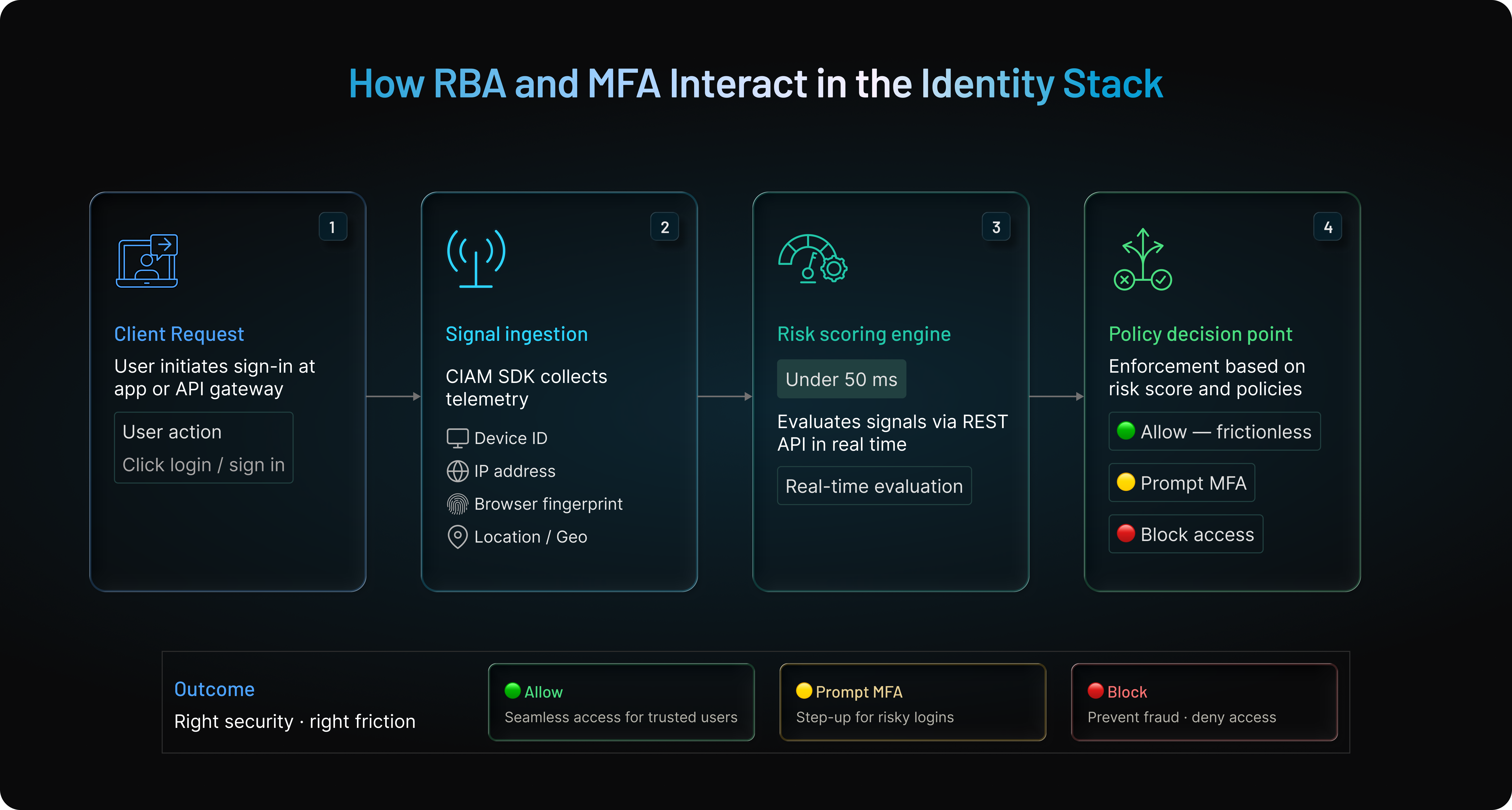
Architecturally, Risk-Based Authentication acts as an evaluation layer sitting between the user request and your Identity Provider (IdP) as shown in the image below.
What Risk Signals Does Risk-Based Authentication Evaluate?
Not every unusual login is malicious. Customers buy new phones, travel for work, switch internet providers, and sign in from different locations every day. Looking at a single signal in isolation often leads to false negatives that frustrate legitimate users.
That's why modern Risk-Based Authentication evaluates multiple signals together before making an authentication decision. Each signal provides another piece of context. Individually they may tell you very little. Combined, they create a much clearer picture of whether a login attempt looks normal or suspicious.
Here are some of the most common signals a risk engine evaluates.
| Signal Category | Specific Contextual Signals | Security Benefit |
|---|---|---|
| Device Context | Device recognition, fingerprinting (browser version, OS, fonts, etc.) | Identifies returning vs. unseen hardware profiles |
| Network & Location | IP reputation (known bad actors, anonymous proxies, etc.), geographic distance, impossible travel | Detects suspicious IP origins and speed/distance anomalies |
| Behavioral Context | Behavioral biometrics (consistent login times and other historical patterns), typing rhythm, mouse movement, gestures, etc. | Identifies automated bots and stolen credential usage |
| Threat Intelligence | Compromised credential lists, velocity and authentication patterns, proxy/VPN feeds | Prevents attacks using known malicious infrastructure |
No single signal determines whether access should be granted or denied. A new device may be perfectly legitimate. An unfamiliar location could simply mean the customer is traveling. Even a suspicious IP address isn't always enough to conclude an account has been compromised.
Risk-Based Authentication works because it evaluates these signals together. The stronger the overall confidence that a login is legitimate, the less friction customers experience. When several high-risk signals appear at the same time, the authentication process automatically becomes more rigorous, protecting customer accounts without forcing every user through the same authentication journey.
MFA vs RBA: A Detailed Comparison
By now, one thing should be clear: Multi-Factor Authentication and Risk-Based Authentication aren't competing technologies. They solve different security challenges and often work best together. Still, understanding where they differ makes it much easier to design an authentication strategy that protects customer accounts without creating unnecessary friction.
The biggest distinction lies in what each approach is trying to accomplish. MFA focuses on verifying identity by requiring additional authentication factors. RBA focuses on evaluating the circumstances surrounding a login before deciding whether additional verification is necessary. One confirms who the user is. The other assesses how risky the login appears.
The differences become easier to understand when viewed side by side.
| Feature | Multi-Factor Authentication (MFA) | Risk-Based Authentication (RBA) |
|---|---|---|
| Primary objective | Verify a user's identity using multiple authentication factors | Evaluate the risk level of each login attempt before deciding how to authenticate |
| Authentication approach | Static authentication policy | Adaptive, context-aware authentication |
| Decision making | Every protected login follows the same authentication requirements | Authentication requirements change based on calculated risk |
| Uses contextual signals | Limited | Extensive analysis of device, location, behavior, network, and threat intelligence |
| Login experience | Can challenge users frequently | Challenges only when risk justifies additional verification |
| Security strength | Prevents unauthorized access with stronger identity verification | Detects suspicious authentication attempts before granting access |
| User friction | Higher when applied universally | Lower because trusted users experience fewer interruptions |
| Protection against stolen credentials | Strong | Stronger when combined with MFA and risk analysis |
| Protection against automated attacks | Limited without additional controls | Identifies unusual authentication patterns and suspicious behavior |
| Best use case | Strengthening authentication | Balancing security, customer experience, and fraud prevention |
Looking at the table, it's easy to assume that RBA is simply a more advanced version of MFA. That isn't quite right.
Imagine an online retailer protecting millions of customer accounts.
If every customer receives an MFA prompt every time they log in, the retailer certainly improves account security. At the same time, returning customers may become frustrated by repeated verification requests, especially when they're using the same phone, the same browser, and the same home network they've used for months.
Now consider the same retailer using Risk-Based Authentication.
A customer signing in from a trusted device on a familiar network proceeds directly to their account with little interruption. Another customer attempts to log in from a newly observed device in a different country while the account is simultaneously receiving failed login attempts from several IP addresses. This login receives a much stronger response—perhaps a passkey challenge, biometric verification, or additional fraud checks before access is granted.
Neither customer was treated identically because neither authentication request carried the same level of risk.
Here's where many organizations make an expensive mistake. They invest heavily in MFA and assume the job is done. While MFA dramatically strengthens authentication, it doesn't decide when additional verification makes sense. As customer bases grow and login volumes increase, applying identical authentication policies to every user often creates unnecessary friction without delivering proportional security benefits.
Risk-Based Authentication addresses that challenge by making authentication decisions more intelligent rather than simply making them stricter.
That doesn't mean RBA should replace MFA. If an attacker successfully bypasses the risk engine or presents a convincing low-risk profile, strong identity verification still matters. Likewise, applying MFA without considering risk may reduce account compromise but can also increase login abandonment and contribute to MFA fatigue.
The strongest customer identity strategies combine both approaches. Risk-Based Authentication evaluates the context of every login, while Multi-Factor Authentication provides additional identity verification only when elevated risk is detected. The result is an authentication experience that adapts to each customer instead of forcing everyone through the same security process.
As authentication threats continue to evolve, many organizations are moving beyond traditional MFA toward Adaptive MFA, a model that combines risk analysis with step-up authentication. Although the terms are sometimes used interchangeably, Adaptive MFA and traditional MFA are not the same. Understanding that distinction is the next step toward building a modern authentication strategy.
Why Modern Organizations Use MFA and RBA Together
If you've made it this far, you've probably noticed a pattern. Every section has pointed toward the same conclusion: comparing MFA and Risk-Based Authentication as if one should replace the other oversimplifies how modern authentication actually works.
Organizations don't choose between them. They combine them.
Think about what happens during a typical customer login. The identity platform first evaluates the authentication request. Is this a recognized device? Has the customer logged in from this location before? Does the IP address have a poor reputation? Is the login behavior consistent with previous sessions? Those questions are answered before the customer is asked to complete another authentication step.
If the overall risk remains low, the customer signs in with minimal interruption.
If the risk increases, the authentication journey changes automatically. The user may be asked to approve a push notification, verify a passkey, complete biometric authentication, or provide another phishing-resistant authentication factor before access is granted.
Notice what's happening here. Risk-Based Authentication isn't verifying the customer's identity—it is deciding whether stronger identity verification is required. Multi-Factor Authentication then provides that additional proof of identity.
That combination creates an authentication experience that's both stronger and smarter.
Consider a B2C banking application.
A customer logs in every weekday from the same smartphone using a passkey. The device is recognized, previous authentication history looks consistent, and the customer simply wants to check their account balance. Interrupting that experience with another authentication challenge every morning provides very little additional value.
Later that day, the same account attempts to initiate a high-value wire transfer from a newly observed laptop connected through a public network. Even if the login itself appears legitimate, the transaction carries far greater risk than viewing an account balance. Instead of treating both actions equally, the system performs step-up authentication, requesting stronger verification before allowing the transaction to proceed.
The authentication requirements changed because the risk changed.
This approach has become increasingly common across customer identity platforms because it improves two objectives that often seem difficult to balance.
First, security teams can focus stronger authentication where it matters most—high-risk logins, sensitive transactions, privileged account changes, or suspicious customer behavior.
Second, legitimate customers aren't forced through repeated verification challenges every time they access an application. Fewer interruptions translate into faster sign-ins, lower abandonment rates, fewer authentication-related support tickets, and a better overall customer experience.
That's particularly important for organizations managing millions of customer identities. A static authentication policy may generate millions of unnecessary MFA prompts every day. Adaptive authentication significantly reduces those challenges while maintaining strong protection against account takeover attempts.
The same approach also prepares organizations for newer authentication technologies. Passkeys, biometric authentication, hardware security keys, and other phishing-resistant authentication methods fit naturally into a risk-based framework. Rather than replacing existing security controls, they become stronger authentication options that can be triggered whenever elevated risk is detected.
Here's where the industry is heading. Authentication is no longer built around fixed security rules that apply equally to every customer. Modern CIAM platforms evaluate context continuously, respond to changing levels of risk, and adapt authentication requirements in real time. MFA and Risk-Based Authentication are no longer separate security strategies—they've become complementary components of the same adaptive authentication model.
The next question, then, isn't whether organizations should combine MFA and RBA. It's where each approach delivers the greatest value across different industries and customer scenarios.
MFA vs RBA: Which Approach Works Best Across Different Industries?
The right authentication strategy depends on more than security requirements. Customer expectations, regulatory obligations, transaction value, and fraud risks all influence how authentication should be implemented.
A streaming platform, for example, doesn't face the same risks as an online bank. Likewise, a healthcare portal handling patient records requires different authentication controls than an e-commerce website processing routine purchases.
That's why organizations increasingly combine Risk-Based Authentication with Multi-Factor Authentication rather than relying on either approach alone.
| Industry | Typical Authentication Risks | Recommended Approach |
|---|---|---|
| Banking & Financial Services | Account takeover, payment fraud, wire transfers, new payee creation | Use RBA to evaluate every login and transaction, then trigger phishing-resistant MFA or passkeys for high-risk activities. |
| Healthcare | Unauthorized access to patient records, compliance requirements, remote access | Apply adaptive authentication to reduce friction for trusted users while requiring MFA for sensitive records or unfamiliar devices. |
| E-commerce & Retail | Credential stuffing, account takeover, loyalty account fraud, checkout abandonment | Allow low-risk customers to sign in quickly while using RBA to detect suspicious logins and require step-up authentication when needed. |
| B2B SaaS | Administrative account compromise, privileged actions, customer tenant protection | Combine RBA with MFA for administrators and high-risk customer logins while minimizing interruptions for trusted users. |
| Travel & Hospitality | Frequent location changes, new devices, loyalty account abuse | Use contextual signals to distinguish legitimate travel from suspicious authentication attempts before requesting additional verification. |
| Education | Remote learning, shared devices, seasonal login spikes | Reduce unnecessary MFA prompts for students while protecting faculty, administrators, and sensitive academic systems through adaptive authentication. |
| Government & Public Services | Identity fraud, citizen data protection, regulatory compliance | Require stronger authentication for high-value services while allowing lower-risk interactions to proceed with minimal friction. |
A surprising pattern emerges across all of these industries. Organizations aren't trying to eliminate authentication challenges; they're trying to eliminate unnecessary ones. Take an online retailer during a holiday sale.
Thousands of returning customers are signing in from devices they've used for months. Most simply want to check an order or complete a purchase. Challenging every one of them with MFA may increase security, but it also adds friction at the exact moment the business wants the checkout experience to feel effortless.
Now picture a different scenario. A customer's password appears in a known credential breach, the login originates from a newly observed device, and several failed authentication attempts have already been recorded against the account. That session deserves far more scrutiny than the routine purchase made from a trusted smartphone.
The authentication policy hasn't changed; the context has.
That's why industries with large customer bases increasingly favor adaptive authentication. Instead of applying identical security controls to every login, they evaluate the risk first and then apply stronger authentication only when the situation demands it.
Whether the goal is preventing financial fraud, protecting healthcare records, securing customer accounts, or reducing login abandonment, the principle remains the same: authentication should respond to risk, not simply follow a fixed rule.
Of course, implementing that strategy effectively requires more than enabling MFA or deploying a risk engine. Organizations also need clear authentication policies, trusted signals, phishing-resistant authentication methods, and continuous monitoring. Those best practices make the difference between an adaptive authentication strategy that improves both security and customer experience and one that simply adds complexity.
Best Practices for Combining MFA and Risk-Based Authentication
Deploying Multi-Factor Authentication is relatively straightforward. Building an authentication strategy that protects customer accounts without frustrating legitimate users takes more planning.
The most successful implementations don't rely on a single security control. They layer risk analysis, strong authentication, intelligent policies, and continuous monitoring to make authentication decisions that adapt as customer behavior changes.
Here are the practices that consistently produce the best results.
| Best Practice | Why It Matters |
|---|---|
| Use adaptive authentication instead of static policies | Avoid challenging every customer with MFA. Evaluate login risk first and trigger additional verification only when confidence drops. |
| Choose phishing-resistant authentication methods | Replace SMS-based verification where possible with passkeys, FIDO2 security keys, or biometric authentication to reduce phishing and adversary-in-the-middle attack risks. |
| Evaluate multiple risk signals together | Device reputation, IP intelligence, login history, behavioral patterns, and geographic context provide a more accurate assessment than relying on a single indicator. |
| Apply step-up authentication to sensitive actions | Viewing an account and changing payment details don't carry the same level of risk. Require stronger authentication for privileged or high-value transactions rather than every session. |
| Establish trusted devices carefully | Recognizing previously authenticated devices reduces unnecessary MFA prompts while maintaining strong security for unfamiliar devices. |
| Continuously review authentication policies | Customer behavior, attack techniques, and business requirements evolve. Regularly update risk thresholds and authentication rules to reduce false positives and strengthen protection. |
| Monitor authentication events continuously | Track unusual login patterns, impossible travel events, credential stuffing attempts, and repeated authentication failures to detect emerging threats before accounts are compromised. |
| Balance security with customer experience | Every authentication challenge introduces friction. The objective isn't to eliminate MFA; it's to ensure customers encounter additional verification only when the calculated risk justifies it. |
A reduction in account takeover attempts is important, but so are customer-facing outcomes such as login success rates, authentication completion rates, MFA abandonment, support ticket volume, and overall customer satisfaction. Measuring both security and user experience provides a far more accurate picture of whether your authentication strategy is achieving its goals.
Modern authentication isn't about adding more verification steps. It's about making smarter authentication decisions. Organizations that combine Risk-Based Auth with phishing-resistant MFA, adaptive policies, and continuous risk evaluation are better positioned to stop modern identity attacks while delivering the seamless login experiences customers increasingly expect.
Financial & Regulatory Impact
-
Reducing SMS Costs: B2C enterprises sending millions of SMS OTPs daily see dramatic cost reductions by using RBA to eliminate MFA challenges for ~80% of routine, low-risk logins.
-
Meeting PSD2/SCA Standards: RBA enables compliance with European PSD2 rules by dynamically triggering Strong Customer Authentication (SCA) specifically during high-risk financial transactions.
How LoginRadius Helps You Implement Adaptive Authentication
Choosing between Multi-Factor Authentication and Risk-Based Authentication is only part of the equation. The bigger challenge is implementing both without increasing operational complexity or creating unnecessary friction for customers.
LoginRadius Customer Identity and Access Management (CIAM) helps organizations build adaptive authentication experiences by combining intelligent risk evaluation with flexible authentication policies. Instead of applying the same security controls to every login, organizations can evaluate contextual signals in real time and trigger additional verification only when the calculated risk justifies it.
The platform supports a broad range of modern authentication capabilities, including Multi-Factor Authentication, Risk-Based Authentication, Adaptive MFA, passkeys, FIDO2/WebAuthn, social login, passwordless authentication, and Single Sign-On. This allows organizations to secure customer identities while offering authentication experiences that match the needs of different applications, customer journeys, and risk levels.
For example, a returning customer signing in from a recognized device can access their account with minimal interruption, while a login attempt from an unfamiliar device, suspicious network, or unusual location can automatically trigger step-up authentication or stronger phishing-resistant verification. Security policies adapt to changing risk instead of relying on static authentication rules.
LoginRadius also gives organizations centralized control over authentication policies, customer identity management, fraud prevention, and compliance requirements from a single CIAM platform. That makes it easier to protect customer accounts, reduce account takeover attempts, and improve login success rates without sacrificing the customer experience.
As authentication threats continue to evolve, successful identity strategies will depend less on challenging every user and more on understanding which authentication requests deserve additional scrutiny. Adaptive authentication makes that possible, and combining Risk-Based Authentication with strong identity verification helps organizations deliver secure, low-friction customer experiences at scale.
Conclusion
Authentication has changed. Protecting customer accounts is no longer just about adding another verification step—it's about making smarter authentication decisions.
Multi-Factor Authentication remains one of the most effective ways to verify identity and stop unauthorized access. Risk-Based Authentication adds the intelligence needed to determine when that verification should happen. Together, they create an adaptive authentication strategy that strengthens security, reduces unnecessary friction, and helps organizations respond to modern identity threats with greater precision.
As customer expectations continue to rise and account takeover attacks become more sophisticated, relying on static authentication policies becomes increasingly difficult to justify. Every unnecessary MFA prompt affects the user experience. Every suspicious login that goes undetected increases business risk. Finding the right balance between security and convenience is no longer optional it's a competitive advantage.
Whether you're securing a consumer application, a B2B SaaS platform, an online banking service, or a healthcare portal, the objective remains the same: verify legitimate users quickly while making it significantly harder for attackers to succeed.
Looking to choose the right approach? LoginRadius helps organizations build modern customer authentication experiences with Adaptive MFA, Risk-Based Authentication, passkeys, passwordless authentication, phishing-resistant security, and enterprise-grade CIAM capabilities all from a single platform.
Ready to modernize your customer authentication strategy? Schedule a personalized demo to see how LoginRadius can help you reduce login friction, prevent account takeover attacks, and deliver secure, seamless authentication experiences at scale.
FAQs
Q: What is the difference between MFA and Risk-Based Authentication (RBA)?
A: MFA verifies a user's identity using multiple authentication factors, while RBA evaluates the risk of a login attempt and determines whether additional verification is required. They work best together as part of an adaptive authentication strategy.
Q: Is Risk-Based Authentication the same as Adaptive Authentication?
A: They are closely related but not identical. Risk-Based Authentication evaluates login risk, while Adaptive Authentication uses that risk assessment to dynamically adjust authentication requirements, often by triggering MFA.
Q: Can Risk-Based Authentication replace MFA?
A: No. RBA complements MFA rather than replacing it. It determines when stronger authentication is needed, while MFA provides the additional identity verification.
Q: What risk signals does Risk-Based Authentication evaluate?
A: RBA analyzes contextual signals such as device recognition, IP reputation, geographic location, login history, impossible travel, behavioral patterns, and threat intelligence to calculate login risk.
Q: What is step-up authentication?
A: Step-up authentication requires additional identity verification only when a login or transaction is considered high risk. This helps improve security without challenging users during every session.
Q: Is Adaptive MFA more secure than traditional MFA?
A: Adaptive MFA generally provides stronger protection because it combines risk analysis with MFA, challenging users only when suspicious activity is detected while reducing unnecessary authentication prompts.
Q: Which industries benefit most from combining MFA and RBA?
A: Industries such as banking, healthcare, retail, B2B SaaS, government, travel, and education benefit from adaptive authentication because they must balance strong security with a seamless customer experience.
Q: Does Risk-Based Authentication improve the customer experience?
A: Yes. By allowing low-risk users to sign in with minimal friction and requiring MFA only for suspicious activity, RBA reduces unnecessary login interruptions and improves authentication success rates.
Q: How do passkeys work with Risk-Based Authentication?
A: Passkeys provide phishing-resistant authentication that can be triggered by RBA when elevated risk is detected. Together, they strengthen account security while simplifying the login experience.
Q: Why should organizations use MFA and RBA together?
A: Combining MFA with RBA enables adaptive authentication, where login decisions are based on real-time risk. This approach strengthens security, reduces account takeover risk, and minimizes unnecessary friction for legitimate users.