Introduction
A customer might discover a brand on one device, register on another, return through a mobile app, sign in with a social account, and later update their preferences through a customer portal. For a digital marketer, all of those interactions are more useful when they can be connected to the right customer identity.
That is often where the problem starts. Customer information can be fragmented across authentication systems, CDPs, CRMs, analytics tools, and marketing platforms. Some visitors remain anonymous. Others create duplicate accounts or use different login methods. Even when useful customer data exists, teams still need to know which information belongs to whom, whether it can appropriately be used, and how to maintain that identity across digital experiences.
Customer Identity and Access Management (CIAM) provides the identity layer behind those journeys. It helps businesses register and authenticate customers, manage profiles and preferences, maintain identity continuity, and connect appropriate customer identity data with the wider technology stack.
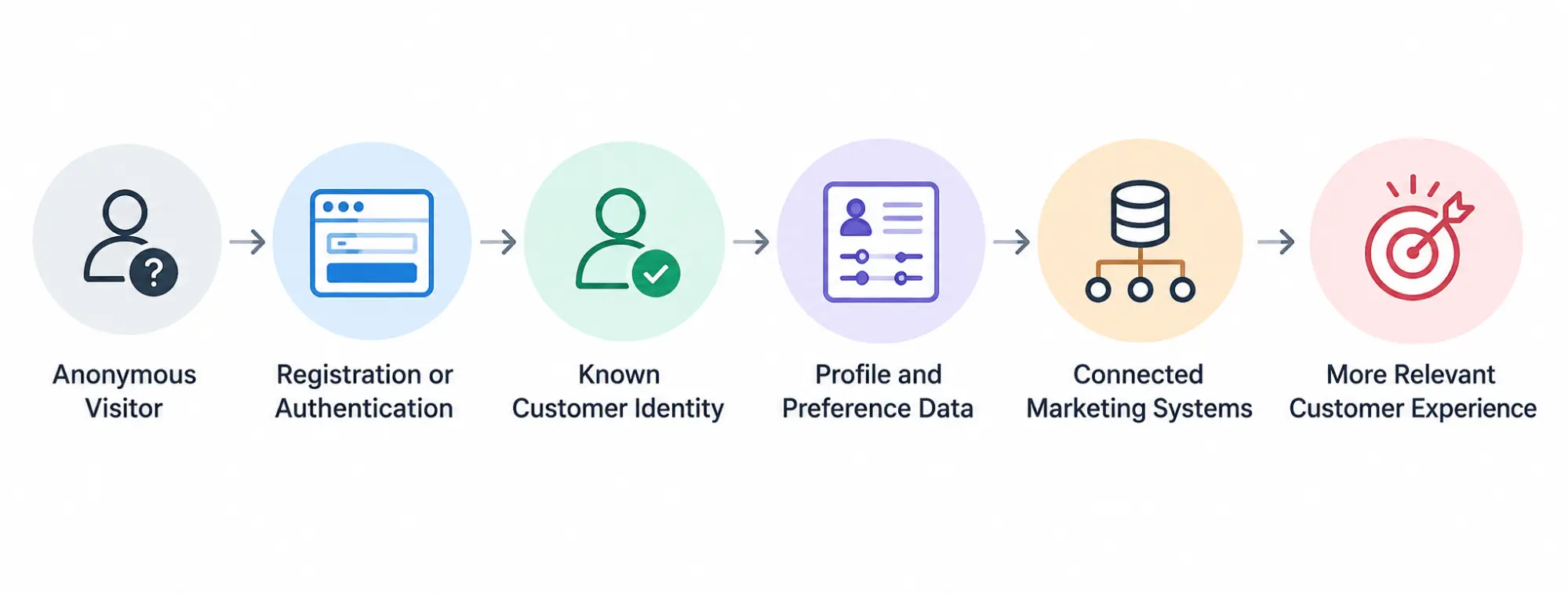
For marketers, that creates a clearer progression:
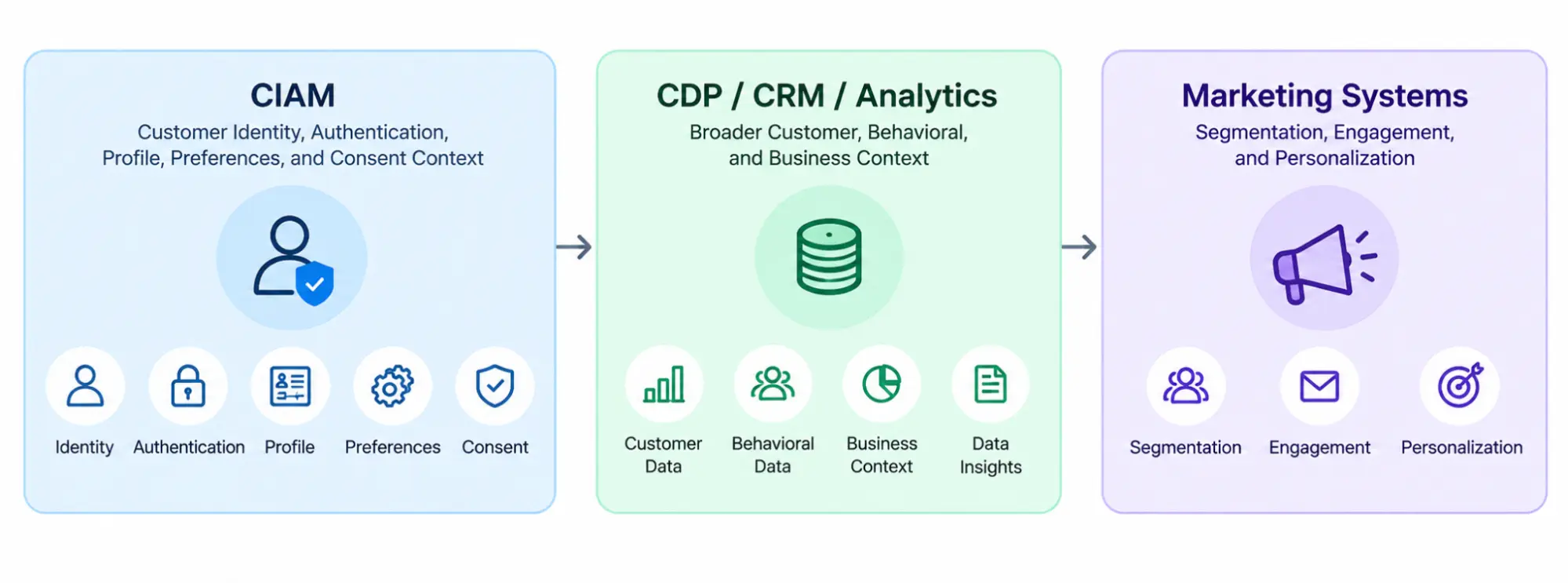
CIAM does not replace a Customer Data Platform (CDP), CRM, analytics solution, or marketing automation platform. Its role is different. CIAM establishes and manages the customer identity that those systems can work with, subject to the appropriate consent, privacy, and access controls.
That distinction matters. Better lead nurturing does not come from collecting more customer data for its own sake. It comes from knowing who the customer is, reducing unnecessary friction when they identify themselves, and connecting reliable identity information with the systems responsible for segmentation, personalization, and engagement.
For digital marketers trying to move prospects from first interaction toward conversion and long-term engagement, customer identity is an important part of that foundation.
What Is CIAM for Digital Marketers, and Why Does Customer Identity Matter for Lead Nurturing?
For digital marketers, Customer Identity and Access Management (CIAM) provides the identity foundation that connects a known customer with the digital experiences, profile information, preferences, and permitted data associated with that identity.
CIAM handles capabilities such as customer registration, authentication, profile management, account recovery, consent and preference management, and identity continuity. Marketing systems can then use appropriate identity and profile data alongside information from other sources to support segmentation, personalization, and customer engagement.
The distinction is important. A marketing automation platform may decide which campaign to run. A CDP may combine behavioral and customer data from multiple sources. A CRM may contain sales or relationship information. CIAM answers a different question: who is the customer interacting with the business, and how is that identity securely established and managed?
Connect Marketing Activity to a Known Customer Identity
Before a visitor identifies themselves, marketers may have a session, device, campaign, or other permitted signals, but they do not necessarily have an authenticated customer identity.
Registration or authentication changes that relationship.
Visitor → Registration or Authentication → Known Customer Identity → Connected Customer Journey
Once the customer is known, appropriate profile information and preferences can be associated with that identity. Connected systems can use that identity as one input when building a more consistent understanding of the customer.
This does not mean CIAM should attempt to identify every anonymous visitor. Anonymous behavioral analytics and identity management are different functions. CIAM becomes particularly valuable when a customer chooses to establish or access an account.
Build a More Consistent Identity Across the Customer Lifecycle
Lead nurturing rarely happens in one interaction. A prospect may register today, return several days later, update their profile, use another device, and eventually become a customer.
Without a consistent identity layer, those interactions can become fragmented.
CIAM helps maintain the relationship between the customer and their account as they move through different stages: Acquisition → Registration → Identification → Engagement → Conversion → Retention
That continuity gives connected marketing systems a more dependable identity reference instead of treating every authenticated interaction as an unrelated customer.
Here’s where teams usually go wrong: they focus heavily on collecting customer data but give less attention to the identity connecting that data together. More attributes do not automatically produce better personalization if the underlying customer identity is duplicated, incomplete, or inconsistent.
Give Marketing Systems Better Identity Context
A CIAM profile can contain appropriate customer attributes such as verified contact information, profile details, preferences, and other information collected through the identity journey. Depending on the architecture, those attributes can be connected with CDPs, CRMs, analytics platforms, and marketing automation systems.
The broader marketing stack can then add its own context—campaign interactions, behavioral information, transactions, product usage, or other business data.
A cleaner separation looks like this:
Keeping those responsibilities clear prevents CIAM from becoming a catch-all label for the entire customer data stack.
For marketers, the first practical opportunity begins even earlier: making it easier for an interested visitor to become a known customer without turning registration into another conversion barrier.
Turn Anonymous Visitors Into Known Customer Identities Without Adding Registration Friction
A marketer cannot personalize every anonymous interaction around a verified customer identity. At some point, the visitor needs a reason to register, sign in, or otherwise establish an account relationship.
That moment can also become a conversion barrier.
Long registration forms, unnecessary fields, rigid password requirements, or limited sign-in options can add friction before the customer has received enough value to justify the effort. CIAM helps businesses design registration and authentication journeys that collect the information needed to establish an account without demanding everything at once.
Keep Initial Registration Focused on What Is Actually Needed
It can be tempting to use registration as an opportunity to collect as much customer information as possible. For marketers, more fields may appear to mean a richer profile.
But every required field adds another decision for the customer.
A better approach is to collect the information necessary to create and secure the account first, then request additional relevant information later when there is a clear reason for it. Progressive profiling can support this model by building the customer profile across subsequent interactions rather than relying on one oversized registration form.
The journey becomes: Anonymous Visitor → Simple Registration → Customer Identity Created → Future Interactions → Additional Relevant Profile Data
This gives marketing teams room to develop a richer customer profile without making the first interaction carry the entire data-collection burden.
Offer Authentication Options That Fit the Customer Journey
Returning customers should also have a practical way to access their accounts.
Depending on the application and audience, CIAM can support authentication approaches such as passwords, social login, passwordless methods, passkeys, or federated sign-in. The right combination depends on the use case rather than the number of options available.
For example, social login can reduce the need to create another set of credentials, while passkeys can provide a passwordless authentication experience using FIDO2/WebAuthn. Passwordless approaches such as magic links or OTP-based flows can also be appropriate in some customer journeys.
The marketing value is indirect but important: authentication should help legitimate customers continue their journey rather than become an unnecessary obstacle within it.
Create a Clear Transition From Anonymous to Known
Once a customer registers or authenticates, CIAM can establish the account identity that other authorized systems can reference.
Anonymous Interaction → Registration or Sign-In → Authenticated Customer → Customer Profile → Connected Systems
That transition needs to be described carefully. CIAM does not automatically convert anonymous browsing history into a verified customer profile, nor should marketers assume every anonymous identifier belongs to a known person. Connecting pre-authentication activity to an authenticated identity depends on the application's architecture, privacy choices, consent requirements, and data practices.
What CIAM does provide is a reliable point at which the business knows which authenticated account it is dealing with.
Preserve Identity When Customers Return in Different Ways
Registration is only useful if the customer can reliably return to the same identity.
A person might initially register with an email address and later choose Google or another supported identity provider. Without appropriate account-linking logic, the second authentication method can result in a separate profile rather than reconnecting the customer with the existing account.
For marketers, fragmented identities can distort customer profiles, segmentation, and personalization. For customers, the problem is more immediate: they sign in successfully but cannot find the information or experience they expected.
Secure account linking and consistent identity management help reduce that fragmentation.
Getting visitors identified is only the beginning, though. A basic account record rarely contains enough information to support meaningful personalization. The next opportunity is to build a richer customer profile over time using first-party and intentionally provided customer data.
Build Richer Customer Profiles With First-Party and Zero-Party Data Collected Through CIAM
A customer identity becomes more useful to marketers as relevant information is added to it over time. The answer, however, is not to ask for every possible attribute during registration.
CIAM can help businesses collect and manage customer-provided profile information throughout the identity lifecycle. That can include contact details, preferences, demographic or account attributes relevant to the service, and other information the customer chooses to provide.
For marketers, this creates a stronger source of customer context without treating identity management as a substitute for a CDP or analytics platform.
Use First-Party Data From Direct Customer Relationships
First-party data is information a business collects through its own interactions with customers. Depending on the system involved, this can include account information, transactions, product activity, website or application behavior, and other direct interactions.
CIAM contributes a particularly important part of that picture: the known customer identity and associated profile information.
Once appropriate identity data is connected with other first-party sources, marketing teams can build a more coherent view of the known customer.
For example:Customer Identity + Profile Data + Business Data + Behavioral Data → Connected First-Party Customer Context
Not every element in that equation belongs inside CIAM. Purchase history may live in a commerce platform. Behavioral events may come from analytics. Campaign engagement may sit in a marketing platform. CIAM helps provide the identity those systems can reference when the architecture and permitted data use allow it.
Capture Zero-Party Data Customers Intentionally Provide
Zero-party data is information customers deliberately provide about themselves, their interests, preferences, or intentions.
That distinction can be valuable for marketers. Instead of inferring every preference from observed behavior, businesses can sometimes ask customers directly.
A customer might choose preferred product categories, communication preferences, interests, language, or other relevant information. Depending on the experience, CIAM profile and preference management can provide a place to associate appropriate customer-provided attributes with the customer's identity.
The principle is simple: ask for information when there is a clear reason to ask for it.
Collecting attributes merely because they might become useful later can add friction and create unnecessary data-management responsibilities.
Build Customer Profiles Gradually With Progressive Profiling
A new visitor rarely needs to complete a detailed marketing profile before creating an account.
Progressive profiling allows businesses to request additional relevant information across later interactions rather than placing every question in the initial registration journey.
A typical progression might be: Initial Registration → Basic Customer Profile → Customer Returns → Existing Data Checked → Relevant Information Requested → Profile Updated
This can help marketers develop richer profiles while keeping initial registration focused.
Timing matters. Asking a customer about preferences after they have interacted with a relevant product or service can feel more natural than presenting a long questionnaire before they have even created an account.
Progressive profiling should also avoid repeatedly asking for information the business already has. A connected identity profile makes it easier to determine which relevant attributes are already available and which may still be useful to request.
Keep Profile Data Accurate as the Customer Relationship Changes
Customer information is not static. Contact details change. Interests evolve. Communication preferences shift. Information collected during registration may eventually become outdated.
Allowing customers to review and update appropriate profile and preference information can help maintain better data quality over time.
That matters for personalization. A technically sophisticated campaign can still produce a poor experience if it relies on stale or incorrect customer information.
CIAM therefore contributes more than initial data collection. It can support the ongoing identity and profile lifecycle behind the customer relationship.
The next question is what marketers actually do with that context. A richer profile only becomes valuable when it helps create more relevant journeys, segmentation, and lead nurturing rather than simply adding more fields to a database.
Use Customer Identity and Profile Data to Personalize Lead Nurturing Across the Customer Journey
Collecting customer data is not the end goal. Marketers need to turn relevant, permitted information into experiences that make sense for the person receiving them.
That becomes easier when marketing systems can connect activity to a consistent customer identity. Instead of working only with isolated sessions or disconnected profiles, teams can use appropriate identity attributes, preferences, and data from connected systems to inform segmentation and engagement.
CIAM provides the identity foundation. The CDP, CRM, marketing automation platform, recommendation engine, or other connected system determines how that context is activated.
Create More Relevant Customer Segments
Broad segments built from limited information can miss important differences between customers.
Once a customer is known, appropriate profile attributes and preferences from CIAM can be combined with permitted data from other systems. A CDP, for example, might connect identity information with behavioral or transactional data before creating audiences for marketing activation.
The relationship can look like this: Known Customer Identity → Profile and Preferences → Connected Customer Data → Segmentation → Relevant Engagement
A retailer might segment authenticated customers using stated product interests alongside purchase or browsing information held elsewhere. A subscription service might use account attributes together with product usage. The exact data depends on the business and the customer's relationship with it.
The important part is that segmentation starts from a more consistent understanding of which customer the data belongs to.
Personalize Experiences Without Turning CIAM Into a Recommendation Engine
CIAM can provide identity and profile context that helps connected systems personalize digital experiences, but it is useful to keep the responsibilities clear.
A personalization platform might decide which content, product, offer, or experience to present. CIAM can help establish the authenticated customer and make appropriate profile attributes available to that system.
For example: Customer Authenticates → Identity Recognized → Appropriate Attributes Retrieved → Personalization System Applies Rules or Models → Experience Presented
That is more precise than saying CIAM itself automatically creates personalized recommendations.
It also gives teams clearer architectural boundaries. Identity systems establish who the customer is. Marketing and experience systems decide what to do with the permitted context they receive.
Use Identity Events to Support Timely Customer Journeys
Changes within the identity lifecycle can also provide useful signals to connected systems.
Registration, profile updates, preference changes, account verification, or other relevant identity events may be passed to downstream applications through supported integrations, APIs, or event-driven mechanisms.
A newly registered customer, for instance, may enter an onboarding journey. A preference update might affect future communications. A completed profile could change which experience is appropriate.
Here’s where teams usually go wrong: every identity event does not need to become a marketing trigger.
The event needs a legitimate purpose, the downstream system needs the right context, and customer communication preferences and applicable privacy requirements still matter.
Maintain Relevant Experiences When Customers Return
Lead nurturing rarely follows a straight line from first visit to purchase.
A prospect may register, leave, return through another device, explore a different product, update a preference, and convert much later. Maintaining a consistent customer identity helps connected systems recognize that these authenticated interactions relate to the same account.
That continuity can make nurturing less repetitive. A known customer should not repeatedly receive an experience designed for someone the business has never seen before simply because they changed devices or authentication methods.
It can also help prevent contradictory experiences—for example, continuing to request profile information the customer has already supplied.
Keep Personalization Useful Rather Than Excessive
More identity data does not automatically mean more effective personalization.
There is a point where personalization stops being useful and begins to feel unnecessary or intrusive. Marketers still need to decide which attributes genuinely improve the customer journey, why those attributes are being used, and whether they should be shared with a particular downstream system.
A better model is selective: Trusted Identity + Relevant Data + Appropriate Purpose → Useful Personalization
That is a stronger foundation for lead nurturing than simply collecting the largest possible customer profile.
But identity data rarely operates inside one platform. To make these journeys work, CIAM has to connect cleanly with the CDP, CRM, marketing automation, and analytics systems already responsible for much of the marketing lifecycle.
Connect CIAM, CDP, CRM, and Marketing Automation Without Blurring Their Roles
Digital marketing rarely runs on one platform. Customer identity may be managed in CIAM, behavioral data consolidated in a CDP, relationship information stored in a CRM, and campaigns executed through marketing automation.
These systems become more useful when they work together. They do not become the same system.
That distinction matters because describing CIAM as the place where every customer interaction, transaction, campaign, and behavioral signal lives creates the wrong architecture. CIAM should provide a reliable customer identity layer that other authorized systems can connect to.
Understand What Each Platform Contributes
The simplest way to separate these technologies is by the primary job each one performs.
| Technology | Primary Role | Value for Digital Marketing |
|---|---|---|
| CIAM | Manages customer identity, registration, authentication, profiles, preferences, and related identity controls | Establishes and maintains known customer identities |
| CDP | Collects and unifies customer data from multiple sources | Builds broader customer context for segmentation, analysis, and activation |
| CRM | Manages customer relationships, accounts, and business interactions | Provides sales, service, and relationship context |
| Marketing Automation | Manages campaigns, workflows, and customer communications | Activates nurturing and engagement journeys |
| Analytics | Measures customer and digital activity | Helps teams understand behavior and performance |
There can be overlap between platforms, and individual products may offer capabilities beyond these categories. The table describes their primary roles rather than imposing rigid technical boundaries.
Use CIAM as the Identity Layer Behind the Marketing Stack
CIAM can provide the persistent account identity that connected systems use when working with known customers.
Consider a customer who registers for an account, specifies a product preference, later browses several products, makes a purchase, and receives a follow-up campaign.
Different systems may own different pieces of that journey:
CIAM → Customer Identity + Authentication + Profile + Preferences
Analytics / CDP → Behavioral and Cross-Source Customer Context
CRM → Customer Relationship and Business Context
Marketing Automation → Campaign and Nurturing Execution
The value comes from connecting the systems appropriately rather than forcing all of their data into the identity platform.
Connect CIAM and CDP for Better Identity Resolution
CIAM and CDPs are particularly complementary.
A CDP may receive data from websites, applications, commerce platforms, CRM systems, and other sources. CIAM can contribute authenticated customer identifiers and appropriate profile attributes that help connected systems associate data with known customer accounts.
A simplified architecture looks like this: Customer → CIAM Identity → CDP → Segmentation → Marketing Activation
But identity resolution still needs careful implementation. Similar email addresses, shared devices, or matching profile attributes should not automatically be treated as proof that two identities belong to the same person.
Authenticated identifiers and properly designed account-linking processes provide a stronger identity foundation than relying only on probabilistic matches.
Connect CIAM and CRM Without Duplicating Customer Records Everywhere
CRM and CIAM also answer different questions.
CIAM is concerned with how customers establish, secure, and manage their digital identities. A CRM is generally concerned with the organization's relationship and interactions with those customers.
Connecting the two can allow appropriate identity information to support sales or service workflows while relevant CRM information remains in the system designed to manage it.
The goal should not be to copy every available attribute into every platform. That creates synchronization problems, increases unnecessary data exposure, and makes it harder to determine which system owns a particular field.
Teams should define which system is authoritative for each category of data and how updates move between systems.
Let Marketing Automation Handle Campaign Execution
CIAM can help marketing systems understand which known customer they are dealing with and provide appropriate profile or preference context. It should not be described as the engine responsible for designing and executing every nurture campaign.
Marketing automation platforms remain responsible for functions such as campaign workflows, audience activation, communication sequences, and engagement logic.
The connection might look like: CIAM Identity Event → Approved Integration → Marketing Automation → Relevant Journey
For example, a completed registration could trigger an onboarding workflow in a connected marketing platform. A preference change might update which communications are appropriate for that customer.
What happens after the identity event belongs to the downstream workflow.
Define Data Ownership Before Connecting the Stack
Here’s where teams usually go wrong: integrations are built first, and data ownership is decided later.
Before connecting CIAM with a CDP, CRM, analytics platform, or marketing automation system, teams should determine which system owns each data type, which identifiers connect records, what information each destination actually needs, and how consent or preference changes should propagate where applicable.
A cleaner architecture is easier to maintain: Trusted Customer Identity → Appropriate Data Sharing → Specialized Marketing Systems → Customer Experience
That architecture also sets up the next issue marketers cannot treat as an afterthought. Connecting more customer data across more systems makes privacy, consent, preferences, and access controls increasingly important.
Build Privacy-Aware Marketing Around Customer Consent, Preferences, and Secure Identity Data
Connecting customer identity with CDPs, CRMs, analytics tools, and marketing platforms can create better context for marketers. It also creates a basic responsibility: customer data should not move between systems simply because an integration makes it possible.
Marketers need to understand what information is being collected, why it is needed, where it is used, and which customer choices apply to that use. CIAM can support this by connecting identity with relevant consent and preference information while protecting access to customer accounts and profiles. Privacy-aware marketing starts with purpose, not volume.
Capture Consent in the Customer Identity Journey
Registration, profile management, and other customer-facing identity journeys can provide appropriate points for collecting consent where it is required.
The consent experience should make the customer's choice clear rather than burying it inside the authentication process. Businesses also need to distinguish between information required to operate an account and optional uses of data for purposes such as particular marketing communications.
Where supported, consent records can be associated with the customer identity so connected systems have the context needed to respect those choices.
That creates a clearer relationship: Customer Identity → Consent Choice → Permitted Data Use → Connected System
CIAM can help manage that identity and consent context. Whether a particular processing activity satisfies legal requirements depends on the organization's implementation, purpose, jurisdiction, policies, and other obligations. CIAM by itself does not make an organization compliant.
Give Customers Control Over Relevant Preferences
Consent and customer preferences are related, but they are not interchangeable.
A customer might choose which types of communications they want, select areas of interest, change a preferred language, or update other experience-related preferences. Giving customers a way to review and modify appropriate information can help keep those profiles useful over time.
For marketers, current preferences are generally more useful than assumptions based on old information.
For customers, the benefit is control. Their relationship with the brand does not have to remain frozen around choices made during the first registration.
Share Only the Customer Data a Connected System Needs
A marketing integration should not automatically receive an entire identity profile.
If a downstream platform needs a customer identifier and a small set of relevant attributes to perform its function, exposing unrelated identity data adds little marketing value while expanding the amount of information distributed across the stack.
A more deliberate model is: Customer Profile → Determine Purpose → Select Appropriate Attributes → Authorized Integration → Destination System
This is also where access controls matter. Internal teams and connected applications may require different levels of access to customer identity information.
The goal is not to make customer data difficult to use. It is to make its use intentional.
Protect the Identity Behind the Marketing Profile
A rich marketing profile becomes much less useful if the underlying customer account can be easily compromised.
Authentication, MFA, passwordless options, account recovery controls, session management, and other identity protections therefore have an indirect but important relationship with marketing data quality and customer experience.
Consider an account takeover. An attacker may change profile details, preferences, contact information, or other account data. Downstream marketing systems could then act on information that no longer represents the legitimate customer.
Security and personalization are not separate concerns when both depend on the same identity.
Keep Consent and Preference Changes Connected to Downstream Systems
A customer choice is only useful if systems that depend on it can respond appropriately.
When a customer updates a relevant consent or communication preference, connected applications may need that change through the integration architecture. Otherwise, the CIAM profile can show one preference while a downstream marketing system continues operating with stale information.
The exact synchronization model will depend on the stack, but the principle should remain consistent: Customer Updates Choice → Identity Record Updated → Relevant Connected Systems Receive Appropriate Change → Future Experience Reflects Current Preference
Here’s where teams usually go wrong: they treat consent capture as a one-time registration checkbox while customer data continues moving through an evolving marketing stack.
Consent, preferences, identity, and connected data use need to be considered throughout the customer lifecycle.
That becomes even more relevant as marketers strengthen their first-party data strategies. CIAM and CDPs can work particularly well together here—but only when each platform is used for the job it is designed to do.
Use CIAM and CDPs Together to Strengthen First-Party Data-Driven Marketing
First-party data becomes more useful when marketers can connect it to the right customer. That is one reason CIAM and Customer Data Platforms (CDPs) can complement each other so well.
CIAM establishes and manages known customer identities. A CDP can bring together data from multiple business and digital sources around those customers. Used together, they can give marketers stronger identity context without forcing the identity platform to become the repository for every behavioral, transactional, or campaign event.
The relationship is straightforward:
CIAM → Trusted Customer Identity
CDP → Broader Customer Data and Behavioral Context
Connected Together → Identity-Aware Segmentation and Activation
Give the CDP a Stronger Identity Foundation
A CDP may receive information from websites, mobile applications, commerce systems, CRM platforms, analytics tools, marketing applications, and other sources. The difficult part is not always collecting those signals. It is determining which records belong to the same customer.
CIAM can contribute authenticated customer identifiers and appropriate profile information to that process.
When a customer signs in, the business has a stronger identity signal than an anonymous browser or device identifier alone. That authenticated identity can help connected systems associate permitted activity with the appropriate known customer.
This does not mean every data point should automatically be joined to an identity. Identity resolution still needs appropriate matching rules, data governance, privacy controls, and a clear purpose.
Combine Identity Data With Broader First-Party Context
CIAM does not need to store a customer's entire digital history for marketers to benefit from identity.
Consider an authenticated retail customer. CIAM may manage the customer's identity, profile, login methods, and relevant preferences. A commerce platform owns orders. Analytics records digital activity. The CRM contains relationship information. A CDP can bring appropriate information from those systems together for segmentation and activation.
The architecture might look like this: CIAM Identity + Commerce Data + CRM Data + Behavioral Data → CDP → Customer Segment → Marketing Activation
This division of responsibility gives marketers richer context while allowing each system to remain focused on what it does best.
Use First-Party Relationships Instead of Depending Entirely on Third-Party Identifiers
The older marketing conversation often framed first-party data around an approaching “cookieless future.” That framing is too narrow.
Browser policies, platform restrictions, privacy expectations, and advertising technologies continue to change. Building direct customer relationships remains useful regardless of what happens to any single browser identifier or advertising mechanism.
CIAM supports that direct relationship when customers choose to register, authenticate, maintain a profile, or provide relevant preferences.
For marketers, that means a strategy can rely more heavily on information gathered through the organization's own customer relationships rather than assuming third-party identifiers will always provide the customer context they need.
Improve Segmentation With Identity-Aware Customer Data
A CDP can create audiences using information from multiple sources. Connecting those records with a consistent known identity can improve the quality of the customer context used for segmentation.
For example, marketers might combine a customer's stated product preferences with recent product activity and purchase information held in other systems. The resulting segment can then be activated through an appropriate marketing platform.
CIAM contributes the identity and relevant profile context. The CDP performs broader data unification and segmentation. The activation system handles the campaign or experience.
Keeping those responsibilities separate avoids overstating what any single platform does.
Keep Identity Resolution Accurate Across Multiple Login Methods
Here’s where identity-aware marketing can become messy.
A customer may register with email and password, later use a social provider, and access the brand through multiple applications or devices. If those interactions produce unrelated customer identities, the CDP may receive fragmented records for someone who is actually the same account holder.
Secure account linking and consistent customer identifiers can help maintain continuity for known identities.
But marketers should not solve fragmentation by aggressively merging records based on weak signals. A shared email address, device, or similar profile attribute is not always sufficient evidence that two records represent the same person.
Identity resolution should favor accuracy over creating the largest possible unified profile.
Activate Customer Data With the Same Privacy Discipline Used to Collect It
Combining CIAM and CDP data can make customer profiles more useful, but it also increases the importance of controlling what moves downstream.
Only appropriate data should be shared for a defined purpose. Relevant consent and preferences need to be respected. Changes to customer choices may also need to propagate to systems that rely on them.
The objective is not a “360-degree customer profile” containing every piece of data the business can find. It is a sufficiently accurate, appropriately governed view of the customer for the experience being delivered.
That foundation becomes particularly valuable when the same customer moves between web, mobile, portals, and other digital touchpoints. The next challenge is keeping the identity—and therefore the customer journey—consistent across those channels.
How CIAM Supports Lead Nurturing From First Interaction Through Conversion and Retention
CIAM does not nurture a lead by itself. It does not decide which email to send, score a prospect, build an advertising audience, or determine the next campaign. Its contribution sits underneath those activities.
CIAM can help establish who a known customer is, reduce friction when that person registers or returns, maintain relevant profile and preference information, and provide an identity layer that CDPs, CRMs, analytics tools, and marketing platforms can connect to. That makes its role easier to see across the complete customer journey.
| Marketing Stage | Common Identity Challenge | How CIAM Can Help |
|---|---|---|
| Discovery | Visitor may still be anonymous | Provides a path toward registration or authentication when the visitor chooses to identify themselves |
| Registration | Long or complex signup can add friction | Supports streamlined registration and appropriate authentication options |
| Identification | Customer records may become fragmented | Establishes and maintains a known customer identity |
| Profile Building | Marketers initially know little about the customer | Supports profile management and progressive collection of relevant information |
| Nurturing | Engagement lacks customer context | Makes appropriate identity, profile, and preference data available to connected systems |
| Personalization | Customer data exists in disconnected platforms | Provides identity context that can be connected with CDP, CRM, and other data |
| Conversion | Registration or authentication can interrupt the journey | Supports flexible authentication experiences appropriate to the application |
| Retention | Preferences and profile information change over time | Allows appropriate customer information and preferences to be maintained |
| Re-engagement | Returning customers may appear fragmented across channels | Helps preserve identity continuity across supported digital experiences |
Make Registration Part of the Customer Journey, Not a Barrier Around It
The first meaningful CIAM interaction often happens when an anonymous visitor decides to create an account.
That transition matters. Asking for too much information too early can introduce unnecessary friction, while collecting too little over the entire relationship can leave connected systems with limited customer context.
A more flexible approach establishes the identity first and develops the profile as the relationship progresses.
Visitor → Registration → Known Identity → Profile Development → Continued Engagement
Progressive profiling can support the later stages without turning initial registration into a lengthy marketing questionnaire.
Give Nurturing Systems Better Context Once the Customer Is Known
After registration or authentication, marketers can work with a known account rather than only an anonymous interaction.
Appropriate profile attributes and customer-provided preferences can then be connected with broader first-party data from a CDP, CRM, commerce system, analytics platform, or other business application.
Marketing automation can use that context when executing nurture journeys.
The sequence is therefore closer to: Known Identity → Relevant Customer Context → Segmentation → Marketing Workflow → Customer Interaction
CIAM owns the identity foundation in this sequence. The downstream marketing platform owns the nurture logic.
Reduce Identity Friction Near Conversion
Conversion journeys can involve account creation, authentication, verification, or returning to an existing account. Poorly designed identity experiences can introduce friction at exactly the point when a customer is trying to complete an action.
Flexible authentication options can help businesses design an experience appropriate to their audience. Existing customers should also be able to return to the correct account rather than accidentally creating another identity because they chose a different supported login method.
CIAM cannot guarantee a conversion. It can help prevent avoidable identity friction from becoming one more obstacle in the journey.
Continue the Identity Relationship After Conversion
The role of CIAM does not end when a lead becomes a customer.
Customers return. Their preferences change. They add authentication methods, update profile information, use new devices, and interact through different channels. Ensuring proper account linking can help connected marketing and customer-experience systems work with more current and consistent context.
This matters for retention because a returning customer should not continually be treated like an unknown prospect.
Measure Identity Experience Alongside Marketing Performance
Marketers should also look beyond campaign metrics when evaluating identity-enabled journeys.
| KPI | Why It Matters |
|---|---|
| Registration Completion Rate | Reveals signup friction |
| Authentication Success Rate | Reveals login friction |
| Profile Completion Rate | Indicates customer context quality |
| Consent Opt-In Rate | Measures permissioned audience growth |
| Duplicate Account Rate | Indicates identity fragmentation |
| Returning Customer Recognition Rate | Measures continuity across journeys |
| Lead-to-Customer Conversion Rate | Measures business impact |
Registration completion, authentication success, account recovery patterns, profile completion, preference updates, and duplicate-account issues can reveal friction that affects the broader customer experience.
Those signals should not automatically be interpreted as marketing outcomes. They can, however, help teams identify where identity journeys may be interrupting acquisition, engagement, or return visits.
Here’s where the distinction becomes useful: CIAM does not create the marketing strategy. It gives that strategy a stronger identity foundation.
The remaining question is how LoginRadius can support that foundation in practice—from registration and authentication to customer profiles, progressive profiling, consent, account linking, and integration with the wider marketing stack.
How LoginRadius Helps Digital Marketers Build Identity-Powered Customer Journeys
Throughout this article, we have focused on a simple idea: effective lead nurturing starts with a reliable customer identity.
Registration, authentication, profile management, consent, preferences, account linking, and identity continuity all contribute to that foundation. Without them, customer data can become fragmented, personalization can lose context, and marketing systems may struggle to work with a consistent understanding of the customer.
LoginRadius helps businesses establish and manage that identity layer while integrating with the broader customer technology ecosystem.
Create Low-Friction Registration and Authentication Experiences
The customer journey often begins with registration or sign-in.
LoginRadius supports customer registration and authentication experiences that can be adapted to business requirements, customer expectations, and security needs. Organizations can support traditional username and password authentication, social login, passwordless authentication methods, passkeys, MFA, and federated identity scenarios where appropriate.
The objective is not simply to provide more authentication options. It is to help businesses create customer onboarding and sign-in experiences that balance convenience, security, and account continuity.
Build and Manage Unified Customer Profiles
Customer profiles frequently become fragmented when identity information is spread across disconnected applications.
LoginRadius provides a centralized customer identity platform that can manage customer profile information and identity attributes across digital experiences. This creates a more consistent identity foundation that connected applications and systems can reference.
For marketers, a unified customer profile can help reduce duplicate identity issues while supporting more accurate customer context across the broader marketing stack.
Support Progressive Profiling and Ongoing Customer Data Collection
Customer relationships evolve over time.
Rather than collecting every possible attribute during registration, businesses can progressively build customer profiles through future interactions. LoginRadius supports profile management capabilities that allow organizations to collect, update, and manage customer information throughout the customer lifecycle.
This approach can help reduce registration friction while still allowing relevant customer context to grow over time.
Manage Customer Preferences and Consent
Customer identity is closely connected to customer choice.
LoginRadius supports consent and preference management capabilities that help businesses manage customer permissions, communication preferences, and profile-related choices within the customer identity journey.
As customer preferences change, organizations can maintain a more current identity record that can be shared with connected systems according to business requirements and integration design.
Maintain Identity Continuity Across Authentication Methods
Customers increasingly use multiple authentication methods throughout their relationship with a brand.
A customer may register with an email address, later use Google or another social provider, and eventually authenticate through a different supported channel. Without proper identity management, these interactions can create fragmented customer records.
LoginRadius supports account linking capabilities that help businesses maintain identity continuity across approved authentication methods while reducing unnecessary duplicate accounts.
Connect Customer Identity With the Broader Marketing Ecosystem
Identity becomes more valuable when it can be connected with the systems responsible for customer engagement.
LoginRadius provides APIs, webhooks, and integration capabilities that allow organizations to connect customer identity with CRM platforms, CDPs, analytics solutions, marketing automation tools, customer service systems, and other business applications.
A simplified architecture might look like: Customer → LoginRadius CIAM → CRM / CDP / Analytics / Marketing Automation → Customer Experience
This allows each platform to focus on its primary role while using a consistent customer identity foundation.
Balance Customer Experience, Security, and Privacy
Here’s where many organizations struggle. Marketing teams want smoother customer journeys. Security teams want stronger controls. Privacy teams need confidence that customer data is being handled appropriately.
Treating these objectives as competing priorities often creates friction between teams. A better approach is to establish identity as the common foundation.
Registration, authentication, profile management, consent, account recovery, and customer preferences all become part of the same customer identity strategy. When those capabilities work together, businesses can create experiences that are easier for legitimate customers to use while maintaining appropriate security and privacy controls.
For digital marketers, the result is not simply more customer data. It is a stronger identity foundation that can support lead nurturing, personalization, customer engagement, and long-term relationship building across the entire customer lifecycle.
Conclusion: Turn Customer Identity Into a Stronger Foundation for Lead Nurturing and Conversion
Digital marketers do not need another platform claiming to replace the entire customer technology stack. They need reliable customer identity underneath it.
CIAM helps establish that foundation by connecting registration, authentication, customer profiles, preferences, consent, and identity continuity. When appropriate identity data is connected with CDPs, CRMs, analytics platforms, and marketing automation systems, marketers can work with better customer context while each platform continues doing the job it was designed to do.
The impact stretches across the customer journey. Registration can become less demanding. Profiles can develop over time. Known customers can receive more relevant experiences. And returning customers can maintain a more consistent identity across supported channels and authentication methods.
LoginRadius provides a developer-centric CIAM platform for managing customer and partner identities across these journeys. From flexible authentication and progressive profiling to account linking, consent management, APIs, and integrations, businesses can build identity experiences that support both customer experience and security requirements.
Want to make customer identity a stronger part of your digital marketing strategy? Book a LoginRadius demo to see how CIAM can connect secure customer identity with the systems powering your acquisition, personalization, engagement, and retention journeys.
FAQs
Q: What Is CIAM for Digital Marketers?
A: CIAM helps digital marketers connect known customers with secure identities, profiles, preferences, and consent information. This identity context can support personalization, segmentation, and engagement across connected marketing systems.
Q: How Does CIAM Help Marketers Nurture Leads?
A: CIAM establishes a consistent customer identity and manages relevant profile and preference data. Connected CDPs, CRMs, and marketing automation platforms can use this context to create more relevant nurturing journeys.
Q: Can CIAM Help Improve Conversion Rates?
A: CIAM can support conversion by reducing registration and authentication friction and enabling more relevant customer experiences. Actual conversion impact depends on the broader journey, implementation, audience, and marketing strategy.
Q: How Does CIAM Support Personalized Marketing?
A: CIAM provides known customer identity, profile attributes, preferences, and appropriate consent context. Marketing and personalization systems can combine this information with other permitted customer data to tailor experiences.
Q: What Is the Difference Between CIAM and a CDP?
A: CIAM primarily manages customer identity, authentication, profiles, and related identity controls. A CDP combines customer data from multiple sources for segmentation, analysis, and activation.
Q: How Do CIAM and CDPs Work Together?
A: CIAM can provide authenticated customer identifiers and appropriate profile data, while a CDP combines that identity context with behavioral, transactional, and other customer data for segmentation and activation.
Q: How Does CIAM Support First-Party Data Strategies?
A: CIAM helps businesses establish direct relationships with known customers through registration, authentication, profiles, and preferences. That identity foundation can connect appropriate first-party data across authorized systems.
Q: How Does CIAM Help Marketers Manage Customer Consent and Preferences?
A: CIAM can associate relevant consent and preference choices with a customer's identity and allow appropriate updates over time. Connected systems can use this context to respect current customer choices.