Introduction
In the modern digital landscape, companies collect customer data everywhere marketing platforms, CRM systems, analytics tools, subscription engines, and product experiences. Every interaction leaves behind a signal. Every signal adds context. And together, they are supposed to tell a coherent customer story.
But here’s the reality most teams face.
The data exists, yet it remains scattered. Identity information lives in one system. Behavioral data sits in another. Subscription status updates somewhere else. Each platform works well on its own, but none of them speak fluently with the others. Over time, this disconnect turns customer identity into fragments instead of a complete picture.
This is not a data collection problem.
It is an integration platform problem.
Modern CIAM success no longer depends on how many tools you deploy or how much data you capture. It depends on how effectively your CIAM integration platform connects, synchronizes, and activates customer identity data across your entire digital ecosystem.
This article explains why integration matters at an identity level. The downloadable LoginRadius CIAM Integration Platform guide shows how this works in practice.
The Hidden Cost of Disconnected Customer Identity Data
When customer identity data spreads across multiple platforms, the damage rarely appears immediately. Systems continue to operate. Dashboards still load. Campaigns still launch. On the surface, everything looks fine.
The cost shows up quietly.
Customer profiles drift out of sync. The same user appears differently across systems. Marketing sees one version of the customer, support sees another, and analytics teams work with partial context. Over time, this creates three persistent problems.
First, fragmented identities. Multiple systems store different pieces of the same customer, but none hold the complete truth. A single email address can map to multiple profiles, subscriptions, or engagement histories.
Second, incomplete decision-making. Strategy teams plan personalization, segmentation, and growth initiatives based on identity data that reflects only part of the customer journey. The result feels intuitive but rests on missing information.
Third, operational drain. Teams compensate by exporting data, reconciling spreadsheets, and building fragile scripts to keep systems aligned. These efforts consume time, introduce errors, and still fail to scale.
A dedicated CIAM integration platform exists to eliminate this fragmentation—without forcing organizations to rebuild their entire technology stack.
What Is a CIAM Integration Platform?
A CIAM integration platform acts as the central identity layer for your business tools. It synchronizes customer identity data between your CIAM system and the third-party applications that depend on that data.
That distinction matters.
Simple connectors move data in isolation. They connect Tool A to Tool B and stop there. When the ecosystem grows, those connections multiply, break, and demand constant maintenance.
A CIAM integration platform operates differently.
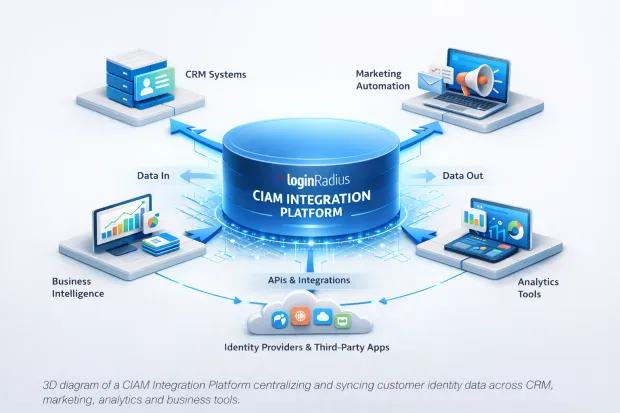
It establishes a single identity source of truth and orchestrates how customer data flows in and out of that source. In the LoginRadius model, customer identity data lives centrally, remains continuously updated, and becomes accessible across marketing automation, CRM, analytics, and business intelligence platforms.
Three characteristics define this approach:
-
Centralized storage that anchors identity data in one authoritative system
-
Automatic data integration that removes manual syncing and reconciliation
-
Fully managed service delivery, where integration upkeep does not fall on internal teams
LoginRadius treats identity as the control plane, not a downstream dependency. Data stays active. Profiles stay current. Systems stay aligned.
LoginRadius CIAM Integration Platform Built for Identity-First Data Orchestration
The LoginRadius CIAM Integration Platform transforms how organizations leverage customer identity data to drive business outcomes.
LoginRadius operates as the central storage layer for customer identities. From that position, the platform automatically synchronizes identity data across the digital tools that rely on it. Marketing automation platforms receive accurate profile attributes. CRM systems reflect real engagement states. Business intelligence tools analyze consistent, unified data.
This alignment does not require constant oversight.
The platform ensures customer profiles remain up to date by continuously consolidating data retrieved from multiple sources. Identity data never stagnates. Each update strengthens the unified view rather than creating new discrepancies.
Equally important, the service operates as a fully managed CIAM integration platform. LoginRadius handles updates, connector reliability, and ongoing compatibility. Teams do not manage infrastructure. They focus on execution.
This is where identity orchestration shifts from theory to operational reality.
For a detailed architecture view, the downloadable datasheet walks through the platform design and data flow model.
Two-Way Data Syncing: Turning Identity Into an Active System
Most identity systems behave like storage lockers. Data goes in, sits there, and waits for someone to pull it out. That approach looks fine on diagrams but fails in live environments where customer context changes constantly.
A CIAM integration platform has to do more than store identity data. It has to move with it.
The LoginRadius CIAM Integration Platform supports two-way data syncing, which changes how identity functions across your ecosystem. Identity data does not just flow outward into downstream tools. It also flows back in continuously enriching the centralized customer profile.
Here’s how it actually works in practice.
When customer activity occurs in external systems—such as subscription changes in marketing automation tools -- that data can sync directly into LoginRadius and become part of the persistent identity record. Subscription status, preferences, and engagement signals stop living in isolation. They attach to the customer profile where identity decisions originate.
At the same time, LoginRadius streams customer identity data outward based on defined rules. User attributes move into CRM systems, mailing lists update automatically, and segmentation logic stays aligned with real customer state rather than stale exports.
This bidirectional model turns identity into an active system rather than a passive database. Data remains current. Systems stay aligned. Teams stop questioning which platform holds the “right” version of the customer.
That clarity alone removes more operational friction than most teams expect.
150+ Plug-and-Play Integrations Without Custom Engineering Overhead
Integration speed matters, but stability matters more.
LoginRadius supports over 150 plug-and-play integrations, covering marketing automation platforms, CRM tools, analytics systems, and business intelligence solutions. These integrations deploy quickly, but their real value shows up over time.
Most organizations start with good intentions. They build custom pipelines to connect systems, wire APIs together, and manage data flows manually. It works at first. Then platforms update. APIs change. Edge cases appear. Maintenance grows.
This is where teams usually go wrong.
The LoginRadius CIAM Integration Platform removes that entire burden. Integrations arrive prebuilt, tested, and ready to activate. More importantly, LoginRadius maintains them as part of the managed service. Connector health, compatibility, and updates remain the provider’s responsibility not yours.
That shift changes how integration teams operate. Engineering resources stop getting pulled into maintenance cycles. Architects stop designing around fragile pipelines. Directors gain predictability instead of recurring cleanup work.
You still control how integrations behave. You just don’t carry the cost of keeping them alive.
Customizability That Matches Business Reality
Prebuilt integrations only work if they adapt to real business conditions. Otherwise, they create new constraints instead of removing old ones.
LoginRadius avoids that trap.
The CIAM integration platform gives teams full control over data behavior, not just data movement. You decide what syncs, when it syncs, and where it goes. Identity data does not flood every system by default. It follows rules defined by business objectives.
For example, certain identity attributes may need to flow into analytics platforms but stay out of marketing systems. Some triggers may activate immediately, while others sync on specific events. These decisions belong to the business, not the platform.
This level of customizability ensures that identity integration supports how teams actually operate. Marketing teams get clean, relevant identity data. Data teams avoid duplication and noise. Compliance requirements remain intact.
Instead of forcing organizations into rigid integration models, LoginRadius lets identity data move with intention.
Unified Customer View Across the Entire Digital Ecosystem
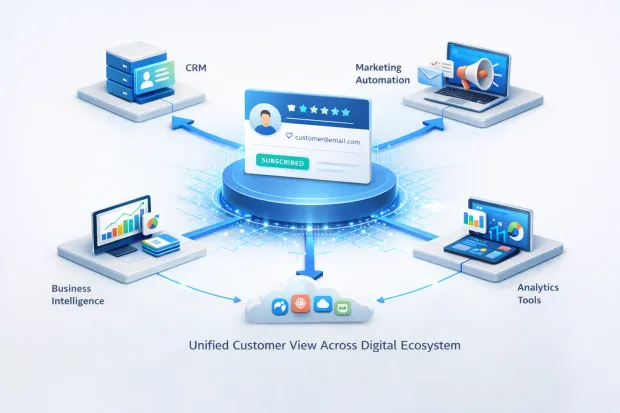
A unified customer view does not emerge from dashboards. It emerges from consistent identity data across systems.
Without integration, each platform builds its own version of the customer. Over time, those versions drift apart. Teams spend more energy reconciling differences than acting on insights.
The LoginRadius CIAM Integration Platform eliminates that drift.
Automatic data integration ensures that every connected system uses the same identity foundation. Updates sync continuously. Profiles remain aligned. Data discrepancies disappear before they surface.
This consistency changes how organizations operate. Strategy discussions move faster because teams trust the data. Personalization improves because context remains accurate. Customer experiences feel coherent instead of stitched together.
Most importantly, identity becomes reliable infrastructure. Every tool works from the same truth. Every decision rests on the same customer understanding.
That is what a unified customer view actually means in practice.
Zero Integration Maintenance Because Identity Infrastructure Should Be Invisible
Integration rarely fails on day one. It fails quietly over time.
APIs change. Data models evolve. Third-party platforms introduce new requirements. What starts as a “set it once” integration slowly turns into a recurring operational burden. Teams begin monitoring logs, patching connectors, and allocating engineering cycles just to keep data flowing.
This is exactly where identity infrastructure should not demand attention.
The LoginRadius CIAM Integration Platform operates as a fully managed service, which means LoginRadius takes ownership of ongoing integration maintenance. Connector updates, compatibility adjustments, and operational reliability stay handled behind the scenes.
Your team does not track API changes.
Your engineers do not maintain brittle sync logic.
Your architects do not redesign integration flows every quarter.
Identity infrastructure fades into the background, where it belongs. The platform keeps working. Data stays current. Systems remain aligned. Teams focus on outcomes instead of plumbing.
For directors and integration leaders, this matters more than it sounds. Predictability replaces firefighting. Integration stops behaving like technical debt and starts behaving like stable infrastructure.
Who Should Care Most About a CIAM Integration Platform?
A CIAM integration platform is not for early-stage stacks or isolated applications. It becomes critical when identity sits at the center of multiple business systems—and those systems need to agree.
This platform matters most to organizations operating at scale, especially where customer identity drives experience, analytics, and growth.
It directly serves:
Directors of Digital and Platform Leaders
Responsible for cohesive customer experiences across channels, products, and regions. Without integrated identity data, consistency breaks fast.
Authentication and Integration Experts
Designing identity architecture that must scale without constant rework. Centralized integration removes complexity instead of adding it.
MarTech and CRM Owners
Relying on accurate customer identity data to power segmentation, personalization, and lifecycle engagement. Identity accuracy determines campaign effectiveness.
Data and Analytics Teams
Depending on clean, centralized identity data to support reporting, insights, and strategic decisions. Fragmented identity ruins analysis before it begins.
LoginRadius currently supports over 3,000 businesses and reaches more than one billion users monthly, proving that this CIAM integration model holds up under real enterprise pressure not just theoretical scale.
Why Leading Enterprises Choose LoginRadius for CIAM Integration
Enterprises choose LoginRadius because it treats customer identity as operational infrastructure, not an afterthought.
The platform delivers one identity, one profile, and one integration layer across all customer touchpoints. Data no longer competes across systems. Identity no longer fragments across platforms. Business strategies finally align with who customers actually are.
LoginRadius also removes the friction that usually accompanies integration at scale:
-
Centralized customer identity storage
-
Automatic data integration across tools
-
Two-way data syncing that keeps profiles current
-
Managed connectors that stay reliable over time
-
Customizability without engineering overhead
This combination turns identity into an active system of record accurate, governed, and continuously in motion.
For enterprises, the decision often comes down to trust. LoginRadius has already proven its ability to operate globally, securely, and at scale. That confidence is difficult to replicate with fragmented or homegrown approaches.
Conclusion
Customer identity does not fail because of lack of data.
It fails because the data never connects.
Without integration, identity remains static. Profiles drift. Systems disagree. Teams compensate manually. Over time, complexity grows while confidence shrinks.
A modern CIAM integration platform changes that equation.
LoginRadius transforms customer identity into a living system continuously updated, consistently shared, and deeply connected to the tools that run your business. Integration stops being a recurring challenge and starts behaving like dependable infrastructure.
If identity matters to your organization, integration is not optional. It is the layer where CIAM either delivers value or falls short.
See how unified customer identity and real-time data integration actually work architected, managed, and ready to scale.
FAQs
Q: What is a CIAM integration platform?
A: A CIAM integration platform centralizes customer identity data and automatically syncs it across marketing, CRM, analytics, and business tools, ensuring every system operates on the same identity source of truth.
Q: How does two-way data syncing improve customer identity management?
A: Two-way syncing keeps identity data current by allowing updates to flow both into and out of the CIAM system, eliminating stale profiles and ensuring real-time alignment across platforms.
Q: Do CIAM integrations require ongoing maintenance from internal teams?
A: With a fully managed CIAM integration platform like LoginRadius, ongoing connector updates and compatibility changes are handled by the provider, removing maintenance overhead from internal teams.
Q: Who benefits most from using a CIAM integration platform?
A: Mid-to-large enterprises with multiple customer-facing systems benefit the most, especially teams managing identity, authentication, integrations, marketing technology, and data analytics at scale.