Introduction
Authentication was built around a fairly predictable assumption: a human signs in, or an application authenticates, and the system decides what that identity can access. AI agents complicate that model.
An agent can interpret a user's request, choose a tool, call an API, delegate part of the task to another agent, and continue working after the original interaction has ended. A single instruction can turn into a chain of actions across multiple systems.
That creates an identity problem traditional authentication was not designed to answer on its own. Knowing that a credential is valid doesn't tell you which agent is acting, whose authority it carries, what task was delegated, or whether a particular action should still be allowed.
API keys and shared service accounts make this harder because they can blur the relationship between the principal that initiated the task and the agent actually performing it.
Secure AI agent authentication needs to preserve that relationship: Human or Application → Delegated Authority → AI Agent Identity → Scoped Resource Access → Authorized Action
The agent should have a verifiable identity of its own, while its authority remains connected to the principal and limited to the task, resource, and actions it was authorized to perform.
This changes the security question from simply “Is this agent authenticated?” to “What is this authenticated agent allowed to do right now, and on whose authority?”
That's the foundation for securing AI agents across APIs, tools, MCP servers, and increasingly autonomous workflows.
What Is AI Agent Authentication?
AI agent authentication is the process of establishing and verifying the identity of an AI agent before it accesses APIs, tools, MCP servers, data, applications, other agents, or protected enterprise resources.
The important distinction is that the agent should not automatically inherit the identity of the human or application that initiated the task. The principal may provide the authority, but the AI agent is the actor performing the work.
A basic relationship looks like this: Human Principal → Delegates Authority → Authenticated AI Agent → Authorized Resource Access
Keeping those identities separate gives security systems a clearer answer to two questions: Who authorized the task, and which agent actually performed it?
AI Agent Authentication vs. Authorization vs. Delegation
These concepts work together, but they solve different problems.
Authentication establishes which agent is making the request. Authorization determines what that authenticated agent is permitted to access or execute. Delegation establishes whose authority the agent is using and how much of that authority has been transferred for the task.
An authenticated agent therefore should not automatically receive everything its principal can access. Its effective authority should be constrained by the intersection of the relevant permissions and policies: Effective Agent Authority = Principal Authority ∩ Agent Permission ∩ Delegated Task ∩ Resource Policy ∩ Current Context
For example, a customer may authorize a travel agent to search flights and make a booking. That does not mean the same agent should automatically gain access to unrelated customer data or every operation available through the travel platform.
AI Agents Need Their Own Verifiable Identity
Treating the agent as a distinct identity makes its actions attributable without turning it into the user. The system can identify the principal behind the request while separately identifying the agent executing it.
That relationship can be preserved through the authorization and audit chain: Principal → Agent → Delegated Authority → Resource → Action
This becomes especially important as agents interact with multiple tools or delegate work to other agents. Authority should remain traceable to its source rather than expanding simply because another agent enters the workflow. A useful boundary is: Agent Authority ≤ Delegated Authority ≤ Principal Authority
AI agent authentication therefore establishes more than whether an agent possesses a valid credential. It creates the identity foundation needed to govern what that agent can do on behalf of someone else.
Why Traditional Authentication Breaks for AI Agents
Traditional authentication works well when the actor and the requested action are relatively predictable. A user signs in and performs an action, or an application authenticates and executes a predefined workflow.
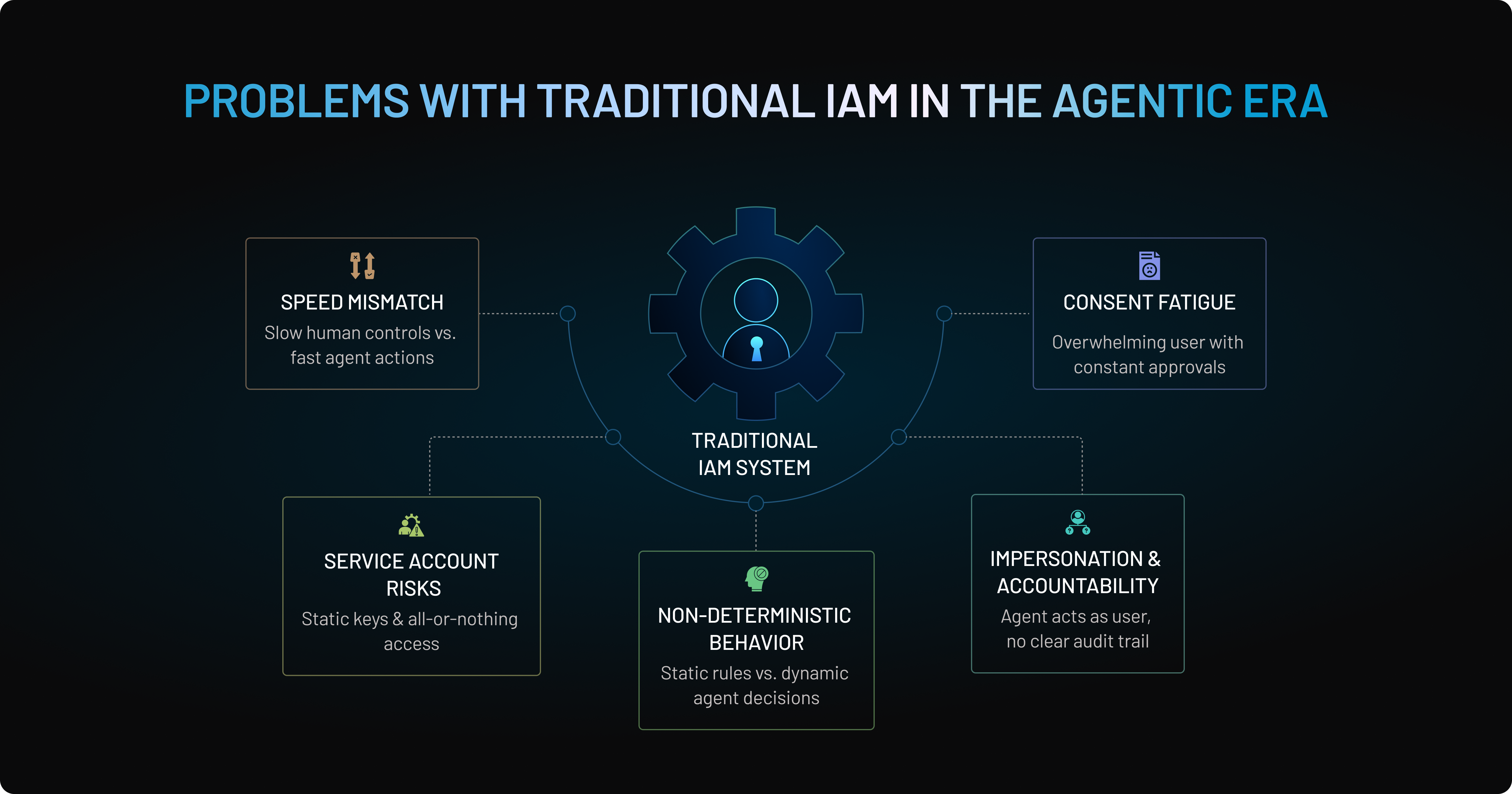
AI agents behave differently. One authenticated agent may interpret a goal, choose among several tools, make multiple API calls, and continue acting as the task evolves. That makes the credential only one part of the security decision.
Machine-Speed, Non-Deterministic Execution Changes the Security Model
A human typically makes actions one at a time. An AI agent can turn one instruction into dozens of downstream requests within seconds.
The sequence may also change depending on context. An agent asked to resolve a support issue might inspect an account, retrieve an order, select a tool, initiate a refund, or escalate the case. Another run of the same task may follow a different path.
Authentication can establish which agent initiated those requests, but it cannot assume every action produced by the agent's reasoning is authorized. Security policy needs to remain enforceable outside the agent's decision-making process.
API Keys and Shared Service Accounts Create a Governance Gap
Static API keys are convenient for machine access, but possession of a key often says little about the task behind a request. Long-lived or broadly scoped credentials can also remain usable well beyond the context in which access was originally needed.
Shared service accounts introduce another problem. If several agents operate as ai-automation-service, logs may show the account that accessed a resource without clearly identifying the agent or principal responsible for the action.
Agentic workflows need stronger attribution: Principal → Agent → Resource → Action
That relationship becomes difficult to preserve when multiple agents share the same identity or credential.
Overprivileged Agents Increase the Blast Radius
Giving an agent broad permissions because it might need them is risky. The agent may have access to ten operations while the current task requires only two.
Prompts are not a reliable authorization boundary. Telling an agent “only issue refunds below $100” should not be the control preventing a $5,000 refund if the underlying credential can authorize it.
Authority should instead remain bounded: Agent Authority ≤ Delegated Authority ≤ Principal Authority.
The agent receives enough access to complete the approved task, not every permission available to the user or application behind it.
Agent Authority Can Outlive the Original Interaction
Some agent tasks finish immediately. Others continue asynchronously, wait for another system, delegate work, or resume after the user has left.
Simply carrying forward the user's original session or a long-lived credential creates ambiguity: Is the task still authorized? Does the principal still have the underlying permission? Has the delegated authority expired or been revoked?
Long-running agent workflows therefore need an explicit authority lifecycle rather than assuming that successful authentication at the beginning remains sufficient throughout execution.
Traditional authentication still provides the identity foundation. What changes with AI agents is everything that must remain verifiable after authentication: the principal, the agent, the delegated authority, the resource, and the action being attempted.
Authentication, Authorization, and Delegation Solve Different Problems
For AI agents, three controls need to remain distinct:
Authentication → Who is the agent?
Authorization → What is the agent permitted to do?
Delegation → On whose behalf is it acting, and what authority was granted for this task?
A valid agent credential answers the first question. It should not automatically answer the other two.
The resulting authority can be expressed as: Effective Agent Authority = Principal Authority ∩ Agent Permission ∩ Delegated Task ∩ Resource Policy ∩ Current Context
If any part of that intersection does not permit the requested action, authentication alone should not make the action valid.
This is what makes AI agent authentication different from simply issuing another machine credential. The system needs to preserve not only which identity authenticated, but also where its authority came from and whether that authority still covers the action being attempted.
| Security Dimension | Human User | Traditional APIs or other Non-human identities | AI Agent |
|---|---|---|---|
| Primary actor | Person | Application or service | Autonomous or semi-autonomous agent |
| Source of authority | User's own permissions | Assigned service permissions | Own permissions + delegated authority |
| Action selection | Human chooses | Predetermined by code | Agent may dynamically choose |
| Execution duration | Usually tied to a session | Persistent or scheduled | Interactive or asynchronous |
| Delegation | Limited | Usually predefined | May act for a user, app, or another agent |
| Resource access | Apps and services | APIs and infrastructure | APIs, tools, MCP servers, data, other agents |
| Audit requirement | Who did it? | Which service did it? | Who authorized it, which agent acted, and what did it do? |
The key change is that identity alone no longer describes the full security relationship. An agent may authenticate successfully while still lacking authority to perform a particular action for a particular principal.
OAuth 2.1: A Strong Foundation for Non-Human Auth
So, if static API keys are the "governance gap," what fills it?
Interestingly, we didn't need to invent a new cryptographic protocol from scratch. We needed to apply the best parts of an existing one, strictly. This is why LoginRadius, and the broader AI ecosystems including the Model Context Protocol (MCP), has chosen OAuth 2.1.
Now, you might know OAuth 2.1 as a cleanup of OAuth 2.0, deprecating insecure flows like the Implicit Grant. But for AI agents, it is much more than a cleanup. It is the structural foundation that allows us to treat non-human entities with the same rigorous security hygiene we apply to humans.
Here is why OAuth 2.1 is the non-negotiable standard for Agentic IAM.
1. Killing the "Forever Token" with Rotation
The most dangerous thing about a standard API key is that it usually works forever. If an agent’s key leaks, attackers have a permanent backdoor until someone manually rotates it (which, let’s be honest, rarely happens).
LoginRadius utilizes OAuth 2.1 to enforce short-lived, rotating access tokens. Instead of a static secret, the agent authenticates to the LoginRadius Authorization Server to request a JSON Web Token (JWT). This token has a strict expiration (exp claim) - often valid for just minutes or hours.
If a token is leaked, its window of utility is tiny, drastically limiting the "blast radius" of a breach. Furthermore, because we at LoginRadius handle the lifecycle centrally, we support automatic key rollover (JWKS), meaning we can rotate the underlying signing keys without needing to redeploy a single line of agent code.
2. Solving the "Confused Deputy" with Audience Binding
"Confused Deputy" problem - where a malicious service tricks an agent into giving up its credentials has been a big risk associated with AI agents. OAuth 2.1 slams the door on this via Audience Binding.
In the LoginRadius Agentic IAM architecture, every token we issue is cryptographically bound to a specific target.
-
The Mechanism: When an agent requests access, it must use Resource Indicators (RFC 8707) to specify exactly who it wants to talk to.
-
The Result: We issue a token with an aud (audience) claim matching that resource.
-
The Enforcement: If the agent tries to pass that token to a different service (like a malicious logger), that service cannot replay the token against Salesforce because the aud claim won't match. The token is useless outside its intended destination
3. PKCE is Mandatory (Even for Machines)
Finally, OAuth 2.1 mandates Proof Key for Code Exchange (PKCE) for all clients. Historically, PKCE was used to protect mobile apps.
In the agentic world, it prevents authorization code injection attacks. Even if an attacker intercepts the authorization code returning to your agent, they cannot exchange it for an access token without the cryptographic code verifier that only your agent possesses.
LoginRadius Agentic IAM: The Key Principles
Here are the key principles driving our architecture:
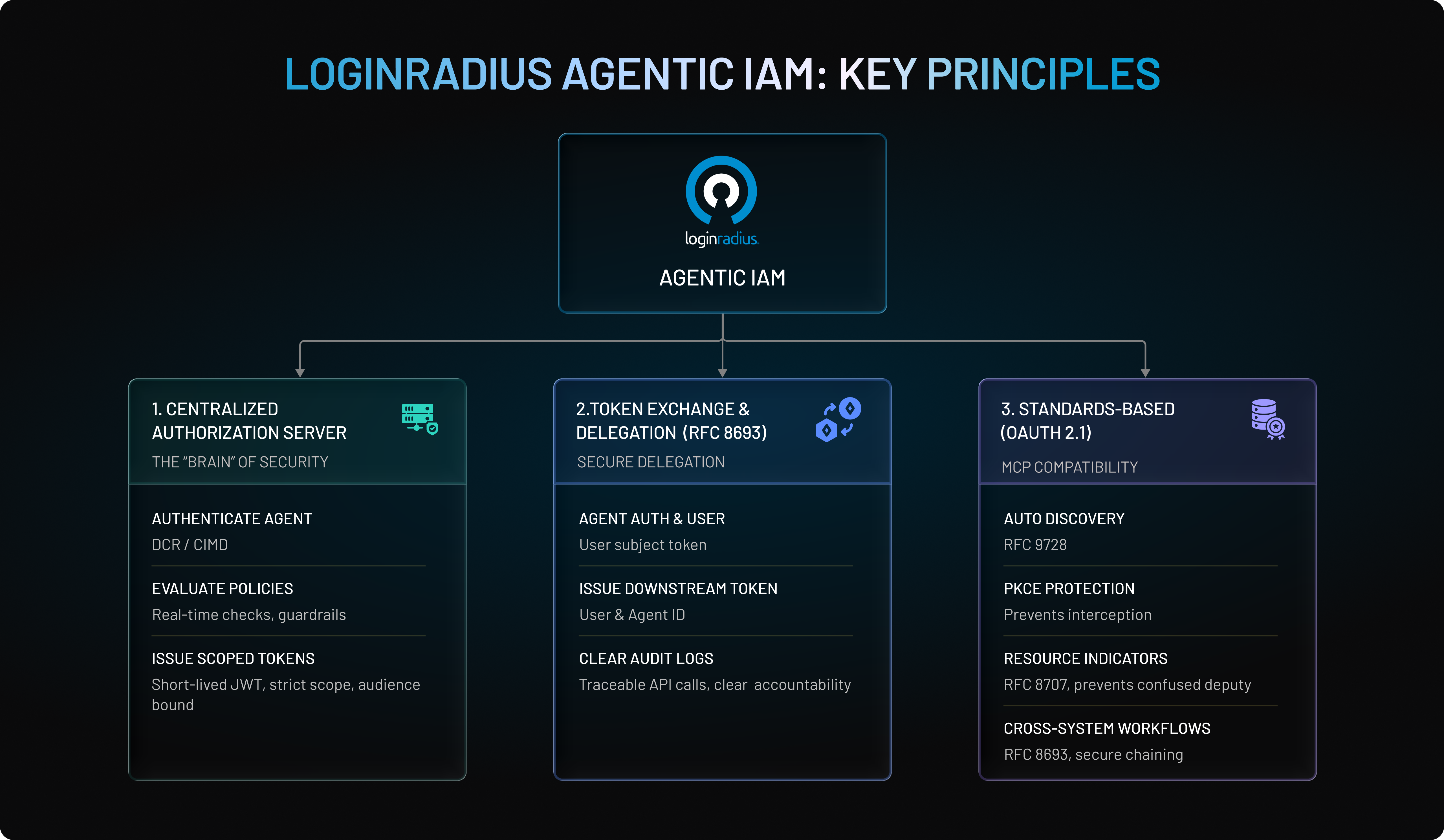
1. The Centralized Authorization Server
In an agentic architecture, the LoginRadius platform functions as the Centralized Authorization Server. It acts as the "brain" of your security posture, handling three critical jobs:
-
It Authenticates the Agent: We don’t let AI Agents roam free. Every agent is assigned a verifiable, unique identity managed independently of users. Whether through Dynamic Client Registration (DCR) or Client ID Metadata Documents (CIMD), we ensure the agent is exactly who it claims to be before it ever gets a credential.
-
It Evaluates Policies: Just because an agent is authenticated doesn't mean it gets a free pass. Our server evaluates access policies in real-time. It checks if the agent is allowed to request specific scopes (e.g., files:read) and enforces context-aware guardrails.
-
It Issues Scoped Tokens: Once the agent passes these checks, we issue a short-lived access token (JWT). This token is strictly scoped to the requested permissions and bound to a specific audience, ensuring that if it’s intercepted, it can’t be used to attack unrelated services
2. Token Exchange & Delegation (RFC 8693)
Agents usually do their best work when they are helping someone. But letting an agent "impersonate" a user is a security nightmare that destroys accountability.
We leverage RFC 8693 (OAuth 2.0 Token Exchange) to solve this. Instead of impersonation, we use Delegation.
-
The Flow: The agent authenticates with its own credentials but presents a "subject token" representing the human user.
-
The Result: We issue a new downstream token that cryptographically encodes both identities: the User (the resource owner) and the Agent (the acting party).
-
The Benefit: This ensures that your audit logs are crystal clear. You can trace every API call back to the specific agent instance and the human who authorized it.
3. Standards-Based (OAuth 2.1)
LoginRadius aligns agent authentication with the MCP mandate by enforcing OAuth 2.1, ensuring native compatibility with the growing MCP ecosystem. Agents automatically discover authorization servers via RFC 9728, eliminating custom integrations.
OAuth 2.1–mandated PKCE protects against intercepted authorization codes, while RFC 8707 resource indicators bind tokens to specific audiences to prevent “confused deputy” attacks.
For cross-system workflows, OAuth token exchange (RFC 8693) enables agents to securely chain calls across domains without losing user context.
The Hardest Challenges in AI Agent Authentication—and the Protocols That Address Them
AI agent authentication does not require an entirely new identity stack. Many of the mechanisms already exist across OAuth, OpenID Connect (OIDC), token exchange, resource indicators, workload identity, and emerging agent protocols such as MCP.
The harder problem is combining them correctly. Each mechanism addresses a different part of the identity chain, and none should be treated as a substitute for action-level authorization.
| Agent Authentication Challenge | Relevant Protocol or Control |
|---|---|
| Authenticate the human principal | OpenID Connect (OIDC) |
| Establish agent or application identity | OAuth client authentication / workload identity |
| Secure interactive authorization | OAuth authorization flow with PKCE |
| Delegate authority to an agent | OAuth 2.0 Token Exchange (RFC 8693) |
| Restrict access to the intended resource | OAuth 2.0 Resource Indicators (RFC 8707) |
| Discover authorization requirements | OAuth 2.0 Protected Resource Metadata (RFC 9728) |
| Control API or tool operations | OAuth scopes + resource-side authorization policy |
| Protect MCP resources and tools | MCP authorization mechanisms built around OAuth |
| Reduce credential exposure and replay risk | Short-lived, narrowly scoped credentials; sender-constrained tokens where appropriate |
| Control agent-to-agent delegation | Scoped token exchange + delegation policy |
| Terminate authority | Token revocation + identity and delegation lifecycle controls |
Agent Identity Architecture: From Human Principal to Agent, Tool, Tenant, and NHI
Secure AI agent authentication becomes easier to reason about when every participant in the workflow has a clear identity and role.
A typical architecture may look like this: Human Principal → Application → AI Agent → Authorization Layer → MCP Server / Tool → API or Resource
Principal Identity: Who Ultimately Authorized the Task?
The principal is the human, application, or other authorized identity from which the task originates.
For customer-facing AI agents, this will often be an authenticated customer. In enterprise automation, the principal could be an employee, workload, app, or another authorized agent.
The principal matters because an agent acting on behalf of someone should not acquire authority that the principal did not possess in the first place.
Agent Identity: Which AI Agent Is Actually Acting?
The AI agent needs to remain identifiable separately from its principal and hosting application.
Consider an application containing three agents:
Application → Support Agent
Application → Billing Agent
Application → Account Recovery Agent
Using only the application's identity would make these agents appear identical to downstream systems even though their responsibilities and risk profiles are very different.
Distinct agent identities improve attribution and allow credentials, permissions, ownership, monitoring, and revocation to be managed at the agent level.
Application Identity: Where Is the Agent Running?
The application hosting an agent is another security principal, but it should not automatically be treated as the agent itself.
One application may host several agents, while an agent may also interact with services outside the application in which it originated.
Keeping the distinction explicit gives the architecture three separate questions:
Who initiated the task? → Principal
Which software environment initiated or hosts the workflow? → Application
Which autonomous actor performed the action? → Agent
That distinction becomes useful during authorization and incident investigation.
Tool and Resource Identity: What Is the Agent Trying to Access?
Agents do not operate in isolation. They interact with APIs, databases, SaaS applications, MCP servers, tools, and other protected resources. Those resources also need clear identity boundaries.
An agent authorized to access a CRM should not assume the same authority applies to a payment API simply because both tools are available in its environment.
Likewise: Resource Access ≠ Permission to Perform Every Action on That Resource
An agent may be allowed to read an order but not cancel it, or retrieve account details but not change account ownership. Resource identity establishes the target; authorization policy determines the permitted operations.
Tenant and Organization Context Must Remain Part of the Identity Boundary
Multi-tenant systems introduce another dimension: where is the identity allowed to act?
An agent, principal, and API may all be valid independently while the requested action still crosses the wrong tenant boundary.
For example, a support agent operating for Customer A should not retrieve Customer B's records because both customers use the same underlying application.
This is particularly important for SaaS and CIAM environments where the same agent infrastructure may serve many organizations or customer populations.
Delegated Authority Connects the Principal to the Agent
When an agent acts on behalf of another identity, the architecture needs to preserve that relationship rather than flattening both identities into one.
The delegation carries the context needed to constrain what the agent may do. The detailed mechanics of token exchange and delegation policy belong elsewhere; what matters here is that the principal-agent relationship remains visible throughout the workflow.
AI Agents Are Part of the Broader Non-Human Identity Landscape
AI agents belong within the wider category of non-human identities: Non-Human Identities → Applications, Workloads, Service Accounts, Automation, Bots, Devices, AI Agents
They share many NHI requirements: clear ownership, credential lifecycle management, permissions, monitoring, inventory, and deactivation.
AI agents add another challenge. Unlike many traditional workloads that follow predetermined execution paths, an agent may dynamically choose tools, change its sequence of actions, or delegate part of a task.
That means existing NHI governance remains necessary, but agentic workflows also require controls around delegated authority and action-level execution.
Preserve the Identity Chain Across Multi-Agent Workflows
Each additional agent introduces another actor that should remain identifiable. Downstream authority must remain derived from valid upstream authority rather than expanding simply because another agent joins the workflow.
The architecture therefore needs to preserve enough context to reconstruct the complete path:
Principal → Agent → Delegated Authority → Tenant → Resource → Action → Policy Decision → Result
That chain provides the foundation for authentication, authorization, auditing, and revocation without forcing every participant in an agentic workflow to appear as the same identity.
Separate the Decision Surface From the Execution Surface
AI agents need freedom to reason. That does not mean they need equivalent freedom to execute.
An agent may interpret a goal, build a plan, choose a tool, decide which API to call, and determine which parameters to send. Those decisions happen on what we can call the decision surface.
The moment that plan attempts to change a protected system, it reaches the execution surface.
That boundary matters. Agent Reasoning → Proposed Action → Authorization Decision → Execute / Step-Up / Deny
The agent can decide what it wants to do. The authorization system decides whether it is allowed to do it.
The Decision Surface Is Where the Agent Reasons
The decision surface includes activities such as interpreting prompts, retrieving context, planning tasks, selecting tools, and choosing the next action. Consider a customer-support agent handling: “My order arrived damaged. Please fix this.”
The agent might inspect the order, review refund policy, determine that a refund is appropriate, and select the refund API. Those are reasoning decisions.
The agent may conclude that a $150 refund is the correct outcome. That conclusion does not give it authority to issue $150. A security policy may independently establish: Agent autonomous refund limit = $100
The proposed action therefore reaches the execution boundary and fails the autonomous authorization check.
This gives us an important rule: Reasoning can propose an authority-dependent action. It cannot create the authority required to perform it.
The Execution Surface Is Where Policy Must Take Control
The execution surface begins when the agent attempts an operation that affects a protected resource.
Examples include:
Read Customer Record → CRM
Issue Refund → Payment System
Delete File → Storage Service
Change Email Address → Customer Account
Invoke Tool → MCP Server
Before execution, the system can evaluate the agent identity, principal, delegated authority, tenant, resource, requested operation, and relevant policy.
The agent's reasoning may provide context for the request, but it should not be the final security authority. That separation keeps authorization deterministic even when agent behavior is not.
Tool Discovery Should Not Become Tool Authority
Agentic systems increasingly allow models to discover tools dynamically. An MCP server, for example, may expose multiple operations that an agent can inspect and select.
But seeing a tool is different from being authorized to execute it. Tool Available to Agent ≠ Tool Authorized for Agent
An agent may discover:
search_orders
issue_refund
change_account_owner
delete_account
The fact that all four tools are visible does not mean its credential or delegated authority should permit all four operations.
Authorization should be evaluated when the agent attempts to cross from tool selection into execution.
Keep Authorization Outside the Agent's Prompt and Reasoning
Prompts can guide behavior: “Never refund more than $100.”
That instruction may improve agent behavior, but it should not be the control enforcing the refund limit.
A stronger architecture also enforces:
Requested Refund ≤ $100 → Allow
Requested Refund > $100 → Additional Authorization or Deny
Why separate the two?
Because prompts and model reasoning can be influenced by unexpected input, retrieved content, tool responses, configuration errors, or prompt injection. An external authorization layer creates a security boundary that does not depend on the model consistently interpreting its instructions.
The same principle applies to other sensitive actions:
Agent proposes file deletion → Policy checks deletion authority
Agent proposes money transfer → Policy checks transaction authority
Agent proposes another agent invocation → Policy checks delegation authority
The decision can be dynamic. The security boundary should remain enforceable.
Evaluate Authorization at the Moment of Action
An agent's permissions may appear sufficient when a task begins but become inappropriate later.
The principal's permissions may change. A delegation may expire. The agent may select a different resource. The requested operation may be more consequential than earlier actions.
Execution-time authorization lets the system evaluate the action that is actually about to occur rather than assuming that initial authentication approved the entire future workflow.
For example:
Agent authenticated successfully
↓
Read order → Allowed
↓
Issue $45 refund → Allowed
↓
Issue $4,500 refund → Requires additional authorization
↓
Delete customer account → Denied
The same authenticated agent receives different decisions because authentication establishes identity, while authorization evaluates each protected action.
For higher-risk actions, policy may require additional user verification or human approval before execution. The detailed question of how much autonomous authority an agent should receive belongs to the Least Agency model later in this guide.
Separating the decision surface from the execution surface creates a useful architectural boundary:
Agent decides what action to request.
Identity establishes who is requesting it.
Delegation establishes the authority behind it.
Policy determines whether the action is permitted.
The protected resource enforces the decision.
AI agents can remain flexible in how they reason without receiving unlimited flexibility in what they can execute.
Authentication in a Zero Trust Agentic Architecture
A successfully authenticated AI agent should not become permanently trusted.
In a Zero Trust agentic architecture, identity establishes the starting point for access. Each meaningful action can still be evaluated against the principal, delegated authority, target resource, tenant, and current context.
A simplified decision path looks like this: Verify Agent → Validate Principal → Validate Delegation → Check Resource → Evaluate Action → Evaluate Context → Allow / Step-Up / Deny
The principle is straightforward: authenticate the agent, then continuously constrain what that authenticated identity can do.
Use Short-Lived, Resource-Bound Credentials
Agent credentials and access tokens should carry only the authority needed for the intended resource and should remain valid only as long as necessary.
An agent using a CRM and payment service, for example, should not rely on one broadly reusable credential:
Agent → CRM-Scoped Access → CRM API
Agent → Payment-Scoped Access → Payment API
If one credential is exposed, narrower scope and lifetime can limit how far it can be reused.
The protocol mechanics behind short-lived and resource-specific access were covered earlier. In a Zero Trust model, the important point is that successful authentication should not create open-ended access across the agent's entire tool environment.
Reevaluate Authorization When Context Changes
Agent workflows can evolve after authentication. A task may run for hours, switch resources, move between agents, or resume after the principal's permissions have changed.
Authorization should therefore be reevaluated when relevant context changes.
That context may include: Principal permissions → Delegation validity → Agent status → Tenant → Resource → Requested action → Risk
Suppose an agent begins a task while a customer has permission to manage a subscription. If that permission is removed before an asynchronous cancellation occurs, the original authentication event should not guarantee that the later action succeeds.
The same principle applies when an agent crosses tenant boundaries, invokes another agent, or attempts an operation outside the original task.
Require Stronger Authorization as Consequence Increases
Not every agent action carries the same risk.
Reading a product catalog and changing account ownership should not pass through identical authorization requirements simply because the same authenticated agent requested both.
Policy can respond differently as consequences increase:
Low-Risk Action → Allow
Higher-Risk Action → Step-Up or Additional Approval
Unauthorized Action → Deny
This keeps stronger controls near consequential actions instead of forcing additional verification into every low-risk step.
The broader question of how much autonomous authority an agent should receive is covered later under Least Agency.
Make Revocation and Auditability Part of Continuous Trust
Zero Trust also means authority must be removable while an agent is operating.
Depending on what changes, an organization may need to revoke an access token, terminate delegated authority, remove access to a resource, or disable the agent identity.
That control is especially important for long-running and asynchronous workflows. Authority that was valid when a task started may no longer be valid when the next action occurs.
Each consequential action should also remain attributable through a chain such as: Principal → Agent → Delegated Authority → Resource → Action → Policy Decision → Result
This allows teams to determine not only that a valid credential was presented, but why the action was permitted and whose authority supported it.
Zero Trust does not require re-authenticating an AI agent before every API call. It requires avoiding permanent trust based on a previous authentication event.
Identity is verified. Authority is constrained. Context is reevaluated. Actions are authorized. Access remains revocable.
The Four Security Layers Required for Secure AI Agent Authentication
The controls covered so far can be organized into four security layers: Identity → Authority → Execution → Governance
Each answers a different question about an agentic workflow.
Identity — Who is acting?
Establish a verifiable identity for the AI agent and keep it distinct from the human principal, application, or other agent behind the task. The system should be able to identify both who supplied the authority and which agent performed the action.
Authority — What is the agent allowed to do?
Constrain access through the principal's permissions, agent permissions, delegated task, tenant, resource policy, and current context. Effective authority should remain within the intersection of those boundaries:
Effective Agent Authority = Principal Authority ∩ Agent Permission ∩ Delegated Task ∩ Resource Policy ∩ Current Context
Execution — Should this specific action happen?
Evaluate protected operations when the agent attempts to execute them. Access to an API, tool, or MCP server should not automatically authorize every action exposed by that resource. Higher-risk actions may require stronger authorization, while unauthorized actions should be denied.
Governance — What happened, and should the authority continue?
Maintain ownership, monitoring, auditability, credential lifecycle controls, delegation visibility, and revocation. Teams should be able to reconstruct:
Principal → Agent → Authority → Resource → Action → Decision → Result
These layers are complementary. Authentication without constrained authority creates overprivileged agents. Authority without execution controls allows permissions to become overly broad. Execution without governance makes consequential actions difficult to investigate or revoke.
Secure AI agent authentication depends on keeping all four connected throughout the agent's lifecycle.
Move Beyond Least Privilege to “Least Agency”
Least privilege asks an important security question: What is the minimum access this identity needs?
AI agents introduce another: How much of that access should the agent be allowed to exercise autonomously?
Those questions are related, but they are not identical.
An agent may legitimately need access to a customer account, payment system, or administrative API to complete its job. That does not mean every permitted operation should be executable without another decision point.
This leads to a useful extension of least privilege: Least Privilege = Minimum Access Required
Least Agency = Minimum Autonomous Authority Required
Permission Does Not Automatically Mean Autonomous Permission
Consider a calendar assistant. To perform its role, the agent may need permission to read calendars, create events, modify meetings, invite participants, cancel events, or delete them.
From an access-control perspective, several of those permissions may be legitimate.
From an autonomy perspective, they carry different consequences.
Read availability → Autonomous
Create routine meeting → Autonomous
Reschedule important meeting → Policy-dependent
Cancel executive meeting → Human approval
Delete entire calendar → Deny
The agent can therefore possess valid access while still facing tighter controls over how independently it may exercise that access.
A useful rule is: Permitted Authority ≠ Autonomous Authority
Constrain Least Agency Across Multiple Dimensions
Autonomous authority can be narrowed across several dimensions rather than relying on a single role or scope.
Data Scope — which records or information may the agent use?
Tool Scope — which APIs, tools, or MCP capabilities may it invoke?
Action Scope — which operations may it perform?
Delegation Scope — which authority may it pass to another agent?
Time Scope — how long may the authority remain active?
Autonomy Scope — which actions may execute without additional approval?
This creates a more precise control model than simply classifying an agent as “trusted” or “untrusted.”
Match Autonomous Authority to the Consequence of the Action
A useful way to design a Least Agency is to examine how consequential an operation becomes as the agent moves from observing a system to changing it.
For example: Read → Recommend → Draft → Modify → Commit → Delete
The farther an agent moves toward irreversible or high-impact actions, the stronger the authorization boundary may need to become.
A procurement agent might operate under a policy such as:
| Agent Action | Autonomy Level |
|---|---|
| Search approved vendors | Autonomous |
| Compare vendor pricing | Autonomous |
| Prepare purchase order | Autonomous |
| Submit purchase under $500 | Autonomous |
| Submit purchase from $500–$5,000 | Human approval required |
| Submit purchase above $5,000 | Deny or escalate |
The exact thresholds depend on the organization's risk model. The important point is that autonomy is intentionally designed rather than inherited from the agent's overall permissions.
Put Human-in-the-Loop Controls at Consequential Boundaries
Human-in-the-loop (HITL) controls are most useful when they protect actions where human judgment or explicit consent materially changes the risk.
Requiring approval for every tool call would undermine the purpose of an autonomous agent. Requiring no approval for consequential actions can create unnecessary exposure.
The better boundary sits where the consequence changes.
Common HITL candidates may include:
Large financial transactions
Account ownership or security changes
Destructive operations
Sensitive data exports
High-impact administrative actions
Actions outside the agent's normal operating range
The agent can perform the surrounding low-risk work autonomously and pause only when it reaches the protected execution boundary.
Human Approval Should Authorize the Action, Not Permanently Elevate the Agent
Approval itself can become a privilege-escalation path if it is implemented too broadly.
Suppose a user approves a $2,000 payment. That approval should not turn into permanent permission for the agent to make future $2,000 payments.
Instead, approval should be tied as closely as practical to the specific context: Principal → Agent → Resource → Action → Amount/Parameters → Approval → Expiration
Once the approved action is completed or the authorization expires, the additional authority should disappear.
This keeps HITL aligned with Least Agency: the human grants the minimum additional autonomy required for the specific action rather than broadly increasing the agent's privileges.
Least Agency Should Survive Agent-to-Agent Delegation
Autonomy limits should not disappear when one agent invokes another.
If Agent A requires human approval before initiating a high-value transaction, delegating the payment step to Agent B should not create a path around that requirement.
The downstream agent may receive narrower operational authority, but it should not receive greater autonomous authority than the delegation permits.
That gives engineering teams another useful invariant: Downstream Autonomy ≤ Delegated Autonomy
The same principle that limits permissions across delegation chains should also limit autonomy.
Design for the Worst Plausible Authorized Decision
There is a practical test engineering teams can use when defining agent permissions:
If this agent makes the worst plausible decision within its current permissions, what can it execute without another control stopping it?
If the answer includes deleting critical data, transferring significant funds, changing account ownership, exposing sensitive information, or delegating broad authority, the agent probably has too much autonomous authority.
Least privilege limits what the agent can access. Least Agency limits what it can decide and execute independently. For autonomous systems, both boundaries matter.
How to Prevent AI Agents from Creating Backdoor Accounts?
When organizations deploy Agentic AI, they focus on automation, productivity, and intelligent workflows. Rarely do they pause to ask a more uncomfortable question:
Can our AI agents create identities we are not aware of?
Backdoor accounts in traditional systems were often created by malicious insiders or attackers who gained privileged access. In Agentic AI systems, the risk takes a different form. An autonomous AI agent with provisioning authority can unintentionally—or maliciously—create unauthorized user accounts, service accounts, API keys, or delegated identities.
If governance controls are weak, those accounts may persist undetected.
Preventing AI-generated backdoor accounts is not just a security concern. It is an identity governance problem rooted in AI agent identity, AI agent authentication, and enforcement architecture.
How AI Agents End Up Creating Backdoor Accounts
AI agents increasingly interact with identity systems. They may provision customer accounts, create temporary access tokens, onboard vendors, trigger DevOps workflows, or automate administrative tasks.
In production environments, these capabilities often include:
-
Creating new user profiles
-
Assigning roles or permissions
-
Generating API credentials
-
Granting delegated access
-
Invoking identity management APIs
If an AI agent has broad write permissions to identity infrastructure, the blast radius expands significantly.
Backdoor accounts can emerge through several paths. An AI agent may be manipulated via prompt injection to provision a privileged account “for troubleshooting.” It may misinterpret internal instructions and create persistent service credentials. It may duplicate identity templates with excessive privileges. Or it may delegate authority in ways that effectively create shadow access.
The most dangerous part? These actions may appear legitimate if identity logs lack delegation context.
Preventing backdoor account creation begins with strong AI agent identity governance.
AI agent identity must be treated as a governed, lifecycle-managed entity. AI in IAM platforms must ensure that AI agents have clearly defined scopes and authority boundaries. An AI agent responsible for customer onboarding should not possess administrative privileges over identity infrastructure.
AI in identity and access management systems must support granular policy enforcement. Identity provisioning APIs should evaluate both the acting AI agent and its delegated authority before allowing account creation.
Without explicit separation of AI agent identity, provisioning power becomes indistinguishable from abuse.
Identity discipline prevents privilege sprawl.
Building a Backdoor-Resistant Agentic AI Security Framework
A resilient agentic AI security framework must integrate:
-
Strict AI agent identity governance
-
Scoped AI agent authentication
-
Delegation-aware authorization
-
Policy-enforced provisioning workflows
-
Identity-centric logging
-
Continuous anomaly detection
AI in IAM must extend beyond login and into lifecycle governance. AI in identity and access management must treat provisioning as a high-risk operation requiring layered validation.
Backdoor accounts do not appear because AI is malicious. They appear because identity governance is incomplete.
AI Agent Authentication Execution Checklist for Engineering Teams
Before moving an AI agent into production, engineering and security teams should verify that identity, delegation, authorization, execution, and revocation work as one control chain.
Use this checklist during architecture reviews and pre-production testing.
| Check | What to Verify |
|---|---|
| 1. Give every agent a distinct identity | The agent can be authenticated and attributed independently of the user, application, or shared service account. |
| 2. Preserve the principal-agent relationship | Systems can identify both who authorized the task and which agent performed the action. |
| 3. Avoid exposing reusable user credentials | Agents use delegated or purpose-specific access rather than receiving passwords, session cookies, or broadly reusable user tokens. |
| 4. Issue narrow, short-lived access | Credentials are limited by appropriate scope, resource, task, tenant, and lifetime rather than granting persistent broad access. |
| 5. Enforce delegation boundaries | Agent authority cannot exceed the authority delegated by the principal, and downstream agents cannot expand it. |
| 6. Authorize protected actions at execution time | Access to an API, tool, or MCP server does not automatically permit every operation exposed by that resource. |
| 7. Apply Least Agency | The agent receives only the autonomous authority needed for its task, with additional approval required for consequential actions where appropriate. |
| 8. Preserve tenant and organizational boundaries | Agent access remains restricted to the correct customer, organization, account, or security domain throughout the workflow. |
| 9. Maintain complete audit context | Logs connect the principal, agent, delegated authority, resource, action, authorization decision, and result. |
| 10. Make authority immediately revocable | Teams can terminate credentials, delegated authority, resource access, or the agent identity without unnecessarily disabling the principal. |
Two invariants are worth testing throughout the implementation:
Agent Authority ≤ Delegated Authority ≤ Principal Authority
Permitted Authority ≠ Autonomous Authority
Test Failure Paths, Not Just Successful Authentication
A production test should verify more than whether the agent can obtain a token and complete its intended workflow.
Test what happens when:
-
an access token expires during execution;
-
a token intended for one resource is presented to another;
-
an agent attempts to cross a tenant boundary;
-
one agent delegates unauthorized authority to another;
-
an action exceeds the agent's permitted or autonomous scope;
-
a long-running task resumes after the principal's permissions or delegation have changed.
The complete execution path should remain enforceable from beginning to end: Identify Agent → Authenticate → Establish Principal → Validate Delegation → Issue Scoped Access → Request Resource → Authorize Action → Execute or Step-Up → Audit Result → Revoke When Required
If the architecture can enforce that chain even when credentials expire, context changes, delegation fails, or the agent proposes an unauthorized action, authentication is doing more than proving identity. It is supporting a controlled agent execution model.
Implementing Secure AI Agent Authentication With LoginRadius
Building secure agent authentication requires more than adding another credential type. The identity architecture needs to preserve the relationship between the principal, agent, delegated authority, protected resource, and resulting action.
LoginRadius extends identity and access controls into agentic workflows so organizations can manage AI agents as identifiable actors while keeping their authority scoped, auditable, and revocable.
Establish Independent Identities for AI Agents
AI agents should remain distinguishable from the customers, applications, and services around them.
LoginRadius supports an identity model in which agents can be represented and managed independently rather than relying on shared service accounts or simply appearing as the user.
This gives organizations a clearer foundation for agent ownership, authentication, access control, lifecycle management, and attribution.
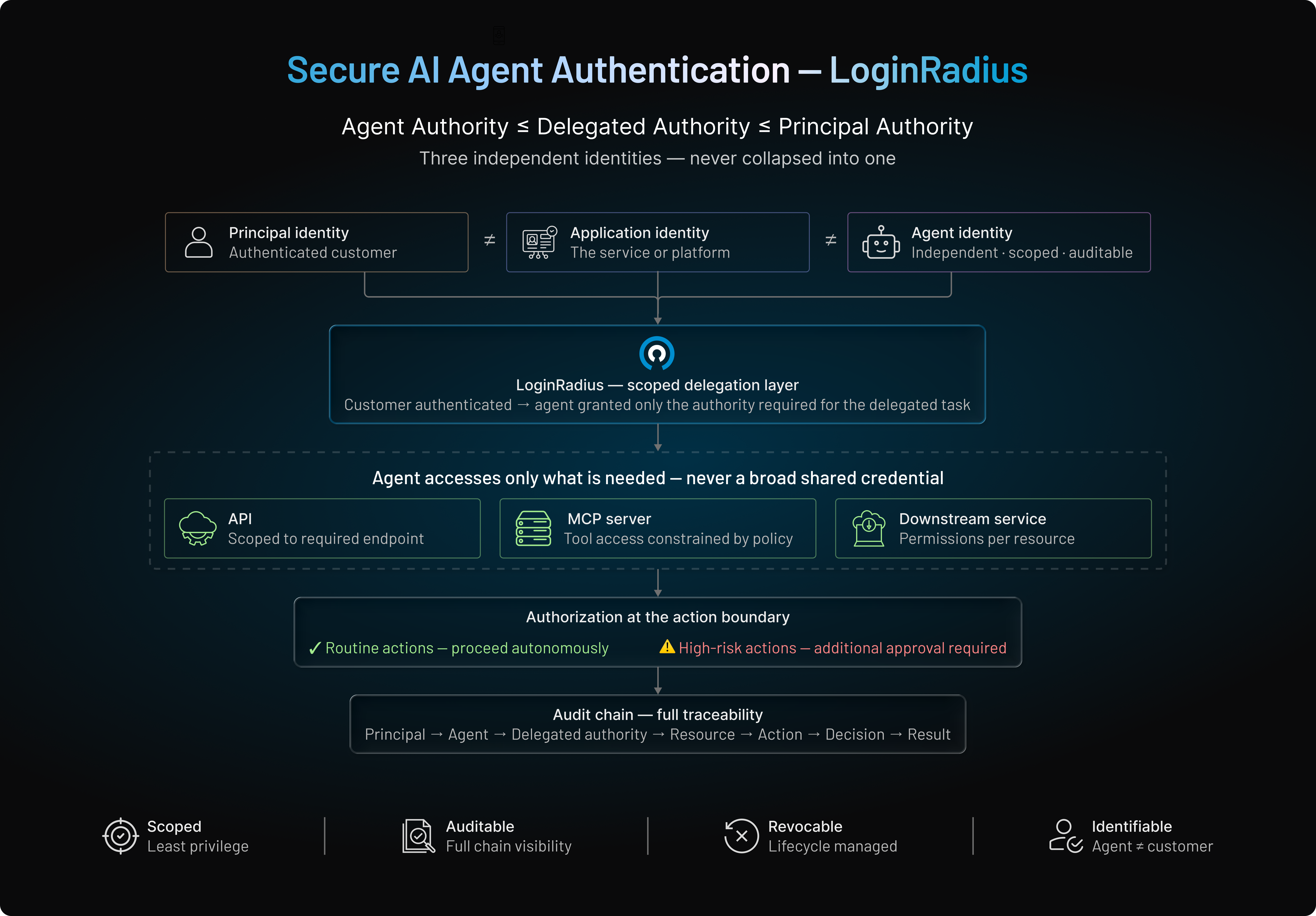
Principal Identity ≠ Application Identity ≠ Agent Identity
The distinction becomes particularly important when several agents operate inside the same application or interact with the same downstream APIs.
Preserve Principal Identity and Scoped Delegation
When an agent acts for a customer, the customer's authenticated identity should remain connected to the workflow without requiring the agent to become that customer.
The desired relationship is: Authenticated Customer → Delegated Agent Authority → Protected Resource
Using standards-based authorization patterns, agent access can be constrained to the authority required for the delegated task rather than simply copying the customer's full permissions.
This preserves both sides of the transaction: who supplied the authority and which agent exercised it.
Use Scoped Access Across APIs, Tools, and MCP Servers
Agent workflows frequently cross several protected systems. An agent may retrieve customer information from one API, invoke an MCP-connected tool, and then request an operation from another service.
Those resources should not automatically share one broad access credential.
LoginRadius's agentic identity approach uses standards-based authentication and scoped access to help constrain agent interactions across APIs, tools, and MCP servers. Access can be designed around the intended resource and required permissions rather than giving the agent unrestricted access to every connected system.
This supports the principle established throughout this guide: Agent Authority ≤ Delegated Authority ≤ Principal Authority
Enforce Authorization at the Action Boundary
Authenticating the agent and granting access to a resource should not mean every operation exposed by that resource is automatically permitted.
Authorization needs to remain part of execution.
An agent might be permitted to retrieve an account but not change its owner, or prepare a transaction but not independently execute one above an organization's risk threshold.
For consequential operations, the architecture can introduce stronger authorization or approval requirements before execution. This allows autonomous workflows to continue for routine actions while keeping higher-risk decisions behind an additional control boundary.
Maintain Auditability, Revocation, and Agent Lifecycle Control
Agent authority also needs a clear end.
Organizations should be able to trace agent activity back through the identity and authorization chain: Principal → Agent → Delegated Authority → Resource → Action → Decision → Result
That context helps security teams investigate agent behavior without treating every action as though it came directly from the customer.
Lifecycle controls are equally important. Agent credentials, delegated access, resource permissions, and the agent identity itself should be manageable and revocable as requirements change.
The result is a cleaner security model: customers retain their identities, agents retain theirs, and authorization connects the two without collapsing them into a single principal.
For organizations introducing autonomous agents into customer-facing applications, APIs, and tool ecosystems, LoginRadius provides an identity foundation for extending authentication and access control into these emerging agentic workflows.
Conclusion: Authenticate the Agent, Govern the Authority
AI agents change what happens after authentication. They can choose tools, make API calls, delegate work, and take actions across multiple systems—sometimes without a human present for every decision. A valid credential alone cannot govern that kind of authority.
The stronger model keeps the security chain visible: Principal → Agent → Delegated Authority → Resource → Permitted Action
The agent gets its own verifiable identity instead of borrowing the user's. Delegated permissions stay narrower than the principal's authority. Sensitive actions are evaluated at execution time, and higher-risk decisions can require additional approval. Just as importantly, that authority can expire or be revoked without disrupting the principal behind it.
This is the shift engineering teams need to make: authenticate the agent, but govern the authority it carries.
LoginRadius helps organizations extend their identity architecture to AI agents with independently managed agent identities, scoped access, delegated authorization, policy enforcement, and lifecycle controls for agentic workflows.
As AI agents move from answering questions to taking consequential actions, identity needs to move with them.
Ready to secure AI agents across your applications, APIs, tools, and MCP servers? Explore LoginRadius Agentic IAM or contact our identity experts to build an agent authentication architecture designed for controlled, auditable access.
FAQs
Q: What is AI agent authentication?
A: AI agent authentication verifies the identity of an AI agent before it accesses APIs, tools, MCP servers, data, or other protected resources. It establishes which agent is acting so its access can be authorized, audited, and revoked independently.
Q: How do AI agents authenticate to APIs?
A: AI agents can authenticate using OAuth-based access tokens, workload credentials, or other machine identity mechanisms. For sensitive workflows, short-lived, scoped, and resource-specific credentials are generally preferable to shared or long-lived API keys.
Q: Should AI agents use API keys or OAuth?
A: API keys can work for limited machine-to-machine scenarios, but they often lack the delegation and fine-grained authorization needed for agentic workflows. OAuth is better suited when agents require scoped, short-lived, resource-specific, or delegated access.
Q: What is the difference between AI agent authentication and authorization?
A: Authentication establishes which agent is making the request. Authorization determines which resources and actions that authenticated agent is permitted to access or execute under the current policy and context.
Q: How does OAuth work for AI agents?
A: OAuth can provide AI agents with scoped access tokens for protected APIs and tools without exposing user credentials. Combined with token exchange and resource-specific authorization, it can also support delegated and downstream agent access.
Q: How can an AI agent securely act on behalf of a user?
A: Keep the user and agent as separate identities and explicitly delegate only the authority required for the task. The agent should receive scoped, limited-duration access rather than inheriting the user's complete credentials or permissions.
Q: How do you authenticate AI agents accessing MCP servers?
A: MCP servers can use OAuth-based authorization to protect access to exposed tools and resources. The agent should authenticate with appropriate credentials, while authorization policies separately determine which tools and actions it may execute.