For years, JWTs have become the foundation of authentication and authorization across OpenID Connect (OIDC), OAuth 2.0, APIs, and machine-to-machine applications. Every access token, ID token, and service token ultimately relies on a signing key to establish trust between identity providers, applications, and APIs.
But while JWT adoption has accelerated, signing key management has remained surprisingly outdated. Many organizations still operate with long-lived signing keys that are manually rotated, inconsistently documented, and difficult to revoke during security incidents. As environments scale across applications, services, and tenants, maintaining trust in tokens becomes increasingly complex.
That's why we built LoginRadius Enterprise JWT Key Lifecycle Management, including automated signing key rotation, key revocation, application-specific signing keys, and enhanced JWKS management.
In this blog, we'll explain why we built it, the challenges we faced, how the system works behind the scenes, and how it compares to the approaches commonly found across the CIAM market today.
The Problem We Wanted to Solve
If you talk to any expert operating across identity circles, they will tell you one common thing about JWT - JWT Trust Is Only as Strong as the Signing Key!
Most JWT deployments are built on asymmetric cryptography.
With algorithms such as RS256:
-
A private key signs JWTs.
-
A public key verifies those JWTs.
-
Applications retrieve verification keys through a JWKS endpoint.
This architecture is secure and scalable, but introduces a challenge: what happens when signing keys need to change?
Organizations frequently need to:
-
Rotate keys according to security policies.
-
Revoke compromised keys.
-
Replace weak or aging cryptographic material.
-
Support application-specific trust boundaries.
-
Maintain service availability during key transitions.
Without proper lifecycle management, key changes can easily break authentication flows, invalidate tokens unexpectedly, or create security blind spots.
Why Key Rotation Matters?
Security teams don't rotate keys simply because standards recommend it.
They rotate them because long-lived keys actually increase risk.
If a private signing key is exposed through:
-
Infrastructure compromise
-
Backup leakage
-
Insider threats
-
Misconfigured systems
then attackers may potentially generate valid-looking JWTs.
Regular key rotation helps:
-
Reduce key exposure windows
-
Limit blast radius
-
Align with security best practices
-
Improve cryptographic hygiene
Industry frameworks such as NIST, OWASP, PCI-DSS, and HIPAA also emphasize the importance of cryptographic key lifecycle management.
Beyond Signing Key Rotation: The Shift to Enterprise Key Lifecycle Management
While rotation is an important security control, we realized; it only addresses one part of a much larger challenge.
As we explored how modern organizations use OAuth 2.0, OpenID Connect, APIs, and machine-to-machine authentication, a common pattern emerged: the real problem isn't rotating keys. The real problem is managing trust throughout the entire lifecycle of those keys.
Consider a typical JWT signing key. Before it can be used, it must be generated securely and distributed through a trusted verification mechanism such as JWKS. While active, it signs access tokens, ID tokens, and service tokens across multiple applications and services. Eventually, it must be replaced, retained temporarily for verification purposes, and ultimately revoked or retired when it is no longer trusted.
In other words, a signing key doesn't simply exist in an "active" or "inactive" state forever. It moves through a series of trust states throughout its lifetime.
Traditional key rotation mechanisms often focus only on the transition between one active key and the next. However, organizations also need to answer critical operational and security questions:
-
How do existing JWTs continue to validate after a rotation?
-
How do applications discover replacement verification keys?
-
What happens when a signing key is compromised before the next rotation cycle?
-
How can trust be maintained across multiple applications with different security requirements?
-
How do teams prepare future keys without disrupting running systems?
These challenges become even more significant in large-scale identity environments where thousands of applications, APIs, and machine-to-machine services rely on JWT-based authentication every day.
This realization led us to rethink the problem from a broader perspective.
Rather than building a standalone key rotation feature, we set out to create a foundation for Enterprise JWT Key Lifecycle Management.
The goal was simple:
-
Maintain continuous trust during key transitions.
-
Enable immediate response to key compromise through revocation.
-
Preserve backward compatibility for previously issued tokens.
-
Support application-specific trust boundaries.
-
Reduce operational overhead through automation.
By approaching the problem as a lifecycle rather than a single event, we were able to design a system that manages signing keys from creation through retirement while ensuring applications can continue validating tokens throughout the process.
Key rotation remains an essential part of the solution, but it is not the entire story. It becomes one stage in a broader lifecycle, that has been designed to help organizations strengthen identity security, reduce cryptographic risk, and maintain uninterrupted trust across their authentication ecosystem.
And that philosophy ultimately shaped every architectural decision behind the feature we built.
JWT Signing Key Rotation - How We Built This Capability
When we started evaluating JWT signing key rotation, revocation, and management within LoginRadius, we quickly realized that the challenge wasn't the lack of cryptographic capabilities. We already had the ability to generate signing keys, sign JWTs, publish verification keys through JWKS endpoints, and support OAuth 2.0 and OpenID Connect workloads.
We just lacked the capability to manage those keys throughout their life cycle.
For example, rotating a signing key isn't as simple as replacing one key with another. Existing access tokens and ID tokens may remain valid long after a new key has been activated. Clients need a reliable way to continue verifying previously issued tokens while simultaneously trusting newly signed ones.
Similarly, key compromise introduces an entirely different set of challenges. If a signing key is suspected to be exposed, organizations need the ability to revoke trust immediately, promote a replacement key, and continue issuing tokens without disrupting authentication flows.
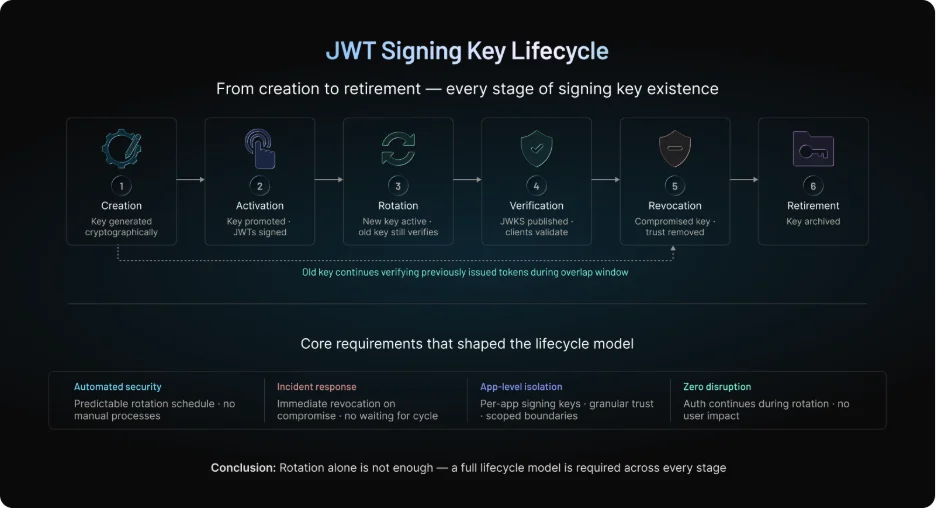
As we spoke with customers and reviewed real-world deployment patterns, several requirements consistently emerged, as discussed below.
Automated Security Operations
Security teams wanted the ability to rotate signing keys on a predictable schedule rather than relying on manual processes.
Regular key rotation helps reduce long-term exposure and aligns with common security recommendations and internal governance policies.
Immediate Incident Response
Organizations needed a way to respond to compromised keys without waiting for the next scheduled rotation cycle.
In these situations, revocation becomes just as important as rotation.
Application-Level Trust Boundaries
Many customers operate multiple applications, APIs, and services within the same tenant.
Using a shared signing key across every workload means a compromise in one area can potentially impact every application relying on that key.
Customers increasingly wanted stronger isolation between applications and more granular control over trust relationships.
Zero Authentication Disruption
Perhaps the most important requirement was maintaining continuity.
No matter how frequently keys are rotated, applications should continue authenticating users and validating tokens without interruption.
Security improvements should not come at the cost of reliability.
These requirements led us to a simple conclusion:
We couldn't solve the problem with the rotation feature alone.
What customers needed was a lifecycle model that could manage signing keys across every stage of their existence, from creation and activation to rotation, verification, revocation, and retirement.
That realization became the foundation for the architecture we ultimately built.
To guide our implementation, we established a set of core design principles focused on balancing security, operational simplicity, and uninterrupted trust.
Our Design Principles
When designing JWT signing key lifecycle management, we wanted to avoid adding security controls that increased operational complexity or created new points of failure.
Instead, we focused on building a system that could strengthen token security while remaining transparent to applications, developers, and end users.
Several design principles guided our implementation from the beginning.
Security Without Operational Complexity
One of the biggest challenges with cryptographic key management is that security improvements often come with operational overhead.
Manual rotations require coordination. Emergency key replacements can become time-sensitive incidents. Configuration drift can lead to inconsistent trust across applications and services.
Our goal was to automate as much of the lifecycle as possible while still giving administrators control when needed.
Whether a signing key is rotated automatically based on a predefined schedule or manually through an API, the underlying workflow remains consistent and predictable.
This helps teams maintain stronger security practices without introducing additional management burden.
Backward Compatibility First
JWTs don't disappear the moment a new signing key becomes active.
Applications may still receive access tokens and ID tokens that were issued before a rotation occurred. Removing trust too early can lead to token validation failures, authentication issues, and a poor user experience.
To avoid this, we designed the system around a gradual trust transition model.
When a signing key is rotated, it doesn't immediately disappear. Instead, it enters a verification-only state where previously issued tokens can continue to be validated until the configured grace period expires.
This ensures that key rotations remain invisible to users and applications while maintaining security best practices.
Trust Continuity Over Key Replacement
Many key management systems treat rotation as a replacement event.
Old Key → New Key
We approached the problem differently.
Our objective wasn't simply replacing keys. It was to maintain trust throughout the transition.
That means:
-
Existing tokens must continue to verify.
-
New tokens must immediately use the latest active key.
-
Applications must discover updated verification keys automatically.
-
Trust relationships must remain stable throughout the lifecycle.
This focus on trust continuity influenced how keys are exposed through JWKS, how grace periods are handled, and how revocation events are processed.
Prepare Before You Rotate
Security events often become disruptive when organizations are forced to generate, distribute, and activate new keys under pressure.
To reduce this risk, we wanted future signing keys to be available before they are needed.
Every rotation automatically prepares the next generation of signing keys in advance, ensuring a replacement is always available when the next lifecycle event occurs.
Instead of reacting to change, the system is continuously prepared for it.
Support Multi-Application Security
Modern identity environments rarely consist of a single application.
Organizations frequently manage multiple customer-facing applications, APIs, internal systems, and machine-to-machine services from the same identity platform.
A shared signing key across every application can create an unnecessarily large trust boundary.
As part of this project, we wanted to support application-specific signing keys that allow organizations to isolate trust between workloads.
This approach helps reduce blast radius, strengthen security segmentation, and provide greater flexibility as environments scale.
Stay Aligned with Open Standards
LoginRadius already supports industry-standard identity protocols including OAuth 2.0 and OpenID Connect.
Any improvements to signing key management needed to work seamlessly within those standards.
This meant preserving standard JWT validation workflows, supporting JWKS-based key discovery, and ensuring applications could continue verifying tokens without requiring custom integrations or proprietary trust mechanisms.
By adhering to established standards, organizations can strengthen security without changing how applications consume or validate tokens.
Together, these principles became the foundation for the architecture we built. The next challenge was translating those goals into a practical lifecycle model that could manage signing keys through every stage of trust, from activation and verification to rotation and eventual retirement.
Designing the Key Lifecycle
To support automated rotation, emergency revocation, backward compatibility, and application-level trust boundaries, we redesigned how signing keys are managed within the LoginRadius token infrastructure.
Instead of maintaining a single active signing key, we introduced four dedicated key states within the TokenConfig collection:
TokenConfig
-
Tokens
-
NextTokens
-
PreviousTokens
-
RevokedTokens
Each collection represents a different stage in the lifecycle and determines how a key can participate in signing, verification, and JWKS publication.
Key States
Tokens
The Tokens collection contains all active signing keys.
These keys are currently trusted by the platform and are responsible for:
-
Signing newly generated JWTs
-
Verifying JWTs
-
Publishing public keys through JWKS endpoints
Only keys within Tokens are eligible for token signing.
| State | Active |
|---|---|
| Sign JWTs | ✅ |
| Verify JWTs | ✅ |
| Expose in JWKS | ✅ |
During token generation, LoginRadius selects a key from the Tokens collection and includes its corresponding kid in the JWT header.
NextTokens
The NextTokens collection contains pre-generated signing keys that are reserved for future activation.
| State | Pending |
|---|---|
| Sign JWTs | ❌ |
| Verify JWTs | ❌ |
| Expose in JWKS | ❌ |
These keys allow the platform to activate a replacement signing key immediately during:
- Scheduled rotation
- Manual rotation
- Emergency revocation
By generating future keys in advance, rotation operations become deterministic and do not require real-time key generation.
PreviousTokens
When a rotation occurs, the active key is moved into PreviousTokens.
| State | Verify Only |
|---|---|
| Sign JWTs | ❌ |
| Verify JWTs | ✅ |
| Expose in JWKS | ✅ |
These keys continue to verify JWTs issued before the rotation event.
For every entry stored within PreviousTokens, LoginRadius records:
- RotateAt
- RotateType
Where RotateType can be Auto or Manual.
Keys remain in this state until the configured grace period expires.
This ensures existing access tokens, ID tokens, and machine-to-machine tokens remain valid during key transitions.
RevokedTokens
The final lifecycle state is RevokedTokens.
| State | Revoked |
|---|---|
| Sign JWTs | ❌ |
| Verify JWTs | ❌ |
| Expose in JWKS | ❌ |
Keys enter this state when:
- Their grace period expires
- An administrator manually revokes them
- An emergency trust event occurs
For every revoked key, LoginRadius records:
- RevokeAt
- RevokeType
Where RotateType can be Auto or Manual.
Once a key enters this state, it is completely removed from authentication workflows.
Signing Behavior
JWT signing is intentionally restricted to active keys. So technically speaking, the signing source is Tokens.
When generating a token:
-
Select active key from Tokens
-
Sign JWT using private key
-
Include corresponding kid
-
Return token
Verification Behavior
Verification follows a broader trust model than signing.
During Token Verification:
| Accepted | Rejected |
|---|---|
| ✅Tokens | ❌NextTokens |
| ✅PreviousTokens | ❌RevokedTokens |
The verification process is:
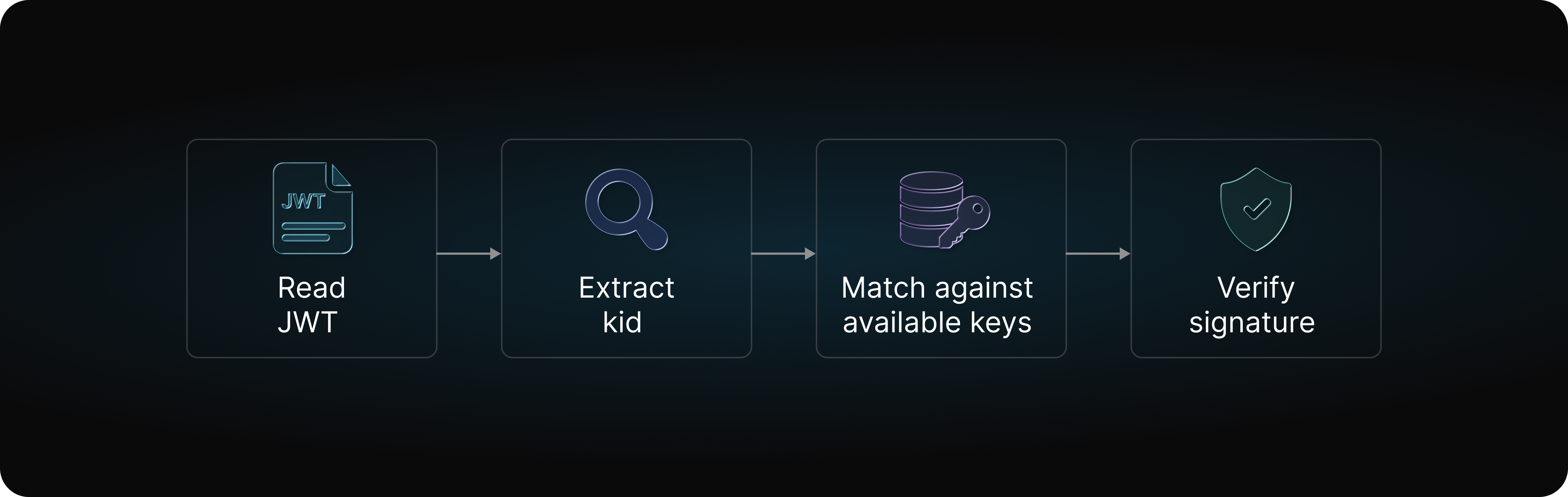
This approach allows applications to validate both newly issued tokens and tokens issued before the most recent rotation.
JWKS Publication Rules
The JWT trust model is reflected directly within the JWKS response.
| Published Keys | Excluded Keys |
|---|---|
| ✅Tokens | ❌NextTokens |
| ✅PreviousTokens | ❌RevokedTokens |
As a result:
-
Future keys remain private until activation
-
Revoked keys can never be trusted again
-
Existing tokens continue validating during grace periods
This lifecycle model became the foundation for both automated key rotation and key revocation, allowing LoginRadius to maintain trust continuity while reducing operational overhead.
How Automated Key Rotation Works
One of the primary goals of this implementation was to reduce the operational overhead associated with managing JWT signing keys while ensuring uninterrupted token verification across applications and APIs.
To achieve this, LoginRadius supports automatic key rotation through a configurable RotateFrequency setting. When Auto Rotate is enabled, the platform automatically executes the rotation workflow at the configured interval, eliminating the need for manual intervention while maintaining backward compatibility for previously issued tokens.
Regardless of whether the rotation is triggered automatically or manually, the underlying workflow remains consistent.
1. Move the Current Key to PreviousTokens
The signing key selected for rotation is moved from the Tokens collection to PreviousTokens.
During this transition, LoginRadius records lifecycle metadata including:
-
RotateAt
-
RotateType
Note, for auto-rotation, here RotateType should be Auto
Once moved to PreviousTokens, the key is no longer used to sign new JWTs. However, it remains trusted for token verification during the configured grace period.
2. Promote the Next Signing Key
After the current key is rotated out, an available key from NextTokens is promoted to Tokens.
| Before Rotation | | | --- | | --- | | Tokens | Key-A | | NextTokens | Key-B | | After Rotation | | | Tokens | Key-B | | PreviousTokens | Key-A |
The newly promoted key immediately becomes available for JWT signing and verification.
A new activation timestamp (StartAt) is recorded to indicate when the key becomes active.
3. Generate a New Future Key
To ensure the next rotation can occur without delay, LoginRadius automatically generates a new key pair and stores it in NextTokens.
| Tokens | Key-B |
|---|---|
| PreviousTokens | Key-A |
| NextTokens | Key-C |
Maintaining a future key in advance ensures that replacement signing keys are always available when the next rotation event occurs.
4. Enforce the Grace Period
Rotated keys remain in PreviousTokens for the configured GracePeriod.
During this period, applications can continue validating JWTs that were issued prior to the rotation event, ensuring a seamless transition between signing keys.
Once a key's RotateAt timestamp exceeds the configured grace period, LoginRadius automatically moves it to RevokedTokens.
At this stage, the key is permanently removed from the trust chain and is no longer available for verification.
Rotation APIs
Endpoint: POST /v2/manage/internal/signing-keys/rotate - Rotate All the Tokens Key
Endpoint: POST /v2/manage/internal/signing-keys//rotate - Rotate one based on the Kid from the Tokens Key
Authorization: DashboardM2M
Description: Manually trigger key rotation,
-
Move the Tokens Key to PreviousToken.
-
If the respective NextToken is available, move the NextToken's Key to Tokens with StartAt time to the current Time.
-
Otherwise, generate a new KeySet and add to Tokens with StartAt time to current Time.
-
Generate a new Set of tokens in the NextTokens
Why Revocation Is Just as Important as Rotation
While key rotation is designed for planned security maintenance, key revocation is designed for situations where trust must be removed immediately.
Common examples include:
-
Suspected private key compromise
-
Insider threats
-
Accidental exposure through logs or backups
-
Application decommissioning
-
Security incidents requiring immediate containment
In these scenarios, organizations cannot wait for the next scheduled rotation event. Trust must be removed immediately while ensuring authentication services remain available.
To address this, LoginRadius introduces a dedicated key revocation workflow.
Revocation Workflow
Unlike rotation, which moves keys through a transitional verification period, revocation immediately removes trust from the affected key.
When a revocation request is triggered, LoginRadius performs the following actions:
1. Move Keys to RevokedTokens
The selected key is moved into the RevokedTokens collection.
Depending on the operation being performed, the revocation can target Tokens or PreviousTokens
During the transition, LoginRadius records:
-
RevokeAt
-
RevokeType
And updates ExpireAt to the current timestamp.
Once revoked, the key is no longer trusted for signing or verification.
2. Promote a Replacement Key
After revocation, LoginRadius checks for an available key within NextTokens.
If a future key exists, it is immediately promoted to Tokens.
| Before Revocation | | | --- | | --- | | Tokens | Key-A | | NextTokens | Key-B | | After Revocation | | | RevokedTokens | Key-A | | Tokens | Key-B |
This ensures JWT signing can continue without interruption.
3. Handle Missing Future Keys
The platform is designed to continue operating even if no future key is available.
If the NextTokens collection does not contain an available key, LoginRadius automatically generates a new key set and activates it immediately.
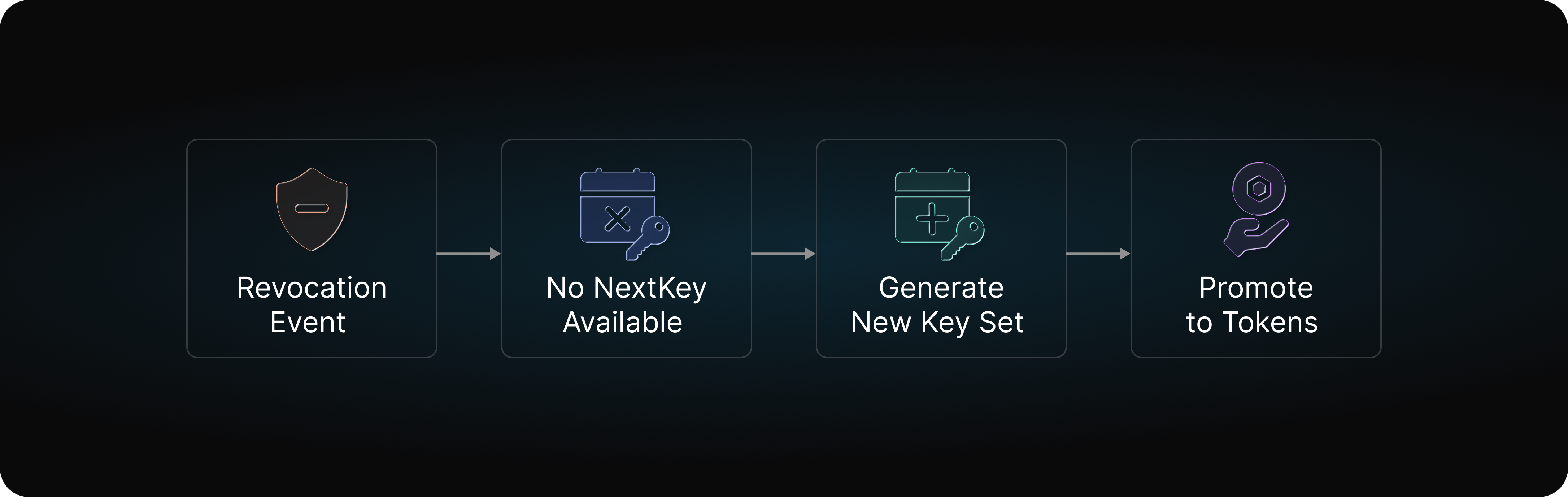
This guarantees that token issuance remains available regardless of the current lifecycle state.
4. Generate the Next Future Key
Once the replacement key becomes active, LoginRadius generates a new future key and stores it in NextTokens.
| Tokens | Key-B |
|---|---|
| NextTokens | Key-C |
| RevokedTokens | Key-A |
This keeps the lifecycle prepared for future rotation or revocation of events.
Verification Behavior After Revocation
Revoked keys are completely removed from the trust chain.
During token verification:
| Accepted | Rejected |
|---|---|
| ✅Tokens, ✅PreviousTokens | ❌RevokedTokens |
JWTs signed using keys contained within RevokedTokens are rejected during verification and their public keys are not exposed through JWKS endpoints.
Revocation APIs
Endpoint: POST /v2/manage/internal/signing-keys/revoke - Revoke All the Tokens and PerviousTokens Key
Endpoint: POST /v2/manage/internal/signing-keys//revoke - Revoke one based on the Kid from the Tokens/PerviousTokens Key
Authorization: DashboardM2M
Description: Manually trigger key rotation,
-
Move the Tokens/PreviousTokens Key to RevokedTokens.
-
If the respective NextToken is available, move the NextToken's Key to Tokens with StartAt time to the current Time.
-
Otherwise, generate a new KeySet and add to Tokens with StartAt time to current Time.
-
Generate a new Set of tokens in the NextTokens
Application-Specific Signing Keys – Reducing the Blast Radius
Most identity platforms traditionally rely on a shared signing key model, where all applications within a tenant use the same JWT signing key pair.
While this approach simplifies key management, it also creates a much larger trust boundary.
In this model, a compromised signing key affects every application that depends on it. Rotating or revoking that key may also require coordinating changes across multiple systems, increasing operational complexity and the potential impact of security incidents.
As we designed the new lifecycle framework, we wanted to give organizations greater control over how trust is established and managed across applications.
To achieve this, we worked on support for application-specific signing keys.
Isolating Trust Boundaries
Instead of relying solely on a tenant-wide signing key, LoginRadius now allows each application to maintain its own dedicated signing key pair.
Each application's signing keys are managed independently within the key lifecycle framework.
This means:
-
Key rotations can occur independently.
-
Revocation events are isolated to the affected application.
-
Verification keys are exposed only through the application's trust boundary.
-
A compromise in one application does not automatically impact others.
For organizations managing dozens or even hundreds of applications, this creates a much more secure and scalable trust model.
Dedicated JWKS Endpoints
Application-specific signing keys are paired with dedicated JWKS endpoints. You can get more details about the exposed endpoints from our docs page here.
This allows consuming applications and services to retrieve only the verification keys relevant to their specific trust relationship.
From a verification perspective, applications continue to use standard OAuth 2.0 and OpenID Connect workflows. The only difference is that trust can now be managed at a much more granular level.
Engineering Challenge: When Caching Becomes a Security Problem
Designing the key lifecycle model was only part of the challenge.
Once we started implementing rotation and revocation workflows, we encountered a more subtle but equally important problem: ensuring every application instance operates using the same signing key configuration at the same time.
Like many distributed systems, LoginRadius uses a multi-layer caching strategy to optimize performance and reduce database lookups.
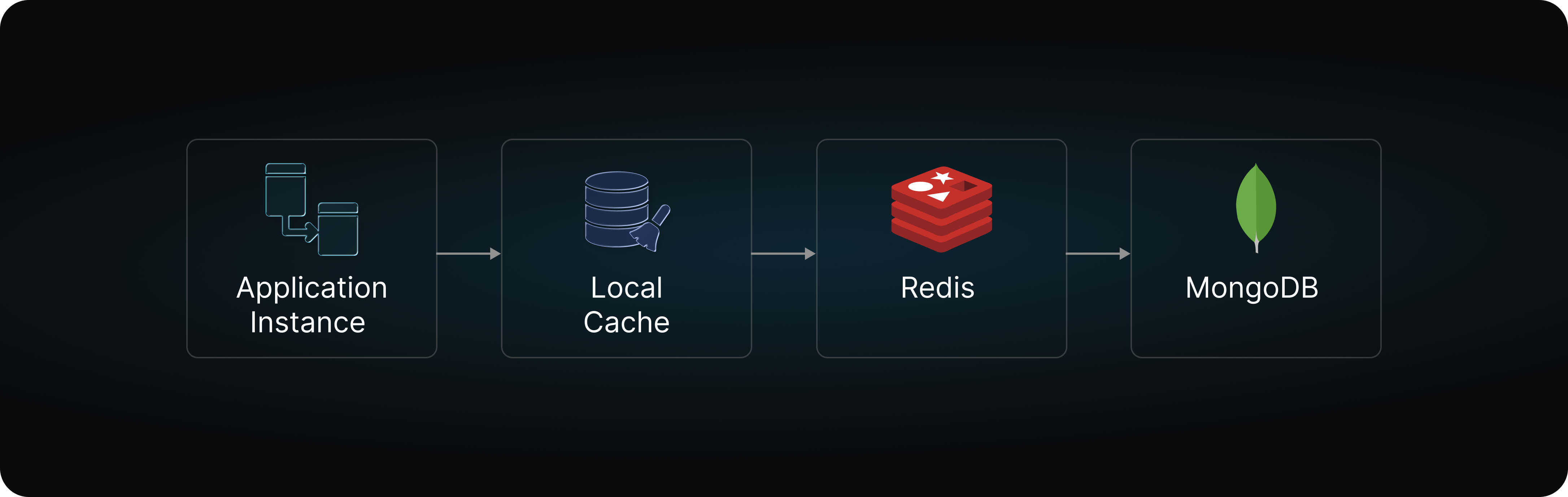
Under normal circumstances, this architecture works extremely well. Token configurations are retrieved quickly, database load is minimized, and authentication requests remain highly performant.
However, signing keys have unique requirements.
Unlike many other configuration types, key rotations and revocations are security events. Delays in propagating updated key information can result in inconsistent trust decisions across the platform.
The Consistency Challenge
Consider the following rotation scenario:
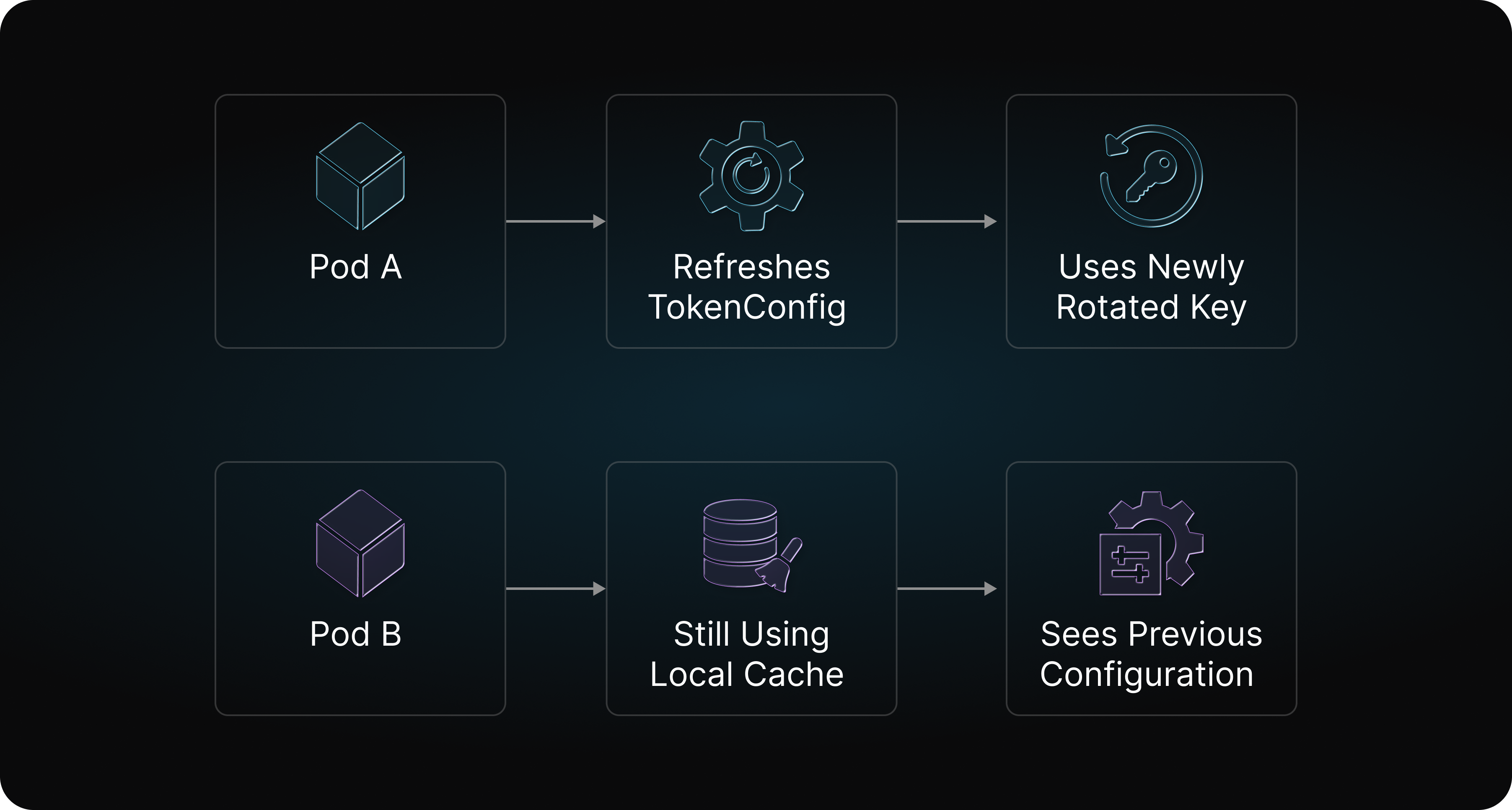
Both pods are technically operating correctly according to the information available to them.
The problem is that they no longer agree on the current trust state.
This creates a potential inconsistency where one instance begins issuing JWTs using a newly activated signing key while another instance is still validating tokens against stale key information.
| Pod A | Signs JWT using Key-B |
|---|---|
| Pod B | Attempts Verification |
Using Stale Configuration
In distributed environments running multiple application instances, these inconsistencies can manifest as intermittent token validation failures that are difficult to diagnose and even harder to reproduce.
Why Local Cache Became a Problem
The issue originated from the local in-memory cache layer.
Token configurations were cached using the configured CacheExpiry value. If no custom value was provided, the default cache lifetime was 15 minutes.
While this caching model is acceptable for many application settings, a 15-minute delay can be significant during:
-
Key rotations
-
Key revocations
-
Security incidents
-
Trust recovery operations
In these situations, we wanted changes to become authoritative immediately rather than after a cache expiration cycle.
Our Solution
After evaluating several approaches, we decided to remove the local cache dependency for TokenConfig.
Instead of relying on potentially stale in-memory data, signing key configuration is now retrieved directly from the shared data layers:
Application Instance
↓
Redis
↓
MongoDB
This ensures every application instance works with the latest available signing key configuration.
As a result:
✅ Key rotations become immediately visible across all instances.
✅ Revocations are consistently enforced.
✅ JWT signing and verification behavior remain synchronized.
✅ Trust decisions remain consistent throughout the environment.
Security Over Micro-Optimizations
In most distributed systems, local caching is considered a performance optimization.
For signing key management, however, consistency is often more important than marginal performance gains.
A few extra milliseconds spent retrieving current key information is preferable to having different parts of the system make different trust decisions.
By prioritizing consistency over local cache performance for signing key configurations, we were able to ensure that key lifecycle events are reflected across the platform as quickly and reliably as possible.
This architectural decision became a critical part of making automated rotation and revocation practical in real-world, distributed deployments.
How LoginRadius Compares to Traditional JWT Key Rotation Approaches
Most identity systems today support JWT signing and JWKS-based verification. Some platforms also provide basic signing key rotation capabilities.
However, as customer identity environments become larger and more distributed, organizations increasingly need capabilities beyond periodically replacing signing keys.
Typical JWT key management implementations focus primarily on key generation and rotation. LoginRadius extends that model by introducing a dedicated signing key lifecycle framework designed to support both planned maintenance events and emergency trust recovery scenarios.
| Capability | LoginRadius | Typical JWT Key Rotation |
|---|---|---|
| JWT Signing & Verification | ✅ | ✅ |
| JWKS Endpoints | ✅ | ✅ |
| Manual Key Rotation | ✅ | ✅ |
| Automated Key Rotation | ✅ | Varies |
| Grace-Period Verification | ✅ | Varies |
| Key Revocation | ✅ | Varies |
| Pre-Generated Future Keys | ✅ | Limited |
| Application-Specific Signing Keys | ✅ | Limited |
| Dedicated Key Lifecycle States | ✅ | Limited Visibility |
| Automated Key Promotion | ✅ | Varies |
The goal is not simply to rotate signing keys more frequently, but to ensure trust remains uninterrupted throughout the entire key lifecycle.
By separating active, future, verification-only, and revoked keys, organizations gain greater control over how trust is established, maintained, and retired across applications.
Why Automated Key Rotation for Enterprise Deployments
The value of application-specific signing keys becomes more apparent as environments scale.
Consider an enterprise managing:
-
Customer-facing web applications
-
Mobile applications
-
Partner integrations
-
Internal APIs
-
Machine-to-machine services
A shared signing key turns all of these systems into a single trust domain.
Application-specific keys allow organizations to divide that trust domain into smaller, independently managed segments.
This provides several benefits:
-
Reduced blast radius during security incidents
-
Stronger application isolation
-
Independent key rotation schedules
-
Application-level revocation capabilities
-
More granular trust management
Combined with automated rotation, revocation, and lifecycle management, application-specific signing keys help organizations move from a tenant-wide trust model to a more resilient and scalable approach to JWT security.
As we implemented these capabilities, however, we encountered an engineering challenge that had less to do with cryptography and more to do with distributed systems: ensuring every application instance always operated on the latest signing key configuration.
Who Benefits from Enterprise JWT Key Rotation and Lifecycle Management?
JWT signing key rotation and lifecycle management becomes increasingly important as identity ecosystems scale. It benefits all types of businesses under multiple use cases.
Organizations Managing Multiple Applications
Applications often have different risk profiles, user bases, and trust requirements.
Application-specific signing keys allow each workload to maintain independent trust boundaries while reducing the impact of key compromise.
OAuth 2.0 and OpenID Connect Deployments
Organizations relying on access tokens and ID tokens need a mechanism for rotating signing keys without disrupting token validation.
Automated rotation and grace-period verification help maintain compatibility throughout key transitions.
Machine-to-Machine Authentication
Service-to-service communication frequently relies on JWTs for authorization and trust establishment.
Dedicated JWKS endpoints and lifecycle-managed signing keys simplify verification while maintaining security.
Security-Conscious Enterprises
Organizations operating in regulated environments often require stronger controls around cryptographic key management.
Automated rotation, revocation, lifecycle tracking, and application-level isolation help support internal security initiatives while reducing operational complexity.
Large-Scale Distributed Systems
As environments grow across multiple applications, services, and deployment instances, manually managing signing keys becomes increasingly difficult.
Automated lifecycle management helps ensure trust remains consistent across the environment while reducing administrative overhead.
What's Next: Building the Future of Identity Trust Management
JWT signing keys sit at the heart of modern authentication systems. Every access token, ID token, and machine-to-machine interaction ultimately depends on a trusted signing infrastructure.
As organizations expand their identity ecosystems, key management can no longer be treated as an occasional maintenance activity. It becomes an ongoing process of managing trust across applications, users, services, and environments.
With the introduction of automated signing key rotation, key revocation, application-specific signing keys, and lifecycle-aware trust management, LoginRadius takes an important step toward simplifying how organizations manage JWT security at scale.
This release represents more than a new security feature. It establishes the foundation for a more comprehensive approach to identity trust management, where cryptographic operations become automated, resilient, and easier to govern across modern customer identity environments.
And we're just getting started.
Interested in getting a first-hand experience of how auth feels with LoginRadius? Book a demo today!
FAQs
Q. What is a JWT Key?
A JWT (JSON Web Token) key is a cryptographic key used to sign or verify a JSON Web Token. It helps ensure that the token is authentic and has not been tampered with.
When a user authenticates with an identity provider, the provider may issue a JWT containing claims. An API can use the issuer's public key to verify the JWT's signature before trusting those claims.
In simple terms, a JWT key is the cryptographic mechanism that lets a system prove that a JWT came from a trusted issuer and hasn't been modified.
Q. What does Key Rotation Mean?
Key rotation is the practice of regularly replacing an existing cryptographic key with a new one. It helps reduce the risk of a key being compromised and limits how long a stolen or exposed key can be used.
For JWTs, key rotation typically means replacing the key used to sign tokens while ensuring applications can still verify tokens signed with the previous key during a transition period.
For example:
-
Key A is used to sign JWTs.
-
A new Key B is generated.
-
The system starts signing new JWTs with Key B.
-
Key A remains available for verification for a short period, so existing tokens don't suddenly become invalid.
-
Once tokens signed with Key A expire, Key A is retired or removed.
Q. What are the benefits of JWT Key Rotation?
JWT key rotation strengthens authentication security as it regularly replaces the cryptographic keys that are used to sign and verify tokens. It has the following benefits:
-
Reduces key compromise impact: Limits how long an exposed signing key can be exploited.
-
Strengthens security: Reduces risks associated with long-lived cryptographic keys.
-
Limits the attack window: Retires compromised or outdated keys after existing tokens expire.
-
Supports compliance: Helps meet security and cryptographic key-management requirements.
-
Enables seamless updates: Introduces new keys without disrupting token verification.
-
Improves key management: Automates key replacement and reduces reliance on long-lived keys.
Q. Why do I need JWT Key Rotation?
JWT key rotation is an important part of cryptographic key management. It is recommended by security frameworks and industry best practices. You should do it because:
-
Security frameworks recommend regularly changing cryptographic keys to reduce exposure. Standards such as PCI DSS, SOC 2, ISO 27001, and NIST guidance emphasize secure cryptographic key management.
-
Rotating keys limits how long an exposed signing key can remain trusted.
-
Defined rotation schedules prevent cryptographic keys from remaining active indefinitely.
-
Planned rotation ensures new keys can be introduced without disrupting authentication.
-
Documented key-rotation policies provide evidence of structured security and access-control practices.
Q. How often should I rotate the JWT keys?
While there is no compulsory timeline, security best practices often recommend JWT keys should be rotated once every three to six months. Rotating JWT keys periodically help increase cryptographic security and reduce risk of exposed key misuse drastically. So, rotating keys periodically is highly recommended.