Introduction
In the identity and access management world, few topics cause more confusion than OIDC vs OAuth. The terms are often used interchangeably in blog posts, developer discussions, and even architecture diagrams. But despite appearing similar, OAuth and OpenID Connect solve two very different problems.
OAuth was designed to handle authorization. It determines what an application is allowed to access on behalf of a user. For example, when you allow a third-party app to access your Google Drive files or read your calendar events, OAuth is the protocol working behind the scenes to grant those permissions without exposing your password.
However, many developers started using OAuth as a login mechanism. At first glance it seemed to work. Applications could obtain tokens and treat them as proof of identity. The problem is that OAuth was never designed to verify who the user actually is. It only confirms that an application has permission to access a resource.
To address this gap, the identity industry introduced OpenID Connect, an identity protocol built on top of OAuth 2.0 that adds the missing authentication layer. This allows applications to authenticate users and obtain reliable identity information through standardized tokens.
Understanding the difference between OAuth vs OpenID Connect is essential for anyone building modern authentication systems. If OAuth controls what applications can access, OIDC confirms who the user is. When used together, they form the foundation of secure login systems, API authorization, and single sign-on experiences used by platforms like Google, Microsoft, and many enterprise identity providers.
Before comparing OAuth2 vs OpenID Connect in detail, it’s important to understand the original purpose of OAuth and why it became the backbone of modern authorization frameworks.
What Is OAuth?
OAuth is an authorization framework that allows applications to access specific resources on behalf of a user without exposing the user’s credentials.
In traditional systems, third-party applications often required users to share their usernames and passwords to access services. This created obvious security risks. If a user gave their credentials to an application, that application effectively had full control over their account. OAuth was introduced to solve this exact problem by replacing credential sharing with secure, limited-access tokens.
Instead of sharing passwords, OAuth allows a user to grant an application permission to access certain resources through an authorization process. Once the user approves access, the authorization server issues an access token. This token acts as a temporary key that allows the application to interact with the resource server, such as an API, within the scope of the permissions granted.
For example, imagine connecting a project management tool to your Google Calendar. The tool does not receive your Google password. Instead, Google asks whether you want to allow the application to read or manage your calendar events. Once you approve, OAuth issues a token that allows the application to access only the permitted calendar data.
This is why OAuth focuses on answering one critical question: What is this application allowed to access?
However, OAuth does not provide a reliable way to confirm the identity of the user. An access token proves that authorization has been granted, but it does not inherently verify who the user is. This limitation becomes important when developers attempt to use OAuth as an authentication solution.
What Is OpenID Connect (OIDC)?
While OAuth handles resource authorization, modern applications require a secure framework to verify a user's identity and authenticate users. OpenID Connect (OIDC) solves this by adding an identity layer on top of OAuth 2.0 to handle user authentication. In simple terms, if OAuth answers "What data can this application access?", OIDC answers "Who is the user logging in?".
📘 Deep Dive Identity Guide
Looking for a granular, step-by-step breakdown of how OpenID Connect handles cryptographically signed handshakes, public key management (JWKS), and relying on party validation rules? Read our comprehensive technical guide to OIDC Authentication and Security.
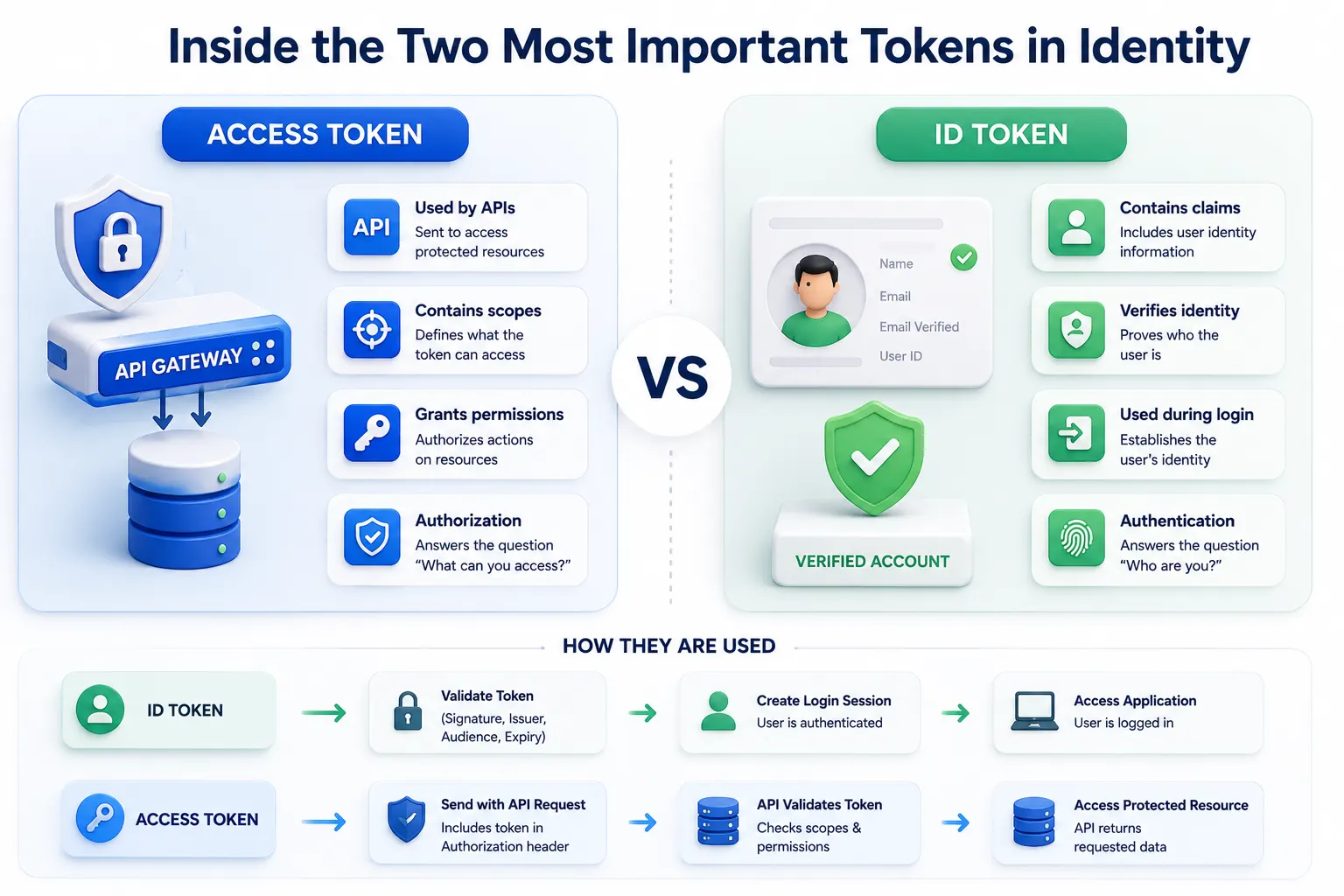
OIDC extends the OAuth framework by introducing the ID Token a cryptographically signed JSON Web Token (JWT) that safely carries verified user profile information (known as claims) directly to the client application. The ID Token allows the application to confirm that the user has authenticated with the identity provider and that the identity information can be trusted.
A typical decoded OIDC ID Token payload contains structured claims like the unique user ID (sub), issuer metadata (iss), and basic profile details:
1{
2  "iss": "https://identity-provider.loginradius.com",
3  "sub": "usr_9j2f8d3k4m1s",
4  "aud": "client_app_abc123xyz",
5  "exp": 1782399600,
6  "iat": 1782396000,
7  "auth_time": 1782395995,
8  "nonce": "n_0S6_WzA2Mj",
9  "name": "Jane Doe",
10  "given_name": "Jane",
11  "family_name": "Doe",
12  "email": "jane.doe@example.com",
13  "email_verified": true,
14  "picture": "https://identity-provider.loginradius.com/profiles/usr_9j2f8d3k4m1s.png"
15}
Unlike traditional OAuth implementations, OIDC also standardizes endpoints (such as the UserInfo endpoint), allowing developers to fetch consistent profile data across any identity provider. A typical decoded OIDC ID Token payload contains structured claims like the unique user ID (sub), issuer metadata (iss), and basic profile details:
Today, most modern authentication systems rely on OpenID Connect when implementing login functionality. Services like Google Sign-In, Microsoft Identity Platform, and enterprise single sign-on systems all rely on OIDC to provide secure identity verification while still using OAuth for resource authorization.
OAuth vs OpenID Connect: The Core Difference and Why OIDC Was Introduced
To clearly understand OIDC vs OAuth, it’s important to look at both the core difference between the two protocols and why OpenID Connect was introduced in the first place.
| Comparison Aspect | OAuth 2.0 | OpenID Connect (OIDC) |
|---|---|---|
| Primary Purpose | Authorization (Resource Access Management) | Authentication (Identity Verification) |
| Core Question Answered | "What is this application allowed to access?" | "Who is the user logging in?" |
| Primary Token Type | Access Token (often opaque or scope-based) | ID Token (Always a cryptographically signed JWT) |
| Target Audience | Resource Server / API Endpoints | Client Application (Frontend/SPA/Mobile) |
| Standard Endpoints | Token Endpoint, Authorization Endpoint | UserInfo Endpoint, Discovery Endpoint (.well-known) |
How OAuth and OpenID Connect Work Together
Although discussions about OIDC vs OAuth often frame them as separate technologies, modern identity systems rarely use them independently. In practice, OAuth and OpenID Connect are designed to work together, forming the foundation of secure authentication and authorization architectures used by modern applications.
1[User App] --(1) Auth Request / Scopes: openid email--> [IdP Server]
2[User App] <--(2) Delivers: ID Token & Access Token--- [IdP Server]
3[User App] --(3) Present Access Token---------------> [Secure API]
The process typically begins with authentication through OpenID Connect. When a user attempts to log in, the application redirects them to an identity provider such as Google, Microsoft, or another identity platform. The identity provider verifies the user’s credentials and confirms their identity. Once authentication is successful, the provider issues an ID Token, which allows the application to validate who the user is.
After the user’s identity is verified, OAuth takes over to manage authorization. The identity provider issues an access token that allows the application to access specific resources or APIs based on the permissions granted by the user. These permissions may include accessing profile information, interacting with application services, or retrieving data from protected APIs.
This combined approach is why most modern authentication flows include both protocols. OpenID Connect ensures the application knows the identity of the user, while OAuth ensures that the application only receives the level of access that has been explicitly approved.
For example, when a user signs in using a social login option like Google, OpenID Connect confirms the user’s identity and provides the application with basic identity information. OAuth then allows the application to access additional resources, such as the user’s email address or profile data, depending on the permissions granted during the authorization step
By separating identity verification from permission management, this architecture creates a more secure and scalable identity system. Instead of forcing a single protocol to handle both authentication and authorization, OpenID Connect and OAuth work together to manage identity and access in a structured and standardized way.
Real-World Example: Social Login Using OAuth and OpenID Connect
One of the easiest ways to understand how OpenID and OAuth work together is through social login. When users click options like “Continue with Google,” “Sign in with Apple,” or “Login with Facebook,” the application is using both OpenID Connect and OAuth in the background.
The process begins when a user selects a social login provider on the application. Instead of authenticating the user directly, the application redirects the user to the identity provider. This provider could be Google, Microsoft, Apple, or another trusted authentication service that already manages the user’s credentials.
Once redirected, the user signs in with the identity provider. At this point, OpenID Connect handles authentication by verifying the user’s identity. After successful authentication, the identity provider issues an ID Token, which contains verified identity information about the user such as their unique identifier, email address, and authentication details.
The application validates this ID Token to confirm that the user is legitimate. This step ensures that the login request truly came from the identity provider and that the identity information has not been altered.
After authentication is completed, OAuth handles authorization. The identity provider issues an access token that allows the application to retrieve approved user information or access specific APIs. The scope of access depends on the permissions granted by the user during the authorization step.
This approach allows applications to authenticate users securely without managing passwords directly. It also gives users greater control over what data they share with third-party applications.
Platforms like LoginRadius simplify this entire process by providing built-in support for OAuth and OpenID Connect authentication flows. Instead of implementing complex identity protocols from scratch, developers can integrate social login, identity verification, and secure token management through a unified CIAM platform.
With LoginRadius, applications can support authentication through multiple identity providers while maintaining a single unified user identity. This ensures that users can sign in using different providers while still being associated with the same account profile.
In many cases, this is achieved through intelligent identity management features such as account linking, which helps maintain a single user identity across multiple login methods.
Common Developer Mistakes When Implementing OAuth and OpenID Connect
Even though OAuth and OpenID Connect are widely used across modern applications, developers still make several implementation mistakes when working with these protocols. Most of these issues arise from misunderstanding the roles of authentication and authorization, especially when comparing oauth vs OpenID or oauth2 vs OpenID connect. Here are the actions to take to avoid common developer mistakes:
-
Don’t use OAuth access tokens as proof of authentication. Access tokens are designed to authorize API requests, not to confirm a user’s identity. Treating an access token as authentication evidence can introduce serious security risks because the token does not necessarily contain verified identity information.
-
Properly validate the ID Token issued by OpenID Connect. The ID Token is the primary mechanism used to verify a user’s identity, but it must be validated correctly. Applications should always check the token signature, issuer, audience, and expiration time before trusting the identity claims contained within it.
-
Don’t rely on outdated authentication flows. Earlier implementations of OAuth commonly used the implicit flow, especially in browser-based applications. However, modern security recommendations encourage using the Authorization Code Flow with PKCE, which provides stronger protection against token interception attacks.
-
Avoid mixing authentication logic directly with app authorization rules. Authentication should confirm the user’s identity, while authorization should determine what actions that user is allowed to perform within the system. Combining these responsibilities can make identity systems difficult to scale and harder to secure.
Identity platforms such as LoginRadius help reduce these implementation risks by providing standardized OAuth and OpenID Connect workflows that follow modern security best practices. Instead of manually handling token validation, authentication flows, and authorization logic, developers can rely on built-in identity infrastructure that correctly separates authentication and authorization responsibilities while maintaining secure token management.
Understanding these common mistakes helps developers implement identity protocols more safely and avoid the confusion that often surrounds OpenID vs OAuth implementations in real-world systems.
⚠️ Security Warning: The Authorization Code Flow with PKCE (Proof Key for Code Exchange) is mandatory because it mitigates code interception attacks on public clients such as Single Page Apps (SPAs) and native mobile apps, which cannot securely store a client secret. By utilizing a dynamic cryptographic challenge (code_challenge) verified at the token endpoint, it ensures that even if an attacker intercepts the authorization code, they cannot exchange it for an access token.
Production Checklist: ID Token Validation
When processing an OIDC ID Token, your client application must explicitly validate the following fields before trusting user claims:
-
Signature (alg): Cryptographically verify the signature against the Identity Provider’s public keys (JWKS).
-
Issuer (iss): Confirm the token origin strictly matches your IdP's URL.
-
Audience (aud): Ensure the client ID matches your specific application deployment.
-
Expiration (exp): Reject any tokens where the current system epoch time exceeds the token's lifespan.
Modern Authentication Architecture Using OAuth and OpenID Connect
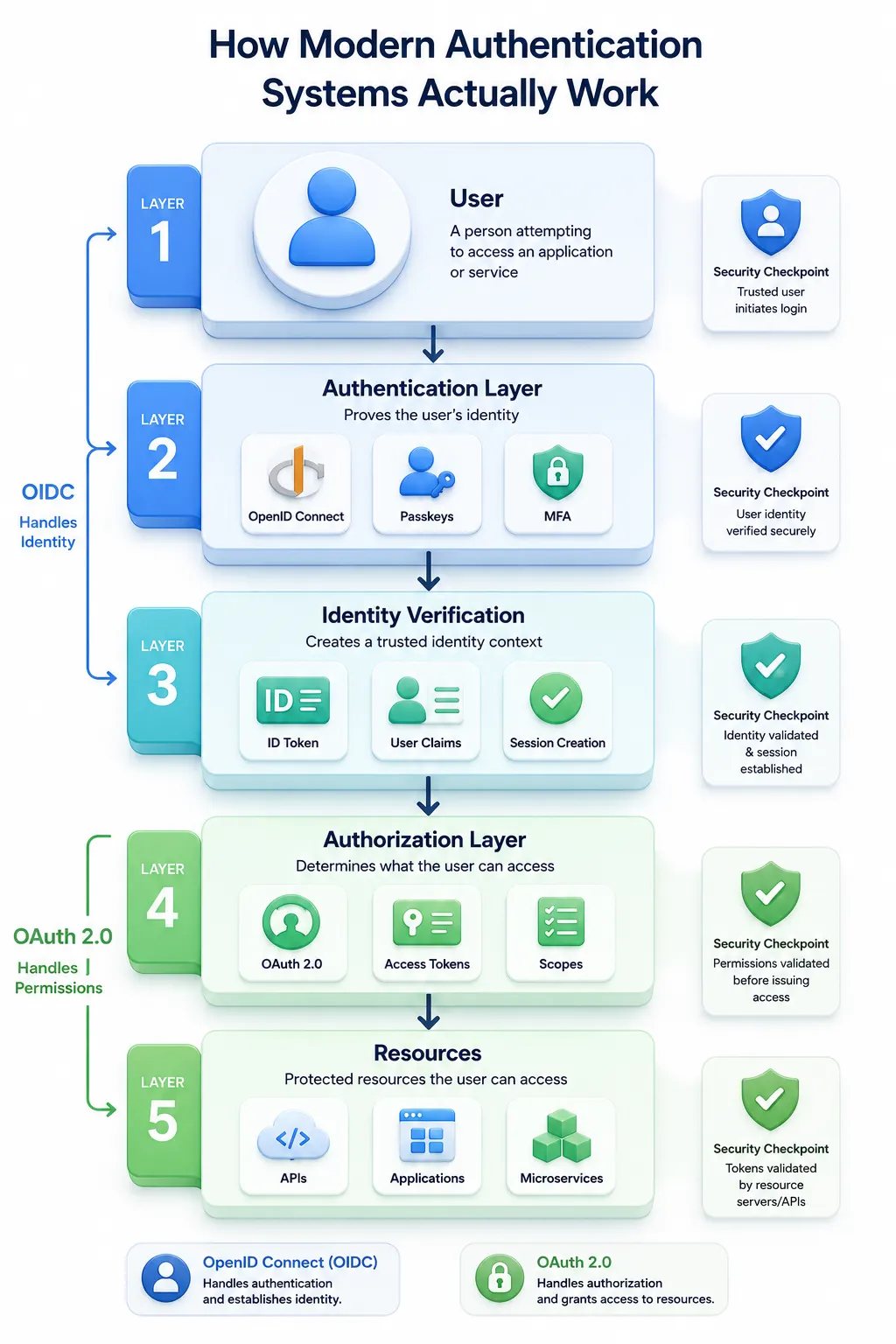
Modern digital applications rarely rely on a single identity protocol. Instead, they combine multiple security mechanisms to create a layered authentication architecture. In this architecture, OpenID Connect handles authentication, while OAuth manages authorization, allowing applications to securely verify users and control access to APIs and services.
When a user attempts to sign in, the authentication process typically begins with OpenID Connect. The application redirects the user to an identity provider where their credentials are verified. After successful authentication, the provider issues an ID Token, which the application validates to confirm the user’s identity.
This step ensures that the login process is handled by a trusted identity provider rather than by the application itself.
Once the user’s identity is confirmed, OAuth takes over to handle authorization. The identity provider issues an access token, which allows the application to interact with APIs or services on behalf of the authenticated user. These tokens define the level of access granted to the application and help enforce secure access control across different system components.
Modern authentication architectures often add additional security layers beyond OAuth and OpenID Connect. Multi-factor authentication, device recognition, risk-based authentication, and passkey-based login mechanisms are commonly integrated into identity systems to strengthen user verification and reduce account takeover risks.
For organizations building customer-facing applications, implementing this architecture manually can become complex. Identity platforms such as LoginRadius provide pre-built support for OAuth 2.0 and OpenID Connect while integrating advanced authentication capabilities like adaptive authentication, social login, and multi-factor verification.
This allows developers to focus on application development while relying on a standardized identity infrastructure to manage authentication and authorization securely.
By combining OpenID Connect for identity verification and OAuth for resource authorization, modern authentication architectures create a flexible and secure identity framework capable of supporting web applications, mobile platforms, APIs, and enterprise ecosystems.
When Should You Use OAuth vs OpenID Connect?
Understanding when to use OAuth and when to use OpenID Connect is essential for designing secure identity systems. Although the two protocols are closely related, they serve different purposes in an authentication and authorization architecture.
OAuth should be used when the goal is to grant applications permission to access protected resources. It allows users to authorize applications to interact with APIs without sharing their credentials. This is commonly used in integrations where one application needs access to another service, such as allowing a productivity tool to access a user’s cloud storage or calendar data.
In these scenarios, OAuth focuses entirely on permissions and resource access. The protocol ensures that the application receives only the level of access that the user has approved, typically through the use of access tokens that define the permitted scope.
OpenID Connect should be used when the application needs to authenticate users and confirm their identity. Unlike OAuth, OpenID Connect provides a standardized way to verify who the user is through the use of ID Tokens and identity claims. This makes OIDC suitable for implementing login systems, single sign-on experiences, and identity federation across multiple applications.
In many real-world implementations, both protocols are used together. OpenID Connect authenticates the user and establishes their identity, while OAuth authorizes the application to access specific resources or APIs on behalf of that user. This combination creates a secure and scalable identity model used by modern applications and enterprise platforms.
Identity platforms such as LoginRadius implement this model by providing integrated support for both OAuth and OpenID Connect. Developers can enable secure authentication flows, social login options, and API authorization while maintaining centralized control over user identities and permissions across applications.
Choosing between OpenID vs OAuth is therefore not about selecting one protocol over the other. Instead, it is about understanding how each protocol contributes to a secure identity architecture and using them together to manage both authentication and authorization effectively.
Conclusion
Understanding the difference between OAuth and OpenID Connect is essential for anyone building modern authentication systems. Although they are closely related, they were designed to solve two different problems within identity and access management.
OAuth focuses on authorization. It allows applications to access specific resources on behalf of a user without requiring the user to share their credentials. By issuing access tokens and defining permission scopes, OAuth ensures that applications receive only the level of access that has been explicitly approved.
OpenID Connect adds the missing authentication layer. It verifies the user’s identity and provides standardized identity information through ID Tokens. This allows applications to confidently determine who the user is while still relying on OAuth to manage resource permissions.
The confusion around OIDC vs OAuth often arises because the two protocols operate within the same authorization framework. However, their roles remain clearly defined. OpenID Connect confirms identity, while OAuth controls access.
Modern applications rely on both protocols working together to build secure login experiences, enable single sign-on, and protect APIs. When implemented correctly, this combination provides a flexible identity architecture capable of supporting web applications, mobile platforms, third-party integrations, and enterprise ecosystems.
Platforms like LoginRadius help simplify the implementation of these identity standards by providing built-in support for OAuth 2.0 and OpenID Connect authentication flows. This allows organizations to deploy secure authentication and authorization systems without managing the complexity of identity protocols themselves.
As digital applications continue to grow and integrate with external services, understanding OAuth vs OpenID and how these protocols work together will remain fundamental to building secure and scalable identity systems.
Modern Identity Requires More Than Login
Authentication is no longer just about signing users in. Organizations must verify identities, secure APIs, prevent account takeovers, and deliver seamless user experiences across every channel.
LoginRadius provides enterprise-grade OIDC, OAuth 2.0, adaptive MFA, social login, and customer identity management in a single platform so your team can focus on building products, not identity infrastructure. Schedule a Demo and See LoginRadius in Action
FAQs
Q: What is the difference between OAuth and OpenID Connect?
A: OAuth is an authorization framework that allows applications to access resources on behalf of users. OpenID Connect is an authentication protocol built on OAuth 2.0 that verifies the user's identity.
Q: Can OAuth be used for authentication?
A: Technically it can be misused for authentication, but OAuth was not designed for this purpose. OpenID Connect should be used instead because it provides identity tokens and authentication verification.
Q: What is an ID token in OpenID Connect?
A: An ID token is a JWT issued by the identity provider that contains user identity information such as user ID, email, issuer, and authentication time.
Q: Why is OpenID Connect built on OAuth 2.0?
A: OAuth provides a secure authorization framework, while OpenID Connect adds an identity layer on top of it to support user authentication.
Q: Do modern applications use both OAuth and OIDC?
A: Yes. Most modern authentication architectures use OpenID Connect for login and OAuth for API authorization.