
Introduction
Role-based access control (RBAC) is one of the most practical ways to manage authorization when users need different levels of access to applications, data, and resources. Instead of assigning permissions individually, RBAC groups permissions into roles and assigns those roles to users. That sounds straightforward. In a customer identity environment, though, the access model can become complicated quickly.
A single application may serve customers, partners, organization administrators, delegated admins, and other external identities across multiple tenants. A user might administer one organization, have limited access to another, and hold no permissions elsewhere. A role such as “Admin” means very little unless the system also knows where that authority applies and which actions it permits.
This is where RBAC identity management becomes particularly useful. It provides a structured way to connect identities with roles and permissions while keeping authorization boundaries clear. When combined with explicit tenant or resource scope, lifecycle controls, and the Principle of Least Privilege, RBAC can help organizations give users the access they need without granting broader authority by default.
For enterprise CIAM, the challenge isn't simply creating roles. It's designing an authorization model that remains understandable and manageable as users, organizations, permissions, and access requirements change.
What Is RBAC Identity Management, and How Does It Work in CIAM?
Role-based access control (RBAC) is an authorization model that grants access based on the roles assigned to a user rather than managing permissions separately for every individual. A role represents a defined set of permissions, such as viewing an account, updating a profile, managing users, or administering an organization.
The basic relationship is: User → Role → Permission → Resource
For example, a customer may have a Member role that allows access to their own account, while an Organization Admin may be permitted to invite users or manage settings within a specific organization. The application evaluates the user's assigned role and its permissions before allowing an action.
This separation becomes valuable as the number of users grows. Without RBAC, teams can end up maintaining individual permission assignments across thousands or millions of identities. Roles provide a reusable authorization structure instead.
But there is an important catch. In CIAM, knowing that someone is an Admin may not be enough. The application may also need to determine which organization, tenant, account, or resource that role applies to. An administrator for Organization A should not automatically receive the same authority in Organization B.
RBAC vs. Authentication: Identity and Authorization Are Different Decisions
Authentication and RBAC answer different questions.
Authentication asks: Who is this user?
Authorization asks: What is this authenticated user allowed to do?
RBAC belongs to the authorization side. A user can successfully authenticate with a password, passkey, social login, or MFA and still be denied access to a particular resource because their role does not include the required permission.
Keeping these decisions separate is important. Strong authentication provides confidence in the identity attempting an action. It does not, by itself, determine whether that identity should be allowed to perform the action.
Why RBAC Works Differently for Customer and Partner Identities
Traditional workforce RBAC often maps roles to relatively stable organizational responsibilities. A finance employee may receive finance-related access, for example, while an IT administrator receives a different set of permissions.
CIAM introduces a different access landscape. External users may belong to different organizations, manage multiple accounts, act on behalf of a partner, or receive delegated administrative privileges. The same person can even hold different roles depending on the organization or resource they are accessing.
Consider a partner user who is an Admin for Tenant A but only a Viewer for Tenant B. Assigning a global “Admin” role would be too broad. The authorization decision needs both the role and its applicable scope. That gives us a more useful CIAM model: Identity → Role → Scope → Permission → Resource
Here’s where teams usually go wrong: they design roles first and treat scope as an implementation detail. In multi-tenant CIAM, scope is part of the authorization boundary. Roles define what a user can potentially do; scope determines where that authority applies.
As the access model grows, other concepts become equally important—role hierarchies, constraints, sessions, permission assignments, and separation of duties. Understanding those building blocks makes it much easier to design enterprise RBAC without creating an unmanageable collection of roles.
Important Enterprise RBAC Concepts for Managing Roles, Permissions, and Access
Enterprise RBAC becomes easier to design when a few concepts are clearly separated. Roles and permissions are only part of the model. User assignments, resource scope, sessions, hierarchies, and constraints also determine what an authenticated user can actually access.
This matters even more in CIAM, where the same identity may interact with multiple organizations, applications, or resources under different levels of authority.
| RBAC Concept | What It Means | CIAM Example |
|---|---|---|
| User | An identity that can be assigned one or more roles | Customer, partner user, organization admin |
| Role | A defined collection of permissions | Member, Billing Admin, Organization Admin |
| Permission | Authority to perform a specific action | View profile, invite user, update billing |
| Resource | The object or service being accessed | Account, organization, application, workspace |
| User-Role Assignment | Association between a user and a role | User assigned Organization Admin |
| Permission-Role Assignment | Association between permissions and a role | Organization Admin receives user-management permissions |
| Session | The active context in which assigned roles may be used | User operates as an admin within Organization A |
| Role Hierarchy | A structure in which one role may inherit permissions from another | Owner inherits permissions available to Admin |
| Constraint | A rule limiting how roles can be assigned or used | A user cannot hold conflicting approval roles |
| Scope | The boundary within which authority applies | Admin permissions limited to Tenant A |
A role should represent a meaningful access responsibility rather than becoming a convenient label for every possible permission combination. If teams create a new role whenever one user needs slightly different access, role explosion follows quickly.
Permissions need the same discipline. Broad permissions such as “manage everything” may be easier to implement initially, but they make least-privilege access harder to enforce. More deliberate permissions make it possible to give a role the actions it actually requires without automatically exposing unrelated capabilities.
Scope deserves particular attention in CIAM. A role may define what a user can do, while scope establishes where they can do it. An Organization Admin, for example, may be allowed to manage users within one organization without receiving authority over every organization in the application.
Sessions add another layer. A user may be assigned several roles but operate under a particular role or authorization context during a session. Applications therefore need to consider whether the user's current authorization context still reflects valid role assignments, especially after permissions or organizational relationships change.
Role hierarchies and constraints help manage more complex environments. Hierarchies can reduce duplication by allowing appropriate permissions to be inherited across related roles. Constraints can prevent combinations of authority that create unnecessary risk—for example, separating the ability to initiate a sensitive operation from the ability to approve it.
These concepts are closely related, but they solve different authorization problems. Keeping those boundaries clear makes the next question easier to answer: which RBAC model should an organization use to represent them?
The Four RBAC Models and How They Support Different Access Requirements
RBAC is not limited to a single way of organizing roles and permissions. As access requirements become more complex, the model can incorporate role hierarchies, constraints, and administrative relationships.
The commonly discussed progression includes Core RBAC, Hierarchical RBAC, Constrained RBAC, and Symmetric RBAC. In the earlier NIST RBAC model, the foundational level was called Flat RBAC; the later NIST/ANSI standard formalized Core RBAC as the required base component. The terminology differs slightly, but the underlying idea is similar: start with users, roles, permissions, and sessions, then add capabilities for more complex authorization requirements.
Core RBAC Establishes the Basic User-Role-Permission Relationship
Core RBAC provides the fundamental structure for role-based authorization. Users are assigned to roles, permissions are assigned to roles, and those roles determine which operations a user may perform.
A simple CIAM relationship might look like: Customer → Organization Member → View Workspace
Instead of granting the View Workspace permission separately to every customer, the permission belongs to the Organization Member role. Users who need that level of access receive the role.
This model works well when access responsibilities are clearly defined and there is little need for inheritance or complex restrictions between roles.
Hierarchical RBAC Allows Roles to Inherit Permissions
Hierarchical RBAC introduces relationships between roles. A more privileged role can inherit permissions associated with another role, reducing the need to duplicate the same permissions across multiple assignments.
For example: Organization Owner → Organization Admin → Member
An Organization Admin might inherit standard Member permissions while receiving additional authority to invite or manage users. An Organization Owner could inherit those capabilities and receive additional permissions for organization-level administration.
Hierarchies can simplify permission management, but deeper is not necessarily better. Large inheritance chains make it harder to determine why a user has a particular permission and can unintentionally broaden access when a lower-level role changes.
For CIAM, role inheritance should also remain within the appropriate organizational or resource boundary. Being an Owner of one organization should not create inherited authority in another.
Constrained RBAC Places Restrictions on How Roles Are Assigned or Used
Some access decisions cannot be safely represented through inheritance alone. Constrained RBAC introduces rules that restrict certain role assignments or combinations.
A common example is separation of duties (SoD). An organization may not want the same user to initiate and approve a sensitive operation.
Two forms are particularly useful: Static Separation of Duties (SSD) prevents a user from being assigned conflicting roles at the same time.
Dynamic Separation of Duties (DSD) may allow a user to hold multiple roles but prevents conflicting roles or permissions from being activated together within a particular session or operation.
These constraints can be useful for sensitive administrative, financial, approval, or delegated-access workflows where one role should not provide unchecked authority over an entire process.
Symmetric RBAC Extends Control Over Role and Permission Administration
Symmetric RBAC extends the model by supporting administrative relationships around both user-to-role and permission-to-role assignments. This makes it easier to examine and manage RBAC from both directions: which roles a user holds and which roles contain a particular permission.
That becomes useful in large environments where authorization governance involves more than assigning users to predefined roles. Security and identity teams may also need to understand where sensitive permissions are used, review role definitions, and change permission-role relationships without inspecting every user individually.
Symmetric RBAC is less commonly discussed in day-to-day CIAM implementations than core or hierarchical RBAC, but the underlying governance problem becomes increasingly relevant as role and permission structures grow.
A quick comparison makes the progression clearer:
| RBAC Model | What It Adds | Where It Helps |
|---|---|---|
| Core RBAC | Users, roles, permissions, and sessions | Straightforward role-based authorization |
| Hierarchical RBAC | Permission inheritance between roles | Related roles with increasing levels of authority |
| Constrained RBAC | Restrictions such as separation of duties | Sensitive or conflicting access responsibilities |
| Symmetric RBAC | Broader management of user-role and permission-role relationships | Large RBAC environments requiring stronger governance |
These models are not necessarily four competing choices. An enterprise authorization design can use the basic RBAC structure while introducing hierarchy or constraints where the access model requires them.
Whichever capabilities are used, the security objective stays consistent: a role should provide enough authority for the user to perform the intended task without granting unnecessary access. That brings RBAC directly into the Principle of Least Privilege.
How Enterprise RBAC Enforces the Principle of Least Privilege
The Principle of Least Privilege (PoLP) says that a user, application, or other identity should receive only the access required to perform its intended tasks—and no more. RBAC gives organizations a practical way to apply that principle by grouping appropriate permissions into roles rather than granting broad access directly to individual users.
The distinction matters. Least privilege is the security principle; RBAC is one way to enforce it. Simply deploying RBAC does not automatically produce least-privilege access. A poorly designed Admin role with excessive permissions is still overprivileged, even if the application technically uses RBAC.
A useful way to evaluate access is: Required Permissions + Appropriate Role + Correct Scope → Least-Privilege Access
For CIAM, that last part is easy to overlook. A partner administrator may legitimately need permission to manage users, but only within the organizations they administer. Giving the correct permission under a global scope would still violate least privilege.
Design Roles Around Required Permissions, Not Convenience
Roles should reflect real access responsibilities. Start by identifying the actions a user needs to perform, then group those permissions into roles that represent meaningful responsibilities.
Broad roles are tempting because they reduce initial configuration work. They also make it easier for unnecessary permissions to accumulate. A Billing Admin, for example, should not receive user-management permissions simply because both functions are considered administrative.
Keep Privileged Roles Narrow and Purpose-Built
Roles capable of changing permissions, managing other users, accessing sensitive data, or performing high-impact operations deserve tighter boundaries.
Instead of placing every administrative capability into one powerful role, organizations can separate responsibilities where the application requires it. Combined with constrained RBAC and separation of duties, this can prevent a single role from carrying unnecessary authority across unrelated operations.
Apply Least Privilege to Scope, Not Just Permissions
Permission checks answer only part of the authorization question. Consider: User → Organization Admin → Manage Users
That looks valid until the resource boundary is considered. A safer decision includes scope: User → Organization Admin → Organization A → Manage Users
Now the application knows both what the user may do and where that authority applies.
This becomes especially important for multi-tenant SaaS applications, partner ecosystems, and delegated administration. Roles that cross tenant boundaries unintentionally can expose resources even when the individual permissions appear correctly configured.
Review Access as Roles and Relationships Change
Least privilege is not a one-time configuration exercise. Customers change organizations, partners lose responsibilities, administrators move between roles, and permissions evolve as applications add functionality.
Without regular review and timely revocation, valid access can gradually become excessive access. This is often called permission creep or privilege creep.
Role assignments, privileged permissions, organizational memberships, and delegated access should therefore be reviewed throughout the identity lifecycle. When a relationship ends, the associated access should end with it.
Keep Least Privilege Visible as the RBAC Model Scales
Here’s where teams usually go wrong: they optimize RBAC for easier administration and assume least privilege will follow automatically. It won't.
Role inheritance, reusable roles, delegated administration, and broad permission sets can simplify operations, but each can also expand effective access if boundaries are unclear. The goal is not to create the fewest roles possible. It is to maintain an access model that remains understandable, appropriately scoped, and easy to revoke.
For enterprise CIAM, this means treating roles, permissions, scope, and lifecycle changes as parts of the same authorization model. The next challenge is applying that model when a single application serves multiple tenants, organizations, and resource boundaries.
Designing RBAC for Multi-Tenant CIAM With Global, Tenant, and Resource-Level Access
Multi-tenant CIAM makes RBAC more challenging because a role rarely exists in isolation. The application also needs to know the boundary within which that role is valid.
Consider a B2B SaaS platform where one person belongs to three customer organizations. They may be an administrator for one organization, a standard member of another, and have read-only access to the third. A single global role cannot accurately represent all three relationships.
A more useful authorization structure separates access into different levels: Global Roles → Tenant or Organization Roles → Resource-Level Permissions
This allows the application to keep broad platform authority separate from organization-specific responsibilities and individual resource access.
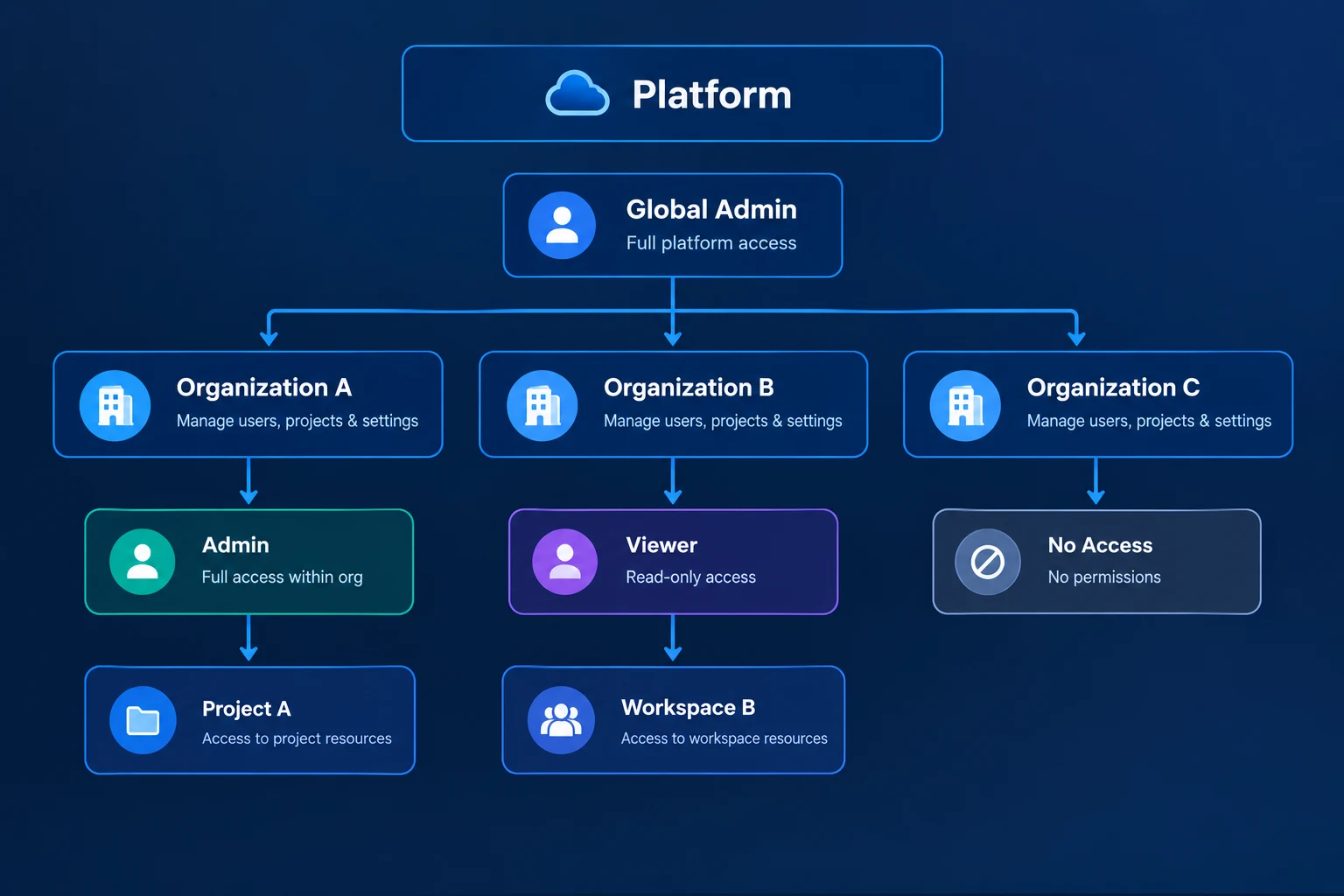
Global Roles Should Be Reserved for Platform-Wide Authority
Global roles apply across the application rather than within a single customer organization or tenant. Because their scope is broad, they should be used carefully.
A platform-level administrative role, for example, may need capabilities that are unavailable to customer organization administrators. Those permissions should not be mixed into ordinary tenant roles simply because both users perform some form of administration.
This separation also makes authorization easier to reason about. When platform-wide authority is explicit, teams can avoid accidentally turning an organization-level role into a route to global access.
Tenant and Organization Roles Keep Authority Within Customer Boundaries
Most customer and partner administration belongs at the tenant or organization level.
An Organization Admin might be able to invite members, manage organization settings, or assign permitted roles—but only within the organization where that administrative relationship exists.
The same identity can therefore hold different assignments simultaneously:
User → Admin → Organization A
User → Member → Organization B
User → Viewer → Organization C
The role name alone is not enough to authorize an action. The application must evaluate the role together with the tenant or organization associated with the requested resource.
This is particularly important for partner identities. A partner administrator may legitimately manage several customer organizations without receiving authority over every tenant using the application.
Resource-Level Permissions Provide Finer Access Where Roles Are Too Broad
Not every authorization requirement maps neatly to an organization-wide role.
Some applications need to control access to specific projects, workspaces, accounts, documents, or other resources within a tenant. Resource-level permissions can provide that additional granularity without requiring a new role for every possible access combination.
Suppose an Organization Member can generally view projects, but only selected users may modify Project A. The authorization decision may need to consider both the user's organization role and their permission for that particular resource.
That relationship might look like: Identity → Organization Role → Tenant Scope → Resource Permission → Requested Action
The goal is not to push every authorization decision down to individual resource permissions. Doing so can recreate the management complexity RBAC was intended to reduce. Use roles for repeatable access patterns and introduce finer-grained controls where the resource model actually requires them.
Delegated Administration Needs Explicit Boundaries
Delegated administration is common in CIAM. A business may allow customer administrators or partners to manage users without giving them platform-wide administrative control. The dangerous shortcut is treating delegated administration as a smaller version of a global Admin role.
Instead, delegated authority should answer specific questions: Which organization can this administrator manage? Which actions can they perform? Which roles can they assign? Can they grant a role equal to or more privileged than their own? Which resources remain outside their control?
An administrator who can assign roles without appropriate restrictions may be able to indirectly grant permissions they should not control.
Authorization Should Resolve Role, Scope, Permission, and Resource Together
A multi-tenant authorization decision therefore needs more context than: Does this user have the Admin role?
A more complete evaluation is: Authenticated Identity → Role → Tenant/Organization Scope → Required Permission → Target Resource → Allow or Deny
If the role belongs to Organization A but the requested resource belongs to Organization B, the request should not become valid simply because the role name matches.
This is one of the most important design rules for CIAM RBAC: authority should follow the user's relationship to the target resource, not just the presence of a role.
Once those relationships are defined, the application still needs a reliable way to carry and enforce authorization information across sessions, tokens, APIs, and downstream services.
How RBAC Permissions Are Enforced Through Tokens, Claims, Sessions, and APIs
Defining roles and permissions is only one part of RBAC. Applications still need to carry enough authorization context to the systems making access decisions and verify that context when a protected action is requested.
In modern CIAM architectures, that information may travel through access tokens, session state, or authorization data available to an API or policy layer. The exact implementation varies, but the principle is consistent: the service protecting a resource must be able to determine whether the authenticated identity has the required authority for that specific request.
For a multi-tenant application, checking for a role such as Admin is rarely sufficient. The decision may also depend on the organization, resource, permission, and current authorization context.
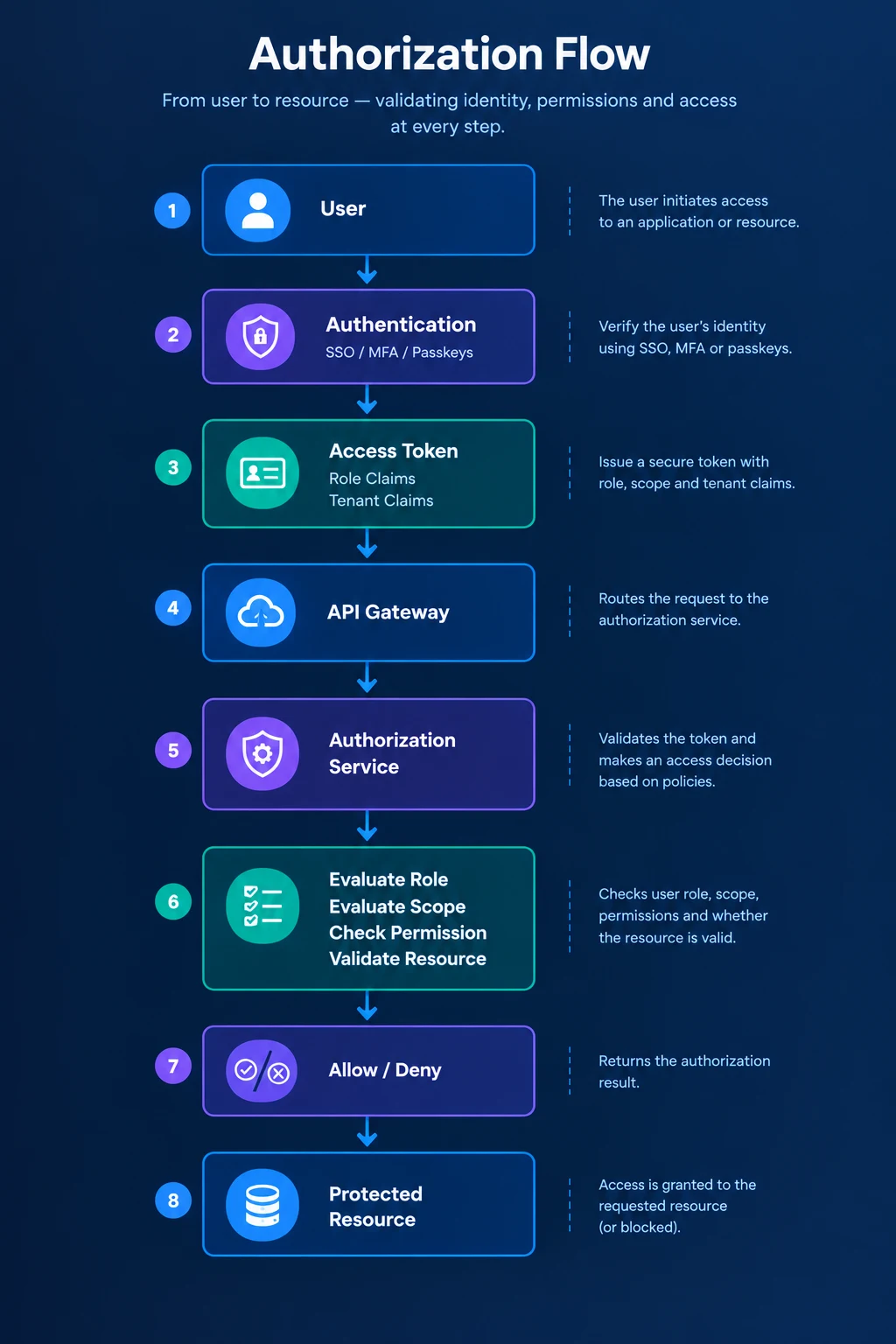
Example RBAC Authorization Flow
-
The user authenticates using SSO, passkeys, MFA, or another login method.
-
The identity provider issues an access token containing role and tenant claims.
-
An API receives the request.
-
The authorization service evaluates role, scope, permissions, and resource context.
-
The application allows or denies the request.
Keep Identity Claims and Authorization Claims Distinct
Identity and authorization information serve different purposes.
With OpenID Connect (OIDC), identity claims can describe the authenticated user. OAuth access tokens, depending on the authorization architecture and token design, can carry or reference information used by APIs to determine what access has been granted.
Roles, permissions, scopes, tenant identifiers, and similar authorization context should therefore not be treated as interchangeable with basic identity information.
An application may know exactly who the user is and still deny the request because that identity does not have permission to perform the requested action.
Carry Only the Authorization Context the API Needs
Authorization data needs to be useful without becoming unnecessarily broad.
For example, an API handling an organization-level action may need to evaluate: User → Organization → Role/Permission → Requested Resource → Requested Action
If a token or session indicates only that the user is an Admin, the API may not know which organization that authority belongs to. If it contains every permission the user has across every organization, the authorization model can become harder to manage and may expose more authorization information than the receiving service needs.
The better approach depends on the architecture. Some systems include appropriate authorization claims in access tokens. Others use identifiers or scopes and resolve current permissions through an authorization service or policy layer. What matters is that the API validates the authority relevant to the requested resource instead of trusting a role name without context.
Enforce Permissions at the API and Resource Boundary
UI controls are useful for customer experience, but hiding a button is not authorization. A user may bypass the interface and send a request directly to an API. Protected APIs must independently verify whether that request is permitted.
Consider an endpoint that removes a member from an organization. The authorization logic may need to establish that the requester is authenticated, belongs to the relevant organization, has the required permission, and is allowed to exercise it against the target resource.
The resulting decision might resemble: **API Request → Validate Authentication Context → Resolve Organization → Check Required Permission → Validate Resource Scope → Allow or Deny. **Client-side controls can reflect the result. They should not be the control that determines it.
Account for Role and Permission Changes During Active Sessions
Here’s where it gets interesting. Authorization can change while a user is still signed in.
An administrator may be demoted, removed from an organization, or lose a sensitive permission. A partner relationship may end. If an application relies on long-lived authorization data without accounting for these changes, previously valid access can remain usable longer than intended.
How quickly a change takes effect depends on the session and token architecture. Applications may use shorter-lived access tokens, token renewal, session invalidation, current authorization lookups, or other revocation strategies where appropriate.
The important requirement is simpler: changing or removing a role should have a defined path to changing effective access.
Treat Authorization as a Server-Side Decision, Not a Token Assumption
A valid token proves only what that token and its issuer are designed to establish. Its presence should not automatically mean that every requested action is authorized.
The resource server still needs to validate the token appropriately and evaluate the authorization requirements for the requested operation. In multi-tenant CIAM, that frequently means matching the user's authority to the correct tenant and resource rather than checking authentication alone.
This separation keeps RBAC enforceable beyond the login boundary: Authentication → Authorization Context → API/Policy Evaluation → Resource-Level Decision → Allow or Deny
Roles provide a manageable starting point for those decisions. But some authorization requirements depend on attributes and contextual conditions that a role alone cannot represent cleanly. That is where the distinction between RBAC and ABAC becomes useful.
RBAC vs. ABAC: When Roles Are Enough and When Context Matters
RBAC works well when access can be organized around recognizable responsibilities. An Organization Admin manages users. A Billing Admin handles billing operations. A Member receives standard application access. Roles make these permissions easier to assign, review, and reuse across large numbers of identities.
But roles cannot always express every authorization condition cleanly. What if access depends on the user's organization, the classification of a resource, the requested action, or another attribute available at decision time? Trying to represent every combination as a new role can quickly lead to role explosion.
This is where attribute-based access control (ABAC) becomes useful.
RBAC makes authorization decisions primarily through roles and their associated permissions. ABAC evaluates policies using attributes associated with subjects, resources, actions, and, where applicable, environmental context.
The difference becomes clearer when the same access request is expressed both ways.
RBAC: Does this user have a role with permission to edit the resource?
ABAC: Do the relevant attributes satisfy the policy required to edit this particular resource?
| Area | RBAC | ABAC |
|---|---|---|
| Decision Basis | Roles and associated permissions | Attributes evaluated against policies |
| Access Structure | Role-based and reusable | Fine-grained and policy-driven |
| Administration | Often simpler when responsibilities are stable | Can require more policy design and governance |
| Granularity | Best suited to repeatable permission sets | Useful when access depends on multiple attributes |
| Typical CIAM Example | Organization Admin can manage users | Permit an action when user, organization, resource, and policy attributes satisfy defined conditions |
When RBAC Is the Better Fit
RBAC is a strong fit when groups of users repeatedly need the same permissions.
A multi-tenant SaaS application, for example, may have well-defined Member, Billing Admin, and Organization Admin responsibilities. Creating reusable roles for those responsibilities is easier to understand than evaluating a large collection of attributes for every basic authorization decision.
Roles also give administrators a recognizable way to reason about access. Asking “Who are our organization administrators?” is generally easier than reconstructing equivalent access from numerous individual policy conditions. That simplicity is valuable but only while roles continue to represent meaningful access patterns.
When RBAC Alone Becomes Too Coarse
Problems appear when teams start creating roles to represent every possible exception.
Imagine that an application needs different authorization rules based on organization membership, resource ownership, data classification, or another relevant property. Encoding every combination as a separate role could produce definitions such as Regional-Billing-Admin-A, Regional-Billing-Admin-B, and dozens of similar variations.
That is usually a warning sign. ABAC can express these conditions through policies that evaluate the attributes relevant to the decision instead of creating another permanent role for each variation.
This does not mean ABAC is automatically more secure or that finer-grained authorization is always better. More policy inputs can also mean more policy complexity. Those policies need clear ownership, reliable attribute data, testing, and governance.
RBAC and ABAC Can Work Together
Enterprise authorization does not have to become an RBAC versus ABAC decision.
A practical architecture can use RBAC to establish baseline authority and additional policy conditions where a role alone cannot express the required boundary.
For example: Organization Admin Role → Has User Management Permission → Organization Attribute Matches Target Resource → Policy Conditions Satisfied → Access Allowed
The role answers whether the user has the underlying administrative authority. Additional attributes can narrow where or under what defined conditions that authority can be exercised.
This approach can preserve the administrative clarity of RBAC without creating a new role for every contextual variation.
The important part is keeping responsibilities clear. Roles should represent durable access responsibilities. Attributes and policies should handle conditions that genuinely depend on additional context.
There is another distinction worth making. Some contextual signals are not authorization attributes at all. A suspicious login location, unusual device, or elevated authentication risk may indicate that the application needs stronger identity assurance before proceeding. That brings us to risk-based authentication—and why it can strengthen an RBAC-protected journey without replacing the authorization decision itself.
How Risk-Based Authentication Strengthens RBAC Without Replacing Authorization
RBAC determines whether an identity has the authority to perform an action. Risk-based authentication addresses a different question: does the application have sufficient confidence in the authentication event or current session to proceed?
That distinction matters. A user may have the correct role and permission to perform a sensitive action, but the application may detect signals that justify additional verification. Conversely, successfully completing stronger authentication should not grant a permission the user did not already have.
A simplified relationship looks like this: Authenticated User → RBAC Permission Check → Risk Evaluation → Allow / Step-Up / Deny
RBAC Determines Authority; Risk Signals Influence Assurance
Suppose an Organization Admin has permission to modify sensitive account settings. Under normal conditions, the application may allow the action based on the authenticated session and valid authorization context.
If relevant risk signals indicate that additional assurance is required, the application can request another authentication step before allowing the action to continue.
The important point is that the user's authorization has not changed. The Organization Admin role still defines what the user is permitted to do. Risk-based controls influence whether the current level of authentication assurance is sufficient for that action.
Step-Up Authentication Should Not Create New Permissions
Completing MFA or another step-up challenge can provide stronger assurance that the person attempting an action is the legitimate account holder. It does not turn a Member into an Admin or authorize access to a resource outside the user's permitted scope.
For example: Member → Requests Admin-Only Action → Permission Missing → Deny
There is no reason to offer step-up authentication here. The user lacks the underlying authorization.
Compare that with: Organization Admin → Requests Sensitive Authorized Action → Additional Assurance Required → Step-Up Authentication → Re-evaluate → Allow or Deny
In the second case, the user already has the required authority. Step-up authentication addresses assurance, not entitlement.
Use Risk-Based Controls Where Additional Assurance Is Justified
Not every RBAC-protected action needs the same authentication requirements. Higher-impact operations may justify stronger controls than routine actions.
Depending on the application's risk model, relevant signals may include changes in device or session context, unusual authentication behavior, or other indicators evaluated by the authentication system. Sensitive actions such as changing security settings or performing privileged administrative operations may also trigger predefined step-up requirements.
The exact signals and thresholds will vary by implementation. What should remain consistent is the separation between the two decisions:
Authorization: Is this identity permitted to perform the action?
Authentication assurance: Is the current authentication context sufficient to proceed?
Keeping those decisions distinct prevents RBAC from becoming overloaded with authentication logic and prevents stronger authentication from being mistaken for broader authorization.
When RBAC, appropriate scope, and risk-based authentication are used together, they provide complementary controls. But poor role design can still undermine the entire model. Role explosion, stale access, missing tenant boundaries, and excessive delegated authority are some of the failure patterns enterprise CIAM teams need to catch early.
Common RBAC Failure Patterns That Weaken CIAM Authorization
RBAC can simplify access management, but the model tends to become harder to control as applications add customers, organizations, partners, resources, and administrative workflows. The problem is rarely RBAC itself. More often, access structures gradually stop reflecting how authority is supposed to work.
Some failure patterns are especially common in enterprise CIAM.
Role Explosion Makes Access Harder to Understand
A new role can seem like the easiest answer whenever an existing role does not fit a particular user or use case. Over time, that creates dozens of slightly different roles with overlapping permissions.
You might start with: Member → Admin → Owner
and eventually end up with: Member → Senior Member → Project Admin → Billing Admin → Limited Admin → Regional Admin → Partner Admin → Custom Admin
Not every additional role is unnecessary. The warning sign is when roles exist mainly to represent one-off exceptions rather than durable access responsibilities.
Before creating another role, check whether the requirement is better represented through a permission, resource scope, hierarchy, or policy condition.
Permission Creep Gradually Expands Effective Access
Roles change as products evolve. A team may add a permission to an existing role to solve an immediate requirement without checking every user who already holds that role.
The result can be subtle. Users who were correctly authorized when the role was created may later inherit capabilities they no longer need.
Permission creep can also happen at the individual level when users accumulate roles as their responsibilities change but old assignments remain active.
Regular access reviews matter for this reason. Teams need visibility into both sides of the relationship: which roles a user holds and which permissions those roles currently provide.
Missing Tenant Scope Can Turn Valid Roles Into Excessive Access
A user may legitimately hold an Admin role and still be unauthorized for the requested resource.
Consider: User → Admin → Manage Users
If the application fails to bind that authority to the correct organization, the role can become broader than intended.
The authorization decision should preserve the relationship: User → Admin → Organization A → Manage Users → Organization A Resource
Requests involving Organization B need their own valid authorization context. This is particularly important when one identity belongs to multiple organizations or when partners administer resources for several customers.
Stale Access Can Survive Changes in Customer and Partner Relationships
External relationships change frequently. A customer administrator may leave an organization. A partner may stop managing an account. A user's role may be downgraded while an existing session or authorization artifact still reflects earlier privileges.
If those changes do not propagate into effective access quickly enough, authorization can become stale.
Teams should therefore define what happens when a role is removed, an organization membership ends, or a sensitive permission changes. Role lifecycle and session/token behavior need to support the same access model rather than operating independently.
Delegated Administrators Can Become Overprivileged
Delegated administration is useful because customers and partners can manage appropriate access without depending on a platform administrator for every change.
But delegation needs limits.
An Organization Admin who can assign any available role could potentially grant another user permissions beyond the administrator's own intended authority. Similar problems appear when delegated admins can modify protected roles, expand their own permissions, or administer resources outside their organization.
Delegated administration should define not only who can assign roles, but also which roles and permissions they are allowed to manage, for whom, and within which scope.
Support Access and Impersonation Need Stronger Controls
Support teams sometimes need controlled access to troubleshoot customer issues. Giving support personnel permanent customer-level administrative roles is a poor substitute for a purpose-built support workflow.
Where impersonation or delegated support access is required, the application should define appropriate authorization boundaries, limit what can be performed, maintain auditability, and provide a clear way to end that access.
The goal is to solve the support problem without silently turning temporary operational access into standing privilege.
Authorization Data Can Outlive the Permissions Behind It
Roles and permissions may be represented or referenced through sessions and access tokens. If authorization changes but previously issued authorization context remains usable for too long, a user may temporarily retain capabilities that have already been removed from the source access model.
There is no single revocation strategy that fits every architecture. Token lifetime, session invalidation, authorization lookups, refresh behavior, and the sensitivity of the protected operation all affect the design.
What matters is having a deliberate answer to a simple question: If we remove this permission now, when does the user's effective access actually change?
These problems become much easier to control when RBAC is treated as an ongoing authorization system rather than a one-time collection of roles. Clear permissions, limited scope, lifecycle controls, access reviews, and server-side enforcement all need to work together.
That leads directly to the practical side of the model: how to design and maintain enterprise RBAC without allowing access structures to become unnecessarily complex or overprivileged.
Enterprise RBAC Best Practices for Secure and Scalable Access Management
A well-designed RBAC model should remain understandable as the application grows. Security teams need to know why a user has access, developers need predictable authorization rules to enforce, and administrators need a manageable way to change or revoke that access.
That requires more than creating a few roles during initial application design. RBAC needs clear permission boundaries, controlled administration, lifecycle management, and regular review.
-
Design Permissions Before Creating Roles
-
Apply Least Privilege by Default
-
Avoid Creating Roles for Individual Users
-
Keep Tenant and Resource Scope Explicit
-
Use Role Hierarchies Carefully
-
Apply Separation of Duties to Sensitive Operations
-
Restrict Delegated Role Administration
-
Review Roles and Access Regularly
-
Revoke Access When the Underlying Relationship Ends
-
Audit Changes to Roles, Permissions, and Assignments
-
Test Authorization at the API and Resource Layer
A sustainable RBAC model comes down to a few connected disciplines: define permissions deliberately, keep roles meaningful, limit their scope, enforce authorization server-side, and remove access when it is no longer justified.
The final test is how those principles behave together in a realistic multi-tenant CIAM environment.
How Enterprise RBAC Works in a Multi-Tenant CIAM Application
Consider a B2B SaaS application used by multiple customer organizations. Each organization manages its own users, while selected partners can work across several customer accounts. The platform also has internal support functions that require tightly controlled access.
A basic role structure might include: Organization Owner → Organization Admin → Billing Admin → Member
These roles represent repeatable responsibilities, but they do not exist globally. An Organization Admin for Customer A should not automatically receive administrative authority over Customer B.
Now add a partner user who manages accounts for two customers: Partner User → Partner Admin → Customer A + Customer B
The Partner Admin role may include permission to manage designated resources within those two organizations. Customer C remains outside the user's scope, even though the same role exists elsewhere in the platform.
This gives the authorization model several pieces to evaluate: Identity → Role → Organization Scope → Permission → Resource → Requested Action
A Sensitive Action Shows How the Controls Work Together
Suppose the Partner Admin requests an export from Customer A.
The application should not authorize the operation simply because the identity has a Partner Admin role. It needs to verify that the role applies to Customer A and that the role includes the permission required for that export.
The request can be represented as: Partner Admin Requests Export → Authentication Context Validated → Customer A Scope Confirmed → Export Permission Checked → Target Resource Validated → Additional Assurance if Required → Allow or Deny → Audit Event
Now change one detail. The same user requests an export from Customer C.
The identity is still authenticated. The Partner Admin role is still valid. The export permission may also exist within that role. But the user has no delegated relationship with Customer C.
The result should be: **Valid Identity + Valid Role + Valid Permission + Invalid Organization Scope → Deny. **That distinction is what prevents a valid role from becoming unintended cross-tenant access.
Step-Up Authentication Can Protect Sensitive Authorized Actions
Assume the Customer A export is considered sensitive and requires stronger authentication assurance.
Because the Partner Admin already has the required authorization, the application can request step-up authentication before proceeding. Successfully completing that challenge allows the original authorization process to continue.
If the user had requested the Customer C export instead, step-up authentication would not fix the missing authorization. Stronger authentication cannot create a tenant relationship or permission that does not exist.
Support Access Should Follow a Separate Controlled Path
The same application may allow support personnel to assist customers. Rather than giving support users permanent Organization Admin roles across every tenant, the platform can use a separate, controlled support-access model.
For example: Support Identity → Authorized Support Workflow → Customer Scope → Limited Support Permissions → Time/Session Boundary → Audited Action
The exact controls depend on the application, but the separation matters. Customer administration, partner delegation, and internal support access represent different relationships and should not be collapsed into one broad administrative role.
Access Changes Need to Reach the Enforcement Layer
Finally, suppose Customer A removes the partner's administrative access.
Changing the role assignment in the identity or authorization system is only the beginning. The application also needs a defined way for that change to affect active authorization context, sessions, tokens, APIs, and downstream services as appropriate.
Otherwise, the source of truth may say the user no longer has access while an existing authorization artifact continues to permit the action.
A well-designed RBAC architecture keeps these pieces connected: Identity → Role Assignment → Scope → Permission → Enforcement → Audit → Revocation
That is what turns RBAC from a collection of role names into an authorization model that can support customer, partner, and delegated access at enterprise scale.
Conclusion
RBAC gives organizations a structured way to manage authorization without maintaining permissions separately for every user. But enterprise CIAM needs more than assigning people to roles. Those roles must carry the right permissions, operate within explicit tenant and resource boundaries, and change as customer and partner relationships evolve.
The Principle of Least Privilege should remain the reference point. Give each identity the authority required for its role, keep privileged access narrow, enforce decisions at the API and resource layer, and revoke access when the underlying relationship changes. Where roles become too coarse, contextual policies can add precision without turning every access variation into another role.
For applications serving customers, partners, and organizations at scale, the goal is straightforward: make authorization predictable for developers, manageable for administrators, and appropriately scoped for every identity.
LoginRadius helps businesses securely manage customer and partner identity and access with enterprise-grade CIAM capabilities designed to integrate with modern applications and identity architectures.
Want to build more controlled customer and partner access without adding unnecessary identity complexity? Book a Demo to see how LoginRadius can support your CIAM requirements.
FAQs
Q: What is RBAC in identity management?
A: Role-based access control (RBAC) is an authorization model that assigns permissions to roles and roles to users. It helps determine what an authenticated identity is allowed to access or do within an application.
Q: What are the four types of RBAC?
A: The commonly discussed RBAC models are Core RBAC, Hierarchical RBAC, Constrained RBAC, and Symmetric RBAC. They build from basic role-permission relationships to inheritance, constraints, and broader role-permission administration.
Q: What is Core RBAC?
A: Core RBAC establishes the fundamental relationship between users, roles, permissions, and sessions. Users receive roles, and those roles provide the permissions required to access specific resources or perform actions.
Q: What is the difference between Hierarchical and Constrained RBAC?
A: Hierarchical RBAC allows roles to inherit permissions from related roles. Constrained RBAC adds restrictions, such as separation of duties, to prevent conflicting or excessive combinations of access.
Q: How does RBAC support the Principle of Least Privilege?
A: RBAC supports least privilege by grouping only the necessary permissions into appropriate roles. When roles are also limited by tenant or resource scope, users can receive the access they need without unnecessary authority.
Q: What is the difference between RBAC and ABAC?
A: RBAC primarily bases authorization on roles and their permissions, while ABAC evaluates attributes of subjects, resources, actions, and applicable context against policies. ABAC can provide finer-grained decisions when roles alone are too broad.
Q: Can RBAC and ABAC be used together?
A: Yes. RBAC can establish baseline permissions through roles, while ABAC-style policies apply additional attribute-based conditions where needed. This can provide finer control without creating a separate role for every access variation.
Q: How is RBAC different in CIAM and workforce IAM?
A: Workforce RBAC typically manages employee access based on organizational responsibilities. CIAM RBAC must account for customers, partners, delegated administrators, multiple organizations, and tenant or resource-specific access boundaries.
Q: How does RBAC work in a multi-tenant application?
A: Multi-tenant RBAC evaluates a user's role together with the organization, tenant, or resource where that authority applies. An Admin in Tenant A should not automatically receive Admin access to Tenant B.
Q: What are RBAC roles?
A: RBAC roles are collections of permissions representing a specific access responsibility. Examples include Member, Billing Admin, Organization Admin, and Owner.
Q: What are RBAC permissions?
A: Permissions define the actions a user can perform on a resource, such as viewing profiles, inviting users, updating billing information, or managing settings.
Q: What is role explosion in RBAC?
A: Role explosion occurs when organizations create too many narrowly defined roles to handle exceptions. This can make authorization difficult to manage, audit, and understand.