Introduction
Access control used to be simple: assign a role, grant access, and move on. But in a Zero Trust world, that model starts to break. Users log in from different devices, locations change, risk signals fluctuate, and sensitive data moves across systems. Static permissions can’t keep up with that level of complexity.
This is where the debate between RBAC and ABAC becomes critical. RBAC organizes access around predefined roles, making it predictable and easy to manage. ABAC, on the other hand, evaluates multiple attributes like identity, device posture, location, time, and risk to make real-time access decisions.
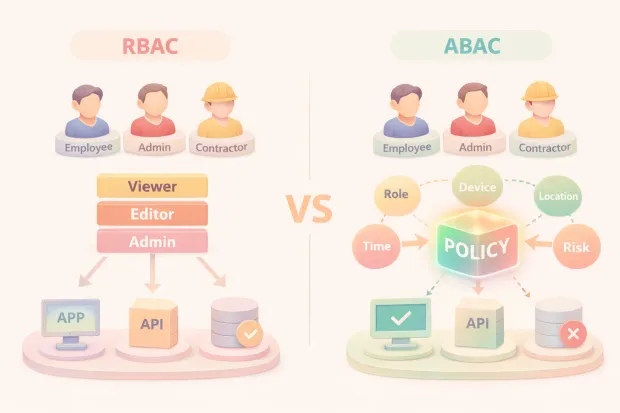
In Zero Trust architectures, where every request must be continuously verified, this difference is not just technical; it’s foundational. RBAC answers who should generally have access, while ABAC answers whether access should be allowed right now, under current conditions.
So the real question isn’t ABAC vs RBAC. It’s: Which model can actually enforce security in dynamic, context-aware environments?
In this guide, you’ll learn how both models work, where each one fails, and how modern Zero Trust systems combine them to deliver precise, scalable access control.
Why Zero Trust Forces a Rethink of Access Control
Zero Trust doesn’t just change how you authenticate. It changes what authorization must do after the login succeeds.
In older models, the strongest checkpoint was the front door: credentials, MFA, maybe VPN. Once inside, access decisions were mostly static. The assumption was simple if the user is authenticated and “in the network,” they’re probably safe.
That’s not how modern systems behave anymore. Users move between SaaS tools, APIs, and cloud services. Devices change. Locations change. Risk changes. Attackers don’t need to break the wall if they can steal a valid identity.
Zero Trust reacts to that reality by treating every access request like a new event that needs a reason. Not a role. Not a title. A reason. The request should be allowed because the user is valid and the context is acceptable and the resource isn’t being accessed in a suspicious way.
This is why access control becomes the real engine behind Zero Trust—because it’s where “verify explicitly” becomes an actual decision, not a slogan.
So when teams compare abac vs rbac, they’re really asking: Can our access model keep up with changing risk and context? Zero Trust expects it to.
RBAC: Why Role-Based Access Control Still Dominates
RBAC dominates because it gives teams something they always crave: structure.
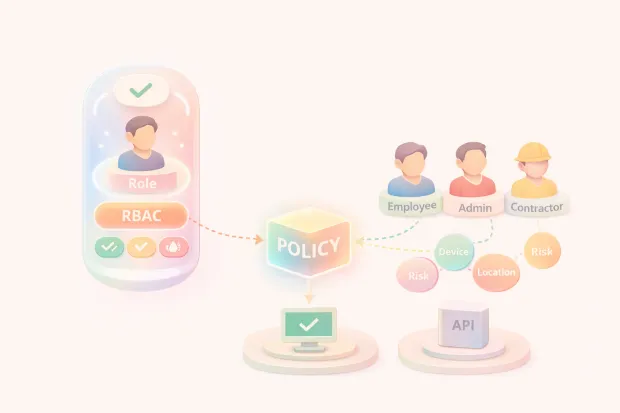
With role-based access control, you can map responsibilities to permissions in a clean, explainable way. A support agent gets support permissions. A finance analyst gets finance permissions. An admin gets admin permissions. You can hand this model to auditors, security teams, and engineering teams, and everyone understands it without translation.
This is why RBAC in cybersecurity still remains the default in so many organizations. It’s operationally friendly. It’s easy to manage at the start. It’s predictable. You can build onboarding and offboarding around roles. You can reduce manual entitlement decisions. You can implement RBAC controls using groups, directory roles, and application roles without inventing a policy language.
A realistic role-based access control example is a CRM system:
-
Sales Rep: create/update leads and opportunities
-
Sales Manager: approve discounts and view team pipeline
-
Admin: manage users, integrations, and security settings
That example of role-based access control isn’t exciting, but it’s reliable, and reliability is why RBAC keeps winning in day-to-day enterprise reality.
Example RBAC Policy
In an RBAC model, permissions are usually mapped directly to roles. A simplified policy might look like this:
{
"user": "Asha",
"role": "HR_Manager",
"permissions": [
1"view_employee_records",
2"edit_employee_records",
3"approve_leave_requests"
]
}
This model is easy to understand, but it assumes that every user with the same role should receive the same level of access in every situation.
Where RBAC Quietly Starts Failing in Zero Trust
RBAC begins to fail when organizations start needing decisions based on “right now,” not “who you are.”
Roles are stable by design. Zero Trust environments are unstable by nature.
A role doesn’t tell you whether:
-
The device is managed or compromised
-
The location is normal or suspicious
-
The request is happening during expected hours
-
The action is low-risk (read) or high-risk (export, delete, approve)
-
The data is public or regulated
So teams try to force RBAC to behave like ABAC. They add roles for every condition: Contractor-ReadOnly, Contractor-ReadOnly-EU, Contractor-ReadOnly-EU-AfterHours. It looks manageable for a few months, then the role list becomes its own attack surface: unclear, messy, and impossible to maintain cleanly.
This is the trap: RBAC looks simple until it becomes policy by role naming convention. That’s when rbac access stops being clarity and starts becoming accidental complexity.
And the worst part is it happens quietly. You don’t notice it until access reviews become painful, permission drift spreads, and every new use case triggers another role.
Real-World Example: Where RBAC Falls Short in Zero Trust
Consider a B2B SaaS platform where a sales manager has access to customer records based purely on their role. In a traditional RBAC (Role-Based Access Control) model, the role is enough; the system assumes that anyone assigned to it should always have access.
But in a Zero Trust environment, that assumption no longer holds. Every access request must be evaluated in real time.
Is the login coming from a trusted, managed device?
Is the user accessing data from an expected location?
Has the session been flagged as high-risk?
Does the sensitivity of the customer data require step-up authentication?
RBAC alone cannot answer these questions because it operates on static role assignments rather than dynamic context. This often leads to over-permissioning or blind spots in security enforcement.
In contrast, ABAC (Attribute-Based Access Control) evaluates multiple signals: identity, device posture, location, time, and risk before granting access. Platforms like LoginRadius enable this shift by combining identity context with adaptive policies, allowing organizations to enforce fine-grained, real-time access decisions that align with Zero Trust principles.
Instead of trusting a role, the system continuously verifies whether access should be allowed under current conditions.
Real-World Example: Why Hybrid Access Control Often Wins
In practice, most organizations don’t fully replace RBAC; they evolve it. A hybrid access control model combines the simplicity of roles with the precision of attributes.
For example, an engineer may have role-based access to deployment tools, but ABAC policies refine that access further. Production access may only be granted if the request comes from a secure device, the user passes strong MFA, the session risk is low, and the action occurs within an approved maintenance window.
This layered approach reflects how modern identity platforms, including LoginRadius, are designed to operate. RBAC provides the foundational structure for managing users at scale, while ABAC enforces contextual controls that adapt to real-world conditions.
The result is an access model that is both manageable and secure, one that supports Zero Trust by moving away from static permissions toward continuous, context-aware verification.
ABAC: The Access Model Built for Context
The ABAC model exists because roles can’t explain context.
Attribute-Based Access Control evaluates attributes at runtime about the user, the resource, and the environment, and makes a decision based on policy rules. That sounds complex, but the intent is very practical: allow access when conditions are safe, restrict it when conditions change.
ABAC shines when your access decision depends on signals like:
-
device posture (managed/unmanaged)
-
location (expected/unexpected)
-
time (business hours vs abnormal time)
-
risk score or anomaly detection
-
resource sensitivity (PII, financial data, admin controls)
A simple ABAC-style rule looks like this: A contractor can access the API only if they’re using a managed device, the request comes from an allowed region, and the contract status is active.
That’s why ABAC maps cleanly to Zero Trust: you aren’t granting access “because role.” You’re granting access “because conditions still look safe.”
Example ABAC Policy
In an ABAC model, access decisions can include multiple attributes and environmental signals:
{
"subject": {
"department": "HR",
"employmentType": "Full-Time",
"clearanceLevel": 3
},
"resource": {
"type": "employee_record",
"classification": "confidential"
},
"environment": {
"deviceTrust": "managed",
"location": "India",
"time": "business_hours"
},
"action": "view",
"effect": "allow"
}
Here, access is not granted just because a person belongs to HR. It is granted only when the surrounding conditions also satisfy the policy.
The Real Trade-off: ABAC vs RBAC in Practice
The real trade-off isn’t “static vs dynamic.” It’s “easy to govern vs easy to scale.”
RBAC is easier to audit and explain. ABAC is easier to adapt when done right.
RBAC breaks through:
-
role explosion
-
permission drift (roles slowly becoming junk drawers)
-
brittle exceptions that don’t generalize
ABAC breaks through:
-
bad attributes (stale or inaccurate signals)
-
unclear ownership (who maintains “device compliance”?)
-
policy sprawl (too many policies with overlapping logic)
-
debugging pain (why was access denied?)
So ABAC vs. RBAC becomes a question of operational maturity. If your org can’t reliably produce and manage attributes, ABAC can become chaotic. If your org needs context-aware decisions and keeps forcing RBAC to do it, RBAC becomes chaotic.
Different failure paths. Same result: access decisions you can’t trust.
RBAC vs ABAC: Key Differences in Zero Trust
| Category | RBAC | ABAC |
|---|---|---|
| Access decision basis | Roles assigned to users | Attributes tied to users, devices, resources, and context |
| Flexibility | Lower | Higher |
| Context awareness | Limited | Strong |
| Policy precision | Broad and role-based | Fine-grained and condition-based |
| Scalability in dynamic environments | Can become hard to manage | Better suited for changing access conditions |
| Zero Trust fit | Partial | Stronger |
| Typical use case | Stable teams with predictable access needs | Distributed systems with contextual security requirements |
| Main weakness | Role explosion and over-permissioning | Higher policy design complexity |
How to Decide Between RBAC and ABAC in a Zero Trust Model
Choosing between RBAC (Role-Based Access Control) and ABAC (Attribute-Based Access Control) in a Zero Trust model is less about picking the “better” approach and more about aligning access control with how dynamic your environment actually is.
RBAC works well in systems where access patterns are stable, job roles are clearly defined, and permissions don’t need to change frequently. It simplifies governance by grouping users into roles, making it easier to manage at scale, especially in traditional enterprise setups.
However, Zero Trust changes the equation. In modern environments, access decisions are rarely static. They depend on real-time signals such as device posture, user behavior, location, session risk, and data sensitivity.
This is where RBAC starts to fall short. It cannot easily adapt to contextual changes without creating excessive roles or complex overrides, leading to over-permissioning or operational friction.
ABAC addresses this gap by evaluating multiple attributes at the time of access. Instead of asking “Does this user belong to a role?”, ABAC asks “Should this access be allowed right now, under these exact conditions?” This makes it far more aligned with Zero Trust principles, where trust is continuously verified and never assumed.
In practice, most organizations do not choose one model exclusively. A hybrid approach is often the most effective: RBAC provides the foundational structure for broad access control, while ABAC adds a dynamic enforcement layer for context-aware, fine-grained decisions.
This combination allows organizations to maintain operational simplicity while achieving the precision and adaptability required for Zero Trust access control.
When RBAC Works Best and When ABAC Becomes Necessary
RBAC (Role-Based Access Control) works best in environments where access requirements are predictable, roles are clearly defined, and permissions remain relatively static over time. It is particularly effective for organizations with structured hierarchies such as finance, HR, or support teams where users consistently need access to the same set of resources.
By grouping permissions into roles, RBAC simplifies access management, reduces administrative overhead, and makes auditing more straightforward. This makes it a practical choice for baseline access control in many enterprise systems.
However, when access decisions must respond to real-time context, RBAC begins to show its limitations. Modern Zero Trust environments require access to adapt dynamically based on factors like device security posture, user location, session risk, time of access, and data sensitivity.
This is where ABAC (Attribute-Based Access Control) becomes essential. Instead of relying on static roles, ABAC evaluates multiple attributes at the moment of access, enabling fine-grained and context-aware policy enforcement.
For example, a user may be granted access only if they are on a managed device, within an approved geography, during business hours, and interacting with data that matches their clearance level.
In Zero Trust access control, this distinction is critical. RBAC answers who generally has access, while ABAC determines whether access should be allowed under current conditions. As a result, organizations often use RBAC as a foundational layer for broad permission grouping and introduce ABAC where precision, adaptability, and continuous verification are required.
This shift is what enables access control systems to move from static trust models to dynamic, risk-aware enforcement.
Why ABAC Aligns More Naturally With Zero Trust
Zero Trust security is built on a simple but powerful principle: never trust, always verify. Every access request whether from a user, device, or application must be evaluated continuously based on real-time context.
This is where ABAC (Attribute-Based Access Control) has a clear structural advantage. Instead of relying on static permissions, ABAC evaluates multiple attributes at the moment of access, including user identity, device posture, location, session risk, time of request, and resource sensitivity.
This allows organizations to enforce context-aware, risk-adaptive access control that reflects what is happening right now not what was defined at login.
RBAC (Role-Based Access Control), by contrast, is designed for predictability, not adaptability. It answers static questions like “What should someone in this role typically access?” but struggles with dynamic decisions like “Should access be allowed under current conditions?”
In Zero Trust environments, where access must adapt to changing signals and evolving risk, this limitation becomes significant. ABAC fills that gap by enabling fine-grained policy enforcement and continuous verification, which are core requirements of Zero Trust architecture.
This is why modern identity platforms such as LoginRadius increasingly incorporate attribute-based and context-driven controls alongside traditional role-based models.
By combining identity signals with real-time context, organizations can move beyond static trust models and implement access control that is both precise and resilient. In practice, ABAC doesn’t just support Zero Trust it operationalizes it, turning policy into dynamic enforcement at every access decision point.
The Best Approach for Many Organizations: RBAC as the Base, ABAC as the Enforcement Layer
For most organizations, the question is not whether to choose RBAC (Role-Based Access Control) or ABAC (Attribute-Based Access Control), but how to combine them effectively without adding unnecessary complexity.
RBAC remains highly valuable as a foundational layer it organizes access around roles, teams, and job functions, making large-scale user management predictable and easier to govern. It answers the baseline question: who should have access in principle? However, in modern Zero Trust environments, that baseline is no longer sufficient on its own.
This is where ABAC becomes critical. By evaluating real-time attributes such as device posture, user risk, session behavior, location, and data sensitivity, ABAC adds a dynamic enforcement layer on top of RBAC.
Instead of granting blanket access based on roles, it ensures that every access request is validated against current conditions. This allows organizations to enforce fine-grained, context-aware policies without redesigning their entire identity system from scratch.
In practice, a hybrid RBAC + ABAC model delivers the best of both worlds: RBAC provides structure and scalability, while ABAC introduces precision and adaptability. Modern identity platforms like LoginRadius are built around this layered approach, enabling organizations to gradually evolve toward Zero Trust access control.
Rather than replacing roles entirely, they extend them with contextual intelligence transforming static permissions into continuously verified access decisions that align with real-world risk.
How to Introduce ABAC Without Breaking Existing Access Controls
Adopting ABAC (Attribute-Based Access Control) doesn’t require a disruptive overhaul of your existing RBAC system it requires a strategic, incremental rollout.
The most effective approach is to start by identifying where RBAC begins to break down: scenarios where access decisions depend on real-time context such as device posture, user location, session risk, time of access, or data sensitivity.
These high-risk and high-variability touchpoints are ideal entry points for introducing ABAC policies because they deliver immediate security value without impacting the entire system.
Rather than replacing roles, organizations should layer ABAC on top of existing RBAC foundations. RBAC continues to handle broad permission grouping, while ABAC enforces context-aware controls at the point of access.
For example, a user may retain role-based access to an application, but ABAC policies can restrict access unless the device is trusted, the session meets risk thresholds, and the request aligns with defined security conditions.
This phased, hybrid approach minimizes operational disruption, avoids policy sprawl, and aligns naturally with Zero Trust principles where access is continuously evaluated instead of statically granted.
Modern identity platforms like LoginRadius support this transition by enabling organizations to introduce attribute-based policies alongside existing role structures, without forcing a complete redesign of their authorization model.
Over time, this allows teams to evolve from static, role-centric access control to dynamic, context-driven enforcement building a more resilient and scalable Zero Trust architecture.
Why Most Zero-Trust Systems End Up Hybrid
Most mature teams don’t replace RBAC. They stabilize RBAC and then layer ABAC on top.
RBAC handles the “base identity” story:
-
Who is this user in the organization?
-
What baseline capabilities come with their job function?
ABAC handles the “situational trust” story:
- Should this user perform this action on this resource right now?
A hybrid model is what makes Zero Trust workable at scale because it keeps the system explainable. You still have roles that define broad access. But you add context-aware enforcement for sensitive actions: exporting data, modifying security settings, accessing privileged endpoints, or touching regulated resources.
The hybrid approach also prevents the worst of both worlds:
-
You avoid role explosion by not encoding context into roles.
-
You avoid ABAC chaos by not encoding job structure into policies.
Governance: The Part Everyone Underestimates
ABAC doesn’t fail because policies are hard. It fails because governance is ignored until production forces the issue.
In ABAC, attributes become security-critical. That means you need answers to questions people avoid early on:
-
Where does each attribute come from?
-
Who owns it?
-
How often is it updated?
-
How do we validate it?
-
What happens if it’s missing?
Even for RBAC, governance matters because role definitions drift over time. “Admin” has five different meanings across systems. “Viewer” starts gaining edit permissions because “it was urgent.”
Governance is the difference between access control being a system and access control being a collection of shortcuts.
If you want Zero Trust to hold, you need policy reviews, attribute lifecycle ownership, and logs that can explain decisions. Otherwise access becomes guesswork with pretty names.
A Subtle Problem That Breaks Authorization Logic
Identity inconsistency breaks authorization more often than teams want to admit.
If a single person can exist as multiple identities email/password one day, social login another day, SSO later your access logic starts evaluating fragments. Roles attach to one identity record. Attributes attach to another. Risk signals apply inconsistently. Access becomes unpredictable.
This is why identity unification matters. Account linking and unified profiles prevent “shadow identities” from silently undermining your authorization model.
In Zero Trust, you can’t continuously evaluate trust if you don’t even know whether two login events belong to the same human.
This seems like an implementation detail. It isn’t. It’s fundamental.
How to Choose Without Overthinking It
You don’t need a philosophy. You need a decision path that matches your reality.
Choose RBAC-first when:
-
your org structure is stable
-
your apps have clear permission boundaries
-
audit clarity is a priority
-
you’re early in access governance maturity
Choose ABAC (or hybrid) when:
-
access depends on device/location/time/risk
-
you protect APIs and microservices
-
you have sensitive actions like exports, admin functions, payments
-
you need step-up enforcement based on context
If you’re serious about Zero Trust, the hybrid model is usually the “adult” choice: RBAC for baseline, ABAC for context. It’s not trendy. It’s simply how systems survive at scale.

Conclusion
RBAC and ABAC are more than just access control models they represent two fundamentally different approaches to security in a world that is rapidly moving toward Zero Trust.
RBAC brings structure, consistency, and operational simplicity, making it a reliable foundation for managing access at scale. ABAC, on the other hand, introduces the precision and adaptability required to evaluate access in real time based on identity, device posture, session risk, location, and data sensitivity.
In modern environments where conditions change constantly, this shift from static permissions to dynamic, context-aware enforcement is no longer optional it’s essential.
The most effective strategy isn’t choosing one over the other. It’s designing an access control model that evolves with your architecture. A hybrid RBAC + ABAC approach allows organizations to maintain control and scalability while introducing the flexibility needed for Zero Trust.It ensures that access is not just assigned but continuously verified, enforced, and aligned with real-world risk.
As you rethink your access control strategy, the key question is not “Which model is better?” but “Can your current model adapt to real-time security demands?” If the answer is no, it’s time to move beyond static roles and toward context-driven access control.
If you're looking to implement Zero Trust access control with fine-grained authorization, adaptive policies, and real-time identity context, platforms like LoginRadius can help you move beyond static roles. Book a demo today to see how you can combine RBAC and ABAC to build a scalable, secure, and future-ready identity architecture.
FAQs
Q: What is the main difference between ABAC vs RBAC?
A: The difference between ABAC vs RBAC is how access decisions are made. RBAC grants access based on roles, while ABAC evaluates attributes like user context, device, location, and risk at runtime.
Q: Is RBAC still relevant in Zero Trust security?
A: Yes, RBAC in cybersecurity is still relevant for baseline access and governance. However, Zero Trust environments often require ABAC to handle dynamic, context-aware authorization decisions.
Q: When should organizations use the ABAC model instead of RBAC?
A: The ABAC model works best when access depends on conditions such as device posture, time, or data sensitivity. It’s commonly used in Zero Trust architectures and API-driven environments.
Q: Can RBAC and ABAC be used together?
A: Although both models differ, many organizations combine RBAC controls with ABAC policies. RBAC defines general access, while ABAC adds real-time enforcement based on attributes.
Q: Is ABAC better than RBAC for Zero Trust?
A: ABAC is usually better suited for Zero Trust because it evaluates access using real-time context, not just static roles. That makes it more effective for fine-grained and adaptive enforcement.
Q: Why is RBAC not enough for Zero Trust?
A: RBAC works well for broad permission grouping, but it does not handle context-rich decisions well. Zero Trust requires access to adapt based on current risk, device state, location, and resource sensitivity.
Q: Can RBAC and ABAC be used together?
A: Yes. Many organizations use RBAC to define baseline access and ABAC to enforce contextual controls on top of it. This hybrid model is often more practical than choosing one alone.
Q: Is ABAC harder to implement than RBAC?
A: Usually, yes. ABAC offers more flexibility, but it also requires stronger policy design, attribute management, and governance. The added complexity is often worth it in dynamic environments.
Q: What is the main Zero Trust advantage of ABAC?
A: Its biggest advantage is precision. ABAC can evaluate multiple live conditions before granting access, which aligns closely with Zero Trust’s “never trust, always verify” model.