
Introduction
You probably already locked down your internal users. MFA. Password policies. Access reviews. Clean. Now pause for a second and look outside your firewall.
Partners. Vendors. Client organizations. Resellers. Agencies. Contractors. That’s where things usually unravel.
Most B2B platforms treat external access as an afterthought. And that’s exactly why the b2b onboarding checklist has quietly become one of the most important assets for modern SaaS companies.
Not because onboarding sounds exciting. Because broken onboarding bleeds revenue, trust, and security.
At LoginRadius, we audited more than 100 real B2B platforms across SaaS, retail, CRM, developer tools, and GTM ecosystems. Platforms that proudly market themselves as “enterprise-ready.”
What we saw was uncomfortable.
-
No verification.
-
No MFA.
-
Sign-up flows that feel like compliance paperwork.
-
Zero delegated admin.
-
And almost no audit visibility.
That gap between internal IAM maturity and external onboarding reality? That’s the identity problem no one wants to talk about.
This blog breaks it open.
It’s built around a downloadable b2b onboarding checklist created from those audits, designed to help B2B teams benchmark their onboarding, spot risk fast, and fix it before partners bounce or security escalations follow.
Why B2B Onboarding Is No Longer Just a UX Problem
Ask ten SaaS leaders what customer onboarding is, and most will talk about product tours, emails, or activation flows.
That definition falls apart in B2B.
Because b2b customer onboarding is not a single user journey. It’s an organization onboarding another organization often with multiple roles, permission layers, security expectations, and identity providers involved.
And this is where many platforms stall.
Our audit surfaced the same patterns again and again:
-
External users onboard without email or phone verification
-
MFA treated as optional
-
IT teams forced to manage every partner user manually
-
Only Google or Microsoft SSO offered
-
No audit trail when something goes wrong
These issues don’t just slow onboarding. They undermine trust.
For modern SaaS companies, b2b iam now sits at the center of revenue protection, compliance posture, and partner retention.
If your onboarding breaks, expansion stops.
Hidden Cost of Getting B2B Onboarding “Mostly Right”
Most teams still underestimate how early identity decisions show up in revenue metrics. In B2B, onboarding friction rarely announces itself as a “security issue.” It shows up as stalled deals, delayed partner launches, endless support tickets, and awkward emails that start with “can you just add one more user for us?”
By the time leadership notices churn or slowdowns in expansion, the damage has already occurred. That’s why strong b2b customer onboarding best practices always start with identity architecture, not product walkthroughs or enablement emails.
What makes this harder is scale. A saas customer onboarding process that works for ten partners collapses at fifty. At a hundred, it becomes a liability.
Manual approvals, shared roles, and IT-managed access do not age well. The platforms that grow cleanly treat onboarding as a system, not a flow. They standardize verification, delegate control to partner admins, and enforce security by default.
This is exactly where a practical b2b saas onboarding checklist becomes useful not as documentation, but as a forcing function for better decisions. If your onboarding depends on exceptions, it won’t survive growth.
Why Onboarding Fails When Organizations Start to Grow
Here’s the part that often gets missed: onboarding is the first moment your platform proves whether it actually understands B2B reality.
Partners don’t judge you only by features. They judge you by how quickly they can get the right people in, with the right access,
without waiting on your support team. When onboarding forces workarounds, shared credentials, over-permissioned roles, and manual approvals teams don’t complain loudly. They adapt quietly. And those adaptations usually weaken security over time.
Another pattern we’ve seen repeatedly is teams treating onboarding as a one-time event instead of a living access model. The first user signs up, access looks fine, and everyone moves on. Then a second team joins. Then a regional admin. Then a contractor.
Suddenly, roles don’t fit, permissions sprawl, and internal IT becomes the bottleneck. This is where b2b onboarding breaks down—not because the platform can’t authenticate users, but because it can’t model real-world organizations cleanly.
Strong b2b customer, iam anticipate that mess before it shows up. It assumes orgs will grow, roles will change, and access will need to tighten over time not loosen. That’s why scalable onboarding relies on fundamentals like multi-tenancy, delegated admin, and audit visibility from day one.
Not because they sound “enterprise,” but because they remove guesswork later. A solid iam checklist doesn’t slow teams down. It prevents them from painting themselves into corners they’ll regret six months in.
What We Actually Found When We Audited 100+ B2B Platforms
Here’s where teams usually go wrong.
1. Identity Verification Is Missing or Superficial
Roughly 30% of platforms never verify who signs up.
That’s how fake domains slip in. That’s how test accounts become production risks.
In any serious b2b identity management model, email and phone verification are table stakes. Yet many platforms still skip them to “reduce friction.”
The result? Higher friction later when cleanup becomes inevitable.
2. MFA Is Absent Where It Matters Most
Over 90% of audited platforms lacked consistent MFA enforcement.
No push MFA. No TOTP. No passkeys. Sometimes not even CAPTCHA.
That’s not a risk edge case. That’s a predictable failure point.
A modern iam checklist must treat MFA as foundational not optional, not “phase two.”
3. Form Fatigue Still Dominates First Touch
One platform demanded 14 fields at sign-up.
This pattern shows up constantly in b2b saas onboarding checklist reviews. Teams try to collect everything up front, then wonder why activation drops.
Progressive profiling exists for a reason. Use it.
4. Delegated Admin Is Missing Almost Everywhere
Most platforms still route partner user management through internal IT.
That model collapses at scale.
True b2b customer iam requires delegated administration at the organization level. Without it, onboarding speed suffers and support load explodes.
5. SSO Choices Are Narrow and Outdated
Eighty-eight percent of platforms offered only Google or Microsoft SSO.
That sounds reasonable until your partner stack doesn’t align.
B2B onboarding must support SAML, GitHub, Apple ID, and modern federation paths—or deals quietly die during setup.
6. Audit Logs Are an Afterthought
No logs. No clarity. No accountability.
When compliance teams ask “who accessed what,” many platforms can’t answer.
That’s not a tooling gap. That’s an IAM failure.
These breakdowns cost conversions and credibility.
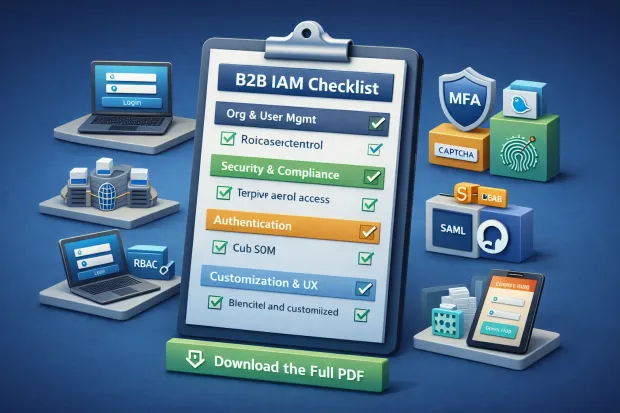
The Complete B2B Onboarding Checklist (What Actually Matters)
This is where theory ends.
Below is the b2b onboarding checklist built from real audits not slides, not assumptions.
1. Organization & User Management
At the center of B2B onboarding sits structure.
-
Multi-tenant architecture for managing multiple organizations
-
Role-based access control scoped by organization
-
Delegated admin for every partner org
-
Lifecycle management with JIT provisioning
If your platform can’t separate orgs cleanly, everything downstream breaks.
2. Security & Compliance Foundations
These controls are not advanced. They are required.
-
MFA using push, TOTP, SMS, or biometrics
-
Bot protection and rate limiting
-
Email and phone verification at sign-up
-
SOC2, GDPR, HIPAA readiness
-
Real-time audit logs with alerts
Strong b2b iam starts here.
3. Authentication Experience
Security that blocks onboarding is not security.
-
Federated SSO (Google, Microsoft, SAML, GitHub)
-
Passwordless login options
-
Risk-based adaptive authentication
-
Social login support
This is where saas onboarding best practices intersect with identity architecture.
4. Customization & UX
Partners notice details.
-
Branded login and signup pages per organization
-
Progressive profiling instead of long forms
-
Mobile-first login experiences
These are not cosmetic choices. They influence trust and completion rates.
Why LoginRadius Was Built Specifically for This Problem
Most IAM tools started in workforce identity and stretched outward.
That stretch shows.
LoginRadius did the opposite.
Our platform was designed for b2b customer onboarding, multi-org complexity, and external identity scale from day one.
Here’s how that shows up in practice:
-
True multi-tenant architecture
-
Organization-scoped RBAC
-
Built-in delegated administration
-
Passwordless login with adaptive MFA
-
Branded onboarding per partner org
-
Bot protection and verification baked in
-
Compliance readiness without bolt-ons
-
Proven scale across billions of identities
This is b2b identity management without workarounds.

A 10-Minute Self-Audit for B2B Teams
Let me make this simple.
Answer these honestly:
-
Do you verify every external signup?
-
Is MFA enforced across partner access?
-
Can partners manage their own users?
-
Do you support SAML and GitHub SSO?
-
Can you trace access activity in real time?
-
Are login experiences branded per org?
If even one answer is “no,” your onboarding stack is carrying risk.
That’s exactly why we built the b2b onboarding checklist.
Why Secure Onboarding Has Become a Competitive Advantage
In B2B SaaS today:
-
Friction kills expansion
-
Weak IAM invites compliance risk
-
Slow onboarding delays revenue
Modern onboarding isn’t just about speed. It’s about control without chaos.
LoginRadius gives B2B teams that balance—secure access, flexible onboarding, and identity architecture that scales with partner ecosystems.