Introduction
Passwords have quietly become the weakest layer in modern digital security. Not because cryptography failed, but because humans did. As digital platforms expanded, users ended up managing dozens, sometimes hundreds of accounts. The outcome was inevitable. Registration friction increased. Password reuse became routine. Security teams inherited growing risk, while product teams watched conversion rates stall.
This isn’t speculation. It’s a pattern every mature digital business has already seen.
When users are forced to create and remember yet another password, two things happen. Some abandon the experience entirely. Others push through but reuse an existing password, exposing your platform to account compromise.
LoginRadius calls this out directly in its CIAM Passwordless Login framework: password creation either deters users or leads to reused credentials, both of which hurt security and growth
That tension between usability and security used to feel unavoidable. It isn’t anymore.
Passwordless Login changes the equation by removing the password from the identity flow altogether. Instead of relying on static secrets, passwordless authentication verifies identity through secure, time-bound access links delivered to a user’s email. No passwords to create. No passwords to remember. No passwords to reset.
What makes this shift important isn’t novelty, it’s alignment with how modern users already behave. People may forget passwords, but they rarely lose access to their primary email. By anchoring authentication to verified email ownership, passwordless login removes friction while strengthening security.
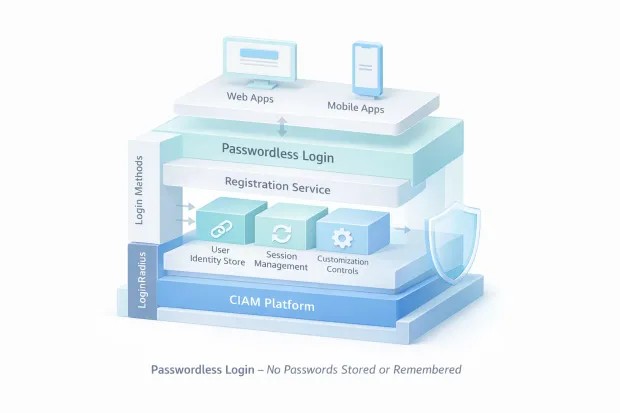
LoginRadius doesn’t treat this as an add-on feature. Passwordless Login is built directly into the cIAM Registration Service, making it part of the core registration and login lifecycle rather than a parallel workaround
That architectural decision matters for organizations operating at scale across web and mobile properties.
This guide explains how LoginRadius implements Passwordless Login, why it delivers measurable business value, and how its built-in customizability makes it viable for real-world CIAM deployments not just demos.
What Is Passwordless Authentication and Why It Works Better Than Passwords
To understand why passwordless authentication works, it helps to acknowledge why passwords fail in practice not in theory.
Passwords assume that users will consistently create unique, complex credentials and remember them over time. In reality, users face an ever-growing number of digital accounts. The outcome follows a familiar pattern. Some users abandon registration when asked to create yet another password.
Others proceed but reuse credentials they already know. LoginRadius explicitly highlights this issue in its CIAM Passwordless Login approach: passwords either deter users or push them toward reuse, both of which introduce security risk
Passwordless authentication removes this pressure entirely.
Instead of relying on “something a user knows,” passwordless systems verify “something a user controls.” In the LoginRadius model, that control is ownership of an email address. Authentication becomes a verification step rather than a memory test. The user enters an email address, receives a secure verification link, and confirms access by clicking it.
This shift matters because it aligns authentication with real-world behavior. People may forget passwords, but they rarely forget how to access their primary inbox.
By eliminating passwords from the equation, passwordless authentication removes a major source of friction while simultaneously closing off one of the most common attack vectors: reused credentials.
This is why passwordless authentication is not just more convenient; it is structurally safer. It replaces long-lived secrets with short-lived verification events. Identity becomes something you confirm in the moment, not something you store indefinitely.
LoginRadius CIAM Passwordless Login: Built Into the Registration Service, Not Bolted On
A common mistake teams make with passwordless login is treating it as an optional layer rather than a core identity capability. When passwordless authentication lives outside the primary registration flow, it introduces inconsistency, edge cases, and operational complexity.
LoginRadius avoids this by embedding Passwordless Login directly into its cIAM Registration Service. The datasheet describes the Registration Service as providing “a multitude of methods for registration and login,” with Passwordless Login positioned as a first-class option rather than an afterthought
That architectural decision changes everything.
By building Passwordless Login into the Registration Service itself, LoginRadius ensures that the same identity logic governs both new user onboarding and returning user access. There is no separate passwordless flow to maintain, no parallel logic to reconcile, and no fragmentation across platforms. Registration and authentication operate as a single, unified experience.
For directors and platform owners, this matters because identity systems rarely fail at login they fail at scale. When authentication methods behave differently across web and mobile properties, or when registration logic diverges from login logic, teams lose visibility and control. Embedding passwordless authentication at the Registration Service layer eliminates that drift.
Passwordless Login becomes part of the identity foundation, not a feature teams need to defend or justify later.
How Passwordless Login Actually Works
One of the most practical strengths of LoginRadius’ Passwordless Login is its consistency. The datasheet makes this explicit: the passwordless authentication process is identical for initial registration and all subsequent logins.
That consistency removes cognitive load for users and operational complexity for teams.
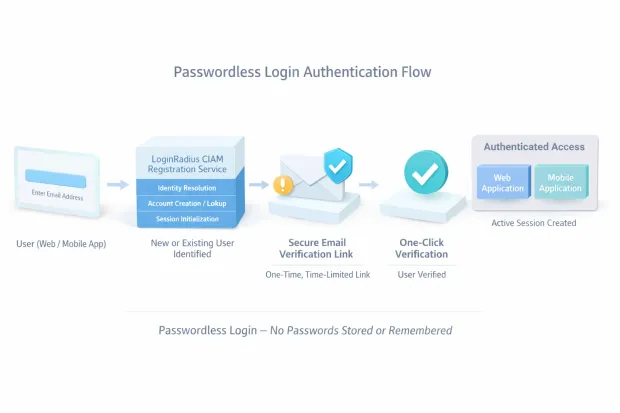
Here’s how the flow works in practice:
The user begins by entering an email address. That single input acts as both an identifier and a starting point. Behind the scenes, LoginRadius determines whether the email belongs to a new user or an existing one. If the account does not exist, the platform creates it automatically. If it does, the system proceeds with authentication.
In both cases, LoginRadius sends a secure verification link to the user’s email address. When the user clicks that link, they are authenticated and logged in automatically.
No passwords are created. No credentials are stored. No branching flows appear on the screen.
This design eliminates entire categories of friction password creation rules, confirmation fields, reset flows, and credential recovery processes. It also simplifies identity architecture. There is one way in and one way back, regardless of whether the user is new or returning.
For CIAM teams managing large user bases, that simplicity translates into fewer support issues, cleaner analytics, and a more predictable authentication surface.
One-Click Access Without Compromising Security
The idea of “one-click access” often raises eyebrows among security leaders. Speed and security rarely coexist in traditional authentication models. Passwordless Login challenges that assumption.
LoginRadius states clearly that removing the password element not only reduces friction but “maintains and even enhances security”
That claim holds up when you examine where most authentication breaches originate.
A significant portion of account compromise stems from password reuse. When users recycle credentials across platforms, a breach elsewhere becomes a breach everywhere. Passwordless Login eliminates this risk by removing reusable secrets entirely. There is nothing static to steal, store, or replay.
Authentication relies on secure, time-bound verification links. These links are valid for a limited window and tied directly to a specific authentication request. Even if intercepted later, they lose value quickly. This short-lived verification model reduces the attack surface without forcing additional steps on legitimate users.
Security improves because identity verification becomes contextual and temporary. Access is granted based on real-time proof of control rather than possession of a long-lived secret.
For organizations balancing usability and risk, this is the critical shift. Passwordless Login proves that strong security does not require complex user behavior. In fact, removing complexity often strengthens security by eliminating the most failure-prone element: human password management.
Customizability That Fits Real-World CIAM Requirements
Passwordless Login only succeeds at scale when it adapts to the business not the other way around. This is where many identity solutions fall short. They offer a clean demo flow but collapse under real-world requirements like branding, regionalization, session control, and user segmentation.
LoginRadius designed its cIAM Passwordless Login with this reality in mind.
According to the datasheet, Passwordless Login provides a “high level of flexibility and customizability,” allowing teams to control key aspects of the experience directly from the dashboard
This is not cosmetic customization. These controls affect security posture, conversion behavior, and user trust.
Teams can customize the login email template, ensuring the verification message looks unmistakably legitimate and on-brand. This matters because the email itself becomes part of the authentication interface. A generic or unfamiliar message introduces hesitation at the exact moment users expect clarity.
LoginRadius also allows administrators to configure verification link expiration time. Shorter expiration windows strengthen security for sensitive environments, while slightly longer windows reduce friction for consumer-facing use cases. The point is control. Security teams and product teams don’t have to fight over one default setting.
Session lifetime is another critical lever. Teams decide how long a user remains authenticated after clicking the verification link, aligning identity behavior with business risk tolerance.
Beyond these core controls, the platform supports multiple languages and enables multiple templates for different user segments
For organizations operating across regions, brands, or customer tiers, this becomes essential. A single global login experience rarely fits everyone.
This level of customizability ensures that Passwordless Login is not a rigid feature. It becomes a configurable identity capability that adapts as business requirements evolve.
Business Impact: Conversion, Experience, and ROI
Passwordless Login earns executive attention because it produces measurable outcomes. LoginRadius outlines the benefits clearly in the datasheet, and they map directly to the metrics directors care about
Conversion: Removing the First Drop-Off Point
Every additional field in a registration flow introduces friction. Password creation is one of the most common abandonment triggers. By reducing registration and login to a single email input and a verification click, Passwordless Login removes that barrier entirely.
LoginRadius highlights “improved conversion rates due to easy and secure one-click access” as a core benefit.
This aligns with how users behave. When access feels immediate, hesitation disappears.
Experience: Eliminating a Known Pain Point
Passwords frustrate users long before they fail. Remembering them, resetting them, and managing them across devices creates unnecessary friction. Passwordless Login replaces that with a seamless experience built around actions users already perform daily checking email and clicking links.
The datasheet notes “improved customer experience due to seamless one-click access”
That improvement compounds over time, especially for repeat users and mobile-first audiences.
ROI: Cutting Operational Waste
Password resets are expensive. They generate support tickets, slow down users, and distract teams from higher-value work. LoginRadius explicitly calls out that Passwordless Login results in “no password reset requests from customers” because users no longer create or remember passwords.
This is where ROI becomes tangible. Reduced support load translates into lower operational cost. Fewer authentication failures translate into higher engagement and retention. When security incidents tied to credential reuse decrease, risk exposure shrinks as well.
Passwordless Login doesn’t just improve the top of the funnel it cleans up the cost structure behind it.
Why Passwordless Login Works Especially Well for Web and Mobile Properties
Web and mobile environments expose the weaknesses of password-based authentication faster than any other channel. Typing complex passwords on mobile devices leads to errors, retries, and abandonment. Password managers behave inconsistently across apps and embedded browsers. Users bounce between devices mid-session.
LoginRadius positions Passwordless Login as a one-click solution for both web and mobile properties, and that consistency is key.
Because authentication happens through an email verification link, the experience remains the same regardless of device. Users don’t need to remember where a password was saved or whether auto-fill will work. The login flow follows them.
This makes Passwordless Login especially effective for:
-
Consumer applications where speed determines engagement
-
Mobile-first platforms where friction kills retention
-
Global user bases with varying levels of technical comfort
By standardizing authentication across channels, Passwordless Login creates a unified identity experience that feels modern and predictable. That predictability builds trust and trust drives usage.
Where Teams Usually Go Wrong With Passwordless Authentication Rollouts
Passwordless authentication delivers results when implemented deliberately. When teams rush or treat it as a surface-level enhancement, they miss the upside.
One common mistake is positioning Passwordless Login as a secondary option rather than the default. If users must choose between “password” and “passwordless,” many stick with what they know. Adoption stalls, and teams conclude incorrectly that passwordless doesn’t work.
Another misstep involves underestimating the importance of the verification email. Since the email is the gateway to access, it must feel intentional and trustworthy. LoginRadius enables full customization of email templates for this reason. Ignoring that capability leads to unnecessary user doubt.
Teams also misconfigure verification link expiration without considering real user behavior. Links that expire too quickly frustrate legitimate users. Links that last too long introduce risk. The ability to tune expiration time exists so teams can strike the right balance, not so they can set it once and forget it.
Finally, many organizations ignore segmentation. LoginRadius supports multiple templates and languages, yet teams often deploy a single experience for all users. That shortcut creates friction in global or multi-brand environments where expectations differ.
Passwordless Login succeeds when teams treat it as an identity strategy not a UI tweak.
Why LoginRadius Wins This Conversation: Passwordless Login Built for CIAM Reality
Many platforms talk about passwordless authentication. LoginRadius operationalizes it.
The cIAM Passwordless Login offering removes passwords entirely, embeds authentication into the Registration Service, and provides the configurability required to run identity at scale. It does not rely on fragile workarounds or partial implementations.
LoginRadius delivers:
-
One-click Passwordless Login for web and mobile properties
-
A unified flow for registration and login
-
Dashboard-level control over templates, link expiration, and session lifetime
-
Multi-language and segmented experiences
-
Measurable business benefits: higher conversion, better experience, reduced resets, and stronger security
For directors and senior authentication leaders, the distinction is clear. This is not about experimenting with passwordless ideas. It is about deploying Passwordless Login as a core CIAM capability that improves security while unlocking growth.
That’s why LoginRadius doesn’t just participate in the passwordless conversation, it leads it.
Conclusion
Passwords didn’t fail because they were badly designed. They failed because they asked users to behave in ways that no longer match reality. Expecting people to invent, store, rotate, and protect dozens of credentials guarantees friction, and reuse guarantees risk.
Passwordless Login removes that burden entirely.
With LoginRadius CIAM Passwordless Login, users authenticate using a simple, one-click verification process that works the same way for registration and every subsequent login. They enter an email address, receive a secure verification link, and gain access instantly without creating or remembering passwords
For organizations, the impact is direct and measurable:
-
Higher conversion rates because registration friction disappears
-
Zero password reset requests because passwords no longer exist
-
A cleaner customer experience built around speed and simplicity
-
A stronger authentication layer that minimizes account compromise by eliminating reused credentials.
What makes this approach viable at scale is not just the flow, but the customizability behind it. LoginRadius allows teams to control email templates, verification link expiration, session lifetime, language support, and segmented experiences directly from the dashboard. That flexibility turns Passwordless Login into a controllable identity strategy not a rigid UX experiment.
For directors and senior passwordless authentication experts, the takeaway is clear: Passwordless Login is no longer a “future roadmap item.” It is a proven way to improve security posture while unlocking growth that traditional login models quietly suppress.
If your identity strategy still depends on passwords, you are carrying unnecessary friction and unnecessary risk.
Download the LoginRadius CIAM Passwordless Login datasheet to review the full passwordless flow, configuration options, and business benefits in one focused asset built for teams who take customer identity seriously.
FAQs
Q: What is Passwordless Login and how does it improve security?
A: Passwordless Login removes stored passwords and authenticates users through secure, time-bound verification links. This eliminates password reuse and significantly reduces the risk of account compromise.
Q: How does LoginRadius implement passwordless authentication?
A: LoginRadius integrates Passwordless Login directly into its cIAM Registration Service, using email-based verification links for both registration and login without requiring users to create or remember passwords.
Q: Is Passwordless Login suitable for enterprise and high-traffic applications?
A: Yes. LoginRadius’ cloud-based identity platform supports scalable, secure Passwordless Login with configurable session lifetime, link expiration, and multi-language support for enterprise environments.
Q: How does Passwordless Login impact conversion and ROI?
A: By eliminating password creation and reset flows, Passwordless Login reduces registration friction, improves customer experience, and lowers support costs directly improving conversion rates and ROI.