Introduction: IAM Canada Is No Longer Optional. It’s Strategic
For Canadian IT leaders and product owners, the “where” of data is now as important as the “how.” While global platforms offer scale, they often fall into the U.S. CLOUD Act trap making data residency a hollow promise. In 2026, jurisdictional protection is a strategic advantage, and true data sovereignty is the only shield against foreign warrants and failed Privacy Impact Assessments.
Today’s IAM conversation has moved beyond MFA and secure logins into the boardroom. Whether you need CIAM for seamless customer experiences or identity verification to meet FINTRAC requirements, identity is now the primary mechanism for aligning with Law 25 and the CPPA.
Canadian consumers and enterprise buyers are more privacy-aware than ever; questions about data location are no longer abstract; they're contractual. By choosing a domestically anchored provider, organizations don't just manage access; they reduce procurement friction and insulate their balance sheets from the rising cost of compliance failure. In 2026, IAM in Canada is no longer just infrastructure, it is a strategic requirement for digital trust.
Deep Tech: The Rise of Canada’s Digital Identity in 2026
In 2026, the static “username and password” model is steadily giving way to Digital ID Wallets and cryptographically verifiable identity. Provinces like Ontario and British Columbia have introduced digital driver’s licenses and government credentials in secure mobile wallets, signaling a broader national shift toward modern digital identity.
This isn’t just digitization, it's a structural change in online trust. Instead of relying on passwords that can be phished or reused, wallet-based credentials use cryptographic proof, making authentication stronger and harder to compromise.
For businesses, this reshapes the CIAM strategy. Identity providers must support Verifiable Credentials (VCs) and open standards aligned with provincial and federal initiatives. Rather than collecting and storing high-risk ID images, organizations can request secure “proofs” from government-issued wallets—reducing data liability and breach exposure. Verification becomes faster, onboarding smoother, and manual reviews largely unnecessary. In regulated sectors like fintech and healthcare, that efficiency is both operationally smart and competitively valuable.
In regulated sectors like fintech and healthcare especially with the recent reintroduction of Bill S-5 (Connected Care for Canadians Act) this interoperability is no longer just "smart," it's becoming a regulatory requirement to prevent data blocking. Canada’s digital identity evolution ultimately points to a future where identity is portable, interoperable, and user-controlled. Organizations that align their IAM Canada strategy now won’t just stay compliant, they’ll build a foundation for long-term digital trust.
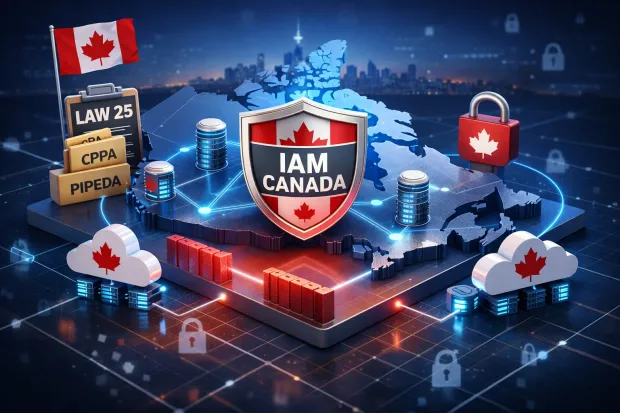
The 2026 Regulatory Horizon: Beyond PIPEDA
While the industry once waited for Bill C-27, the 2026 landscape is now defined by the Consumer Privacy Protection Act (CPPA) and the re-emergence of sector-specific mandates. The regulatory tone has shifted from “encouraged compliance” to “enforced accountability.” Privacy is no longer guidance; it is law with measurable financial consequences. And regulators are no longer patient with vague consent models or loosely governed data flows.
1. The CPPA (Consumer Privacy Protection Act) Enforcement
With the federal CPPA now in force, the “cost of doing business” has changed. Unlike the old PIPEDA, which lacked real financial teeth, the CPPA allows for fines that mirror Law 25 up to 5% of global revenue for the most serious offenses. That’s not a warning letter. That’s a board-level risk scenario.
The CPPA also elevates consumer rights around transparency, consent, and data mobility. Organizations must now demonstrate how they collect, use, store, and transfer personal data with audit-ready documentation.
The Identity Connection: The CPPA introduces “Data Portability.” A domestic provider like LoginRadius or IDENTOS is already built on open standards required to let users move their data seamlessly, saving you from expensive custom engineering to meet “right to transfer” requests.
When your IAM Canada stack supports standardized APIs and export frameworks, compliance becomes architectural, not reactive.
2. Bill S-5: The Connected Care Mandate
Introduced in early 2026, the Connected Care for Canadians Act (Bill S-5) is a game-changer for health tech and insurance platforms. It explicitly prohibits “data blocking” and mandates interoperable standards for health information exchange across provinces. In simpler terms: your systems must talk to each other or you risk regulatory friction.
This shifts identity from a login layer to an interoperability layer. Health data must flow securely between institutions, insurers, and provincial systems without duplicating identity verification processes.
The Identity Connection: If you are a health-tech provider, you can no longer rely on a siloed identity system. You must adopt a PCTF-aligned IAM Canada provider that ensures patient identities are portable, interoperable, and cryptographically verifiable across provincial frameworks. In 2026, identity architecture is healthcare infrastructure.
Why Local Identity is Your Competitive Edge
In 2026, the question for Canadian enterprises has shifted from “Is this secure?” to “Is this sovereign?” The “Local Edge” isn’t about patriotism; it’s about insulating your balance sheet from international legal friction and astronomical breach costs.
In an era where the average cost of a data breach in Canada has climbed to $5.6M CAD (and higher in regulated sectors), jurisdiction is now as critical as encryption strength. Identity has become a financial risk variable, not just a technical control.
To understand why a domestic IAM Canada provider is a strategic requirement rather than a preference, we must look at three high-stakes pillars:
1. The “Cloud Act” Trap: Jurisdictional Insurance
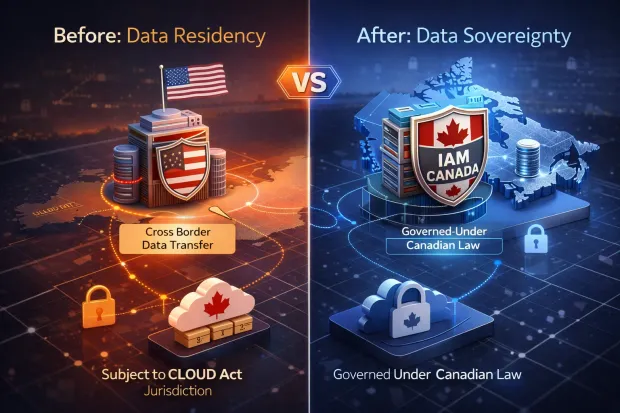
Most US-based identity giants have “Canadian regions,” but residency does not equal sovereignty. Under the U.S. CLOUD Act, the American government can compel a US company to hand over data stored on any of its servers, including those physically located in Toronto or Montreal.
The Risk: If you use a US-headquartered provider, your Canadian customers’ data is potentially subject to warrantless search by a foreign government. That’s not theoretical, it's structural exposure built into the provider’s corporate jurisdiction.
The Law 25 Complication: Quebec’s Law 25 mandates a Privacy Impact Assessment (PIA) before transferring data outside the province. If that data is subject to foreign laws allowing broader access than Canadian law (like the CLOUD Act), your PIA may fail. Using a US provider could effectively make you non-compliant in Quebec by default or at minimum, force complex mitigation strategies.
The Local Advantage: A Canadian-headquartered provider answers only to Canadian courts. This drastically simplifies Law 25 compliance and provides jurisdictional certainty. For industries like Finance, and Healthcare, this clarity enables a powerful promise to stakeholders: “100% Protected in Canada.” That message isn’t marketing, it's defensible governance.
2. Eliminating the “Shadow AI” and Identity Gaps
A significant portion of today's breach costs stems from Shadow AI employees using unauthorized AI tools that quietly expose corporate credentials. Traditional IAM tools often focus on sanctioned apps, leaving a massive security gap in the "gray zone" of browser extensions and unmanaged SaaS. Global IAM platforms sometimes struggle to address the unique mid-market and hybrid work patterns common across Canadian enterprises.
The Solution: Local providers like 1Password (Toronto) have pioneered Extended Access Management, specifically designed to secure unmanaged applications and protect credentials beyond centralized SSO. By closing identity gaps before they escalate, organizations can prevent minor oversights from becoming seven-figure incidents.
3. Trust as a Conversion Metric (The “Quebec Effect”)
With Law 25 fully matured, Canadian consumers and enterprise buyers are more privacy-literate than ever. Privacy Impact Assessments are no longer rare; they're routine. Identity decisions now influence procurement approvals and partnership evaluations.
The Friction: Using a non-Canadian provider means every new initiative requires a complex, cross-border PIA to demonstrate adequate safeguards. Legal reviews stretch. Risk assessments expand. Product launches slow.
The Speed-to-Market: Canadian providers often offer what feels like “Compliance-in-a-Box”. By keeping data domestic and jurisdiction clear, you bypass burdensome legal reviews. The result? Faster deployments, smoother enterprise deals, and fewer regulatory roadblocks.
In a competitive environment where privacy influences purchasing decisions, local identity isn’t just a compliance checkbox, it's a conversion strategy that builds immediate digital trust.
Top Identity Providers Headquartered in Canada
After deep research into the domestic ecosystem, these seven companies stand out for their commitment to Canadian privacy, data sovereignty, and regulatory alignment. They are not simply operating in Canada; they are structurally aligned with Canadian courts, Canadian regulators, and Canadian compliance realities. In a world where “hosted in Canada” can still mean governed elsewhere, that distinction matters.
Each of these IAM Canada providers addresses a different layer of the identity stack CIAM, workforce IAM, identity verification Canada, federated health identity, governance, Zero Trust access, and PKI infrastructure.
Some focus on user experience. Others specialize in compliance depth. Together, they represent the backbone of Canada’s digital identity ecosystem in 2026.
1. LoginRadius – The CIAM Specialist
LoginRadius (Vancouver, BC) remains a premier choice for CIAM in Canada. They specialize in high-scale consumer identities, providing a “front-door” experience that balances security with zero friction. In industries where user onboarding speed directly impacts revenue, that balance is not optional; it's strategic.
Beyond authentication, LoginRadius emphasizes consent orchestration, adaptive MFA, and passwordless experiences aligned with Law 25 and CPPA requirements. Their platform is built for brands that need enterprise-grade identity without sacrificing customer conversion rates.
Best For: Consumer-facing brands needing social login, passwordless authentication, and Law 25 compliance.
Key Advantage: Dedicated Canadian cloud deployment ensuring user profiles remain within national jurisdiction.
2. 1Password – The Workforce Anchor
While widely known as a password manager, 1Password (Toronto, ON) has evolved into a leader in workforce identity through its Extended Access Management (XAM) model. This category addresses the growing security gap between managed enterprise apps and the “shadow IT” tools employees use daily.
In 2026, identity risk increasingly lives outside traditional SSO boundaries. 1Password’s approach acknowledges that reality and focuses on securing credentials, developer secrets, and device trust across both sanctioned and unsanctioned environments.
Best For: Securing employee credentials and closing the unmanaged app gap.
Key Advantage: Canadian headquarters with strong regional infrastructure and workforce-focused security innovation.
3. Trulioo – The Verification Powerhouse
When it comes to identity verification Canada, Trulioo (Vancouver, BC) is a dominant force. They provide real-time KYC and KYB services that connect directly to Canadian credit bureaus, government registries, and global verification databases.
For fintechs and regulated entities, onboarding must be fast but also audit-proof. Trulioo’s infrastructure reduces manual review processes and helps organizations meet FINTRAC and AML compliance without building verification logic internally.
Best For: Fintechs and regulated industries requiring compliant onboarding.
Key Advantage: Deep integration with Canadian data sources for instant identity validation.
4. IDENTOS – The Privacy-First Innovator
IDENTOS (Toronto, ON) has positioned itself as the connective layer for federated digital identity ecosystems particularly in healthcare and public sector environments. Their architecture prioritizes user-controlled data sharing and interoperability across institutional boundaries.
Rather than centralizing identity data, IDENTOS supports federated trust models aligned with Canada’s digital identity roadmap. This makes them particularly valuable in environments where privacy and interoperability must coexist.
Best For: Healthcare, government, and privacy-by-design projects.
Key Advantage: Technology powering Ontario’s digital health identity exchange.
5. Bravura Security – The Governance Veteran
Formerly Hitachi ID, Bravura (Calgary, AB) is a longstanding IAM Canada provider focused on identity governance and privileged access management. They specialize in lifecycle automation, ensuring employees receive the right access at the right time and lose it when they should.
In large enterprises with complex infrastructures, governance is not glamorous, but it is critical. Bravura’s deep expertise in onboarding, offboarding, and compliance reporting makes them a reliable backbone for mature identity programs.
Best For: Large enterprises with complex onboarding/offboarding workflows.
Key Advantage: Canadian-based R&D and enterprise governance specialization.
6. Agilicus – The Zero Trust Disruptor
Located in the Waterloo tech corridor, Agilicus (Kitchener, ON) focuses on identity-aware access without relying on legacy VPN infrastructure. Their model aligns with Zero Trust principles, where identity and device posture determine access, not network location.
As remote work and distributed infrastructure continue to expand, VPN-heavy architectures are becoming inefficient and risky. Agilicus offers a streamlined approach for organizations modernizing secure access models.
Best For: Companies transitioning from VPN-based access to Zero Trust architecture.
Key Advantage: Fully Canadian-owned, mid-market-friendly deployment model.
7. Entrust – The Security Titan
Entrust, with deep Ottawa roots, operates at the high-assurance end of the identity spectrum. Their expertise spans PKI, digital certificates, hardware security modules, and advanced identity verification.
For government agencies, financial institutions, and critical infrastructure operators, Entrust provides the cryptographic foundation that underpins secure digital ecosystems. When the requirement is maximum assurance, they bring decades of expertise.
Best For: Critical infrastructure, government, and high-assurance banking.
Key Advantage: Extensive PKI and certificate management capabilities with a strong Canadian heritage.
Collectively, these IAM Canada providers demonstrate that the domestic ecosystem is not niche; it is robust, diverse, and strategically positioned for Canada’s evolving regulatory landscape. The real decision isn’t whether Canadian providers can compete. It’s which one aligns best with your identity priorities.
Quick look at the Leaders: IAM, CIAM, and IDV
| Provider | Category | Best For | Data Residency |
|---|---|---|---|
| LoginRadius | CIAM | Customer Experience | CA Native |
| 1Password | IAM / XAM | Employee Security | CA Native |
| Trulioo | IDV | KYC/Compliance | CA Localized |
| IDENTOS | Digital ID | Health & Gov | CA Native |
| Bravura | IGA / PAM | Enterprise Governance | CA Native |
How to Select the Best Identity Provider for Your Business
Choosing from the best IAM Canada providers isn’t just about feature comparison; it’s about strategic alignment. Identity decisions impact compliance posture, procurement timelines, and long-term architecture flexibility. The right provider should fit not only your technical stack, but also Canada’s evolving regulatory and jurisdictional landscape.
Before signing a multi-year contract, pause and evaluate through a distinctly Canadian lens. A global platform might look impressive in a Gartner quadrant, but if it complicates your Privacy Impact Assessment or exposes you to cross-border legal friction, that “industry leader” label becomes less reassuring.
Here’s a practical checklist that prioritizes the Canadian Context:
-
Sovereignty Check: Is the company Canadian-owned, or just a US firm with a Canadian server? True sovereignty is critical for Law 25 compliance and reducing foreign jurisdiction risk.
-
Regulatory Alignment: Do they offer built-in support for CPPA, PIPEDA, and Quebec Law 25 requirements? Look for consent tracking, data portability workflows, and audit-ready logging not vague “compliance-ready” claims.
-
Support Language: Do they provide 24/7 support in both official languages (English and French)? For organizations operating nationally, bilingual compliance and documentation can accelerate procurement approvals.
-
Integration Versatility: Can they connect to legacy on-prem systems (Bravura/Agilicus environments) as well as modern cloud-native stacks (LoginRadius/1Password ecosystems)? Hybrid environments are common in Canada. Your identity provider must seamlessly bridge both worlds.
Ultimately, selecting an IAM Canada solution should feel less like buying software and more like choosing a long-term governance partner. The best provider won’t just authenticate users, they'll simplify compliance, reduce risk exposure, and adapt as Canada’s digital identity framework continues to evolve.
The PCTF: Canada’s 2026 “Gold Standard” for Trust
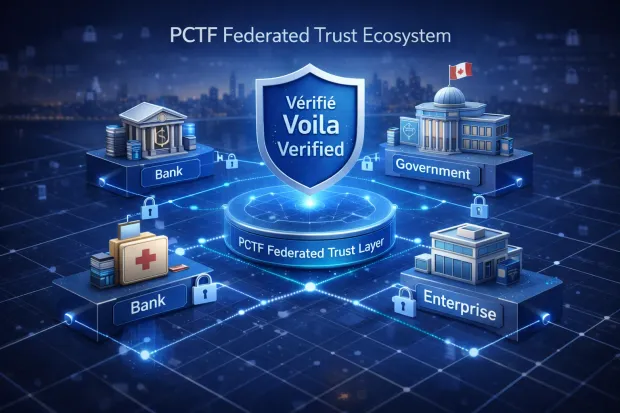
If Law 25 and PIPEDA provide the legal “sticks,” the Pan-Canadian Trust Framework (PCTF) is the “carrot” that enables growth. Developed by the Digital ID & Authentication Council of Canada (DIACC), the PCTF establishes auditable standards that ensure digital identity systems can interoperate securely across provinces and sectors. It moves identity from fragmented silos toward a coordinated, trust-based ecosystem.
In 2026, PCTF compliance is rapidly becoming the benchmark for interoperability in IAM Canada strategies. It’s what allows a bank in Ontario to trust a digital credential issued by a provincial health authority in British Columbia without re-verifying the user from scratch. That shared trust reduces duplication, lowers verification costs, and enhances user experience.
More importantly, the PCTF is not just a technical framework, it's a confidence signal. As digital identity adoption accelerates, enterprises want assurance that their identity provider aligns with nationally recognized standards. PCTF alignment demonstrates that your identity stack follows auditable governance models, consent controls, and assurance levels designed specifically for Canada’s regulatory environment.
Why the PCTF matters for your 2026 Strategy
Interoperability: It ensures your chosen identity provider can integrate with provincial digital wallets (like the Ontario Digital ID) and participate in federated identity exchanges across jurisdictions.
The “Voilà Verified” Trustmark: This certification signals to auditors and increasingly to enterprise customers that your identity platform meets a rigorously assessed Canadian standard for privacy, transparency, and “Notice & Consent.” In regulated sectors, that trustmark can shorten procurement cycles.
Reduced Liability: Under the PCTF, organizations can shift toward a federated trust model. Instead of collecting and storing sensitive identity documents, you rely on verified credentials issued by trusted authorities. Less stored data means lower breach exposure and fewer long-term compliance risks.
In short, PCTF alignment turns identity from a compliance burden into a strategic enabler. It allows Canadian businesses to scale digital services confidently without reinventing trust every time a new integration is required.
Conclusion
The move toward identity management Canada is no longer a niche requirement reserved for government agencies or crown corporations; it has become a baseline expectation for any organization that values customer trust and regulatory resilience. In 2026, identity is the control plane of your digital business. It influences compliance outcomes, procurement decisions, breach exposure, and even brand perception.
By partnering with a domestic IAM Canada provider, you are not merely checking a compliance box, you are architecting jurisdictional clarity into your infrastructure. You are reducing cross-border legal complexity, simplifying Privacy Impact Assessments, and aligning your identity stack with Canada’s evolving digital sovereignty strategy. That alignment doesn’t just protect you today; it positions you for whatever regulatory reform comes next.
There’s also a competitive layer that shouldn’t be ignored. Customers, enterprise buyers, and regulators increasingly ask where data lives and who governs it. Being able to answer confidently “Protected under Canadian law” isn’t marketing spin. It’s strategic differentiation.
Whether you need the frictionless CIAM scale of LoginRadius, the verification depth of Trulioo, the workforce protection of 1Password, or the Zero Trust modernization of Agilicus, the Canadian identity ecosystem has matured into a robust, sovereign alternative to global incumbents. The real question is no longer whether IAM Canada solutions can compete.
It’s whether your business can afford not to choose one.
FAQs
Q: What is the difference between IAM and CIAM in a Canadian context?
A: IAM (Identity and Access Management) typically focuses on employees (Workforce Identity), ensuring they have the right access to internal tools. CIAM (Customer Identity and Access Management) focuses on your external users, prioritizing a seamless, secure, and branded login experience for your apps and websites.
Q: Does Law 25 require me to use a Canadian identity provider?
A: While Law 25 doesn't explicitly mandate Canadian vendors, it requires you to conduct a Privacy Impact Assessment (PIA) for any data leaving Quebec. Using a provider with Canadian data residency significantly simplifies this process and reduces legal risks.
Q: How does "identity verification Canada" work with FINTRAC?
A: For financial institutions, identity verification Canada providers like Trulioo match user-provided data against "dual-source" records (like credit files or utility bills) to meet FINTRAC’s strict anti-money laundering (AML) requirements.
Q: Can I use 1Password for my enterprise IAM needs?
A: Yes. While traditionally a password manager, 1Password now offers Extended Access Management (XAM), which allows enterprises to manage access to apps, secure developer secrets, and ensure device health across the entire workforce.
Q: Why is data sovereignty better than just data residency?
A: Data residency means your data sits on a server in Canada. Data sovereignty means that because the provider is headquartered in Canada, the data is protected by Canadian laws and cannot be seized by foreign governments under laws like the U.S. CLOUD Act without a Canadian court order.
Q: Are digital IDs mandatory for Canadians in 2026?
A: No, as of 2026, canada digital identity programs remain voluntary. However, they are becoming the preferred method for high-security transactions in banking and healthcare due to their superior security and ease of use.