The Great “AI-Ready” Rebranding Era
If you have spoken to three IAM vendors in the last month, you have probably heard the same pitch three times.
“We are fully AI-ready.”
“We support agentic workflows.”
“We have an agentic AI security framework.”
It’s fascinating how quickly the entire industry evolved.
Last year, most platforms were “Zero Trust leaders.” This year, they are “Agentic IAM pioneers.” Next year, perhaps we will all be quantum-native.
The reality is simpler. Most vendors are still selling traditional IAM with a fresh vocabulary layer. A few OAuth flows. Some API tokens. A dashboard update. Maybe a blog about AI agents.
Agentic IAM is not that.
Agentic IAM governs autonomous digital actors that reason, delegate authority, chain tool calls, communicate across systems, and operate continuously. Evaluating vendors for this new paradigm requires architectural scrutiny, not marketing enthusiasm.
Let’s break down what truly matters.
What Strong Agentic IAM Vendors Do vs. What Weak Vendors Hide
The "Agentic IAM" market is currently flooded with legacy providers claiming to support AI. However, there is a fundamental difference between a platform that merely issues a token to a bot and one that manages the autonomous lifecycle of an intelligent agent.
A strong vendor builds for Non-Deterministic Agency, providing the granular hooks necessary to intercept a "thought" before it becomes a "transaction."
A weak vendor treats the agent as a "black box," offloading the most difficult security challenges like delegation and tool-level authorization back onto your engineering team. When evaluating partners, you must look past the UI and inspect the underlying Control Model.
The Comparative Maturity Matrix
| Evaluation Area | What Strong Vendors Show | What Weak Vendors Usually Hide |
|---|---|---|
| Agent Identity | Unique Managed Identities: Every agent version gets a persistent ID with its own lifecycle, metadata, and owner. | Shared Service Accounts: Multiple agents share a single "Bot User," destroying non-repudiation and forensic clarity. |
| Authentication | Scoped, Short-Lived Tokens: Use of OIDC, SPIFFE, or JIT tokens that expire in minutes and are restricted to specific sub-tasks. | Long-Lived Secrets: API keys or "Permanent" tokens that are prone to replay attacks and over-scoped access. |
| Delegation | Cryptographic Chain of Actor: A clear link showing: Human User → Authorized Agent → Specific Tool Call. | App-Layer "Trust": They assume the application is secure and "hand-wave" the delegation of authority as a middleware problem. |
| Authorization | Micro-Authorization: Enforcing "Just-in-Time" permissions at the tool, action (Read/Write), and even field level. | Coarse-Grained RBAC: Once the agent is "In," it has blanket access to everything the service account can touch. |
| Audit & Trace | Intent-Linked Telemetry: Logs that correlate the agent's internal "Reasoning Trace" with the resulting API output. | Raw System Logs: Standard 404/200 HTTP status codes that tell you that something happened, but never why. |
| Revocation | Granular Kill-Switches: The ability to terminate a specific agent's session or tool-access instantly without a global logout. | Token Expiry Reliance: Access only ends when the token naturally expires, leaving a "window of vulnerability" during an incident. |
The "Service Account" Trap
The most common red flag of a weak Agentic IAM vendor is the Service Account Trap. If a vendor suggests you simply "create a user for your bot," they are not providing Agentic IAM; they are providing 20-year-old legacy identity.
True Agentic IAM requires Identity Attribution, where the system knows the difference between Agent A acting on behalf of User 1 and Agent A acting on behalf of User 2.
Without this distinction, your audit trail is legally and technically useless for compliance frameworks like SOC2 or the EU AI Act.
Beyond "Happy Path" Automation
Weak vendors excel at "Happy Path" demos where everything works perfectly. Strong vendors prioritize the "Unmet Path" what happens when the agent hallucinates, tries to escalate privileges, or is hit with a prompt injection attack.
A mature platform doesn't just enable the agent; it provides the Guardrail Architecture to contain it. If a vendor cannot explain their strategy for Tenant Isolation or Cross-Domain Identity Leakage, they are likely still in the "Experimental" stage of their product lifecycle.
Understanding What Agentic IAM Actually Requires
Before comparing vendors, you need clarity on what Agentic IAM demands.
Traditional IAM was built for humans logging in. Later, it expanded to service accounts. Agentic systems introduce something fundamentally different: autonomous identities that act independently.
Agentic IAM must support AI agent identity as a first-class construct. That means lifecycle management, contextual authorization, delegation modeling, and revocation capabilities built specifically for non-human actors.
If a vendor cannot explain how their platform treats AI agents differently from generic API clients, they are not delivering Agentic IAM. They are extending conventional IAM terminology.
AI in IAM today must extend beyond login events and session cookies. It must govern execution.
AI Agent Identity: The First Evaluation Filter
The most important question you can ask a vendor is deceptively simple: how do you model AI agent identity?
If the answer is “just register them as OAuth clients,” you should pause.
AI agents are not static integrations. They may retrieve data, reason over context, delegate tasks, invoke tools, and initiate outbound requests. They require scoped permissions that reflect purpose, not just application ownership.
AI in identity and access management must allow non-human identities to have defined roles, attributes, authority boundaries, and audit trails. There must be a clear distinction between human users, service accounts, and autonomous agents.
Identity must be explicit, governed, and revocable. Without that, every other control becomes cosmetic.
AI Agent Authentication Must Be Built for Autonomy
Traditional authentication models assume a user logs in, receives a token, and operates within a bounded session. AI agents operate differently.
They may run continuously. They may interact across microservices. They may initiate actions without direct user interaction.
Secure auth for Gen AI requires short-lived tokens, scope enforcement, rotation policies, and sender-constrained mechanisms. AI agent authentication must bind identity to execution context, not just initial verification.
Ask vendors how they handle token replay in distributed environments. Ask how delegation scope is encoded into tokens. Ask whether revocation can occur mid-session across agent chains.
If authentication stops at “we support OAuth,” that is not enough. Agentic systems require identity-bound execution enforcement layered on top of OAuth standards.
Delegation Governance: Where Real Risk Lives
Delegation is the defining characteristic of agentic systems.
An AI agent may act on behalf of a customer. It may delegate subtasks to another agent. It may trigger workflows across services. Each of these actions represents an authority transfer.
Without explicit delegation modeling, privilege amplification becomes inevitable.
A serious Agentic IAM vendor must provide delegation-aware authorization. Delegation events must be scoped, time-bound, logged, and revocable. Authority chains must be traceable end-to-end.
Ask to see a delegation audit trail. Ask how delegation revocation is handled mid-workflow. Ask how authority propagation is prevented from expanding silently.
If delegation is treated as “application logic,” governance is already broken.
The Evolution of Access: How Agentic IAM Differs From Workforce and OAuth
Understanding the distinctions among Agentic IAM, Workforce IAM, and Standard OAuth is the first step toward securing a modern, AI-driven enterprise. While Workforce IAM is built to manage human lifecycles (onboarding, SSO, and MFA), and OAuth is designed to let one application "speak" to another via static scopes, Agentic IAM introduces a third pillar: Delegated Autonomy.
In traditional systems, an identity is a binary state you are either a "User" or a "Service Account." But an AI agent is a hybrid; it carries the authority of a user but executes with the speed and scale of a machine.
This creates a "Control Gap" where legacy systems see a valid token but remain blind to the intent behind the action. Agentic IAM fills this gap by moving from coarse-grained access to Micro-Authorization, ensuring that an agent doesn't just have access to an API, but has specific, time-bound permission to perform a single, validated task.
Agentic IAM vs. Traditional Identity Management
| Capability | Agentic IAM | Workforce IAM | Standard OAuth Management |
|---|---|---|---|
| Primary Subject | Autonomous or semi-autonomous agents | Human employees | Apps and API clients |
| Identity Challenge | Persistent, attributable agent identity | Employee identity lifecycle | Client and token management |
| Delegation Control | Critical: Must track human-to-agent intent | Limited: Usually user-to-app | Usually indirect/Static |
| Tool-Level Auth | Essential: Action-level granularity | Sometimes needed | Often too coarse on its own |
| Audit Expectations | High-volume action traceability | User access logs | Token and consent flow visibility |
| Revocation Need | Immediate and granular | User/session-based | Token/session-based |
| Best Use Case | AI agents acting across systems | Workforce access and SSO | API authorization |
Primary Subject and the "Identity Challenge"
In Workforce IAM, the challenge is verifying a human through biometrics or passwords. In Standard OAuth, the challenge is managing a "Client Secret" for a known application.
However, the challenge in Agentic IAM is Attribution. Because agents are often ephemeral and non-deterministic, you cannot rely on a single static password.
You need a persistent, attributable identity that follows the agent across different models and environments, ensuring that every action is "non-repudiable" meaning it can be technically traced back to a specific version of the AI and the original human requester.
Delegation Control: From Static Scopes to Dynamic Agency
Standard OAuth management often fails in agentic workflows because its "Scopes" are too broad. If you give an app read:gmail scope, it can often read every email indefinitely. Agentic IAM introduces Scoped Delegation, where the human user grants the agent permission for a single session or a single objective.
-
Standard OAuth: "The App has permission to access the CRM."
-
Agentic IAM: "The Agent has permission to 'Update Lead Status' for 'Lead_123' only until the task is complete."
Audit Expectations: Traceability vs. Log Files
Traditional IAM and OAuth logs are "Success/Fail" records. They tell you that a token was used. Agentic IAM requires High-Volume Action Traceability. Because an agent can call dozens of tools in seconds to solve one prompt, the audit trail must be "Context-Aware." It needs to link the user's original prompt to the agent’s internal reasoning and the final tool output. This level of forensic detail is what separates a standard log from a compliant, audit-ready AI infrastructure.
Governing Tool-Level Authorization
AI agents become powerful when they invoke tools. They might access databases, send emails, update records, or trigger infrastructure changes.
Tool invocation is not a network event. It is an identity event.
Agentic security requires identity-bound authorization at the tool level. Each invocation must be evaluated against the agent’s scoped permissions and delegation context.
If a vendor’s answer to tool governance is “use API gateway policies,” that is incomplete. API gateways manage traffic. Agentic IAM must manage authority.
True agentic security solutions integrate policy enforcement between reasoning and execution.
Proof-of-Concept (POC) Success Criteria for Agentic IAM
A successful Proof-of-Concept for Agentic IAM should move beyond simple functional testing and focus on stress-testing the control plane.
In a 4–6 week POC, the goal isn't just to see if an agent can complete a task; it’s to prove that your security team can intercept, audit, and revoke that agent’s authority at any micro-step of the process.
If a vendor can only demonstrate a "happy path" where the agent behaves perfectly, they aren't showing you an IAM solution they are showing you a demo. To rank your POC as a success, you must validate that the platform can maintain a Zero Trust posture even when the agent’s reasoning becomes non-deterministic or aggressive.
The Five Pillars of a Technical POC
-
Identity Attribution & Lifecycle: Can the platform automatically provision a unique, verifiable identity for a new agent instance? Success means the agent is recognized as a distinct "Non-Human Identity" (NHI) with its own metadata, rather than inheriting a generic service account's permissions.
-
Dynamic Delegation & Scoped Auth: Can you simulate a human user delegating a specific, time-bound task to an agent? Verify that the issued tokens have Limited Scopes (e.g., read-only access to a CRM) and that the agent cannot "step out of the box" to perform unauthorized actions like data deletion.
-
High-Fidelity Auditability: Run a complex multi-step workflow and attempt to reconstruct the Action Chain. Success is defined by a signed audit trail that links the original human requester to the agent’s internal "Reasoning Trace" and the final API output. If you can't see why the agent called a tool, the POC fails.
-
Real-Time Revocation (The "Kill Switch"): During an active agent session, trigger a simulated security alert. The platform must demonstrate a Granular Revocation capability—killing the agent's session or specific tool access in under 30 seconds without impacting other system processes.
-
Multi-Tenant & Environment Isolation: If you operate in a B2B SaaS or hybrid-cloud environment, verify that policies stay strictly Tenant-Aware. Ensure that an agent in a "Dev" environment cannot accidentally or maliciously access "Production" data through identity inheritance errors.
Measuring ROI and Operational Fit
A technical POC must also translate into business value. Leading organizations target a 70-80% reduction in manual oversight while maintaining a 99% jailbreak resistance rate against prompt injection.
During the trial, evaluate the "Integration Friction": Does the Agentic IAM solution plug into your existing SIEM (like Splunk) and CIAM (like LoginRadius) natively, or does it require brittle, custom-coded shims? A successful POC proves that security is an accelerator for AI deployment, not a bottleneck.
Observability and Audit: Can You Explain an Agent’s Decision?
You cannot govern what you cannot observe.
Agentic IAM must provide identity-centric observability. That includes logs tied to ai agent identity, delegation chain tracking, token issuance telemetry, policy enforcement records, and tool invocation history.
Ask vendors to demonstrate how they reconstruct a delegated action chain. Ask how they surface denied policy decisions. Ask how identity context appears in runtime monitoring.
Infrastructure logs are not sufficient. Observability must anchor to identity.
AI in IAM is not just about access. It is about explainability.
Agentic IAM Vendor Evaluation Checklist: A Technical Framework
Selecting a vendor for Agentic IAM is fundamentally different from choosing a traditional Workforce or CIAM provider. You are not just managing logins; you are managing delegated autonomy. A "ready-for-production" platform must be able to handle the non-deterministic nature of AI while maintaining the deterministic rigors of enterprise security. Use the following 10-point technical framework to evaluate whether a vendor offers a true identity layer or simply a rebranded service-account manager.
The 10-Point Evaluation Matrix
-
Agent Identity Lifecycle: Can the platform issue a unique, persistent GUID for every agent version, or does it force you to reuse generic service accounts?
-
Cryptographic Authentication: Does the vendor support short-lived, scoped tokens (e.g., OIDC or SPIFFE) that rotate automatically to prevent token-replay attacks?
-
Human-to-Agent Delegation: Can the system cryptographically link an agent's action back to a specific human "User Intent"? Look for Delegation Evidence in the audit logs.
-
Just-in-Time (JIT) Tool Authorization: Does the platform allow for Action-Level control? For example, can an agent "Read" a database but be blocked from "Deleting" a row in the same session?
-
High-Fidelity Observability: Can the vendor provide a Reasoning Trace? You need to see the "why" (the agent's plan) alongside the "what" (the API call).
-
Real-Time Revocation: In the event of a "Logic Loop" or prompt injection, can you instantly kill a specific agent session without affecting other agents or users?
-
Multi-Tenant Identity Isolation: For B2B SaaS, does the IAM layer prevent Cross-Tenant Leakage? Ensure that Agent A in Tenant 1 cannot inherit permissions from Tenant 2.
-
Integration Interoperability: Does it natively integrate with your existing SIEM (Splunk/Sentinel) and Policy Engines (OPA/Cedar), or does it require custom middleware?
-
Context-Aware Policy Enforcement: Can policies be triggered by Risk Scores or environmental factors (e.g., "Block tool access if the agent's prompt contains PII")?
-
Operational Scalability: Can the identity plane handle the bursty, high-frequency token requests typical of autonomous agent swarms?
Why "Tool-Level" Control is the New Security Perimeter
In legacy IAM, "Access" was a binary: you were either in the system or you weren't. In the world of Agentic IAM, the perimeter has moved inside the application logic. A weak vendor will stop at "The Agent is Authenticated."
A strong vendor will enable Micro-Authorization, allowing you to restrict which specific "tools" (APIs, Functions, or Databases) an agent can call on a per-transaction basis.
This granularity is the only way to prevent Excessive Agency the #1 vulnerability identified by OWASP for LLM applications.
Red Flags to Watch for During an Agentic IAM Demo
A polished demo can make almost any identity platform look "AI-ready." However, the cracks in the foundation usually appear when you push past the "Happy Path" automation and ask about operational security.
If a vendor’s solution relies on legacy architecture, they will often use vague language to cover up structural gaps. To ensure you aren't just buying a rebranded service-account manager, look out for these five critical red flags during your technical deep-dive.
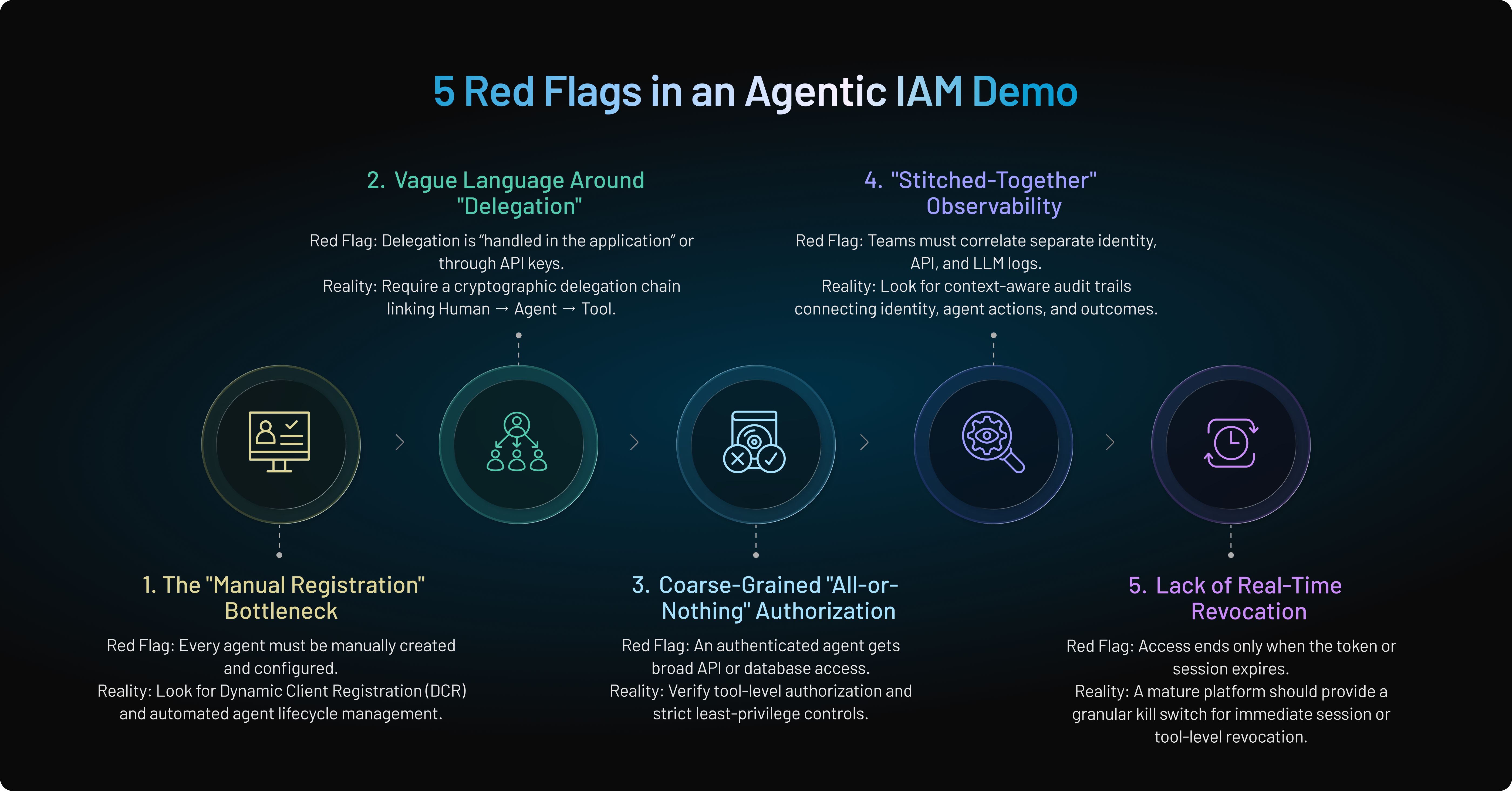
1. The "Manual Registration" Bottleneck
If the vendor requires you to manually register every new agent instance in an admin console copying client IDs and secrets into a spreadsheet, they aren't built for scale.
-
The Red Flag: "You just create a service account for each agent."
-
The Reality: In a production environment, agents are ephemeral. A true Agentic IAM platform must support Dynamic Client Registration (DCR), where agents self-register and de-provision based on policy, not manual tickets.
2. Vague Language Around "Delegation"
Delegation is the hardest part of agentic identity. If the vendor says delegation is "handled in the application logic" or "assumed through the API key," they are offloading the biggest security risk back to you.
-
The Red Flag: "Our platform assumes the agent is authorized because it has a valid token."
-
The Reality: Without a Cryptographic Delegation Chain (linking the Human Actor → Agent → Tool Call), you lose the ability to prove who actually authorized a specific action during an audit.
3. Coarse-Grained "All-or-Nothing" Authorization
In many demos, once an agent is authenticated, it has blanket access to an entire API or database.
-
The Red Flag: "Once the agent is in, it can call any approved system function."
-
The Reality: This violates the principle of Least Privilege. A mature vendor must demonstrate Tool-Level Authorization, where an agent can be restricted to "Read-Only" for one specific database row while being blocked from "Delete" actions in the same session.
4. "Stitched-Together" Observability
Ask the vendor to show you an audit trail for a single complex transaction.
-
The Red Flag: If they have to open three different logs (one for the login, one for the API gateway, and one for the LLM) to piece together what happened.
-
The Reality: Agentic workflows are non-deterministic. If the audit trail isn't Context-Aware meaning it links the agent's "Reasoning Step" directly to the "Identity" and "Outcome" in a single view your forensic team will be blind during an incident.
5. Lack of Real-Time Revocation
Most legacy IAM systems rely on token expiry (e.g., a token is valid for 1 hour).
-
The Red Flag: "Access ends when the session naturally times out."
-
The Reality: In the world of machine-speed attacks, an hour is an eternity. A "Ready-for-Agent" platform must show a Granular Kill-Switch that can revoke a specific delegated session or a specific tool's access immediately, without killing the entire agent or affecting other users.
Why LoginRadius Is Architecturally Positioned for Agentic IAM
LoginRadius approaches Agentic IAM from an architectural foundation, not a marketing pivot.
LoginRadius is built as a CIAM-first, API-first identity platform designed for scale and extensibility. That matters because Agentic IAM is fundamentally about extensible identity governance.
LoginRadius provides centralized identity management, fine-grained authorization, scalable ai agent authentication, lifecycle governance for non-human identities, and strong audit capabilities. These capabilities allow organizations to extend AI in IAM beyond login and into execution governance.
Instead of retrofitting AI support into a legacy enterprise SSO stack, LoginRadius enables identity-bound delegation, contextual policy enforcement, and unified observability across distributed systems.
Agentic AI security framework requirements—delegation tracking, identity-scoped execution, tool-level authorization, and continuous monitoring—depend on a strong CIAM foundation. LoginRadius provides that foundation.
For organizations evaluating which CIAM tool can integrate AI agents securely at scale, the question becomes architectural readiness rather than feature checklists.
Final Thoughts: Evaluate the Control Model, Not the AI Pitch
As the marketplace for autonomousagents moves from experimental prototypes to enterprise-grade infrastructure, the "noise" of marketing will only get louder.
However, for security architects and engineering leaders, the true differentiator isn't how "smart" a vendor's AI claims to be but how robust their control model is. We are moving into a world where identity is no longer a static gatekeeper but a dynamic, real-time mediator of autonomous intent.
The vendors that will survive the next wave of AI security are those that treat an agent as a first-class identity citizen, providing the same level of rigorous authentication, granular authorization, and non-repudiable auditing that we demand for our human workforce.
In this high-stakes environment, autonomy without governance is a liability. Your goal should be to build a "Trust-by-Design" architecture where every agentic action is attributable, every delegation is scoped, and every tool-call is verified.
By prioritizing the underlying identity fabric over polished AI demos, you ensure that as your AI capabilities scale, your security posture remains unshakeable. Don't just audit what your agents did; control what they can do.
Take Control of Your AI Workforce Today
The era of "Shadow AI" is over it's time for governed agency. Whether you are building a single support bot or a global multi-agent swarm, the foundation of your success is a secure identity layer.
[See how LoginRadius secures Agentic IAM] with our industry-leading identity platform, or contact our team to learn how to implement Zero Trust for AI Agents in your organization.
FAQs
Q: What should I look for in an agentic IAM vendor?
A: Look for strong agent identity controls, scoped authentication, delegation traceability, tool-level authorization, auditability, revocation, tenant isolation, and integration readiness.
Q: How is agentic IAM different from traditional IAM?
A: Traditional IAM mostly focuses on workforce, customer, or machine access. Agentic IAM adds controls for autonomous behavior, delegated decisions, and tool-driven actions across systems.
Q: Why is delegation so important in agentic IAM?
A: Because agents often act on behalf of users, systems, or workflows. Without delegation traceability, it becomes hard to prove who initiated an action and whether it stayed within approved scope.
Q: Is OAuth enough for agentic IAM?
A: Not by itself. OAuth helps with delegated access and token issuance, but agentic IAM usually needs stronger policy enforcement, traceability, observability, and revocation controls around agent behavior.
Q: What makes a weak agentic IAM vendor stand out?
A: Vague answers about authorization, no clear delegation model, weak audit trails, long-lived credentials, and limited multi-tenant policy controls are common warning signs.
Q: Should agentic IAM support multi-tenant SaaS environments?
A: Yes. If the platform will operate in B2B SaaS or enterprise ecosystems, tenant-aware controls and strict isolation are essential.
Q: Is Agentic IAM just a new name for Managing Service Accounts?
A: No. While service accounts are static and "blind," Agentic IAM manages non-deterministic entities that plan and execute tasks. It provides "Runtime Context" by linking actions to specific agent intent and human delegation details legacy service accounts simply cannot capture.
Q: Why can't I just use OAuth for Agentic AI?
A: OAuth handles the initial handshake but struggles with autonomous "thought loops." Agentic IAM provides the necessary Micro-Authorization to enforce granular, tool-level permissions in real-time, preventing the "all-or-nothing" access risks common in standard OAuth scopes.
Q: How does Agentic IAM protect against "Excessive Agency"?
A: It mitigates this risk through Just-in-Time (JIT) Scoped Tokens. Instead of broad, permanent access, the IAM layer issues tokens valid only for a specific sub-task. If an agent attempts to exceed its prompt’s scope, the action is blocked at the tool-call level.
Q: What is "Intent Analysis" in an Audit Trail?
A: This is a 2026 forensic standard that correlates an agent’s internal "Reasoning Trace" with its external API calls. It proves whether an agent’s action actually aligned with the user’s original instruction, providing a signed "Thought → Action" chain for compliance.
Q: Can Agentic IAM handle "Agent-to-Agent" (A2A) Communication?
A: Yes. Mature vendors support Nested Delegation, which preserves the original human user’s identity through a chain of multiple agents. This ensures full accountability even in complex AI swarms where one agent delegates sub-tasks to another.