Introduction
Identity systems have aged quietly. Early IAM models were built for predictable users, fixed devices, and clear perimeters, where a single trust decision at login was usually enough. That world no longer exists. Users move fluidly across devices and sessions, applications span APIs and third parties, and attackers don’t force entry—they log in with stolen credentials and blend in. Yet most identity systems still stop thinking once authentication succeeds.
This guide explains why static identity models break at scale and what replaces them. You’ll learn how Agentic IAM shifts identity from a one-time checkpoint to a continuous decision layer, how trust is evaluated in real time, and how modern CIAM platforms like LoginRadius are evolving to support autonomous, context-aware identity without adding friction.
Identity Evolution
Traditional IAM Was Not Built for This New-Age
Traditional identity and access management (IAM) was created to manage employee access, not unpredictable external users. Its core responsibility was to ensure that the right employee had the right access to the right internal system. This worked well in controlled environments where roles changed slowly, devices were managed, and usage patterns were relatively stable.
The problem is that these same principles were stretched far beyond their original intent when organizations began applying them to customers, partners, and consumers. Static roles, one-time authentication, and long-lived sessions simply do not map well to environments where millions of users behave differently every second.
As scale increases, the limitations of static identity models become painfully obvious. A system that only evaluates trust once cannot distinguish between a legitimate customer and a hijacked session later in the day.
Security teams responded by adding more rules, more policies, and more authentication challenges, which increases complexity without actually improving decision quality. Over time, identity systems become brittle, rule-heavy, and difficult to reason about, while attackers continue to adapt faster than the policies meant to stop them.
How CIAM Improved Identity but Still Fell Short
Customer Identity and Access Management platforms significantly improved the situation by focusing on scalability, usability, and customer experience. CIAM introduced features like social login, adaptive authentication, and centralized identity profiles, making it possible to support millions of users without collapsing under operational complexity. Compared to traditional IAM, this was a major step forward.
Despite these improvements, most CIAM systems still rely on event-based decisions. Authentication happens, risk is assessed at that moment, and then the session proceeds largely unchecked. Adaptive authentication helps at login, but once trust is granted, it remains mostly static. This means CIAM can reduce friction during onboarding but still lacks the ability to continuously evaluate whether ongoing behavior makes sense. In other words, CIAM made identity more user-friendly, but not truly intelligent. So for this new age of AI, we need Agentic IAM.
What Is Agentic IAM?
Agentic IAM (Agentic Identity and Access Management) is an identity and access management model designed to identify, authenticate, authorize, govern, and audit autonomous AI agents that act on behalf of users, applications, or organizations. It extends established IAM controls to a new kind of identity: one that can reason, select tools, invoke APIs, make decisions, and take actions with varying levels of autonomy.
That last part changes the identity problem considerably. A human user usually signs in and interacts with applications within a reasonably defined session. A traditional machine identity, such as a service account or application client, typically performs predefined operations based on code and assigned permissions.
An AI agent however behaves completely differently. Give it a goal such as “resolve this customer’s billing issue,” and it may determine which systems to query, what information it needs, which API to call, and what action to take next. Agentic IAM ensures that autonomy does not translate into unrestricted access.
Instead of allowing an agent to operate through a shared API key, a human user's credentials, or an excessively privileged service account, the agent must be treated as a distinct, verifiable identity. Its access can then be tied to a defined owner or principal, delegated authority, permitted resources, specific actions, task context, and a limited period of time.
This creates an identity and authorization chain that looks more like: Human Identity → Delegated Authority → AI Agent Identity → Requested Action → Resource → Authorization Decision
For multi-agent systems, the chain can become longer: Human → Agent A → Delegated Task → Agent B → Tool or API → Action
Every additional hop creates another place where authority can become broader than intended or accountability can disappear. Agentic IAM is designed to preserve those boundaries.
What Makes an Identity “Agentic”?
Suppose an authenticated customer tells a financial assistant: “Pay my electricity bill.”
The customer may have access to several bank accounts and many capabilities within the banking application. The agent should not automatically inherit all of them. Its authority might instead be restricted to one account, one biller, a maximum transaction amount, and a short execution window.
The effective authorization boundary therefore becomes: User Authority ∩ Agent Permission ∩ Delegated Task ∩ Resource Policy ∩ Current Context
Agent authorization can also depend on the relationship between the principal, agent, and resource. The same authenticated agent may be authorized to work with Customer A’s account while having no authority over Customer B’s—even when both resources are exposed through the same API. That makes the decision relationship-aware: Principal → Delegated Agent → Specific Resource → Permitted Action
Roles and scopes still provide useful boundaries, but they may not capture the complete authorization context. In an agentic workflow, who delegated authority, which agent received it, which resource is being accessed, and what action was authorized can also determine whether access should be allowed.
Authentication establishes the agent’s identity. Agentic authorization determines how much authority that identity can exercise for the task.
Agentic IAM vs Agentic AI
Agentic AI and Agentic IAM describe related but very different parts of the architecture.
Agentic AI refers to AI systems capable of pursuing goals and performing actions with a degree of autonomy. The focus is on what the agent can reason about, decide, coordinate, and execute.
Agentic IAM governs the identity and access surrounding those actions. It establishes which agent is acting, on whose behalf, with what authority, against which resource, and under what conditions that action should be permitted.
An AI agent might decide that issuing a refund is the appropriate next action. Agentic IAM should determine whether that particular agent is actually authorized to issue it.
The distinction matters. Agentic IAM is not about making IAM itself “more intelligent” simply by adding AI to authentication or risk decisions. Its more important role is making autonomous agents identifiable, controllable, and accountable as they interact with real systems and sensitive data.
Agentic IAM Extends IAM Rather Than Replacing It
Agentic IAM builds on established identity capabilities such as authentication, OAuth-based authorization, token validation, lifecycle management, policy enforcement, least privilege, and auditing. What changes is how these controls are applied when the actor can make decisions and take actions autonomously.
Continuous authorization becomes particularly useful because an agent’s authority may need to change as it accesses new resources, invokes tools, or reaches higher-risk actions. Agentic IAM adds this agent-specific governance without replacing the IAM, CIAM, or machine identity systems already protecting humans and applications.
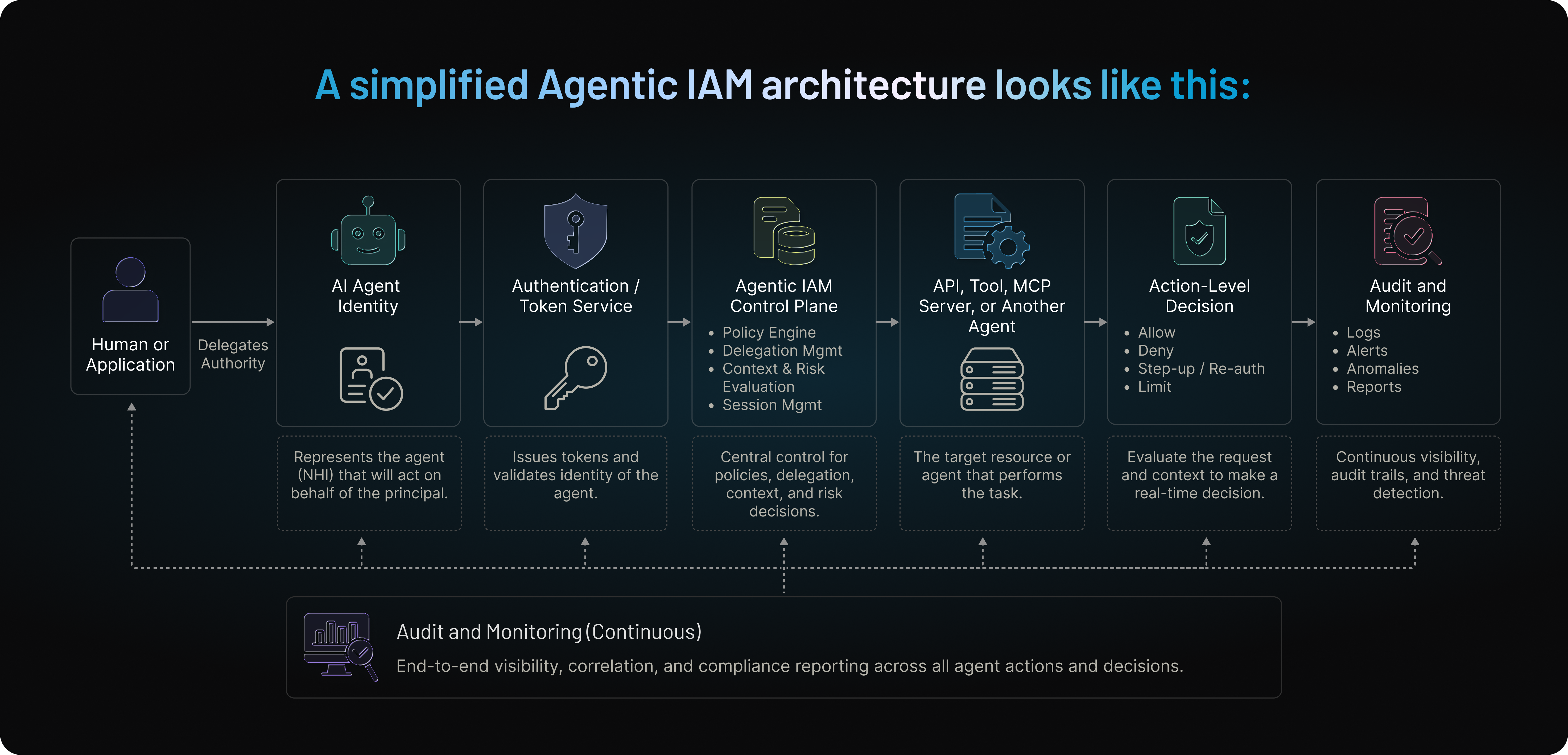
How Does Agentic IAM Work? Inside the Identity and Authorization Architecture
Agentic IAM connects an AI agent’s identity to the principal it represents, the authority delegated to it, and the actions it is permitted to perform.
Consider a customer asking an AI travel agent: “Cancel my hotel booking and request a refund.” The customer may already be authenticated, but the agent still needs its own identity and sufficient authority to act.
A simplified architecture looks like: Customer Identity → Delegated Authority → Agent Identity → Policy Evaluation → Scoped Access → Booking/Refund API
The important part is the context preserved through that chain. The system should not lose sight of which agent is acting, whose authority it is using, and what action that authority permits.
1. Establish a Unique Identity for the AI Agent
The agent first needs an identity that can be distinguished from the human user, application, or other agents around it.
Using a customer's credentials or sharing one API key across multiple agents makes accountability difficult. If several agents operate under the same credential, security teams may know that an API call was authenticated without knowing which agent actually initiated it.
A distinct agent identity creates a foundation for authentication, authorization, lifecycle management, monitoring, and revocation.
2. Connect the Agent to Its Owner or Principal
An agent rarely acts without context. It may operate for a customer, employee, application, organization, or another agent. Agentic IAM needs to preserve that relationship.
For our travel example, the system should be able to distinguish: Customer Identity → Travel Agent Identity from simply: Travel Agent Identity
This matters because the same agent may perform different actions for different customers. Knowing the agent's identity alone does not establish whose data or authority it is currently allowed to use.
This relationship should also be verifiable rather than assumed. If an agent claims to be acting for Customer A, downstream authorization needs trusted context establishing that connection. Otherwise, a legitimate agent identity could potentially operate with the wrong principal’s authority.
Agentic IAM therefore needs to preserve both agent identity and principal binding as authority moves through delegated workflows. This helps downstream services verify not only which agent is making the request, but also whose authority that agent is permitted to exercise.
3. Define the Authority Being Delegated
Delegation determines what the agent has actually been authorized to do.
If the customer asks the travel agent to cancel one hotel reservation, the agent does not need every permission available to the customer's travel account. Its authority can be constrained to the requested task, relevant resource, permitted actions, and appropriate time window.
For example: Customer → Travel Agent → Booking #4821 → Cancel + Request Refund
This is much safer than: Customer → Travel Agent → Full Customer Account Access
Delegation is therefore not simply about passing the user's permissions downstream. It is about narrowing them.
4. Authenticate the Agent and Establish Trusted Context
Before an agent receives access, the system needs to verify the identity presenting the request. Depending on the architecture, this may involve OAuth-based credentials, signed tokens, workload identities, certificates, or other cryptographically verifiable mechanisms.
The resulting identity context can also carry information needed downstream, such as the principal behind the agent, audience, scope, delegation relationship, and other relevant claims.
Authentication establishes which agent is making the request. It does not determine whether that agent is authorized to perform the requested action.
5. Evaluate the Requested Action Against Policy
The authorization layer evaluates whether the authenticated agent is permitted to perform the requested action.
That decision may consider the agent's identity, delegated scope, user authority, requested resource, action, current context, risk signals, and organizational policy.
Suppose the travel agent has permission to cancel bookings but the refund exceeds a configured threshold. The system might allow the cancellation while requiring additional customer verification before issuing the refund. The result does not always have to be simply allow or deny.
It may be: Allow → Allow With Restricted Scope → Require Step-Up Verification → Require Human Approval → Deny
This gives businesses a way to increase controls as the consequences of an agent's actions increase.
6. Issue Narrow and Short-Lived Access
Once authorization succeeds, the agent should receive only the access required for the approved action.
Broad, long-lived credentials are particularly risky for autonomous systems because they may remain useful well after the original task has ended. Short-lived, audience-bound, and appropriately scoped tokens can reduce that exposure.
For the travel agent, authorization might allow access only to the booking service, only for Booking #4821, and only for the period needed to complete the cancellation.
The principle is straightforward: Give the agent enough authority to complete the task—not every permission the underlying user possesses.
7. Re-Evaluate Authority as the Agent Takes New Actions
Agent workflows can change while they are running.
An agent may move from reading data to modifying it, invoke another tool, request a more sensitive resource, or delegate work to another agent. A decision made at the beginning of the workflow may no longer be sufficient.
Agentic IAM can therefore apply authorization at meaningful points throughout execution.
A low-risk lookup might proceed immediately. A refund, payment, account change, or access to sensitive information may trigger another policy decision or require human verification.
This is where continuous authorization becomes especially useful. It allows authority to be reassessed when the agent’s requested action, resource, context, or risk changes rather than treating the first successful authentication as permanent approval.
8. Maintain an Audit Trail and Revoke Access When Needed
Autonomous actions need attribution.
Security and compliance teams should be able to trace important activity through the identity chain:
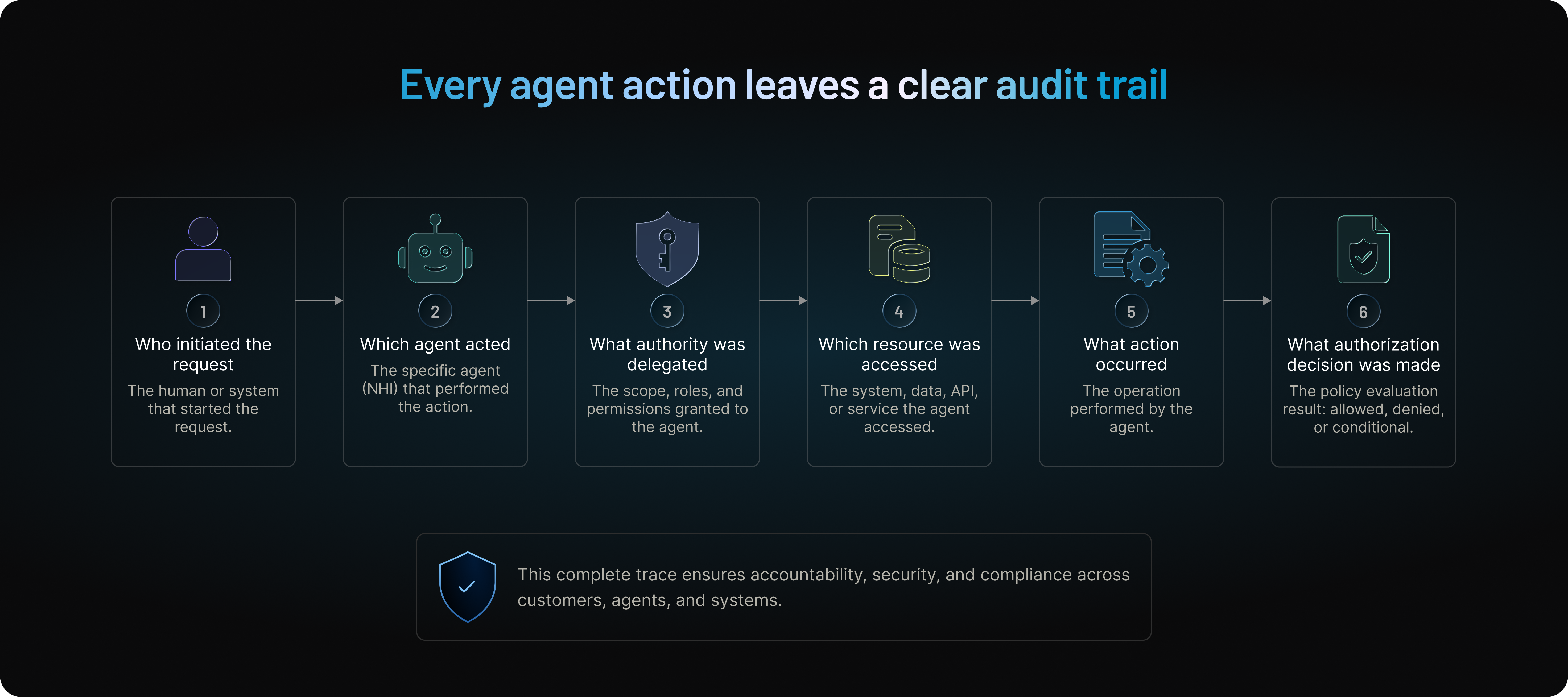
That visibility becomes even more important when several agents participate in the same workflow.
Agent identities also need lifecycle controls. When an agent is disabled, compromised, replaced, or no longer required, its credentials and permissions should be revocable without affecting unrelated users or agents.
The complete Agentic IAM flow can therefore be summarized as:
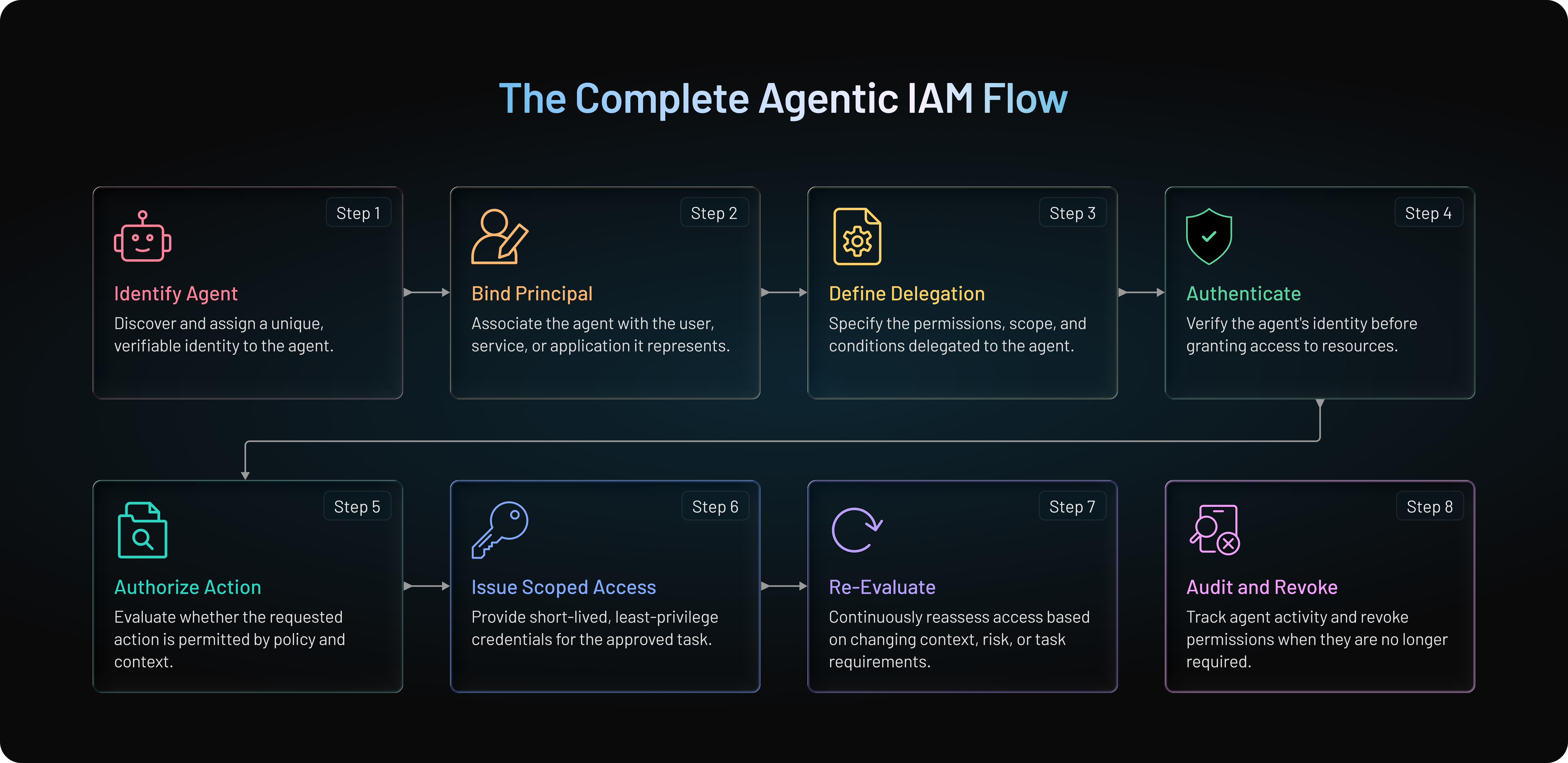
The objective is consistent throughout: prove which agent is acting, whose authority it is using, and whether that authority permits the requested action.
Traditional IAM vs CIAM vs Agentic IAM: What Changes With AI Agents?
Traditional IAM, CIAM, and Agentic IAM govern different actors and access relationships. Traditional IAM primarily focuses on workforce identities, CIAM on customers and external users, and Agentic IAM on autonomous AI agents that may act on behalf of those humans or other systems.
The differences become clearer when we compare what each model is designed to control.
| Capability | Traditional IAM | CIAM | Agentic IAM |
|---|---|---|---|
| Primary identities | Employees, contractors, partners | Customers and external users | AI agents and autonomous actors |
| Main objective | Secure workforce access | Secure, scalable customer identity and access | Govern autonomous agent access and actions |
| Typical actor | Human employee | Human customer | AI agent acting independently or on behalf of another identity |
| Authentication | Workforce credentials, MFA, federation | MFA, passwordless, passkeys, social login, federation | Agent/workload credentials plus principal and delegation context |
| Authorization | Roles, groups, policies | Customer/application access policies | Scoped, delegated, contextual, and action-level authorization |
| Delegation | Usually limited | OAuth consent and delegated access in applicable flows | Fundamental to user-to-agent and agent-to-agent workflows |
| Access duration | Sessions and assigned access | Sessions and access tokens | Prefer narrowly scoped, short-lived authority where appropriate |
| Decision context | Identity, role, device, policy | Identity, consent, risk, device, customer context | Agent identity, principal, task, scope, resource, action, risk, and delegation |
| Agent-to-agent access | Not a primary use case | Not a primary use case | Core consideration in multi-agent systems |
| Accountability | User → Resource | Customer → Application | Human/System → Agent → Tool/Agent → Action |
| Lifecycle focus | Joiner, mover, leaver | Registration through account deletion | Discovery, ownership, provisioning, permission changes, revocation, retirement |
The most important difference is where authority originates and how far it is allowed to travel.
With traditional IAM, an employee might receive access because their role allows it. With CIAM, a customer authenticates and receives appropriate access to an application or service. With Agentic IAM, an agent may need to use authority originating from that human while remaining subject to its own permissions and the limits of the delegated task.
For example, a customer may have permission to view transactions, update their profile, manage payment methods, and transfer money. If that customer asks an AI financial agent: “Show me how much I spent on travel last month.” the agent does not need every capability available to the customer. Its effective authority may be limited to reading a particular set of transaction data for the requested analysis.
If the customer later asks: “Transfer ₹50,000 to this new account,” the identity system can treat that as a different authorization decision. The customer may need to verify the action, the agent may require an additional scope, and organizational policy may require stronger controls.
This is where Agentic IAM differs from simply giving an AI system access to a user's account.
It separates: What the human can do
from: What the agent is permitted to do
and further from: What the agent has been authorized to do for this particular task.
NHI vs M2M vs AI Agents: How Do They Relate to Agentic IAM?
AI agents are often grouped with service accounts, workloads, APIs, bots, and other machine identities under the term non-human identity (NHI). That is broadly correct, but the terms are not interchangeable.
Likewise, M2M authentication and Agentic IAM can both involve software accessing software. The difference lies in the actor being governed and the authority behind its actions.
What Is a Non-Human Identity (NHI)?
A non-human identity is a digital identity used by something other than a person to access systems or resources. Applications, workloads, service accounts, APIs, devices, automation, bots, and AI agents can all fall into this category.
AI agents are therefore a type of NHI, but not every NHI is an AI agent. What distinguishes an agent is its ability to interpret a goal, choose among available tools or actions, and operate with some degree of autonomy.
That autonomy introduces additional identity questions around delegation, scope, resource access, intent, and accountability.
What Is M2M Authentication?
Machine-to-machine (M2M) authentication allows applications or services to authenticate and communicate without a human participating in each interaction.
A common pattern is: Application A → Authenticates → Receives Access Token → Calls API B
OAuth 2.0 client credentials, for example, can support service-to-service access when an application acts on its own behalf.
Agent workflows may use similar authentication infrastructure. But M2M authentication establishes machine access; by itself, it does not determine whether an autonomous agent was authorized to choose and perform a particular action on someone else’s behalf.
Why an AI Agent Is Not Just Another M2M Client
Consider a scheduled application that retrieves customer records each night and an AI support agent asked to “resolve this customer’s subscription issue.”
The scheduled application follows predefined application logic. The support agent may decide which customer information to retrieve, which tools to invoke, and whether another action is necessary to complete the task.
Both involve machine-to-machine communication, but the agent introduces an additional authorization problem: who initiated the task, what authority was delegated, which resources and actions are permitted, and whether that authority can be passed downstream.
The relationship can be summarized simply:
NHI describes a broad category of non-human identities.
M2M describes a machine-to-machine access or communication pattern.
An AI agent describes an autonomous actor capable of selecting and taking actions.
Agentic IAM governs the identity, authority, access, lifecycle, and accountability surrounding that autonomous actor.
Core Capabilities of an Agentic IAM Architecture
Agentic IAM is not a single authentication mechanism or protocol. It combines identity, authorization, delegation, lifecycle, and governance controls to keep autonomous agents within defined boundaries as they interact with applications, APIs, tools, and other agents.
| Core Capability | What It Does |
|---|---|
| Agent discovery and ownership | Identifies production agents and assigns accountable owners. |
| Verifiable agent identity | Gives each agent an independently authenticatable identity. |
| Delegated authorization | Connects agent authority to the principal and task behind it. |
| Fine-grained access control | Restricts agents by resource, action, scope, and policy. |
| Short-lived credentials | Limits how long and where agent credentials remain usable. |
| Continuous authorization | Re-evaluates access as resources, actions, context, or risk change. |
| Agent lifecycle management | Supports registration, permission changes, suspension, revocation, and retirement. |
| Human-in-the-loop controls | Requires stronger verification or approval for consequential actions. |
| Auditability and observability | Preserves attribution across principals, agents, tools, and actions. |
These capabilities work together to create controlled autonomy. An agent can still reason, select tools, and complete approved tasks, but its authority remains tied to an identifiable principal, bounded by policy, adjustable as context changes, and revocable when the task or trust relationship ends.
Protocols and Standards That Support Agentic IAM
Agentic IAM does not depend on a single protocol. It combines established identity and authorization standards with newer protocols designed for AI agents, tools, and multi-agent interactions.
The exact combination depends on the architecture, but the following technologies can support different parts of the agent identity and authorization lifecycle.
OAuth 2.0 and OAuth 2.1
OAuth provides a framework for delegated authorization and API access. In agentic workflows, it can help separate the authority of the human principal from the permissions granted to the agent through scopes, audiences, consent, and authorization policies.
OAuth 2.1 terminology is increasingly used for modern OAuth deployments and incorporates current security practices. Agentic IAM can build on these patterns rather than creating a separate authorization model for AI agents.
OpenID Connect (OIDC)
OIDC adds an identity layer on top of OAuth and is commonly used to authenticate users and communicate identity claims.
In Agentic IAM, OIDC can establish the authenticated human principal behind an agent workflow. That identity context can then contribute to decisions about what authority may be delegated to the agent.
OAuth 2.0 Token Exchange (RFC 8693)
OAuth 2.0 Token Exchange defines a mechanism for exchanging one security token for another, making it useful when authority needs to move across services, agents, or downstream APIs.
A flow might look like: User Token → Agent Context → Token Exchange → Downstream Token → API
In multi-agent systems, token exchange can support narrower downstream authority when the authorization server enforces appropriate scope, audience, and policy constraints.
JSON Web Tokens (JWTs)
JWTs provide a compact format for carrying signed claims between systems. Agentic architectures may use them to communicate identity and authorization context such as subject, issuer, audience, scopes, expiration, and other policy-relevant claims.
A JWT is a token format, not an authorization policy. Receiving a valid token does not by itself mean every requested agent action should be permitted.
SCIM
SCIM standardizes identity provisioning and lifecycle operations. For AI agents, SCIM-based patterns can support centralized registration, updates, suspension, deprovisioning, and governance where the surrounding identity infrastructure supports agent identities.
This becomes useful as organizations move from a handful of experimental agents to larger inventories that require consistent lifecycle controls.
SPIFFE and SPIRE
SPIFFE provides workload identity standards, while SPIRE is an implementation of the SPIFFE specifications. They can establish cryptographically verifiable identities for workloads running across distributed infrastructure.
In agent architectures, these identities can help establish which workload is executing an agent. Agentic IAM can then apply additional context around delegation, principal relationships, and permitted actions.
Model Context Protocol (MCP)
MCP standardizes how AI applications connect to tools, data sources, and external capabilities. From an identity perspective, the important question is not simply whether an agent can reach an MCP server, but whether it is authorized to invoke a particular capability or access a particular resource. Agentic IAM can provide the identity and authorization context used to govern those interactions.
Agent2Agent (A2A)
A2A is designed to support communication and collaboration between AI agents. As agents delegate tasks or interact across systems, identity and authority need to remain traceable across those relationships.
Agentic IAM helps preserve context around which agent initiated an interaction, whose authority it represents, what was delegated, and what the receiving agent is permitted to do.
No Single Protocol Solves Agentic IAM
These technologies address different layers of the problem. OAuth and token exchange support delegated API access, OIDC establishes identity context, JWTs carry claims, SCIM supports lifecycle operations, SPIFFE/SPIRE establish workload identity, and MCP and A2A support emerging agent interactions.
Agentic IAM is the governance layer that brings those pieces together around agent identity, delegated authority, policy enforcement, lifecycle control, and accountability.
Agentic IAM Security Risks and the Identity Controls That Reduce Them
AI agents create familiar identity risks in unfamiliar ways. Stolen credentials, excessive permissions, weak authorization, and orphaned accounts are not new problems. What changes is the speed and autonomy with which an agent can use that access.
An over-privileged employee still has to decide to perform an action. An over-privileged agent may perform hundreds of actions across several systems while pursuing a single goal.
Agentic IAM cannot eliminate every AI security risk, but it can reduce the identity and access risks surrounding those actions.
Excessive Agency and Privilege
One of the clearest risks is giving an agent more authority than its task requires.
Suppose a customer asks an AI support agent to check the status of an order. If the agent receives broad access to the customer's entire account, it may technically be able to update profile information, cancel orders, modify subscriptions, or initiate refunds. The safer approach is to constrain authority around the task.
Risk: Agent receives broad account or system privileges.
Identity control: Least privilege, delegated scopes, resource restrictions, action-level authorization, and short-lived access.
The goal is not to prevent the agent from acting. It is to make sure the range of possible actions stays inside an approved boundary.
Credential and Token Exposure
AI agents may use access tokens, API credentials, workload identities, or other credentials to interact with downstream systems. If those credentials are exposed through logs, agent context, insecure storage, compromised infrastructure, or other systems, they may be reused outside the intended workflow.
The risk increases when credentials are broadly scoped or remain valid longer than the task requires. An agent that has finished its work should not retain unnecessary authority simply because its token or credential is still active.
Agent credentials should therefore be short-lived, scope-bound, audience-restricted, securely stored, rotated where appropriate, and revocable. Their lifetime should reflect the task or trust relationship they were issued to support.
When that relationship ends, the associated authority should end with it.
Broken Delegation and Privilege Expansion
Delegation becomes dangerous when an agent receives more authority than the principal intended—or when that authority expands as a task moves between agents and services.
A customer might authorize Agent A to read travel preferences and search for flights. If Agent A delegates part of the task to Agent B, the second agent should not automatically receive every permission available to Agent A or the customer.
A useful security rule is: Delegated Authority ≤ Delegating Authority
Each delegation step should preserve or narrow the existing authorization boundary, not silently expand it. That applies to both human-to-agent and agent-to-agent delegation.
Authorization systems should validate the principal, delegating agent, receiving agent, requested resource, permitted action, scope, audience, and relevant policy context before downstream authority is granted.
Confused Deputy Problems
An agent, tool, or intermediary may have legitimate access to a protected resource but be manipulated into using that authority for another actor.
This is a version of the confused deputy problem and becomes particularly relevant when agents call MCP servers, APIs, plugins, or other intermediary services.
Imagine an MCP server that can access several internal APIs. If it accepts a token intended for another service and passes that token downstream without validating its audience or intended use, authorization boundaries can weaken quickly.
Resource-specific tokens, audience validation, explicit authorization checks, and avoiding unsafe token passthrough help maintain separation between services.
The important question is not simply whether a credential is valid. It is whether this actor is authorized to use this credential for this resource and action.
Shadow and Orphaned Agents
Agents can appear quickly across an organization. A development team creates one for testing. Marketing deploys another for campaign automation. Customer support introduces several specialized agents. Months later, some may still hold credentials even though nobody actively manages them.
These shadow or orphaned agents create the same lifecycle problems seen with forgotten service accounts, potentially at much greater scale.
Agent discovery, ownership records, access reviews, credential expiration, lifecycle automation, and reliable deprovisioning help reduce this risk.
If nobody can answer who owns this agent and why it still has access, that access deserves review.
Missing Human Accountability
Autonomous systems can make responsibility difficult to establish when audit records capture only the final API call. For sensitive workflows, businesses should be able to reconstruct enough of the authorization chain to understand:
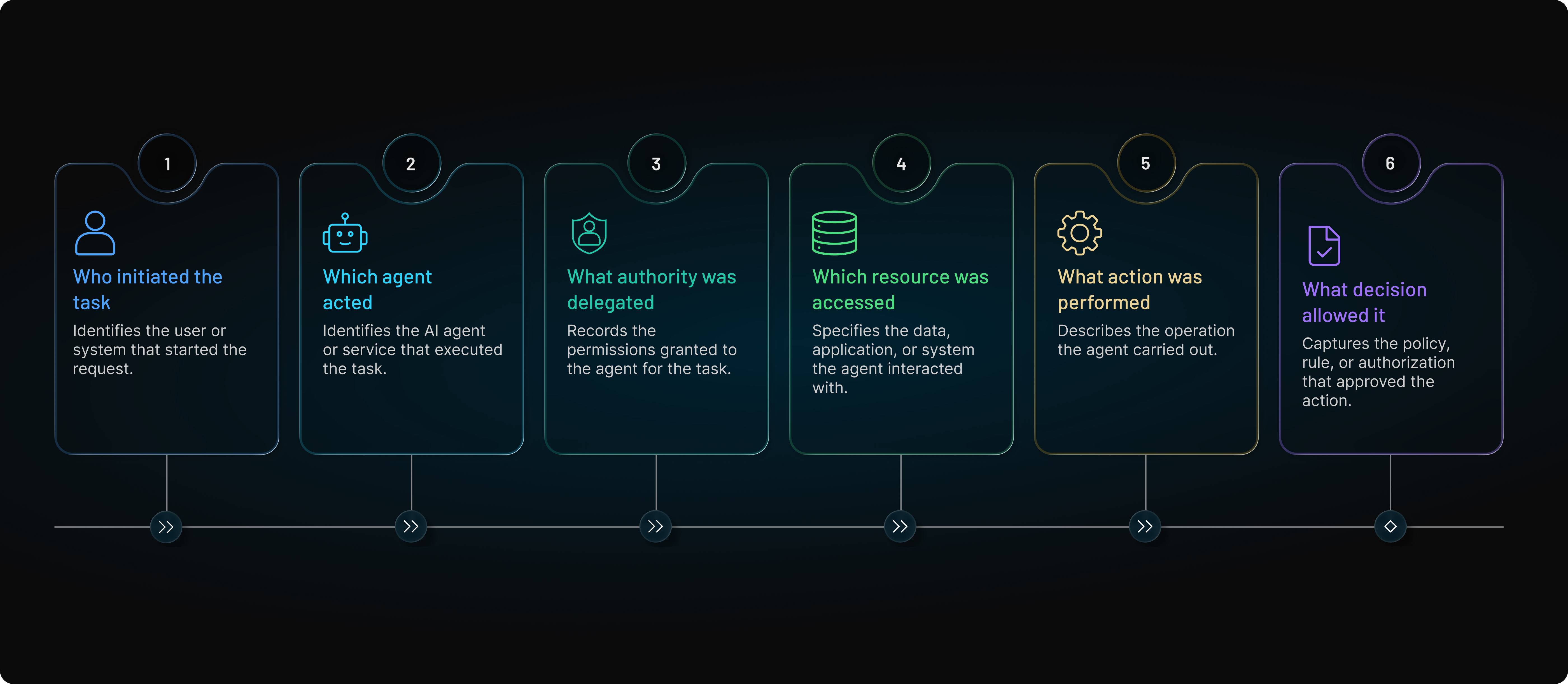
This does not mean logging every piece of an agent's internal reasoning. The goal is to record the identity and authorization context needed to understand consequential actions.
Good auditability makes autonomy accountable without requiring a human to supervise every individual step.
Agentic IAM Use Cases Across Customer, Enterprise, and Multi-Agent Workflows
Agentic IAM becomes relevant wherever AI agents can move beyond generating responses and take actions across applications, APIs, tools, or business systems. The authorization boundary varies by use case, but the underlying requirement remains consistent: agent actions need identifiable, bounded, and accountable authority.
Customer Support Agents
A customer support agent may retrieve profile information, check orders, update preferences, or initiate approved service actions. Access should reflect both the authenticated customer and the specific task being performed.
For example, an agent resolving a delivery issue might be allowed to view the relevant order and update its delivery instructions without receiving access to unrelated orders, account credentials, or broader customer data.
Commerce and Shopping Agents
Shopping agents can search products, compare options, manage carts, or place orders for customers. The challenge becomes more significant when the agent can complete transactions rather than simply recommend products.
A customer might allow an agent to purchase from an approved merchant below a defined spending limit while requiring additional verification for higher-value transactions, new payment methods, or changes to account information.
Customer-Controlled and Bring-Your-Own AI Agents
Businesses may increasingly receive requests from AI agents they did not build or operate. A customer could authorize a personal shopping assistant, financial assistant, travel agent, or another third-party AI service to interact with a business on their behalf.
That creates a different trust boundary. The business needs to establish which agent is requesting access, which customer authorized it, what authority applies, and which resources or actions the business is willing to expose.
A safer relationship looks like: Authenticated Customer → Approved External Agent → Scoped Delegation → Business API
Banking and Financial Agents
Financial agents may retrieve balances, categorize transactions, pay bills, move funds, or assist with financial workflows. These actions do not carry equal risk.
An agent might be permitted to read transaction history while a fund transfer requires tighter limits, stronger verification, or explicit human approval. Agent identity also helps preserve attribution when financial actions are initiated autonomously.
Developer and DevOps Agents
Developer agents may inspect repositories, generate code, run tests, interact with CI/CD systems, create infrastructure changes, or invoke cloud APIs. Giving such agents broad developer or service-account credentials can expose far more authority than an individual task requires.
Agent-specific identities and task-bounded permissions make it easier to distinguish routine development assistance from higher-risk actions such as production deployments or infrastructure changes.
Enterprise Productivity Agents
Enterprise agents can coordinate calendars, retrieve documents, summarize internal information, update business systems, or execute workflows across SaaS applications.
Their access can quickly span several systems. An employee’s productivity agent might need permission to schedule a meeting and retrieve selected project documents without automatically inheriting every application, file, or administrative permission available to that employee.
Multi-Agent Systems
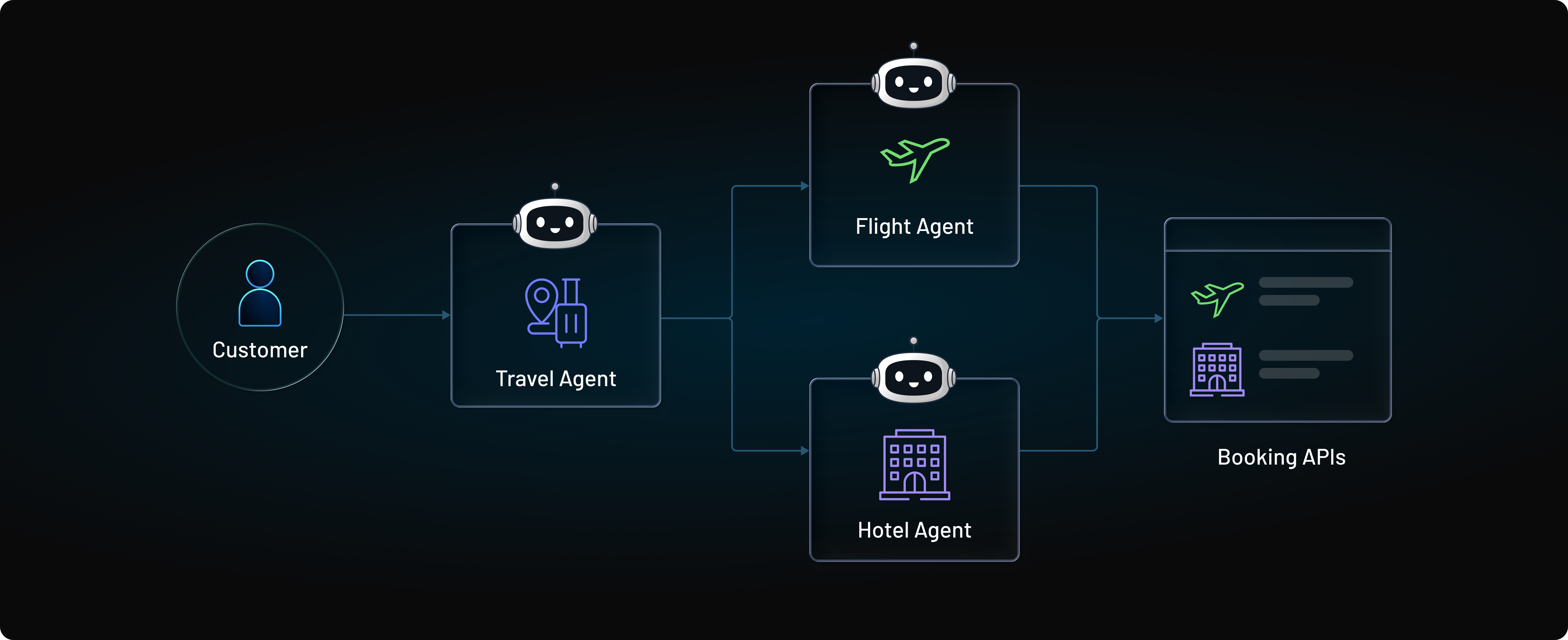
More complex workflows may involve several agents collaborating on a single goal. A travel agent, for example, could coordinate with separate flight, hotel, and payment agents.
Each handoff introduces another authorization boundary. Systems need to preserve which principal initiated the workflow, which agent delegated the task, what authority moved downstream, and which actions each receiving agent may perform without allowing permissions to expand across the chain.
A travel workflow could look like:
How to Implement Agentic IAM for AI Agents
Implementing Agentic IAM does not require replacing an existing IAM, CIAM, or API security stack. The practical goal is to extend those controls so AI agents become identifiable, governed actors with explicit ownership and bounded authority.
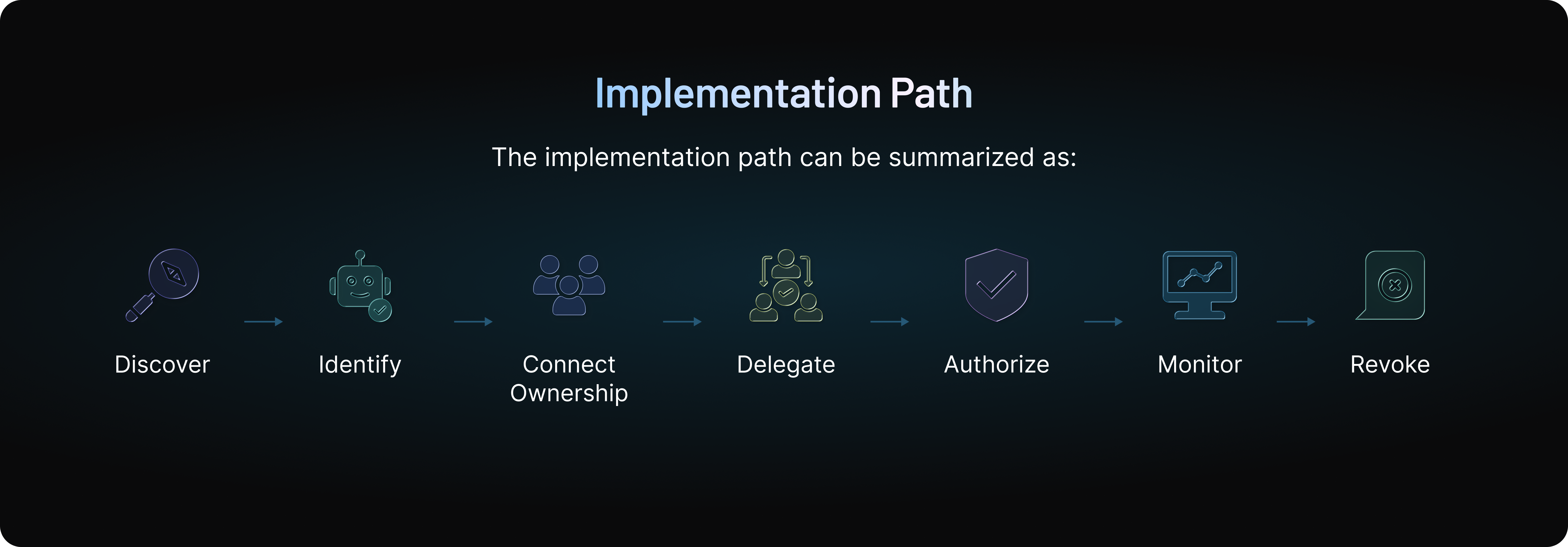
A useful implementation sequence is:
1. Discover Agents and Assign Ownership
Start by identifying AI agents operating across customer applications, internal systems, development environments, APIs, and automation workflows. Include both production agents and externally managed agents that can interact with protected resources.
Each agent should have an accountable owner and its own verifiable identity rather than relying on shared user, service-account, or application credentials. Record what the agent does, where it operates, which systems it can reach, and who is responsible for its lifecycle.
2. Connect Agents to Principals and Define Delegation
Determine whose authority each agent can exercise. Depending on the workflow, that principal could be a customer, employee, application, service, or another authorized agent.
Then define the delegation boundary: which resources the agent can access, which actions it can perform, under what conditions, and for how long.
A useful rule is: Agent Authority ≤ Delegated Authority ≤ Principal Authority
Do not automatically copy the principal’s full permissions to the agent. Grant only the authority required for the task.
3. Replace Persistent Credentials With Scoped, Short-Lived Access
Avoid giving agents broadly scoped credentials that remain valid across unrelated tasks. Where the architecture supports it, use short-lived access tied to the intended resource, audience, scope, and execution context.
Credential lifetime should reflect task lifetime. When the task ends, the agent should not retain unnecessary authority simply because an access token or credential remains technically valid.
4. Enforce Action-Level Authorization Across Tools and Agents
Authorization should be evaluated against the action the agent is attempting, not merely whether it successfully authenticated.
Apply policy when agents access APIs, invoke tools, interact with MCP servers, delegate work to other agents, or attempt higher-risk operations. Consider the principal, agent identity, delegated authority, requested resource, action, and current context before access is granted.
Sensitive actions may require tighter limits, additional verification, or explicit human approval.
5. Monitor, Review, and Revoke Agent Access
Agent governance continues after deployment. Monitor agent activity, maintain attribution across actions and delegation chains, and review whether existing permissions still match the agent’s purpose.
Update or revoke access when ownership changes, workflows evolve, risk increases, or an agent is retired. Orphaned agents and obsolete credentials should be removed rather than left active indefinitely.
The implementation goal is straightforward: every production agent should be discoverable, attributable to an owner or principal, limited to necessary authority, observable while acting, and revocable when that authority is no longer needed.
Zero Trust That Does Not Punish Legitimate Users
Why Zero Trust Often Gets a Bad Reputation
Zero Trust is conceptually sound but frequently implemented poorly. Many organizations interpret it as “never trust anyone,” which leads to constant verification, endless prompts, and deeply unhappy users. The irony is that this approach often creates more security fatigue than security.
Agentic IAM provides a more practical interpretation of Zero Trust by enforcing continuous verification of AI agents without continuous interruption. Trust is never assumed permanently, but it is also not revoked without evidence.
Continuous Verification Without Constant Friction
In an Agentic IAM system, Zero Trust is enforced through observation rather than interrogation. The system continuously verifies that the current behavior aligns with a trusted identity, but it does so quietly. Verification challenges are reserved for moments when confidence actually drops, not when policy says it might.
This approach aligns much more closely with how humans assess trust in the real world. We do not repeatedly ask people to prove who they are if nothing changes. We pay attention, notice deviations, and react when something feels off.
How LoginRadius Supports Agentic IAM
LoginRadius extends identity and access controls to AI agents as distinct actors rather than treating them as shared service accounts or extensions of a human identity. The platform combines agent identity, delegated access, scoped authorization, lifecycle controls, human oversight, and auditability for agent-driven applications.
When an agent acts for a customer, LoginRadius CIAM can establish and protect the verified customer identity behind the interaction. Agentic IAM then governs the agent and the authority it can exercise on that customer’s behalf.
Govern AI Agents as Distinct Identities
LoginRadius enables organizations to assign unique, verifiable identities to AI agents independently of users and applications. Agents can be registered and managed as first-class identities, with lifecycle controls covering registration, auditing, access changes, revocation, and retirement.
This separation matters operationally. An organization can manage or revoke an agent’s identity without disrupting the customer or other agents participating in the same environment.
Issue Scoped and Delegated Agent Access
When an agent needs to act on behalf of a user, LoginRadius supports OAuth-based delegated access rather than requiring the agent to inherit or reuse the user’s credentials.
Access tokens can represent the user identity, agent identity, authorized scopes, and expiration while remaining short-lived and scope-bound. LoginRadius also centralizes token issuance, refresh, rotation, and revocation across APIs and third-party tools.
For downstream workflows, OAuth token exchange can support delegation while maintaining the identity context behind the request.
Apply Fine-Grained Authorization and Human Approval
Authentication alone does not determine what an agent should be allowed to do. LoginRadius supports per-agent and per-action permissions alongside policy-based authorization, allowing access to be constrained according to the agent, requested scope, resource, and action.
The same model extends to MCP environments, where short-lived scoped tokens can be mapped to individual tools and APIs and authorization policies enforced at the server boundary.
Higher-risk actions can introduce a human checkpoint. An agent can pause while a person reviews, approves, or rejects a sensitive action before execution continues.
Preserve Agent-to-Action Auditability and Revocation
Agentic workflows need attribution beyond a generic application or system identity. LoginRadius provides visibility into agent actions, token usage, and delegation chains, with audit context showing which agent acted, on whose behalf, when, and why.
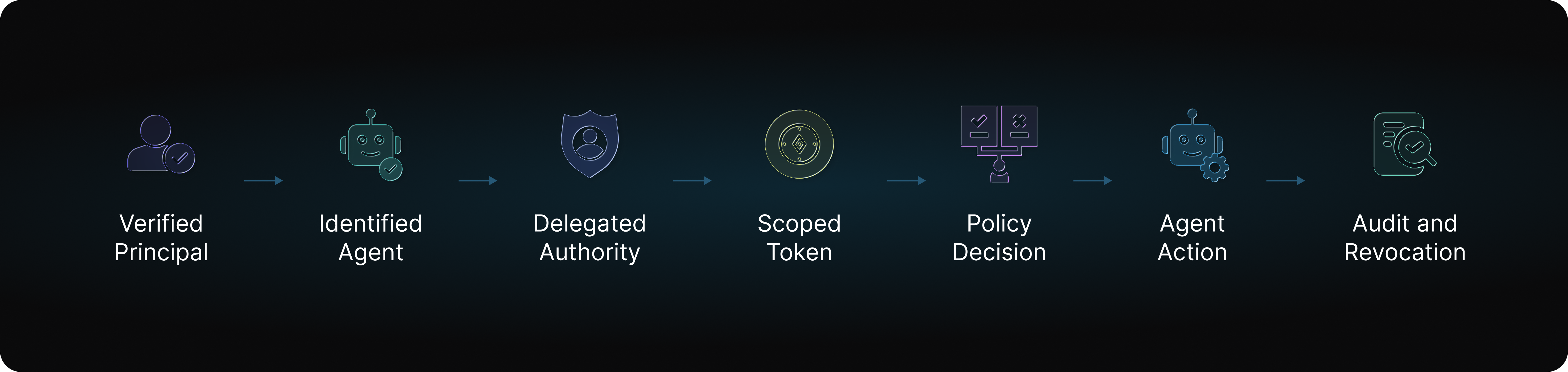
If an agent is compromised, misbehaves, changes purpose, or no longer requires access, its credentials can be rotated or revoked without removing access for the underlying user or unrelated agents. Together, these controls create a traceable authorization chain:
Keep Customer Identity and Agent Identity Separate
Consider a banking assistant that helps an authenticated customer understand recent transactions.
LoginRadius can establish the customer's identity and support stronger authentication where required. The application can then use that verified identity context when determining what the agent may access.
The relationship becomes: Verified Customer ≠ AI Agent
Instead: Verified Customer → Delegated Task → Identified Agent → Authorized Resource
Keeping those identities separate improves accountability and avoids relying on customer credentials as agent credentials.
Use Standards-Based Identity as the Foundation
Agentic systems still need to interact with existing applications and APIs. Standards such as OAuth 2.0 and OpenID Connect remain important for authentication and authorization across those environments.
LoginRadius supports standards-based identity and API-driven integrations, allowing organizations to connect customer identity with the applications and services agents may interact with.
The agent layer can then build on that identity foundation rather than creating a separate customer identity model solely for AI interactions.
Apply Stronger Customer Verification When Agent Actions Become Sensitive
Agent workflows can move from low-risk assistance to consequential actions very quickly.
An agent may begin by answering an account question and later attempt to change profile information, initiate account recovery, modify a subscription, or perform another sensitive operation. Those transitions create opportunities to bring the customer back into the authorization flow.
Depending on the application and risk policy, stronger authentication or additional verification can be required before the sensitive action proceeds. This allows businesses to preserve a low-friction agent experience for routine tasks without treating every autonomous action as equally trusted.
Extend Existing Identity Infrastructure Instead of Creating an AI Identity Silo
The broader architectural opportunity is to connect agent identity with the identity systems businesses already operate.
CIAM continues to govern customer authentication, profiles, consent, and customer-facing identity journeys. Agent-specific identity and authorization controls can govern the autonomous actor, delegated authority, tool access, and agent lifecycle.
Together, the architecture can preserve a chain such as:** Customer Identity → Authentication → Delegated Authority → Agent Identity → Authorization → Tool/API → Action**
That is a more sustainable model than allowing every AI application to develop its own isolated identity and access logic.
As agentic experiences become part of customer journeys, businesses will need identity infrastructure capable of keeping the human principal connected to the autonomous actions performed on their behalf. LoginRadius provides the CIAM foundation for that human identity layer while organizations extend their authorization architecture to govern agents, tools, and delegated access.
The result is not a choice between CIAM and Agentic IAM. It is an identity architecture in which customer identity remains verifiable even when the customer is no longer the actor making every individual request.
Conclusion: Govern AI Agents as Identities, Not Shared Credentials
AI agents introduce a new identity challenge because they can make decisions and act across real systems without a human executing every step. A valid credential alone is no longer enough. Businesses need to know which agent acted, whose authority it used, what it was permitted to do, and when that authority should end.
Agentic IAM brings these controls together through distinct agent identities, scoped delegation, action-level authorization, lifecycle governance, human oversight, and auditability.
LoginRadius extends modern identity infrastructure to AI agents with verifiable agent identities, scoped and delegated access, policy-based authorization, lifecycle controls, and traceable agent actions.
As AI agents gain more autonomy, their authority should become more controlled—not less.
Explore LoginRadius Agentic IAM to govern AI agents from identity and authorization through execution, audit, and revocation.
FAQs
Q: What is Agentic IAM?
A: Agentic IAM (Agentic Identity and Access Management) governs the identity, authentication, authorization, delegated authority, lifecycle, and access of autonomous AI agents. It helps ensure agents act within defined permissions when accessing applications, APIs, tools, or other agents.
Q: How is Agentic IAM different from traditional IAM?
A: Traditional IAM primarily manages human workforce identities and their access to organizational resources. Agentic IAM extends identity controls to autonomous AI agents that can choose actions, invoke tools, and operate on behalf of humans or systems.
Q: What is the difference between Agentic IAM and CIAM?
A: CIAM manages customer identity, authentication, consent, profiles, and secure access to digital services. Agentic IAM governs AI agents and the authority delegated to them, while CIAM can establish the trusted customer identity behind an agent-driven interaction.
Q: Are AI agents considered non-human identities?
A: Yes. AI agents can be considered a type of non-human identity (NHI), alongside service accounts, applications, workloads, bots, and devices. What distinguishes AI agents is their ability to make decisions and take actions with varying levels of autonomy.
Q: What is the difference between NHI, M2M, and AI agent identity?
A: NHI is a broad identity category for non-human actors, while M2M describes machine-to-machine communication or access. AI agents are NHIs with autonomous capabilities, and Agentic IAM provides the identity and access controls needed to govern their actions.
Q: How are AI agents authenticated and authorized?
A: Agents can authenticate using mechanisms such as signed tokens, workload credentials, certificates, or OAuth-based credentials. Authorization then determines which resources and actions an authenticated agent can access based on scope, delegation, policy, and context.
Q: What protocols and standards are used in Agentic IAM?
A: Agentic IAM can use OAuth, OpenID Connect (OIDC), JWTs, OAuth Token Exchange, SCIM, and workload identity technologies such as SPIFFE/SPIRE. MCP and A2A can additionally support agent-to-tool and agent-to-agent interactions.
Q: How does Agentic IAM secure agent-to-agent and agent-to-tool access?
A: Agentic IAM applies distinct agent identities, scoped delegation, least privilege, token validation, resource-specific authorization, monitoring, and revocation. Authority should remain constrained as requests move from one agent, tool, or API to another.