In the digital landscape of 2026, identity is the new fence around your house. It might sound like a rehearsed line that gets repeated often, but in Canada: it carries regulatory weight, contractual consequences, and occasionally board-level panic too.
For Canadian businesses, identity is no longer just about authentication screens and MFA prompts. It is about jurisdiction, accountability, and proving that your user data does not quietly cross borders.
With frameworks like PIPEDA, CPPA, and Quebec’s Law 25 reshaping how customer data is handled, businesses are being forced to rethink not just how users authenticate, but where that identity data lives and how it flows across systems.
This shift is even more visible at the provincial level. In regions like British Columbia, government-backed identity ecosystems such as the BC Services Card (BCID) are setting new expectations for secure, verifiable digital access. Identity is no longer isolated within your application—it’s becoming part of a broader national and provincial trust framework.
For organizations operating in Canada, choosing a CIAM platform is no longer just a technical decision. It’s a strategic one—balancing compliance, user experience, and the ability to integrate with evolving identity infrastructures.
In this guide, we break down the top Canadian CIAM platforms helping businesses meet these demands—while delivering secure, scalable, and frictionless authentication experiences.
What to Look for in a Canadian CIAM Platform
Not all CIAM platforms are built for the realities of operating in Canada. While most vendors offer standard authentication features, choosing the right CIAM platform in Canada requires a deeper evaluation—one that accounts for regulatory expectations, data sovereignty, and the growing role of trusted digital identity ecosystems.
Here are the key factors Canadian businesses should consider when evaluating a customer identity and access management (CIAM) solution:
Canadian Data Residency & Jurisdictional Control
For many organizations, especially in regulated sectors, where customer identity data lives is just as important as how it’s secured. A strong CIAM solution in Canada should offer clear data residency options, ensuring that user data is stored and processed within Canadian borders.
This is critical for aligning with regulations like PIPEDA and provincial frameworks such as FOIPPA, while also reducing legal and contractual risks tied to cross-border data transfers. More importantly, it gives organizations confidence in maintaining full jurisdictional control over customer identity data.
Support for Modern Authentication Standards
User expectations have evolved—and so have security threats. A modern customer identity management platform should support a wide range of authentication methods, including:
-
Multi-Factor Authentication (MFA)
-
Passwordless authentication
-
FIDO2 and WebAuthn-based passkeys
These capabilities not only strengthen security but also improve user experience by reducing friction during login and account recovery flows.
Developer-Friendly Architecture & Standards
Flexibility is key when integrating CIAM into modern applications. Look for platforms built on widely adopted standards like OAuth 2.0, OpenID Connect (OIDC), and emerging protocols aligned with OAuth 2.1.
A developer-friendly CIAM platform should provide:
-
Well-documented APIs and SDKs
-
Support for custom authentication flows
-
Easy integration across web, mobile, and backend systems
This ensures faster implementation and the ability to adapt identity workflows as business needs evolve.
Integration with Canadian Identity Ecosystems (e.g., BCID)
Canada’s identity landscape is evolving beyond traditional login systems. Provincial and government-backed identity providers—such as the BC Services Card (BCID)—are introducing new ways to verify users through trusted, authoritative sources.
As a result, businesses should evaluate whether a CIAM platform in Canada can integrate with these identity ecosystems using standards-based protocols. This enables:
-
Verified user identities
-
Reduced fraud and identity spoofing
-
Seamless access to public and private digital services
Even if not an immediate requirement, this capability is quickly becoming a forward-looking consideration for organizations building long-term digital infrastructure.
Scalability for High-Volume Customer Identity Use Cases
Whether you're serving thousands or millions of users, your customer identity and access management platform must scale without compromising performance or security.
Look for platforms that offer:
-
High availability and uptime SLAs
-
Low-latency authentication responses
-
Proven ability to handle peak traffic and API loads
Scalability is especially critical for industries like fintech, healthcare, retail, and public services, where identity systems are directly tied to user experience and revenue.
Now that we know what are the features to look for, let’s jump straight in to see which are the top CIAM platforms in Canada that offer these and more!
Top Canadian CIAM Platforms in 2026
Choosing a CIAM platform in Canada isn’t just about features—it’s about alignment. With evolving privacy laws, data residency expectations, and the rise of government-backed digital identity ecosystems, the “best” platform depends on how well it fits your operational and regulatory reality.
Here’s a closer look at the leading CIAM platforms Canadian businesses are evaluating in 2026.
1. LoginRadius (Headquarters: Vancouver)
LoginRadius stands out as a leading Canadian CIAM platform built for high-scale consumer and enterprise use cases.
Headquartered in Vancouver, it offers full Canadian data residency, ensuring customer identity data remains within national borders—an essential requirement for organizations navigating PIPEDA and emerging CPPA regulations.
From a capability standpoint, LoginRadius supports modern authentication methods including passwordless login, passkeys, and adaptive multi-factor authentication. Its architecture is built on open standards like OAuth 2.0 and OpenID Connect, making it easier for development teams to integrate secure authentication into web and mobile applications.
What sets it apart in the Canadian context is its alignment with regional identity frameworks and government-backed digital identity initiatives. As provinces continue to invest in trusted identity systems, businesses are increasingly looking for CIAM platforms that can integrate with these ecosystems—not just manage authentication in isolation.
LoginRadius supports this shift by enabling secure integrations with provincial identity providers such as BC Services Card (BCID) using standards like OAuth 2.0 and OpenID Connect. This allows organizations to verify users against authoritative sources while maintaining full control over authentication flows and user experience.
For enterprises balancing compliance, scalability, and user experience, LoginRadius offers a strong, locally aligned alternative to global IAM providers.
Read more: Native BC Services Card (BCID) Integration with LoginRadius - Steps
Key Strengths:
-
Built in Canada with strong data residency alignment
-
Flexible authentication orchestration (MFA, passwordless, passkeys)
-
No-code + developer extensibility balance
-
Designed for integration with emerging identity ecosystems
-
Enterprise-grade scalability and performance
Best For: Enterprises and digital-first businesses that need a balance of compliance, flexibility, and fast time-to-market.
2. Entrust CIAM (Headquarters: Ottawa)
Entrust is a Canadian security company with deep expertise in cryptography, digital certificates, and identity verification.
Its CIAM capabilities are designed for high-assurance environments, offering phishing-resistant MFA and AI-powered identity verification. This makes it particularly strong in industries where identity assurance and fraud prevention are critical.
While Entrust excels in security depth, integration with provincial identity ecosystems like BCID may require custom implementation depending on the use case.
Key Strengths:
-
Strong cryptographic foundation
-
High-assurance authentication and identity verification
-
Enterprise-grade compliance capabilities
Best For: Financial institutions, government agencies, and regulated enterprises that prioritize security, identity assurance, and fraud prevention over rapid deployment.
3. IDENTOS FPX (Headquarters: Toronto)
IDENTOS focuses on privacy-first identity solutions, particularly for healthcare and public sector organizations.
Its platform emphasizes user-controlled identity, consent management, and secure digital wallets, aligning well with Canada’s privacy regulations and patient-centric models.
While well-suited for decentralized identity approaches, integration with broader government-backed identity providers may vary based on implementation.
Key Strengths:
-
Privacy-by-design architecture
-
Strong healthcare and public sector alignment
-
Federated identity and digital wallet capabilities
Best For: Healthcare providers, public sector organizations, and enterprises that require privacy-first CIAM solutions with strong consent and data governance controls.
4. SecureKey (Headquarters: Toronto)
SecureKey specializes in building trusted digital identity networks, connecting individuals, financial institutions, and government services.
Its distributed identity model enables secure identity verification without sharing sensitive personal data, using privacy-enhancing technologies like Triple Blind protocols.
SecureKey is closely aligned with government and financial identity ecosystems in Canada, making it a strong player in verified identity use cases, though it may complement rather than replace traditional CIAM platforms.
Key Strengths:
-
Deep integration with financial and government identity networks
-
Privacy-preserving identity verification
-
Strong digital identity infrastructure
Best For: Organizations participating in federated identity networks, especially in banking, fintech, and government-backed identity initiatives.
5. Agilicus (Headquarters: Kitchener)
Agilicus focuses on external identity and access management, particularly for managing vendors, partners, and third-party users.
Its approach allows authentication using existing identities, reducing friction in B2B and partner access scenarios. This makes it a practical solution for organizations with distributed user ecosystems.
However, for large-scale consumer CIAM use cases in Canada or integration with provincial identity systems, it may need to be part of a broader identity architecture.
Key Strengths:
-
Strong partner and vendor identity management
-
Federated identity support
-
Lightweight and flexible deployment
Best For: Organizations managing partner, vendor, and third-party access, especially in B2B environments with distributed identity needs.
Comparing the Top CIAM Platforms in Canada in 2026
| Feature / Capability | LoginRadius | Entrust | IDENTOS | SecureKey | Agilicus |
|---|---|---|---|---|---|
| Canada Data Residency Support | ✅ Strong alignment | ✅ Strong (Canada-based infrastructure options) | ✅ Strong (privacy-first design) | ✅ Strong (Canada-focused deployments) | ⚠️ Depends on deployment |
| Compliance Readiness (PIPEDA, FOIPPA) | ✅ Built with Canadian use cases in mind | ✅ Strong enterprise-grade compliance | ✅ Strong privacy & consent alignment | ✅ Strong (financial-grade identity networks) | ⚠️ Moderate |
| Integration with Government Identity Providers (e.g., BCID) | ✅ Native / Standards-based support | ⚠️ Possible via custom integration | ⚠️ Use-case dependent | ✅ Strong alignment with government identity ecosystems | ⚠️ Limited / not core focus |
| Authentication Methods (MFA, Passwordless, Passkeys) | ✅ Extensive | ✅ Strong (incl. phishing-resistant MFA) | ⚠️ Focused on federated identity models | ⚠️ Not a traditional auth-first platform | ⚠️ Moderate |
| No-Code / Low-Code Customization | ✅ Advanced (Identity Studio, Auth Studio) | ❌ Limited | ⚠️ Limited | ❌ Minimal | ⚠️ Moderate |
| Developer Flexibility (APIs, SDKs) | ✅ High | ✅ Strong | ⚠️ Moderate | ⚠️ Moderate | ✅ Strong |
| Time-to-Market | ✅ Fast deployment | ❌ Longer implementation cycles | ⚠️ Moderate | ❌ Depends on ecosystem integration | ✅ Fast (lightweight use cases) |
| Enterprise Scalability | ✅ Proven | ✅ Proven | ⚠️ Use-case specific | ✅ Strong (network-based scale) | ⚠️ Moderate |
Could I choose an IAM Platform instead of a CIAM Platform?
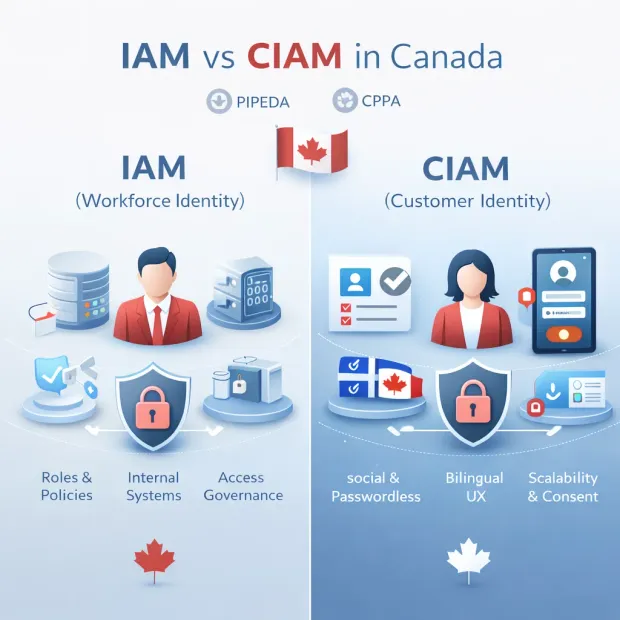
An IAM platform, traditionally known as Workforce Identity, focuses on employees. It answers questions like: Can this developer access production? Can HR access payroll records? Should contractors have VPN privileges? IAM platforms are about internal governance, policy enforcement, and reducing insider risk. They are optimized for structured organizations, role hierarchies, and compliance audits.
A CIAM platform, on the other hand, is built for customers. Not 500 employees. Potentially five million users. It handles high-volume registrations, progressive profiling, social logins, passwordless flows, and adaptive authentication. It must scale elastically, support consumer-grade UX, and survive marketing campaigns that spike traffic overnight.
While an IAM platform prioritizes control and internal security, a CIAM platform prioritizes user experience, scalability, and privacy transparency. It must integrate consent management, data subject access requests, and erasure workflows. It must operate in a way that supports PIPEDA compliance without destroying conversion rates.
If you are building a digital product for public users, you are not simply looking for an identity tool. You are looking for a CIAM platform that understands Canadian data residency, bilingual support, and evolving privacy law. Using a workforce IAM tool for customer identity is like using accounting software to manage your CRM. It technically stores data. It is not designed for the job.
Conclusion
The complexity of Canada's data sovereignty requirements has made one thing clear: building your own identity stack is no longer a heroic engineering challenge. It is a compliance risk.
Ten years ago, companies proudly built custom authentication systems. In 2026, that approach feels less innovative and more reckless. Privacy law has evolved. User expectations have risen. Threat landscapes have expanded. The cost of a breach is no longer just technical remediation. It is regulatory scrutiny and reputational erosion.
Choosing a partner like LoginRadius or Entrust is not simply about outsourcing a login screen. It is about inheriting a compliance-ready framework that aligns with Canadian law, supports PIPEDA compliance, and ensures data residency Canada standards are met without constant legal consultation.
Identity is now a strategic asset. It impacts growth, user trust, and contract eligibility. Canadian businesses that treat identity as infrastructure, not as an afterthought, position themselves to win enterprise deals and build long-term credibility.
The question is no longer whether you need a CIAM platform. The question is whether your current provider understands Canadian sovereignty as more than a marketing slide.
Ready to Make Identity a Competitive Advantage?
If you are evaluating vendors, the smartest move is to conduct a sovereignty-first assessment. Compare hosting guarantees, jurisdiction exposure, consent workflows, and deletion orchestration capabilities. Then compare user experience and scalability.
Because in 2026, the best CIAM platform in Canada is not just the one that authenticates users. It is the one that protects them under Canadian law while helping your business grow without legal surprises.
If your customer identity data still crosses borders without you fully knowing how or why, it is time to pause and reassess. Canadian privacy law is not slowing down, and neither are enterprise procurement teams asking tough sovereignty questions.
Audit your current CIAM or IAM platform against Canadian data residency standards, PIPEDA compliance requirements, and jurisdictional exposure risks. If your provider cannot give you clear contractual guarantees, that is your signal.
Ready to evaluate a Canadian-first CIAM strategy? Start with a sovereignty-focused identity assessment and ensure your authentication layer is not the weakest link in your compliance posture.
FAQs
Q: What is a CIAM platform and why do I need one in Canada?
A: A CIAM platform manages customer identities, registrations, and logins. In Canada, you need one to handle specific privacy requirements like PIPEDA and Law 25, which demand strict consent management and data residency.
Q: Who are the top competitors for LoginRadius in the Canadian market?
A: Within Canada, top competitors include Entrust (for enterprise security) and IDENTOS (for healthcare). Globally, they compete with Okta and Auth0, though LoginRadius often wins on Canadian data sovereignty and local support.
Q: Can I use a US-based CIAM if I have customers in Canada?
A: Yes, but you must ensure your privacy policy explicitly states that data is being stored in the US and is subject to US laws. This can be a hurdle for SaaS Canada companies looking to win government or enterprise contracts that mandate local hosting.
Q: Why should I choose a Canadian-headquartered CIAM over a global provider with a Canadian data center?
A: Beyond server location, Canadian-headquartered vendors are structurally aligned with local laws like Law 25. They typically offer native bilingual support, local privacy impact assessment (PIA) documentation, and are not subject to the U.S. CLOUD Act, which can sometimes bypass local data residency.