Introduction
Most modern cyberattacks no longer begin with complex exploits or infrastructure breaches. They begin with something much simpler: your login page.
Nearly every digital service today depends on user accounts. Banking apps, SaaS platforms, e-commerce sites, gaming services, and developer tools all rely on identity to grant access. This makes user accounts one of the most attractive targets for cybercriminals.
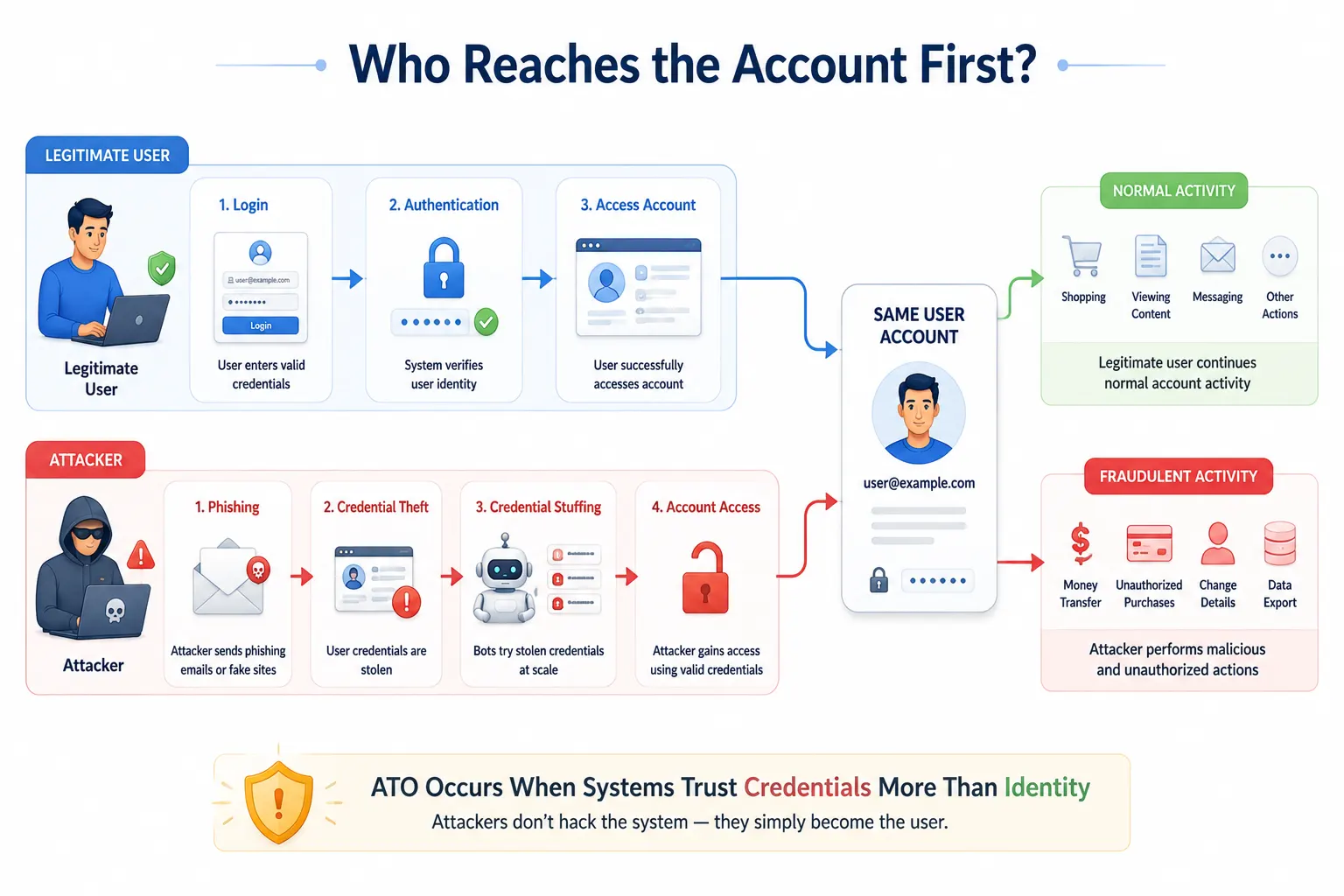
Instead of breaking into systems, attackers often take the easier route: they gain access to an existing account and operate as the legitimate user. When this happens, the platform sees it as a normal login, even though the person behind it is an attacker. This type of attack is known as account takeover (ATO).
In this guide, we’ll explore the modern ATO attack lifecycle, examine real account takeover examples, and explain how organizations can detect account takeover and deploy security controls that help stop account takeover attacks before they cause damage.
What Is Account Takeover (ATO) and Why It’s a Growing Security Threat
Account takeover (ATO) is a cyberattack in which a malicious actor gains unauthorized access to a legitimate user account and uses it to perform fraudulent or malicious activities.
In most cases, attackers obtain access using stolen credentials such as usernames and passwords. These credentials are often collected through phishing campaigns, data breaches, malware infections, or credential marketplaces on the dark web.
Once attackers successfully log in, they effectively become the user in the eyes of the system. Because the credentials appear valid, the platform may initially treat the activity as legitimate.
This is what makes account takeover attacks difficult to detect. Unlike traditional hacking attempts that exploit system vulnerabilities, ATO attacks rely on compromised identity rather than broken infrastructure.
After gaining access, attackers typically move quickly to take control of the account. Common actions include changing passwords, modifying email addresses, adding new payment methods, or disabling security alerts to prevent the real user from regaining access.
These attacks can result in several types of fraud, including unauthorized financial transactions, fraudulent purchases, loyalty point theft, or large-scale data exfiltration in enterprise environments.
Modern ATO attacks have also become highly automated. Cybercriminals often use credential lists obtained from previous breaches and run automated login attempts across multiple platforms. Even if only a small percentage of credentials work, attackers can still compromise thousands of accounts.
For organizations managing millions of users, even a tiny success rate can translate into significant financial loss and reputational damage. This is why implementing effective account takeover protection and account takeover prevention strategies has become a critical part of modern identity security.
Understanding how these attacks work is the first step toward building systems that can detect account takeover attempts and stop them before attackers gain control of user accounts.
Why Account Takeover Attacks Are Increasing Rapidly
Account takeover attacks are not new, but their scale and frequency have increased dramatically over the past decade. What used to require manual effort by attackers can now be executed automatically using large credential datasets and attack tools.
Several factors have contributed to the rapid growth of account takeover attacks.
Reason 1: Password reuse. Many users still use the same password across multiple platforms. When one service experiences a data breach, those stolen credentials can be reused to access accounts on other websites. Attackers simply test the same username and password combination across different platforms until they find a match.
Reason 2: Massive credential leak data available online. Billions of usernames and passwords from past breaches are circulating in underground marketplaces. These credential lists provide attackers with a ready-made dataset for launching large-scale ATO attacks.
Reason 3: Automation. Attackers now use bot-driven tools to run thousands or even millions of login attempts in a short period of time. These automated attempts are designed to bypass traditional defenses and identify accounts that still use compromised credentials. This method, commonly known as credential stuffing, has become one of the most common techniques used in account takeover attacks.
Reason 4: Heavy reliance on password-only authentication. Without additional security layers such as adaptive authentication or multi-factor verification, stolen credentials can easily lead to successful logins.
The result is a rapidly growing wave of account takeover fraud affecting industries such as banking, e-commerce, SaaS platforms, gaming services, and loyalty programs. Because attackers only need a small percentage of successful logins to profit, even well-secured platforms remain attractive targets.
This makes strong account takeover prevention and modern account takeover protection mechanisms essential for protecting user identities at scale.
The Modern ATO Attack Kill Chain: How Account Takeover Actually Happens
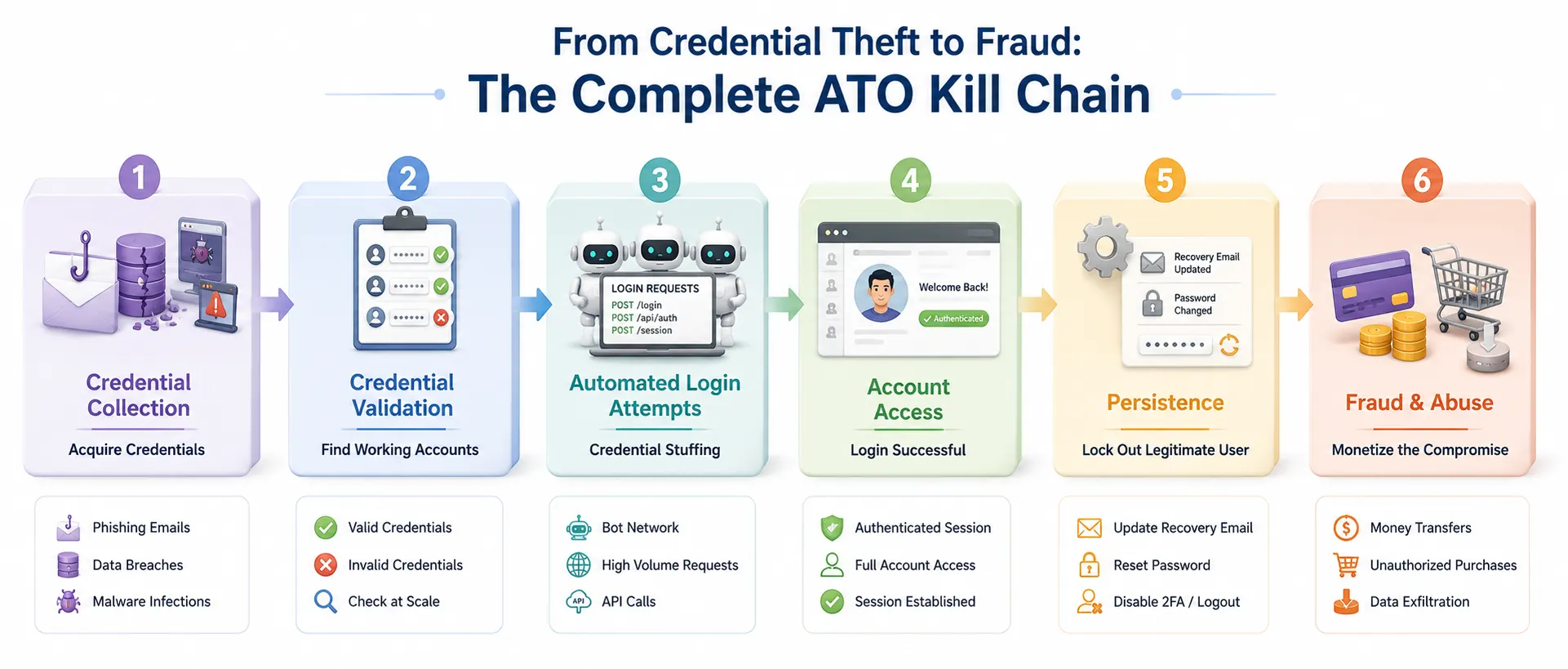
Account takeover attacks rarely happen in a single step. Instead, they follow a structured sequence of actions that gradually lead to full control of a user account. Security teams often refer to this sequence as the ATO attack kill chain.
Understanding this lifecycle is important because it reveals where organizations can interrupt the attack and implement effective account takeover prevention controls. Most account takeover attacks follow a predictable flow.
Stage 1: Credential Collection-Where Most ATO Attacks Begin
Every account takeover attack starts with one basic requirement: valid user credentials.
Before attackers can access an account, they must first obtain the username and password associated with it. This phase is known as credential collection, and it fuels the majority of modern ATO attacks.
Attackers rely on several methods to gather credentials at scale. Here are some common techniques for credential collection:
-
Phishing: Attackers create fake login pages that closely resemble legitimate services. Users are tricked into entering their credentials, which are then captured and stored by the attacker.
-
Data breaches: When organizations suffer security breaches, exposed usernames and passwords often end up circulating on underground marketplaces. These breach datasets can contain millions of credentials that attackers later reuse for launching account takeover attacks.
-
Malware: Certain types are designed to capture login details directly from infected devices. Keyloggers, for example, record everything a user types, including passwords.
-
Social engineering tactics: By impersonating customer support agents or trusted contacts, attackers can convince users to reveal login details or authentication codes.
The end result is the same: attackers collect large datasets of credentials that can later be used in automated attacks. These credential lists then become the foundation for many ATO attack campaigns.
Because credential collection happens outside the targeted platform, it is often difficult for organizations to detect at this stage. However, understanding how credentials are obtained helps organizations design stronger account takeover protection systems that do not rely solely on passwords for authentication.
Stage 2: Credential Stuffing and Automated Login Attempts
Once attackers collect large volumes of stolen credentials, the next step is testing them across different platforms. This phase is where many account takeover attacks actually succeed.
The most common technique used at this stage is credential stuffing.
Credential stuffing is an automated attack where stolen username and password combinations are tested across multiple websites and applications. Attackers rely on the assumption that many users reuse the same credentials across different services. Even if only a small percentage of credentials work, attackers can still compromise a large number of accounts.
Automation makes this process extremely efficient. Attackers use bot-driven tools that can send thousands of login requests in a short period of time. These tools distribute traffic across different IP addresses and devices to avoid simple detection mechanisms.
In many ATO attacks, bots attempt logins at massive scale until they find valid credentials. Once a successful login occurs, the compromised account becomes a target for further exploitation.
Because these attacks mimic normal login behavior, detecting them requires advanced account takeover protection mechanisms such as bot detection, login rate analysis, and behavioral monitoring.
Without these defenses, automated login attempts can easily bypass traditional authentication systems and lead to successful account takeover attacks.
Stage 3: Account Access and Persistence-When the Attacker Takes Control
Once a login attempt succeeds, the attacker has effectively completed the most difficult part of the account takeover attack. From the system’s perspective, the credentials are valid and the user appears authenticated.
At this stage, the attacker gains full access to the account and begins securing that access so the legitimate user cannot easily regain control. Their actions might include:
-
Modifying account recovery settings. This often includes changing the registered email address, updating the password, or adding a new phone number for recovery verification. By doing this, attackers ensure that password reset notifications are redirected away from the real user.
-
Disabling certain security alerts. Removing previously configured authentication methods, and/or any security alerts. These steps help prevent the original user from noticing suspicious activity immediately.
-
Attempting to establish persistence. This means creating ways to maintain access even if the account owner eventually resets their password. For example, attackers may add new API tokens, generate access sessions, or link additional login methods to the account. Once persistence is established, attackers can safely continue their activities without immediate interruption.
This phase is particularly dangerous because the compromised account now behaves like a legitimate user account. Any actions performed from it, whether data access, purchases, or configuration changes, may appear normal to the system.
Effective account takeover detection at this stage often relies on monitoring suspicious account changes such as password resets, recovery email modifications, or new device logins. These behavioral signals can help organizations identify compromised accounts and respond quickly before further damage occurs.
Stage 4: Fraud, Abuse, and Data Theft-The Final Goal of ATO Attacks
After attackers secure access to a compromised account, the final stage of an account takeover attack begins. This is where the real damage happens.
At this point, the attacker already controls a legitimate account and can operate without immediately raising suspicion. Because the actions originate from an authenticated session, many traditional security systems treat them as normal user behavior.
The exact objective of the attacker depends on the platform being targeted.
In financial platforms, attackers often initiate unauthorized transfers or attempt to withdraw funds. They may also link new payment methods or redirect transactions to controlled accounts, leading to direct account takeover fraud.
In e-commerce platforms, attackers typically exploit stored payment details. They may place fraudulent orders, purchase digital goods, or change shipping addresses so products are delivered elsewhere.
For SaaS platforms, the motivation is often data access. Attackers may export sensitive business data, download customer records, or attempt privilege escalation by creating new administrator accounts.
Gaming and loyalty platforms face a different type of abuse. Attackers frequently steal valuable digital assets such as game skins, in-game currencies, reward points, or airline miles and then sell them in underground marketplaces.
This stage is what makes account takeover attacks particularly costly for businesses. Even a small number of compromised accounts can result in financial losses, regulatory issues, and reputational damage.
Preventing this stage requires early detection of suspicious behavior after login. Monitoring unusual transactions, rapid configuration changes, or large data exports can help organizations detect account takeover attempts before attackers fully exploit compromised accounts.
Effective account takeover protection therefore focuses not only on login security but also on monitoring post-login activity to identify fraud and abuse quickly.
This step-by-step structure is what makes ATO attacks both scalable and profitable for cybercriminals. Each stage of the kill chain presents an opportunity for organizations to detect account takeover attempts and deploy stronger account takeover protection mechanisms before the attack progresses further.
How to Detect Account Takeover Before Real Damage Happens
Detecting an account takeover attack early is critical. Once attackers gain full control of an account and begin fraudulent activity, the financial and reputational damage can escalate quickly.
The challenge is that many ATO attacks initially look like legitimate logins. The attacker uses valid credentials, accesses the platform through normal login pages, and often behaves cautiously to avoid triggering immediate alerts.
Because of this, modern account takeover detection relies on analyzing multiple signals rather than relying on passwords alone.
Unusual Login Locations
One of the most common indicators of a compromised account is a login attempt from an unexpected geographic location.
For example, if a user normally logs in from Toronto and suddenly authenticates from another continent within minutes, the system should flag the activity as suspicious.
This technique is often called impossible travel detection and is widely used in modern identity security systems.
Device and Browser Fingerprinting
Each device generates a unique set of signals such as browser version, operating system, screen resolution, and installed fonts.
If an account suddenly logs in from a completely different device profile, it may indicate that a malicious actor has obtained the user’s credentials.
Device fingerprinting helps detect these anomalies and plays a major role in account takeover protection.
Login Velocity and Automation Signals
Many account takeover attacks are launched using automated bots. These bots attempt thousands of login attempts within a short period.
Monitoring login velocity, IP reputation, and abnormal request patterns helps security teams identify automated attack campaigns such as credential stuffing.
Suspicious Post-Login Behavior
Even after a successful login, certain actions may signal a compromised account.
Common red flags include:
-
Rapid password changes
-
Recovery email modifications
-
Addition of new payment methods
-
Large data exports or unusual transactions
Monitoring these activities helps organizations detect account takeover attempts even after the attacker has logged in.
Identity Correlation and Unified User Profiles
Another challenge during ATO detection is fragmented identities. When users create multiple accounts using different login methods such as email, social login, or passwordless authentication, security systems may struggle to recognize that they belong to the same person.
Identity platforms that support account linking and unified user profiles can help solve this problem by correlating multiple login identities with a single user profile. This allows businesses to better monitor user behavior and detect suspicious activities across authentication methods.
You can explore how unified identities improve security in this LoginRadius resource: Account Linking by LoginRadius
The datasheet explains how linking multiple login identities into a single user profile can reduce identity fragmentation, improve behavioral analysis, and strengthen security controls.
By combining behavioral monitoring, device intelligence, and identity correlation, organizations can significantly improve their ability to detect account takeover attacks before attackers reach the fraud stage.
How to Stop Account Takeover Attacks: Modern Prevention Strategies
Detecting an account takeover attack is important, but preventing it in the first place is even more critical. Once attackers gain access to a user account, the time window to stop fraud becomes very small. Implementing account takeover protection is a delicate balancing act. If your authentication checks are too loose, cybercriminals will exploit your users.
If they are too rigid, you create friction that tanks customer sign-ups, checkouts, and engagement. Modern account takeover prevention relies on invisible, risk-based logic that calculates threat telemetry in the background, only challenging users when a risk threshold is breached. The core dilemma here is balancing identity security with user friction.
Building a Layered Defense: The Modern CIAM Stack
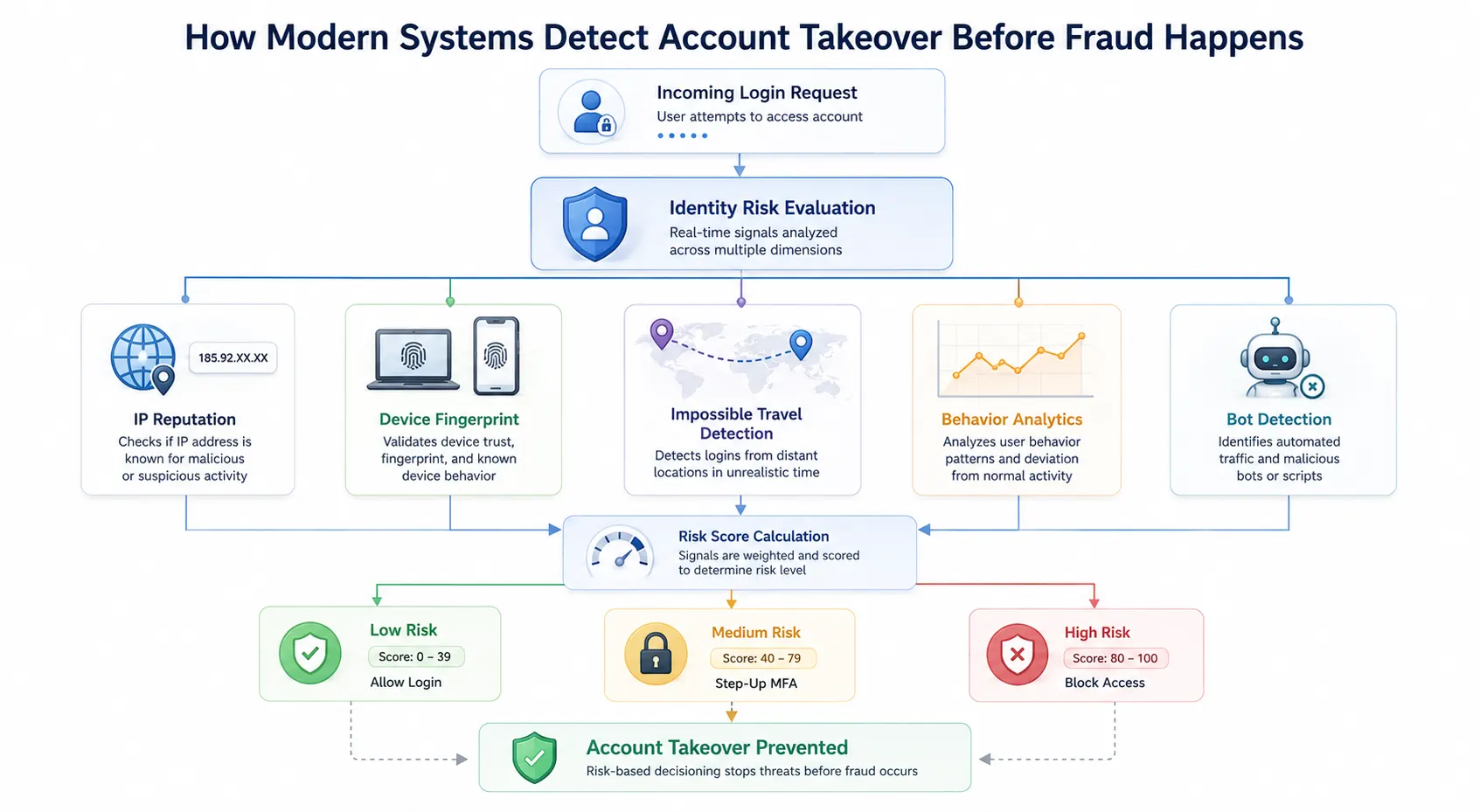
Stopping automated and manual ATO attacks requires a multi-layered identity perimeter where defenses talk to each other in real-time.
-
Layer 1: Edge & Bot Mitigation Before a user even inputs a password, the system analyzes network requests. By tracking IP reputation, identifying residential proxy networks, and tracking login velocity (e.g., hundreds of attempts from one IP), rate-limiting and CAPTCHAs filter out credential stuffing bots.
-
**Layer 2: Adaptive Contextual Scoring **When a login is attempted, the platform runs a silent contextual evaluation. It cross-references the user's typical device fingerprint and checks for impossible travel anomalies (e.g., a login in London 10 minutes after a login in New York).
-
Layer 3: Dynamic Step-Up Authentication Based on the risk score generated in Layer 2, the system dynamically shifts its behavior stopping attackers who only possess stolen passwords. A proven strategy based on risk scores is:
-
For Low risk users → Normal login
-
Medium risk → Automatically trigger step-up authentication (OTP or MFA)
-
High risk → Login blocked or additional verification required
-
-
Layer 4: Passwordless Ecosystems The most absolute form of ATO prevention is eliminating the password entirely. Adopting FIDO2-compliant WebAuthn standards (like Passkeys and device biometrics) removes the vulnerability of credential leaks and phishing entirely, because there is no static text string for an attacker to steal or reuse.
For those who don’t want to build a layered system, here are some alternate strategies that are still used today in 2026 to stop or slow down account takeover attacks.
Multi-Factor Authentication (MFA)
Multi-factor authentication adds an additional verification step beyond the password. Even if attackers obtain valid credentials, they still cannot access the account without the second authentication factor.
Common MFA methods include:
-
One-time passwords (OTP)
-
Authenticator apps
-
Push notifications
-
Biometrics
-
Hardware security keys
MFA remains one of the most effective account takeover protection mechanisms available today, but it definitely adds friction to users if you are adding it to every user at all times.
Bot and Automation Detection
Many ATO attacks rely heavily on automation. Bots attempt thousands of login attempts using stolen credential lists.
Modern identity security systems analyze traffic patterns, request signatures, and behavior anomalies to identify automated login attempts and block malicious bot activity.
Rate Limiting and Login Protection
Rate limiting restricts how many login attempts can occur from a single IP address or device within a certain timeframe. This helps slow down credential stuffing campaigns and prevents large-scale account takeover attacks.
Combined with CAPTCHA challenges or bot detection, rate limiting becomes an effective layer of account takeover protection.
Passwordless Authentication
The most effective long-term strategy for preventing ATO attacks is reducing reliance on passwords altogether.
Passwordless authentication methods such as passkeys, biometrics, and device-based authentication eliminate the risk of password reuse and credential theft. Because no password is stored or transmitted, attackers have far fewer opportunities to compromise accounts. Organizations adopting passwordless models significantly strengthen their account takeover prevention posture while improving user experience.
For Suspicious Post-Login Behavior: Continuous Session Hardening
Account takeover protection does not end when a user successfully enters their credentials. If an attacker uses a highly sophisticated method to get past the login screen, your platform must monitor post-login behavioral signals to catch them before fraud occurs.
When sensitive modifications are requested such as changing an email address, disabling security alerts, or altering a bank routing number the platform should execute a security cooldown period and require immediate, explicit re-authentication using an independent security factor.
| Suspicious Post-Login Behavior | Risk Signal Level | Automated Action Triggers |
|---|---|---|
| Rapid Password Changes | Medium | Trigger Step-Up MFA via Push Notification |
| Recovery Email/Phone Modifications | High | Send security notification to old email; 24-hr transaction cooldown |
| Addition of New Payment Methods | Medium | Enforce device biometric or passkey re-verification |
| Large Data Exports / Outlier Transactions | High | Terminate active session; temporarily flag account for manual admin review |
Account Takeover Examples: How ATO Attacks Impact Real Platforms
Understanding account takeover examples helps illustrate how damaging these attacks can be in real-world environments. While the techniques used by attackers may be similar, the impact varies depending on the platform being targeted.
Below are some common scenarios where account takeover attacks frequently occur.
| Industry Target | Primary Attack Vector | Attacker's End Goal | Practical Prevention Architecture |
|---|---|---|---|
| Banking & Finance | Credential stuffing against web portals; social engineering | Unauthorized fund transfers, beneficiary modification | Enforce continuous adaptive risk scoring, session-token binding, and mandatory step-up MFA for high-value actions. |
| E-Commerce & Retail | Stored credential replay, session hijacking | Stored payment abuse, fraudulent orders, shipping address changes | Deploy bot mitigation at checkout endpoints; flag sudden shipping updates immediately following a password change. |
| SaaS & Enterprise | Phishing, automated bot validation, malware | Sensitive data exfiltration (customer databases), privilege escalation | Implement phishing-resistant MFA (Passkeys/FIDO2 keys) and account linking to track unified identities. |
| Gaming & Loyalty | Bulk bot login attempts | In-game asset liquidation, stealing reward miles/points | Enforce aggressive login rate-limiting based on IP reputation, combined with behavioral anomaly detection post-login. |
Why Unified Identity Management Matters
Many organizations struggle to detect suspicious activity because users often create multiple identities using different login methods. For example, a user might log in using email/password on one device and social login on another.
Without a unified identity view, detecting suspicious patterns across these login methods becomes difficult.
Identity platforms that support unified user profiles help correlate multiple identities belonging to the same user, improving behavioral analysis and strengthening account takeover protection.
Real-world account takeover examples demonstrate that ATO is not limited to one industry. Any platform that manages user identities, especially those with large user bases, must implement strong identity security controls to prevent attackers from abusing compromised accounts.
Conclusion
Account takeover attacks have become one of the most persistent threats facing modern digital platforms. Attackers no longer need sophisticated exploits or system vulnerabilities. In many cases, they simply log in using stolen credentials.
Because these logins often appear legitimate, account takeover attacks can bypass traditional security controls and remain undetected until fraud or data theft occurs.
Understanding what account takeover is and how the modern ATO kill chain operates is the first step toward building stronger defenses. From credential collection and automated login attempts to account manipulation and fraud, each stage of the attack lifecycle presents opportunities for detection and prevention.
Organizations that rely only on passwords leave themselves vulnerable to credential stuffing, phishing, and large-scale ATO attacks. Effective account takeover prevention requires a layered identity security approach that includes adaptive authentication, behavioral monitoring, bot detection, and passwordless authentication models.
Modern identity platforms help organizations implement these defenses without sacrificing user experience. By combining risk-based authentication, identity intelligence, and secure authentication methods, businesses can build strong account takeover protection systems that stop attacks before they cause damage.
As digital services continue to grow, protecting user identities will remain a critical responsibility. Organizations that prioritize identity security today will be far better prepared to detect account takeover attempts, prevent fraud, and maintain trust with their users.
FAQs
Q: What is account takeover (ATO)?
A: Account takeover (ATO) is a cyberattack where an attacker gains unauthorized access to a user account using stolen credentials or manipulated authentication methods. Once inside, the attacker can impersonate the user and perform fraudulent activities.
Q: What causes account takeover attacks?
A: Account takeover attacks usually occur due to phishing, credential stuffing, password reuse, data breaches, or malware that steals login credentials. Attackers then use these credentials to access accounts across different platforms.
Q: How can you detect account takeover attacks?
A: Organizations can detect account takeover by monitoring suspicious login behavior such as unusual locations, impossible travel patterns, new devices, rapid password changes, and abnormal user activity after login.
Q: How can businesses stop account takeover attacks?
A: Businesses can stop account takeover attacks by implementing multi-factor authentication (MFA), adaptive authentication, bot detection, rate limiting, behavioral analytics, and passwordless authentication methods.
Q: What is the best protection against account takeover fraud?
A: The most effective protection combines multiple security layers, including MFA, risk-based authentication, bot protection, identity monitoring, and passwordless authentication to prevent attackers from using stolen credentials.