Introduction
Shadow IT is a familiar problem. An employee signs up for an unapproved SaaS application, a team starts storing files outside sanctioned systems, or a developer deploys a tool that security does not know exists. The underlying problem is visibility: the organization cannot protect technology it does not know is being used.
Shadow AI starts in much the same way, but the consequences can be different. An employee might paste customer information into a public AI assistant to summarize it. A developer may connect an application to an external model API without going through a security review. An approved SaaS platform might introduce a new AI feature that begins processing company data. Or a team may deploy an AI agent that can access APIs and perform actions without being registered within existing governance processes.
None of this necessarily begins with malicious intent. Usually, the motivation is much simpler: people find an AI tool that helps them work faster and start using it.
That creates a difficult question for security teams: which AI systems are actually operating across the organization, what information are they handling, and what can they access?
This is where Shadow AI moves beyond the traditional Shadow IT problem. AI can consume sensitive information and generate new content. Increasingly, AI agents can also invoke tools, interact with APIs, modify records, trigger workflows, or act on behalf of a user. An unmanaged application creates one kind of exposure. An unmanaged system capable of taking action creates another.
| Area | Shadow IT | Shadow AI |
|---|---|---|
| What becomes unmanaged? | SaaS, applications, devices, infrastructure | AI tools, models, copilots, APIs, and agents |
| Typical activity | Stores, processes, or shares data | Consumes data, generates outputs, and may perform actions |
| Common entry point | Unapproved software or account | Public AI, embedded AI, model API, coding assistant, or agent |
| Visibility challenge | Unknown technology | Unknown AI usage, data flows, and agent activity |
| Detection signals | SaaS, endpoint, and network activity | Network, endpoint, identity, API, data, and behavioral telemetry |
| Governance focus | Application approval and access | AI inventory, data controls, identity, authorization, and monitoring |
The distinction matters because organizations cannot solve Shadow AI simply by blocking a list of AI websites. AI capabilities are increasingly embedded inside applications, development environments, APIs, workflows, and autonomous agents.
The goal, then, is not to stop employees and developers from using AI. It is to make AI use discoverable, attributable, appropriately authorized, and governed before an invisible productivity shortcut becomes a security or compliance problem.
What Is Shadow AI, and How Has It Changed the Shadow IT Problem?
Shadow AI is the use, deployment, or integration of AI tools, models, features, APIs, or autonomous agents without appropriate organizational visibility, approval, or governance. It can happen when:
-
Employees independently use public AI applications
-
Developers connect unapproved AI services to company systems
-
Teams deploy AI-powered workflows
The word “unapproved” can be misleading, though. Shadow AI does not always mean someone secretly installed a prohibited application.
Traditional Shadow IT generally involves technology that a person uses. With agentic AI, the technology may also act. An AI agent could retrieve information, call an API, update a record, invoke another tool, or trigger a workflow after receiving an initial instruction.
The progression can look like this: User → AI Tool → Generates Output
But increasingly, it can become: User → AI Agent → Tool or API → Enterprise Resource → Action
This does not mean every unauthorized AI application is an autonomous agent. Most Shadow AI still includes familiar tools such as generative AI assistants, coding tools, external models, and AI-enabled SaaS. The important change is that the category now extends from unmanaged AI usage to potentially unmanaged AI action.
That is what makes Shadow AI more than a renamed version of Shadow IT. The visibility question is no longer limited to “Which application is being used?” Security and governance teams increasingly need to understand which AI capability is operating, who or what initiated it, what data it can reach, and whether it has authority to take action.
Why Does Shadow AI Create Security, Data, and Accountability Risks?
The biggest problem with Shadow AI is not AI itself. It is the combination of powerful AI capabilities with limited visibility and inconsistent controls.
When an AI tool operates outside established governance, security teams may not know what data it receives, which systems it connects to, what credentials it uses, or whether its activity is being logged. As AI moves from generating content to interacting with enterprise systems, those gaps become more consequential.
Sensitive Data Can Leave Governed Environments
An employee asking an AI assistant to summarize a document may inadvertently provide customer information, intellectual property, financial data, source code, or internal business plans to an external service.
The same exposure can happen automatically. An AI application connected to a knowledge base, CRM, repository, or database may retrieve sensitive information as part of its workflow.
The concern is not that every AI provider handles submitted data in the same way. Policies around storage, retention, training, and enterprise data protection vary. The problem with Shadow AI is that the organization may never have evaluated those conditions for the tool being used.
Credentials and Secrets Can Enter AI Workflows
Developers often work with API keys, access tokens, configuration files, code repositories, and infrastructure credentials. If those materials are included in prompts, source files, logs, or AI-assisted development workflows, credentials can move outside their intended security boundary. AI applications can introduce another issue: their own credentials.
A quickly built AI integration may rely on a long-lived API key, shared token, service account, or broadly privileged credential because it is convenient during development. If that experiment becomes operational, temporary access decisions can quietly turn into persistent security exposure.
Unreviewed AI Outputs Can Influence Business Decisions
Shadow AI can also create risk on the output side. Generated code may contain vulnerabilities. A summary may omit important context. An AI-generated customer response may contain incorrect information. An internal analysis may be treated as authoritative even though nobody has established how the model should be used for that decision.
The risk increases when AI output feeds directly into another workflow. Human review that existed during experimentation can disappear as teams automate more of the process.
This creates an important distinction: AI Generates Recommendation → Human Reviews → Action
versus: AI Generates Decision → Tool or API Called → Action Executed
The second flow requires much stronger control over permissions, validation, and accountability.
Autonomous Agents Can Turn Data Exposure Into Action Risk
An AI assistant that can only generate text has a limited action surface. An agent connected to enterprise tools may be able to retrieve records, update accounts, send communications, initiate transactions, or invoke additional services.
Its capabilities can progress quickly: Read → Generate → Modify → Execute → Delegate
An unmanaged agent with excessive permissions could therefore affect systems rather than simply expose information. Shared credentials and broad standing privileges make the situation harder to contain because the organization may struggle to determine exactly which agent performed an action or under whose authority it occurred. Read this article to learn more about how to secure your AI agents.
Unknown AI Expands the Attack Surface
Every external model API, AI application, plugin, agent integration, or connected tool can introduce another dependency into the environment.
When those dependencies are known, they can be assessed and monitored. When they are not, security teams cannot consistently evaluate their configurations, vulnerabilities, permissions, or data flows.
This is the familiar Shadow IT problem with an added complication: some AI systems are connected deeply enough to both consume enterprise information and initiate activity against enterprise resources.
Identity Gaps Make Accountability Difficult
Eventually, many Shadow AI risks become an identity problem.
Suppose an automated workflow changes customer data. An audit trail showing only that a shared service account called an API is not enough. Security teams may need to establish:
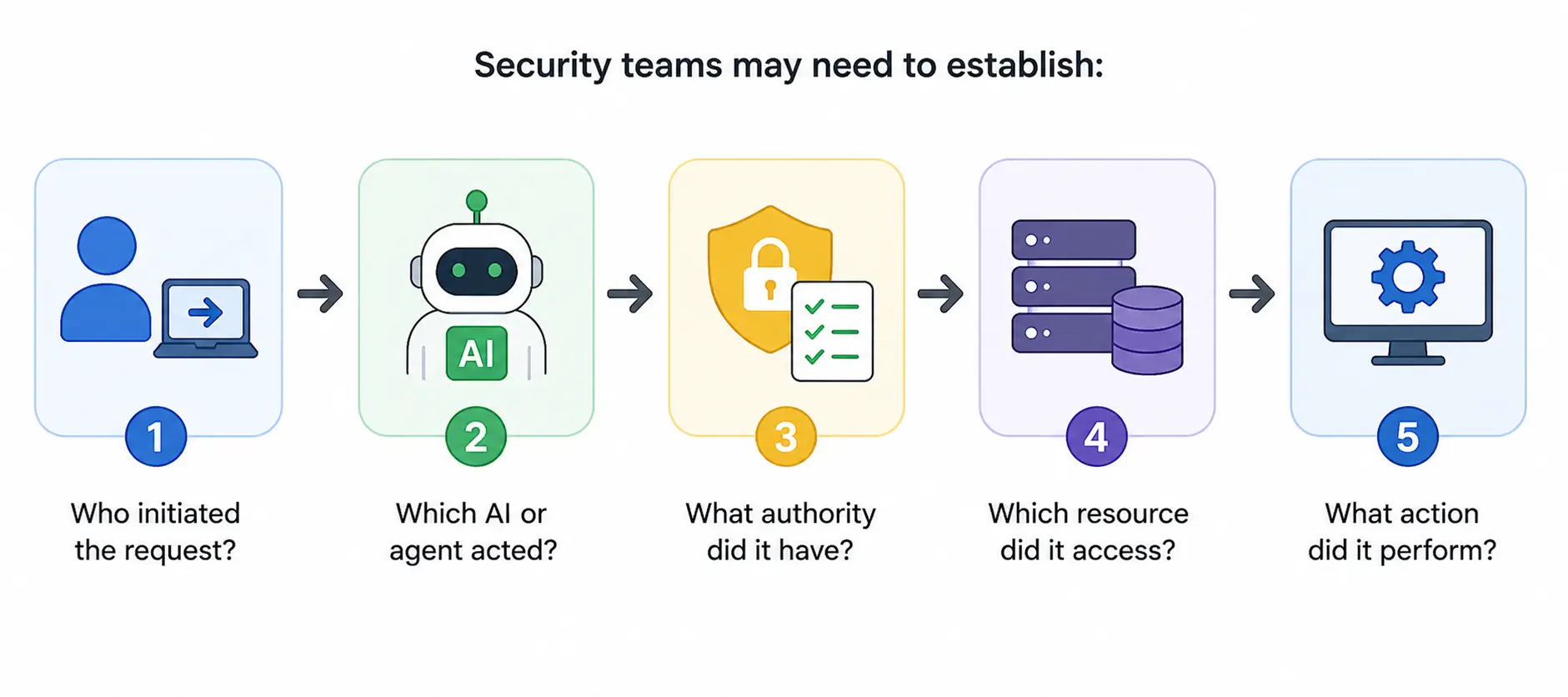
If an AI agent operates through shared credentials or inherits a user's broad permissions, those questions become difficult to answer.
This is why agentic IAM becomes especially important as we move toward agentic workflows. Organizations need to distinguish the human principal, application, workload, and AI agent rather than collapsing all of them into a single credential.
The practical issue is visibility. Once security teams know which AI is being used, which identity is behind it, what data it touches, and what resources it can reach, they can start making risk-based decisions instead of treating every AI tool as equally dangerous.
How Can Organizations Detect Shadow AI Across Users, Devices, APIs, and Agents?
Shadow AI is difficult to detect because there is no single place where all AI activity appears. A browser-based assistant leaves a different footprint from an external model API. A locally running AI agent looks different again. An AI capability embedded inside an approved SaaS application may not appear as a new application at all.
That makes Shadow AI detection a correlation problem. Security teams need signals from the places where AI activity actually touches the enterprise: networks, endpoints, SaaS environments, identities, APIs, and sensitive data.
| Control Layer | What to look for |
|---|---|
| Network and DNS telemetry | AI services being accessed and API endpoints being called. |
| Endpoint Detection and Response | Processes, Apps, and other local AI tools |
| Cloud Access Security Broker (CASB) | OAuth connections to Saas AI |
| Identity and other IAM activities | Unknown OAuth grants |
| API Monitoring | Unexpected model endpoints, new AI SDKs, hard-coded model credentials, or unusual API destinations |
| Data Loss Prevention (DLP) | Sensitive data uploads |
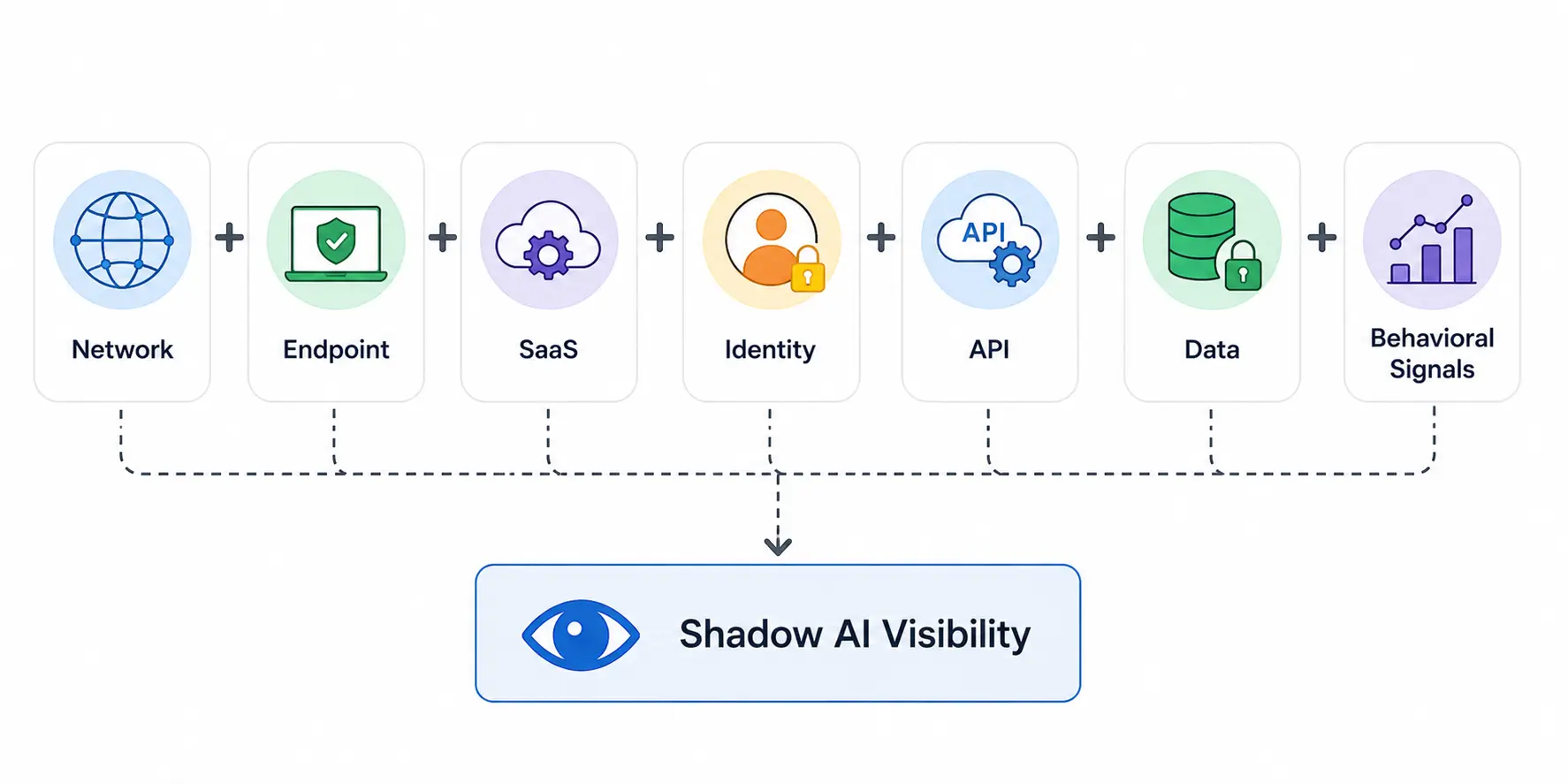
No single telemetry source will reliably detect every form of Shadow AI. Network monitoring may find an external AI service but miss the context of the interaction. Identity logs can reveal an unusual OAuth grant but miss a personal AI account. Endpoint telemetry can discover a local agent but not necessarily understand everything it accesses.
The goal is to connect those signals well enough to answer three practical questions: What AI is being used? Who or what is using it? What data and systems can it reach?
Once those answers are available, discovery can move into remediation rather than becoming another security dashboard nobody acts on.
What Should You Do After Shadow AI Is Detected?
Detection is only useful if it leads to a decision. Once an unknown AI tool, integration, or agent appears, the immediate response should not be to block it automatically. Security teams first need to understand what was discovered, who is using it, what information it has touched, and whether it can access or modify enterprise resources.
A browser-based AI assistant used for non-sensitive research does not present the same risk as an unmanaged agent holding credentials to a production API. Treating both situations identically can create unnecessary friction while leaving the more serious exposure buried in a long list of alerts.
Identify the User, Application, Workload, or Agent
Start by establishing ownership. For employee-facing AI, determine which users or teams are using the service and whether corporate or personal accounts are involved. For an AI integration, identify the application owner, associated service accounts, OAuth grants, API credentials, and connected resources.
Agentic workflows require another level of attribution. Teams should determine whether the agent has its own identity, operates through a service account, or simply inherits a user's permissions. If nobody can identify who owns an AI integration, that is already useful risk information.
Determine What Data and Systems Were Exposed
Next, investigate the AI system's reach. Did employees enter public information, internal documents, customer records, credentials, source code, or regulated data? Does the application have read-only access, or can it modify enterprise resources? Is it connected to email, cloud storage, repositories, databases, CRM systems, or internal APIs?
For AI agents, examine available tools and permissions as well. An agent that can query a knowledge base presents a different exposure from one that can update customer records or initiate transactions.
The investigation should establish both sides of the connection: Data the AI Can Receive ↔ Resources the AI Can Access or Modify
That gives teams a much clearer basis for deciding what happens next.
Classify the Risk Before Taking Action
Not every Shadow AI discovery deserves the same response.
A low-risk use case involving non-sensitive information might only require monitoring or formal approval. A tool processing confidential information may need tighter data controls or migration to an approved enterprise alternative. An unmanaged agent with excessive privileges, exposed credentials, or access to critical systems may require immediate containment.
A practical response model is: Low Risk → Monitor or Sanction
Moderate Risk → Restrict, Review, or Move to an Approved Alternative
High Risk → Block, Revoke Access, and Investigate
Risk should depend on factors such as data sensitivity, permissions, business impact, identity assurance, credential exposure, and whether the AI can perform actions.
Revoke Credentials When Access Cannot Be Trusted
If an investigation uncovers exposed or unnecessary credentials, removing the AI application alone may not be enough.
Compromised API keys should be rotated. Unnecessary OAuth grants should be revoked. Tokens and sessions may need invalidation. Unknown service accounts should be investigated, and permissions that exceed the application's legitimate purpose should be reduced or removed.
This matters especially for AI experiments. A developer may stop using a prototype while the API key or service account created for it remains active long afterward.
Remediation should remove that residual access, not just the visible application.
Decide Whether to Sanction, Restrict, Replace, or Remove the AI
Some Shadow AI tools should be blocked. Others may reveal a legitimate business requirement that the organization's approved technology does not currently meet.
Suppose several teams independently adopt the same AI service because it solves a real productivity problem. Simply blocking the service may push employees toward another unmanaged alternative. Security and IT teams should instead determine whether the capability can be approved, replaced with an enterprise-controlled option, or offered with appropriate restrictions.
That creates four possible outcomes: Sanction when the AI can meet organizational security and governance requirements.
Restrict when the tool is useful but certain data, users, permissions, or capabilities should remain unavailable.
Replace when an approved alternative can deliver the same business capability with stronger controls. Remove when the risk cannot be reduced to an acceptable level.
Shadow AI is therefore not always evidence that employees are ignoring security. Sometimes it exposes a gap between the AI capabilities people need and the ones the organization has made safely available.
The best remediation closes both gaps: remove unacceptable access while giving legitimate AI use a governed path forward.
What Compliance and Regulatory Risks Can Shadow AI Create?
Shadow AI creates an uncomfortable compliance problem: an organization may be responsible for how information and AI systems are used even when security, privacy, or compliance teams do not know that the AI use exists.
Consider an employee who uploads customer information to an unreviewed AI service. The immediate security question is whether the data has been exposed. The compliance questions go further. Was the organization permitted to process the information that way? Where was it sent? What safeguards applied? Was the provider evaluated? Can the organization document what happened?
Those questions become difficult to answer when AI adoption happens outside established governance. The exact obligations depend on the organization, jurisdiction, industry, type of data, and role it plays in the AI lifecycle. Still, several frameworks illustrate why Shadow AI deserves compliance attention.
| Regulation or Framework | Why Shadow AI Matters |
|---|---|
| EU AI Act | Undiscovered AI systems can make it harder to determine applicable AI Act roles, risk categories, transparency requirements, and other obligations. |
| GDPR | Employees may provide personal data to AI services without appropriate consideration of lawful processing, data minimization, processors, transfers, retention, or other safeguards. |
| HIPAA | AI services processing protected health information can create exposure when required privacy, security, contractual, or access safeguards have not been established. |
| PCI DSS | Payment or account data entered into unauthorized AI systems can move outside environments and controls intended to protect that information. |
| NIST AI RMF | Unknown AI makes structured AI risk identification, assessment, measurement, monitoring, and management much harder. |
| ISO/IEC 42001 | Uninventoried AI can undermine an organization's ability to systematically govern AI systems, responsibilities, risks, and ongoing use. |
How Can Organizations Prevent Shadow AI Without Blocking AI Adoption?
Trying to prevent Shadow AI by banning every unsanctioned AI tool is tempting. It is also difficult to sustain.
Employees adopt AI because it saves time. Developers use model APIs because they can add capabilities quickly. Business teams enable AI features because those features are increasingly built into software they already use. If governance makes legitimate AI use unnecessarily difficult, people are more likely to work around it.
A better strategy is to make approved AI easier to use while putting clear boundaries around data, access, and high-risk capabilities. Here is a checklist:
-
Maintain an inventory of AI systems and capabilities
-
Define what employees can do with AI
-
Provide approved AI alternatives
-
Control what AI can access
-
Give AI agents distinct and governed access
-
Make AI review continuous
-
Train employees around real AI workflows
How Can You Build a Practical Shadow AI Governance Framework?
Shadow AI governance becomes easier when it is treated as a continuous operating process rather than a one-time inventory exercise.
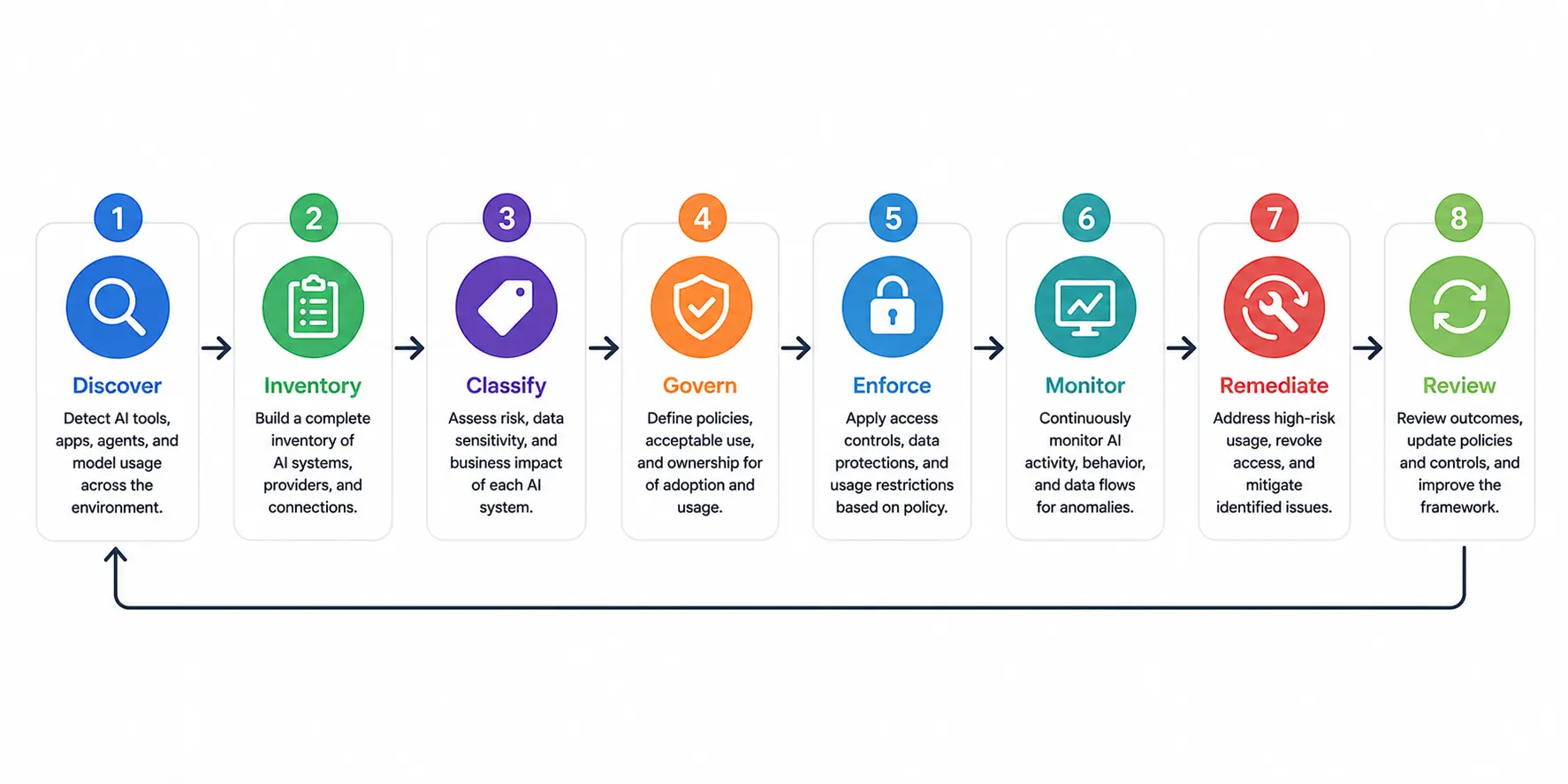
Each stage answers a different question about AI operating within the organization.
1. Discover AI Activity
Start by finding AI usage across the environment, including tools employees access directly, AI capabilities inside SaaS applications, model APIs, internal AI projects, and autonomous agents.
Discovery should draw from the telemetry already discussed network, endpoint, SaaS, identity, API, and data signals rather than depend on employees voluntarily reporting every AI tool they use. The immediate goal is simple: reduce the unknown AI footprint.
2. Build and Maintain an AI Inventory
Move discovered AI into a central inventory. For each relevant system, record its purpose, owner, users, model or provider where appropriate, connected applications, data access, credentials, and whether it can perform actions.
For agents, the inventory should also identify the agent's identity, available tools, permissions, and the person or application responsible for its deployment.
An inventory turns scattered AI activity into something security and governance teams can evaluate consistently.
3. Classify AI by Risk
Not every AI use requires the same level of control.
Risk classification can consider the sensitivity of the data involved, business impact, degree of autonomy, external connectivity, permissions, regulatory requirements, and whether the AI can modify enterprise resources.
For example, an AI assistant working with public marketing information may require relatively lightweight controls. An agent capable of modifying customer accounts should receive substantially more scrutiny. This keeps governance proportional instead of forcing every AI use case through the same process.
4. Establish Governance Requirements
Once AI use cases are classified, define what is required for each risk level.
That can include an identified owner, approved data categories, security review, privacy assessment, human oversight, authentication requirements, access limitations, logging, or periodic review.
Higher-risk AI should face stronger requirements before it gains access to sensitive data or consequential actions.
The policy becomes more useful when it answers what must happen before this AI use is allowed, rather than simply declaring AI “approved” or “unapproved.”
5. Enforce Access and Data Boundaries
Governance needs technical enforcement behind it. Apply appropriate access controls so AI applications and agents can reach only the resources necessary for their purpose. Protect sensitive data from unauthorized AI destinations, constrain API permissions, manage credentials securely, and enforce organizational policies at relevant control points.
For agents, authorization should become increasingly granular as their ability to act increases.
An agent permitted to read an order should not automatically be permitted to cancel it.
6. Monitor AI Activity Continuously
Approval is not the end of governance.
Monitor important AI systems for changes in usage, permissions, data access, integrations, and behavior. New SaaS AI features may appear. Internal projects may expand. Agents may gain additional tools. Usage patterns may shift well beyond what was originally approved.
Monitoring helps identify when a sanctioned AI system starts operating outside its expected boundaries and when new Shadow AI appears.
7. Remediate Based on Risk
When unmanaged or unsafe AI is discovered, use the risk classification to determine the response.
Some activity can be sanctioned. Some should be restricted or migrated. High-risk access may require credential rotation, permission revocation, blocking, or investigation.
The important part is consistency. Similar risks should produce similar responses rather than depending entirely on who happens to discover the AI first.
8. Review and Improve the Program
AI environments change too quickly for governance rules to remain static.
Review the AI inventory, approved tools, access policies, risk classifications, incidents, exceptions, and remediation outcomes periodically. If the same unsanctioned tool repeatedly appears, investigate why. If employees consistently request a particular capability, the approved AI environment may need to evolve. Governance should learn from Shadow AI rather than merely remove it.
A compact operational checklist looks like this:
| Governance Area | Key Question |
|---|---|
| Discovery | Which AI tools, models, APIs, and agents are actually being used? |
| Ownership | Who is responsible for each AI system? |
| Data | What information can the AI receive or retrieve? |
| Identity | Which user, application, workload, or agent is acting? |
| Access | What resources can it reach? |
| Authorization | Which actions is it permitted to perform? |
| Monitoring | Can important AI activity be observed and attributed? |
| Remediation | Can access, tokens, permissions, or credentials be revoked quickly? |
| Review | Are AI systems and policies reassessed as usage changes? |
This framework does not require organizations to invent an entirely separate security program for Shadow AI. Many controls already exist across identity, data protection, endpoint security, network security, API management, and application governance.
The challenge is connecting them around AI.
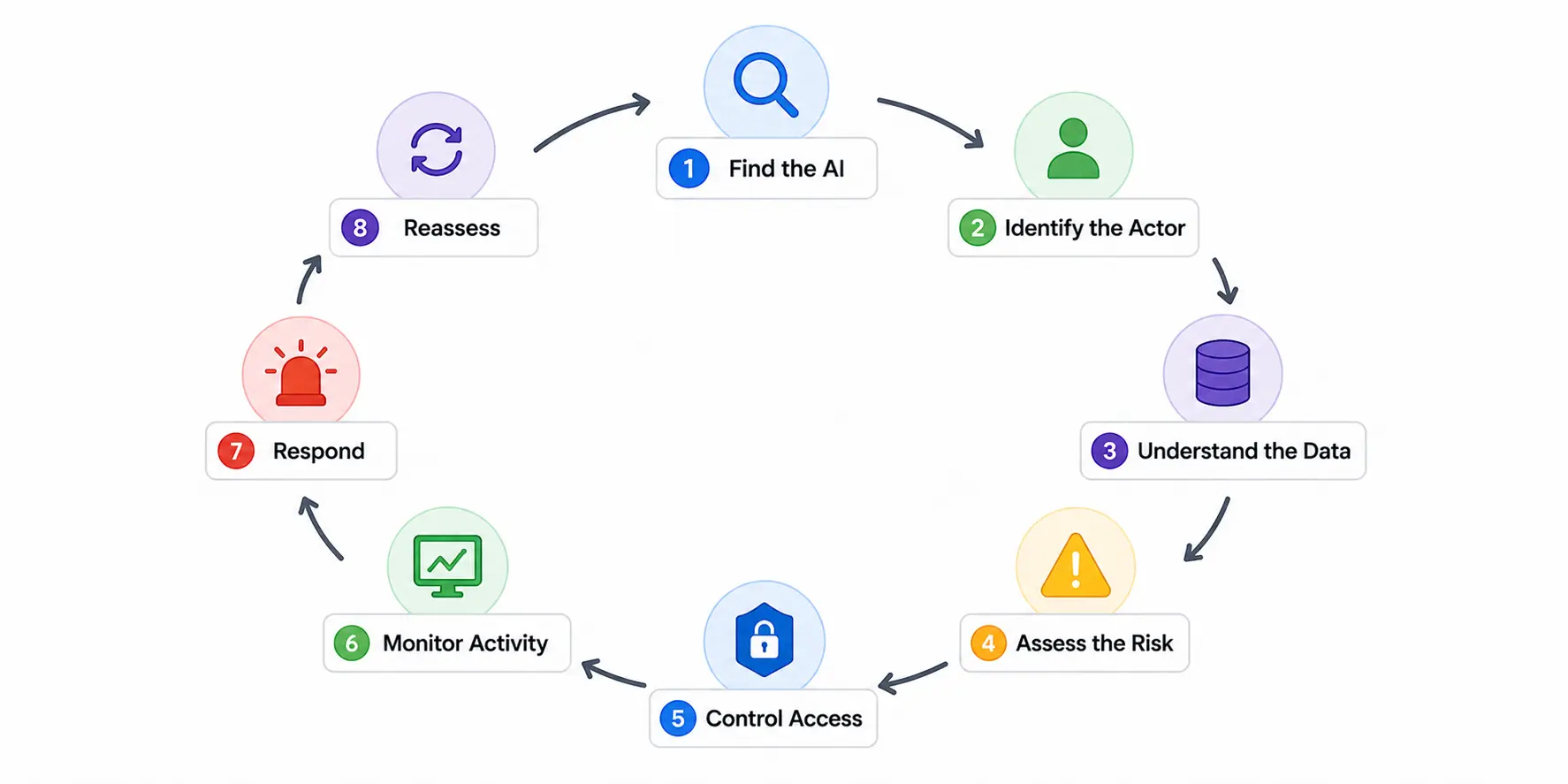
As AI adoption grows, that cycle provides something a simple blocklist cannot: a way to bring legitimate AI into governance while continuing to uncover what remains outside it.
How Does Identity Governance Help Control Shadow AI?
Discovering an unknown AI service answers one question: What AI is being used?
It does not necessarily answer the next ones. Who is using it? Is an application or AI agent acting instead? Which credentials does it hold? What resources can it access? And if that access becomes risky, can it be revoked without disrupting everything else?
This is where identity and access controls become an important part of Shadow AI governance.
Connect AI Activity to an Identity
AI activity may originate from several types of actors: an employee using an assistant, an application calling a model API, a workload running an automated process, or an AI agent performing a delegated task. Keeping those actors distinguishable improves accountability.
For employee-facing AI, existing authentication can establish the user behind an approved application. For service-to-service workloads, machine identities can separate automated access from human access. Agentic systems add another requirement: distinguishing the AI agent from the user or application on whose behalf it may be acting.
Instead of recording only: User → API
an agentic workflow may need to preserve: User → AI Agent → Delegated Authority → API or Tool. That context becomes useful when investigating an action later.
Limit AI Access With Scoped Authorization
Identity establishes who or what is requesting access. Authorization determines what that identity can actually do.
This distinction becomes important when AI applications move beyond generating content and begin interacting with enterprise resources.
An agent that needs to retrieve order status, for example, should not automatically receive permission to cancel orders, issue refunds, or modify customer profiles. Access should reflect the task being performed.
Where supported by the architecture, scoped and short-lived access can reduce the reliance on broadly privileged, long-lived credentials.
The principle is straightforward: AI Identity → Approved Scope → Specific Resource → Permitted Action
The more consequential the action, the more important that boundary becomes.
Preserve Delegation When AI Acts for a User
Some agents act independently as workloads. Others operate on behalf of a human.
In delegated scenarios, simply giving the agent the user's credentials creates a weak security boundary. The downstream system may see the user but lose visibility into which agent actually performed the action.
A stronger model preserves both identities:
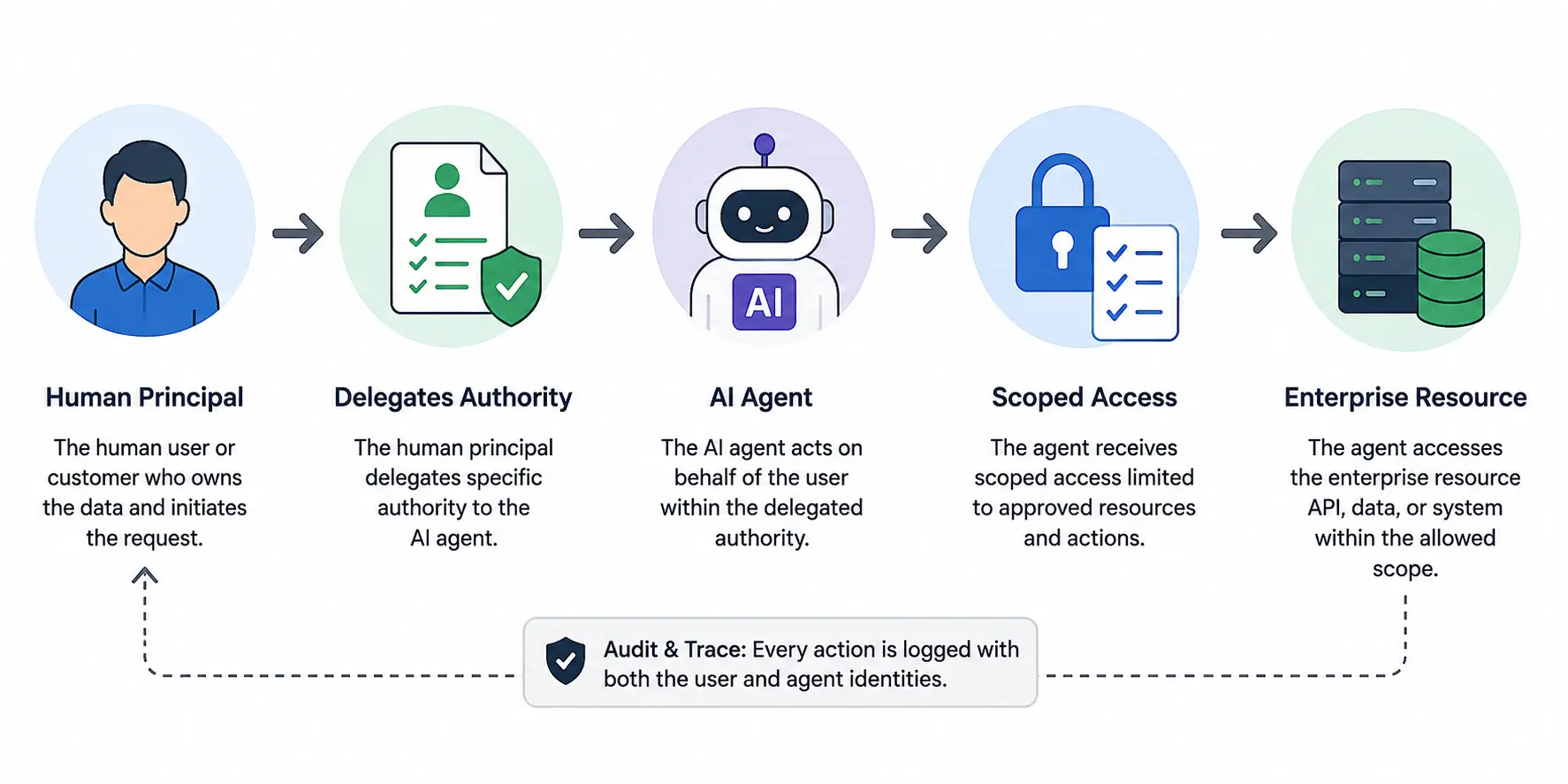
This makes it possible to distinguish between what the user is allowed to do and what the agent has specifically been authorized to do for that user.
Delegated authorization also makes revocation more precise. Access granted to an agent can be removed without necessarily disabling the user's entire account.
Require Additional Verification for Sensitive Actions
Not every AI action should proceed solely because an agent already has a valid token.
Higher-impact operations may justify additional policy checks or human approval. Changing sensitive account information, initiating a financial transaction, deleting records, or performing another consequential action can trigger stronger verification before execution.
A governed flow might look like:
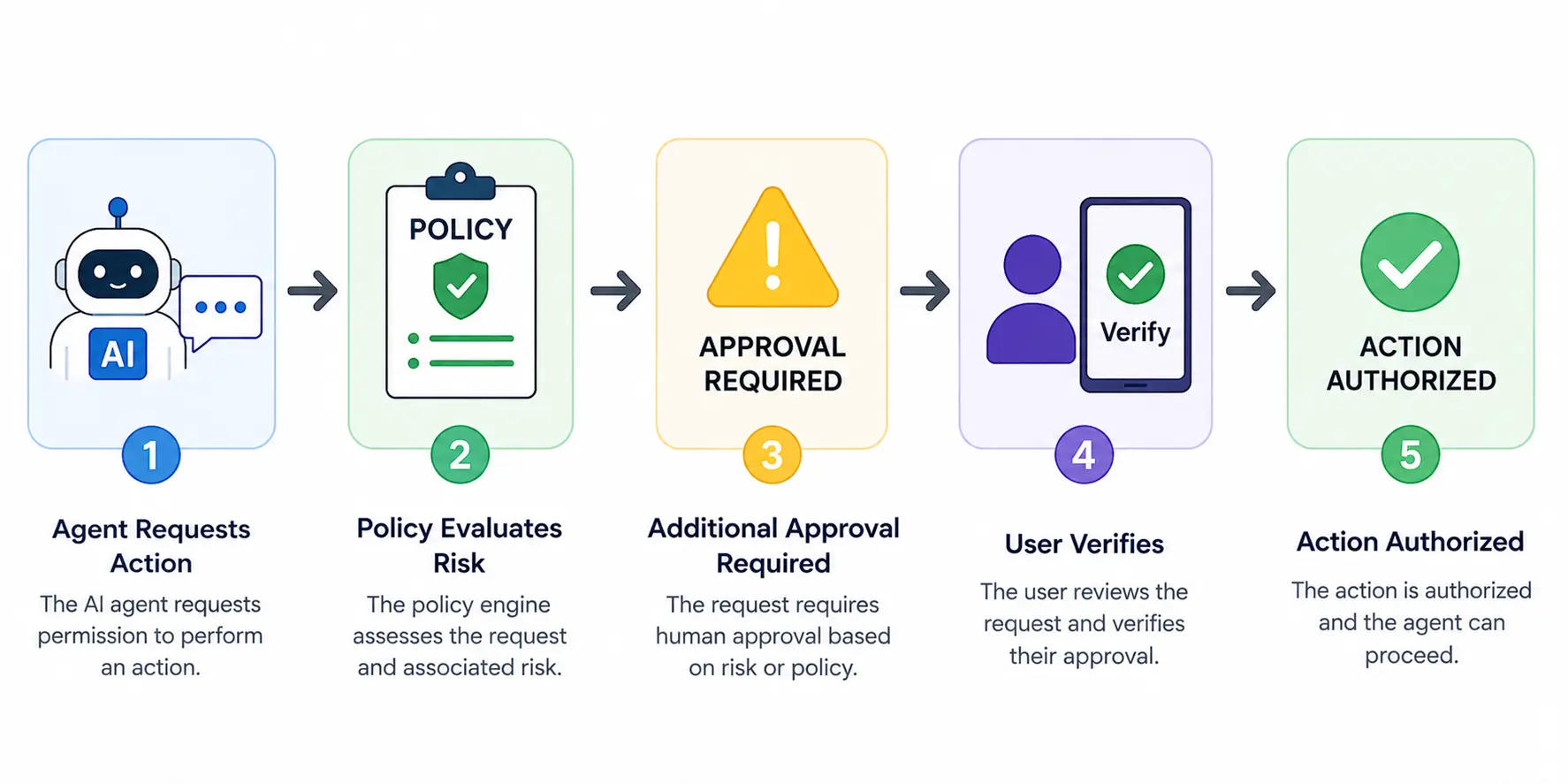
This introduces a useful boundary between giving an agent enough autonomy to be productive and giving it unrestricted authority.
Make Agent Actions Traceable
Good identity governance should also improve the audit trail.
For important agent-driven activity, organizations should be able to reconstruct more than the API call itself. Ideally, records can establish the user or application that initiated the task, the agent involved, the authority delegated to it, the resource accessed, and the action performed.
That creates a clearer accountability chain: Principal → Agent → Authority → Resource → Action → Result
This becomes particularly useful when several agents or tools participate in the same workflow.
Identity governance does not replace network monitoring, endpoint security, DLP, CASB, or other Shadow AI discovery controls. Its role is different.
Those controls help organizations discover where unmanaged AI is appearing. Identity and authorization help determine who or what is behind the activity, what it should be allowed to reach, and how that access can be constrained or revoked.
Together, they move Shadow AI governance from visibility toward enforceable control.
How Can LoginRadius Help Govern Access for AI Applications and Agents?
Shadow AI cannot be solved by identity controls alone. Organizations still need network, endpoint, SaaS, API, and data-security tooling to discover AI activity across the environment.
Identity becomes important once an AI application or agent needs access to customers, APIs, tools, or protected resources.
LoginRadius can provide that identity and authorization layer, helping organizations move AI-driven access away from shared credentials and broadly privileged tokens toward identifiable, scoped, and revocable access.
Establish Separate Identities for AI Agents
An AI agent should not have to appear as its user simply because it is acting on that user's behalf.
LoginRadius Agentic IAM supports treating AI agents as distinct identities with their own lifecycle. That separation makes it possible to manage an agent independently, including its registration, permissions, credentials, auditing, and access revocation.
This creates a clearer relationship: Customer Identity → Delegated Authority → AI Agent Identity → Protected Resource
If an agent is compromised, retired, or no longer trusted, its access can be revoked without necessarily disabling the customer's identity or unrelated agents.
Replace Broad Credentials With Scoped Access
Static API keys and shared service accounts make AI access difficult to constrain and attribute.
LoginRadius supports standards-based authorization using OAuth and scoped access tokens so that agents can receive permissions aligned with the resources and actions they actually need.
Instead of giving an agent broad API access, authorization can be narrowed to a particular purpose: Agent → Scoped Token → Permitted API or Tool → Authorized Action
Short-lived, scope-bound access also reduces dependence on persistent credentials that may remain valid long after an AI experiment or integration has changed.
Preserve User Context When Agents Act on Their Behalf
Many AI applications are useful precisely because they can perform tasks for customers.
But there is an important difference between delegating authority and handing the agent the customer's credentials.
LoginRadius supports delegated authorization flows in which an agent can operate with limited authority rooted in user approval. Token exchange can then provide downstream access appropriate to the agent, user, resource, and requested scope.
This helps preserve both sides of the relationship: who authorized the task and which agent actually performed it.
That distinction becomes increasingly important for auditability as AI workflows involve more APIs, tools, and downstream services.
Secure MCP-Based Access to Enterprise Tools
Model Context Protocol (MCP) gives AI applications a standardized way to connect with tools and resources. Those connections still need authentication and authorization.
LoginRadius supports OAuth-based authorization for MCP environments, including user-approved delegated access and scoped permissions for tools and APIs.
An MCP-enabled workflow can therefore follow a controlled path: User → Approves Access → AI Agent → Scoped Authorization → MCP Server → Tool or API
The AI receives access to the capabilities required for the task rather than unrestricted access to everything exposed behind the MCP server.
Add Human Approval to Sensitive Agent Actions
Some actions should remain under human control even when an AI agent has legitimate access.
LoginRadius supports human-in-the-loop controls for higher-impact agent activity. Sensitive requests can require additional approval or stronger authentication before authorization proceeds.
For example: Agent Requests Sensitive Action → Policy Check → User Approval or Step-Up Authentication → Scoped Authorization → Action
This provides a useful safeguard for workflows involving consequential changes while still allowing lower-risk tasks to remain automated.
Improve Traceability and Revocation
When something goes wrong in an AI workflow, teams need more than confirmation that an API call occurred.
LoginRadius's Agentic IAM capabilities are designed to preserve context around agent identity, user delegation, token usage, permissions, and actions. That makes it easier to trace activity back through the authorization chain and investigate who or what was responsible.
Access can also be revoked when an agent no longer requires it or its behavior becomes unacceptable.
For Shadow AI governance, this creates a useful division of responsibility:
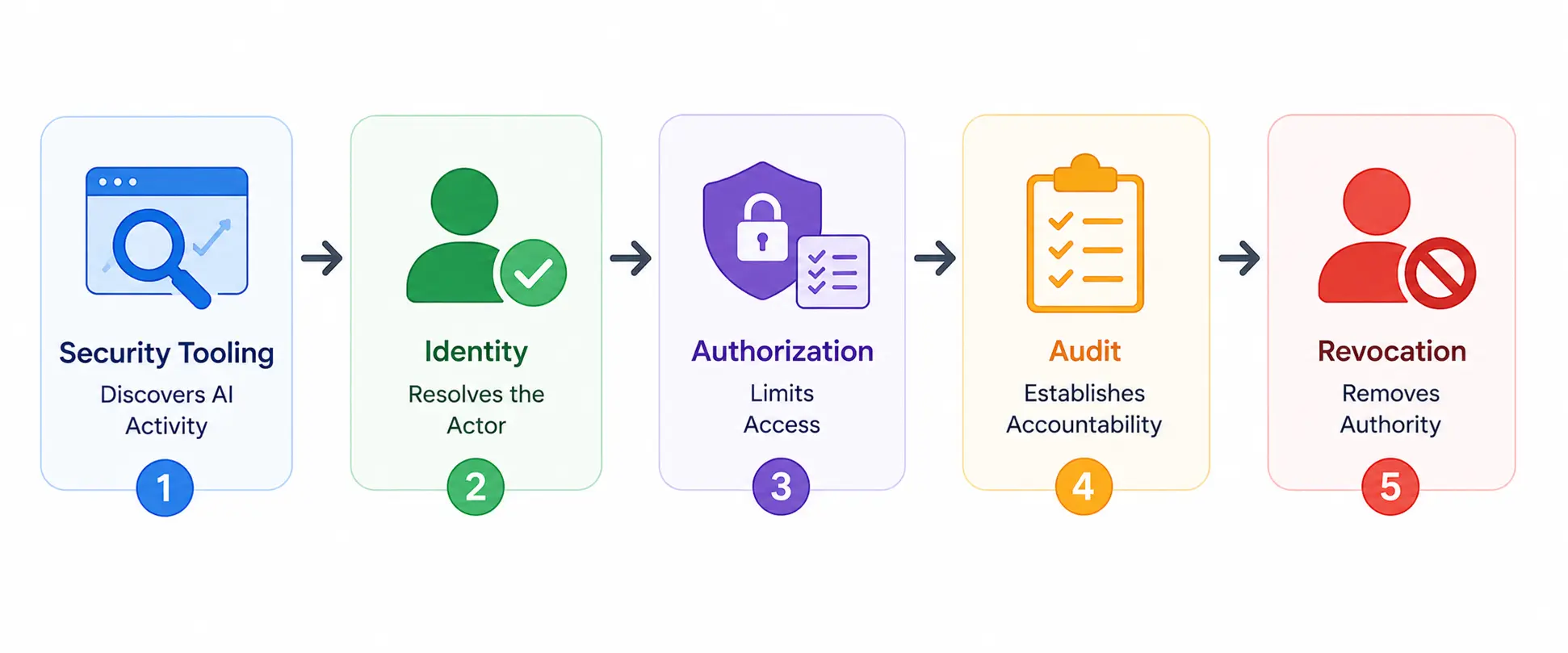
LoginRadius therefore addresses a specific part of the Shadow AI challenge: governing identity and access once AI applications and agents interact with customer identities, APIs, MCP servers, tools, and other protected resources.
That distinction matters. Discovering Shadow AI tells an organization what has appeared in its environment. Strong identity and authorization controls help ensure that AI which is allowed to remain cannot operate with undefined identities, unlimited permissions, or untraceable authority.
Conclusion: Turn Shadow AI Visibility Into Governed and Accountable AI Access
Shadow AI will become harder to manage as AI moves beyond standalone assistants and becomes embedded in SaaS applications, development environments, APIs, MCP-connected tools, and autonomous agents. Trying to block every new AI capability is unlikely to be a sustainable strategy.
A stronger approach starts with visibility. Discover which AI systems are being used, identify the people, applications, or agents behind them, understand what data and resources they can reach, and apply controls based on actual risk.
For AI agents, that also means making authority explicit. Agents should have identifiable access, limited permissions, clear delegation, traceable actions, and a way to revoke access when it is no longer appropriate.
LoginRadius can help organizations build that identity layer for AI-driven applications and agents with standards-based authentication, delegated authorization, scoped access, agent identities, and controls for sensitive actions.
As your organization moves from experimenting with AI to allowing AI to act across customer-facing applications and APIs, identity needs to evolve with it.
Ready to build governed identity and access for the agentic AI era? Book a demo with LoginRadius to explore how you can secure customer and AI-agent access without slowing down AI adoption.
FAQs
Q: What is Shadow AI?
A: Shadow AI is the use of AI tools, models, APIs, features, or agents without appropriate organizational visibility, approval, or governance. It can include both unsanctioned AI tools and unreviewed AI capabilities inside approved applications.
Q: What is an example of Shadow AI?
A: A common example is an employee entering company or customer information into an unapproved generative AI tool. Other examples include developers using unauthorized model APIs or teams deploying unmanaged AI agents with access to enterprise systems.
Q: What is the difference between Shadow AI and Shadow IT?
A: Shadow IT generally refers to unauthorized applications, devices, or cloud services. Shadow AI extends the problem to AI systems that can process sensitive data, generate outputs, and increasingly interact with APIs, tools, or enterprise resources.
Q: Why is Shadow AI a security risk?
A: Shadow AI can expose sensitive data, credentials, source code, or enterprise resources to systems that have not undergone appropriate security review. AI agents can increase the risk further when they have permission to perform actions.
Q: How can organizations detect Shadow AI?
A: Organizations can correlate network, endpoint, SaaS, identity, API, DLP, and behavioral telemetry to identify unknown AI activity. No single detection source provides complete visibility across every type of Shadow AI.
Q: What tools can detect Shadow AI?
A: Organizations commonly use network and DNS monitoring, EDR, CASB, DLP, identity logs, API monitoring, SaaS discovery, and behavioral analytics. The appropriate combination depends on where AI is being used and what resources it can access.
Q: How can businesses prevent Shadow AI?
A: Maintain an AI inventory, define clear acceptable-use policies, provide approved AI alternatives, protect sensitive data, restrict unnecessary permissions, and continuously monitor AI activity. Governance should enable legitimate AI adoption rather than depend entirely on blocking.
Q: Can Shadow AI create compliance risks?
A: Yes. Unmanaged AI can create compliance exposure when personal, healthcare, payment, or other regulated information is processed without required safeguards or oversight. The exact obligations depend on the data, use case, jurisdiction, and applicable regulation.