Introduction
Have you ever abandoned a sign-up because a website asked for far more information than seemed necessary? Many users have as they are paying closer attention to:
-
what businesses collect
-
why it is collected
-
how much control do I have on data usage
A long registration form, a vague consent message, or a privacy setting buried five clicks deep can create doubt before the relationship has even started.
The role of privacy has changed in the last few years and it is no longer just a legal requirement handled behind the scenes. It now influences product design, customer experience, brand reputation, and long-term growth. Privacy has become part of how people judge a digital business.
You cannot treat privacy as something to review after the product is built. By then, unnecessary data is already being collected, access rules are scattered across systems, and customers have little visibility into how their information is used. Fixing those issues later is possible, but rarely simple.
It is not simply about avoiding penalties or publishing a privacy policy. It is about handling personal information responsibly every time it is collected, used, stored, shared, or deleted. This guide explains how businesses can turn digital privacy into a practical advantage by improving transparency, reducing risk, strengthening customer confidence, and building digital experiences people are comfortable returning to.
Why Digital Privacy Matters Today
Digital privacy isn't receiving more attention simply because new regulations continue to emerge. The bigger shift is happening in the way people interact with digital services. Customers sign in across multiple devices, use dozens of applications every day, and expect those experiences to feel connected, secure, and effortless. Behind the scenes, businesses rely on cloud platforms, APIs, third-party services, and increasingly intelligent systems to deliver those experiences.
That creates enormous opportunities. It also creates far greater responsibility.
Organizations are no longer protecting a single database sitting inside a corporate network. They're managing personal information that moves continuously across applications, partners, devices, and digital ecosystems. As that complexity grows, so does the importance of handling customer data responsibly. Three major shifts are driving this change:
-
Customer Expectations are Evolving: Customers don't read privacy policies because it is fun, they do because they know when something feels off.
-
Don’t ask for information that doesn't seem necessary. Example:Apps that request access to contacts before first use.
-
People still care about product quality, pricing, and features. Increasingly, though, they also pay attention to how businesses collect, explain, and manage personal information.
-
-
AI is reshaping digital privacy:
| AI Capability | Accompanying Digital Privacy Risk | Safeguard / Strategy |
|---|---|---|
| Personalized Recommendations | Training models on raw PII without consent | Data anonymization and differential privacy |
| Automated Fraud Detection | Over-retention of device and behavioral telemetry | Telemetry data expiry schedules |
| Identity Verification | Biometric data exposure | On-device biometric storage / FIDO2 |
-
Digital identity is now central: Privacy is no longer just about protecting stored information. It's about managing digital identities responsibly.
- Identity connects every stage of the customer journey. Registration determines what information is collected. Authentication verifies who's requesting access. Consent records customer choices. Authorization controls access to sensitive information. Deletion ensures personal data can be removed when it's no longer needed.
The Cost of Ignoring Digital Privacy:
-
Financial Risk: Fines under GDPR can reach up to €20M or 4% of global annual turnover (whichever is higher).
-
Customer Churn: According to industry benchmarks, over 40% of consumers have switched brands due to unclear data practices or excessive data requests.
-
Reputational Damage: The average cost of a data breach involving compromised customer credentials exceeds $4.5 Million.
What Is Digital Privacy?
Digital privacy is the responsible collection, use, storage, sharing, and deletion of personal information across digital services. For individuals, it means having meaningful control over their data. For businesses, it means handling that information transparently and protecting it throughout the entire customer relationship.
That sounds straightforward. In practice, it touches almost every part of a digital experience.
When someone creates an account, signs in, makes a purchase, changes a communication preference, or closes an account, personal information moves through multiple systems. Digital privacy determines what should be collected, why it is needed, who can access it, and how long it should remain stored. It is also broader than cybersecurity.
A company can have strong firewalls, encrypted databases, and advanced threat detection while still handling personal information poorly. It may collect more data than necessary, retain old records indefinitely, or share information for purposes customers never expected.
Security protects data from unauthorized access. Privacy governs whether that data should have been collected, used, or shared in the first place. Both matter. Neither can replace the other.
What Types of Personal Data Does Digital Privacy Cover?
Personal data goes far beyond a name or email address. Some information is provided directly by customers, while other data is generated automatically as they use websites, applications, devices, or connected services.
| Data Category | Common Examples | Why It Requires Protection |
|---|---|---|
| Identity Data | Name, email address, phone number, date of birth | Identifies a customer and supports account management |
| Authentication Data | Passwords, passkeys, MFA methods, recovery codes | Protects account access and verifies identity |
| Government Identifiers | Passport details, driver's license, national ID numbers | Can enable identity theft or fraud if exposed |
| Financial Data | Payment cards, billing details, transaction records | Supports payments and carries significant fraud risk |
| Health and Sensitive Data | Medical records, insurance details, disability information | Can cause serious personal harm if misused |
| Biometric Data | Fingerprints, facial scans, voiceprints | Is difficult or impossible to replace after compromise |
| Device and Technical Data | IP address, browser type, device ID, operating system | Can help identify users and track activity |
| Location Data | GPS location, travel history, IP-based location | May reveal routines, movements, or sensitive locations |
| Behavioral Data | Browsing activity, purchases, searches, login history | Supports analytics and personalization but can become intrusive |
| Zero-Party Data | Preferences, interests, communication choices | Is shared |
Not every category carries the same level of risk. A preferred language setting does not require the same controls as a fingerprint, payment card, or government identity document. Mature privacy programs classify data by sensitivity and apply stronger safeguards where exposure would cause greater harm.
Teams end up protecting all data with the same broad policy but fail to account for context. The better approach is more deliberate. Sensitive information may require stronger encryption, tighter access controls, shorter retention periods, and additional authentication before it can be viewed or changed. Lower-risk data may still need protection, but not necessarily the same level of restriction.
Digital Privacy vs. Data Security vs. Cybersecurity
These terms often appear together, which makes them easy to confuse.
| Concept | Main Focus | Example |
|---|---|---|
| Digital Privacy | How personal information should be collected, used, shared, and controlled | Allowing customers to manage consent or delete an account |
| Data Security | Protecting information from unauthorized access, alteration, or loss | Encrypting customer records and restricting database access |
| Cybersecurity | Defending systems, applications, networks, and identities from attacks | Preventing phishing, ransomware, credential theft, or account takeover |
| Data Protection | Safeguarding information throughout its lifecycle | Applying retention schedules, backups, encryption, and secure deletion |
Although these disciplines overlap, they answer different questions. Cybersecurity asks, “How do we stop an attacker?” Data security asks, “How do we protect this information?” Digital privacy asks, “Should we collect and use this information, and what control should the individual have?” That distinction matters.
A secure system can still create a poor privacy experience. A privacy policy can also make ambitious promises that weak security controls fail to support. The strongest digital services align privacy, security, and customer control rather than treating them as separate initiatives.
Digital privacy, then, is not a single feature or compliance task. It is a way of making responsible decisions about personal information from the moment it is collected until the moment it is deleted.
Those decisions are usually guided by a small set of widely accepted principles.
The Core Principles of Digital Privacy
Digital privacy isn't defined by a single law, technology, or security framework.
Instead, it's built on a set of principles that guide how organizations collect, use, protect, and manage personal information throughout its lifecycle. Although privacy regulations differ around the world, they all reinforce similar ideas: collect responsibly, be transparent, respect customer choices, and protect the information you've been trusted with.
Understanding these principles doesn't require legal expertise.
They're simply good practices that help organizations build products customers are comfortable using.
Core Principles at a Glance
| Principle | What It Means | Practical Example |
|---|---|---|
| Data Minimization | Collect only what's necessary | Ask only for an email address during newsletter signup |
| Purpose Limitation | Use data only for its stated purpose | Don't reuse recovery phone numbers for marketing |
| Transparency | Clearly explain data practices | Describe why location access is requested before asking for permission |
| User Control | Give customers ownership of their information | Allow profile updates, data export, and account deletion |
| Consent and Choice | Let customers make informed decisions | Provide clear opt-in and opt-out controls |
| Privacy by Design | Build privacy into products from the start | Consider data minimization during feature planning |
| Security and Confidentiality | Protect information against unauthorized access | Encrypt customer records and require strong authentication |
| Accountability | Make privacy an organization-wide responsibility | Conduct regular privacy reviews and maintain audit logs |
These principles may appear simple, but together they shape how modern organizations approach digital privacy. Every decision from designing a registration flow to defining data retention policies should reinforce these fundamentals.
The next step is understanding how those principles are applied throughout the entire customer journey, from the moment personal information is collected until it's securely deleted.
The Digital Privacy Lifecycle
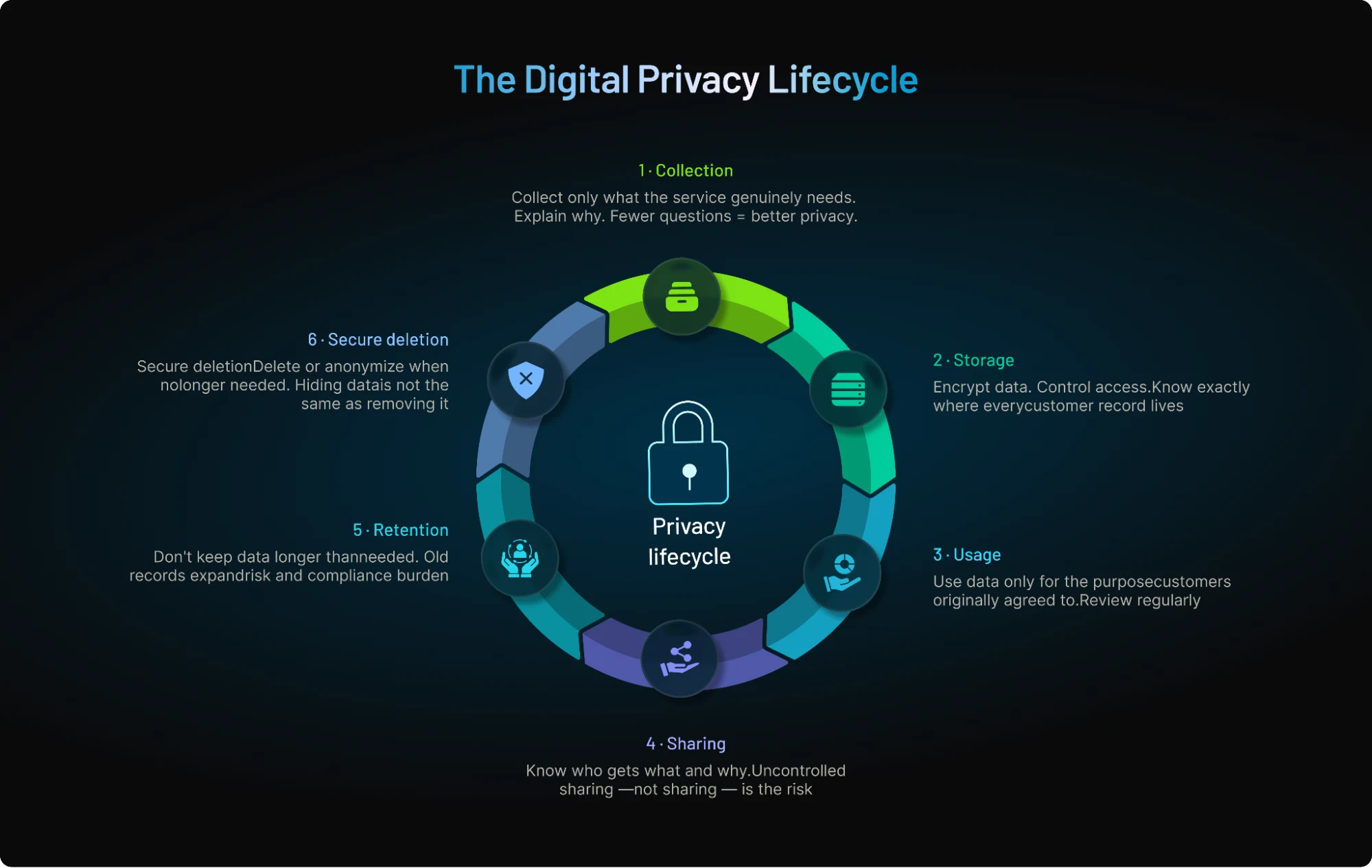
| Lifecycle Stage | Key Objective | Privacy Focus |
|---|---|---|
| Data Collection | Gather only necessary information | Data minimization and transparency |
| Data Storage | Protect personal information | Encryption, access controls, and secure infrastructure |
| Data Usage | Use information responsibly | Purpose limitation and accountability |
| Data Sharing | Control third-party access | Vendor governance and secure data exchange |
| Data Retention | Keep information only as long as needed | Retention policies and risk reduction |
| Secure Deletion | Remove information safely | Secure deletion and regulatory compliance |
Looking at privacy as a lifecycle changes the conversation.
Instead of asking, "How do we protect customer data?" organizations begin asking a more useful question: "How do we manage customer information responsibly from beginning to end?"
That shift encourages better decisions at every stage not just after data has already been collected. The lifecycle provides the foundation.
Privacy by Design: Building Privacy Into Every Digital Experience
Privacy by Design, is a framework that encourages organizations to consider privacy during planning, design, development, and deployment instead of treating it as an afterthought. The goal isn't to slow down your product innovation. It is to build products that naturally respect customer privacy from the very beginning.
The Seven Principles of Privacy by Design
Originally developed by former Ontario Information and Privacy Commissioner Ann Cavoukian, Privacy by Design is built around seven widely recognized principles that continue to influence privacy programs around the world.
| Principle | What It Means in Practice |
|---|---|
| Be Proactive, Not Reactive | Identify and address privacy risks before they become problems. Apply retention and deletion policies automatically. |
| Privacy as the Default | Collect only the information that is absolutely necessary and protect it without requiring customers to configure settings. |
| Privacy Embedded Into Design | Include privacy requirements during product planning and system architecture. Limit internal access based on business needs. |
| Full Functionality | Deliver strong privacy without sacrificing usability or business goals. |
| End-to-End Security | Protect personal information throughout its entire lifecycle—from collection to secure deletion—using strong authentication, encryption, and access controls (especially when changing or deleting PII). |
| Visibility and Transparency | Clearly explain how customer information is collected, used, and managed. |
| Respect for User Privacy | Give customers meaningful control over their personal information and preferences. |
Although these principles were introduced years ago, they still shape how modern organizations design privacy-first digital services.
Privacy by Design in Practice
| Traditional Approach | Privacy-First (CIAM) Approach | |
|---|---|---|
| Registration | Long forms asking for optional PII upfront | Progressive profiling (email/passkey first) |
| Authentication | Static passwords + basic SMS MFA | Passwordless / adaptive risk-based MFA |
| Consent | Hidden inside lengthy Terms of Service | Granular, self-service consent center |
| Data Retention | Permanent database storage | Automated lifecycle-based deletion |
Privacy by Design benefits more than compliance teams.
Developers spend less time redesigning features to address privacy concerns later. Security teams reduce unnecessary exposure to sensitive data. Customers gain greater transparency and control over their information.
As digital products continue to evolve, building privacy into every stage of development is often more effective and far less expensive than trying to retrofit privacy after launch.
Global Data Regulations Every Business Should Know
Digital privacy isn't governed by a single law.
Organizations often serve customers across multiple countries, each with its own privacy requirements, legal expectations, and individual rights. A business operating in North America today may also have customers in Europe, Australia, or Asia tomorrow, making privacy compliance an ongoing responsibility rather than a one-time project.
Fortunately, most modern privacy regulations share the same objective.
They encourage organizations to collect personal information responsibly, explain how it will be used, protect it from unauthorized access, and give individuals greater control over their own data.
Although the legal details differ, the underlying principles remain remarkably consistent.
Major Digital Privacy Regulations
| Regulation | Region | Primary Focus |
|---|---|---|
| GDPR (General Data Protection Regulation) | European Union | Protects personal data, strengthens individual rights, and requires lawful processing of personal information. |
| CCPA/CPRA (California Consumer Privacy Act / California Privacy Rights Act) | California, United States | Gives consumers greater control over how businesses collect, use, and share personal information. |
| PIPEDA (Personal Information Protection and Electronic Documents Act) | Canada | Governs how private-sector organizations collect, use, and disclose personal information. |
| LGPD (Lei Geral de Proteção de Dados) | Brazil | Establishes rules for processing personal data while expanding consumer privacy rights. |
| DPDP Act (Digital Personal Data Protection Act) | India | Defines responsibilities for organizations handling digital personal data and strengthens individual control. |
| Australian Privacy Act | Australia | Regulates personal information handling through the Australian Privacy Principles (APPs). |
Regardless of where an organization operates, these regulations encourage similar privacy practices.
They expect businesses to be transparent about data collection, request information responsibly, safeguard personal data, and respect customer rights throughout the information lifecycle.
| Regulatory Requirement | Compliance | Technical CIAM Implementation |
|---|---|---|
| Right to Erasure / Deletion | GDPR and CCPA | Automated API-triggered user account deletion across databases |
| Right to Access / Portability | GDPR | One-click JSON/CSV user profile export in self-service portal |
| Explicit Consent (Opt-In) | GDPR and DPDP | Just-In-Time (JIT) consent banners with immutable logging |
Read More - Navigating the Shifting Landscape of Data Privacy and Regulations
Why Customer Identity Is the Foundation of Digital Privacy
Digital privacy doesn't begin when customer information is stored. It begins much earlier when someone creates an account, signs in, grants consent, updates a profile, or requests that their information be deleted. Every one of those interactions depends on identity.
Without knowing who the customer is, organizations cannot consistently apply privacy preferences, protect personal information, or honor customer rights across different systems and channels.
This is where Customer Identity and Access Management (CIAM) becomes important.
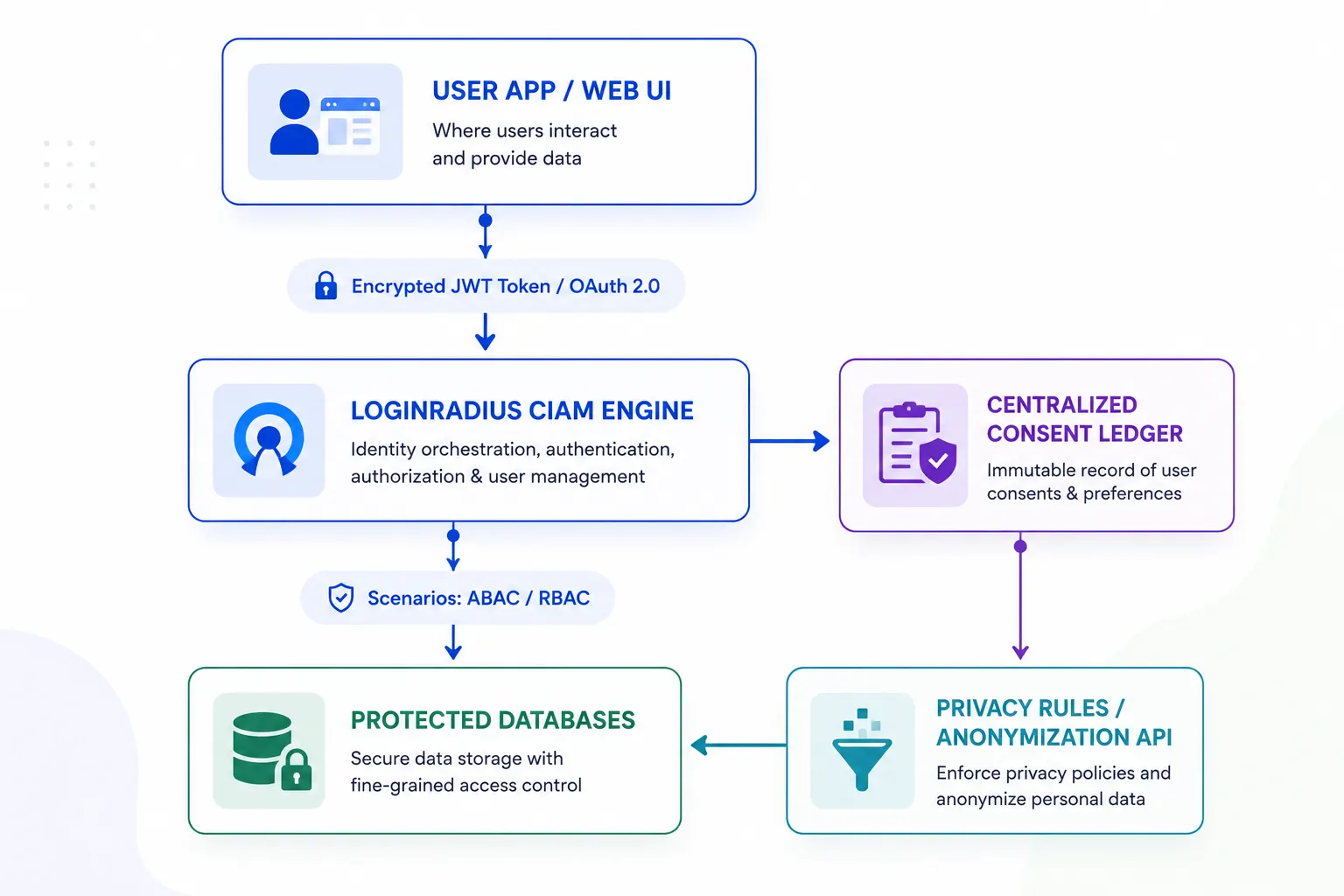
CIAM helps businesses securely manage customer identities throughout their lifecycle, from registration and authentication to profile management, consent, and account recovery. Instead of treating privacy as a separate compliance activity, it makes privacy part of everyday customer interactions.
How CIAM Improves Both Privacy and Customer Experience
Privacy and customer experience are often seen as competing priorities.
They don't have to be.
Modern CIAM platforms improve both by reducing unnecessary friction while giving customers greater control over their information.
Progressive Profiling Reduces Unnecessary Data Collection
Customers shouldn't have to complete long registration forms before experiencing your product.
Progressive profiling collects only the information needed to get started and requests additional details over time as the customer relationship grows.
That approach improves registration while supporting data minimization.
Modern Authentication Protects Accounts Without Creating Friction
Passwords alone no longer provide the balance customers expect between security and convenience.
Passkeys, passwordless authentication, adaptive Multi-Factor Authentication (MFA), and risk-based authentication help verify identities while reducing unnecessary login challenges.
Security adapts to risk instead of interrupting every sign-in.
Transparency and Self-Service Build Customer Confidence
Customers increasingly expect to manage their own identities. CIAM supports that through self-service profile updates, consent management, communication preferences, authentication settings, and account deletion.
When customers can easily understand and control how their information is used, privacy becomes part of the overall experience, not just a legal requirement. Digital privacy ultimately depends on trusted customer identities.
The better organizations manage those identities, the easier it becomes to protect personal information, respect customer choices, and deliver secure digital experiences across every touchpoint.
An 8-Step Framework for Customer Data Privacy
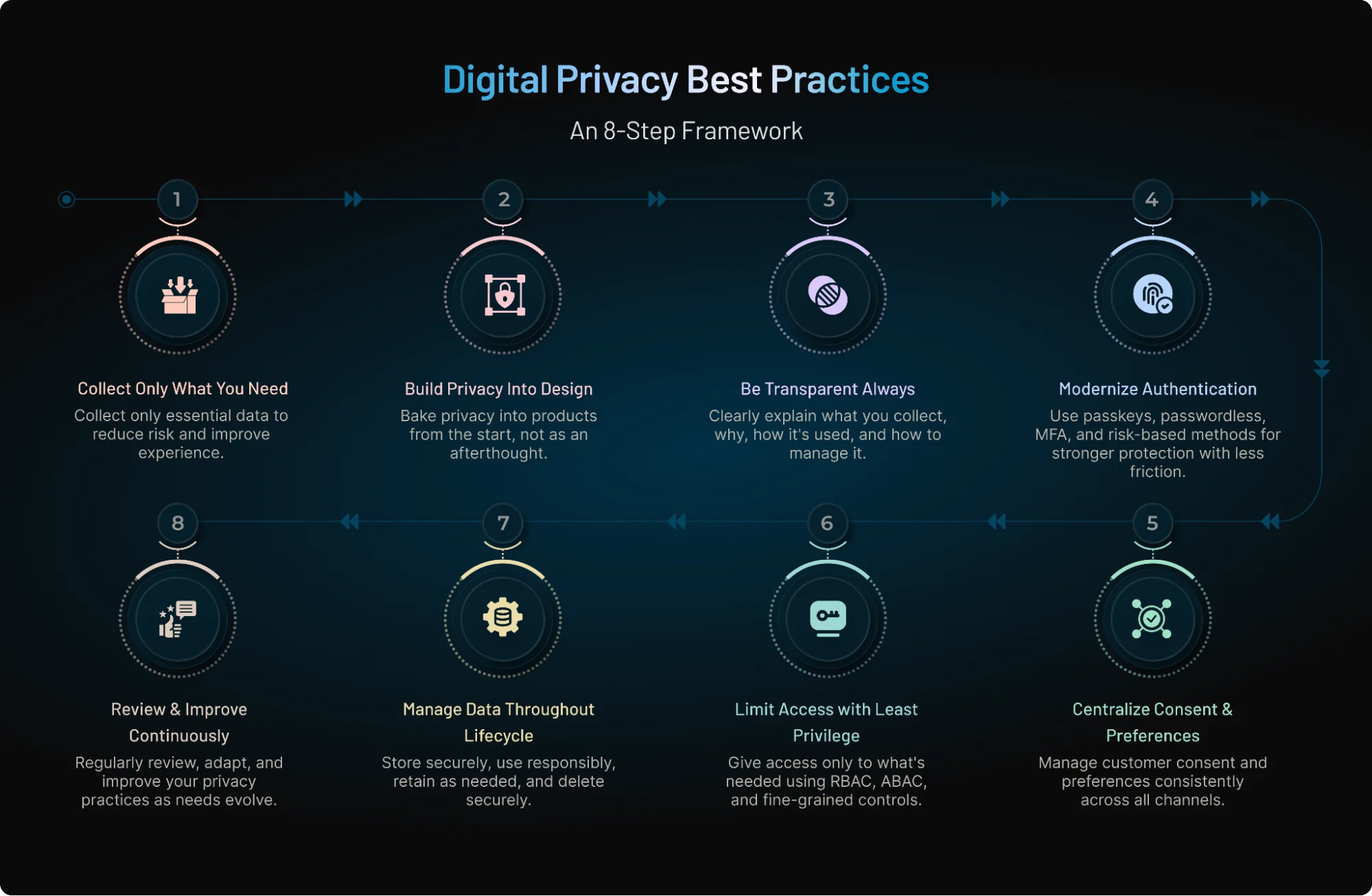
Instead of another long educational section, this becomes a practical implementation guide.
Digital privacy isn't strengthened through a single technology or compliance initiative.
It improves when organizations consistently apply the right practices across product development, customer identity, security, and data governance.
By now, we've explored the principles, lifecycle, and technologies behind digital privacy. The next step is turning those ideas into everyday operational practices.
Whether you're launching a new application or modernizing an existing digital platform, these eight best practices provide a practical framework for building privacy into every customer interaction.
1. Collect Only the Data You Need
Every piece of customer information comes with responsibility.
Before adding another field to a registration form or profile page, ask whether that information is genuinely required to deliver the service.
Collecting less data helps reduce privacy risk, simplifies compliance, improves data quality, and often creates a faster registration experience for customers. Start small. Request additional information only when there's a clear business purpose.
2. Build Privacy Into Product Design
Privacy shouldn't begin during compliance reviews.
It should begin when products are designed.
Embedding privacy into user journeys, APIs, databases, authentication flows, and identity architecture makes it easier to scale while avoiding expensive redesigns later.
The earlier privacy becomes part of development, the easier it is to maintain throughout the product lifecycle.
3. Make Transparency Part of Every Customer Interaction
Customers are generally willing to share personal information when they understand why it's needed.
Explain:
-
what information is collected
-
why it's required
-
how it will be used
-
how customers can manage it
Clear communication builds confidence far more effectively than lengthy privacy policies hidden in website footers.
4. Modernize Customer Authentication
Strong authentication protects both customer identities and personal information.
Rather than relying solely on passwords, organizations should consider modern approaches such as:
-
Passkeys
-
Passwordless authentication
-
Adaptive Multi-Factor Authentication (MFA)
-
Risk-based authentication
These methods improve security while reducing unnecessary login friction for legitimate users.
5. Centralize Consent and Preference Management
Customer preferences change over time.
Organizations need a consistent way to capture, manage, and update consent across websites, mobile applications, customer portals, and other digital channels.
Centralized consent management helps ensure customer choices remain accurate, transparent, and respected throughout the relationship.
6. Limit Access Using Least Privilege
Not everyone inside an organization needs access to every customer record.
Applying least privilege through Role-Based Access Control (RBAC), Attribute-Based Access Control (ABAC), and fine-grained authorization reduces unnecessary exposure while improving accountability.
The fewer people and systems that can access sensitive information, the lower the overall privacy risk.
7. Manage Data Throughout Its Entire Lifecycle
Privacy doesn't end once customer information has been collected.
Organizations should establish clear processes for:
-
secure storage
-
responsible usage
-
retention
-
archival
-
secure deletion
Managing information throughout its lifecycle helps reduce long-term security, operational, and compliance risks.
8. Continuously Review and Improve
Digital privacy isn't something organizations complete once. Customer expectations evolve.
Technology changes. Threats become more sophisticated. Regular privacy reviews help identify opportunities to strengthen policies, improve customer experiences, modernize authentication, and adapt to changing business requirements before problems emerge.
Continuous improvement should become part of every privacy program.
Digital Privacy Best Practices Checklist
| Best Practice | Business Benefit |
|---|---|
| Collect Only Necessary Data | Reduces risk while improving customer trust and registration completion rates |
| Adopt Privacy by Design | Prevents costly redesigns and embeds privacy into product development |
| Be Transparent | Strengthens customer confidence through clear communication |
| Modernize Authentication | Protects customer identities while reducing login friction |
| Centralize Consent Management | Keeps customer preferences consistent across every touchpoint |
| Apply Least Privilege | Limits unnecessary access to sensitive customer information |
| Manage the Data Lifecycle | Protects information from collection through secure deletion |
| Continuously Improve | Keeps privacy programs aligned with changing technology and customer expectations |
There's no universal checklist that guarantees perfect digital privacy. Every organization operates in a different industry, serves different customers, and manages different types of personal information. Even so, these eight practices provide a strong foundation.
Organizations that consistently apply them tend to collect less unnecessary data, protect customer identities more effectively, simplify compliance efforts, and create digital experiences that customers trust.
Ultimately, digital privacy isn't measured by the number of policies an organization publishes.
It's measured by the confidence customers have every time they choose to share their information.
Digital Privacy Maturity Model: Where Does Your Organization Stand?
Every organization wants to protect customer data. The difference lies in how they approach it.
Some businesses focus primarily on meeting regulatory requirements. Others invest heavily in cybersecurity but overlook customer experience. More mature organizations recognize that digital privacy influences every customer interaction from registration and authentication to consent management and account recovery. Privacy maturity isn't measured by the number of policies an organization publishes.
It's reflected in how consistently privacy is built into products, processes, and everyday decisions.
The following model provides a simple way to evaluate where your organization stands today and what the next stage of improvement looks like.
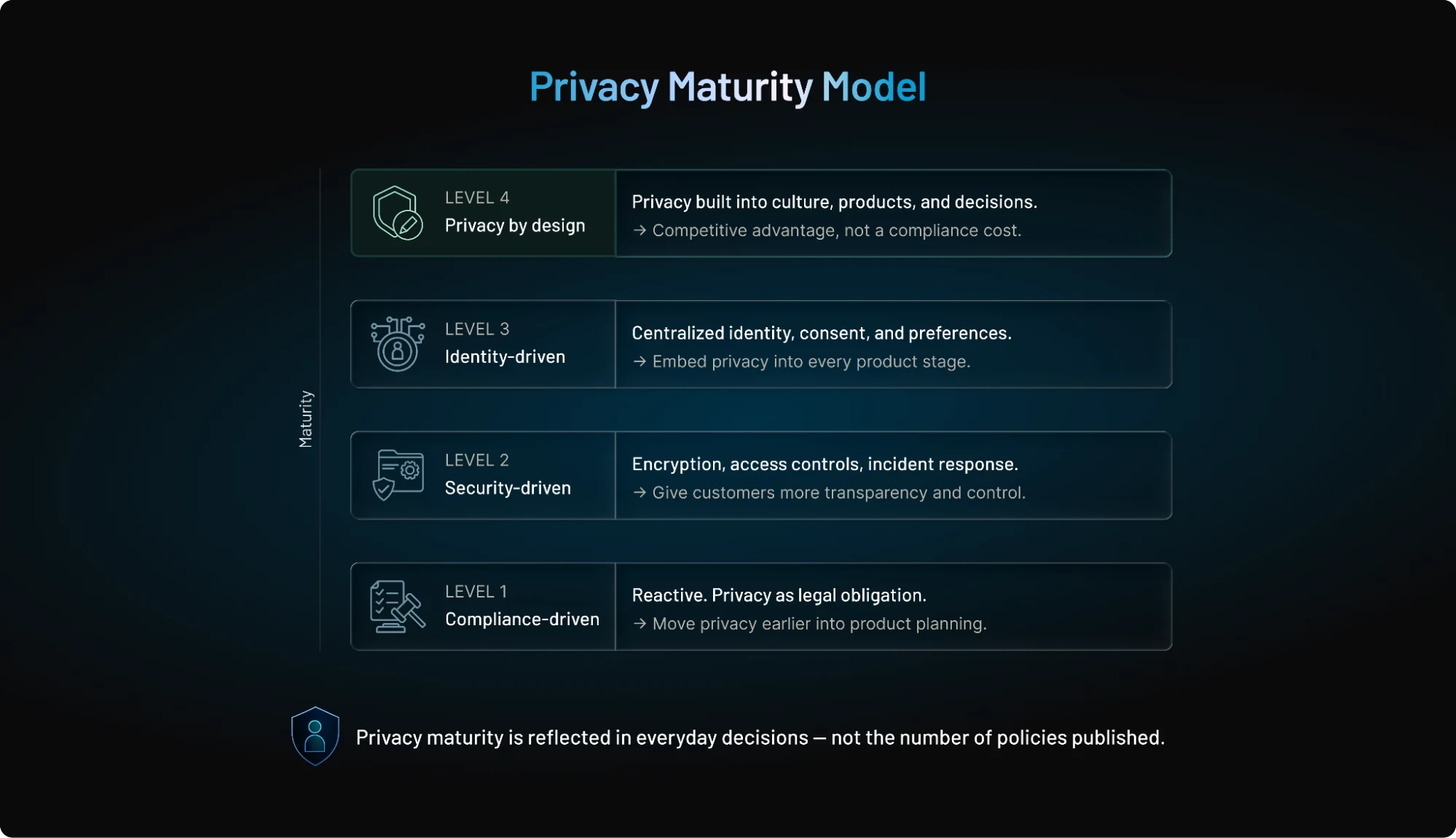
Level 1: Compliance-Driven
Privacy initiatives are largely reactive. Organizations introduce new controls because regulations require them or customers request them. Privacy policies exist, consent is collected where necessary, and compliance activities often increase before audits.
This creates an important foundation, but privacy is still viewed primarily as a legal obligation.
Next step: Move privacy discussions earlier into product planning instead of treating them as a final compliance review.
Level 2: Security-Driven
Organizations begin investing in stronger technical controls. Encryption, access management, authentication, monitoring, and incident response become priorities. Customer information is better protected, but privacy decisions are still largely driven by security rather than customer experience.
The focus shifts from simply meeting regulations to reducing operational risk.
Next step: Give customers greater transparency and control over how their personal information is managed.
Level 3: Identity-Driven
Here's where the mindset changes. Organizations recognize that privacy depends on managing customer identities consistently across every digital touchpoint.
Identity platforms help centralize authentication, consent, profile management, authorization, and customer preferences while reducing fragmented customer records across multiple applications.
Privacy becomes easier to scale because identity remains consistent throughout the customer lifecycle.
Next step: Embed privacy into every stage of product development rather than treating it as a separate initiative.
Level 4: Privacy by Design
Privacy becomes part of the organization's culture. Product teams consider data minimization before building new features. Engineers evaluate privacy during architecture discussions. Customer experience, security, and compliance teams work together instead of operating independently. At this stage, privacy is no longer viewed as a cost of doing business.
It becomes a competitive advantage that strengthens customer trust and supports long-term growth.
Digital Privacy Maturity Model at a Glance
| Maturity Level | Primary Focus | Typical Mindset |
|---|---|---|
| Level 1 | Compliance | "We need to meet regulatory requirements." |
| Level 2 | Security | "We need to better protect customer information." |
| Level 3 | Identity | "Privacy depends on trusted digital identities." |
| Level 4 | Privacy by Design | "Privacy is part of every product and business decision." |
Most organizations won't fit perfectly into a single level. You may already have strong authentication but still rely on fragmented consent management. You may follow Privacy by Design for new applications while older systems continue using legacy identity processes. That's completely normal.
Privacy maturity isn't about reaching a finish line. It's about making steady improvements that strengthen customer trust over time.
The technologies shaping digital privacy continue to evolve, and customer expectations aren't standing still either. Understanding where privacy is heading next helps organizations prepare for the opportunities and responsibilities that lie ahead.
The Future of Digital Privacy
Digital privacy has never been static. Customer expectations evolve. Technology evolves. Regulations evolve. The way organizations collect and use personal information changes alongside them. What's different today is the speed of that change.
Artificial intelligence is becoming part of everyday applications. Authentication is moving beyond passwords. New identity technologies are giving people greater control over their personal information. At the same time, customers expect businesses to be more transparent than ever before.
Organizations that prepare for these shifts today will be better positioned to build trusted digital experiences tomorrow.
1. AI Governance Will Become a Business Priority
Artificial intelligence is helping organizations personalize experiences, detect fraud, automate support, and improve decision-making. Those capabilities depend on customer data.
As AI adoption grows, organizations will need stronger governance around how personal information is collected, processed, and used within AI systems. Customers will increasingly expect clear answers about what data is being used, why it's needed, and how automated decisions affect them.
Responsible AI will become just as important as intelligent AI.
2. Passkeys and Passwordless Authentication Will Become the New Standard
Passwords continue to be one of the weakest links in digital security. The industry is steadily moving toward passkeys, passwordless authentication, and adaptive authentication methods that improve both security and usability. Reducing reliance on passwords doesn't simply improve login experiences.
It also reduces the amount of sensitive credential data organizations need to manage, lowering both operational and privacy risks.
3. Privacy-Enhancing Technologies Will Gain Wider Adoption
Organizations increasingly want to analyze and share data without unnecessarily exposing personal information.
That's driving interest in Privacy-Enhancing Technologies (PETs) such as:
-
Differential privacy
-
Homomorphic encryption
-
Secure multi-party computation
-
Confidential computing
-
Tokenization
Although some of these technologies are still maturing, they're expected to play a much larger role in AI, analytics, and secure data collaboration over the next few years.
4. Digital Identity Wallets and Verifiable Credentials Will Reshape Identity
Today's digital experiences often require customers to repeatedly share the same personal information across multiple services. Digital identity wallets and verifiable credentials offer a different approach.
Instead of uploading entire identity documents, customers will increasingly be able to share only the information required for a specific interaction for example, proving they are over a certain age without revealing their full date of birth. This concept, known as selective disclosure, improves privacy while simplifying digital experiences.
5. Privacy Will Become a Competitive Advantage
Perhaps the biggest shift isn't technological. It's strategic.
Customers increasingly reward organizations that are transparent about data collection, respect privacy choices, and make personal information easy to manage.
Businesses that continue treating privacy as a compliance exercise may satisfy regulatory requirements.
Organizations that treat privacy as part of their product experience are more likely to strengthen customer trust, improve retention, and differentiate themselves in competitive markets. Privacy is becoming a business advantage not just a legal obligation.
Looking Ahead
The technologies shaping digital privacy will continue to evolve, but the underlying objective remains remarkably consistent. Give customers greater visibility into their information.
Give them meaningful control over it. Protect it throughout its lifecycle.
Organizations that build around those principles won't need to reinvent their privacy strategy every time technology changes. They'll already have the foundation needed to adapt, innovate, and earn customer trust in a rapidly evolving digital world.
That brings us to one final question: How can organizations turn these ideas into a long-term competitive advantage?
Conclusion
Digital privacy has evolved far beyond protecting databases or meeting compliance requirements. Today, it influences every stage of the customer journey from the moment someone creates an account to the day they decide to delete it. Every registration, login, profile update, consent change, and account recovery request shapes how customers perceive your business.
One message has remained consistent throughout this guide. Digital privacy isn't achieved through a single regulation, security product, or privacy policy. It's built through thousands of everyday decisions: collecting only the information you truly need, explaining why it's required, protecting it with modern authentication, giving customers meaningful control, and managing personal data responsibly throughout its lifecycle.
Organizations that approach privacy this way gain more than compliance. They reduce operational risk. They simplify governance. They strengthen customer confidence. And they create digital experiences that people are comfortable returning to.
As digital ecosystems become more connected and artificial intelligence becomes part of everyday applications, privacy will become even more closely tied to identity. Businesses that invest in privacy-first identity strategies today will be better prepared to adapt to tomorrow's technologies, regulations, and customer expectations. Ultimately, digital privacy isn't just about protecting information. It's about protecting relationships.
Customers are far more likely to trust organizations that are transparent about data collection, respect their choices, and make it easy to control personal information. Over time, those seemingly small interactions become one of the strongest competitive advantages a business can build.
Build Privacy-First Customer Experiences with LoginRadius
Creating privacy-first digital experiences begins with trusted customer identities.
LoginRadius helps organizations modernize Customer Identity and Access Management (CIAM) with secure authentication, passkeys, passwordless login, adaptive Multi-Factor Authentication (MFA), progressive profiling, consent management, fine-grained authorization, and self-service identity management all from a single platform.
Whether you're launching a new digital product or modernizing an existing identity infrastructure, LoginRadius enables you to strengthen privacy, simplify compliance, and deliver seamless customer experiences without compromising security or scalability.
Ready to make digital privacy a competitive advantage? Explore how LoginRadius CIAM helps organizations protect customer data, build trust, and deliver secure, privacy-first digital experiences at enterprise scale.