Adaptive MFA vs MFA: The Smarter Choice for Modern Security

Adaptive MFA vs MFA highlights the shift from one-size-fits-all MFA methods to dynamic, risk-based authentication for CIAM.
profile
Kundan SinghFirst published: 2025-12-16Last updated: 2025-12-16
adaptive-mfa-vs-mfa
Table of Contents

Introduction

Introduction

The way we authenticate users is changing faster than ever. With attackers bypassing passwords, intercepting OTPs, and exploiting predictable login flows, the old model of “one password + one code” is no longer enough.

At the same time, customers expect login experiences to be instant, seamless, and invisible. Security teams need stronger protection, while growth and product teams need frictionless UX. This tension has pushed MFA into a new era, one where authentication must be smart, risk-aware, and adaptive rather than static and repetitive. That’s where Adaptive Multi-Factor Authentication (Adaptive MFA) comes in.

Traditional MFA still protects millions of accounts, but it wasn’t built for modern threat patterns, large-scale CIAM environments, or user journeys where every extra second impacts conversions. Adaptive MFA, on the other hand, brings intelligence, personalization, and real-time risk scoring into the authentication process, making it both more secure and more user-friendly.

When teams compare adaptive MFA vs MFA, they’re really comparing two different security philosophies: static step-up for everyone versus risk-based decisioning that adapts per login attempt. This shift is powered by adaptive authentication, which evaluates context first and challenges only when signals indicate real risk.

In this blog, we’ll break down how both approaches work, compare their strengths and weaknesses, and help you determine which MFA model truly fits your product, your customers, and your security goals.

What Is Traditional MFA?
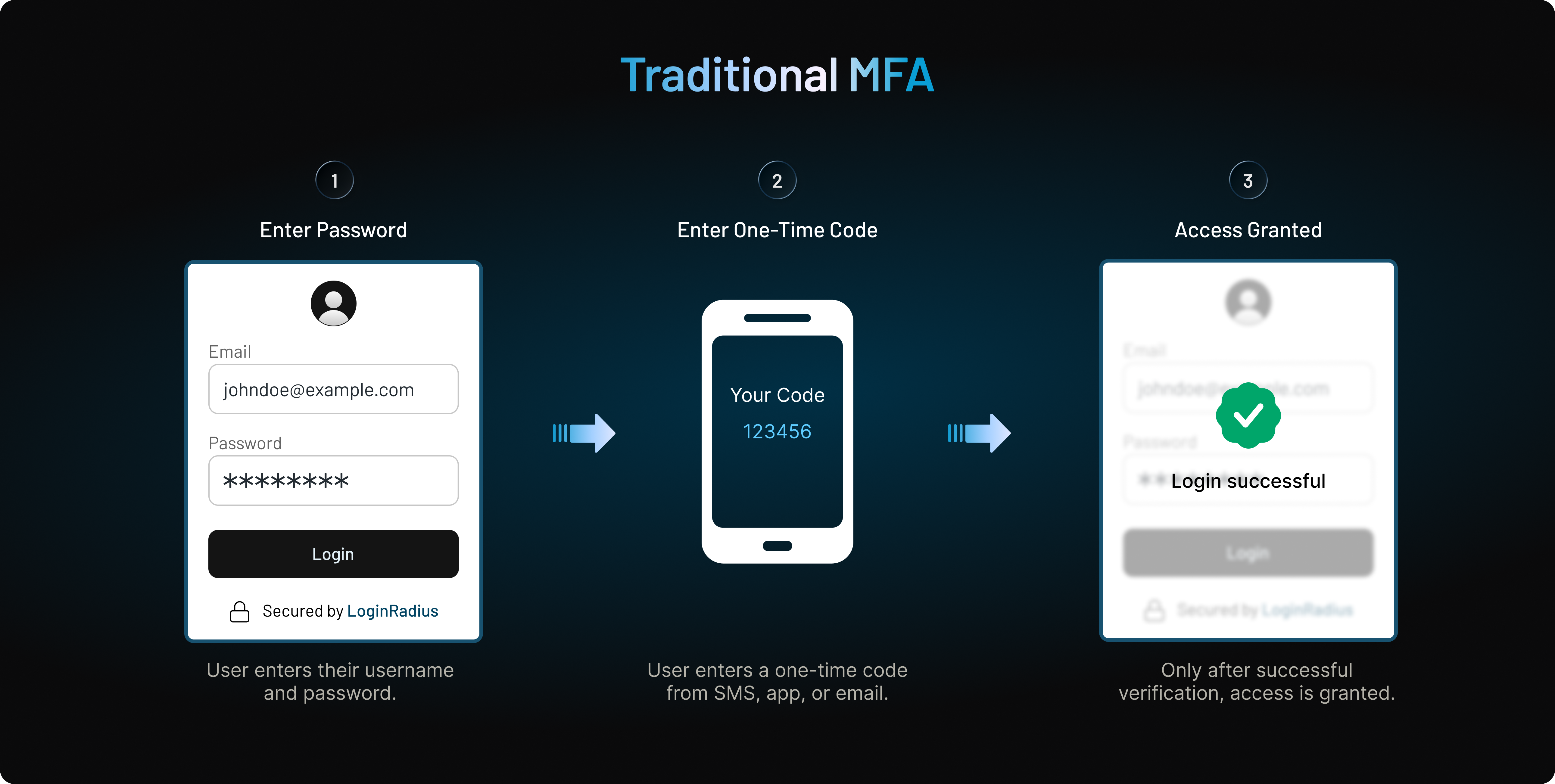
Traditional Multi-Factor Authentication (MFA) is the classic model most people know: you enter your password… then you enter a one-time code… and only then do you get in. It adds a second layer of security beyond the password, but it applies this same step to everyone every time. No intelligence. No context. No awareness of risk.

At its core, traditional MFA relies on combining:

  • Something you know → a password

  • Something you have → OTP, authenticator app, SMS code, email link

  • Something you are → biometrics (in some cases)

Traditional MFA supports multiple types of mfa, depending on the second factor used. In practice, most teams standardize a few multi factor authentication methods that balance usability, cost, and attack resistance across user segments.

And while this approach has helped reduce password-related breaches, it comes with friction and predictable patterns that attackers have learned to exploit.

How Traditional MFA Works?

The flow is fixed and static:

  1. User enters a username and password

  2. System sends a second factor (SMS OTP, authenticator app code, email OTP, push notification)

  3. User enters/approves the second factor

  4. Access granted

Whether you’re logging in from your personal laptop at home or a suspicious device in another country, traditional MFA still forces the exact same verification steps.

Why Traditional MFA Became So Popular

Traditional MFA exploded in adoption because:

  • It was easy to understand

  • Easy to roll out

  • Familiar to users

  • Supported by all major apps and platforms

  • Stronger than passwords alone

For years, this was the go-to method for boosting account security across banks, SaaS platforms, shopping apps, and employee portals.

Traditional MFA vs Adaptive MFA

These are common mfa methods used across consumer apps and enterprise platforms, and they also represent the baseline most mfa solutions offer out of the box.

Real-World Examples of Traditional MFA

Example 1: SMS OTP for Online Banking

You log into your banking app → it sends a 6-digit SMS code → you enter it → done. This is traditional MFA at its simplest. Effective, but vulnerable to SIM-swap attacks.

Example 2: Email OTP for eCommerce Checkout

An online shop sends you a verification code to confirm a purchase. Fast but easy for attackers to intercept if your email is compromised.

Example 3: TOTP Code on Google Authenticator

You open an authenticator app → copy the 6-digit rotating code → paste it to log in. More secure than SMS, but still a static step applied to everyone equally.

Limitations of Traditional MFA

While traditional MFA adds a crucial layer of protection, it has clear drawbacks:

  • Same experience for all users Whether the user is high-risk or low-risk, the system can’t tell the difference.

  • Friction-heavy login flow OTP fatigue, app switching, and slow SMS delivery cause abandonment.

  • Vulnerable to modern attacks Attackers now bypass static MFA using:

    • Man-in-the-middle phishing kits

    • SIM-swaps

    • OTP interception

    • Real-time phishing proxies

  • No contextual intelligence The system does not check device trust, behavior patterns, IP reputation, or anomalies.

This is why static MFA is struggling to keep up in today’s threat landscape—leading organizations to adopt more intelligent and adaptive models.

Also read: Explore the key benefits of MFA

What Is Adaptive MFA?

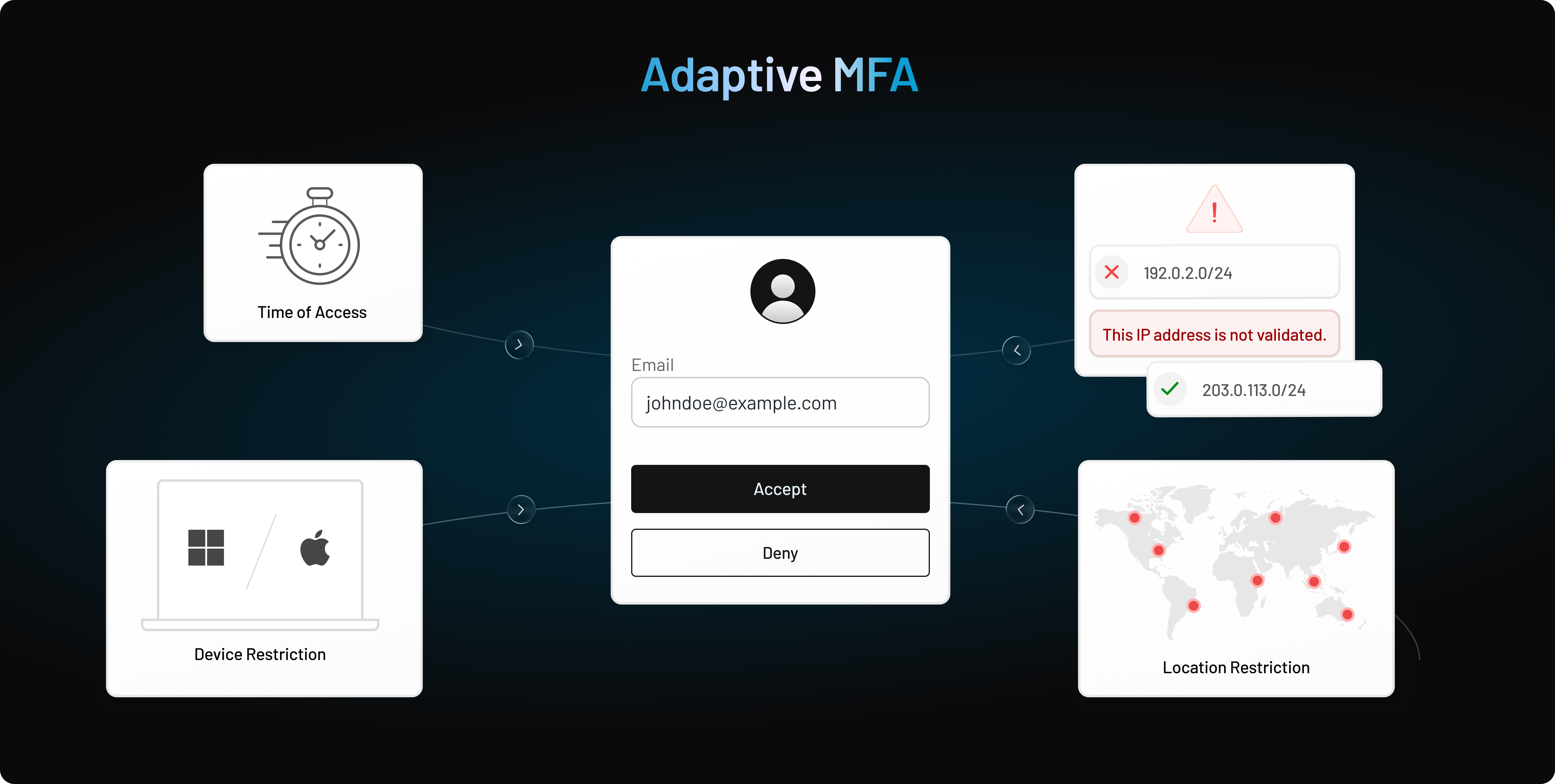
Traditional MFA treats every login the same. Adaptive Multi-Factor Authentication (Adaptive MFA) does the opposite; it adjusts authentication requirements based on how risky the login attempt appears.

Adaptive MFA is a modern form of adaptive multi factor authentication where authentication requirements change based on risk signals like device trust, location anomalies, IP reputation, and behavioral deviations. This is why the concept is frequently grouped under adaptive authentication, because the system “learns” what normal looks like and responds dynamically.

Instead of forcing every user to enter an OTP, Adaptive MFA analyzes context, user behavior, device trust, and real-time risk before deciding whether to challenge the user or let them in seamlessly.

Think of it as an authentication system that doesn’t just ask, “Do you have the right password?” It also asks, “Does this login look normal for this user?”

It’s intelligent, flexible, and built for modern CIAM platforms where friction can cost conversions and poor protection can lead to account takeovers.

How Adaptive MFA Works?

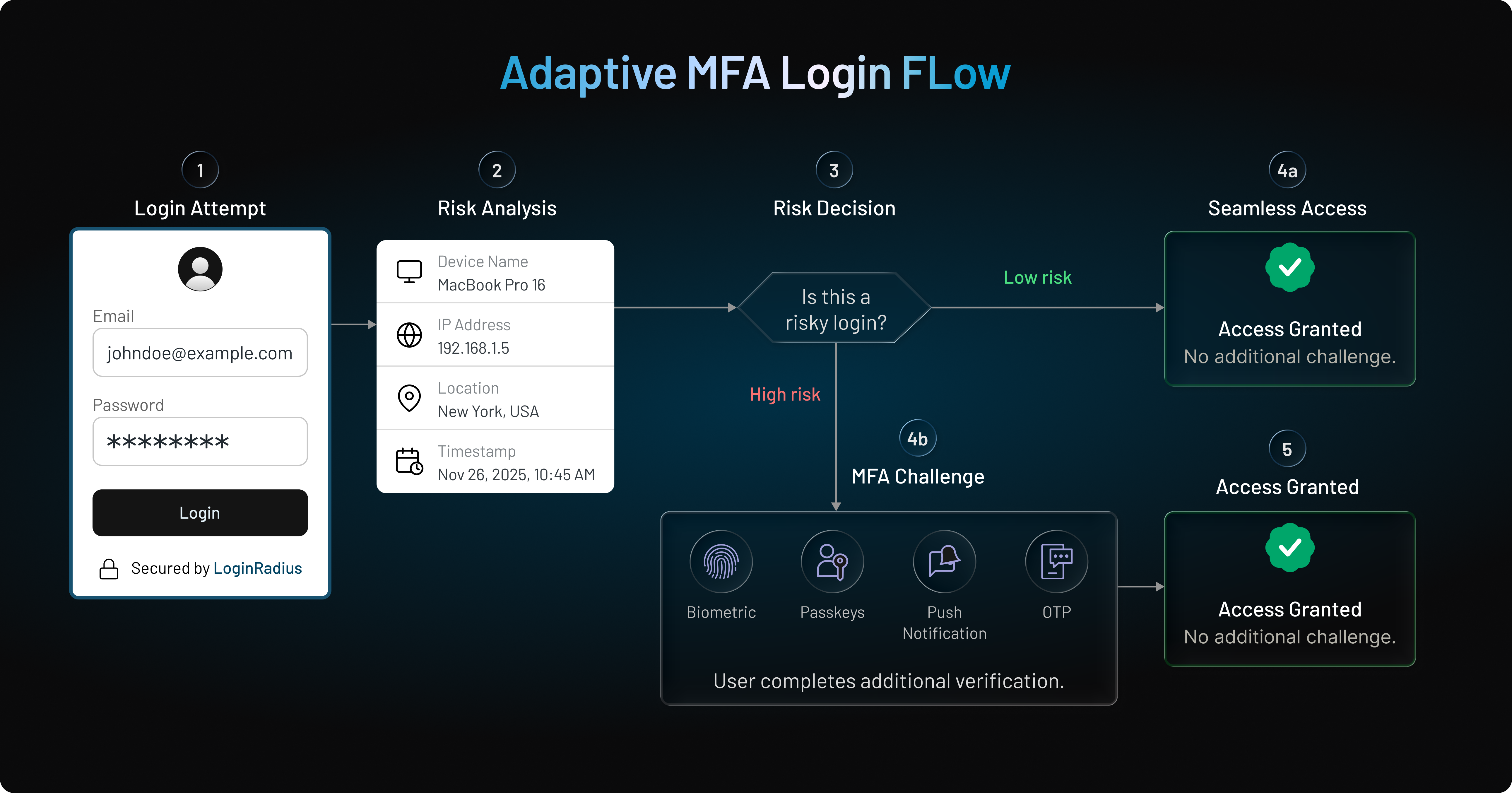
Adaptive MFA takes everything traditional MFA does and makes it smarter, faster, and more responsive. Instead of applying the same second factor to every login, Adaptive MFA evaluates risk signals in real time and adjusts the authentication process based on what it learns. Every login attempt becomes a mini security investigation happening in milliseconds.

It’s authentication that thinks before it challenges. And that’s exactly what modern CIAM environments need.

The Adaptive MFA Flow

Here’s how it works in practice:

Step 1: User Initiates Login

The user enters their credentials or begins a passwordless flow. Nothing unusual yet, just the start of a normal login attempt.

Step 2: Risk Engine Analyzes the Attempt

This is the heart of what is adaptive authentication: using context and threat signals to decide whether MFA is necessary, and if so, which factor is best for that moment.

This is where Adaptive MFA becomes powerful.

It evaluates signals such as:

  • Device fingerprint (Is this a trusted or new device?)

  • Location pattern (Is the user logging in from their usual region?)

  • IP reputation (Has this IP been flagged for abuse?)

  • Network trust (Public Wi-Fi, OR browser, VPN?)

  • Behavioral patterns (Is the user moving or typing differently?)

  • Login time consistency (Is this a usual login time?)

  • Threat intelligence feeds (Are bots involved?)

Each signal contributes to a risk score.

Step 3: System Assigns a Real-Time Risk Score

The authentication engine decides whether the login looks safe, suspicious, or outright malicious.

  • Low-risk → Fast, frictionless access

  • Medium-risk → Silent or passive checks

  • High-risk → Step-up authentication

  • Very high-risk → Deny the attempt

This is the opposite of traditional MFA, where everyone goes through the same steps regardless of risk.

Step 4: Adaptive MFA Responds Intelligently

The system adapts the authentication flow based on that risk score:

  • Seamless Login: If everything looks normal, the user gets in instantly no OTPs, no push delays.

  • Silent Checks: The system may perform extra background verification (like IP risk reevaluation).

  • Step-Up Authentication: When suspicious behavior is detected, the user must verify with TOTP, push, biometrics, or a security key.

  • Blocked Attempt: High-risk or malicious behavior is stopped before the login completes.

This provides security exactly when needed and stays invisible when not.
Real-World Examples of Adaptive MFA

Example 1: Logging In From Your Trusted Laptop at Home

You’ve logged in from this device 20 times in the past month.

Location matches your usual city. IP is clean.

Behavior is normal.

Adaptive MFA: “Low risk. No need for an OTP.”

You log in instantly, with no friction.

Example 2: Logging In From a New Device in a New Country

You’re in Singapore today, but you logged in from Canada two hours ago.

This looks like impossible travel.

IP reputation is medium risk.

Device unknown.

Adaptive MFA: “High risk. Trigger step-up authentication.”

The system requires biometric authentication or a security key.

Why Adaptive MFA Matters Today

Threats have shifted. Attackers now use real-time phishing kits, proxy tools, OTP bypass malware, and AI-driven attack automation. Traditional MFA cannot respond dynamically. Adaptive MFA can.

At the same time, customers are more impatient than ever. OTP delays, app switching, and friction lead to massive abandonment. Adaptive MFA solves this by reducing unnecessary steps for trusted users while increasing security controls only when real threats appear.

It delivers the perfect balance:

  • Stronger security

  • Less friction

  • Better conversions

  • Lower support load

Exactly what a modern CIAM platform needs.

Smart ADaptive MFA

Adaptive MFA vs Traditional MFA: Security Comparison

Security is where the difference between Adaptive MFA and Traditional MFA becomes impossible to ignore. While both offer protection beyond passwords, their ability to defend against modern attacks is vastly different. Traditional MFA adds a second step. Adaptive MFA adds intelligence.
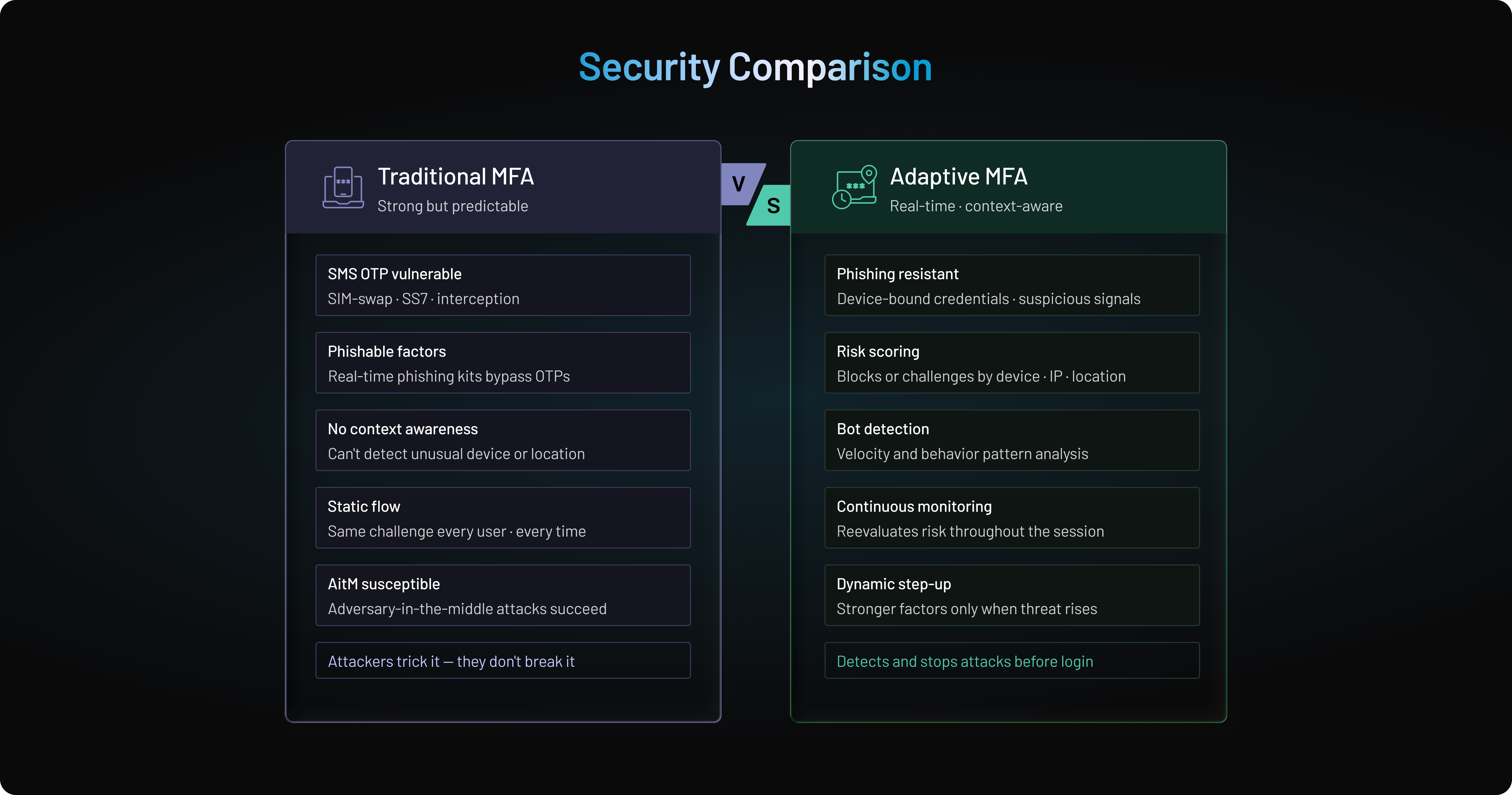
Traditional MFA Security: Strong but Predictable

Traditional MFA blocks many basic attacks such as password spraying, simple credential theft, and low-effort breaches. But because the flow is static, attackers have learned how to exploit it.

Weaknesses include:

  • SMS OTP Vulnerabilities: SIM-swaps, SS7 attacks, OTP interception

  • Phishable Factors: Real-time phishing kits bypass OTPs easily

  • No Context Awareness: It can’t detect unusual devices or locations

  • Static Flow: Same challenge for every user, every time

  • Susceptible to AitM (Adversary-in-the-Middle) Attacks

Attackers don’t need to break MFA; they just need to trick it.

Adaptive MFA Security: Real-Time, Context-Aware Defense

Adaptive MFA evaluates context, behavior, and risk before it even decides which security method to use. This makes it significantly harder to manipulate.

Key advantages:

  • Phishing Resistance: Recognizes device-bound credentials & suspicious behavior

  • Risk Scoring: Blocks or challenges based on device, IP, location, and threat data

  • Bot Detection: Identifies automated attacks using velocity & behavior patterns

  • Continuous Monitoring: Doesn't trust a session forever—reevaluates risk

  • Dynamic Step-Up: Uses stronger factors only when the threat level rises

This means Adaptive MFA can detect and stop attacks before the user even sees a login screen.

Adaptive MFA and MFA Comparison

Adaptive MFA vs Traditional MFA: User Experience Comparison

Security is critical but for customer-facing apps, user experience can make or break growth. This is exactly where Adaptive MFA creates a major advantage.

While Traditional MFA adds the same step for everyone, Adaptive MFA adjusts authentication based on trust, making the login journey smoother for legitimate users.
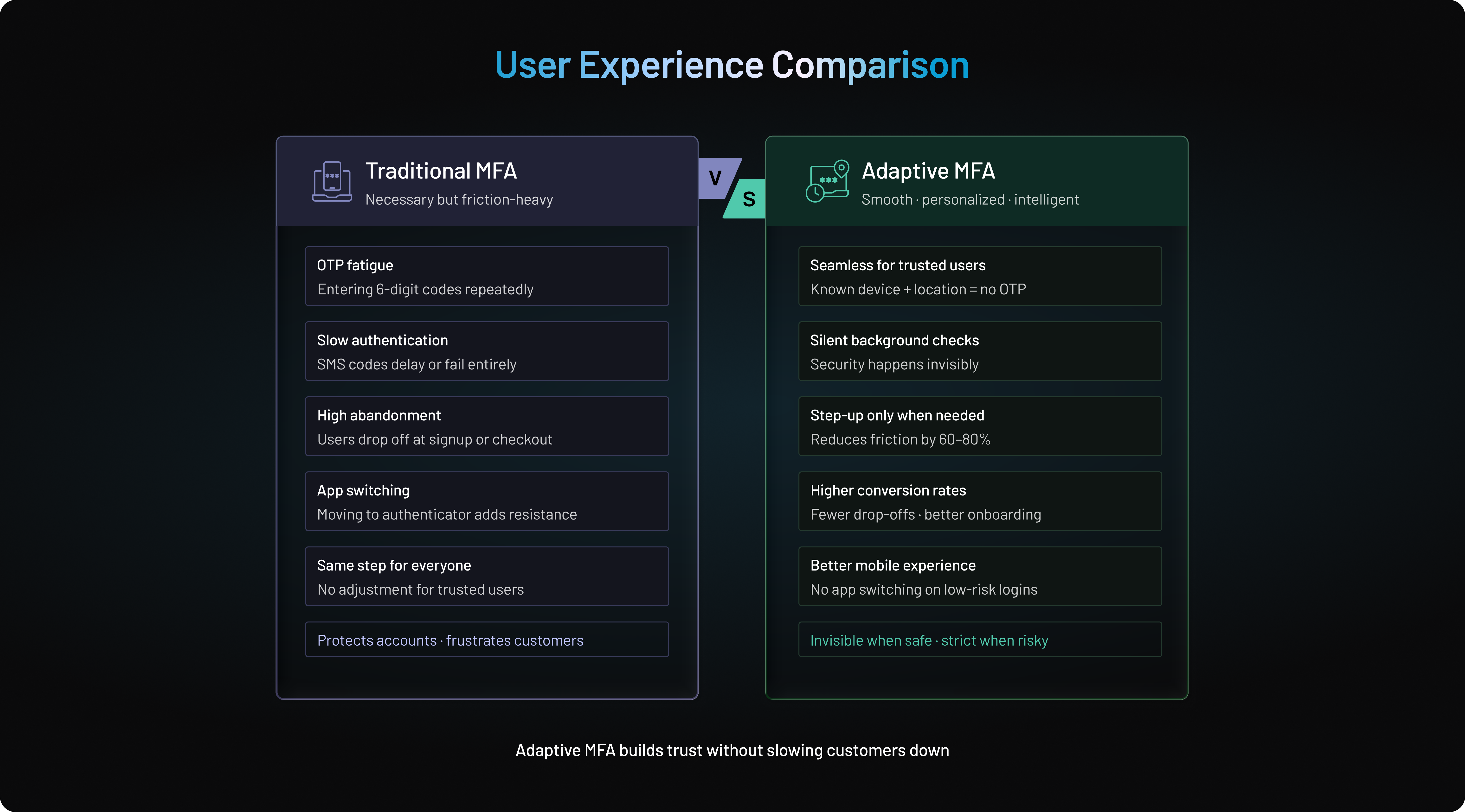
Traditional MFA UX: Necessary But Friction-Heavy

Traditional MFA forces all users into the same second step, even when the login attempt is completely safe. This leads to:

  • OTP fatigue Users get tired of entering 6-digit codes over and over.

  • Slow authentication SMS codes may delay or fail entirely.

  • High abandonment Many users drop off during signup or checkout if MFA feels tedious.

  • App switching Moving between apps (e.g., to Google Authenticator) adds resistance.

Traditional MFA protects accounts, but it often frustrates users especially in CIAM environments where millions of customers interact daily.

Adaptive MFA UX: Smooth, Personalized, and Intelligent

Adaptive MFA transforms the login flow into a user-friendly experience by challenging only when needed.

Here’s how it improves UX:

  • Seamless Logins for Trusted Users Known device + familiar location + normal behavior = no OTP required.

  • Silent, Background Verification Users don’t even notice security checks happening behind the scenes.

  • Step-Up Only When Risk Is High Reduces unnecessary friction by 60–80%.

  • Higher Conversion Rates & Fewer Drop-Offs Especially valuable for eCommerce, SaaS onboarding, and mobile apps.

  • Better Mobile Experience No app switching or copy-pasting codes for low-risk logins.

Adaptive MFA feels “invisible” to users when everything looks normal and “strict” when something seems risky. This balance builds trust without slowing people down.

Cost & Operational Comparison: Adaptive MFA vs Traditional MFA

Cost is one of the most overlooked but most decisive factors when choosing an authentication method. While both Adaptive MFA and Traditional MFA help secure accounts, their long-term operational impact is dramatically different.

Traditional MFA tends to look cheaper upfront, but it creates hidden costs over time. Adaptive MFA requires slightly more intelligence at the start, but it saves organizations money in the long run by reducing support needs, preventing fraud, and improving conversion.

Let’s break it down clearly.

Traditional MFA Costs: Lower Setup, Higher Operations

At first glance, Traditional MFA seems simple and cost-effective to implement. But because it challenges every user equally, it often increases operational and user-related expenses.

Where Traditional MFA Gets Expensive

  • SMS OTP Delivery Costs For large user bases, global SMS delivery becomes expensive fast, especially with international rates.

  • Support Tickets for OTP Failures Users frequently run into issues: “Didn’t receive the OTP,” “Authenticator app not working,” “Lost device.” These requests increase the support workload.

  • Friction → Lower Conversion Rates Every extra step in the login flow pushes users away—impacting revenue for eCommerce, SaaS, and consumer apps.

  • Higher Fraud Recovery Costs Static MFA is easier to bypass through real-time phishing or SIM-swaps, leading to expensive remediation.

Traditional MFA may start inexpensive, but for high-volume consumer environments, the operational costs quickly stack up.

Adaptive MFA Costs: Higher Intelligence, Lower Long-Term Spend

Adaptive MFA requires risk-based logic, device intelligence, and contextual analysis but this investment pays off.

Where Adaptive MFA Saves Money

  • Fewer OTPs = Lower SMS and Infrastructure Costs Because low-risk users skip step-up authentication, you send fewer OTPs, significantly cutting SMS delivery costs.

  • Massively Reduced Support Tickets No more constant OTP failures, app-sync issues, or “I didn’t get the code” problems.

  • Higher Conversion & Lower Drop-Offs Seamless login reduces friction, improves user experience, and keeps users from abandoning flows.

  • Better Fraud Prevention = Lower Remediation Costs Adaptive MFA blocks risky logins before they happen, reducing financial impact from account takeovers.

  • Scales Efficiently for CIAM Dynamic checks mean fewer manual interventions and reduced strain on backend systems.

Adaptive MFA is not just more secure it is more cost-efficient, especially for large-scale consumer identity platforms.

When Traditional MFA Is Enough

While Adaptive MFA is clearly the more advanced authentication method, Traditional MFA still has a place, especially for environments where simplicity matters more than dynamic intelligence. The key is understanding where predictable, fixed authentication steps are acceptable and where they’re not.

Traditional MFA works well in scenarios where risk is low, user volume is controlled, and friction is manageable.

Best Scenarios for Traditional MFA

1. Internal Workforce Applications

For small or mid-size teams logging into internal tools, traditional MFA is often sufficient. The user environment is familiar, controlled, and predictable. The friction created by OTP or authenticator apps is generally acceptable in an employee setting.

2. Low-Risk Applications

If an application doesn’t handle sensitive data and the impact of account compromise is low, static MFA can be a simple and effective security layer without requiring complex risk analysis.

3. Limited User Base or Small Apps

For startups, pilot projects, or tools with only a few dozen or few hundred users, the cost and complexity of deploying Adaptive MFA may not yet be necessary. Traditional MFA offers a quick and affordable security upgrade.

4. Compliance-Driven Environments

Some regulatory frameworks simply require MFA, not risk-based authentication. In such cases, traditional MFA meets the minimum compliance requirements without additional overhead.

5. Environments Where User Experience Is Not the Top Priority

Internal admin portals, controlled-access apps, or systems used by trained professionals can tolerate the friction of static MFA. If the user experience is less critical than access control, traditional MFA can be enough.

Traditional MFA Is Still Valuable, Just Not Everywhere

Traditional MFA remains meaningful for specific use cases, but it struggles in customer-facing, high-traffic, global environments where friction, SMS failures, and modern attack patterns create bigger issues. For those environments, Adaptive MFA offers a smarter, more scalable solution.

When Adaptive MFA Is the Better Choice

Adaptive MFA becomes the clear winner in any environment where security must be intelligent, and user experience must remain smooth. For modern CIAM—where millions of customers log in from different devices, regions, and networks adaptive authentication isn’t just an upgrade; it’s a necessity.

Here are the scenarios where Adaptive MFA delivers the greatest value.

1. High-Traffic Customer Applications (CIAM)

Consumer-facing platforms eCommerce, media, gaming, travel, streaming cannot afford friction. OTP delays or repeated MFA prompts directly impact revenue and user satisfaction.

Adaptive MFA ensures:

  • seamless login for trusted users

  • step up only when risk is detected

  • fewer drop-offs and authentication failures

Perfect for large user bases where UX and security need to coexist.

2. Apps Targeted by Modern Threats

If your application faces:

  • phishing campaigns

  • credential stuffing

  • bot attacks

  • real-time MFA bypass tools

  • automated session hijacking

Then traditional MFA simply isn’t enough. Adaptive MFA’s risk scoring and contextual intelligence significantly reduce account takeover risks.

3. Global or Mobile-Heavy User Bases

Users log in from different devices, networks, and regions. Adaptive MFA shines by adjusting to each user's context:

  • Public Wi-Fi? → Stronger checks

  • Same home device? → Seamless login

  • New IP or country? → Step-up auth

  • Normal behavior? → Skip MFA

This flexibility is essential for global delivery.

4. Industries With Sensitive or Regulated Data

Industries that cannot afford compromised accounts:

  • Banking and fintech

  • Healthcare (PHI / HIPAA)

  • Government and public-sector apps

  • Education systems

  • SaaS platforms with admin access

Adaptive MFA offers the highest level of contextual protection with minimal disruption.

5. Businesses Prioritizing Conversion & Retention

Every additional login step affects:

  • sign-up completion

  • checkout success

  • returning user engagement

  • subscription renewals

Adaptive MFA reduces customer friction by removing unnecessary OTP flows for low-risk users while protecting businesses from fraud-related losses.

6. Organizations Moving Toward Zero Trust & Identity-First Security

Zero trust demands continuous verification, not one-time checks. Adaptive MFA fulfills this by analyzing risk throughout the session, not just at login. Traditional MFA cannot meet zero-trust requirements effectively.

Adaptive MFA Is Ideal When…

You serve millions of customers. You care about fast login & conversion rates You face modern threats. You operate globally You handle sensitive data. You follow zero-trust or identity-first security principles.

Wherever security and UX need to coexist, Adaptive MFA wins every time.

CIAM Perspective: Why Adaptive MFA Is Becoming the Standard

From a CIAM (Customer Identity and Access Management) standpoint, Adaptive MFA is no longer a “nice-to-have.” It has become the core of how modern digital platforms balance airtight security with frictionless customer experiences.

Traditional MFA worked well when threat patterns were simpler and user expectations were lower. But today’s CIAM needs to demand far more intelligence, personalization, and real-time decisioning.

Adaptive MFA delivers exactly that, making it the new standard for customer identity platforms across industries.

Security Alone Isn’t Enough. CIAM Must Also Protect User Experience

In customer environments, every extra second counts. A delayed OTP, a failed push notification, or an unnecessary MFA prompt can cause:

  • Abandoned sign-ups

  • Dropped logins

  • Checkout failures

  • Lost revenue

  • Poor user satisfaction

Adaptive MFA recognizes this and ensures low-risk users glide through login without friction, while high-risk scenarios receive stronger authentication. It’s a balance that traditional MFA simply cannot offer.

Adaptive MFA Reduces Account Takeovers at Scale

Consumer apps are high-value targets for attackers. Credential stuffing, phishing campaigns, device fraud, OTP interception these attacks hit millions of accounts at once.

Traditional MFA reacts the same way to all attempts. Adaptive MFA predicts and responds based on risk.

With contextual checks and behavioral analytics, Adaptive MFA:

  • Blocks automated bot attacks

  • Detects unusual travel patterns

  • Flags suspicious devices or IPs

  • Differentiates legitimate users from attackers

This proactive defense model aligns perfectly with CIAM requirements.

Global User Bases Need Dynamic Authentication

Customer-facing platforms often serve:

  • Users across multiple countries

  • Hundreds of device types

  • Varied network conditions

  • Different security expectations

Traditional MFA breaks under this complexity.

Adaptive MFA thrives in it by adjusting authentication based on:

  • Region

  • Network quality

  • Local regulations

  • Device capabilities

  • Risk levels

This makes it ideal for multinational brands, global eCommerce, and high-growth SaaS.

Aligns Perfectly With Zero Trust and Identity-First Security

Modern CIAM strategies increasingly lean toward zero trust, where identity not the network is the new security perimeter.

Adaptive MFA fits naturally into this model because it:

  • Continuously evaluates risk

  • Never assumes trust

  • Validates behavior during the session

  • Detects anomalies instantly

Traditional MFA authenticates a user once and assumes trust afterward—which is no longer acceptable in modern environments.

Better Conversion, Higher Retention, and Stronger Brand Trust

From the CIAM perspective, authentication is not just a security step; it’s a business driver.

The login experience influences:

  • Customer loyalty

  • User satisfaction

  • App engagement

  • Conversion rates

  • Revenue performance

Adaptive MFA removes unnecessary friction without weakening security creating a login journey that users actually enjoy.
Role of MFA

Platforms that adopt adaptive MFA are perceived as:

  • More secure

  • More reliable

  • More user-friendly

This builds long-term brand trust and strengthens the customer relationship.

If you’re selecting between mfa solutions, your choice comes down to whether you need static enforcement across all logins or adaptive decisioning that optimizes security and UX in adaptive MFA vs MFA comparisons.

Decision Framework: Adaptive MFA or Traditional MFA?

Deciding between Adaptive MFA and Traditional MFA depends on your security requirements, user experience goals, application scale, and threat landscape. Traditional MFA is predictable and simple, while Adaptive MFA is intelligent and designed for modern CIAM environments where friction, global usage, and advanced threats are real concerns.

Below is a clear decision framework to help you choose the right approach.

Comparison Table: Adaptive MFA vs Traditional MFA

CategoryTraditional MFAAdaptive MFA
Authentication FlowStatic, same steps for every userDynamic, risk-based & context-aware
User ExperienceHigher friction (OTP every time)Low friction (step-up only when needed)
Security LevelGood, but predictableExceptional, with real-time risk analysis
Resilience to Modern AttacksWeak against phishing, SIM-swaps, AitMStrong phishing resistance, anomaly detection
Risk ScoringNot availableCore feature, evaluates every login
Behavioral AnalysisNoneEvaluates deviations in behavior & patterns
Device & IP IntelligenceNot includedDeep device fingerprinting, IP reputation checks
Scalability for CIAMStruggles at high scaleBuilt for millions of users & global traffic
Conversion ImpactHigh drop-offs due to OTP fatigueHigher conversion = fewer interruptions
Cost EfficiencyHigher long-term costs (SMS OTP, support tickets)Lower operational costs, fewer support needs
Compliance AlignmentMeets minimum MFA standardsAligns with modern identity-first + zero-trust frameworks
Ideal Use CaseWorkforce tools, low-risk appsCustomer-facing apps, high-risk use cases, global platforms
Friction ControlNo control same for all usersPersonalized friction based on trust & context
Bot & Credential-Stuffing DefenseLimited protectionStrong detection via risk analysis
Session IntelligenceNoneContinuous monitoring & anomaly detection
Future-ReadinessOutdated in the evolving threat landscapeModern, AI-ready model for CIAM

How to Choose Out Of The Two:

Choose Traditional MFA if:

  • Your app has a small user base

  • Users are internal employees

  • Friction is acceptable

  • You only need to meet basic compliance requirements

  • Threat levels are low

  • You prefer a simple static flow

Choose Adaptive MFA if:

  • You serve millions of customers

  • Your platform is global and mobile-heavy

  • You face modern attacks: phishing, bots, credential stuffing

  • You want frictionless login experiences

  • UX, conversion, and retention matter

  • You follow zero-trust or identity-first security

  • You want to reduce SMS + support costs

  • You want security that scales intelligently

Conclusion

The way users authenticate has fundamentally changed. Traditional MFA played an important role in strengthening security beyond passwords, but digital threats have evolved, and so have user expectations.

Today’s customers want fast, seamless experiences, while organizations need stronger, more intelligent protection against increasingly sophisticated attacks. Adaptive Multi-Factor Authentication delivers exactly that.

By combining risk scoring, contextual intelligence, behavioral analysis, device trust, and real-time threat signals, Adaptive MFA creates a security model that adapts to each individual login attempt.

It protects users before a threat becomes dangerous and stays invisible when everything looks safe. This is the level of intelligence modern CIAM platforms demand.

Traditional MFA still has its place, especially in smaller, lower-risk environments, but it cannot match the balance of security, scalability, and low friction that Adaptive MFA offers. For high-traffic consumer applications, global user bases, enterprise SaaS platforms, and any business operating in a zero-trust or identity-first environment, Adaptive MFA is no longer optional. It’s the new standard.

Choosing Adaptive MFA doesn’t just improve security; it improves the entire user journey. It boosts login success rates, reduces abandonment, lowers support volume, and builds deeper trust with your customers. In the long run, it leads to a platform that is more secure, more resilient, and far more user-friendly.

If you want an authentication experience that feels effortless for users and uncompromising for attackers, Adaptive MFA is the clear winner.

Ready to Deliver Smarter, Context-Aware Authentication?

Your customers deserve an authentication system that’s as smart and dynamic as the threats they face. Book a Live Demo to see Adaptive MFA in action. Explore LoginRadius CIAM to build secure, frictionless identity journeys.

FAQs

Q: What is the main difference between traditional MFA and adaptive MFA?

A: Traditional MFA applies the same step-up challenge to every login, while adaptive MFA evaluates risk signals (device, IP, behavior, location) in real time and only challenges when needed. That makes adaptive MFA both smarter and more context-aware than static MFA.

Q: When should I choose adaptive MFA vs MFA for my applications?

A: Choose adaptive MFA when you have high login volumes, mixed-risk user groups, or sensitive data and want strong security without constant friction. Standard MFA is fine for smaller, low-risk apps, but adaptive MFA is better for modern CIAM and Zero Trust architectures.

Q: Does adaptive MFA really reduce user friction compared to traditional MFA?

A: Yes. With adaptive MFA, low-risk logins often pass with silent checks, while only risky sessions see extra prompts. Users experience fewer MFA challenges overall, improving authentication UX and conversion rates without weakening protection.

Q: Is adaptive MFA more secure than regular MFA?

A: Adaptive MFA adds an extra defense layer by combining MFA factors with continuous risk scoring, anomaly detection, and policy controls. This makes it more effective than traditional MFA alone at catching account takeover attempts, MFA fatigue attacks, and other modern threats.

book-a-free-demo-loginradius

Kundan Singh
By Kundan SinghDirector of Product Development @ LoginRadius.
Featured Posts

Adaptive MFA vs MFA: The Smarter Choice for Modern Security

Security Keys vs TOTP vs Push: Which Authentication Method Is the Strongest?

2FA Benefits & Risks: Real Tradeoffs Behind Modern Authentication

Beginner’s Guide to Authentication and Authorization in Digital Security

A Complete Guide to Adaptive MFA for Modern CIAM

What Is OTP?

The Rise of Agentic IAM: Securing Agents Before They Go Rogue

What Is Single Sign-On (SSO)?

Your Identity Security Playbook: Stop Fraud, Catch Threats, and Make Customers Love Your Security

Passwordless & MFA in 2026: Passkeys, Push MFA, Device Trust, and Continuous Authentication

What Is Biometric Security?

What Is Device ID?

What Is Dynamic Access Control?

What Is 2FA and How It Works: Guide to Modern Authentication

What Is SMART on FHIR?

2FA in 2025: How Leading Providers Keep Digital Identities Safe

What Is a YubiKey?

Biometric Authentication Methods: How They Work & When to Use Them

Compliance Management: Processes, Systems & Best Practices

RBAC and Access Management: The Foundation of Secure IAM

How Does SAML Authentication Work?

ID Token vs. Access Token: Understand the Difference

AI-Driven Fraud Detection: The Future of Digital Trust

OIDC Authentication: How Modern Apps Verify Identity

A Complete Guide to 2FA Authentication in 2025: Methods, Risks, and Modern Best Practices

Cybersecurity Awareness Month 2025: Why Businesses Can’t Afford to Look Away

Secure Customer Experiences with Phone Authentication: Why Mobile Matters

Best Descope CIAM Alternatives in 2025

Passwordless Login: Technical Workflows, Business ROI, and Regional Adoption

Top 10 Frontegg Alternatives to Consider in 2025

Identity and Access Management in Banking: Why It’s Crucial for Security and Customer Experience

Top 10 FusionAuth Alternatives in 2025

Unlocking Secure Digital Experiences with Authorization as a Service

CIAM Platform Integrations: The Key to a Strong Customer Identity Strategy

Email is Hacked! 7 Immediate Steps to Follow

Data Governance in Healthcare: Best Practices & Future Trends

Why Social Login is a Game-Changer for eCommerce Login

Top WordPress Social Plugin Picks for Seamless Logins

Why Privacy-First Companies Choose Canada for Data Storage

Top Auth0 Alternatives for 2025: Simpler, Faster, and More Flexible CIAM Options

What Are Digital Certificates and How Do They Secure the Web

Why Hosting Your CIAM Solution in a Canadian Data Center Gives You the Edge

B2B IAM vs Workforce IAM: What Enterprises Must Know

Access Control in Security: What It Is and Why It Matters

The Making of The Power of Digital Identity: A Candid Interview with Rakesh Soni

What is Certificate-Based Authentication and Why It’s Used

6 Key Ecommerce Challenges in 2025 (And How CIAM Solves Them)

B2B vs B2C Authentication- A Quick Guide

Password Best Practices for Stronger Security

Building Community Beyond Borders: Our Thailand Story

1FA vs 2FA vs MFA: Which Method Secures You Best?

B2B IAM Best Practices and Architecture Guide

Adding Partner IAM With LoginRadius: A Complete Guide to B2B Identity Management

What is User Authentication, and Why is it Important?

What is Partner IAM / B2B IAM - A Complete Guide

Still Bending Workforce IAM for Your B2B Networks? Introducing LoginRadius Partner IAM—Built from the Ground Up

What is Biometric Authentication and How It's Changing Login

Location-Based Data Residency Boosts Trust and Conversions

The Impact of AI on Cybersecurity

PINs vs Passwords: Which is More Secure?

Why Global Businesses Trust Canada for Data Hosting Services

Passkeys vs Passwords: The Upgrade Your Security Needs

What is the Best Way to Authenticate Users?

Canada as a Global Hub for Privacy-First CIAM Platforms

How to Choose a Strong Password- A Quick Guide

A Complete Guide to Device Authentication Methods

What is a One-Time Password (OTP) ? – A Complete Guide

A Quick Guide to Username and Password Authentication

Types of Authentication and Identity Verification

What is Strong Authentication in Cybersecurity?

Top 9 User Authentication Methods to Stay Secure in 2025

Authentication vs Authorization: Key Differences, Real Examples & Best Practices

Guide to Authentication Methods & Choosing the Right One

Identification and Authentication: A Quick Comparison

Understanding Authentication, Authorization, and Encryption

Introducing the LoginRadius Trust Center: Always Up-to-Date and at Your Fingertips

What is Token Authentication and How Does It Work?

What is OTP Authentication and How Does it Work?

What is Role-Based Access Control (RBAC)?

LoginRadius Launches Next-Generation CIAM Console: Self-Serve, No-Code, and Built for Speed

Quick Guide to Single-factor, Two-factor, and Multi-factor Authentication

Democratizing Authentication: Introducing LoginRadius' Free Forever Developer Plan

Mobile Authentication: Everything You Need to Know

What is Push Notification Authentication and How It Works?

Code Less, Build More: Unveiling LoginRadius' AI-Powered Developer Documentation

Types of Multi Factor Authentication & How to Pick the Best

Risk-Based Authentication vs. MFA: Key Differences Explained

Revamped & Ready: Introducing the New Developer-First LoginRadius Website

What is SCIM? A Developer's Guide to Understanding and Using SCIM

RBAC vs ABAC: A Developer’s Guide to Choosing the Right Fit

CISOs’ Top Cybersecurity Threats 2025: Scattered Spider, Deepfakes, and More

LoginRadius 2024: A Year of CIAM Innovations

What is Passkey Authentication - A Complete Guide

How AI-Enabled Cybersecurity Solutions Are Strengthening Our Online Security

What is Identity Orchestration

LoginRadius Releases 2024 Consumer Identity Report, Highlights the Shifting Trends in Consumer Preferences

Celebrating 8th Year Milestone: How Our Collaboration with a Leading Healthcare Company Transformed Millions of Lives

Unlock Your Digital Freedom: How Automating Passwordless Authentication Can Transform Your Security

How To Secure GenAI by Implementing RBAC In The Enterprise

The Hidden Pitfalls: Why Most CIAM Systems Fail Under Pressure

No More Login Hassles: Effortless Migration to LoginRadius Awaits

How Cookie Management Supports GDPR and CCPA Compliance

LoginRadius Launches Identity Orchestration for Seamless Identity Workflows

Passkeys: Unlocking Benefits for a Better Online Shopping Experience

AI and the Changing Face of Enterprise Security Threats

Leading the Charge in Customer IAM: LoginRadius Recognized as an Overall Leader by KuppingerCole

Gearing Up for Better Customer Experiences? Choose No-Code Identity Orchestration

Announcement - LoginRadius Launches PassKeys to Redefine Authentication Security and User Experience

Decoding the Rise of Zero-Trust Adoption in Government Sector

Say Goodbye to Passwords: How Passkeys Are Reinventing Online Security

Announcement - LoginRadius Unveils the Future of Authentication with Push Notification MFA

Is Your CIAM Adapting to Global Needs? 6 Key Areas to Win Privacy-Concerned Customers

The Growing Threat of Identity-Based Attacks and the Need for an Advanced Identity Security Approach

How AI Is Changing the Game in User Authentication

eIDAS 2.0: The Digital Revolution Is Here – Is Your Business Ready to Comply?

A Quick Guide To Choosing The Right Zero Trust Vendor

Cloud Security Governance: Protecting Assets in the Digital Frontier

What is Silver SAML Vulnerability and How Can We Protect Our Digital Identities?

Identity Security for Device Trust: Navigating 2024 & Beyond

Exciting Leadership Updates Amid Strategic Growth at LoginRadius

From Past to Present: User Authentication's Evolution and Challenges

How Does Multi-Tenancy in Customer IAM Solutions Boost Security?

How No/Low Code CIAM Balances Security and User Engagement?

Beyond Passwords: Navigating Tomorrow's Authentication Landscape

How does identity management address the top 5 security challenges in B2B SaaS?

Reinforcing Security with Advanced Risk-Based Authentication in 2024 & Beyond

2FA vs MFA: Understanding the Differences

Okta Token Theft Implicated in Cloudflare's Security Breach

Voice OTP by LoginRadius: Revolutionizing Secure and Seamless User Authentication

Which is Safer: Biometric or Password?

7 Reasons to Use Biometric Authentication for Multi-Factor Authentication

Exploring Digital Identity Verification with Effective Crucial Data Checks

5 Reasons Why LoginRadius Leads the Way in the CIAM Landscape in 2024 & Beyond

Above the Horizon: Exploring the Power of a Strong Cloud Identity Platform

Streamlining Authentication: Elevate User Experience with LoginRadius AutoLookup

A Journey Through Our Top 10 Blogs from 2023

Now and Beyond- Staying Ahead with the 10 Key Cybersecurity Trends of 2024

B2B SaaS SSO Login: Exploring Enterprise Considerations in 2024

Securing Corporate Applications: A Comprehensive Guide to Enterprise Application Security

Strengthening Security Measures: The Role of Two-Factor Authentication (2FA)

Securing the Throne: Privileged Access Management (PAM) Best Practices Unveiled

7 Common Authentication Vulnerabilities to Steer Clear of

What is Identity Lifecycle Management?

Strengthening Security and Compliance: The Role of Identity Governance

Understanding the Okta Hack: Breach in Customer Support and Lessons for Organizations

Managing Generative AI Security Risks in the Enterprise- A Quick Guide

Empowering Your Security: Exploring the Advantages of Time-Based One-Time Passwords (TOTP)

The Future of Personalization: Embracing Zero-Party Data

Comprehensive Guide to Flexible CIAM Deployment Options with LoginRadius

Small Steps, Big Shields: Navigating Cybersecurity Awareness Month 2023 Safely

Streamlining Access with Converged Identity Platforms

How Retailers Can Balance Privacy While Foiling Thieves

The Power of No-code Customer IAM in Reducing Churn

CIAM: Enhancing Security & Building Consumer Trust-All At Once

Maintaining Trust: Customer Identity Verification Challenges & Best Practices

Unlocking Smartphone Security: How to Hackproof Your Smartphone

Phishing-Resistant MFA Login for Mobile Applications: Strategies and Challenges

True Passwordless Authentication: Stronger Defense Against Cyberattacks

Identity Governance vs. Identity Management: Navigating the Differences

Navigating Identity Verification Challenges in Regulated Industries: 7 Effective Solutions

Enhancing Security: Leveraging 5 Real-Time Techniques to Detect Phishing Attacks

A Comprehensive Guide to the Five A's of Cloud Identity Management

Understanding the Difference Between Identity Access Management On-Premise and Cloud

Learn the Impact of Identity Theft on Businesses in 2023

LDAP Authentication: Meaning and How it Works?

7 Things Your Security Team Need To Know Before Creating A CIAM Strategy

Choosing Between Self-Managed and Service-Based SSO Solutions: A Comprehensive Comparison

What is Cloud Identity and its Benefits?

The Legal Implications of SSO: Privacy, Security, and Compliance

Data Privacy Laws for 2023: A Closer Look at 9 Key Regulations

4 Reasons Why SSO Integrations Are a Must-Have For Online Businesses

Consumer vs. Enterprise: Navigating the Dual Nature of Digital Identity

LoginRadius Releases Consumer Identity Trend Report 2023, Highlights The Future of Customer Identity

What is a Password Vault and How Does it Work?

How a Culture of Identity Governance Empowers Digital Transformation?

Securing the Digital Frontier: The Power of AI in Next-Gen CIAM

Replatforming 101: Everything You Need to Know

Best Practices for Username and Password Authentication

The Ultimate Guide to Choosing the Right CIAM Solution

How to Use Identity Management at Every Stage of the Customer Journey?

Protecting Your Cloud Data: The Power of SaaS Security and IAM Governance

The Rise of Account Creation Fraud: What You Need to Know

Why Direct-to-Consumer (D2C) Businesses Must Take A Strategic Approach To CIAM?

What are Self-Sovereign Identities?

7 Uncommon Cyber Attacks in 2023: Why Your Organization Needs To Be Ready For The Worst-Case Scenarios

Identity Modernization: What Is It & Why Should You Care?

A Lot Can Happen In The Cloud: Multi-Cloud Environment and its Optimization Challenges

Can Security and User Experience Co-Exist in the Authenticating and Authorizing Space?

Business On The Move: How Just-in-Time Migrations Are Making Smooth CIAM Transitions

3 Digital Onboarding Trends To Watch In 2023 (And What You Can Do About It Now)

6 Tips to Prevent Accidental Data Exposure Within Your Company

Top Priorities for Customer IAM Leaders in 2023 and How to Prepare

Electronic Theatre Controls: A LoginRadius Customer Success Story

Distributed Multi-Cloud Identity Management and Its Endless Business Benefits

How The Age Of Smart Credentials Is Rewriting The Rules For Physical Verification?

Incident Response Vs. Disaster Recovery: What’s The Difference and Which Do You Need?

The Customer Experience is About to Get Even Better With Passive Authentication

What is Dynamic Authorization & Why Does it Matter?

What’s the Difference Between Attack Surface and Attack Vector?

How Identity-Based Access Ensures Robust Infrastructure Security Amidst the Growing Identity Crisis?

2FA Bypass Attacks- Everything You Should Know

IAM vs. Customer IAM: Understanding the Role of CIAM in Accelerating Business Growth

Why MFA Fatigue Attacks May Soon Be Your Worst Nightmare?

InfoSec Director, Alok Patidar Answers Your Most Difficult Questions on Cybersecurity

Understanding MITRE ATT&CK Framework?

Identity Fabric vs. Zero Trust: Is One a Better Alternative Than The Other?

The Role of Customer Identity Management in IoT Security: How It's a Must!

Securing Centralized Access Without Compromising User Experience

User Authentication in the Metaverse: What’s Changing?

LoginRadius Pledges To Raise Awareness This Cybersecurity Month

Public Cloud Risks - Is Your Organization Prepared for Cloud Threats?

What Brands Need to Know for Building the Future of Data Compliance?

Okta Identity Credentials on the Radar of Oktapus Phishing Campaign

BC Municipality Digitizes its Citizen Services. LoginRadius Brings Identity to the Table.

The Role of Customer Authentication in Paving the Way for Digital Agility

What Brands Need to Know for Building the Future of Data Compliance?

6 Alternative Authentication Methods For Your Online Customers

Implementing Zero Trust? Make Sure You're Doing It Correctly

What is Federated SSO (Single Sign-On)?

MFA Prompt Bombing: Is it a New Threat Vector to Worry About?

Privacy-Centric Enhancements: CEO Rakesh Soni Shares His Thoughts on Shifting Data Strategies

The Role of Identity Management in Securing Your Citizen’s Data

Why is Data Privacy an Immediate Enterprise Priority?

What is Out-of-Band Authentication?

How Can Enterprises Use SSO to Boost Data Collection?

Why Your Business Needs A Simple Passwordless Experience (Minus the User Friction)

Will Apple’s ‘Lockdown Mode’ Reduce State-Sponsored Attacks?

Authentication, Identity Verification, and Identification: What's the Difference

IoT Botnet Attacks: Are They the Next Big Threat to Enterprises?

Skiperformance - a LoginRadius Customer Success Story

Cross-Device Authentication and Tracking: The Opportunities and Underlying Privacy Risks

How Identity Modernization Will Thrive Business Success in 2022 and Beyond

The Pros & Cons of Reusable Digital Identity: What You Need To Know

What is Cloud Security and How it Works?

Age of No-Code Technologies: Identification and Authentication

SSO vs. Social Login: What’s the Difference? [Infographic]

Planning a Digital Makeover For Your Business? LoginRadius CIAM Can Help!

What is Cloud Computing?

Authentication vs Login - What’s the Difference?

How a Simple Password Reset Can Ruin Your Customer's Experience

GovTech is On The Rise: How Can This Technology Improve Government Services?

5 Access Management Best Practices and Benefits For Businesses

LoginRadius Releases Consumer Identity Trend Report 2022, Key Login Methods Highlighted

BITB Attacks: The New Destructive Phishing Technique

5 Reasons Why You Need to Strengthen Your Identity Authentication

What is the Difference Between MFA vs. SSO?

What is Login Authentication?

5 Ways to Improve Your Customer Verification Process

5 Myths About Phishing You Should Know

4 Common Security Issues Found In Password-Based Login

Personal Information and PII - What’s the Difference?

OTT Platforms and CIAM: How Identity Management Ensures Millions of Viewers to Scale with Ease

Is the Rise of Machine Identity Posing a Threat to Enterprise Security?

LoginRadius Integrates Search in Navigation for Better Customer Experience

5 Privacy Threats in Social Media You Should Know in 2022

Importance of Multi-factor Authentication for SSO

How LoginRadius Creates a Perfect Harmony of UX and Security

Smart Cities and Cyber Security Trends to Watch Out in 2022

Harry Rosen, a LoginRadius Customer Success Story

Top 7 Security Tips from LoginRadius’ Cybersecurity Expert to Follow in 2023

Top 7 Security Tips from LoginRadius’ Cybersecurity Expert to Follow in 2023

This Is How Scammers Get Your Email Address & How to Stop Them

Will Decentralized Auth Change the Perception of Consumer Identities in 2022?

Emerging Threat of Deepfakes: How To Identify And Prepare Against It

Everything You Need to Know Before Buying Cyber Insurance in 2022

5 Challenges for Government Adoption of Citizens’ Access Control

Are You Thinking of Token Management for Your API Product? Think about JWT!

LoginRadius Launches M2M Authorization for Seamless Business Operations

LoginRadius Offers PerfectMind Integration for a Seamless UX

Take Control of Your CIAM Environment with LoginRadius' Private Cloud

10 Tips From CIAM Experts to Reduce the Attack Surface of User Authentication

How LoginRadius Webhook Allows You to Sync Your Data in Real-Time

Federated Identity Management vs. SSO: What's The Difference?

How to Evaluate the Quality of Your User Authentication System

How LoginRadius Offers Customer-Centric Capabilities that Drive ROI

3 Best Stages of IT Security for Implementing Gartner's CARTA

How to Choose the Right User Authentication Option for your Product

An Introduction to Financial-Grade API (FAPI) for Open Banking

Why is PKI The Future of Secure Communications

How to Find the Right SSO Strategy that Fits Your Business

Cybersecurity Best Practices for Businesses in 2023 & Beyond [Infographic]

SSO Integration: How to Secure the Customer Experience on Loyalty Platforms

The Top 5 Trends in CIAM We’ve Watched in 2021

The Major Challenges of Customer Identification in the Retail Industry

Cybersecurity Awareness Month: Predicting the Deadliest Cyber Attacks in 2022

LoginRadius Delivers a Seamless User Experience that Increases Conversions through Enhanced Progressive Profiling

Avoid these Common Mistakes When Dealing with Data Breaches

Tiroler Tageszeitung (TT), a LoginRadius Customer Success Story

What are Security Keys? What are its Advantages?

Everything You Need to Know About OAuth and How it Works

Decentralized Authentication: What Is It And How It Is Changing the Industry

Getting Started with OpenID Connect

Discover the Benefits of Re-Authentication for Enhanced Security

Stand Out from the Crowd: Improve Your Customer Support with CIAM

Why Should You be Customizing Your Identity System to Your Needs

SMS Authentication — Can it Really Protect Your Business?

How Poor Login Concurrency can Impact OTT Platforms' Business

A Comprehensive Guide to Privileged Access Management (PAM)

How Cities Can Improve Civilians’ Digital Experience with Unified Identity

Refresh Tokens: When to Use Them and How They Interact with JWTs

How Progressive Disclosure Makes Your User's Onboarding Easy

What is Digital Identity Verification and Why is it Necessary?

How OTT Services can Simplify Authentication on Various Devices

A Beginner's Guide to Zero Trust Security Model

What is Identity Security?

What is a Token? What are its Pros and Cons?

How to Scale Your Business Quickly with Identity Management

How to Manage Situation After a Data Breach

How to Strike the Right Balance Between Security and Consumer Experience

How NIST is Changing Password Creation in 2021

COVID-19 and Beyond: 5 Risk Management Essentials for Your Enterprise

How WebAuth Secures Your Users’ Login

Adaptive Authentication- Is it the Next Breakthrough in Customer Authentication?

The Rise of BYOI (Bring your own Identity)

Understanding PII Compliance: A Key to Enterprise Data Security

Cyber Security Round-Up: What Happened in June 2021

How Businesses are Experiencing Digital Transformation with Consumer IAM

What is SAML SSO?

LoginRadius Offers Additional Security Layer through Newly-Enhanced Step-up Authentication Feature

Why Big Merchants Need to Deliver a Unified Consumer Experience?

All About Google One Tap Login—Explained!

What to Do if Someone Steals Your JSON Web Token?

What is Web SSO

Working With Industry Authorization: A Beginner's Guide to OAuth 2.0

Password History, Expiration, and Complexity: Explained!

SAML vs OIDC: How to Choose the Right SSO Protocol for Your Business

10 Reasons For Businesses to Implement SASE with a Zero Trust Strategy

Move beyond Traditional Risk Management with Holistic APIs

Identity Providers Explained: How IdPs Power SSO, SAML, and OIDC

What is User Session Management?

How Entertainment Companies Use the LoginRadius CIAM platform

Consumer Data Protection: How to Handle Data Breaches in Your Business

Top 5 User Provisioning Mistakes Enterprises Should Avoid in 2021

How Secure is Two-Factor Authentication (2FA)?

The Changing Role of Identity Management in Enterprise Decision-Making

5 Reasons Why Cloud Governance Matters For Your Business

Implementing Effective Social Authentication Solution with LoginRadius

The Future of Authentication is Passwordless With Magic links

Handling Scalability and Enhancing Security with LoginRadius

Maintaining Quality Data Security Practices

Introduction to Mobile Biometric Authentication

Data Security in Hospitality: Best Practices for Operating In a Post-COVID Era

The Role of Identity management in the media industry

A Detailed Guide on How UX/UI Affects Registration

What Is a Salt and How Does It Boost Security?

Login Using Microsoft Account

A Detail Guide to Consent Management and Processing Data

Workflow Automation- What is it and Why Do You Need It?

How Companies can Enable Account security for their Consumers

What is Progressive Profiling and How it Works?

Password Spraying: What Is It And How To Prevent It?

5 Tips to Prevent OAuth Authentication Vulnerabilities

Calculating ROI, Build vs Buy (Part 1)

Identity Theft Frauds- Staying Ahead in 2021

What is privacy compliance and why is it so important?

Authentication Explained: What it is, How it Works, and Why it Matters in Cybersecurity

What are Federated Identity Providers?

Login with Google Apps

What is Passwordless Login?

What is Standard Login

IoT authentication in the airline industry

Announcement - Authentication API Analytics to Evaluate the Performance of LoginRadius APIs for Your Applications

Multi-Factor Authentication - A Beginner’s Guide

Single Sign-On- A Beginner’s Guide

Top 10 Cybersecurity Predictions for 2021 That SMBs Must Know

How to Put Yourself In Control of Your Data by Leveraging LoginRadius' SSO

What Is User Management?

How CIAM Will Address The 5 Most Popular Issues In The Utility Industry

CIAM Continues to Draw Attention as Okta acquires Auth0

Protecting a Unified Cloud Platform through Cloud Security Management

What is Continuous Authentication

What is Brute Force Attack

What is Identity Authentication: How It Works and What’s Ahead

What is the Power of PIN Authentication Security?

What is Risk-Based Authentication (RBA)?

SaaS IAM for B2B: The Key to Secure, Scalable Partner Access

Understanding the Difference Between Single-Tenant and Multi-Tenant Cloud [Infographic]

What is Phone Login

Why Organizations Must Use API-Driven CIAM for Digital Agility

Why Do Consumers Prefer Social Login [Infographic]

5 Best Practices of Implementing Business Resilience during a Data Breach

What is Broken Authentication Vulnerability and How to Prevent It?

Announcement - LoginRadius Introduces Convenient and Secure Biometric Authentication for Mobile Apps

6 Strategies to Secure Your Cloud Operations Against Today's Cyber Threats

Announcement - LoginRadius Introduces Password Policy to Ensure Best Practices for Businesses and Consumers

How Is New Age Ciam Revolutionizing Consumer Experience?

What is Federated Identity Management

7 Common Web Application Security Threats

Identity Management in Cloud Computing

What is Identity and Access Management (IAM)?

Announcement - LoginRadius Announces Identity Brokering To Establish Trust Between Identity and Service Providers

5 Ways User Onboarding Software Can Revamp Your Application

How to secure an email address on your website

What is Formjacking

DNS Cache Poisoning: Why Is It Dangerous for Your Business

How to Set Up Two-factor Authentication on All Your Online Accounts?

What is Digital Transformation

The Do's and Don'ts of Choosing a Secure Password

How To Secure Your Contact Form From Bot Attacks

What is Identity Proofing and Why is it Important?

Identity Governance in CIAM: Taking Control of Your Data

Announcement: LoginRadius Embraces Privacy Policy Management Amid Heightened Regulatory Updates

Login Security: 7 Best Practice to Keep Your Online Accounts Secure

9 Data Security Best Practices For your Business

How To Make Sure Your Phone Isn’t Hacked

Safe Data Act: A New Privacy Law in the Town

Email is Hacked!: 7 Immediate Steps To Follow

Announcement - LoginRadius Smart and IoT Authentication to Offer Hassle-Free Login for Input-Constrained Devices

Announcement - LoginRadius Announces Authentication and SSO for Native Mobile Apps

9 Identity and Access Management Best Practices for 2021

E-commerce Security: 5 Ways to Enhance Data Protection During the Shopping Season

Identity Management in Healthcare: Analyzing the Industry Needs

Identity Management for Developers: Why it's required more than ever

Announcement - LoginRadius Launches Passwordless Login with Magic Link or OTP, Keeps Barriers Low During Registration and Login

Announcement - LoginRadius Simplifies the Implementation of Federated SSO With Federated Identity Management

Best IDaaS Provider - Why Loginradius is Considered as the Best IDaaS Solution

Social Engineering Attacks: Prevention and Best Practices [Infographic]

Announcement – LoginRadius Announces the Availability of User Management

Consumer Identity Management for the CMO, CISO, and CIO

Announcement - LoginRadius Delivers Exceptional Authentication With The Launch Of Identity Experience Framework

Best SSO Provider: Why LoginRadius Is Considered As The Best SSO Solution

Single-Page Applications: Building A Secure Login Pathway with LoginRadius

LoginRadius Releases Consumer Digital Identity Trend Report 2020

Securing Enterprise Mobile Apps with LoginRadius

Data Governance Best Practices for Enterprises

Top 10 Benefits of Multi-Factor Authentication (MFA)

Build vs Buy: Securing Customer Identity with Loginradius

LoginRadius Identity Import Manager, An Automated Feature for Seamless Data Migration

Why Identity Management for Education Sector has Become Crucial

LoginRadius Approves Consumer Audit Trail for In-Depth Data Analysis and Risk Assessment

Online Casino and Gambling Industry Is Gaining Momentum, So Is the Cyber Threat

How LoginRadius Future-Proofs Consumer Data Privacy and Security

Authentication and Authorization Defined: What's the Difference? [Infographic]

LoginRadius Launches Consent Management to Support the EU's GDPR Compliance

Streaming Applications: How to Secure Your Customer Data

Protecting Organization From Cyber-Threats: Business at Risk During COVID-19

Announcement - LoginRadius China CIAM for Businesses to Benefit From Its Lucrative Market

Why Financial Industry Needs an Identity Management System Now More Than Ever

Announcement - LoginRadius Now Supports PIN Login with Enhanced Features

Corporate Account Takeover Attacks: Detecting and Preventing it

Marriott Data Breach 2020: 5.2 Million Guest Records Were Stolen

How LoginRadius Help Retail and E-commerce Industry to Manage Customer Identities

Announcing New Look of LoginRadius

LoginRadius Announces Its Business Continuity Plan to Fight COVID-19 Outbreak

Unlock the Future of Smart Cities

How LoginRadius Helps Enterprises Stay CCPA Compliant in 2020

Social Login Explained: How “Login with Social Media” Boosts Conversions

Identity as a Service (IDAAS): Managing Digital Identities (Updated)

The Worst Passwords of 2019

Digital Privacy: Securing Consumer Privacy with LoginRadius

One World Identity Report Names LoginRadius a Customer Identity and Access Management (CIAM) Industry Leader

Benefits of Single Sign-On: Advantages, Security, and ROI Explained

Cloud Security Challenges Today: Expert Advice on Keeping your Business Safe

The Role of Passwordless Authentication in Securing Digital Identity

LoginRadius presents at KuppingerCole Consumer Identity World

Digital Identity Management: 5 Ways to Win Customer Trust

CCPA vs GDPR: Global Compliance Guide [Infographic]

Credential Stuffing: How To Detect And Prevent It

A History of Human Identity in Pictures Part 3

A History of Human Identity in Pictures Part 2

A History of Human Identity in Pictures - Part 1

What is Multi Factor Authentication (MFA) and How does it Work?

Why LoginRadius is the Best Akamai Identity Cloud (Janrain) Alternative

5 Reasons To Know Why B2C Enterprises Should Use Single Sign-On

8 Key Components of a Perfect CIAM Platform

What is CIAM? A Complete Guide to Customer Identity and Access Management

What is Single Sign-On (SSO) and How it Works?

California's CCPA 2.0 Passed: Everything You Need to Know About the New CPRA

IAM vs. CIAM: Which Solution is Right For You?

Looking for a Gigya Alternative? Try LoginRadius, a Superior and Modern Identity Platform

Presenting: Progressive Profiling from LoginRadius

Best Practices for Choosing Good Security Questions

How Do I Know If My Email Has Been Leaked in a Data Breach?

The Death of Passwords [Infographic]

How to Use Multi-Factor Authentication When You Don’t Have Cell Phone Access

The Customer Identity Infrastructure that Cruise Line Passengers Don’t See

Why Your Enterprise Needs a Digital Business Transformation Strategy

Reconsidering Social Login from a Security and Privacy Angle

Improving Customer Experience in the Public Sector

Customer Spotlight - Hydro Ottawa

Digital Transformation: Safeguarding the Customer Experience

Rede Gazeta, a LoginRadius Customer Success Story

4 Barriers to Building a Digital Business and How to Overcome Them

LoginRadius Announces $17M Series A Funding from ForgePoint and Microsoft

BroadcastMed, a LoginRadius Customer Success Story

Why Municipalities Are Investing in Citizen Engagement

Customer Experience is Driving Digital Transformation

Identity Fraud Hits All-Time High in 2017

Phishing Attacks: How to Identify & Avoid Phishing Scams

IFMA, a LoginRadius Customer Success Story

Canada To Fine Companies For Not Reporting Data Breaches

Mapegy, a LoginRadius Customer Success Story

Aurora WDC, a LoginRadius Customer Success Story

IOM X, a LoginRadius Customer Success Story

Customer Identity Preference Trends Q2 2016

Customer Identity Preference Trends Q1 2016

Share On:
Share on TwitterShare on LinkedIn