Introduction
A customer decides very quickly whether an onboarding experience feels easy or exhausting. A long form, confusing verification steps, or even a single poorly timed authentication prompt can be enough to lose them. All of this is happening before the relationship has even started. That is the uncomfortable part.
Businesses may spend heavily to attract new customers, then lose them during account creation because the onboarding process asks for too much, explains too little, or treats every user exactly the same. The registration technically works. The experience does not.
Customer expectations have changed in recent times. People want to move between mobile apps, websites, connected devices, and service channels without repeatedly proving who they are. They expect clear choices, fast access, simple recovery, and transparency about how their information will be used. Security still matters, of course, but customers rarely accept security as an excuse for unnecessary friction.
Don’t treat onboarding as a single sign-up screen. Modern customer onboarding includes registration, authentication, identity verification when necessary, consent collection, profile creation, personalization, and the first meaningful action a customer completes after gaining access.
CIAM helps connect those stages. Instead of adding isolated login or verification tools to an already fragmented journey, businesses can manage customer identity, access, privacy preferences, and account security through a coordinated approach. Social login, passwordless authentication, adaptive security, progressive profiling, and self-service account management all have a role, but only when they support the onboarding experience rather than complicate it.
A strong customer onboarding process can reduce abandonment, limit fraud, improve the quality of customer data, and create a more consistent relationship across channels. That is why onboarding has become a customer identity strategy.
What Is Customer Onboarding?
Customer onboarding is the process of introducing new customers to securely register on your digital product or service. It begins with account creation, helps customers verify their identity when needed, set up their account, understand the product, and reach their first meaningful outcome as quickly as possible.
Many businesses mistake registration for onboarding. They aren't the same. Registration is simply the act of creating an account. Onboarding is everything that happens after that to help customers become active, confident, and engaged users. The difference matters because customers don't judge an experience by how easy it is to fill out a form. They judge it by how quickly they can accomplish what they came to do.
Organizations often spend months optimizing their marketing campaigns but very little time improving what happens immediately after someone clicks "Sign Up." Yet this is the stage where trust is established. Customers decide whether your service feels intuitive, secure, and worth returning to.
Customer Onboarding vs. Registration vs. Customer Activation
Although these terms are often used interchangeably, they describe different stages of the customer lifecycle.
| Stage | Purpose | Primary Goal | Helps You With |
|---|---|---|---|
| Customer Registration | Creates a new customer account and captures essential information. | Enable access to the platform or service. | Answering the question, "Who is this user?" |
| Customer Onboarding | Introduces customers to the product, establishes trust, and guides them through their initial experience. | Help customers reach their first successful interaction quickly and securely. | Ensuring you control the process of "How users get started." |
| Customer Activation | Encourages customers to complete key actions that demonstrate product value. | Convert new users into active, engaged customers. | Answering, "Has the user experienced the value of our product?" |
The Modern Digital Customer Onboarding Journey
Customer onboarding rarely follows a straight line anymore. Someone might discover your business on a mobile app, continue registration on a laptop, verify their identity on another device, and return days later to complete their profile. From the customer's perspective, it should feel like one continuous experience. Behind the scenes, there's much more happening.
A modern onboarding journey is designed to help customers reach value quickly while giving businesses enough confidence to establish a trusted relationship. Every interaction should move the customer forward with as little friction as possible. Every additional step should have a clear purpose.
A typical digital customer onboarding journey looks something like this:
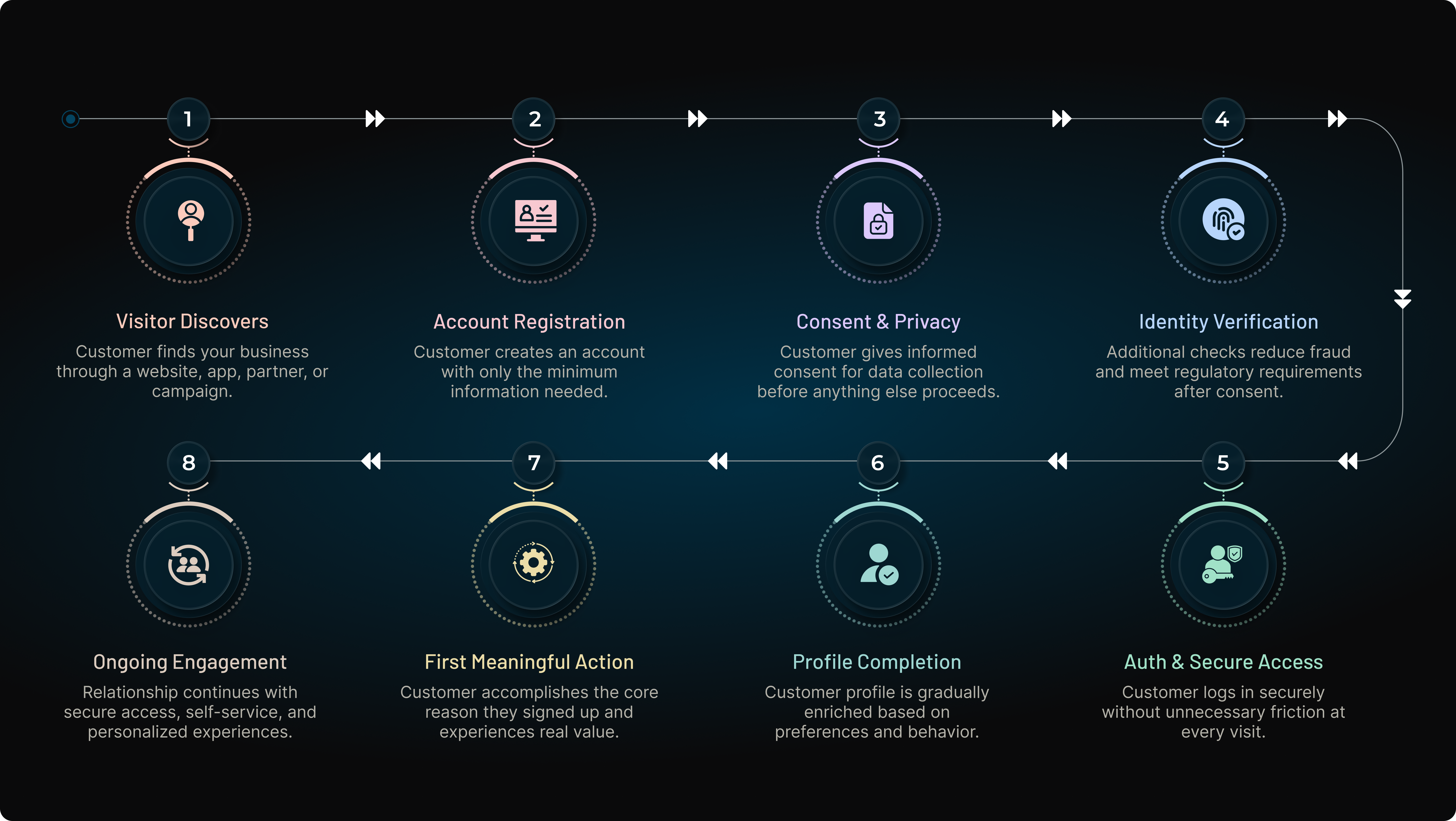
Although every organization has its own onboarding requirements, the principle remains the same: every step should reduce uncertainty for the customer while increasing confidence for the business. The most effective onboarding journeys don't ask customers to work harder. They remove unnecessary barriers so customers can focus on achieving their goals from the very first interaction.
What Creates Friction During Customer Onboarding?
Customer onboarding doesn't usually fail because of one major problem. More often, it's the result of several small frustrations that build up along the way. An extra form field here. A confusing verification email there. A password requirement that feels unnecessarily complex. Individually, they may seem insignificant. Together, they become reasons to leave.
Teams end up designing onboarding around internal processes instead of customer expectations. Customers aren't thinking about compliance workflows, data models, or security policies. They simply want to complete their task without unnecessary interruptions.
| Friction Point | Customer Impact | CIAM Solution |
|---|---|---|
| Overly long sign-up forms | High abandonment rates | Progressive profiling (after customers have experienced your product's value) and Social Sign-On |
| Rigid, blanket MFA requirements | Frustration for low-risk users | Adaptive / Risk-Based Authentication |
| Mobile account setup issues | Drop-offs on mobile web/apps | SDKs and Passwordless authentication (Passkeys/Biometrics) |
Returning customers face their own challenges. They may forget which sign-in method they originally used, switch devices, or return after months of inactivity. If recovering access becomes more difficult than creating a new account, frustration quickly follows. Consistent account recovery and self-service options help customers regain access without unnecessary support requests.
The organizations with the highest onboarding completion rates rarely remove every security control. Instead, they remove unnecessary friction. Every field, every verification request, and every interaction should answer one simple question: Does this help both the customer and the business achieve their goal? If the answer isn't clear, it's worth reconsidering whether that step belongs in the onboarding journey at all.
Deliver Value Before Asking for More
One of the biggest onboarding mistakes is asking customers to complete lengthy forms or configure multiple settings before they experience any value. Whenever possible, help customers accomplish a meaningful task first, then progressively collect additional information as they continue using your product or service.
How CIAM Improves Digital Customer Onboarding
A great onboarding experience isn't created by a single feature. It's the result of multiple identity capabilities working together behind the scenes. Customers shouldn't have to think about authentication methods, consent records, account recovery, or risk signals. They simply expect registration to be quick, secure, and consistent every time they interact with your business.
This is where Customer Identity and Access Management (CIAM) fits into the picture. Instead of treating registration, authentication, privacy, and account management as separate systems, CIAM brings them together into a single customer identity journey. The result is an onboarding experience that feels simpler for customers while giving businesses greater control over security, compliance, and customer data.
Reduce Registration Friction
The easiest onboarding experience is often the one that asks customers to do the least amount of work.
Many organizations now offer multiple registration options so customers can choose the method they're most comfortable with. Some prefer signing up with an existing identity provider. Others want a passwordless experience or a traditional email-based registration. Offering flexibility removes unnecessary barriers without forcing every customer through the same path.
The goal isn't to provide more sign-up choices for the sake of it. It's to help legitimate customers get started quickly while maintaining a secure onboarding process.
Build Trust From the First Interaction
Trust begins long before a customer makes a purchase or becomes an active user. It starts during onboarding.
Not every registration carries the same level of risk. Someone opening a streaming account has different security requirements than someone applying for a financial product or accessing healthcare services. Modern onboarding experiences can evaluate contextual signals such as device characteristics, location, or unusual activity before deciding whether additional verification is necessary.
This approach helps businesses strengthen security without introducing unnecessary friction for every customer.
Collect Better Customer Information
Businesses often want detailed customer profiles as early as possible. Customers usually want the opposite.
Here's where it gets interesting. Collecting less information during registration often leads to better customer data over time. Once customers begin using a product or service, they're generally more willing to share additional information if they understand the benefit.
A gradual approach helps organizations improve profile quality while keeping the initial onboarding experience simple and approachable.
Respect Privacy and Customer Choice
Customers are increasingly aware of how their personal information is collected and used. They expect transparency from the very beginning.
A modern onboarding experience should clearly explain why information is being requested, provide meaningful consent choices, and make it easy for customers to update their preferences later. Giving customers greater control over their information doesn't just support compliance requirements, it also strengthens confidence in the brand.
Navigating Privacy Regulations During Onboarding
Privacy compliance is no longer just a legal mandate it is a core component of building customer trust during account setup. Modern privacy frameworks require explicit transparency before data collection begins:
-
GDPR & CCPA/CPRA Compliance: Customers must be given granular control over how their data is used. Instead of bundled "accept all" checkboxes, onboarding journeys should separate required operational consent (e.g., terms of service) from optional processing consent (e.g., marketing communications, third-party analytics).
-
Identity Verification (KYC/AML): In highly regulated sectors like banking, fintech, and insurance, onboarding requires verifying legal identity (Know Your Customer). CIAM connects document verification steps (such as government ID checks and facial liveness detection) directly to the registration flow, keeping the user in the same digital experience while satisfying compliance mandates.
-
Centralized Preference Centers: Privacy management shouldn't end after registration. Giving users access to a self-service privacy portal where they can view, update, or revoke consent options reduces regulatory risk and demonstrates respect for customer preferences over time.
Simplify Ongoing Account Management
Customer onboarding doesn't end once an account is created. People change email addresses, replace devices, update personal information, and occasionally forget how they originally signed in. If every account change requires contacting customer support, the onboarding experience quickly loses its value.
Self-service profile management, account recovery, and preference updates allow customers to manage their own accounts while reducing operational overhead for the business.
Create Consistent Experiences Across Channels
Customers rarely interact with a business through a single channel anymore. They may begin registration on a website, continue on a mobile app, and return later through a customer portal or another connected service.
Without a unified approach to customer identity, these interactions can feel disconnected. Customers may be asked to register again, repeat verification steps, or provide information they've already shared.
CIAM helps create a consistent onboarding experience across digital touchpoints by recognizing customers throughout their journey and maintaining a unified customer identity. Instead of starting over with every interaction, customers can move between channels with confidence, while businesses deliver secure, personalized experiences that feel connected from the very first sign-up.
How CIAM Fits Into Your Tech Stack During Onboarding
Customer onboarding doesn't happen in isolation. It relies on a synchronized flow of data between your front-end apps, security providers, and back-end business systems. CIAM acts as the identity orchestration layer, coordinating these steps behind the scenes so the customer experiences a single, continuous journey.
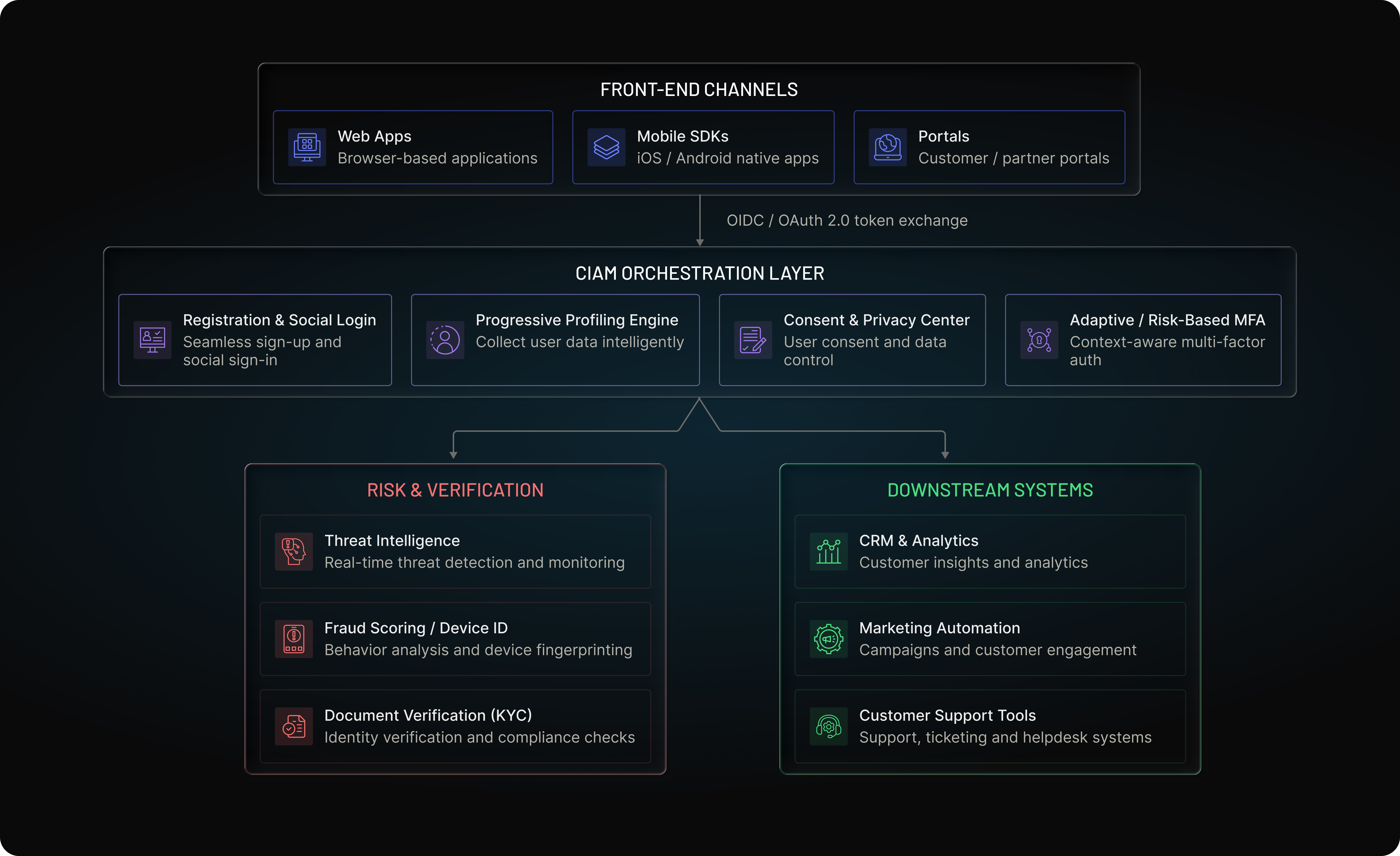
Instead of requiring your developers to manually build custom code for every verification tool, a modern CIAM platform handles the heavy lifting:
-
Standards-Based Protocols: Standard protocols like OpenID Connect (OIDC) and OAuth 2.0 allow your application to authenticate users securely without directly handling sensitive credential data.
-
API-Driven Integrations: Pre-built webhooks and APIs trigger events automatically—such as creating a user record in your CRM or flagging high-risk registrations to your fraud prevention tool in real time.
-
Unified Identity Store: All user profile data, authenticators, and consent records are held in a single secure directory, preventing duplicate records across web and mobile systems.
Customer Onboarding Best Practices
There isn't a universal onboarding process that works for every business. A retail brand, a digital bank, and a B2B SaaS platform all have different customers, different risks, and different regulatory requirements. Even so, the most successful onboarding experiences tend to follow the same principles. They remove unnecessary effort for customers while helping businesses establish trusted, long-term relationships.
-
Ask only for essential Information, collect the rest using Progressive Profiling
-
Offer multiple frictionless sign-in options
-
Design for mobile-first experiences
-
Explain why you're asking
-
Match Security to Risk, using Adaptive Authentication
-
Make Privacy Part of the Experience
-
Guide customers toward their first success, give a personalized experience using CIAM.
-
Support Self-Service Account Management
-
Measure and Improve Continuously
-
Communicate Throughout the Customer Onboarding Journey
An effective onboarding process doesn't need to be complicated. If you can confidently check each item on this list, you're well on your way to creating an onboarding experience that is faster, more secure, and easier for customers to complete.
Common Customer Onboarding Mistakes to Avoid
Even organizations that invest heavily in customer experience can struggle with onboarding. The problem usually isn't a lack of effort; it's focusing on the wrong priorities. Businesses often optimize individual steps instead of looking at the entire customer journey. The result is an onboarding process that works internally but feels frustrating from the customer's perspective.
Treating Registration as the Entire Onboarding Experience
Creating an account is only the starting point. Customers still need to understand what to do next, complete their first meaningful action, and feel confident using your product or service. If onboarding ends immediately after registration, many customers may never reach the point where they experience real value.
Asking for Too Much Information Upfront
Here's where teams usually go wrong. They try to collect every possible detail during the first interaction.
While detailed customer data is valuable, requesting unnecessary information during registration often increases abandonment and encourages customers to provide incomplete or inaccurate details. A shorter registration experience usually leads to higher completion rates and creates opportunities to gather additional information naturally over time.
Applying the Same Journey to Every Customer
Every customer arrives with different goals, devices, and levels of risk. A first-time shopper, a returning subscriber, and a business administrator shouldn't always encounter the same onboarding experience. Adapting the journey based on context creates a smoother experience without reducing security.
Prioritizing Security Over Usability
Strong security is essential, but security measures that interrupt every customer interaction can become obstacles rather than safeguards. Additional verification should be introduced when the situation calls for it, not as a default response for every registration or sign-in attempt.
Ignoring Returning Customers
Many organizations design onboarding exclusively for new users and overlook what happens when customers come back after weeks or months away. Forgotten sign-in methods, difficult account recovery processes, and repeated verification requests often create unnecessary frustration for existing customers.
Poor Communication Throughout the Journey
Customers shouldn't have to guess why they're being asked to verify an email address, accept privacy preferences, or provide additional information. Clear instructions, helpful progress indicators, and meaningful error messages reduce confusion and improve completion rates without changing the underlying onboarding process.
Measuring Registrations Instead of Outcomes
A high number of new accounts doesn't automatically mean onboarding is successful. Some customers register but never return. Others abandon the experience before completing their first important task.
Businesses gain a much clearer picture by measuring activation, onboarding completion, customer engagement, support requests, and long-term retention alongside registration numbers.
The most effective onboarding experiences aren't necessarily the shortest or the simplest. They're the ones that remove unnecessary effort while helping customers achieve their goals with confidence. Every step should have a purpose. If it doesn't improve the customer experience, strengthen security, or support the business, it's worth asking whether that step belongs in the journey at all.
Measuring Customer Onboarding Success
An onboarding experience shouldn't be judged by how many people create an account. That's only the beginning.
The real question is whether customers successfully move from registration to meaningful engagement. Do they complete the onboarding journey? Do they return? Do they accomplish the task that motivated them to sign up in the first place? Those answers provide a much clearer picture of onboarding performance than registration numbers alone.
A surprising pattern we've seen is that businesses often celebrate growing sign-up numbers while overlooking where customers quietly leave the journey. Measuring the right metrics helps uncover those drop-off points and identify opportunities to improve both customer experience and operational efficiency.
Industry Benchmarks for Onboarding Performance
To determine whether your onboarding process is performing well, it helps to measure your results against standard industry benchmarks. While metrics vary by sector, targeting these performance thresholds indicates a healthy, low-friction journey:
| Metric | Target Benchmark | Impact of CIAM Optimization (Estimates from Our Past Knowledge) |
|---|---|---|
| Registration Completion Rate | 65% | Offering Social Login and Passkeys typically increases completion rates by 20% to 35%. |
| Time to First Value (TTFV) | < 3 minutes in B2C / < 3 hours in B2B | Progressive profiling defers non-essential form fields, allowing immediate access to core feature value. |
| Verification Pass Rate (KYC) | > 80% | Contextual step-up triggers prevent false rejections and keep legitimate customers moving forward. |
| MFA Friction Drop-Off Rate | < 5% | Adaptive authentication removes repetitive MFA prompts for low-risk, recognized devices. |
Customer Onboarding Doesn't End After Registration
Completing a registration form isn't the finish line; it's the starting point of the customer relationship. The real measure of onboarding success is what happens after someone signs in for the first time. Do they understand how to use the product? Can they complete key tasks without frustration? Do they return and continue engaging over the following days or weeks?
Successful onboarding guides customers from first login to activation, helping them experience value as quickly as possible. Along the way, businesses may encourage profile completion, introduce important features through contextual guidance, provide educational resources, or recommend the next best action based on the customer's progress. Each interaction helps customers become more confident and comfortable using the product.
The journey doesn't stop there. Continued engagement, thoughtful communication, and consistent support all contribute to long-term adoption and customer loyalty. When onboarding is treated as an ongoing process rather than a one-time event, businesses build stronger relationships, increase retention, and reinforce trust throughout the customer lifecycle.
| Metric | Why It Matters |
|---|---|
| Registration Completion Rate | Shows how many visitors successfully create an account after starting registration. A low completion rate often signals unnecessary friction or confusing registration steps. |
| Onboarding Completion Rate | Measures how many new customers finish the onboarding journey, including profile setup, verification, or other required tasks. |
| Activation Rate | Indicates how many customers complete their first meaningful action, such as making a purchase, starting a free trial, creating a project, or accessing a key feature. |
| Time to First Value (TTFV) | Tracks how quickly customers experience the value of your product or service. Reducing this time often improves engagement and long-term retention. |
| Customer Drop-off Rate | Identifies where customers abandon the onboarding process so teams can prioritize improvements. |
| Identity Verification Success Rate | Helps organizations understand whether legitimate customers can complete verification smoothly without creating unnecessary delays. |
| Support Requests During Onboarding | A high volume of onboarding-related support tickets may indicate unclear instructions, usability issues, or complicated account recovery processes. |
| Fraud Detection Rate | Measures how effectively onboarding processes identify suspicious or fraudulent account creation attempts while allowing legitimate customers to continue without disruption. |
| Customer Retention After Onboarding | Evaluates whether customers continue using the product or service after completing onboarding, providing insight into the long-term effectiveness of the experience. |
No single metric tells the full story. For example, a business may achieve an excellent registration completion rate but struggle with activation because customers don't understand what to do after creating an account. Another organization may have strong security controls but lose legitimate customers during identity verification. Looking at these metrics together provides a more balanced view of onboarding performance.
Numbers alone aren't enough either. Customer feedback, usability testing, session recordings, and support conversations often reveal issues that dashboards cannot. A form field that appears straightforward internally may confuse customers. A verification step that seems minor could become a frequent reason for abandonment.
The most successful organizations treat customer onboarding as an ongoing optimization effort rather than a one-time project. They monitor customer behavior, test improvements, measure outcomes, and refine the experience continuously. Small improvements at each stage of the journey can lead to higher conversion rates, stronger customer trust, fewer support requests, and better long-term business results.
Read more - Customer Success: The Importance of Customer Onboarding
Digital Customer Onboarding Across Industries
Customer onboarding isn't the same for every business. The expectations of someone opening a bank account are very different from those of someone signing up for a streaming service or a B2B SaaS platform. While the goal remains consistent to help customers get started quickly and securely, the onboarding journey should reflect the level of risk, regulatory requirements, and customer expectations within each industry.
Retail and E-commerce
Speed matters. Customers want to browse, purchase, and check out without unnecessary delays. Registration should feel optional rather than mandatory, with opportunities to create an account before or after a purchase. Returning customers also expect their preferences, addresses, and order history to be available across devices.
Financial Services
Banks, fintech companies, and insurance providers operate in a much higher-risk environment. Customer onboarding often includes identity verification, regulatory checks, and fraud prevention before an account can be activated. The challenge is making these security measures feel clear and predictable instead of overwhelming.
Healthcare
Healthcare organizations must protect sensitive patient information while making digital services accessible. Patients expect secure account creation, straightforward consent experiences, and convenient access to appointments, prescriptions, and medical records without repeatedly verifying their identity during every interaction.
B2B SaaS
Here's where it gets interesting. Onboarding in B2B SaaS isn't just about individual users it often involves entire organizations.
A new customer may need to invite teammates, assign roles, configure permissions, connect existing business tools, and establish organizational settings before anyone can begin using the platform effectively. Helping administrators complete these tasks quickly has a direct impact on product adoption.
Telecommunications and Utilities
Customer onboarding frequently involves account verification, service activation, device registration, and billing setup. Customers expect to complete these steps digitally without switching between multiple channels or repeating the same information several times.
Travel and Hospitality
Travel platforms manage customers across websites, mobile applications, loyalty programs, and partner ecosystems. A consistent onboarding experience helps travelers move between booking, check-in, rewards, and support services without creating multiple disconnected accounts.
Media and Streaming
Media companies compete in an environment where customers expect almost immediate access. Long registration processes often result in abandoned subscriptions. Simple account creation, flexible sign-in options, and personalized recommendations encourage customers to start engaging with content sooner.
Although every industry has unique requirements, one principle still remains. Customer onboarding should adapt to the business, not force every customer through the same experience. Organizations that align onboarding with customer expectations, security requirements, and business goals are far more likely to improve conversion, strengthen trust, and build lasting customer relationships.
The Future of Digital Customer Onboarding
Customer onboarding is changing quickly. It's no longer measured by how fast someone can create an account. Increasingly, it's measured by how confidently businesses can recognize legitimate customers while keeping the experience simple from beginning to end.
Artificial intelligence is already influencing this shift. Businesses are using AI to detect unusual behavior, identify suspicious registrations, and streamline onboarding decisions behind the scenes. The objective isn't to replace human judgment. It's to help security teams identify genuine risks while allowing legitimate customers to move forward with fewer interruptions.
Identity is becoming more portable as well. Digital identity wallets and verifiable credentials are creating new ways for customers to prove who they are without repeatedly submitting the same information to every organization they interact with. Although adoption is still evolving, these technologies have the potential to simplify onboarding while giving customers greater control over their personal data.
Privacy expectations will continue to shape onboarding experiences. Customers increasingly expect businesses to collect only the information they need, explain why it's being requested, and provide straightforward ways to manage preferences over time. Organizations that embrace transparency are likely to build stronger customer confidence than those relying on lengthy notices or complicated consent experiences.
Here's where it gets interesting. The future of onboarding isn't about adding more verification steps, it's about making smarter decisions. Businesses are moving toward experiences that adapt to context instead of treating every customer and every interaction the same. Someone signing in from a familiar device with normal behavior may complete onboarding seamlessly, while higher-risk situations can trigger additional verification only when necessary.
Another noticeable shift is the growing emphasis on continuous customer relationships instead of one-time onboarding events. Registration is becoming the starting point rather than the finish line. As customers return, update their information, access new services, or move across different channels, businesses continue strengthening identity, improving personalization, and protecting accounts without forcing customers to repeat the entire onboarding process.
Consistent Omnichannel Experiences
Customers no longer interact with businesses through a single channel. They might begin researching on a website, continue the registration process in a mobile app, verify their identity at a kiosk or retail store, and later contact customer support all within the same journey.
Modern onboarding is moving toward connected experiences that recognize customers across every touchpoint without requiring them to restart the process or repeatedly provide the same information. Consistency across channels is quickly becoming an expectation rather than a competitive advantage.
Passwordless Authentication and Biometrics
Passwords are gradually giving way to more convenient authentication methods. Passkeys, biometrics, and other passwordless technologies allow customers to sign in using device-based authentication instead of creating and managing traditional passwords. Combined with adaptive authentication, these approaches help organizations reduce registration friction while applying stronger security only when additional verification is needed.
As adoption continues to grow, passwordless onboarding is expected to play an increasingly important role in creating faster, more secure digital customer experiences.
The organizations that will stand out over the next few years won't necessarily have the shortest registration forms or the newest technology. They'll be the ones that make every interaction feel effortless while quietly maintaining strong security, respecting customer privacy, and delivering consistent experiences across every digital touchpoint.
Conclusion
Customer onboarding has evolved far beyond account creation. It's the first opportunity to earn a customer's confidence, demonstrate your commitment to security and privacy, and establish the foundation for a long-term relationship. Every interaction during this journey influences how customers perceive your brand, whether they continue engaging with your business, and how easily they adopt your products or services.
The organizations seeing the best results aren't simply making registration faster. They're designing onboarding experiences that remove unnecessary friction, apply security where it adds value, respect customer privacy, and adapt to different customer needs. When these elements work together, businesses can improve conversion rates, reduce fraud, strengthen customer trust, and deliver more consistent digital experiences across every channel.
CIAM makes this possible by bringing customer identity, authentication, authorization, consent management, and account lifecycle management into a unified platform. Instead of treating these as disconnected processes, businesses can create onboarding journeys that are secure, scalable, and designed around the customer from the very first interaction.
If you're looking to modernize your customer onboarding experience, LoginRadius helps organizations deliver secure, frictionless digital journeys without compromising security or compliance. From customer registration and identity verification to authentication, consent management, and self-service account management, our CIAM platform gives you the tools to build trusted customer relationships at every stage of the lifecycle.
Ready to transform your customer onboarding experience? Explore how LoginRadius CIAM can help you reduce onboarding friction, improve customer conversions, strengthen account security, and create seamless digital experiences that keep customers coming back. Book a demo today and discover how modern customer identity can become a competitive advantage for your business.
FAQs
Q: What is customer onboarding?
A: Customer onboarding is the process of helping new customers register, access, and successfully begin using a product or service. It extends beyond account creation to include identity verification, account setup, and the customer's first meaningful interaction.
Q: Why is customer onboarding important?
A: Customer onboarding creates the first impression of your business. A well-designed onboarding process reduces abandonment, improves customer trust, accelerates activation, and encourages long-term engagement.
Q: What is the difference between customer registration and customer onboarding?
A: Customer registration is the process of creating an account, while customer onboarding includes everything that helps customers successfully start using a product or service after registration. Registration is one step within the broader onboarding journey.
Q: What is digital customer onboarding?
A: Digital customer onboarding is the process of acquiring and onboarding customers through digital channels such as websites, mobile applications, and online portals. It combines convenience, security, and privacy to deliver a seamless customer experience.
Q: How does CIAM improve customer onboarding?
A: CIAM helps organizations simplify customer onboarding by managing customer identities, authentication, consent, and account management through a unified platform. This reduces friction while strengthening security and compliance.
Q: How can businesses reduce customer onboarding friction?
A: Businesses can reduce onboarding friction by requesting only essential information, designing mobile-friendly experiences, offering flexible sign-up options, communicating clearly, and applying security measures based on customer risk.
Q: What are the biggest challenges in customer onboarding?
A: Common challenges include long registration forms, identity fraud, poor mobile experiences, unnecessary authentication steps, unclear communication, and balancing strong security with a seamless customer experience.
Q: How do you measure customer onboarding success?
A: Customer onboarding success is measured using metrics such as registration completion rate, onboarding completion rate, activation rate, time to first value, customer retention, support requests, and fraud detection rates.
Q: What are the customer onboarding best practices?
A: Effective customer onboarding focuses on reducing unnecessary friction, collecting only essential information, providing clear guidance, respecting customer privacy, supporting self-service account management, and continuously improving the experience using customer feedback and performance metrics.
Q: Which industries benefit most from digital customer onboarding?
A: Industries such as retail, financial services, healthcare, telecommunications, travel, media, and B2B SaaS benefit from digital customer onboarding by improving customer experience, strengthening security, and streamlining account creation across digital channels.