Introduction
A chatbot giving the wrong answer is a problem. However an AI agent acting on the wrong answer can become a security incident.
That distinction is becoming more important as AI moves beyond conversations. Agents can retrieve customer data, call APIs, invoke tools, update records, trigger workflows, communicate with other agents, and perform tasks on behalf of users. Each additional capability gives the agent more utility. It also gives an attacker or a manipulated agent more ways to cause harm.
Consider the difference: LLM: Prompt → Model → Output
AI Agent: Goal → Reasoning → Decision → Tool or API → Action
The second flow introduces an execution surface that conventional safety controls cannot address on their own. Prompt injection is a particularly useful example. If malicious instructions influence a model, the immediate consequence might be an incorrect or unsafe response. If the same attack manipulates an agent with access to customer records and operational APIs, the agent could attempt to retrieve sensitive information, invoke the wrong tool, or perform an action the user never intended.
And prompt injection is only one such threat. AI agents introduce questions around identity, delegated authority, excessive permissions, credential exposure, tool abuse, memory manipulation, agent-to-agent communication, and accountability.
Teams focus heavily on whether the agent can make a bad decision while paying less attention to what happens after that decision is made. A secure agent architecture has to address both.
Decision Surface: Can an attacker manipulate what the agent decides?
Execution Surface: If the agent makes a bad decision, what is it actually allowed to do?
An agent may be manipulated into attempting an unsafe action. Strong execution controls should still prevent that action when it exceeds the agent's authority, targets a prohibited resource, or requires additional approval.
This changes what “AI agent security” needs to cover. Securing the model is part of the job, but it is not enough. Organizations also need to secure the agent's identity, credentials, delegated authority, data access, tools, execution paths, and lifecycle.
The goal is not to remove autonomy altogether. It is to put boundaries around autonomy so that an agent can perform its intended job without quietly accumulating unrestricted authority.
That requires a security model built around a simple principle: an AI agent should be able to do what it needs to do and very little beyond that.
What Is AI Agent Security, and Why Does It Require More Than LLM Security?
AI agent security is the practice of protecting autonomous or semi-autonomous AI systems across their identity, permissions, data access, tools, decisions, actions, and lifecycle.
The scope matters. An AI agent is not just a model receiving a prompt. It may maintain context, decide which steps to take, select tools, communicate with other systems, and execute actions against real resources. Security therefore has to extend beyond protecting the model and its inputs.
A useful way to see the difference is this:
| LLM Security | AI Agent Security |
|---|---|
| Protects model inputs and outputs | Protects the complete agent workflow |
| Focuses heavily on prompt and data risks | Adds identity, authorization, tool, and execution risks |
| Unsafe behavior may produce a harmful response | Unsafe behavior may trigger a real action |
| Controls model interaction | Controls both decisions and execution |
| Usually limited by application capabilities | May involve APIs, tools, memory, agents, and enterprise systems |
The two are not competing disciplines. AI agent security includes many familiar LLM security concerns, such as prompt injection, sensitive-data exposure, and malicious context. What changes is what sits behind the model.
If a manipulated model can only generate text, the damage is constrained by what the surrounding application allows. Connect that same model to email, a CRM, source-code repositories, payment APIs, or administrative tools, and the security boundary changes immediately.
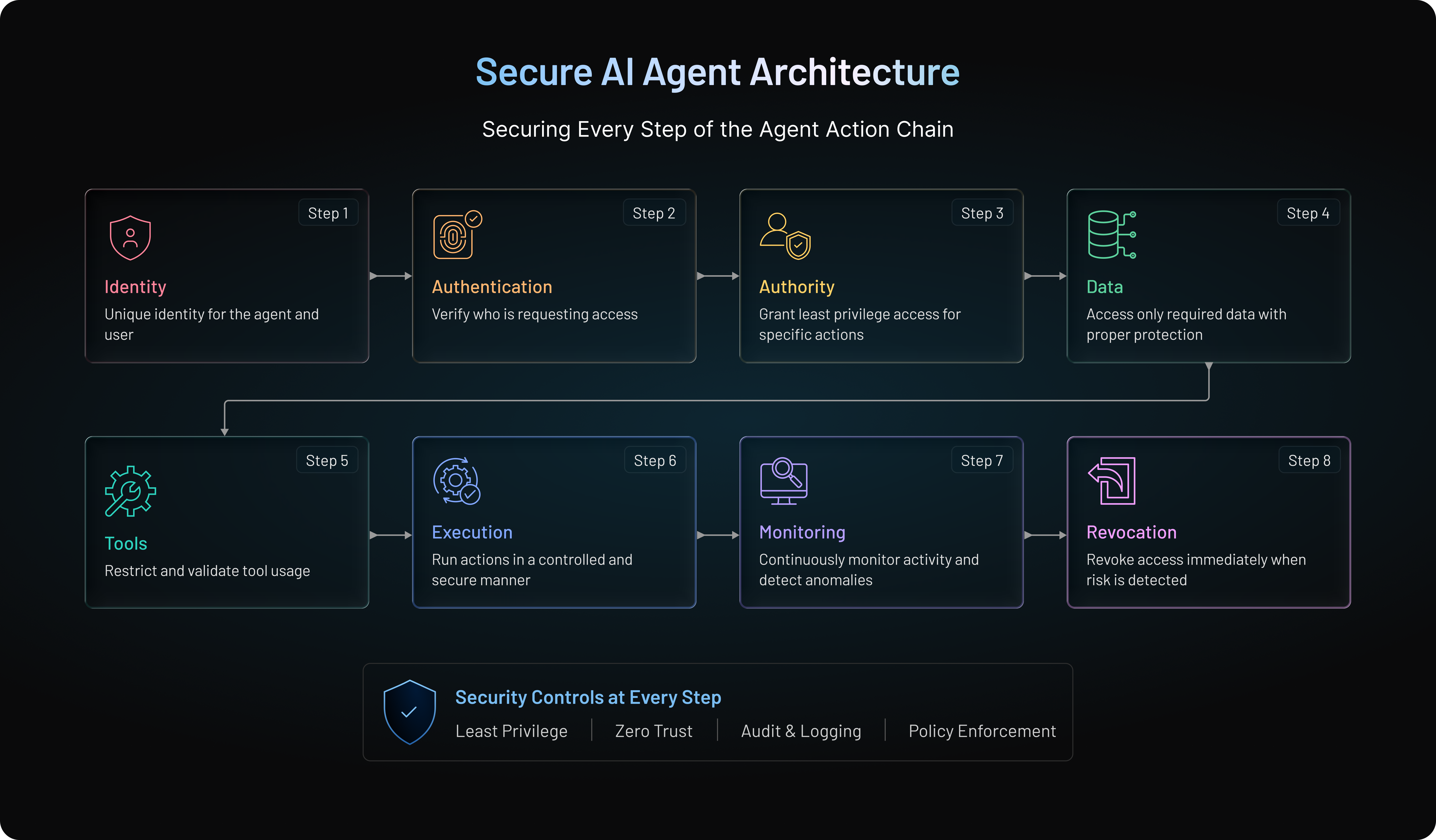
Securing only one part leaves the others exposed.
The Decision Surface and Execution Surface Need Separate Controls
One of the most useful ways to reason about AI agent security is to separate what the agent decides from what the system permits it to execute.
The decision surface covers the information and mechanisms that influence agent behavior: prompts, retrieved documents, memory, model output, external content, tool descriptions, and instructions received from other agents.
Attackers may try to manipulate this surface through prompt injection, poisoned context, malicious documents, compromised memory, or misleading tool responses.
The execution surface begins when the agent attempts to turn a decision into an action. It includes APIs, databases, applications, tools, system commands, credentials, and other resources available to the agent.
This separation creates an important security boundary. Agent Decides to Perform Action → Execution Layer Independently Checks Authority → Allow or Deny
The model should not be the final authority simply because it decided that an action is appropriate.
Suppose an attacker manipulates an agent into attempting to delete a customer account. Prompt defenses may help prevent the malicious instruction from influencing the agent in the first place. But if those defenses fail, the execution layer should still ask whether this agent is permitted to delete that account, whether the user authorized it, and whether additional verification is required.
Delegation Creates a Third Security Surface
There is another dimension once agents start acting on behalf of users or other agents: delegation.
A user might authorize an agent to manage a specific task. That agent may then invoke another service or agent to complete part of it. Without clear boundaries, authority can spread farther than the original user intended.
Consider: Human → Agent A → Agent B → Tool → Enterprise Resource
Agent B should not automatically inherit every permission held by Agent A, and Agent A should not automatically receive everything the human can access.
The delegation surface therefore covers how authority moves between humans, agents, applications, and downstream services.
This gives security teams three related questions:
Decision Surface: What can influence the agent's decision?
Execution Surface: What can the agent actually do?
Delegation Surface: How far can its authority travel?
Strong AI agent security needs controls across all three.
A Secure Model Can Still Produce an Insecure Agent
This distinction is easy to miss.
An organization can use a well-protected model, validate prompts, filter outputs, and still deploy an insecure agent if that agent holds a long-lived API key with excessive permissions, shares credentials with other workloads, or can execute sensitive actions without independent authorization.
The reverse is also useful. Model-level defenses will never be perfect. Strong execution controls can limit the consequences when an agent behaves unexpectedly.
That shifts the security objective away from an unrealistic assumption that the agent will always make the correct decision.
A better objective is: Assume the agent can eventually make a bad decision. Design the surrounding system so that one bad decision does not automatically become an unauthorized action.
That principle will shape everything that follows—from agent identity and scoped authorization to runtime policy enforcement, human approval, monitoring, and revocation.
What Are the Major Security Threats Facing AI Agents?
AI agents create a broader attack surface because they combine reasoning with access. They consume instructions and external context, maintain state, use credentials, select tools, call APIs, and sometimes delegate work to other agents.
An attacker does not necessarily need to compromise the underlying model. Manipulating one part of that chain may be enough.
The most useful way to assess AI agent threats is therefore to ask where the attacker is trying to gain influence or authority.
Prompt Injection, Goal Hijacking, and Malicious Context
Prompt injection remains one of the most recognizable AI security threats, but agents increase its potential impact. A malicious instruction can arrive directly from a user or indirectly through content the agent consumes: an email, webpage, document, retrieved knowledge, API response, or tool output. If the agent treats that content as trusted instruction, its behavior can shift away from the original task.
Goal hijacking takes this further. Instead of merely changing an answer, the attacker attempts to redirect the agent toward a different objective.
For example: Legitimate Goal → Malicious Context Introduced → Agent Goal Manipulated → Unauthorized Action Attempted
Input filtering and context separation can reduce this risk, but they should not become the only defense. The execution layer still needs to reject actions outside the agent's permitted authority.
Identity, Credential, and Privilege Abuse
An agent needs some way to authenticate when accessing protected resources. How that identity is implemented has major security consequences.
Shared service accounts, embedded API keys, long-lived tokens, and credentials inherited directly from users can make it difficult to distinguish one agent from another or determine who authorized an action.
Credential theft then becomes particularly dangerous. An attacker who obtains an overprivileged agent token may not need to manipulate the model at all; they can simply use the authority already attached to that credential.
The safer way is to give agents identifiable, narrowly scoped, and revocable access rather than treating them as invisible extensions of existing accounts.
Excessive Permissions and Delegation Abuse
An agent may need access to several systems to complete a task. The mistake is assuming it needs every capability those systems expose.
Consider a customer-service agent that needs to retrieve an order and prepare a refund recommendation. Giving it permission to modify customer identities, issue unlimited refunds, export account data, and change payment information creates authority far beyond its actual job.
Delegation makes this more complicated. User → Agent A → Agent B → API
If authority is simply passed along the chain, Agent B may end up receiving permissions that were never necessary for its part of the task.
Delegated authority should therefore become narrower as it moves downstream, not silently expanding.
Tool Misuse and Unsafe Execution
Tools turn model decisions into real operations.
An agent may have access to search, email, databases, file systems, CRM functions, payment APIs, administrative operations, shell commands, or MCP-connected tools. Even legitimate tools can become dangerous when invoked with the wrong parameters or in the wrong sequence.
An attacker might manipulate an agent into using a valid tool for an unintended purpose. Or the agent itself might choose an unsafe sequence while trying to satisfy an otherwise legitimate request.
This is why tool access should not be binary.
Instead of: Agent Has Tool → Agent Can Perform Every Tool Operation
prefer: Agent Has Tool → Requested Operation Evaluated → Resource and Parameters Checked → Allow or Deny
Sensitive operations may require additional approval even when the agent is otherwise authorized to use the tool.
Memory Poisoning and Cross-Context Leakage
Persistent memory makes agents more useful because they can retain information across interactions. It also creates another place where malicious or sensitive information can survive.
Memory poisoning occurs when manipulated content is stored and later influences agent behavior. The attacker may not need the harmful instruction to execute immediately. Once persisted, it can affect future decisions or sessions.
Memory can also create privacy boundaries that are easy to overlook. Information associated with one user, tenant, task, or agent should not accidentally become available to another.
Agent memory therefore needs controls around what can be stored, how long it persists, who can access it, and whether external content is validated before becoming a durable context.
Data Exfiltration Through Legitimate Agent Actions
Data theft from an agent does not always look like a traditional breach.
Suppose an agent legitimately has permission to read customer records and call an external search or messaging tool. A malicious instruction could attempt to make the agent retrieve sensitive information and then include it in an outbound tool request.
Each operation may look technically valid when inspected alone.
The problem appears in the sequence: Retrieve Sensitive Data → Place Data in Agent Context → Invoke External Tool → Data Leaves Trusted Boundary
Security controls therefore need awareness of both what the agent can read and where it can send what it reads.
Agentic Supply Chain and MCP Tool Risks
Agents increasingly depend on external models, libraries, APIs, plugins, MCP servers, tools, retrieval sources, and other agents.
Any of those dependencies can become part of the attack path.
A malicious or compromised tool might return manipulated information. An MCP server could expose excessive capabilities. Tool definitions themselves may contain misleading instructions. A previously trusted component may also change after approval.
The security question is no longer simply, “Do we trust this agent?”
It becomes: Which components can influence this agent, and which components can the agent influence in return?
That makes tool discovery, approval, authentication, authorization, version awareness, and ongoing monitoring part of the agent security boundary.
Multi-Agent Systems Can Amplify a Compromise
Multi-agent architectures introduce another problem: trust can propagate.
One agent may specialize in planning, another in retrieving data, and another in executing actions. If the first agent becomes compromised, its instructions may influence downstream agents that assume requests from their peers are trustworthy.
A failure can therefore travel: Compromised Agent → Trusted Agent → Tool → Downstream Agent → Enterprise Resource
Agent-to-agent communication should not automatically imply authorization. Each participant still needs to validate identity, delegated authority, requested scope, and the action it is being asked to perform.
Excessive Autonomy Increases the Impact of Failure
Autonomy is useful because it reduces the need for human intervention. But giving an agent more autonomy also increases what can happen between the initial request and the final result.
The danger is not autonomy by itself. It is autonomy without boundaries.
An agent that can repeatedly call tools, spend money, modify production systems, delegate tasks, or perform irreversible operations without independent controls can turn a single bad decision into a chain of consequences.
This gives security teams a practical way to think about the major threats:
| Threat Category | What Can Go Wrong | Primary Security Direction |
|---|---|---|
| Prompt injection / goal hijacking | Agent follows manipulated instructions | Context isolation + execution controls |
| Identity / credential abuse | Attacker impersonates or takes over an agent | Strong agent identity + short-lived credentials |
| Excessive privilege | Agent reaches unnecessary resources | Least privilege |
| Delegation abuse | Authority expands across agent chains | Scoped delegation |
| Tool misuse | Legitimate capability performs unsafe action | Tool-level authorization |
| Memory poisoning | Malicious state influences future behavior | Memory validation + isolation |
| Data exfiltration | Sensitive data leaves through permitted channels | Data-flow and egress controls |
| Supply-chain compromise | Malicious tools or services influence the agent | Component verification + governance |
| Excessive autonomy | Agent performs high-impact actions unchecked | Runtime controls + human approval |
There is an important pattern across these threats. Prompt defenses alone will not solve identity abuse. Authentication alone will not prevent an authenticated agent from misusing a tool. Least privilege will not stop poisoned memory. Human approval cannot compensate for every poorly scoped credential.
AI agent security needs multiple controls working at different boundaries.
The next question is where to establish the first durable boundary. For enterprise agents, that starts with knowing which agent is acting, who owns it, what authority it has, and how that authority changes throughout its lifecycle.
Secure AI Agents as Non-Human Identities Across Their Full Lifecycle
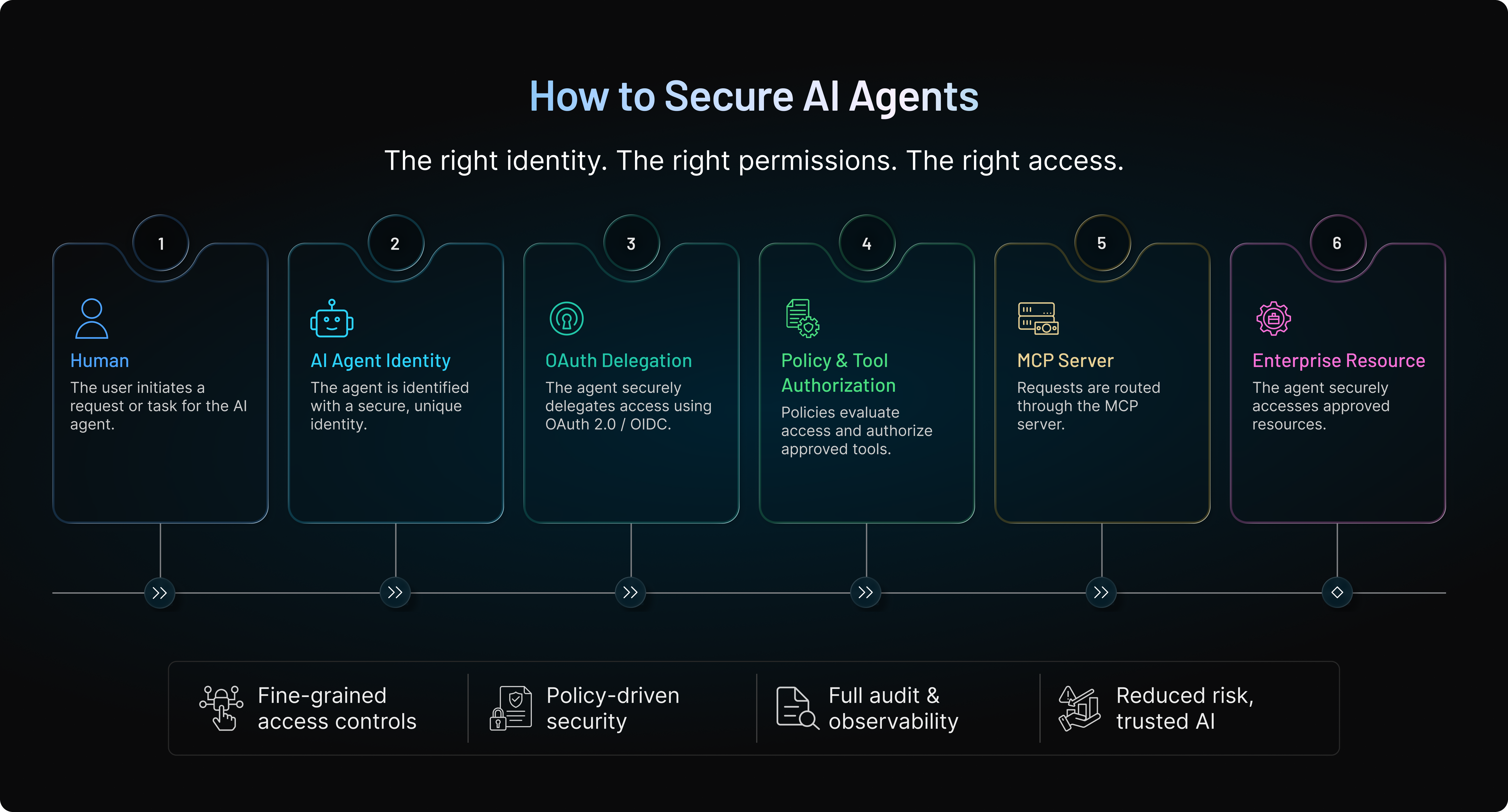
An AI agent that can access enterprise resources needs an identity that security systems can recognize and govern.
That sounds obvious. In practice, many early agent implementations reuse whatever credential is easiest to obtain: a developer API key, shared service account, application secret, or even a user's existing access token. The agent works, but its identity becomes ambiguous.
When something goes wrong, that ambiguity matters. Was the API call made by the user, the application, or the agent? Which agent received the credential? Who owns it? Can access for one agent be revoked without affecting other workloads?
Treating agents as distinct non-human identities (NHIs) creates a cleaner security boundary.
Give Each Agent a Distinct Identity and Owner
An agent should be identifiable independently from the human or application that initiated its work.
Consider two models: User Identity → Shared Credential → AI Agent → API
versus: Human Principal → AI Agent Identity → Scoped Authority → API
The second model preserves a distinction between the principal and the actor. The user may authorize the task, but the agent performing it remains identifiable.
Ownership should be equally clear. Every production agent should have a responsible team, application, or business owner. Otherwise, organizations can accumulate active agents whose permissions remain valid long after the original project or developer has moved on.
Distinct identity also improves incident response. If one agent is compromised, its credentials and authority can be suspended without automatically disabling the human principal or unrelated agents.
Separate Agent Identity From Delegated User Authority
An agent having its own identity does not mean it should operate independently of user authorization.
Some agents run as workloads under organizational authority. Others act on behalf of customers or employees. In the second case, security systems need to preserve both pieces of context:
Which agent is acting?
and
On whose authority is it acting?
A delegated workflow may therefore look like: User → Delegates Limited Authority → Agent Identity → Protected Resource
This is safer than simply handing the agent the user's full credentials.
It also prevents an important conceptual mistake: agent identity and agent authority are not the same thing. Authentication can establish which agent is making the request. Authorization still needs to determine what that agent may do for this user, against this resource, at this moment.
Avoid Shared Credentials and Long-Lived Secrets
Shared API keys make attribution difficult because several agents or services can appear as the same actor. Long-lived credentials create another problem: authority can survive long after the task that originally required it.
Hard-coded secrets are particularly risky in agent environments. They can appear in source code, configuration files, logs, development environments, or automation pipelines and may eventually be exposed to systems that were never supposed to receive them.
Where the architecture supports it, prefer credentials that are agent-specific, narrowly scoped, short-lived, and revocable.
This improves containment. If a credential is compromised, the question changes from:
What else uses this shared secret?
to: Which agent received this credential, what could it access, and is that credential still valid?
That is a much more manageable incident-response problem.
Manage Agent Identity as a Lifecycle, Not a Login Event
Traditional authentication discussions often focus on the moment an identity signs in. Agent security requires a longer view.
An agent may remain operational for weeks or months. Its purpose can change. New tools may be connected. Permissions may expand. Credentials rotate. Ownership may move between teams. Eventually, the agent should be retired.
A useful lifecycle is: Discover or Register → Authenticate → Authorize → Operate → Monitor → Rotate → Suspend or Revoke → Decommission
Each stage has a security purpose.
During registration, establish the agent's owner and intended function. Authentication establishes its identity. Authorization limits its access. Monitoring shows whether its actual behavior remains consistent with that purpose. Rotation limits credential persistence. Suspension and revocation provide containment when something becomes unsafe.
Decommissioning deserves attention too. Removing an agent application without removing its tokens, service accounts, API permissions, tool connections, or downstream grants can leave residual access behind.
Reassess Permissions as the Agent Changes
Agent permissions should not become permanent simply because they were appropriate at deployment.
Suppose a support agent originally retrieves order information. Six months later, it gains refund capabilities, access to customer profiles, and a connection to a shipping system. Its effective security posture has changed substantially even if the agent's identity has not.
Permission reviews should therefore consider not only what scopes are assigned, but also:
Which tools can the agent invoke? Which data can it retrieve? Which actions can it execute? Can it delegate authority? Does it still need every permission it holds?
This becomes particularly important for agents that learn new workflows or gain integrations over time.
Make Revocation Part of the Architecture
Security teams should know how to stop an agent before they need to stop one.
Depending on the architecture, containment might require revoking an access token, disabling an agent credential, removing a delegated grant, disconnecting a tool, or suspending the agent identity entirely.
The important part is that revocation can target the agent's authority without unnecessarily disabling everything around it.
A mature agent lifecycle therefore ends with the same question that should be asked at creation:
Can we identify this agent, understand its authority, and remove that authority when it is no longer justified?
Once that identity foundation exists, organizations can use standards and protocols to carry it across distributed systems. OAuth, token exchange, workload identity, and MCP authorization each solve a different part of that problem.
Which Standards and Protocols Help Secure AI Agent Identity, Delegation, and Tool Access?
AI agents rarely operate inside a single security boundary. A customer authenticates to an application, an agent receives delegated authority, the agent calls an API, an MCP server exposes tools, and another workload may execute the requested operation.
Trying to solve that entire chain with one credential is where architectures start becoming dangerous.
Several existing identity and authorization standards can help, but they solve different parts of the problem.
| Standard or Protocol | Role in AI Agent Security |
|---|---|
| OAuth 2.1 | Delegated authorization and modern OAuth security practices |
| OAuth Token Exchange (RFC 8693) | Exchanges one security token for another appropriate to a downstream context |
| OpenID Connect (OIDC) | Establishes authenticated user identity and identity claims |
| SPIFFE / SPIRE | Provides cryptographically verifiable workload identity |
| MCP Authorization | Controls client access to protected MCP servers and resources |
| JWT / JWS | Carries signed identity and authorization claims |
| mTLS / sender-constrained tokens | Helps bind credentials to the party presenting them |
The important part is not choosing one protocol from this list. It is placing the right control at the right boundary.
Use OAuth for Scoped and Delegated Agent Authorization
OAuth is particularly relevant when an AI agent needs access to an API or protected resource without receiving the user's credentials directly.
Consider a travel agent that needs permission to retrieve a customer's itinerary. The customer may have broad access to their travel account, but the agent does not necessarily need every permission the customer has.
A safer relationship is: User → Authorizes Agent → Scoped Access Token → Travel API
The authorization server can issue access appropriate to the intended task rather than exposing the user's primary credentials.
For agent architectures, scopes should be meaningful enough to constrain capability. A generic scope such as account:write may still provide more authority than an agent needs. Where APIs support it, permissions can become more specific around resources and actions.
OAuth also provides an important separation between authentication and authorization. Knowing which agent or user is present does not automatically determine what that actor should be permitted to do.
Use RFC 8693 Token Exchange for Downstream Access
Agent workflows frequently cross several services.
An agent might begin with authority associated with a user but then need to call a downstream API that should not receive the original token. Passing the same broadly scoped token through every service expands both exposure and blast radius.
OAuth 2.0 Token Exchange, defined by RFC 8693, provides a standardized mechanism for exchanging one security token for another.
A simplified agent flow can look like: User Token → Agent Context → Token Exchange → Downstream Token → API
This can be useful when the downstream token needs a different audience, resource context, or authorization profile. There is an important security nuance here: token exchange does not automatically guarantee privilege reduction. The authorization server still needs policies that determine what the exchanged token may contain. A poorly configured exchange could preserve excessive authority rather than reduce it.
For agentic systems, the desired pattern is generally: Broad Upstream Context → Policy Evaluation → Narrower Downstream Authority
An agent booking a flight, for example, should not need to forward a customer's broadly capable application token to every airline, payment, and itinerary service it contacts. Each downstream interaction can receive authority appropriate to that particular resource and task.
Use SPIFFE and SPIRE When the Agent Runs as a Workload
OAuth is useful for delegated API authorization, but some agents also need a reliable workload identity. This is where SPIFFE and SPIRE can fit.
SPIFFE defines a framework for assigning cryptographically verifiable identities to workloads across heterogeneous infrastructure. A workload receives a SPIFFE ID and can prove that identity using a SPIFFE Verifiable Identity Document (SVID). SPIRE is a production-ready implementation that performs node and workload attestation before issuing those identities.
That can be valuable when an agent runs inside Kubernetes, cloud infrastructure, containers, or another distributed environment and services need to establish which workload is communicating with them.
Instead of: Agent Workload → Static Service Credential → Service
an architecture can use: Attested Workload → SPIFFE Identity → Cryptographic Authentication → Service
SPIRE can issue workload identities based on verified workload and node attributes, reducing dependence on manually distributed long-lived credentials.
But SPIFFE should not be asked to solve a problem it was not designed to solve.
Knowing that: spiffe://example.com/agents/refund-agent
is the authenticated workload does not tell the business whether that agent should be allowed to refund $5,000 to a particular customer.
That remains an authorization and policy decision.
SPIFFE/SPIRE answers: Which workload is this?
Authorization answers: What may this workload do?
Keeping those responsibilities separate makes the architecture easier to reason about.
Secure MCP Connections With Explicit Authorization
The Model Context Protocol introduces another important boundary because it connects AI applications and agents with tools, data sources, and services.
An MCP server might expose relatively harmless search functionality. Another could expose customer records, file operations, database queries, or business actions.
Simply allowing an agent to connect to an MCP server should not mean it can use every capability behind that server.
The security path should instead look closer to: AI Agent or Client → Authorization → MCP Server → Permitted Tool or Resource
MCP's current authorization architecture is based on OAuth concepts for HTTP-based transports, allowing protected MCP servers to require appropriate access tokens rather than relying on informal credential sharing.
Authorization still needs careful design around the capabilities being exposed. If an MCP server provides several powerful tools, broad access to the server can undermine the benefits of controlling individual agent actions.
Sensitive tools may therefore need tighter scopes, policy checks, or additional user approval before execution.
Combine Identity and Authorization Instead of Looking for One “AI Security Protocol”
Here’s where teams can make the architecture unnecessarily complicated: treating OAuth, SPIFFE, MCP, and token exchange as competing approaches.
They can sit at different boundaries in the same workflow.
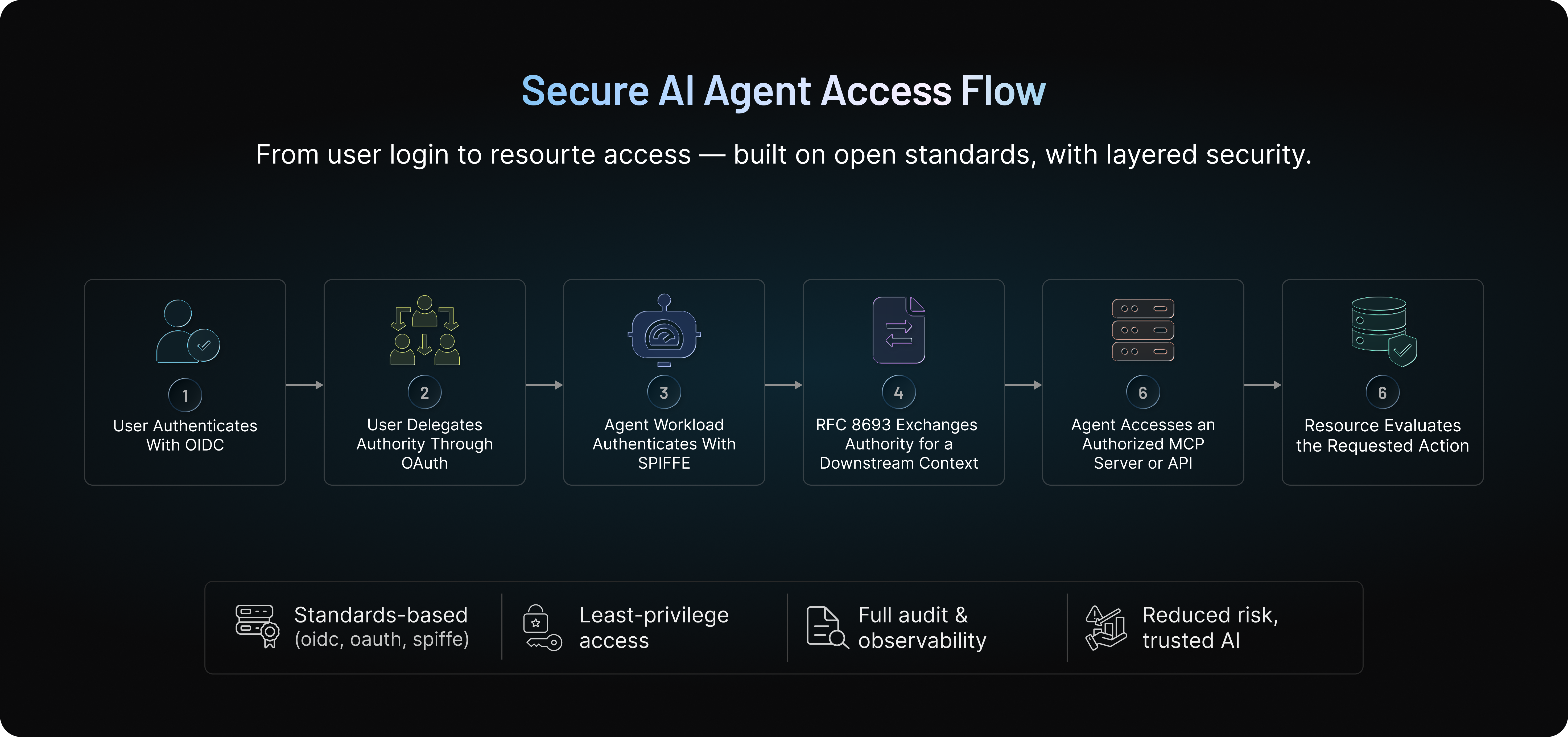
Authentication alone does not make an agent safe. Neither does an OAuth token, an MCP connection, or a cryptographic workload identity.
Standards establish trustworthy identity and authorization signals. Policy still decides how much agency the system should grant.
Apply Zero Trust to AI Agents Across Identity, Authorization, Execution, and Governance
An authenticated AI agent should not automatically become a trusted AI agent.
That principle is familiar from Zero Trust: access should depend on explicit verification, appropriate authorization, and the context of the request rather than assumed trust based on network location or a previous authentication event.
AI agents make this principle especially relevant because their behavior can change from one action to the next. An agent may legitimately read an order at 10:00 and attempt to issue an unusually large refund at 10:02. Both requests come from the same authenticated identity. They do not carry the same risk.
For agentic systems, Zero Trust needs to extend beyond “Can this identity access this application?” toward “Should this agent be allowed to perform this specific action under these conditions?”
A useful architecture separates that problem into four security layers.
Layer 1: Verify the Agent and the Principal Behind the Request
The identity layer establishes who or what is participating in the workflow.
Depending on the use case, that may include a human user, an application, an AI agent, or another workload. When an agent acts for a person, the system should preserve enough context to distinguish the agent from the principal that delegated authority.
The objective is attribution: Human Principal → AI Agent Identity → Request
Security controls should be able to establish both identities rather than collapsing them into a shared account.
Authentication is the starting point. It does not determine whether the requested action should proceed.
Layer 2: Limit What the Agent Is Authorized to Access
The authorization layer defines the agent's boundaries.
Instead of granting broad access because an agent belongs to a trusted application, permissions should reflect the task it is expected to perform.
A customer-support agent might be allowed to: Read Order → Check Delivery → Prepare Refund Request
without automatically receiving authority to: Change Customer Identity → Export Account Data → Issue Unlimited Refund → Modify Payment Method
The same principle applies when agents delegate work. Downstream agents and services should receive the authority required for their part of the workflow, not every permission held by the upstream actor.
This is conventional least privilege applied carefully to an environment where authority can travel across several automated actors.
Layer 3: Re-Evaluate Sensitive Actions at Execution Time
This is where Zero Trust becomes particularly useful for AI agents.
An agent may have legitimate access to a tool while a particular use of that tool is still inappropriate.
Suppose a financial agent is permitted to initiate transfers. A request for $50 to a previously used recipient may fall within established policy. A $25,000 transfer to a new recipient could require a very different decision.
Instead of treating authorization as a one-time gate: Authenticate → Authorize Agent → Trust Everything Until Session Ends
the system can evaluate consequential actions closer to execution: Agent Requests Action → Evaluate Identity + Scope + Resource + Context + Risk → Allow, Deny, or Escalate
Relevant context can include the requested action, resource sensitivity, transaction value, current permissions, delegation chain, user state, or other available risk signals.
The model's confidence should not substitute for this decision. An agent saying “I am 98% confident the user wants this” is not authorization.
Trigger Step-Up Authentication When User Assurance Is No Longer Sufficient
Sometimes the agent's authority is valid, but the operation requires stronger assurance about the human behind it.
That is where step-up authentication can help.
A customer may already have an authenticated session when they ask an agent to perform a sensitive task. Rather than forcing strong authentication for every low-risk interaction, the application can request additional verification when the action crosses an established threshold.
For example: Agent Requests Sensitive Action → Policy Detects Higher Risk → Step-Up Authentication → User Verifies → Action Continues
This keeps routine agent interactions relatively frictionless while protecting higher-impact operations.
The trigger should come from policy, not from the agent deciding for itself whether stronger authentication is necessary.
Use Human-in-the-Loop Approval for Consequential Actions
Some actions need more than stronger authentication. They need an explicit human decision.
Human-in-the-loop (HITL) controls are useful when an agent reaches an action with substantial financial, privacy, security, or operational consequences.
Consider: Agent Prepares Refund → User Reviews Amount and Recipient → User Approves → Refund Executes
The human is not required to supervise every reasoning step. Approval is inserted at the point where the consequence becomes meaningful.
That distinction helps avoid two extremes: unrestricted autonomy and constant approval prompts.
Low-risk tasks can remain autonomous. Higher-risk actions can require explicit approval.
Layer 4: Make Agent Authority Observable and Revocable
Zero Trust does not end when access is granted.
Organizations need enough visibility to determine whether an agent continues to operate within expected boundaries and enough control to stop it when necessary.
For consequential actions, audit records should help reconstruct:
Who initiated the task → Which agent acted → What authority it had → Which resource it accessed → What action was requested → What policy decision was made → What happened
This makes policy decisions as important to the audit trail of the agent activity as authentication events.
Revocation completes the model. If an agent is compromised, behaves unexpectedly, or no longer needs access, security teams should be able to remove its authority without waiting for every existing credential to expire naturally.
Zero Trust Changes “Trusted Agent” Into “Verified Action”
Calling an AI agent “trusted” can create the wrong mental model.
An agent may have a valid identity. It may come from an approved application. Its credentials may be legitimate. None of those facts means every future action should automatically be allowed.
A stronger model is: Verify Identity → Validate Authority → Evaluate Action → Enforce Policy → Observe Result
And repeat when the risk justifies it.
This matters because AI agents are probabilistic systems operating against deterministic business boundaries. The agent can reason about what it believes should happen. Security policy still decides what may happen.
That leads to a principle that goes beyond conventional least privilege. Securing agentic systems requires limiting not only what an agent can access, but also how much independent authority it can exercise once access is granted.
Apply Least Agency to Limit How Much Autonomy an AI Agent Can Exercise
Least privilege asks a familiar security question: What resources should this identity be allowed to access?
AI agents introduce another question: How much independent action should this agent be allowed to take with that access?
Those questions sound similar, but they control different things.
An agent might have perfectly reasonable permission to access a customer account and still have too much freedom in how it uses that permission. It could make repeated changes, chain several tools together, delegate work to another agent, or perform an irreversible operation without asking anyone.
That is why agentic security benefits from an additional principle: Least Agency.
Least Agency means giving an AI agent only the autonomy, tools, authority, duration, and execution freedom required to complete its intended task. The objective is not to eliminate autonomy. It is to prevent autonomy from becoming broader than the business purpose justifies.
Least Privilege Controls Access; Least Agency Controls Autonomy
Consider a customer-service agent with permission to access refund functionality.
Least privilege might restrict it to: Read Order + Create Refund
That is useful, but several questions remain unanswered. How large can the refund be? Can the agent issue one without confirmation? Can it process hundreds in succession? Can it send the task to another agent? Can it change the destination of the refund? How many tools can it invoke before completing the task?
Least Agency addresses those boundaries.
| Least Privilege | Least Agency |
|---|---|
| Which resources can the agent access? | How independently can the agent act? |
| Which API permissions does it receive? | Which actions can it initiate without approval? |
| Which data can it read or modify? | How much data can it process in one task? |
| Which tools can it access? | Which tools can it chain together? |
| Which operations are permitted? | What limits apply to those operations? |
| How broad is its authorization? | How far can it delegate or continue autonomously? |
An agent can therefore satisfy least privilege while still violating Least Agency.
Restrict the Tools an Agent Can Select
Tool access determines much of an agent's real-world capability.
An agent that needs to answer order-status questions might require access to an order lookup tool. It probably does not need a customer-deletion function, database administration capability, or arbitrary shell access.
But simply controlling which tools appear is not always enough. Tools may expose several operations. An agent could legitimately need one operation while others should remain unavailable.
A stronger boundary is: Agent → Approved Tool → Approved Operation → Approved Resource
This limits the execution surface without forcing the model to make security decisions on its own.
Put Boundaries Around Multi-Step Execution
Agent autonomy often comes from its ability to create and execute plans.
A user gives the agent a goal, and the agent determines the intermediate steps. That flexibility is valuable, but unrestricted chains can make failures harder to contain.
Organizations can place limits around factors such as the number of tool calls, workflow duration, amount of data retrieved, transaction value, number of affected resources, or whether the agent can execute destructive operations.
For example: Retrieve Order → Check Eligibility → Prepare Refund
may be allowed autonomously.
But: Retrieve 10,000 Accounts → Modify Records → Export Results → Notify External Service
should not become acceptable simply because each individual tool call is technically permitted.
Security needs to consider the cumulative effect of the workflow.
Limit How Far Agents Can Delegate Authority
Multi-agent systems make Least Agency especially important.
Suppose Agent A is authorized to complete a customer request and decides to delegate one step to Agent B. Agent B should receive only the authority required for that specific subtask.
Prefer: User → Agent A → Limited Task → Agent B → Specific Resource
over: User → Agent A → Full Authority → Agent B
Delegation depth itself can also become a control. Some workflows may allow one downstream agent. Higher-risk environments may prohibit autonomous delegation entirely unless explicitly approved.
The key principle is that adding another agent should not silently expand the original authority.
Match Autonomy to the Consequence of the Action
Not every AI task deserves the same level of independence.
A useful autonomy model is: Observe → Recommend → Act With Approval → Act Within Limits → Act Autonomously
An agent analyzing public documentation might operate near the autonomous end. An agent preparing a payment could recommend the transaction but require approval before execution.
The right position depends on the consequence of failure.
As financial impact, data sensitivity, irreversibility, privilege, or operational impact increases, independent agency should generally decrease.
This gives security teams a better question than “Should we allow AI agents to act autonomously?”
Ask instead: Which actions can this agent perform autonomously, within what limits, and where must control return to a human or policy enforcement point?
Design for Bounded Failure
No combination of prompt filtering, model evaluation, or testing can guarantee that an AI agent will always make the intended decision.
Least Agency assumes that unexpected decisions will eventually occur and limits what those decisions can affect.
If an agent is manipulated, compromised, or simply wrong, bounded authority can prevent one failure from becoming a much larger incident.
The architecture moves from: Agent Makes Decision → Agent Has Access → Action Happens
toward: Agent Makes Decision → Authority and Limits Checked → Action Happens Within Defined Boundary
That is the practical value of Least Agency.
Least privilege reduces the agent's access surface. Least Agency reduces its autonomy surface. Agentic systems need both.
Control High-Risk AI Agent Actions With Runtime Policies, Step-Up Authentication, and Human Approval
Permissions tell an AI agent what it can potentially access. Runtime controls determine whether a particular action should actually proceed.
That distinction becomes critical when agents can perform consequential operations. A support agent may legitimately have refund capability. A DevOps agent may be authorized to deploy code. An account-management agent may be able to change customer information.
None of those permissions should automatically make every possible use of the capability acceptable.
The execution layer needs to evaluate the action in context.
Define Which Agent Actions Are High Risk
Organizations first need to identify operations where a mistake, compromised agent, or manipulated instruction could create meaningful harm.
Common examples include financial transactions, large refunds, account deletion, credential changes, permission changes, sensitive-data exports, production deployments, creation of privileged accounts, and modifications to security controls.
Risk depends on context as well as action type.
A $10 refund and a $10,000 refund may use the same API. Exporting one customer's record and exporting an entire customer database may invoke the same underlying tool. Changing a profile preference is very different from changing the email address used for account recovery.
So rather than classifying an entire tool as simply safe or dangerous, policies should evaluate the specific operation and its parameters.
Evaluate the Action Immediately Before Execution
Agent reasoning can involve several intermediate steps. The security decision should happen as close as practical to the consequential operation.
A useful execution path is: Agent Requests Action → Policy Evaluates Request → Allow, Deny, or Escalate → Action Executes
The policy can consider available signals such as: Agent identity + delegated authority + requested resource + operation + transaction value + data sensitivity + current session assurance + risk context
This prevents an earlier authorization decision from becoming a blanket approval for everything the agent subsequently decides to do. It also keeps enforcement outside the model.
The agent can propose an action. The policy layer decides whether that action is permitted.
Use Different Controls for Different Levels of Risk
Not every agent action needs human intervention. Requiring approval for routine operations would remove much of the value of autonomous agents.
A tiered model works better.
| Agent Action | Example | Appropriate Control |
|---|---|---|
| Low-risk read | Search public documentation | Autonomous |
| Scoped account read | Retrieve user's own order | Scoped authorization |
| Low-impact change | Update a non-sensitive preference | Runtime policy |
| Sensitive account change | Change recovery information | Step-up authentication |
| Sensitive data operation | Export confidential records | Step-up and/or approval |
| Financial action | Large refund or transfer | Explicit approval based on policy |
| Privilege change | Grant administrative access | Strong verification + explicit approval |
| Destructive action | Delete an account or critical resource | Explicit verification before execution |
The exact thresholds will vary by organization and use case. What matters is that the controls become stronger as the consequence of an incorrect action increases.
Trigger Step-Up Authentication When Stronger User Assurance Is Needed
An agent may receive a valid instruction from an authenticated user while the requested operation still requires stronger assurance.
For example, a customer could ask an agent to change the email address associated with account recovery. Rather than allowing the agent to execute that request based solely on an existing session, policy can require additional authentication.
The flow becomes: Agent Requests Sensitive Action → Policy Requires Higher Assurance → User Completes Step-Up → Agent Continues
Step-up authentication is especially useful when the concern is whether the person authorizing the action has been sufficiently verified.
That is different from human approval.
Require Human Approval When the Decision Itself Needs Confirmation
Some actions require a person not only to authenticate again, but to review what the agent intends to do.
Suppose an agent prepares a bank transfer. The user may need to see the recipient, amount, and relevant details before explicitly approving execution.
Agent Prepares Action → Human Reviews Exact Action → Human Approves → Execution Layer Revalidates → Action Executes
The approval should correspond to the operation being performed.
A generic “Allow this agent?” prompt provides much weaker protection than: Approve ₹50,000 transfer to Account X?
The closer approval is bound to the actual resource, action, and parameters, the harder it becomes for an agent to reuse that approval for something else.
Revalidate After Approval Before Executing
Approval should not bypass the rest of the security architecture.
The system should verify that the action being executed still matches what was approved. If the recipient, amount, resource, scope, or other security-relevant parameter changes after approval, the previous authorization should not silently carry over.
Prefer: Action Prepared → Approved → Action Revalidated → Execute Exact Approved Operation
This reduces the risk of a gap between what the human saw and what the agent ultimately sends to the downstream system.
Put Hard Limits Around Irreversible or High-Impact Operations
Some boundaries should not depend entirely on model reasoning or human attention.
Agents can operate within explicit transaction limits, rate limits, resource boundaries, spending limits, data-volume thresholds, or prohibited-action policies.
For example: Refund Agent → Maximum Autonomous Refund: $100
Requests above that threshold can be escalated. Extremely sensitive operations might be prohibited for autonomous execution altogether.
Hard boundaries are useful because they remain enforceable even when the agent's reasoning is manipulated.
Treat Denied Actions as Security Signals
A blocked request should not disappear into an application log.
Repeated attempts to invoke prohibited tools, access unusual resources, exceed transaction limits, or trigger high-risk operations may indicate prompt manipulation, compromised credentials, misconfiguration, or unexpected agent behavior.
A pattern such as: Normal Activity → Repeated Policy Denials → New Tool Attempts → Privilege-Seeking Behavior
deserves investigation even if every individual request was successfully blocked.
Runtime enforcement therefore does two jobs. It prevents unsafe actions, and it produces signals about how agents are behaving.
The objective is not to put a human in front of every agent decision. It is to ensure that the consequences of an action determine how much verification that action requires.
Routine work can remain autonomous. Sensitive actions receive stronger verification. High-impact actions can return control to a human. And some actions simply should not be available to the agent at all.
Monitor, Audit, and Respond to AI Agent Activity Across the Complete Action Chain
Preventing every unsafe AI agent action is unrealistic. Security teams also need to detect unusual behavior, investigate incidents, and quickly remove authority when something goes wrong.
That requires more than recording whether an API returned 200 OK.
An agent action may involve a human principal, an agent identity, delegated authority, several tool calls, a policy decision, and a downstream resource. If those events are logged independently without a common trail, reconstructing an incident becomes difficult.
The audit record should preserve the chain.
Who Initiated the Task → Which Agent Acted → What Authority Was Used → Which Resource Was Accessed → What Action Was Requested → What Policy Decision Was Made → What Happened
This gives security teams something traditional application logs often lack: the context behind the action.
Preserve the Principal, Agent, and Delegation Context
When an agent acts on behalf of a user, logging only the user identity hides the agent that actually performed the operation.
Logging only the agent creates the opposite problem. Investigators can see the machine actor but not whose authority it was using.
For delegated agent workflows, the audit trail should preserve both where possible:
Principal: Customer A
Agent: Support Agent 17
Delegated Authority: Refund Orders
Resource: Order 58421
Action: Issue Refund
Policy Decision: Allowed
Result: $75 Refunded
Multi-agent workflows may need another layer.
If Agent A delegates part of a task to Agent B, the system should retain enough context to reconstruct that delegation rather than making Agent B's request appear unrelated.
This becomes especially valuable when authority crosses several services.
Log Security Decisions, Not Just Successful Actions
Execution logs tell investigators what happened. Policy logs help explain why it was allowed to happen.
For sensitive operations, useful records can include the agent identity, principal or delegating actor, requested action, resource, relevant scope, policy decision, approval status, execution result, and timestamp.
If a step-up authentication or human approval occurred, that event should be associated with the action it authorized.
This makes it possible to distinguish: Action Allowed Because Policy Permitted It
from: Action Allowed After Additional Human Approval
and: Action Attempted but Denied
Denied actions matter too. In some cases, they are the strongest indication that an agent is behaving unexpectedly.
Monitor Agent Behavior, Not Only Authentication Events
A valid login followed by unusual behavior is still unusual behavior. Agent monitoring should therefore look beyond authentication and examine how authority is being used.
Useful signals can include unexpected tool selection, unusual API call volume, repeated policy denials, sudden increases in high-risk actions, abnormal resource access, new delegation patterns, excessive retries, unusual transaction values, or attempts to invoke capabilities outside the agent's normal role.
Consider: Known Agent → Valid Credential → Unusual Tool Calls → Repeated Policy Denials → Sensitive Resource Attempts
Nothing in that sequence necessarily indicates an authentication failure. Together, however, the events may justify investigation or automatic containment.
Baselines can help here. A billing agent that suddenly begins accessing identity-management APIs is more interesting than the same agent making its normal billing requests.
Correlate Events Across Multi-Agent Workflows
Monitoring becomes harder when one task involves several agents and services.
Imagine: Customer → Travel Agent → Flight Agent → Booking API
If the booking is incorrect, investigators need more than the final API call. They need to understand which agent initiated the downstream request, what authority was delegated, and whether that authority changed along the way.
Correlation identifiers can help connect events across the workflow so that security teams can reconstruct the complete path rather than searching through isolated logs.
This becomes even more important when agents communicate asynchronously or when one task triggers several parallel agents.
Protect the Audit Trail From the Agent Itself
An agent should not have unrestricted ability to alter the records used to investigate its behavior.
Security-relevant logs should be sent to infrastructure outside the agent's direct control, with access controls and retention policies appropriate to the organization's security and compliance requirements.
Sensitive information also needs care. Logging complete prompts, tokens, secrets, personal information, or raw tool parameters indiscriminately can turn the monitoring system into another data-exposure risk.
The objective is useful traceability without unnecessary sensitive-data collection.
Build Multiple Levels of Revocation and Containment
When suspicious behavior is detected, security teams need a way to interrupt the agent.
A single global kill switch is useful, but it may be unnecessarily disruptive. Mature architectures can provide containment at several levels:
Access Token → Agent Credential → Delegated Grant → Tool Access → Agent Identity
The appropriate response depends on the incident.
A leaked access token may require token revocation. A compromised delegated grant may need that grant removed while the agent remains active for other users. A malicious tool may need to be disconnected across several agents. A compromised agent identity may need to be suspended entirely.
Granular containment reduces the pressure to choose between doing nothing and shutting down the whole agent platform.
Define What Happens When Security Controls Fail
Agent architectures also need predictable failure behavior.
What happens if the authorization service cannot be reached? What if an approval record cannot be validated? What if security logging fails during a high-risk operation?
For consequential actions, silently proceeding can defeat the entire control architecture.
High-risk workflows should therefore define which failures must fail closed and which lower-risk operations can safely continue under degraded conditions.
The decision should be made during architecture design, not during an incident.
Use Auditability to Answer the Questions That Matter After an Incident
A useful agent audit trail should allow an investigator to move from an unexpected outcome back through the authority chain.
For example: Why was this customer record deleted?
The system should help answer: Which agent deleted it?
Who initiated or authorized the task?
Which credential and delegated authority were used?
Which tool performed the operation?
Which policy allowed it?
Was additional approval required?
Were there unusual actions before or after it?
Without that context, organizations may know that an incident occurred but still struggle to determine why. AI agent security therefore needs to be observable by design.
Identity establishes who acted. Authorization establishes what was permitted. Runtime controls govern what could execute. Auditability preserves the evidence connecting all three.
That evidence is what allows security teams to investigate, contain, and improve the system after deployment.
AI Agent Security Implementation Checklist for Production Environments
A secure AI agent architecture is easier to build when identity, authorization, runtime controls, and monitoring are planned before deployment rather than added after incidents occur.
The checklist below turns the principles from this guide into a practical rollout sequence.
Phase 1: Establish Identity and Ownership
Before an agent receives any permissions, make sure it has a clear identity and owner.
-
Assign a unique identity to every production agent.
-
Record the business or technical owner.
-
Document the agent's purpose and expected behavior.
-
Inventory connected tools, APIs, and downstream services.
-
Classify the data the agent may access.
-
Define how the agent will be suspended or revoked if necessary.
Phase 2: Grant Only the Authority the Agent Needs
Permissions should match the task—not the maximum capability of the platform.
-
Use scoped, short-lived credentials where possible.
-
Remove shared accounts and embedded secrets.
-
Limit API permissions to required resources.
-
Restrict which tools the agent can invoke.
-
Define delegation boundaries for downstream services.
-
Identify actions that should never execute autonomously.
Phase 3: Secure Runtime Execution
Every consequential action deserves an independent policy decision.
-
Evaluate authorization immediately before execution.
-
Apply runtime policy checks to sensitive operations.
-
Trigger step-up authentication when stronger user assurance is required.
-
Require human approval for high-impact actions.
-
Enforce transaction, spending, or execution limits.
-
Revalidate critical actions before they reach downstream systems.
Phase 4: Monitor, Audit, and Improve
Security does not end after deployment.
-
Log the complete principal-to-agent action chain.
-
Monitor unusual tool usage and authorization patterns.
-
Investigate repeated policy denials.
-
Rotate credentials and review permissions regularly.
-
Remove unused agents and stale delegated grants.
-
Test revocation procedures before an incident requires them.
A Production Readiness Snapshot
| Security Area | Deployment Question |
|---|---|
| Agent Identity | Does every agent have its own identifiable identity? |
| Ownership | Is a responsible owner documented? |
| Authorization | Are permissions limited to the intended task? |
| Delegation | Can authority be constrained downstream? |
| Tool Access | Are tool operations appropriately restricted? |
| Runtime Policy | Are sensitive actions evaluated before execution? |
| Human Approval | Do high-impact actions require additional verification? |
| Monitoring | Can unusual behavior be detected? |
| Audit | Can the complete action chain be reconstructed? |
| Revocation | Can agent authority be removed quickly? |
The Security Flow in One Line
A mature AI agent security program follows a repeatable sequence rather than relying on a single defensive control.
Identify → Authenticate → Delegate → Authorize → Execute → Observe → Revoke
Each step reinforces the next. Identity establishes who is acting, delegated authority defines what is permitted, runtime controls govern what may execute, and observability ensures those decisions remain explainable after deployment.
That sequence becomes especially important as organizations move from individual AI assistants to interconnected agent ecosystems where multiple agents, tools, APIs, and workloads participate in the same workflow.
How LoginRadius Helps Secure AI Agents With Scoped Authorization, Human Oversight, and End-to-End Auditability
Securing AI agents becomes much harder when identity, delegation, token management, tool authorization, approvals, and auditing are handled by separate systems.
LoginRadius Agentic IAM brings these controls into an identity and authorization layer designed for agents that act independently or on behalf of users.
The objective is not to control how the model reasons. It is to control the authority available when that reasoning turns into an action.
A typical flow looks like this:
Human Principal → AI Agent Identity → Delegated Authority → Tool or API → Policy Decision → Action → Audit Record
That creates security boundaries before execution while preserving enough context to understand what happened afterward.
Manage AI Agents as Distinct, Governed Identities
LoginRadius can assign AI agents identities independent of the users and applications they interact with.
This avoids forcing every agent into a shared service account or making it indistinguishable from the human whose authority it is using.
Agent identities can be registered and managed through their lifecycle, while associated access can be revoked when an agent is compromised, retired, or no longer requires a particular capability.
This gives organizations a clearer separation between: Who requested the task → Which agent performed it → What authority the agent received
That separation becomes particularly important as multiple agents begin operating for the same customer or across the same APIs.
Issue Short-Lived, Scoped Access Instead of Broad Agent Credentials
LoginRadius supports centralized issuance, rotation, refresh, and revocation of agent access tokens.
Rather than giving an agent a broadly privileged credential that remains useful across unrelated tasks, access can be scoped around the resources and actions the agent needs.
For delegated workflows, authorization context can preserve both the user and agent while limiting the scope and duration of the access being granted.
Downstream services can also use token exchange where appropriate so the original authority does not need to be forwarded unchanged through the entire workflow.
This helps move agent access toward: Specific Agent + Specific Authority + Specific Resource + Limited Duration
rather than: Agent + Permanent API Key + Broad Access
Enforce Authorization at the Tool and Action Level
An agent may legitimately have access to a system without being permitted to perform every operation that system exposes.
LoginRadius supports fine-grained authorization policies that can constrain access by agent, scope, action, and other available authorization context.
That becomes useful for MCP servers and APIs exposing several capabilities.
For example, an agent might be allowed to: Read Booking → Search Flights → Prepare Reservation
while remaining unable to: Cancel Booking → Change Payment Details → Issue Refund
Authorization therefore stays between the agent's decision and the downstream operation.
The agent can request an action. Having access to the tool does not have to mean unrestricted authority to use every capability behind it.
Secure MCP Access With Scoped, Delegated Authorization
For MCP-connected environments, LoginRadius can function as an authorization server between AI clients, agents, MCP servers, tools, and downstream APIs.
Agents can receive scoped tokens rather than user credentials, with permissions restricted to the tools or actions they are authorized to invoke.
Where a downstream API needs different authorization context, RFC 8693 Token Exchange can be used as part of the delegation flow.
A simplified path is: User Authorization → Agent → Scoped MCP Access → Tool → Downstream Scoped Access
This allows authorization to remain explicit as the request moves through the agent ecosystem instead of assuming that connection to an MCP server establishes trust.
Add Human Oversight When Agent Actions Cross Risk Boundaries
Not every agent operation needs manual approval.
LoginRadius can introduce additional verification when a sensitive action reaches a defined security boundary. Depending on the workflow, that can include human approval, re-approval, or stronger authentication before execution continues.
For example: Agent Requests High-Risk Action → Policy Requires Additional Verification → Human Reviews or Verifies → Action Continues or Is Denied
This allows low-risk automation to continue without putting a human into every interaction while preserving human control over consequential operations.
Revoke Agent Authority When Risk Changes
Agent authorization should not become permanent simply because access was valid when it was first issued.
LoginRadius supports centralized token and access revocation so authority can be removed when an agent becomes compromised, its role changes, a delegated relationship ends, or security policy no longer permits the operation.
That gives teams a direct containment path rather than waiting for broad, long-lived credentials to expire.
For autonomous systems operating at machine speed, the ability to remove authority quickly is as important as granting it correctly in the first place.
Make Auditability the Foundation of Agent Accountability
The biggest operational challenge may appear after an agent has already acted.
Imagine discovering that an AI agent changed a customer's account, invoked a sensitive tool, or initiated an unexpected transaction.
Security teams need more than: API Request: Successful
They need to understand the authority chain behind it.
LoginRadius provides visibility into agent activity, token usage, authorization decisions, and delegation context so teams can trace actions back to the identities and permissions involved.
A useful audit trail should help answer:
Who initiated the task?
Which agent acted?
On whose behalf was it operating?
What authority did it receive?
Which tool or resource did it access?
What action was requested?
What policy allowed or denied it?
That is where identity becomes accountability.
When an agent performs an unexpected action, security teams should not have to reconstruct its authority from scattered authentication, application, API gateway, and tool logs.
Agent security works better when attribution is part of the architecture from the beginning.
Move From Agent Access to Governed Agent Authority
Giving an AI agent access to an API is relatively easy.
Determining which agent received that access, whose authority it represents, what it can do, when additional approval is required, and how every action can later be investigated is the harder problem.
LoginRadius Agentic IAM is designed around those identity and authorization boundaries:
Agent Identity → Scoped Authority → Policy Enforcement → Human Oversight → Action-Level Auditability → Revocation
That allows organizations to adopt agentic workflows without treating autonomous agents as permanently trusted applications or invisible extensions of user accounts.
As agents gain more capability, the security architecture can keep authority bounded, attributable, and revocable.
Conclusion: Secure the Agent’s Authority, Not Just the AI Model
AI agent security changes the question security teams need to ask. It is no longer enough to ask, “Can we prevent the model from making a bad decision?”
The harder question is: “What happens when the agent makes one?”
An agent should not be able to turn a manipulated prompt, unexpected decision, or compromised workflow directly into an unrestricted enterprise action. Its identity should be known. Its authority should be limited. Sensitive actions should face independent policy checks. High-impact decisions should return to a human when necessary. And every consequential action should leave enough evidence to understand who acted, under whose authority, and why it was allowed.
That is how organizations can move toward useful autonomy without giving agents invisible or permanent trust.
Identity → Scoped Authority → Runtime Enforcement → Human Oversight → Auditability → Revocation
As AI agents gain access to customer data, APIs, MCP servers, and business-critical workflows, these controls need to follow the agent wherever it acts.
LoginRadius Agentic IAM helps organizations manage agents as distinct identities, issue short-lived and scoped access, enforce fine-grained authorization, add human oversight to sensitive operations, and preserve traceable records of agent activity.
Ready to move your AI agents from broad access to governed authority?
Explore LoginRadius Agentic IAM to build AI agent workflows where access is scoped, actions are attributable, and authority can be revoked when risk changes.
Book a demo with LoginRadius to see how Agentic IAM can secure your AI agents before they move from experimentation into business-critical execution.
FAQs
Q: How do you secure an AI agent?
A: Secure AI agents with distinct identities, least-privilege access, scoped and short-lived credentials, runtime authorization, secure tool access, monitoring, and revocation. High-risk actions should also trigger step-up authentication or human approval.
Q: What are the biggest AI agent security risks?
A: Major risks include prompt injection, goal hijacking, excessive permissions, credential theft, tool abuse, memory poisoning, data exfiltration, unsafe delegation, supply-chain compromise, and excessive autonomy.
Q: How is AI agent security different from LLM security?
A: LLM security primarily protects models, prompts, data, and outputs. AI agent security extends those protections to identity, authorization, tools, delegation, execution, monitoring, and the real-world actions agents can perform.
Q: How does Zero Trust apply to AI agents?
A: Zero Trust means an authenticated agent is not automatically trusted to perform every action. Identity, authority, resource, context, and risk should be evaluated before sensitive operations are allowed to execute.
Q: Why do AI agents need separate identities?
A: Separate identities make agents individually authenticatable, governable, revocable, and auditable instead of hiding them behind shared accounts or user credentials. They also help trace which agent performed a specific action and under whose authority.
Q: How does OAuth 2.1 help secure AI agents?
A: OAuth-based authorization can give agents scoped, limited access to APIs without exposing a user's primary credentials. Combined with appropriate token policies, it helps constrain what an agent can access and do on a user's behalf.
Q: How do you secure MCP access for AI agents?
A: Protect MCP access with authenticated clients, scoped authorization, least-privilege tool permissions, short-lived tokens, and policy enforcement at sensitive operations. High-impact tool calls can require additional user verification or approval.
Q: When should AI agents require human approval?
A: Human approval is most useful for consequential actions such as large payments, account deletion, privilege changes, sensitive-data exports, or production changes. Low-risk actions can remain autonomous within defined security boundaries.