
Introduction
Cloud access control doesn’t usually fail in dramatic ways. There’s no sudden outage. No obvious breach banner. Most of the time, it fails quietly, one extra permission here, one reused role there until the blast radius is much larger than anyone expected.
That’s why access control in cloud security has become such a high-stakes topic. As organizations move deeper into AWS, Azure, and GCP, identity becomes the control plane. Every user action, service call, deployment pipeline, and third-party integration passes through some form of access decision. When those decisions are loose, inconsistent, or outdated, security problems don’t announce themselves—they accumulate.
Role-Based Access Control feels like the obvious answer. It’s familiar. It’s structured. And in theory, it scales. Concepts like aws rbac, Azure role-based access, and GCP IAM roles all promise the same thing: clear permissions tied to clear responsibilities. But here’s the uncomfortable truth: RBAC in the cloud behaves very differently from RBAC on paper.
Cloud environments change constantly. Teams spin up new services. CI/CD pipelines gain permissions. Temporary access becomes permanent because no one circles back. Over time, what started as a clean role-based access control implementation turns into permission sprawl, fragile policies, and roles nobody fully understands.
This is where many teams get stuck. They have RBAC, but they don’t trust it. They hesitate to remove access. They rely on broad roles for speed. And slowly, cloud security access control shifts from a guardrail into a liability.
In this guide, we’ll look at how RBAC actually works across AWS IAM, Azure RBAC, and GCP IAM not as theory, but as it shows up in real environments. We’ll explore where each platform shines, where teams usually slip, and how to design role-based security that holds up as your cloud footprint grows.
Not perfectly. But reliably.
Why access control feels harder in the cloud
Access control didn’t suddenly become complicated. The environment did.
In the cloud, everything moves faster than the systems meant to protect it. New services launch weekly. Teams spin up resources on demand. Automation replaces manual work. And every one of those changes introduces new identities and new permission paths. This is why access control in cloud security feels heavier than it used to even when teams are doing “the right things.”
On-prem access models assumed stability. Cloud platforms assume motion. Users aren’t just employees anymore; they’re services, pipelines, workloads, vendors, and integrations. Each one needs access, often temporarily, often across environments. Multiply that by regions, accounts, and subscriptions, and the permission graph grows quickly.
Here’s the part most teams underestimate: cloud access issues rarely show up as failures. They show up as drift. A role gets reused for convenience. A permission was added “just in case.” A temporary exception is never removed. Over time, cloud security access control weakens without a single moment of collapse.
This is why cloud access control feels harder. Not because RBAC is flawed but because the cloud never stops changing, and access models that don’t adapt quietly fall behind.
RBAC as a design problem, not a configuration task
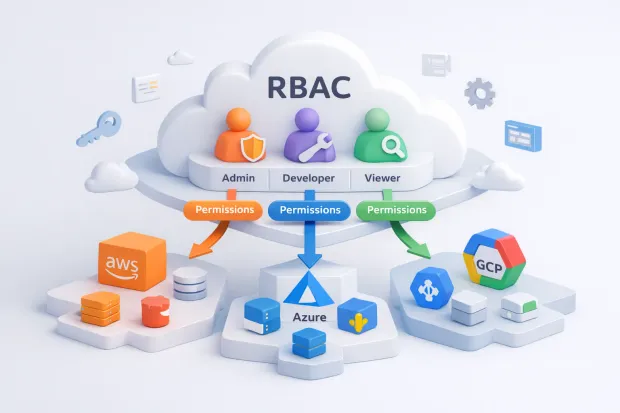
RBAC is often treated like a setup step. Create roles. Assign permissions. Move on.
That approach works briefly and then unravels.
Effective role-based access control implementation starts long before anyone clicks through an IAM console. It starts with understanding how work actually happens. Not how org charts look. Not how teams are named. But how responsibilities flow through systems.
When RBAC is designed around people, it breaks the moment teams change. When it’s designed around responsibilities, it scales. Deployment engineers deploy. Support teams troubleshoot. Security teams investigate. Each of these activities has a predictable access pattern and that’s where roles should come from.
Here’s where teams usually go wrong: they optimize for speed instead of clarity. Broad roles get created to unblock work. Over time, those roles absorb more permissions than intended. Eventually, no one is sure what’s safe to remove.
RBAC works best when it’s treated as architecture, not configuration. Roles have owners. Scopes are intentional. Exceptions are visible. Without that design discipline, even the best tooling can’t prevent permission sprawl.
AWS RBAC: powerful, flexible, and easy to overdo
AWS gives teams immense freedom and that freedom cuts both ways.
At its core, AWS RBAC is built around IAM roles and policies. Roles define who or what can act. Policies define what actions are allowed. On top of that, AWS adds resource-based policies, permission boundaries, and organization-level guardrails. Each layer exists for a reason.
The challenge is that all of them can grant access independently.
This flexibility makes AWS incredibly powerful for complex environments, but it also makes over-permissioning easy. Teams reuse roles across environments. Policies grow organically instead of being redesigned. Wildcards sneak in for speed. Suddenly, role-based access control AWS exists but it’s fragile.
Strong AWS RBAC follows a few quiet principles. Humans assume roles instead of owning credentials. Roles are scoped to environments. Guardrails exist to prevent mistakes, not just detect them later. Most importantly, roles are revisited as systems evolve.
AWS IAM rewards teams that think in layers and intent. It punishes teams that treat policies like static documents. The difference isn’t expertise, it's discipline.
Azure role-based access: clean structure, risky defaults
Azure’s RBAC model is easier to visualize than most. Access flows through a clear hierarchy from management groups to subscriptions, to resource groups, to individual resources. Role assignments at each level determine what actions are allowed.
That clarity is a strength. Azure role-based access makes it obvious where permissions apply. But clarity doesn’t prevent misuse, it just hides it better.
Many teams rely heavily on built-in roles like Owner and Contributor because they work instantly. Projects move faster. Fewer permission errors surface. The risk only appears later, when too many people can change too much, too easily.
Azure RBAC breaks down when scope boundaries aren’t treated as security boundaries. Assigning broad roles at a high level in the hierarchy silently multiplies risk. Custom roles can help, but only if they’re managed carefully. Otherwise, they become just another source of sprawl.
Azure RBAC works best when access feels slightly inconvenient. When teams have to think about scope. When elevated permissions are deliberate. When role-based security is treated as an ongoing responsibility not a one-time setup.
GCP IAM: RBAC with conditions and context
GCP takes a slightly different approach to RBAC and in many ways, it’s the most opinionated of the three.
At its core, GCP IAM still relies on roles and permissions, but it strongly encourages precision. Instead of pushing teams to create endless custom roles, GCP leans on predefined roles combined with contextual controls. This is where IAM Conditions change the game.
With conditions, access decisions don’t depend only on who the identity is and what role it has, but also when and under what circumstances the request is made. Time windows, request attributes, resource tags, and other signals can all factor into whether access is granted. For teams struggling with role explosion, this model can feel refreshingly practical.
But context introduces its own discipline requirements.
Service accounts, in particular, demand careful attention. They power workloads, automation, and integrations and they often outlive the humans who created them. When service accounts accumulate permissions without ownership or review, they quietly become some of the most privileged identities in the environment.
GCP IAM works best when teams resist the urge to over-customize roles and instead focus on combining clear role definitions with narrowly scoped conditions. When done right, this approach supports role-based security without burying teams under maintenance overhead.
When done casually, it creates invisible risk.
Comparing RBAC across AWS, Azure, and GCP
On the surface, RBAC looks consistent across cloud platforms. Roles exist everywhere. Permissions exist everywhere. So do scopes. But the similarities can be misleading.
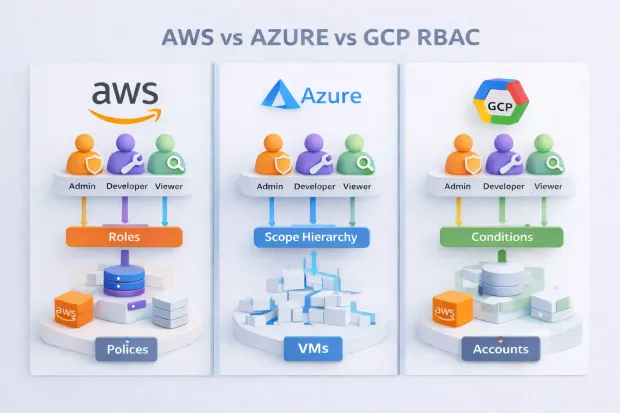
AWS emphasizes flexibility. Multiple policy types, layered controls, and account-level boundaries give teams freedom but also increase the chance of accidental overreach.
Microsoft Azure emphasizes structure. A clear hierarchy makes access easier to reason about, but broad roles assigned too high can silently multiply risk.
Google Cloud Platform emphasizes precision. Conditions and predefined roles reduce sprawl, but only if service accounts and ownership are managed carefully.
The mistake many organizations make is trying to standardize configurations across clouds. That never works. The winning approach is to standardize principles instead.
Least privilege. Clear ownership. Scoped access. Time-bound elevation. Regular review.
When those principles are consistent, the tooling differences stop being obstacles. Cloud security access control becomes portable in mindset even if the syntax changes.
Governance: where RBAC succeeds or quietly erodes
RBAC rarely fails loudly. It fades.
A role gets one extra permission to unblock a deployment. A contractor keeps access longer than planned. An emergency fix becomes a permanent exception. None of these events trigger alarms but together, they reshape your access model.
This is why governance matters more than initial design.
Strong governance doesn’t mean a heavy process. It means visibility. Who owns each role? Who approves changes? How often is access reviewed? What happens to permissions when someone leaves or when a system is decommissioned?
Without answers to those questions, access control in cloud security turns reactive. Teams hesitate to remove access because they’re unsure what will break. That hesitation is the real risk signal.
RBAC succeeds when teams feel confident in pruning permissions. It erodes when access only ever grows. Governance is the difference and it doesn’t require perfection, just consistency.
A realistic approach to implementing RBAC
Most RBAC projects fail because they try to be comprehensive on day one.
A realistic role-based access control implementation starts by acknowledging that you won’t get everything right upfront and that’s fine. The goal isn’t perfection. It’s control.
Successful teams begin with visibility. They inventory identities and permissions, then focus on the riskiest areas first privileged roles, cross-environment access, long-lived service accounts. Instead of redesigning everything, they introduce a small set of baseline roles and migrate gradually.
This phased approach aligns with how cloud environments actually evolve. It allows teams to learn, adjust, and refine without breaking workflows or losing trust internally.
Here’s the quiet metric that matters most: confidence. When teams trust their RBAC model enough to remove access without fear, implementation has succeeded.
That’s when implementing access control stops feeling like a security tax and starts feeling like a system that actually supports the business.
Conclusion
RBAC isn’t broken. What breaks is the assumption that once it’s implemented, the job is done.
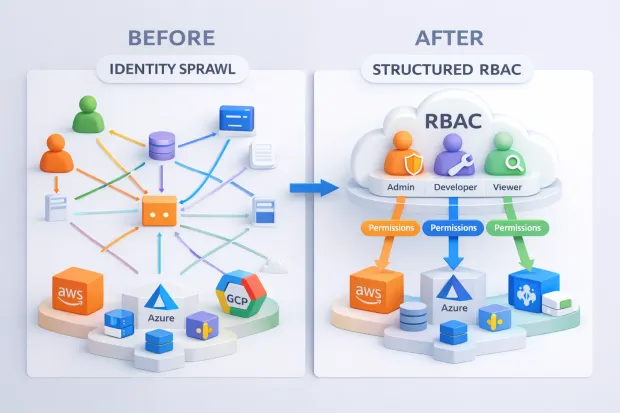
Across AWS, Azure, and GCP, the mechanics of access control differ, but the pattern is the same. Roles start small. Permissions expand. Exceptions pile up. And without deliberate governance, access control in cloud security slowly drifts away from its original intent.
That doesn’t mean RBAC has lost its value. In fact, role-based access control implementation remains one of the most effective ways to manage access at scale when it’s designed around real responsibilities, scoped carefully, and reviewed continuously. The cloud doesn’t make RBAC obsolete. It makes neglect visible.
Strong cloud security access control comes from a mindset shift. Roles aren’t static artifacts. They’re operational tools that need ownership, lifecycle management, and periodic cleanup. Least privilege isn’t a one-time goal, it's an ongoing negotiation between security and speed.
AWS IAM rewards layered thinking. Azure RBAC rewards disciplined scoping. GCP IAM rewards precision and context. None of them forgives indifference.
If there’s one practical takeaway, it’s this: RBAC should give you confidence to remove access, not fear of breaking things. When teams trust their access model enough to simplify it, security improves naturally.
That’s when role-based security stops being a compliance requirement and starts being a foundation you can actually build on. Book a Demo today.
FAQs
Q: Is RBAC still enough for cloud security?
A: RBAC is still the foundation of cloud security access control. Most teams extend it with conditions or attributes over time, but RBAC remains the starting point for managing permissions at scale.
Q: What’s the biggest RBAC mistake teams make in the cloud?
A: Granting broad roles for speed and never revisiting them. Over time, this creates permission sprawl and weakens role based security without anyone noticing.
Q: How does AWS RBAC differ from Azure and GCP?
A: AWS focuses on flexible policy layering, Azure emphasizes scoped role assignments, and GCP adds context through conditions. The principles stay the same, but execution varies.
Q: How often should cloud RBAC access be reviewed?
A: At minimum, privileged access should be reviewed quarterly. High-change environments benefit from more frequent checks to prevent silent permission drift.