Introduction
In a world with 14.02 billion mobile devices, smartphones have quietly become the most trusted identity containers we own. They unlock our banks, our workplaces, our homes, and increasingly, our lives.
For consumers, a mobile app is no longer a convenience layer. It’s a gatekeeper.
For businesses, especially those running Android and iOS native mobile apps, authentication sits at the most fragile intersection of trust, security, and growth. Get it right, and users stay. Get it wrong, and uninstall happens faster than any churn dashboard can alert you.
Here’s where teams usually go wrong.
They treat authentication as a technical checkbox. Something to “get done” before shipping features. In reality, authentication is the first real conversation your app has with a user. It tells them whether you respect their time, their privacy, and their data.
Consumers expect login to feel instant, familiar, and invisible. Developers carry the responsibility of protecting identities, tokens, sessions, and credentials against mobile-specific threats that don’t exist on the web.
That tension between seamless user experience and uncompromising security gets framed as a trade-off far too often. It isn’t.
When your identity layer is built specifically for native mobile apps, security and ease of use stop competing. They reinforce each other.
That’s exactly the problem LoginRadius set out to solve.
This guide explains how modern Android and iOS apps implement secure authentication and SSO without sacrificing speed or experience.
Why Authentication and SSO Are Harder on Mobile Than on the Web
Many teams still approach mobile authentication as a resized version of web login. Same flows. Same assumptions. Same risks plus a few new ones they didn’t plan for.
Native mobile environments operate under a different set of constraints.
First, CAPTCHA doesn’t exist on mobile. The primary defense web apps rely on to block automated registrations simply isn’t available. That leaves registration endpoints exposed unless you build alternative protections into the authentication flow itself.
Second, mobile apps can be decompiled. An attacker doesn’t need access to your backend. They can reverse-engineer the app binary, extract Client IDs, intercept authentication URLs, and spin up a rogue app that looks identical to yours. The result? Stolen credentials, hijacked sessions, and brand damage that’s hard to undo.
Third, session tokens travel differently on mobile. Without secure SDK handling, tokens and keys become easier to intercept during authentication handshakes, especially when developers try to wire everything manually.
These aren’t edge cases. They’re recurring patterns.
LoginRadius approaches mobile authentication with a mobile-first security mindset, not a web retrofit. The SDKs absorb these risks at the framework level, so developers don’t have to reinvent defensive logic for every release.
And crucially, none of this shows up as friction for the user.
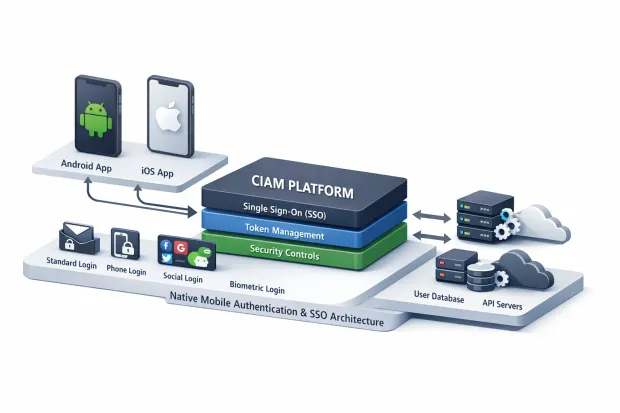
Standard Login and Phone Login: Foundational Trust Still Matters
Despite the rise of biometrics and passwordless authentication, standard login and phone login still anchor identity for millions of users. Especially in mobile environments.
Email and password login remains familiar. Predictable. Trusted. When implemented correctly, it creates a sense of legitimacy from the very first interaction.
Phone login, on the other hand, has become the preferred entry point for mobile-first users. Typing a phone number feels faster than typing an email. It aligns with how users already interact with their devices. And in many regions, it simply converts better.
What often gets overlooked is everything that surrounds these methods.
Session persistence matters. Users expect to stay logged in unless they explicitly log out. Repeated authentication prompts feel like friction, not security.
Profile and password management matter. Forgotten passwords, account updates, and credential resets shape perception long after onboarding ends.
LoginRadius SDKs handle these realities quietly. Secure session handling. Configurable login duration. Built-in profile management. All without forcing teams to build and maintain fragile logic themselves.
Execution defines experience. Even the most “basic” login method can feel polished or painful depending on how it’s implemented.
Stop building this from scratch. The datasheet details how LoginRadius SDKs manage these foundational flows securely while reducing development overhead.
Social Login for Native Mobile Apps: Native vs WebView Isn’t a Detail
Social login often looks simple on paper. In practice, it’s where user experience either accelerates or collapses.
Many apps still rely on WebView-based social login, forcing users to re-enter credentials even when they’re already logged into the social provider’s app. It works, but it feels clumsy.
LoginRadius supports native social login for major providers, including Facebook, Google, Twitter, WeChat, and VKontakte. That distinction matters.
When native login is enabled, the mobile operating system recognizes the user’s existing authenticated session with the provider. No extra prompts. No redundant passwords. The app simply knows who the user is.
The impact shows up immediately. Faster login. Higher completion rates. Less abandonment.
For providers that don’t support native login, LoginRadius SDKs still manage WebView authentication in a consistent, branded way. The experience stays predictable. The UI doesn’t break. The security posture remains intact.
Social login should remove friction, not introduce new ones. On mobile, native integration is the difference.
Single Sign-On (SSO): When One Identity Powers an Entire App Ecosystem
If your organization operates multiple mobile apps, forcing users to authenticate repeatedly is a guaranteed way to erode trust.
SSO authentication changes that dynamic entirely.
With Single Sign-On, the user’s identity is created once and recognized across multiple Android or iOS apps. No re-authentication loops. No fragmented profiles. No confusion about which account belongs where.
From the user’s perspective, it feels like one cohesive ecosystem. From the business side, it creates a single identity foundation that’s easier to manage, secure, and scale.
This isn’t just an enterprise convenience feature anymore. It’s a consumer expectation shaped by the platforms users interact with every day.
LoginRadius implements SSO at the native mobile level, not as a bolted-on experience. Identity recognition happens seamlessly, without exposing tokens or weakening security controls.
Optimize your mobile ecosystem. The full datasheet breaks down how LoginRadius enables SSO across native mobile environments while preserving performance and security.
Beyond Passwords: PIN, Passwordless, and Biometric Authentication
Mobile devices offer something the web never could: hardware-level security tied directly to the user. LoginRadius SDKs are designed to take advantage of that reality.
PIN authentication adds an extra verification layer for sensitive actions. Not every interaction needs a full re-login. Sometimes, confirming a transaction with a PIN strikes the right balance between speed and protection.
Passwordless login through magic links or OTPs removes passwords entirely from the equation. Users authenticate via email or SMS, reducing credential fatigue while increasing engagement. For many mobile apps, this becomes the preferred path once trust is established.
Biometric authentication connects identity to the physical device itself. Fingerprint and Touch ID support allow authentication flows that feel instantaneous while maintaining strong security guarantees.
These methods don’t replace traditional login overnight. They complement it. Context decides which method fits best.
LoginRadius enables teams to layer these options intelligently, without fragmenting identity or complicating the user journey.
Why Developers Choose LoginRadius Android and iOS SDKs
Authentication infrastructure consumes more engineering time than most teams expect. It touches security, UX, compliance, performance, and ongoing maintenance.
LoginRadius SDKs exist to collapse that complexity.
They’re open source, giving developers full visibility and control. Teams can customize behavior without forking fragile logic.
They include built-in API flows for registration and login, eliminating weeks of development work that would otherwise go into recreating standard patterns.
Performance optimizations like automatic data compression reduce bandwidth usage. HTTPS and signed API requests enforce security by default, not as an afterthought.
One detail that often gets missed: SOTT (Secure One Time Token). Because mobile apps can’t rely on CAPTCHA, LoginRadius uses SOTT to prevent automated spam registrations. It’s a mobile-specific defense that solves a very real problem.
This is the difference between an SDK designed for demos and one built for production at scale.
Deep dive available. The datasheet outlines SDK architecture, flows, and security measures in detail.
Enterprise-Grade Security: Protecting the App Itself
Most conversations around mobile authentication stop at users credentials, sessions, and login flows. That’s only half the problem.
In native mobile environments, the application itself becomes a security boundary. And it’s one that attackers actively target.
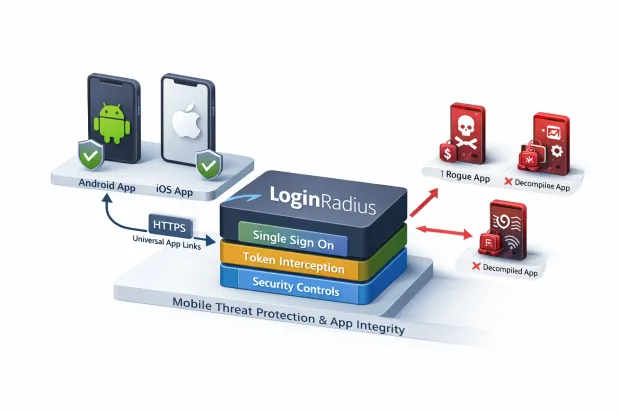
Unlike web apps, native Android and iOS apps can be reverse-engineered. An unauthorized party can decompile the app binary, inspect network traffic, extract Client IDs, or discover authentication endpoints. From there, creating a rogue application that mimics the original becomes disturbingly easy. The goal is simple: trick users into handing over credentials and access tokens.
This is not a theoretical risk. It’s one of the most common mobile attack patterns teams underestimate.
LoginRadius addresses this at the workflow level, not as an afterthought.
The SDKs protect against decompilation-based attacks by binding authentication callback URLs directly to the legitimate application using universal app links on both iOS and Android. Even if configuration details are exposed, attackers can’t hijack the authentication flow because the callback will only resolve to the registered app. The identity handshake simply fails elsewhere.
That single architectural decision shuts down an entire class of mobile-specific threats.
Security also extends to how data moves. LoginRadius SDKs enforce HTTPS communication and signed API requests by default, ensuring that identity data, session tokens, and credentials stay protected in transit. Combined with built-in logging and controlled data usage, this creates visibility without leaking sensitive information.
Then there’s compliance. Native apps operate under strict Apple and Google policies. Authentication missteps don’t just introduce risk; they can lead to app rejection or removal from the store. LoginRadius SDKs follow platform guidelines closely, reducing exposure to compliance-driven disruptions that slow releases or force last-minute rewrites.
Enterprise-grade mobile security isn’t about adding more checks to the UI. It’s about making the app itself resilient, even when someone tries to break it apart.
The Business Bottom Line: Effort, Security, and Experience
Authentication decisions ripple far beyond engineering.
They influence how fast teams ship. How often they patch. How users perceive the brand. And how much risk the business quietly carries as mobile adoption grows.
Building authentication and SSO from scratch looks manageable early on. Then the scale arrives. New login methods get added. Regulations tighten. Security reviews increase. Maintenance cost creeps upward. Velocity slows.
That’s the inflection point where identity stops being “just another feature” and starts dictating operational efficiency.
LoginRadius changes that equation by removing authentication complexity from the product roadmap.
For engineering teams, the impact is immediate. Pre-built Android SDKs and iOS SDKs eliminate the need to design and maintain core authentication flows.
Standard login, phone login, social login, SSO authentication, passwordless methods, and biometric support come ready to integrate. Exception handling, session management, and security controls stay consistent across releases instead of being re-implemented every time.
For security teams, the benefit is control without constant intervention. Protections against spam registrations, token misuse, rogue apps, and insecure traffic are embedded into the SDK workflows. Risk doesn’t grow linearly with user volume.
For the business, the value compounds over time. Faster time-to-market. Lower long-term maintenance cost. Fewer authentication-driven incidents. Higher login success rates. Better retention.
And for users, everything simply works.
Authentication feels natural. Sessions persist appropriately. Login options align with how people actually use mobile devices. Security doesn’t interrupt the experience, it reinforces trust.
That alignment is the real advantage.
When effort decreases, security strengthens, and user experience improves simultaneously, authentication stops being a liability. It becomes a growth enabler.
That’s the outcome modern native mobile apps need and exactly what LoginRadius is designed to deliver.
Conclusion
By the time a mobile app reaches scale, authentication stops being a feature and starts becoming infrastructure. It fades into the background when it works well. And it becomes painfully visible when it doesn’t.
For directors and senior leaders responsible for mobile growth, this is the uncomfortable truth: most authentication failures don’t announce themselves as security incidents. They show up as abandoned sign-ups, incomplete onboarding, repeated logins, forgotten credentials, and quiet uninstall events that never make it into incident reports.
That’s why authentication and SSO decisions for native mobile apps deserve more scrutiny than they usually get.
Android and iOS apps operate under constraints the web never had to deal with: no CAPTCHA, higher decompilation risk, token interception threats, app store compliance pressure, and users who expect everything to work instantly. Treating mobile authentication as a downsized web problem creates gaps. Sometimes small ones. Sometimes catastrophic ones.
LoginRadius approaches this problem from the center, not the edges.
The platform doesn’t just support standard login, phone login, social login, or SSO authentication as isolated features. It treats identity as a continuous, mobile-first system, one that balances developer effort, user experience, and security controls without forcing trade-offs.
Android SDKs and iOS SDKs absorb complexity so teams can focus on product velocity instead of rebuilding authentication logic release after release.
What stands out isn’t any single feature. It’s how the pieces work together. Persistent sessions without sacrificing security. Native social login without credential fatigue. SSO across multiple apps without identity fragmentation. Passwordless, PIN, and biometric options layered where they actually make sense. Protection against rogue apps baked into the flow instead of bolted on later.
This is what mature mobile authentication looks like when it’s designed intentionally.
If your organization is investing in native mobile apps as a core growth channel, authentication cannot remain an afterthought. It shapes first impressions. It defines trust. And over time, it directly influences retention, engagement, and brand credibility.
The full Authentication and SSO for Native Mobile Apps datasheet goes deeper into SDK architecture, security safeguards like SOTT, performance considerations, and real implementation details that don’t fit into a blog format. If you’re responsible for making long-term decisions around mobile identity, this isn’t background reading. It’s fundamental.
Download the complete datasheet and evaluate how your current mobile authentication strategy compares to what modern Android and iOS apps actually require.
Because when authentication scales correctly, everything built on top of it moves faster.
FAQs
Q: Why is authentication more complex for native mobile apps than for web applications?
A: Native mobile apps operate without CAPTCHA, face higher decompilation risk, and rely on local device storage and tokens. These factors demand mobile-first security controls that standard web authentication patterns don’t address.
Q: How does SSO authentication improve user experience in Android and iOS apps?
A: SSO authentication allows users to log in once and access multiple native mobile apps without repeated credentials. This reduces friction, prevents identity fragmentation, and creates a consistent experience across the app ecosystem.
Q: When should apps move beyond standard login and phone login methods?
A: Standard and phone login establish trust, but growing apps benefit from layering passwordless, PIN, or biometric authentication for high-risk actions. Context-based authentication strengthens security without disrupting the user journey.
Q: What role do Android and iOS SDKs play in securing mobile authentication?
A: Purpose-built Android SDKs and iOS SDKs handle token security, session management, and protections against rogue apps. They reduce development effort while enforcing security and app-store compliance by default.