Introduction
Authentication is no longer just about verifying a username and password. Customer identities are accessed from multiple devices, locations, and networks, while attackers increasingly rely on stolen credentials, automated attacks, and phishing campaigns to compromise accounts.
Applying stricter, identical authentication requirements to every login creates more problems than it solves. Challenging every customer with Multi-Factor Authentication can introduce unnecessary friction, while treating every login as equally trustworthy leaves organizations exposed to account takeover and fraud.
Traditional authentication follows fixed rules, applying the same verification process regardless of who is signing in or how risky the login appears. As customer identities become more distributed and cyber threats more sophisticated, organizations need authentication that responds to real-time context instead of static policies. Adaptive MFA addresses this challenge by applying stronger verification only when the calculated level of risk justifies it.
Instead of requiring additional verification for every authentication attempt, Adaptive MFA evaluates contextual risk signals such as device recognition, location, IP reputation, and user behavior to determine when stronger authentication is actually needed.
In this guide, you'll learn how Adaptive MFA works, the technologies that power it, how it differs from traditional MFA, and why it has become an essential capability for modern Customer Identity and Access Management (CIAM) platforms.
What Is Adaptive Authentication?
Adaptive authentication is a security approach that evaluates the context surrounding every login attempt before deciding how a user should be authenticated. Instead of applying the same authentication requirements to every customer, it analyzes signals such as device recognition, location, IP reputation, login history, and user behavior to determine whether a login appears legitimate or potentially risky.
Think of adaptive authentication as the decision engine behind modern identity security. Its primary role isn't to authenticate users directly—it's to assess risk and determine the most appropriate authentication response for each situation. One of the most common ways organizations apply this intelligence is through Adaptive Multi-Factor Authentication (Adaptive MFA).
What Is Adaptive MFA?
Adaptive Multi-Factor Authentication (Adaptive MFA) is a security approach that combines Multi-Factor Authentication (MFA) with real-time risk analysis to determine whether additional verification is required for each login attempt.
A customer signing in from their usual smartphone, home network, and normal location may access their account without an additional challenge. If the same account is accessed from an unfamiliar device in another country a few hours later, Adaptive MFA will require a passkey, biometric verification, or another phishing-resistant authentication method before allowing access to protect against the abnormal request.
This ability to adjust authentication requirements based on real-time risk helps organizations strengthen account security while minimizing unnecessary login friction for legitimate users. As a result, Adaptive MFA has become a foundational capability of modern Customer Identity and Access Management (CIAM) platforms.
Regulatory & Compliance Alignment
Adaptive MFA directly fulfills modern identity compliance requirements by enforcing context-based risk decisions:
-
PSD2 (Strong Customer Authentication): Dynamically triggers SCA during high-value or unusual financial transactions.
-
NIS2: Aligns with AAL2/AAL3 guidelines by requiring step-up verification when environmental risk increases.
-
PCI-DSS 4.0: Meets Requirement 8.3 by ensuring multi-factor controls adjust according to administrative access levels and network risk.
How Adaptive MFA Fits into CIAM
Customer Identity and Access Management (CIAM) introduces authentication challenges that differ significantly from traditional workforce identity systems. Employees typically authenticate within controlled environments, using managed devices and well-defined security policies. Customer identities are far more dynamic.
A modern CIAM platform may authenticate millions of customers, partners, consumers, or citizens across websites, mobile applications, APIs, and digital services every day. Every additional authentication step has the potential to increase friction, interrupt the customer journey, or contribute to abandoned registrations and failed logins.
At the same time, customer accounts remain one of the most attractive targets for cybercriminals. Credential stuffing, phishing, account takeover, and automated fraud continue to exploit stolen credentials at scale, making stronger authentication essential.
Adaptive MFA helps resolve this challenge by applying security where it's needed most instead of treating every authentication request the same. Low-risk customers can access their accounts with minimal interruption, while higher-risk login attempts receive additional verification based on contextual risk.
For CIAM teams, this balanced approach delivers measurable business value beyond stronger security. It reduces authentication friction, improves customer retention, lowers registration abandonment, and helps protect customer accounts from compromise without introducing unnecessary complexity into the sign-in experience.
In other words, Adaptive MFA enables CIAM platforms to achieve what modern digital businesses increasingly require: stronger identity protection without sacrificing the seamless customer experience that drives engagement and long-term loyalty.
A Typical Customer Journey
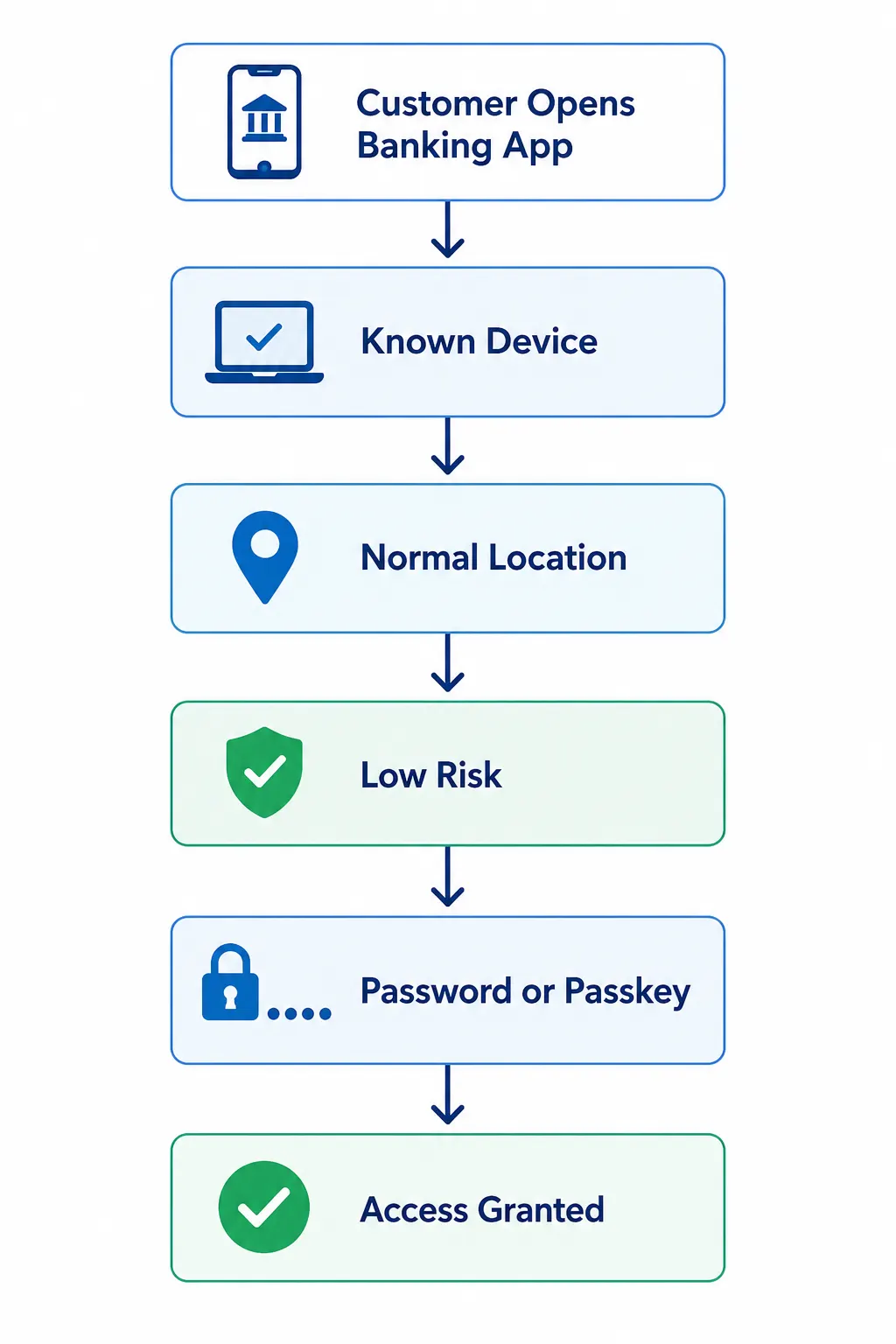
Imagine a customer using a mobile banking application to check their account balance.
On a typical weekday morning, they sign in from their usual smartphone while connected to their home network. Because the login comes from a trusted device, familiar location, and matches the customer's normal behavior, Adaptive MFA identifies the request as low risk and grants access without additional verification.
Later, the same account receives a login attempt from a new device in another country. The unfamiliar location and impossible travel pattern increase the calculated risk, prompting Adaptive MFA to require stronger verification before granting access.
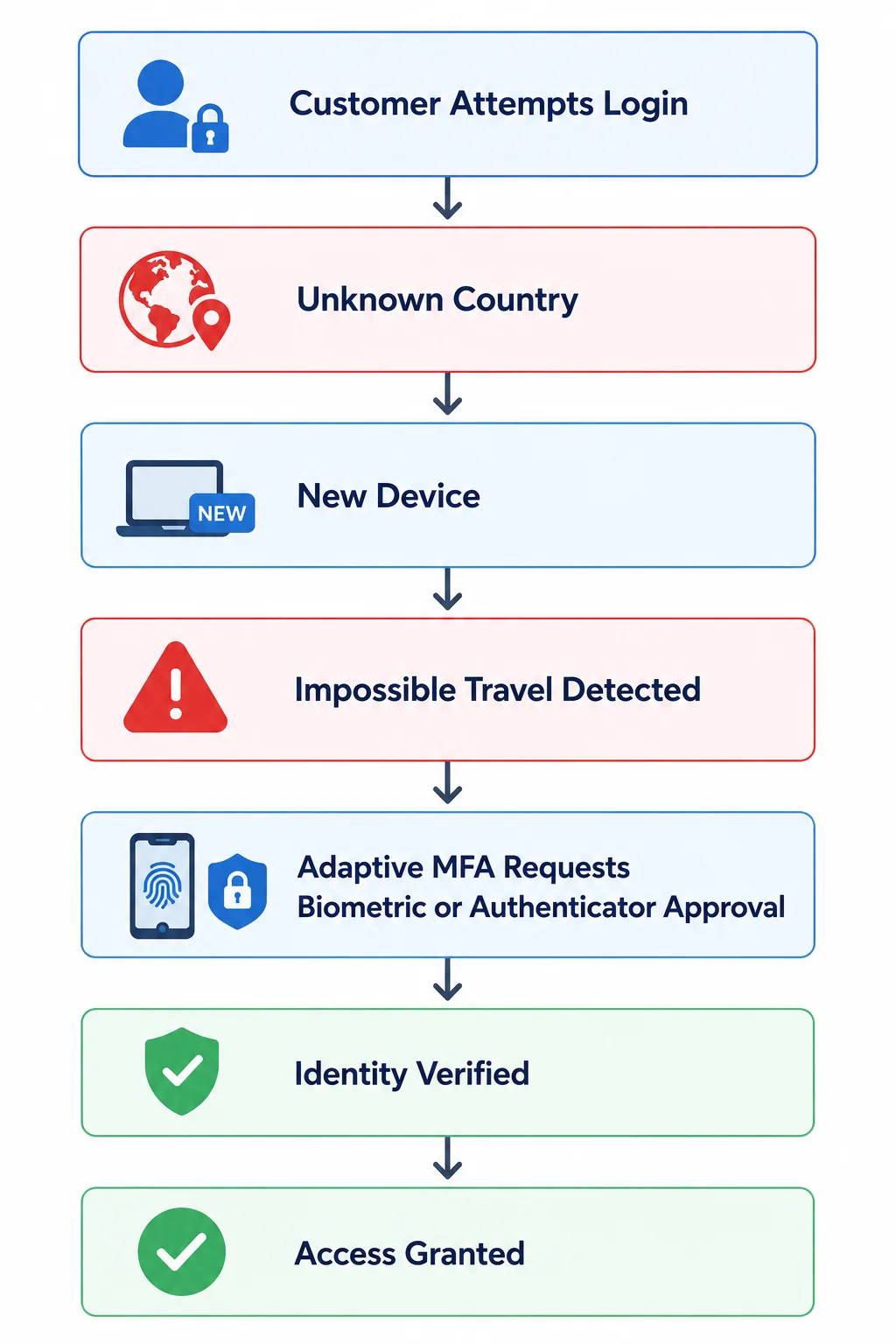
The two scenarios highlight the core principle of Adaptive MFA: trusted customers experience minimal friction, while higher-risk authentication attempts receive additional verification based on contextual risk.
| Benefit | Business Impact |
|---|---|
| Stronger security | Helps prevent credential stuffing, phishing, and account takeover by applying additional verification to high-risk logins. |
| Reduced MFA fatigue | Challenges customers only when additional authentication is justified. |
| Better customer experience | Enables faster access for trusted users while maintaining strong identity protection. |
| Lower fraud | Detects suspicious login behavior before unauthorized access occurs. |
| Higher conversion | Reduces login friction, helping decrease registration and sign-in abandonment. |
| Operational efficiency | Minimizes unnecessary authentication requests, reducing support overhead and improving authentication workflows. |
How Adaptive MFA Works
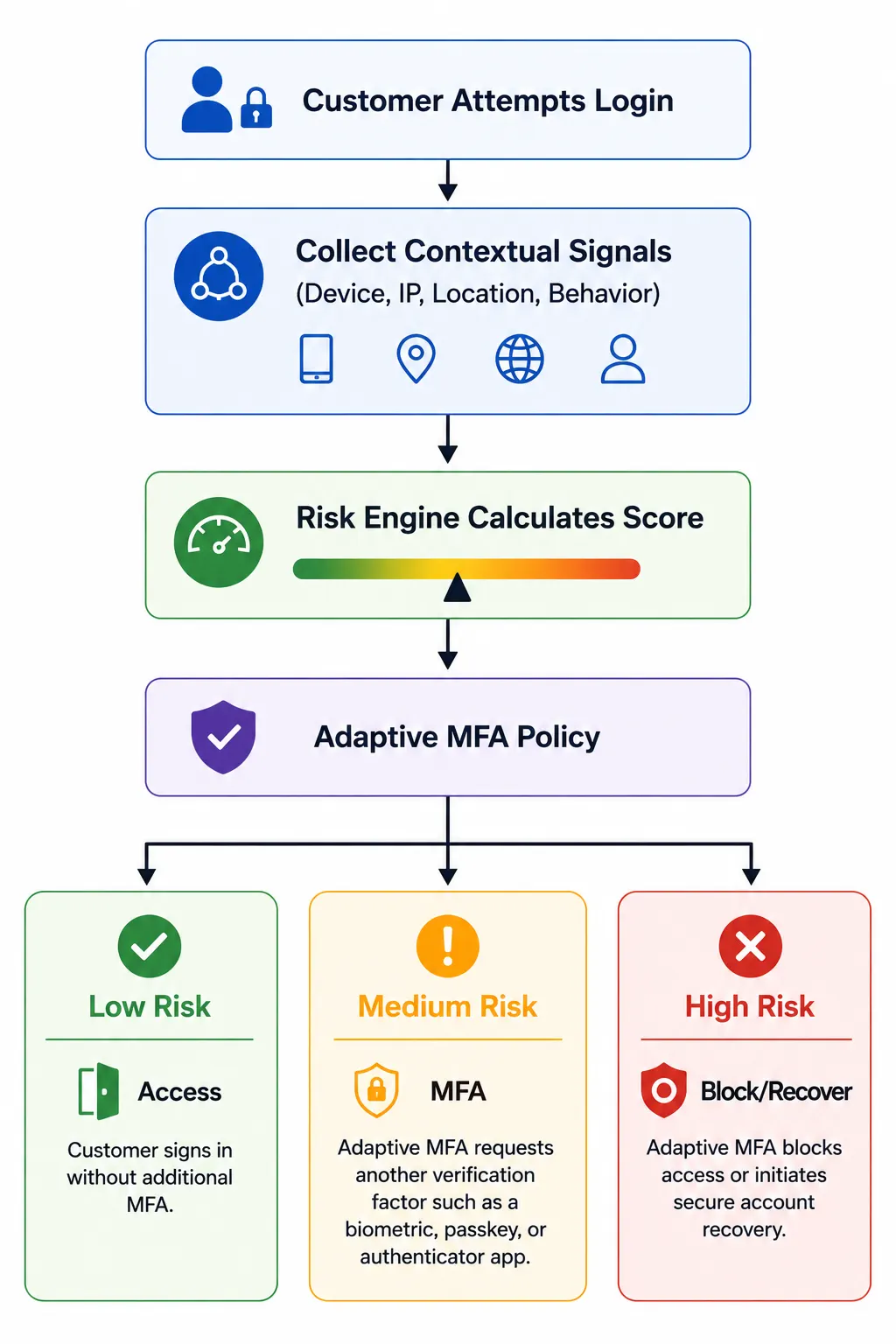
1. Collect Contextual Signals
Every authentication attempt begins by gathering contextual information about the login. The Adaptive MFA platform evaluates signals such as device reputation, geographic location, IP address, browser characteristics, previous login history, user behavior, and other environmental factors that help distinguish normal activity from suspicious behavior.
2. Calculate a Risk Score
The collected signals are analyzed by the risk engine, which assigns a risk score to the authentication request. A login from a familiar device in a trusted location may receive a low-risk score, while an unfamiliar device, unusual location, or impossible travel pattern increases the calculated level of risk.
3. Apply Adaptive MFA Policies
The Adaptive MFA policy determines whether additional verification is required based on the calculated risk score. Rather than applying identical authentication requirements to every user, policies adjust the authentication experience according to the level of risk associated with each login attempt.
1IF User_Status = "Authenticated" AND Device = "Recognized" -> ALLOW
2IF Location = "New Country" AND Impossible_Travel = TRUE -> BLOCK & ALERT
3IF Transaction_Amount > $1,000 AND Behavioral_Risk = "Elevated" -> REQUIRE_STEP_UP (Passkey / FIDO2)
4. Respond According to Risk
| Risk Tier | Trigger Conditions / Signals | Action Taken | Customer Experience |
|---|---|---|---|
| Low Risk | Known device, habitual location, safe IP, normal behavior | Direct Login / Single Factor | Zero friction |
| Medium Risk | Unfamiliar browser, new location, low-risk VPN | Step-up Prompt (Passkey / Biometric / Push) | Minimal 1-step verification |
| High Risk | Using Tor exit node, impossible travel, bad IP reputation, bot behavior | Block session or require Admin / Identity Recovery | Fraud prevented |
Adaptive MFA Learns Over Time
Customer behavior naturally changes over time as people purchase new devices, travel, connect from different networks, or develop new usage patterns. Adaptive MFA continuously refines its understanding of normal login behavior, allowing future authentication decisions to become more accurate without introducing unnecessary friction. By adapting to evolving customer behavior, organizations can strengthen security while maintaining a fast, seamless authentication experience.
How Machine Learning Improves Adaptive MFA
Adaptive MFA uses predefined policies and contextual signals to evaluate login risk, but static rules alone cannot account for every authentication scenario. For example, a traditional policy might require Multi-Factor Authentication whenever a customer signs in from a new country. While effective, fixed rules can generate unnecessary authentication prompts for legitimate users or overlook subtle indicators of suspicious behavior.
Machine learning enhances Adaptive MFA by recognizing patterns that static policies may miss. Instead of evaluating each login attempt in isolation, it analyzes historical authentication data, including login history, device usage, behavioral patterns, and authentication frequency, to establish a baseline of normal customer activity.
When a login deviates significantly from that baseline, the risk engine adjusts the calculated risk score accordingly. A trusted customer using a familiar device may continue without interruption, while unusual behavior, such as an unfamiliar device combined with abnormal login timing or unexpected usage patterns, can trigger additional verification.
By learning from evolving authentication patterns, machine learning helps Adaptive MFA reduce false positives, minimize unnecessary MFA prompts, improve fraud detection, and make more accurate authentication decisions as customer behavior changes over time.
Adaptive MFA Doesn't Stop After Login
Authentication shouldn't always end once access is granted. Customer sessions can change over time as users switch devices, connect from new networks, initiate sensitive transactions, or display unusual behavior.
Modern CIAM platforms continue evaluating these contextual signals throughout an active session. If the calculated level of risk increases, Adaptive MFA can require additional verification before allowing high-risk actions such as updating account information, changing authentication settings, or authorizing financial transactions.
This continuous evaluation helps organizations respond to changing risk without forcing customers to repeatedly authenticate during routine activity. Instead of treating authentication as a one-time event, Adaptive MFA adapts as the customer session evolves.
Authentication Risk Signals Explained
Adaptive MFA decisions are only as effective as the contextual signals used to calculate authentication risk. Every login generates dozens of signals that help the risk engine determine whether the person attempting to access an account is the legitimate customer or someone attempting unauthorized access. No single signal provides a definitive answer and looking at any one of those events in isolation could easily produce false positives. Adaptive MFA evaluates each of these four types of signals together before determining whether additional verification is required.
1. Device Signals
Device Recognition and Device Fingerprinting
One of the strongest trust signals is whether a login originates from a recognized device. Adaptive MFA evaluates browser characteristics, operating system, hardware identifiers, cookies, and other device fingerprinting attributes to determine whether a device has been seen before. A familiar device increases confidence, while a new or unrecognized device contributes additional risk that is evaluated alongside other contextual signals.
2. Environmental Signals
Geographic Location and Impossible Travel
Location helps Adaptive MFA identify unusual login activity. If a customer signs in from Bengaluru and another login appears from London minutes later, the system detects an impossible travel scenario and increases the calculated risk. Geographic analysis also considers travel history, regional risk levels, and previous authentication patterns before deciding whether additional verification is required.
IP Reputation and Network Intelligence
Adaptive MFA evaluates IP reputation to determine whether a login originates from trusted infrastructure or networks associated with credential stuffing, bot activity, VPN abuse, or other malicious behavior. A suspicious IP address doesn't automatically block access, but it increases the calculated risk and may trigger additional authentication when combined with other signals.
3. Behavioral Signals
Login Behavior and Historical Patterns
Historical login behavior provides important context for authentication decisions. Adaptive MFA evaluates factors such as login frequency, trusted devices, typical login times, and previous account activity to establish a baseline of normal behavior. Significant deviations from that baseline increase the calculated risk and may require stronger verification.
Biometrics
Behavioral biometrics analyzes how customers interact with an application by evaluating typing patterns, mouse movement, touchscreen gestures, scrolling behavior, and interaction speed. Although it rarely serves as a standalone authentication factor, it provides additional context that improves risk scoring and helps identify suspicious account activity.
4. Contextual Signals
Transaction Context
Authentication risk doesn't end after login. Adaptive MFA also evaluates the sensitivity of the action being performed. Viewing account information may require no additional verification, while updating payment details, changing security settings, or approving financial transactions can trigger step-up authentication based on the calculated level of risk.
Threat Intelligence
Adaptive MFA incorporates threat intelligence to identify authentication requests associated with compromised credentials, malicious IP addresses, phishing campaigns, botnets, and emerging attack techniques. Combining external threat data with contextual signals helps organizations detect evolving threats and make more accurate authentication decisions.
No single signal determines whether access should be granted. Adaptive MFA evaluates multiple contextual signals together to calculate overall authentication risk before deciding whether users can sign in, complete an additional MFA challenge, or be blocked. This multi-signal approach improves both security and user experience.
The next section explores how these signals are combined within the Adaptive MFA architecture to support real-time authentication decisions.
Adaptive MFA Architecture
Adaptive MFA relies on several identity and security components working together to evaluate login risk before determining whether additional authentication is required. Rather than enforcing the same verification process for every customer, these components continuously assess contextual signals and apply authentication policies based on the calculated level of risk.
Although the underlying architecture is similar to an adaptive authentication system, its purpose within a CIAM platform is different. Every component contributes to a single objective: delivering the right level of authentication at the right time while maintaining a seamless customer experience.
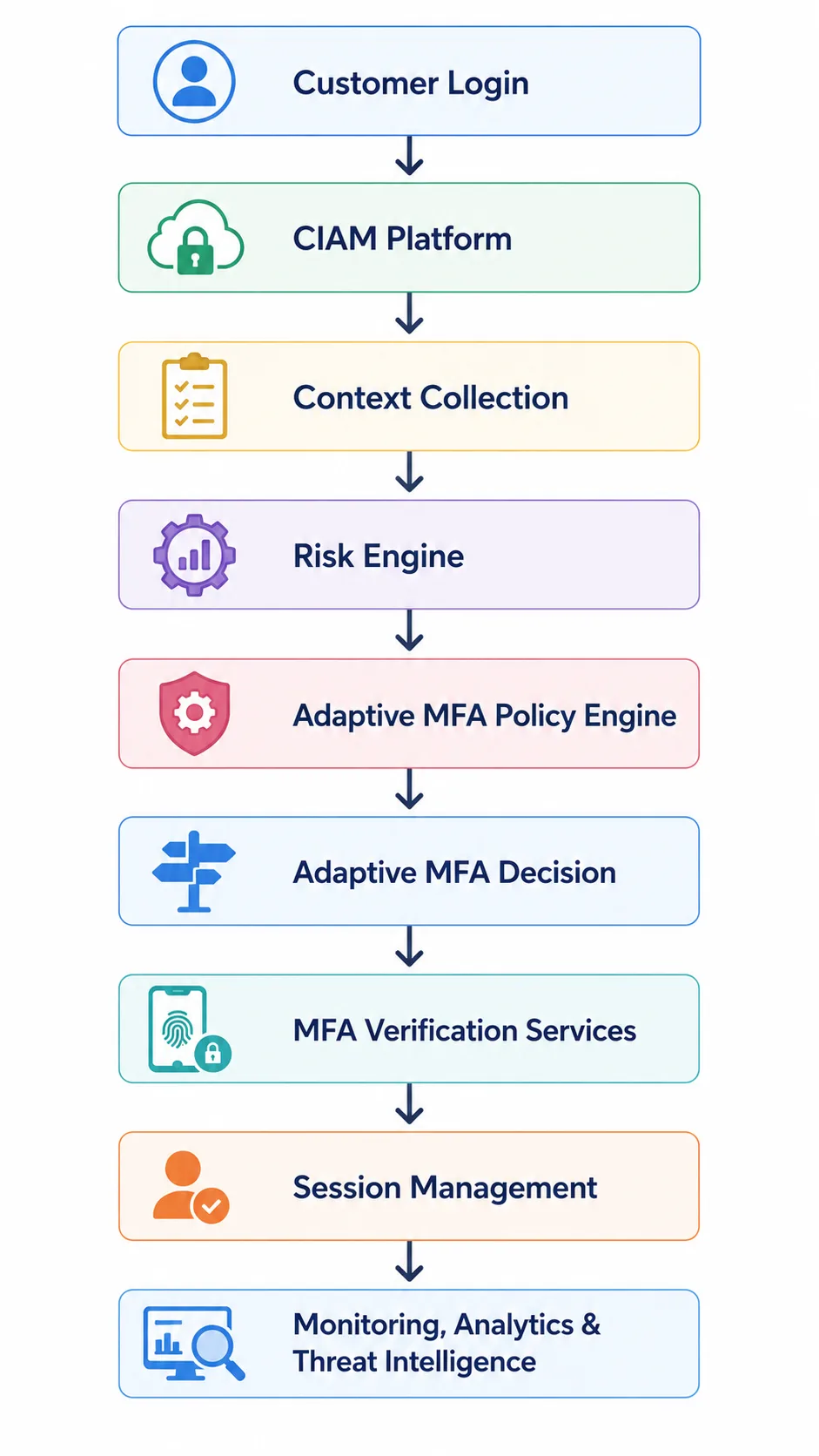
CIAM Platform
The CIAM platform orchestrates the authentication process. It receives login requests, coordinates identity services, and passes contextual information to the risk engine and policy engine for evaluation.
Context Collection
Before making an authentication decision, Adaptive MFA collects contextual signals such as device reputation, IP address, location, browser attributes, login history, network reputation, and user behavior.
Risk Engine
The risk engine analyzes collected signals and calculates a real-time risk score for every authentication request. Rather than relying on a single indicator, it evaluates multiple contextual factors together to determine the likelihood of legitimate user activity.
Adaptive MFA Policy Engine
The policy engine uses the calculated risk score to determine whether access should be granted, additional verification requested, or the authentication attempt blocked. Policies can be configured using risk thresholds, customer groups, application sensitivity, and business requirements.
Adaptive MFA Decision
Once the policy evaluation is complete, the platform determines the most appropriate authentication response.
-
Low-risk logins: Access is granted without additional MFA.
-
Medium-risk logins: Adaptive MFA requests another verification factor.
-
High-risk logins: Access is blocked or additional identity verification and secure account recovery are initiated.
MFA Verification Services
When additional verification is required, Adaptive MFA can invoke authentication methods such as:
-
Passkeys
-
Authenticator apps
-
Biometrics
-
Hardware security keys
-
Push authentication
Organizations can choose the most appropriate method based on security policies and customer preferences.
Session Management
Session management secures authenticated sessions and supports step-up authentication if the customer's risk level changes after login.
Monitoring, Analytics & Threat Intelligence
Continuous monitoring provides visibility into authentication activity, risk trends, suspicious logins, and policy effectiveness, helping organizations refine Adaptive MFA policies and respond more quickly to emerging threats.
Bringing the Architecture Together
Together, these components enable Adaptive MFA to evaluate contextual signals, calculate risk, apply authentication policies, and deliver the appropriate level of verification for every login attempt.
Adaptive MFA vs Other Types of MFA
Traditional MFA vs Adaptive MFA
Multi-Factor Authentication has become a standard security control for protecting customer and workforce accounts. It significantly reduces the risk of compromised passwords by requiring users to verify their identity using an additional authentication factor.
But here's something many organizations discover after deployment: applying the same authentication policy to every login doesn't always produce the best security outcome.
A customer logging in from the same trusted device they've used for years is treated exactly the same as someone attempting to access the account from an unfamiliar browser halfway across the world. Both users receive the same authentication challenge, even though the level of risk is completely different.
Adaptive MFA addresses that limitation by introducing context into the authentication decision. Instead of enforcing identical verification requirements for every login, it evaluates the risk associated with each request and adjusts authentication accordingly.
| Feature | Traditional MFA | Adaptive MFA |
|---|---|---|
| Authentication Policy | Fixed for every login | Adjusts based on real-time risk |
| User Experience | Same verification every time | Authentication changes based on context |
| Risk Awareness | Limited | Continuously evaluates multiple risk signals |
| Device Recognition | Usually not considered | Trusted and unknown devices are evaluated differently |
| Authentication Challenges | Triggered for every protected login | Triggered only when additional verification is needed |
| Fraud Detection | Relies primarily on authentication factors | Combines authentication with behavioral and contextual analysis |
| Customer Friction | Higher | Lower for legitimate users |
| Protection Against Modern Attacks | Good | Stronger against credential theft, account takeover, and automated attacks |
The difference becomes much clearer in everyday scenarios.
Imagine a customer signs in every weekday from the same laptop, using the same browser and home internet connection. With traditional MFA, they're asked to approve a push notification every single time they log in. After weeks or months of repeated prompts, the verification process becomes routine rather than meaningful.
Now imagine the same customer attempts to sign in from an unfamiliar device while travelling overseas, using a network they've never connected through before. Traditional MFA applies exactly the same authentication challenge as before. Adaptive MFA recognizes that the surrounding context has changed and increases the level of verification before granting access.
Here's where it gets interesting. Adaptive MFA doesn't simply reduce authentication prompts. It makes those prompts more valuable.
By requesting stronger verification only when risk increases, organizations can reduce unnecessary interruptions for legitimate customers while focusing security controls on the login attempts that deserve closer attention.
This approach also helps address one of the most common usability challenges associated with traditional MFA. Constant authentication requests contribute to user frustration, increase support tickets, and can even encourage unsafe behaviors such as automatically approving push notifications without carefully reviewing them. Reducing unnecessary prompts helps improve both security and the overall customer experience.
That doesn't mean traditional MFA is obsolete. It still remains an essential layer of identity security and continues to protect millions of applications worldwide. Many organizations begin with traditional MFA before introducing adaptive policies as their authentication requirements become more sophisticated.
For most modern CIAM deployments, however, the objective is no longer choosing between traditional MFA and Adaptive MFA. The goal is determining when additional verification is genuinely necessary and applying the appropriate authentication controls based on the level of risk.
Naturally, that raises another question. If Adaptive MFA relies on risk analysis, how is it different from Risk-Based Authentication? Although both technologies work closely together, they perform different roles within the authentication process.
Did you know that Adaptive MFA neutralizes MFA Fatigue attacks?
Beyond simplifying routine sign-ins, Adaptive MFA provides crucial protection against MFA Fatigue (Push Spam) attacks—a tactic where attackers use stolen passwords to flood a user’s phone with push prompts until they accidentally click "Approve." Instead of blindly sending an MFA notification every time valid credentials are submitted, the Adaptive MFA risk engine evaluates real-time context such as IP reputation, geographic anomalies, and device fingerprints. If an authentication attempt originates from a suspicious or untrusted IP address, the system automatically classifies the request as high-risk and suppresses the push notification entirely. By blocking the prompt at the server level, attackers are prevented from spamming the user, neutralizing the psychological threat of prompt bombardment before it ever reaches the customer's device.
Adaptive MFA vs Risk-Based Authentication
Adaptive MFA and Risk-Based Authentication (RBA) are closely connected, which is why they're often used interchangeably. Although both contribute to modern authentication, they are not the same technology.
Risk-Based Authentication is the decision-making process.
It continuously evaluates contextual signals such as device familiarity, geographic location, IP reputation, login history, behavioral patterns, and threat intelligence to determine how risky an authentication request appears. The result is a dynamic risk score that helps decide how the authentication system should respond.
Adaptive MFA is one of the actions that can follow that decision.
If the calculated risk remains low, the customer may sign in without additional verification. As the level of risk increases, Adaptive MFA introduces stronger authentication methods such as passkeys, biometrics, hardware security keys, or other phishing-resistant authentication factors before granting access.
In other words, Risk-Based Authentication determines when additional verification is necessary, while Adaptive MFA determines how that verification should take place.
| Capability | Risk-Based Authentication | Adaptive MFA |
|---|---|---|
| Primary Purpose | Evaluate authentication risk | Apply additional authentication when risk requires it |
| Main Function | Calculates a real-time risk score | Dynamically adjusts authentication requirements |
| Uses Contextual Signals | Yes | Yes, through the risk assessment process |
| Triggers Additional Verification | Determines whether it's needed | Performs the additional verification |
| Authentication Methods | Does not authenticate by itself | Uses MFA methods such as passkeys, biometrics, security keys, or authenticator apps |
| Typical Role | Risk analysis and policy decision | Adaptive authentication enforcement |
Here's a simple example. A customer signs in from their usual laptop using a recognized browser and trusted network. The risk engine evaluates the request and determines that the overall risk is very low. Since no unusual activity is detected, the customer signs in without any additional challenge.
Later that day, another login attempt for the same account arrives from an unfamiliar device through a network associated with credential stuffing attacks. This time, Risk-Based Authentication identifies elevated risk. Instead of immediately granting access, Adaptive MFA requires phishing-resistant authentication before allowing the login to continue.
Both technologies are working together throughout the process, but they perform different responsibilities.
For organizations building modern CIAM platforms, the distinction is important. Deploying Adaptive MFA without effective risk analysis often results in unnecessary authentication prompts.
Implementing Risk-Based Authentication without strong authentication methods leaves organizations with limited options when suspicious activity is detected. Combining both creates a more intelligent authentication system that balances security with a seamless customer experience.
If you'd like a deeper technical comparison between these two approaches, including implementation considerations and deployment scenarios, read our dedicated guide on MFA vs RBA.
Adaptive MFA vs Passkeys
Passkeys have transformed modern authentication by eliminating passwords and making phishing attacks significantly more difficult. As organizations begin adopting passwordless authentication, a common question follows: if passkeys are so secure, is Adaptive MFA still necessary?
The short answer is yes.
Although both improve authentication security, they solve different problems.
A passkey verifies that the person attempting to sign in possesses a trusted device and can complete user verification, typically through biometrics or a device PIN. Adaptive MFA determines whether the current authentication request requires additional scrutiny before access is granted.
One authenticates the user. The other evaluates the surrounding risk.
| Feature | Passkeys | Adaptive MFA |
|---|---|---|
| Primary Purpose | Passwordless, phishing-resistant authentication | Dynamic authentication based on real-time risk |
| Password Required | No | Can work with passwords or passwordless authentication |
| Risk Evaluation | No | Yes |
| Authentication Decision | Verifies user identity | Determines whether additional verification is required |
| User Experience | Fast and seamless | Changes based on the calculated risk |
| Protection Focus | Credential theft and phishing | Account takeover, anomalous logins, fraud, and suspicious activity |
Here's where it gets interesting.
Imagine a customer signs in using a passkey from their usual smartphone. The authentication is completed successfully, but the device suddenly begins initiating unusually large financial transactions from an unfamiliar network. The customer's identity has already been verified through the passkey, yet the surrounding behavior still deserves additional scrutiny.
Adaptive MFA evaluates that context in real time. Depending on the organization's security policy, it may request another verification step, temporarily limit sensitive actions, or require reauthentication before high-risk transactions are completed.
This illustrates an important point. Strong authentication doesn't eliminate the need for risk assessment.
Passkeys dramatically reduce phishing, credential theft, and password reuse attacks, but they don't evaluate every contextual factor surrounding an authentication request. Device compromise, session hijacking, insider threats, unusual customer behavior, and transaction-level risk can still require additional security decisions after identity has been verified.
For that reason, many organizations deploy passkeys as one of the authentication methods within an Adaptive MFA strategy. Low-risk users enjoy a fast, passwordless login experience, while the platform continues to monitor contextual signals and responds appropriately when risk increases.
Rather than choosing between passkeys and Adaptive MFA, modern CIAM platforms increasingly combine both technologies. Passkeys strengthen identity verification at the point of authentication, while adaptive MFA continuously evaluates risk before and after access is granted. Together, they provide stronger security with far less friction than traditional password-based authentication.
Authentication, however, doesn't always end after the initial login. Modern identity platforms continue evaluating user activity throughout an active session, introducing additional verification only when changing conditions increase the level of risk. This is where continuous authentication and step-up authentication become essential parts of an adaptive security strategy.
Adaptive MFA Use Cases Across Industries
Adaptive MFA has moved well beyond high-security environments. Today, organizations across almost every industry use it to protect customer accounts, reduce fraud, and deliver a smoother sign-in experience. While the authentication principles remain the same, the level of risk and the actions taken in response vary depending on the business and the sensitivity of the transaction.
| Industry | How Adaptive MFA Is Used |
|---|---|
| Banking and Financial Services | Protects online banking, digital wallets, loan applications, and high-value transactions by evaluating customer risk before approving sensitive activities. |
| Healthcare | Secures patient portals, telehealth platforms, electronic health records, and prescription services while helping organizations protect sensitive medical information. |
| Retail and E-commerce | Identifies suspicious logins, prevents account takeover, secures loyalty accounts, and adds verification before high-risk purchases or payment changes. |
| B2B SaaS | Protects customer tenants, administrator accounts, developer portals, and privileged actions without creating unnecessary friction for everyday users. |
| Travel and Hospitality | Secures airline, hotel, and loyalty program accounts while detecting unusual booking patterns, account recovery attempts, and payment fraud. |
| Education | Protects student, faculty, and staff accounts, particularly during remote learning and online examination environments where account security is critical. |
| Government and Public Services | Strengthens access to citizen portals, tax services, licensing platforms, and other digital services handling sensitive personal information. |
Although the industries differ, the authentication challenge is remarkably similar. Every organization must distinguish legitimate customers from attackers without making the login process unnecessarily difficult.
Here's where adaptive MFA delivers the greatest value.
A retail customer checking reward points shouldn't face the same authentication requirements as someone updating payment information. A banking customer viewing their account balance doesn't necessarily require the same level of verification as someone transferring large sums of money. Likewise, a SaaS administrator modifying tenant-wide security policies represents a much higher level of risk than a standard user accessing their dashboard.
Adaptive MFA allows organizations to make those distinctions automatically. Instead of relying on one security policy for every user and every transaction, authentication requirements adjust according to the sensitivity of the action and the calculated level of risk.
This flexibility has become particularly valuable for modern CIAM deployments, where millions of customer authentications occur across web applications, mobile apps, APIs, partner portals, and connected devices every day. Strong security remains essential, but so does delivering a fast and seamless customer experience.
Of course, implementing adaptive authentication successfully requires more than enabling a risk engine. Organizations need clear policies, trusted authentication methods, ongoing monitoring, and well-defined recovery processes. Following proven implementation best practices helps ensure security improvements don't come at the expense of usability.
Adaptive MFA Best Practices
Deploying Adaptive MFA involves more than enabling a risk engine or configuring step-up authentication. Its effectiveness depends on how well contextual risk signals, authentication policies, and user experience work together. A well-designed Adaptive MFA strategy strengthens customer security without introducing unnecessary authentication friction.
Here's a surprising pattern we've seen: organizations often invest heavily in stronger authentication methods but spend far less time refining the Adaptive MFA policies that determine when those methods should be applied. As a result, legitimate users face unnecessary authentication challenges while sophisticated attacks continue to find opportunities around static rules.
The following best practices help organizations build an adaptive authentication strategy that balances security, usability, and operational efficiency.
| Best Practice | Why It Matters |
|---|---|
| Collect Multiple Risk Signals | Evaluate device intelligence, IP reputation, location, behavioral patterns, login history, and threat intelligence together instead of relying on a single indicator. |
| Use Phishing-Resistant Authentication | Support passkeys, FIDO2 security keys, and biometrics for high-risk authentication scenarios to reduce exposure to phishing and credential theft. |
| Implement Risk-Based Policies | Define authentication policies that adapt to changing levels of risk rather than enforcing identical MFA requirements for every user and every login. |
| Enable Step-Up Authentication | Reserve stronger verification for sensitive transactions, unfamiliar devices, privileged actions, and other elevated-risk situations. |
| Continuously Review Risk Models | Adaptive MFA policies should evolve as customer behavior and attack techniques change over time. Regularly refine risk thresholds and security policies to reduce false positives and improve detection accuracy. |
| Monitor Authentication Activity | Track authentication outcomes, failed login attempts, account recovery events, risk scores, and authentication challenges to identify emerging attack patterns. |
| Provide Secure Account Recovery | Recovery workflows should be protected with the same level of security as primary authentication to prevent attackers from bypassing stronger login controls. |
| Balance Security with User Experience | Every additional authentication challenge introduces friction. Apply stronger verification where risk justifies it while keeping routine customer access as seamless as possible. |
Technology alone doesn't make Adaptive MFA effective.
Organizations also need a clear understanding of what constitutes normal customer behavior within their own applications. A banking platform, healthcare portal, e-commerce website, and B2B SaaS application each present different levels of authentication risk, which means their policies should reflect different business priorities.
It's equally important to measure how authentication performs over time. Security teams often focus on blocked attacks, but legitimate user experience deserves the same attention. Monitoring authentication success rates, false positives, login abandonment, support requests, and step-up authentication frequency provides valuable insight into whether authentication policies are protecting customer accounts without creating unnecessary friction.
Adaptive MFA policies should also evolve alongside the threat landscape. Credential stuffing, phishing campaigns, session hijacking, bot activity, and account takeover techniques continue to change. Regular policy reviews, updated threat intelligence, and ongoing refinement of machine learning models help ensure authentication decisions remain accurate as attack methods become more sophisticated.
Ultimately, the objective of Adaptive MFA isn't to challenge customers more often; it's to apply stronger authentication only when the calculated level of risk justifies it. Organizations that combine accurate risk assessment with modern MFA methods can reduce fraud while delivering a faster, more seamless customer experience.
How LoginRadius Supports Adaptive MFA
Building an effective Adaptive MFA solution requires more than enabling Multi-Factor Authentication. Organizations need a CIAM platform that supports Adaptive MFA policies, Risk-Based MFA, and modern authentication methods such as passkeys, while continuously evaluating contextual risk in real time. The platform should integrate seamlessly with existing identity ecosystems and scale to millions of customer identities without compromising security, performance, or user experience.
LoginRadius provides these capabilities through its Customer Identity and Access Management (CIAM) platform.
Organizations can implement Adaptive MFA using configurable Risk-Based MFA policies that evaluate contextual signals such as device intelligence, location, IP reputation, login behavior, and authentication history before determining the appropriate authentication response. Depending on the calculated level of risk, LoginRadius can allow access, trigger step-up authentication, require phishing-resistant verification, or block suspicious login attempts.
The platform also supports a wide range of modern authentication methods, including passkeys, passwordless authentication, biometrics, authenticator apps, social login, enterprise federation, and Single Sign-On (SSO). This flexibility allows businesses to strengthen account security while delivering authentication experiences that align with customer expectations.
For organizations operating global customer applications, LoginRadius is designed to support high-volume authentication, secure API integrations, developer-friendly SDKs, identity orchestration, and compliance with evolving security and privacy requirements. Combined with centralized policy management, detailed audit logs, and continuous monitoring, security teams gain greater visibility and control over customer authentication across every digital touchpoint.
Whether you're modernizing an existing authentication system or designing a new CIAM architecture, Adaptive MFA helps reduce fraud without creating unnecessary friction, and LoginRadius provides the tools to implement it at enterprise scale.
Conclusion
Adaptive MFA has become one of the most effective ways to protect customer identities without compromising the user experience. By combining contextual risk analysis, intelligent policy decisions, and modern authentication methods such as passkeys, biometrics, and phishing-resistant authentication, organizations can reduce account takeover, credential-based attacks, and fraud while delivering fast, frictionless access for legitimate customers.
As digital businesses continue to face increasingly sophisticated identity threats, applying the same authentication requirements to every login is no longer enough. Adaptive MFA enables organizations to strengthen security dynamically, introducing additional verification only when the calculated level of risk justifies it. The result is a more secure authentication experience that balances customer convenience with enterprise-grade identity protection.
If you're looking to modernize customer authentication, reduce login friction, and strengthen identity security at scale, LoginRadius provides the Adaptive MFA capabilities, Risk-Based MFA policies, passkey support, and enterprise CIAM platform needed to deliver secure, seamless digital experiences.
Ready to build a smarter authentication experience? Schedule a personalized demo, explore the LoginRadius CIAM platform, or speak with our identity experts to see how Adaptive MFA can help protect your customers while delivering frictionless authentication at scale.
FAQs
Q: What is adaptive authentication?
A: Adaptive authentication is a security approach that evaluates the context of every login attempt and adjusts authentication requirements based on real-time risk. It helps organizations strengthen security while minimizing unnecessary login friction.
Q: What is Adaptive MFA?
A: Adaptive MFA combines Multi-Factor Authentication with real-time risk analysis. Instead of requiring MFA for every login, it prompts for additional verification only when suspicious activity or elevated risk is detected.
Q: What is the difference between adaptive authentication and Adaptive MFA?
A: Adaptive authentication is the broader strategy of making authentication decisions based on risk. Adaptive MFA is one implementation of that strategy, using contextual risk to determine when additional authentication factors should be required.
Q: How does adaptive MFA calculate login risk?
A: Adaptive MFA evaluates multiple contextual signals such as device recognition, IP reputation, location, user behavior, login history, and threat intelligence. These signals are combined to generate a risk score that determines the appropriate authentication response.
Q: Does adaptive MFA replace Multi-Factor Authentication?
A: Adaptive MFA complements traditional MFA rather than replacing it. It determines when additional verification is required, helping organizations reduce unnecessary authentication prompts while maintaining strong account security.
Q: How does machine learning improve adaptive MFA?
A: Machine learning improves Adaptive MFA by analyzing authentication patterns, identifying unusual behavior, and refining risk scores over time. This helps Adaptive MFA reduce false positives, minimize unnecessary authentication prompts, and make more accurate authentication decisions.
Q: Can adaptive MFA work with passkeys?
A: Yes. Adaptive MFA can use passkeys as a phishing-resistant authentication method. It evaluates the risk associated with each login and determines when passkeys alone are sufficient or when additional verification is required.
Q: What is step-up authentication?
A: Step-up authentication requires users to complete additional identity verification only when a login or transaction is considered high risk. This improves security without interrupting every authentication session.
Q: Which industries benefit most from adaptive MFA?
A: Industries such as banking, healthcare, retail, B2B SaaS, government, education, and travel use adaptive MFA to reduce fraud, prevent account takeover, and deliver secure customer experiences with minimal friction.
Q: Why should organizations implement adaptive MFA?
A: Adaptive MFA helps organizations reduce account takeover, credential stuffing, phishing-related attacks, and fraud by applying additional verification only when the calculated level of risk justifies it. This strengthens security while maintaining a fast and frictionless customer experience.