Introduction
In a world where cyber threats like data breaches and identity theft are making headlines almost every day, securing digital systems isn’t just important, it's essential. That’s where two commonly confused terms come in: authentication and authorization. You’ve probably heard them used together (or even interchangeably), but they serve very different purposes.
Whether you're building secure apps, managing access for a team, or simply curious about how systems stay protected, understanding the difference between authentication and authorization is key.
In this blog, we’ll unpack both concepts with relatable examples and clear insights so you can confidently grasp how each one keeps your data and users safe.
Authentication vs Authorization at a Glance
Authentication (AuthN) verifies identity →Who are you?
Authorization (AuthZ) controls access → What can you do?
Authentication always happens before authorization
Authentication uses credentials like passwords, biometrics, or tokens
Authorization uses roles, permissions, and policies
Both are essential for secure application access
What is Authentication?
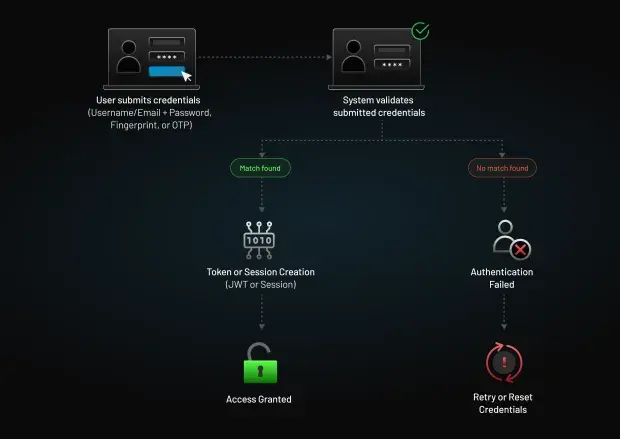
Authentication is the process of verifying a user's identity. It answers the question: Are you really who you say you are?
For authentication, users typically provide credentials such as a username and password, biometric data, or a one-time code to prove their identity. It acts like a digital passport that validates a person before letting them into a system.
Imagine you walk into a secured office building. At the entrance, a security guard checks your ID. If it matches the employee database, you’re allowed in. That’s authentication.
In technical aspects, imagine a user logs into an online banking app with a password and receives a 2FA code on their phone. Only after both credentials are verified is the user granted access. This is a prime example of authentication in cyber security.
What is the Purpose of Authentication?
The core goal of authentication is to ensure that only verified users can access a system. It prevents impersonation, data theft, and breaches by validating user identities before granting entry.
In today’s digital landscape, where everything from cloud apps to enterprise databases is remotely accessible, robust authentication methods — like biometrics, OTPs, and social logins — are critical for security.
Authentication lays the foundation. Without it, systems wouldn’t know who they are dealing with — making any additional security effort meaningless.
What is Authorization?
Authorization is the process of determining what actions a user is allowed to perform. It answers: Do you have permission to access this resource or perform this action?
If authentication is the security guard verifying your ID, authorization is the list showing what rooms or data you're allowed to access.
In simple terms, authorization in cybersecurity is about assigning privileges and access levels to different users based on their role, location, or behavior.
Common Types of Authorization
There are various ways to authorize users, depending on the system’s needs. Here are some of the most common:
1. Role-Based Access Control (RBAC):
RBAC (Role-Based Access Control) is an authorization model based on user roles (admin, editor, viewer). For example, in the LoginRadius console below, the “Admin” has permission to broadcast, download, edit, and read. On the other hand, the “Customer” is only authorized to download and read.
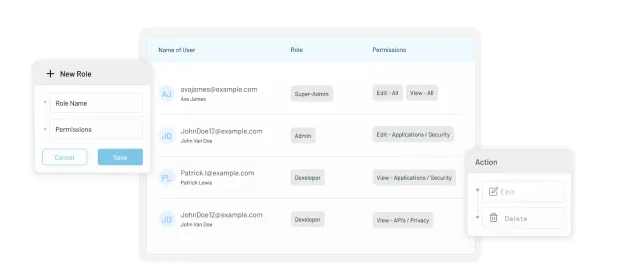
Explore how Role-Based Access Control (RBAC) simplifies permissions and strengthens security.
In a nutshell, RBAC simplifies access management by assigning permissions based on user roles, such as admin, editor, or viewer, rather than handling access at the individual level.
In a B2C context, this often means differentiating capabilities between everyday users and internal staff. For instance, a streaming platform might allow viewers to consume content, while admins manage uploads and settings.
In B2B scenarios, this concept scales to entire organizations. For example, a retail company which collaborates with suppliers, franchisees, and distributors, requires precise control over who can access what across partner ecosystems.
Our Partner IAM feature enables role-based permissions at the organization level, such as Partner Admin or Franchise Manager with access defined down to specific resources or workflows.
Discover how LoginRadius Partner IAM enables precise, organization-level RBAC tailored for complex B2B environments.
2. Attribute-Based Access Control (ABAC)
ABAC (Attribute-Based Access Control) uses attributes like department, role, location, time of day, or device type.
For example, an employee from the finance department can access payroll data only during working hours and only when using a company-issued device—ensuring granular and context-aware security controls.
You can read our RBAC vs ABAC guide for a detailed comparison between RBAC and ABAC to ensure you make the right decision that meets your business requirements.
3. JSON Web Token (JWT) Authorization
JWT (JSON Web Token) authorization is a widely used method for securely transmitting user data between parties—particularly in modern web applications and services. It's especially popular in systems that use stateless authentication, such as RESTful APIs. For instance, after a user logs in, the server issues a JWT that the client then includes in subsequent requests to authenticate without needing to re-enter credentials.
If you’d like to dive deeper into how JWTs work and when to use them, check out our full guide on JWT authorization best practices.
4. OAuth 2.0
OAuth 2.0 is an authorization framework for granting access to resources.
OAuth 2.0 is a widely adopted protocol for delegating access without exposing user credentials. For example, when you log into Spotify using your Google account, Google handles the authentication, and Spotify receives limited, authorized access to your basic profile without ever seeing your Google password. This secure delegation is ideal for third-party integrations and API-based systems.
To understand how OAuth 2.0 works, its core flows, and when to use it, check out our in-depth breakdown on OAuth 2.0 and its role in modern identity management.
The aforementioned types show the depth of authorization in cybersecurity, shaping how users interact with systems securely.
Fine-Grained Authorization (FGA)
Fine-Grained Authorization goes beyond traditional role-based access control.
What is FGA?
Fine-Grained Authorization allows access decisions based on relationships, attributes, and context.
Key Concepts
ReBAC (Relationship-Based Access Control): Access based on relationships between users and resources
Google Zanzibar Model: Powers access control for Google services
OpenFGA: Open-source implementation of fine-grained authorization
AWS Cedar: Policy language for defining permissions
When to Use FGA
Multi-tenant SaaS platforms
Complex permission hierarchies
Collaboration tools (e.g., shared documents)
FGA provides flexibility but adds complexity compared to RBAC.
Authentication vs Authorization
To put it plainly, authentication and authorization are two sides of the same coin often paired but serving different purposes.
-
Authentication: Confirms your identity.
-
Authorization: Grants or denies permissions based on that identity.
Let’s go back to the real world: You check into a hotel (authentication), but your key card only grants you access to your room and the gym — not the penthouse suite (authorization).
Key Differences Between Authentication and Authorization
| Feature | Authentication (AuthN) | Authorization (AuthZ) |
|---|---|---|
| Purpose | Verifies identity | Grants access permissions |
| Key Question | Who are you? | What can you do? |
| Order in Flow | First step | Happens after authentication |
| Credentials Used | Passwords, biometrics, MFA | Roles, policies, permissions |
| Protocols | OIDC, SAML | OAuth 2.0, RBAC, ABAC |
| Failure Result | Login failure or MFA challenge | Access denied (403) |
| CIAM Context | Identity verification | Access control enforcement |
Authentication confirms identity, while authorization determines access. Together, they form the foundation of secure identity and access management systems.
This comparison helps answer the question: How is authentication different from authorization? If you need a more detailed comparison, read this insightful blog.
Authentication vs Authorization: Factors & Permissions
When we take a closer look at auth vs authorization, it's evident that both processes serve different purposes and rely on separate sets of criteria to function effectively. Understanding these underlying components helps demystify how modern systems maintain security without compromising user experience.
Authentication is all about identity verification — confirming that a user is who they claim to be. This is typically done through one or more of the following factors:
-
Something you know – such as a password, PIN, or secret answer to a security question.
-
Something you have – like a hardware token, mobile authenticator app, or a smart card.
-
Something you are – biometric data such as fingerprints, facial recognition, or iris scans.
These layers form the foundation of secure access. For example, logging into your online banking account may require both your password (something you know) and a fingerprint scan (something you are), especially when sensitive transactions are involved.
Authorization, on the other hand, determines what that authenticated user is allowed to do once access has been granted. It sets boundaries and defines permissions based on rules, roles, or policies. Common types of access include:
-
Read-only access – allowing users to view content without making changes, such as viewing reports or dashboards.
-
Edit or write access – enabling users to create, update, or delete content, like editing a document in a CMS.
-
Administrative access – providing full control over a system or platform, including managing users, permissions, and settings.
Both authentication and authorization are vital to protecting sensitive data and ensuring users only have access to the resources they genuinely need.
AI and Adaptive Authentication vs Authorization
Modern systems use AI to enhance both authentication and authorization.
Adaptive Authentication
-
Adjusts login security based on risk
-
Triggers MFA for suspicious activity
-
Uses signals like location, device, behavior
Adaptive Authorization
-
Dynamically changes access permissions
-
Evaluates risk in real time
-
Applies context-aware policies
Example
A user logs in successfully (AuthN), but access is restricted (AuthZ) due to unusual location.
This approach is critical for Zero Trust security models.
Which Comes First, Authentication or Authorization?
Authentication always comes before authorization. This sequence is non-negotiable in cybersecurity and access control. Why? Because a system must first verify who the user is before it can determine what the user is allowed to do.
Think of it as meeting someone at your front door. You wouldn’t ask them which rooms they’d like to enter before confirming they’re a trusted friend or family member. Similarly, in digital systems, authentication validates identity, and only then can authorization define access levels.
Here’s a breakdown to illustrate this better:
Step 1 – Authentication:
The system checks the user’s credentials such as a username and password, fingerprint, or OTP to confirm their identity. During this step, encryption protocols like TLS are typically used to protect credential data as it travels between the client and server, ensuring it can’t be intercepted or tampered with.
Step 2 – Authorization:
Once the identity is verified, the system evaluates what resources that identity has permission to access like read-only access to a report, admin rights on a dashboard, or restricted areas in a company portal.
Step 3 – Encryption in Action:
While encryption supports both steps, it becomes even more critical once access is granted. Sensitive data that the authorized user accesses—whether in transit or at rest—should be encrypted to maintain confidentiality and integrity throughout the session.
Skipping authentication and jumping straight to authorization would be like giving someone the keys to your office without knowing if they even work there. It's not just risky — it's a security failure waiting to happen.
This foundational flow authentication first, followed by authorization, and supported by encryption throughout ensures your digital ecosystem remains secure and logically controlled.
Learn more in our guide on Authentication, Authorization, and Encryption.
Breach Data & Authority Signals
Authentication and authorization failures are among the top causes of security breaches. According to Verizon DBIR, compromised credentials are involved in a majority of breaches
OWASP ranks Broken Access Control as the #1 web security risk. Identity-based attacks continue to rise across enterprises. This highlights why properly implementing both authentication and authorization is critical.
Conclusion
In cybersecurity and identity management, knowing the difference between authorization and authentication is foundational. While they’re often mentioned together, they perform distinct and equally vital roles in protecting systems.
Authentication and authorization are two core pillars of modern security. Authentication verifies identity, while authorization controls access to resources. Both must work together to protect applications, APIs, and user data. As systems evolve toward Zero Trust and passwordless authentication, combining strong identity verification with fine-grained access control becomes essential.
Whether you’re building a secure app, managing employee access, or integrating APIs, always start with authentication and then apply authorization based on roles, policies, or attributes.
By mastering both, you’ll reduce vulnerabilities, improve user experience, and align with best practices in authentication and authorization.
Need help implementing secure authentication and authorization for your applications? Contact LoginRadius to get expert guidance today.
FAQs
Q: Can a person be authenticated and still not authorized?
A: Yes. Being authenticated simply proves identity. A user might log in (authenticated) but lack the right permissions (not authorized) to access certain features or data.
Q: What are the different types of authentication?
A: Common types include:
-
Password-based authentication
-
Biometric (fingerprint, facial recognition)
-
Multi-factor authentication (MFA)
-
Token-based (e.g., JWT)
-
Social login (OAuth)
These are essential for authentication in cyber security.
Q: How is authentication different from authorization?
A: Authentication checks identity; authorization checks access rights. It’s the classic authorize vs authenticate debate where both are needed, but for different reasons.
Q: What is authorization testing?
A: Authorization testing ensures users can only access what they are permitted to. It checks for access control vulnerabilities and misconfigurations key in authorization in cybersecurity.
Q: How does authentication work?
A: Authentication works by matching provided credentials against stored user data. If the credentials match, access is granted. Methods include passwords, biometric scans, OTPs, and digital certificates.
Q: What comes first authentication or authorization?
A: Authentication always comes first. A system must verify who you are before deciding what you can access.
Q: Can authentication happen without authorization?
A: Yes, a user can be authenticated but still not have permission to access certain resources.
Q: What is the difference between AuthN and AuthZ?
A: AuthN (authentication) verifies identity, while AuthZ (authorization) determines access rights.
Q: Is OAuth authentication or authorization?
A: OAuth is an authorization framework. Authentication is added through OpenID Connect (OIDC).
Q: What is the difference in REST APIs?
A: Authentication verifies the user (via token), while authorization checks if the user can access the requested resource.
Q: How does RBAC differ from ABAC?
A: RBAC uses predefined roles, while ABAC uses attributes like user, resource, and context for access decisions.