Introduction
Passwords don’t just create security risks. They quietly drain money. Every forgotten password turns into a support ticket. Every reset flow adds friction. Every reused credential increases breach exposure. And when login feels slow or unreliable, users leave before they even experience the product.
That’s the hidden cost most businesses don’t measure. Passwordless authentication benefits go beyond faster login. For enterprises, it can reduce helpdesk workload, lower password-related security risks, improve onboarding, and support stronger compliance goals. In other words, it is not only a security upgrade. It is an efficient decision.
Teams usually look at passwordless authentication as a user experience feature. Fewer clicks. No password fatigue. Cleaner login. All true.
But the bigger business case sits underneath: fewer reset tickets, fewer credential-based attacks, less IT overhead, and smoother access for customers, employees, and partners.
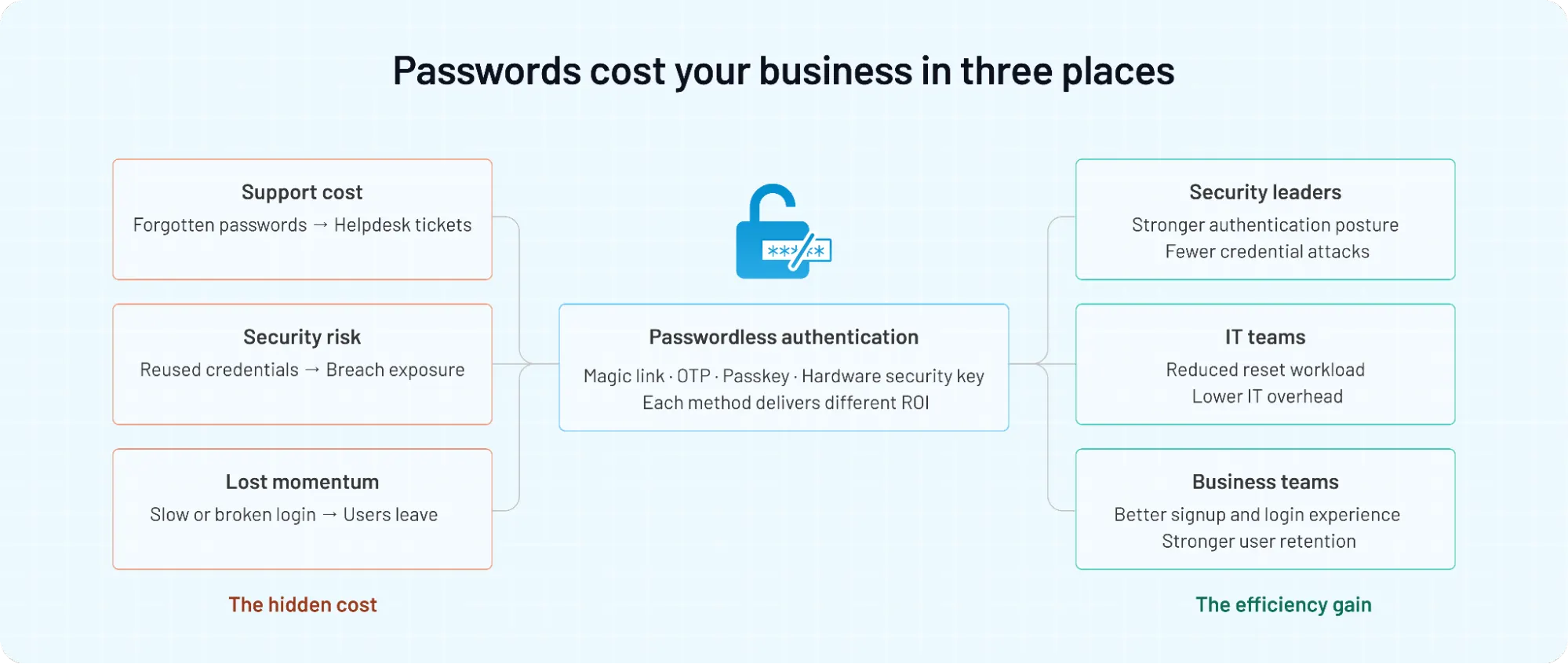
Passwords cost the business in three places: support, security, and lost user momentum. Passwordless helps reduce all three when it is implemented with the right strategy.
That does not mean every passwordless method delivers the same ROI. A magic link, OTP, passkey, and hardware security key all carry different costs, risks, and adoption curves. The real value comes from choosing the right method for the right user journey.
For security leaders, passwordless supports stronger authentication. For IT teams, it reduces repetitive work. For business teams, it removes friction from signup, login, and retention.
That is why passwordless authentication is becoming less of a “future login” conversation and more of a business case for secure, scalable access.

Passwords Are Expensive. Most Teams Just Don’t Measure It
Passwords look simple. Cheap to implement. Easy to understand. But the cost shows up elsewhere.
Every “forgot password” flow creates a support event. Not always a ticket but a disruption. Users retry, abandon, or reach out. At scale, those add up fast. Helpdesks spend a surprising amount of time on access issues that don’t move the business forward. Then there’s security.
Credential-based attacks are still one of the most common entry points. Phishing, reuse, automated login attempts; all of these attacks depend on one thing: passwords. One compromised account can trigger fraud, data exposure, and incident response costs that go far beyond the login layer.
Many organizations invest heavily in security tools monitoring, endpoint protection, MFA but still rely on passwords as the first step. That weak starting point keeps the door open. There’s also a growth impact.
Login friction slows users down. Extra steps, failed attempts, reset loops these moments happen before any real product interaction. Some users recover. Others drop off quietly. That loss rarely shows up in a single metric, but it affects conversion and retention over time. And the operational side?
Managing passwords means maintaining policies, handling resets, enforcing complexity rules, and supporting recovery flows. None of this scales cleanly. We’ve seen that teams treat these costs as isolated issues. Support, security, and UX issues are not isolated as they’re all tied to the same root: password-based access. Individually, each cost seems manageable. Together, they’re expensive.
What Passwordless Authentication Means for Business
Passwordless authentication is often introduced as a security improvement. But, that’s only part of the story. From a business perspective, it changes how access is delivered, how costs are managed, and how users move through your product. It removes a dependency that affects multiple layers: support, security, and experience.
When passwords disappear,
-
Several small frictions disappear with them. No password creation during signup. No reset loops. No complexity rules to enforce. The login step becomes lighter and that ripple shows up across onboarding, retention, and daily usage.
-
On the cost side, fewer password-related issues mean fewer support interactions. IT teams spend less time managing credentials and more time on higher-value work.
-
Instead of relying on something users remember, authentication is tied to stronger factors such as devices, biometrics, or cryptographic credentials. That reduces exposure to common attacks without adding extra steps for users. But the real shift is how these pieces connect.
Improving login experience alone is useful. Reducing support load alone is useful. Strengthening authentication alone is necessary. Passwordless does all three at the same time.
Teams start evaluating passwordless for one reason usually security or UX and end up adopting it because of its broader impact on efficiency and cost. That’s the difference. It’s not just a feature upgrade. It’s a change in how identity supports the business.
Breaking Down the ROI of Passwordless Authentication
ROI for authentication is rarely tracked directly. It shows up in different places such as support costs, security incidents, user drop-offs, and operational effort. When passwords are removed, the impact becomes visible across all of these areas.
-
Support Costs: Password resets are one of the most frequent access-related issues. Each reset may seem small, but at scale, it consumes time across helpdesk teams and interrupts users. Reducing password dependency cuts a large portion of these interactions, freeing up resources and improving response times.
-
Security: Credential-based attacks remain common because passwords can be reused, guessed, or phished. When authentication shifts to device-based or cryptographic methods, the likelihood of these attacks drops. Fewer incidents mean lower recovery costs, less downtime, and reduced risk exposure.
-
User experience: Login friction affects how quickly users reach value. If access is delayed or complicated, some users leave early. Passwordless methods simplify entry, making onboarding faster and return visits smoother. Over time, that improves conversion and retention without additional effort.
-
Operational efficiency also improves. Managing password policies, resets, and recovery flows requires continuous attention. Removing that layer simplifies identity management and reduces ongoing maintenance.
What stands out is how these gains connect. Lower support demand, reduced risk, smoother access, and simpler operations are often treated as separate improvements. In practice, they come from the same change moving away from passwords. That’s where the real ROI comes from.
Cost Comparison: Passwords vs Passwordless
On the surface, passwords look inexpensive. There’s no additional hardware, no new systems to deploy. But the cost doesn’t sit in implementation; it shows up in operations, support, and risk.
Total Password Cost = (N * R * C_s) + (B * C_b) + (U * V_a)
-
N: Number of users
-
R: Frequency of resets
-
C_s: Cost per support interaction
-
B: Probability of breach
-
C_b: Cost of breach response
-
U: User drop-off rate
-
V_a: Value of an abandoned session
With passwords, support costs accumulate quickly. Reset requests, account lockouts, and recovery issues are ongoing. Each interaction takes time, whether handled through automation or by a support team. As the user base grows, so does this overhead.
Security adds another layer of cost. Password-based systems are more exposed to phishing and credential reuse. Preventing and responding to these incidents requires monitoring tools, alerts, investigations, and sometimes recovery efforts. These are recurring costs, not one-time investments.
There’s also a hidden experience cost. Complex password rules, failed logins, and reset flows interrupt users. Some recover and continue. Others drop off. This loss is harder to measure but directly affects acquisition and retention. Passwordless shifts where the cost sits.
There may be initial investment integrating new methods, updating flows, and supporting recovery mechanisms. But ongoing costs tend to decrease. Fewer resets, fewer support issues, and reduced exposure to credential-based attacks change the operational load over time.
Infrastructure also becomes simpler in some areas. Instead of managing password storage, hashing, and policy enforcement, the system focuses on verifying identity through stronger signals. That reduces the need for constant updates tied to password security practices.
The difference is not just in cost amount, but in cost type. Passwords create continuous, distributed overhead. Passwordless moves cost toward setup and reduces recurring effort.
Over time, that shift becomes more efficient.
Passwordless vs MFA: Cost and Efficiency Trade-Offs
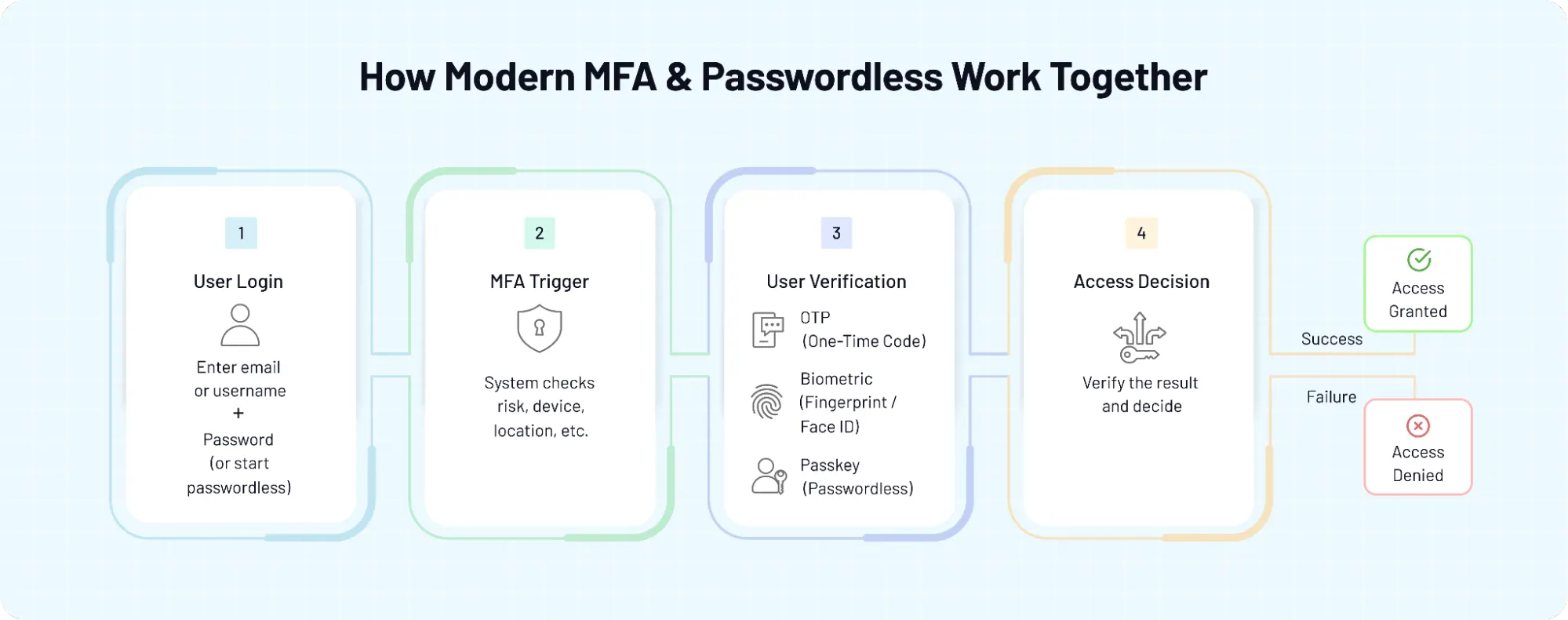
MFA is often the first step teams take to strengthen login security. It adds a second layer on top of passwords, typically a code, push notification, or biometric check. Security improves, but the password still remains part of the flow. That detail matters.
Because even with MFA, the system carries the cost of password resets, recovery flows, and exposure to phishing. Modern attacks don’t stop at stealing passwords; they capture OTPs in real time. So while MFA raises the barrier, it doesn’t remove the underlying risk. There’s also an efficiency trade-off.
MFA introduces additional steps. Users switch between apps, wait for codes, or approve prompts. It works, but it adds friction. For internal users, that may be manageable. For customers, especially at scale, it can slow down access and affect conversion.
Passwordless takes a different route. Instead of layering on top of passwords, it removes them. Authentication starts with stronger factors like devices or cryptographic credentials. That reduces both the attack surface and the number of steps in the login process.
From a cost perspective, MFA adds ongoing overhead managing tokens, handling delivery costs for SMS or email, and supporting user issues when factors fail. Passwordless shifts that effort toward initial setup, with fewer recurring interactions tied to login problems. That doesn’t mean MFA becomes irrelevant.
In many environments, it still plays a role, especially where step-up authentication is needed for high-risk actions. The difference is in how it’s used. Instead of compensating for weak passwords, it becomes part of a broader, context-aware security model. The decision isn’t about replacing one with the other in isolation.
It’s about reducing dependency on passwords while maintaining the right balance between security and efficiency.
IT Efficiency Gains with Passwordless Authentication
Most identity systems carry a quiet operational burden. Password policies need updates. Reset flows need maintenance. Support teams handle access issues daily. None of this directly contributes to product value, yet it consumes time across engineering and IT. Passwordless reduces that overhead.
Without passwords, there are fewer reset requests and fewer edge cases tied to credential management. Helpdesk load drops. Support interactions become less frequent and more focused. Over time, that frees up capacity for work that actually moves the business forward. There’s also a simplification on the engineering side.
Password storage, hashing, policy enforcement, and rotation rules require constant attention. Security standards evolve, and systems need to keep up. When authentication shifts to device-based or cryptographic methods, much of that maintenance layer becomes unnecessary. Deployment cycles benefit as well.
Authentication changes are often complex because they touch multiple systems: user management, session handling, and compliance controls. Passwordless methods, when designed properly, streamline these flows. Fewer dependencies mean fewer points of failure and faster iterations. Another area that improves is consistency.
Different teams often implement authentication differently across products or regions. Passwordless encourages a more unified approach, reducing fragmentation and making identity easier to manage at scale. Our customers share with us that the efficiency gains are not immediate in perception, but they compound quickly. What starts as fewer support tickets turns into measurable reductions in operational effort across teams.
That’s where the real impact shows up not just in cost savings, but in how effectively teams can focus on higher-value work.
Real Business Use Cases Where ROI Is Highest
Passwordless authentication doesn’t deliver the same value everywhere. The impact depends on how often users log in, how sensitive the access is, and how much friction exists today.
In SaaS platforms, login is part of the product experience. Users sign in frequently, switch devices, and interact with multiple workflows. Password-related friction shows up quickly failed logins, reset loops, delayed onboarding. Removing passwords simplifies access, reduces drop-offs, and lowers support demand at scale.
In eCommerce, the effect is more immediate. Users expect fast access, especially on mobile. A slow or failed login can interrupt checkout or account access. Passwordless methods shorten that path. Over time, that improves conversion and reduces abandoned sessions tied to login issues.
Fintech and banking operate under higher risk. Security cannot be relaxed, but friction still needs to be controlled. Passwordless methods like device-based authentication or passkeys help reduce credential-based attacks while keeping access straightforward. The ROI here comes from reduced fraud exposure and fewer recovery events.
For enterprise workforce systems, the value shifts toward security and operational efficiency. Employees access internal tools, often across distributed environments. Password-related issues create support load and potential risk. Passwordless reduces both, especially for high-risk accounts such as admins or privileged users.
Partner and vendor access is another area where complexity builds up. External users often interact with systems less frequently, making passwords harder to manage. Passwordless simplifies access without increasing administrative overhead. Across these scenarios, the pattern is consistent.
The more frequently users interact with login, and the higher the cost of friction or failure, the greater the return from removing passwords.
Where Passwordless Doesn’t Deliver Immediate ROI
Passwordless authentication improves security and efficiency, but the return is not always immediate.
The first factor is implementation effort. Introducing new authentication methods often requires changes across systems, user flows, identity providers, recovery mechanisms, and compliance controls. That initial investment can delay visible gains, especially in complex environments.
User adoption also plays a role. Not all users switch behavior quickly. Some prefer familiar login methods or hesitate to trust new ones. Until adoption reaches a certain level, the impact on support reduction and efficiency may remain limited.
Recovery design is another challenge. Password-based systems have well-understood recovery flows. Passwordless requires alternative mechanisms that are both secure and simple. If recovery is unclear or difficult, it can increase support interactions instead of reducing them.
There’s also variation in use cases. In low-frequency login scenarios, the cost of passwords may not be as visible. The return from removing them tends to be lower compared to environments where users log in daily.
Sometimes, organizations expect immediate cost savings, while the real benefits build over time. As adoption grows and systems stabilize, reductions in support effort, risk, and friction become more consistent.
Passwordless delivers value, but the timeline depends on how it is introduced, how users adapt, and where it is applied.
How to Build a Business Case for Passwordless Authentication
A strong business case starts with visibility. Most organizations know that passwords create friction, but the cost is rarely measured in one place. It’s spread across support, security, and user experience. Bringing those together is the first step.
Start by identifying where the cost shows up. Support tickets related to passwordless login issues. Time spent on resets and account recovery. Security incidents tied to compromised credentials. Drop-offs during signup or login. These are not isolated problems; they share the same root. Once identified, quantify them.
How many password-related tickets are handled each month? How much time does each one take? What does that translate to in operational cost? On the security side, consider incident frequency, response effort, and potential exposure. For user experience, look at completion rates and where users abandon the flow. The next step is mapping the potential gains.
Passwordless reduces dependency on resets, lowers exposure to credential-based attacks, and simplifies login. That translates into fewer support interactions, reduced incident risk, and smoother access. The impact may not appear instantly, but it becomes measurable as adoption increases. Alignment matters as well.
Security teams focus on risk reduction. IT teams look at operational efficiency. Business teams care about conversion and retention. A strong case connects these outcomes instead of treating them separately. The goal is not to eliminate passwords for the sake of change. It’s to reduce ongoing cost and improve how users access systems. When these factors are measured together, the decision becomes clearer.
Passwordless stops being a feature discussion and becomes a business decision backed by measurable impact.
The Future ROI of Passwordless Authentication
The return from passwordless authentication doesn’t stay constant. It improves over time.
As adoption increases, the reliance on passwords continues to drop. That reduces recurring costs tied to resets, support, and credential-related incidents. What starts as a partial improvement becomes a broader operational shift. Platform-level changes are accelerating this.
Ecosystems led by Apple, Google, and Microsoft are making passkeys a default option. As users become familiar with these methods, adoption barriers reduce. Less training, fewer support queries, smoother rollout. Over time, this changes the cost structure.
Instead of continuous effort spent on managing passwords, organizations invest in more stable, device-based authentication. Maintenance becomes lighter. Security updates become less reactive. Identity systems require fewer adjustments tied to password policies. There’s also a shift toward automation.
Modern identity systems are moving toward continuous evaluation monitoring behavior, device signals, and access patterns in real time. Passwordless fits into this model by providing stronger initial verification, allowing systems to rely more on context and less on repeated checks.
The long-term value is not just in cost reduction, but in consistency. Fewer login issues, fewer edge cases, and more predictable access flows across users and devices.
Passwords may not disappear completely in the short term. Some legacy systems will continue to depend on them. But their role will continue to shrink. And as that happens, the efficiency gains become more stable and easier to scale.
Conclusion: Passwordless Is a Cost Strategy, Not Just a Security Upgrade
Passwords create cost in places that are easy to ignore support queues, failed logins, recovery flows, and avoidable risk. Over time, those small inefficiencies compound.
Passwordless changes that pattern.
It reduces dependency on resets, lowers exposure to credential-based attacks, and removes friction from access. The impact shows up across teams less operational effort for IT, fewer incidents for security, and smoother journeys for users. But the outcome depends on execution.
Teams that treat passwordless as a quick feature see limited gains. Teams that align it with user flows, recovery design, and risk signals see measurable improvements in efficiency and cost over time.
The shift is already underway. The question is not whether passwordless makes sense, but how deliberately it is implemented.
Ready to reduce login friction, support overhead, and security risk in one move? Explore how LoginRadius helps you implement passwordless authentication with passkeys, adaptive security, and scalable identity without disrupting your existing stack.
FAQs
Q: Is passwordless authentication worth it?
A: Yes, especially for businesses dealing with high login volume or support overhead. It reduces password resets, lowers security risks, and improves user experience. The value becomes more visible as adoption increases and systems scale.
Q: How much does passwordless authentication save?
A: Savings vary by scale, but most organizations see reductions in support costs, fewer password-related incidents, and improved efficiency. The biggest gains come from fewer reset requests and lower breach-related expenses.
Q: Passwordless vs MFA cost, which is better?
A: MFA improves security but adds ongoing costs like OTP delivery, support, and user friction. Passwordless reduces dependency on passwords, lowering long-term operational and support costs while improving efficiency.
Q: What are the benefits of passwordless authentication?
A: It reduces support workload, strengthens security, and improves login experience. Users access systems faster, while businesses benefit from lower operational costs and reduced risk exposure.
Q: What is the ROI of passwordless authentication?
A: The ROI comes from reduced support costs, fewer security incidents, improved conversion, and operational efficiency. While initial setup requires effort, long-term gains make it a cost-effective strategy.