
Introduction
Passwords should never be stored exactly as customers create them. If an attacker gains access to a database containing plaintext passwords, those credentials are immediately exposed. Hashing helps address that problem by transforming passwords into one-way values that can be used for verification without storing the original password.
But hashing alone is not enough. Two customers who choose the same password can produce the same hash when the same hashing process is applied without unique input. That similarity gives attackers useful information and makes precomputed techniques such as rainbow tables more effective. Password salting is designed to address this problem.
Salt is a unique value incorporated into the password-hashing process. With a different salt for each password, two customers using the exact same password can still have different stored password hashes.
There is an important limit, though. Salting does not make a weak password strong, stop phishing, or prevent an attacker from guessing passwords offline after obtaining stored hashes. Secure password storage requires salting to work alongside an appropriate password-hashing algorithm, suitable cost parameters, and other authentication protections.
So, where exactly does the salt fit, and what should developers do with it? The answer is simpler than it sounds—but a few implementation details make a significant difference.
What Is Salt in Cybersecurity and Password Hashing?
A password salt is a unique value incorporated into the password-hashing process so that identical passwords produce different stored hashes. It is used alongside a password-hashing function to make precomputed attacks less practical and prevent identical passwords from being immediately recognizable by identical hash values.
Consider two customers who independently choose the same password. Without unique salts, applying the same hashing process can produce the same stored result for both accounts: Same Password → Same Hash
With a unique salt for each password, the inputs differ:
Password + Salt A → Hash A
Password + Salt B → Hash B
The customers have chosen the same password, but their stored password hashes are different.
Salt is not another password, an encryption key, or an authentication factor. It also does not need to be secret. The salt can generally be stored alongside the resulting password hash because its purpose is uniqueness, not secrecy. An attacker who obtains the password database may therefore obtain both values but still must attack individual salted password hashes rather than efficiently reuse the same precomputed results across many accounts.
This is also why salt should not be confused with pepper. A pepper is intended to remain secret and is typically kept separately from the password database. Salt and pepper can both contribute to password protection, but they solve different problems.
One distinction matters most: salting and hashing are not interchangeable. Hashing provides the one-way transformation used to create a password verifier. Salting supplies unique input to that process. Secure password storage uses them together, with a purpose-built password-hashing algorithm configured to make password guessing sufficiently expensive.
How Password Salting Works from Registration to Login
Password salting happens as part of password hashing rather than as a separate authentication step that customers see. When a customer creates a password, the authentication system uses a unique salt with a purpose-built password-hashing function and stores the resulting verifier. When that customer returns, the system uses the stored information to verify the submitted password.
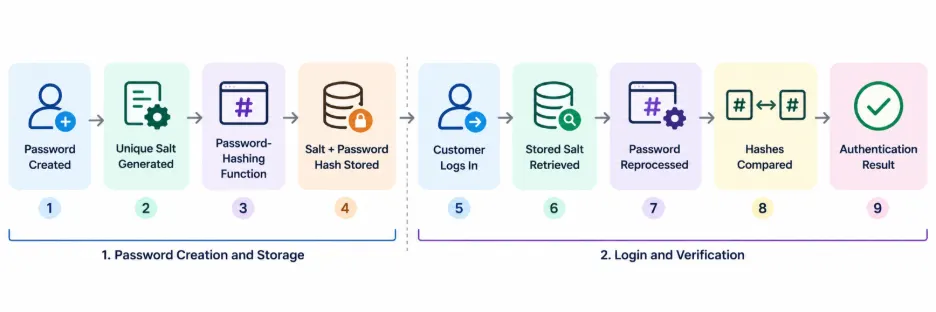
Generate a Unique Salt for the Password
When a new password is created, the system needs a unique salt generated using a cryptographically secure source of randomness. The salt should be sufficiently long to make accidental reuse extremely unlikely.
This should happen for each password rather than assigning one fixed salt to every account. Unique salts are what prevent customers who choose identical passwords from ending up with identical stored password hashes.
In practice, developers often should not generate or combine salts manually. Established implementations of modern password-hashing algorithms can generate and encode the salt as part of the stored password representation.
Process the Password With a Password-Hashing Function
The password and salt are then processed using a password-hashing algorithm designed specifically for storing passwords.
This distinction matters. A fast general-purpose hash such as SHA-256 is designed to compute hashes efficiently. Password hashing deliberately adds computational—and, for algorithms such as Argon2, memory—cost so that large-scale password guessing becomes more expensive.
Algorithms such as Argon2id, scrypt, bcrypt, and PBKDF2 handle password hashing differently, and their suitability depends on the environment and configuration. We will compare those options later.
Store the Password Hash and Salt
After hashing, the application stores the resulting password verifier and the information required to verify the password later. Depending on the password-hashing format or library, the salt, algorithm identifier, work parameters, and resulting hash may be encoded together in one stored representation.
The original password should not be stored.
And the salt does not need to be hidden. Its security purpose comes from being unique, not secret. This allows the authentication system to retrieve the salt when it needs to verify a future login.
Retrieve the Stored Information During Login
When the customer returns, they submit their identifier and password through the application's authentication flow. The system retrieves the stored password-hashing information associated with that account.
It then processes the submitted password using the stored salt and the same relevant hashing parameters. The result can be securely compared with the stored verifier.
If verification succeeds, the password is correct for that account. If it fails, authentication based on that credential is denied.
Rehash Passwords When Security Parameters Need Updating
Password-hashing settings should not necessarily remain unchanged for the lifetime of an account. Hardware improves, recommended algorithms evolve, and work factors that were appropriate years ago may eventually become too inexpensive.
A successful login creates an opportunity to upgrade an older password verifier. After verifying the customer's existing password, the system can hash that password again using the current algorithm or stronger parameters and replace the older stored representation.
Here’s where teams can create unnecessary risk: manually inventing formats such as hash(password + salt) when established password-hashing libraries already manage salts, parameters, and verification correctly. Using well-maintained implementations reduces custom cryptographic logic and makes future upgrades easier to manage.
Why Salting Passwords Makes Stored Credentials Harder to Attack
Salting does not make a password impossible to crack. Its value is more specific: it changes the economics of attacking a collection of password hashes.
Without unique salts, attackers can reuse work across multiple accounts and compare stored hashes for useful patterns. Unique salts remove much of that advantage by making each stored password verifier effectively its own target.
Identical Passwords Produce Different Stored Hashes
Suppose two customers choose exactly the same password. If the same unsalted hashing process is used for both, their stored hashes can be identical. Anyone who obtains the password database can immediately see that the two accounts share the same underlying password, even without knowing what that password is.
Unique salts change the input before password hashing:
Customer A: Password + Unique Salt A → Password Hash A
Customer B: Password + Unique Salt B → Password Hash B
The original passwords may be identical. The stored hashes are not.
This matters at scale. A popular password used by hundreds of customers should not produce one recognizable value repeated throughout the credential database.
Salting Makes Precomputed Rainbow Tables Ineffective
A rainbow table contains precomputed mappings that can be used to look up hashes for possible password values. Against unsalted password hashes, an attacker may be able to reuse the same precomputed work across many accounts.
Unique salts disrupt that model. The attacker would need results that account for each individual salt rather than relying on one reusable table for every password hash produced by the same algorithm.
That is why salting is commonly described as a defense against rainbow-table and other precomputation-based attacks.
It does not mean the password can no longer be guessed. An attacker who has both the stored hash and salt can still try password candidates. The difference is that those guesses have to be evaluated against the individual salted verifier.
Salting Prevents Easy Detection of Shared Passwords
Repeated hashes can reveal relationships inside a breached credential database. If thousands of accounts contain the same unsalted hash, an attacker knows those customers probably share the same password.
With unique salts, that shortcut disappears. Identical passwords produce different stored representations, so attackers cannot simply group equal password hashes to identify accounts sharing a credential.
This is particularly useful when common passwords appear across a large customer population.
Salting Forces More Work Toward Individual Password Hashes
The broader advantage is isolation. Unique salts reduce an attacker's ability to perform one calculation and apply the result efficiently across many password hashes.
But there is an important catch: the cost of each individual guess still depends heavily on the password-hashing algorithm and its configuration. If the application uses a fast general-purpose hash, adding a salt does not suddenly make offline guessing expensive.
Salt removes shortcuts. A purpose-built, appropriately configured password-hashing function makes each remaining guess costly. Secure password storage needs both.
| Threat | Without Salt | With Salt |
|---|---|---|
| Same password | Same hash | Different hash |
| Rainbow tables | Effective | Largely ineffective |
| Shared passwords | Visible | Hidden |
| Bulk attacks | Easier | Harder |
What Password Salting Does Not Protect Against
Salting solves a specific password-storage problem. It makes precomputed attacks less useful and prevents identical passwords from producing identical stored hashes. What it does not do is protect the entire authentication process.
That distinction matters because a salted password can still be weak, phished, reused, or guessed.
Salting Does Not Make Weak Passwords Strong
Adding a unique salt does not increase the strength of the password a customer chose. A predictable password remains predictable.
If an attacker obtains a salted password hash and its associated salt, they can still test likely password candidates against that individual hash. Common and easily guessed passwords may therefore remain vulnerable even when the salting process itself is implemented correctly.
Businesses still need sensible password policies and controls that prevent known weak or compromised passwords from being accepted.
Salting Does Not Stop Offline Password Guessing
When attackers steal a password database, they may be able to perform guesses offline without interacting with the application's login endpoint. That means rate limiting, bot detection, and account lockout at the login page cannot directly slow those attempts.
A unique salt forces the attacker to target salted hashes individually, but the cost of each guess comes largely from the password-hashing algorithm and its configured work factor.
This is why using salt with a fast general-purpose hash is not enough. Purpose-built password-hashing algorithms are designed to make repeated guessing more computationally expensive.
Salting Does Not Prevent Credential Stuffing
Credential stuffing is a different problem. Attackers take username-password combinations exposed elsewhere and try them against another application.
Salting stored passwords cannot stop a customer from reusing the same password across multiple services. If the attacker already knows the plaintext credential from another breach, they can attempt to authenticate normally.
MFA, compromised-password screening, bot and automation detection, rate controls, and risk-based authentication can help address this threat.
Salting Does Not Prevent Phishing
Salt protects how a password is stored. Phishing targets the customer before password storage becomes relevant.
If a customer enters a valid password into an attacker-controlled site, the attacker may obtain the plaintext credential directly. The fact that the legitimate application stores a salted password hash does not prevent that theft.
Where phishing resistance is a priority, businesses may need stronger authentication approaches, such as appropriately implemented passkeys based on FIDO/WebAuthn, phishing resistant MFA rather than relying on password-storage controls alone.
Salting Does Not Replace MFA or Other Authentication Controls
Secure password storage protects credentials if stored password data is exposed. MFA, step-up authentication, risk evaluation, session protection, and bot defenses address different parts of the authentication threat model.
They should not be treated as interchangeable controls.
This is the practical boundary to remember: salting protects the password-hashing process, not the customer’s entire account. Strong authentication still requires controls for how passwords are created, transmitted, stored, entered, recovered, and used during login.
Salting vs Hashing vs Encryption vs Peppering: What Is the Difference?
Hashing, salting, encryption, and peppering are sometimes grouped together because they can all appear in security discussions. They do different jobs.
For password storage, the most important distinction is that passwords generally need to be verified, not recovered. That is why purpose-built password hashing—not reversible encryption—is the foundation of secure password storage. Salts and, in some architectures, peppers provide additional protection around that process.
| Technique | Primary Purpose | Reversible? | Must Be Secret? | Role in Password Storage |
|---|---|---|---|---|
| Hashing | Creates a one-way password verifier | No | No | Foundation of password storage |
| Salting | Makes password-hashing inputs unique | N/A | No | Used with password hashing |
| Encryption | Protects data while allowing authorized recovery | Yes, with the key | Encryption key: Yes | Generally not the preferred way to store passwords |
| Peppering | Adds a separately protected secret to password processing | N/A | Yes | Optional defense-in-depth control |
Hashing Creates a One-Way Password Verifier
Hashing transforms an input into a derived value that is not intended to be reversed to recover the original input. For password authentication, the system can verify a submitted password against the stored verifier without keeping the original password.
Password storage requires more than simply choosing any hash function, though. Purpose-built password-hashing algorithms are deliberately designed to make repeated password guesses expensive. Fast general-purpose hashes such as SHA-256 serve other cryptographic purposes but should not be treated as standalone password-storage algorithms.
Salting Makes Each Password-Hashing Input Unique
Salt introduces unique data into the password-hashing process. Two customers can therefore choose the same password without producing the same stored password hash.
The salt does not need to be secret. It can normally be stored with the password verifier because its purpose is to prevent reusable precomputation and repeated hash values, not to act as a secret key.
Salting and hashing are therefore not competing techniques. Salt is an input to the password-hashing process.
Encryption Protects Data That Needs to Be Recovered
Encryption is different because it is designed to be reversible when the correct decryption key is available. That property is valuable when an application needs to retrieve the original data later.
Passwords usually do not need to be recovered. The system only needs to determine whether the password submitted during authentication is correct. Storing passwords using reversible encryption can therefore create unnecessary risk: compromise of the decryption key could expose every recoverable password protected by it.
There can be specialized architectures with different requirements, but for ordinary password authentication, purpose-built password hashing is the appropriate model.
Peppering Adds a Secret Outside the Password Database
A pepper adds another property that salt deliberately does not provide secrecy.
Depending on the design, a pepper can be incorporated into password processing or applied through an additional keyed operation. Unlike a per-password salt, the pepper should be kept separately from the password database, such as in an appropriate secret-management system or hardware security module.
If an attacker steals only the password database but does not obtain the pepper, that additional secret can make password verification attacks harder.
There is a trade-off. Because the pepper is not derived from each customer's password, rotating a compromised pepper is more complicated than simply generating a new salt. The system generally cannot recompute password verifiers with a new pepper without access to the customer's plaintext password, which may require reauthentication or password resets depending on the implementation.
The simplest way to separate these concepts is by the problem each one solves: hashing creates the password verifier, salting makes each password's hashing process unique, encryption protects recoverable data, and peppering can add a separately stored secret as defense in depth.
Which Password-Hashing Algorithms Should Be Used With Salts?
A unique salt is only one part of secure password storage. The hashing algorithm also needs to be designed for passwords and configured so that each guess requires meaningful computational effort.
That rules out a common shortcut: simply combining a password with a salt and running the result through a fast general-purpose hash such as SHA-256. The output may be salted, but an attacker can still perform password guesses very quickly with modern hardware.
Purpose-built password-hashing algorithms address that problem differently.
Argon2id for Modern Password Storage
Argon2id is a modern password-hashing algorithm designed to make password cracking expensive in both computation and memory. It combines properties of Argon2i and Argon2d and is the variant generally recommended for password storage in current security guidance.
Argon2id supports configurable memory, time, and parallelism parameters. That flexibility allows organizations to tune the cost of password verification for their infrastructure while making large-scale offline guessing more expensive.
Salts should be unique for each password. Established Argon2id libraries can generally generate and encode the salt, algorithm parameters, and resulting hash in the stored representation, so developers should prefer well-maintained implementations over building this logic themselves.
Scrypt When Argon2id Is Not Available
Scrypt is another memory-hard password-based key derivation function. Its memory requirements are intended to increase the resources needed for large-scale parallel password guessing.
It can be an appropriate alternative where Argon2id is unavailable, provided its parameters are configured according to current security guidance and the performance characteristics of the application.
As with Argon2id, parameter selection matters. Simply choosing the algorithm name without configuring an appropriate work factor does not guarantee strong password protection.
Bcrypt for Existing and Legacy Systems
Bcrypt has been widely used for password storage and includes salting as part of its design. It also provides a configurable work factor that can be increased as computing power changes.
For new systems, more modern memory-hard options such as Argon2id are generally preferred where available. bcrypt can still be relevant when maintaining existing applications, but teams should understand its limitations, including its input-length constraints, before relying on it.
Migrating away from an existing bcrypt implementation does not necessarily require resetting every password immediately. Password hashes can often be upgraded progressively after customers successfully authenticate, which we will cover later.
PBKDF2 for Environments With Specific Requirements
PBKDF2 derives a result by repeatedly applying a pseudorandom function, with an iteration count controlling the computational work required. It has long-standing implementation support and remains relevant in environments where specific standards or compliance requirements apply.
Unlike memory-hard algorithms such as Argon2id and scrypt, PBKDF2 primarily increases computational cost through repeated operations. Its security therefore depends heavily on using an appropriate hash function, iteration count, salt, and implementation.
For environments requiring FIPS-validated cryptographic implementations, PBKDF2 may be selected where appropriate.
Why SHA-256, SHA-1, and MD5 Are Not Password-Hashing Algorithms
SHA-256 remains a useful cryptographic hash function. The problem is not that SHA-256 is inherently “broken”; it is that speed is desirable for many of the jobs it was designed to perform.
Password storage needs almost the opposite property.
An attacker attempting millions or billions of password guesses benefits from a hash function that can be calculated extremely quickly. Adding a unique salt prevents reusable precomputation across accounts, but it does not make each SHA-256 calculation sufficiently expensive.
SHA-1 and MD5 have additional cryptographic weaknesses and should not be used for modern password storage either.
The distinction is worth keeping clear: Password + Salt + Fast General-Purpose Hash ≠ Modern Password Storage
A better design uses a unique salt + purpose-built password-hashing algorithm + appropriately configured cost parameters.
The algorithm choice matters, but configuration and maintenance matter just as much. Work factors should be reviewed as hardware and security guidance change, and applications should retain enough information about the algorithm and parameters used for each stored verifier to support future upgrades.
Salt vs Pepper: Why They Solve Different Password-Storage Problems
Salt and pepper can both appear in a password-protection design, but treating them as interchangeable creates the wrong security model. A salt is expected to be available with the password verifier. A pepper gains its value from being kept secret and separate from that database.
The easiest distinction is uniqueness versus secrecy.
| Salt | Pepper | |
|---|---|---|
| Primary purpose | Makes password-hashing inputs unique | Adds a separately protected secret |
| Unique for each password? | Yes | Not necessarily |
| Must remain secret? | No | Yes |
| Stored with password hash? | Yes, typically | No |
| Typical storage location | Password database / encoded hash | Secrets manager, vault, or HSM |
| Primary security value | Limits precomputation and identical password hashes | Adds protection when the password database is compromised without the pepper |
A Salt Is Designed to Be Stored With the Password Hash
Each password should receive its own randomly generated salt. The authentication system needs that value again when verifying the password, so storing it alongside the resulting verifier is expected.
Trying to hide salts usually does not provide the security benefit teams expect. If the design depends on the salt remaining secret, it is relying on the salt to perform a job it was not intended to do.
Its strength comes from uniqueness.
Pepper Must Be Protected Separately
Pepper introduces a secret that is not stored alongside the password hashes. Depending on the architecture, it may be incorporated before password hashing or applied afterward through an appropriate keyed cryptographic operation.
Because the pepper is secret, storing it in the same database as the password hashes defeats much of the reason for having it. It should instead be protected through suitable secret-management infrastructure, such as a secrets vault or hardware security module where appropriate.
This creates another security boundary. An attacker who obtains only the password database may have the hashes and salts but still lack the pepper needed by the password-verification design.
Peppering Adds Operational Complexity
Here’s where it gets interesting. Salts are straightforward to replace when a customer creates or changes a password because the application has the plaintext password at that moment. Peppers are harder to rotate.
If a pepper is compromised, the application cannot simply derive a replacement verifier from the existing password hash. Password hashing is deliberately one-way, and the original passwords should not be stored for later use.
Depending on how peppering is implemented, migration may therefore require customers to authenticate again so their passwords can be processed with a new pepper, or it may require password resets for accounts that cannot be migrated through normal authentication.
That operational cost should be considered before peppering is introduced.
Peppering Does Not Replace Strong Password Hashing
Adding a secret pepper to a weak password-storage scheme does not fix the underlying design. Businesses still need unique salts, a suitable password-hashing algorithm, appropriate work parameters, and secure implementation practices.
Peppering is better viewed as defense in depth. It can provide an additional barrier if the password database is exposed without the separately protected secret, but it should sit on top of a sound password-hashing design rather than compensate for a weak one.
For most developers, the priority order is straightforward: use an established password-hashing implementation, ensure every password receives a unique salt, configure suitable cost parameters, and manage upgrades over time. Add peppering when the threat model and operational environment justify the additional secret-management responsibility.
Password Salting Best Practices Developers Should Follow
The safest password-salting implementation is usually the one with the least custom cryptographic logic. Modern password-hashing libraries already handle much of the difficult work, including salt generation, parameter encoding, and password verification.
Developers still need to make the right architectural choices around those libraries.
Generate a Unique Salt for Every Password
Each stored password should have its own salt. Reusing one fixed salt across an application brings back one of the problems salting is meant to solve: customers with the same password may again produce the same verifier under the same configuration.
A new salt should also be generated when a password is changed or otherwise rehashed in a way that creates a new password verifier.
Generate Salts With a Cryptographically Secure Random Source
Salt values need enough randomness and length to make collisions extremely unlikely. Sequential account IDs, usernames, email addresses, timestamps, or other predictable values should not be used as substitutes for randomly generated salts.
In many cases, developers should not generate the salt themselves at all. A reputable implementation of Argon2id, scrypt, bcrypt, or PBKDF2 can handle salt generation as part of the password-hashing operation.
That is generally preferable to inventing a custom format.
Store the Salt With the Password Verifier
There is no need to build a separate secret store for password salts. The authentication system needs the salt during verification, and salts are not expected to remain confidential.
Depending on the library and algorithm, the stored representation may already contain the algorithm identifier, salt, cost parameters, and resulting password hash in an encoded format.
Keep that distinction clear: a salt can be stored with the hash; a pepper should not be stored there.
Configure an Appropriate Work Factor
Salt uniqueness and hashing cost solve different problems. A unique salt limits reusable precomputation, while the work factor determines how expensive each password guess is.
Argon2id, scrypt, bcrypt, and PBKDF2 expose different parameters for controlling this cost. Settings should follow current guidance while remaining practical for the application's authentication infrastructure.
The target is not to make legitimate authentication noticeably unusable. It is to make large numbers of offline guesses substantially more expensive for an attacker.
Store Enough Information to Support Future Upgrades
Password-storage requirements change. An algorithm considered appropriate today may eventually be replaced, and work factors normally need to increase as hardware becomes faster.
The stored password representation should therefore identify the algorithm and parameters required to verify the credential. That allows the application to recognize older password hashes and upgrade them when an opportunity arises.
This is much easier than assuming every account will use one permanent hashing configuration forever.
Prefer Established Libraries Over Custom Password Cryptography
A homemade scheme may look straightforward: Password + Salt → Hash
The real implementation quickly becomes more complicated. Salt generation, encoding, work parameters, constant-time verification behavior, algorithm migration, input handling, and library updates all need attention.
Use mature, maintained password-hashing libraries provided or recommended for the application's language and framework. Avoid designing a custom algorithm or manually combining cryptographic primitives unless there is a well-justified requirement and appropriate security expertise.
Review Password-Hashing Parameters Over Time
Password storage should not become a “configure once and forget it” control. Teams should periodically review their algorithm choice, work parameters, library versions, and current security guidance.
If stronger parameters can be supported without unacceptable authentication latency or infrastructure cost, older password verifiers can be upgraded progressively as customers authenticate.
A practical password-storage design therefore needs to answer two questions: Is this configuration appropriate today, and can we migrate away from it when it no longer is? Salting is only one part of getting both answers right.
Common Password Salting Mistakes That Weaken Credential Security
Most salting mistakes do not come from ignoring salt entirely. They happen when teams use a salt but give it the wrong properties, pair it with an unsuitable hash function, or assume salting solves more of password security than it actually does.
A technically “salted” password database can still be poorly protected.
| Common Mistake | Why It Weakens Password Protection |
|---|---|
| Using the same salt for every password | Removes per-password uniqueness and can allow identical passwords to produce identical verifiers |
| Using predictable values as salts | Provides less protection against precomputation than unique random salts |
| Treating the salt as a secret | Confuses the role of salt with pepper and adds unnecessary secret-management complexity |
| Using MD5, SHA-1, or SHA-256 as the password-storage function | Fast general-purpose hashes allow password guesses to be computed too quickly |
| Creating custom password-hashing logic | Introduces avoidable implementation and migration risks |
| Using weak cost parameters | Makes individual password guesses cheaper even when salts are unique |
| Storing a pepper with the password database | Removes much of the additional protection gained from keeping the pepper separate |
| Never upgrading old password hashes | Leaves credentials protected by algorithms or parameters that may no longer meet current guidance |
How to Upgrade Legacy Password Hashes Without Breaking Customer Authentication
Password-storage practices change over time. An application may still contain customer credentials protected with an older algorithm, insufficient work parameters, or a legacy salting approach even after the business adopts a stronger standard for new accounts.
That does not always mean every customer needs an immediate password reset. A planned migration can often upgrade password protection progressively while keeping normal authentication working.
Identify Legacy Algorithms and Hashing Parameters
Start by understanding what is already stored. Different groups of accounts may use different hashing algorithms, salt formats, work factors, or password-verifier structures, especially after application migrations or acquisitions.
The authentication system needs enough metadata to determine how a particular stored verifier should be checked. That may include an algorithm identifier, salt, iteration or cost parameters, and other information required by the legacy scheme.
Without that inventory, migration quickly becomes guesswork.
Support Legacy Verification During the Transition
During migration, the application may temporarily need to verify both the older password format and the new one. When a customer attempts to log in, the system identifies the format associated with that account and verifies the submitted password using the corresponding scheme.
This does not mean new passwords should continue using the legacy configuration. New registrations and password changes should use the current approved password-hashing approach.
The legacy verifier exists only to provide a controlled path forward.
Rehash the Password After Successful Authentication
A successful login creates a useful migration point because the application temporarily has access to the customer's submitted plaintext password for verification.
Once the old verifier has been successfully checked, that password can be processed using the current password-hashing algorithm, a newly generated unique salt, and current work parameters. The resulting verifier then replaces the legacy value.
The journey can look like this: Customer Logs In → Legacy Hash Identified → Password Verified Using Legacy Scheme → New Salt Generated → Password Rehashed With Current Scheme → Stored Verifier Updated → Future Logins Use New Scheme
The plaintext password should not be retained after the authentication operation.
Use Password Resets When Transparent Migration Is Not Possible
Some accounts may remain inactive for years, meaning login-based migration will never reach them. Other legacy formats may not be practical or appropriate to support indefinitely.
In those cases, businesses may need a password-reset strategy before the old verifier can be retired. The decision should account for the security risk of keeping legacy hashes, the size and activity of the affected customer population, and the impact of forcing resets.
For higher-risk legacy credentials, waiting indefinitely for the customer to return may not be acceptable.
Track Migration Until Legacy Hashes Can Be Retired
Progressive rehashing only works if teams know how much of the credential population has actually moved.
Monitor the number of accounts remaining on each legacy scheme, establish criteria for retiring old verification code, and remove obsolete algorithms once they are no longer required. Keeping old password-hashing implementations available forever increases maintenance burden and leaves unnecessary legacy security paths in the authentication system.
The important principle is that password hashing should be upgradeable. Businesses should be able to strengthen algorithms and work parameters over time without treating every security improvement as a complete customer-identity migration.
How LoginRadius Helps Protect Password Credentials With Hashing and Salting
Secure password storage is easy to describe conceptually, but maintaining it across a large customer identity system involves more than generating a salt and choosing a hashing algorithm. Teams also need to manage credential verification, password policies, recovery, migrations, authentication security, and changes to password-protection practices over time.
LoginRadius helps businesses manage these requirements as part of a broader customer identity and access management (CIAM) platform. Passwords are protected through hashing and salting rather than stored as plaintext, helping reduce the exposure of original customer credentials if stored authentication data is compromised.
Credential protection also matters during migration. Businesses moving customer identities from an existing authentication system may already have password hashes created with different algorithms, salt formats, or iteration settings. Where supported, LoginRadius can work with existing password-hash information during customer migration, helping organizations move identities without automatically requiring every customer to create a new password on day one.
Password storage is only one layer of account security. LoginRadius can combine credential protection with capabilities such as breached-password protection, MFA, risk-based authentication, bot and brute-force protection, password management, account recovery, and session management. These controls address risks that salting itself cannot solve, including credential stuffing, automated login attempts, and compromised passwords used during authentication.
For development teams, that means password hashing does not have to become separate custom cryptographic logic inside every application. Credential handling can instead sit within the same identity infrastructure used to manage customer authentication, security policies, and account lifecycle workflows.
Salting still has a precise role within that architecture: protect the uniqueness of stored password verifiers. The broader CIAM layer is responsible for helping protect what happens before, during, and after the password is verified.
Conclusion: Secure Password Storage Requires More Than Adding Salt
Password salting solves an important problem: it makes each password-hashing input unique, so identical passwords do not produce identical stored verifiers and attackers cannot efficiently reuse precomputed results across an entire password database.
But salt is only one part of the design. Secure password storage also depends on a purpose-built password-hashing algorithm, appropriate cost parameters, secure implementation, and a plan for upgrading older hashes as security guidance and computing power change. A pepper can add another layer where the threat model justifies it, but it does not replace those fundamentals.
And password storage is only one part of protecting a customer account. Credential stuffing, phishing, automated attacks, insecure recovery, and session theft require controls beyond hashing and salting.
LoginRadius brings credential protection into a broader CIAM approach, helping businesses manage secure customer authentication without maintaining password security as isolated custom logic across every application.
Ready to strengthen how your applications manage customer credentials and authentication? Book a demo with LoginRadius to see how LoginRadius can help you build secure, scalable customer identity experiences.
FAQs
Q: What Is Salt in Cybersecurity?
A: A salt is a unique value incorporated into password hashing so identical passwords produce different stored hashes. It helps protect against precomputed attacks such as rainbow tables.
Q: Why Is Salt Added to Passwords?
A: Salt makes each password-hashing input unique, preventing identical passwords from producing identical stored verifiers. This reduces an attacker’s ability to reuse precomputed results across multiple accounts.
Q: Does a Password Salt Need to Be Secret?
A: No. A password salt does not need to be secret and can typically be stored alongside the password hash. Its security value comes from being unique and appropriately generated, not from remaining hidden.
Q: Where Should a Password Salt Be Stored?
A: A salt can be stored with the corresponding password verifier. Many modern password-hashing libraries encode the salt, algorithm parameters, and resulting hash together in the stored representation.
Q: What Is the Difference Between Salt and Pepper?
A: A salt is unique per password and does not need to remain secret. A pepper is a secret used as an additional defense and should be protected separately from the password database.
Q: Can Two Users Have the Same Password but Different Hashes?
A: Yes. When each password uses a different unique salt, two users with the same password should produce different stored password hashes under the same properly implemented password-hashing scheme.
Q: Does Salting Prevent Brute-Force Attacks?
A: No. Salting limits reusable precomputation but does not prevent an attacker from guessing individual passwords. A purpose-built password-hashing algorithm with suitable cost parameters helps make each offline guess more expensive.
Q: Which Password-Hashing Algorithms Use Salts?
A: Argon2id, scrypt, bcrypt, and PBKDF2 support salted password hashing when properly implemented. Modern libraries often generate and manage salts automatically, reducing the need for custom salting logic.