Introduction
“Sign in with social media” feels harmless. It’s one button. Your user logs in with just a click, no passwords to remember, and no friction. Product teams love it because conversion rates go up. Users love it because nobody wants to invent another password called Summer2026!Final2.
But here’s the uncomfortable truth about social logins: they make authentication easier but not identity management. The moment you introduce multiple social identity providers like Google, Facebook, Apple, or GitHub, you’re no longer managing logins. You’re managing identity relationships. And if you don’t implement proper account linking, you’re essentially inviting duplicate user records, fragmented profiles, and hidden security gaps into your system.
When identity linking isn’t handled carefully, attackers can exploit gaps in how social authentication is processed. Blind email matching, unverified provider claims, or poorly designed linking logic can open doors to account takeover scenarios that security teams lose sleep over.
Done correctly, account linking connects multiple login methods to a single unified user profile without compromising security. Done poorly, it becomes the exact mechanism attackers use to pivot between identities. The challenge is balancing both worlds. Users expect frictionless access. They don’t want security pop-ups every time they try to log in. At the same time, your system must ensure that linking identities doesn’t silently weaken your authentication model.
That tension between seamless UX and serious security is what makes account linking for social login one of the most underestimated components of modern CIAM architecture.
In this guide, we’ll break down how identity linking works, why it matters for social authentication, how to prevent account takeovers, and how to do all of it without killing the user experience that made social logins attractive in the first place.
What Is Account Linking in Social Authentication?
Account linking is the process of associating multiple authentication methods such as email/password and various social identity providers with a single unified user profile in your application.
When a user logs in through social authentication, the provider returns an identity token containing user claims. Your application validates that token and either retrieves an existing profile or creates a new one. The challenge is that each provider issues its own unique identifier. Google might not recognize a Facebook login. Apple doesn’t recognize GitHub logins and so on. Without linking logic, your system treats each login as a separate identity. The result is fragmented user records.
What An Identity Claim Looks Like
When a user authenticates, your application receives a JSON Web Token (JWT). To safely link accounts, your backend logic must look beyond the basic email string and evaluate security claims like email_verified:
1{
2  "iss": "https://accounts.google.com",
3  "sub": "1092830192830192",
4  "email": "user@example.com",
5  "email_verified": true,
6  "name": "Alex Developer"
7}
Warning: If email_verified is false or omitted by the provider, your application must flag the request and deny automatic linking.
A single person may end up with multiple digital identities in your database, each tied to a different login method. These profiles may hold different behavioral histories, permissions, or preferences. Over time, this fragmentation complicates analytics, support workflows, and authorization consistency.
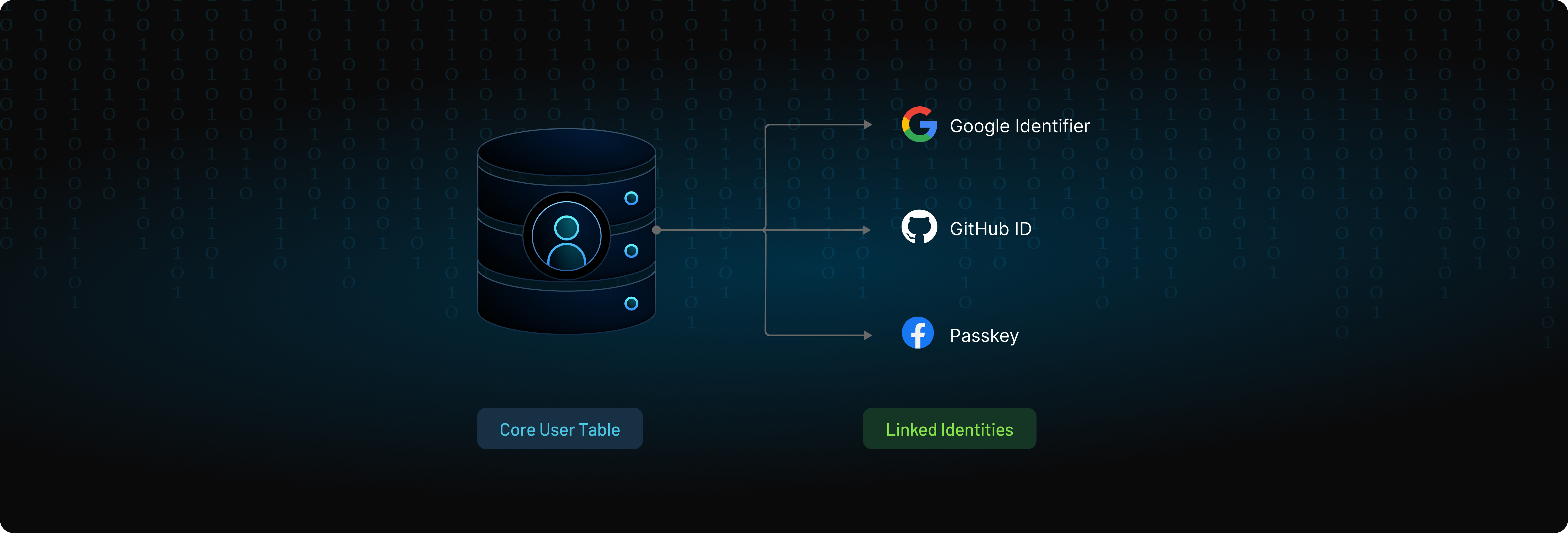
Account linking solves this by binding multiple authentication credentials to one core profile. The login method becomes simply an access channel, not a separate identity record.
It’s important to distinguish linking from merging. Account merging typically consolidates two existing records into one, often irreversibly. Account linking preserves separate credentials while associating them under a unified profile. It’s controlled, traceable, and reversible making it a safer architectural approach.
In short, social logins simplify authentication. Account linking ensures identity remains singular and structured.
Why Social Logins Create Hidden Security Risks?
Social authentication feels secure because major providers handle credential validation and token issuance. However, the security risk rarely lies within the provider. It lies in how your system processes and associates identities afterward.
The most common issue is** duplicate account creation. **When a user signs in with one provider and later uses another, your system may generate a new profile instead of recognizing the existing one. These parallel accounts fragment data and weaken identity clarity. Operationally, this creates confusion. From a security perspective, it creates gaps. Those gaps become dangerous when automatic linking is implemented carelessly.
Many systems rely solely on matching email addresses to determine whether two identities belong to the same user. But not all providers guarantee the same level of email verification. Some allow unverified claims. Others may reflect outdated ownership. If your linking logic blindly trusts the email field without validating its assurance level, you risk connecting identities that should remain separate.
Attackers don’t need to break OAuth to exploit this. They only need to find weaknesses in your linking logic. If they gain access to a secondary social account that shares an email claim with a target profile, weak linking rules could allow unintended association.
Additionally, inconsistent verification policies across providers can lower your overall security posture. When multiple social identity providers are supported, your trust model must account for the weakest assurance level among them.
Social logins increase convenience. But every additional authentication option expands your potential entry points. Without disciplined identity linking, those entry points remain loosely governed.
The Three Types of Account Linking (And Their Security Trade-Offs)
Not all account linking is created equal. The way you connect identities determines whether you’re strengthening your authentication model or quietly weakening it.
Modern systems typically implement one of three approaches: automatic account linking, consumer-initiated identity linking, or API-based linking controlled by developers. Each comes with different security implications.
1. Automatic Account Linking
Automatic account linking occurs when your system detects that two login attempts share the same email address and links them behind the scenes.
From a UX perspective, this feels magical. The user signs in with Google today and Facebook tomorrow, and everything just works. No prompts. No decisions. One unified profile.
Here’s how the flow looks visually:
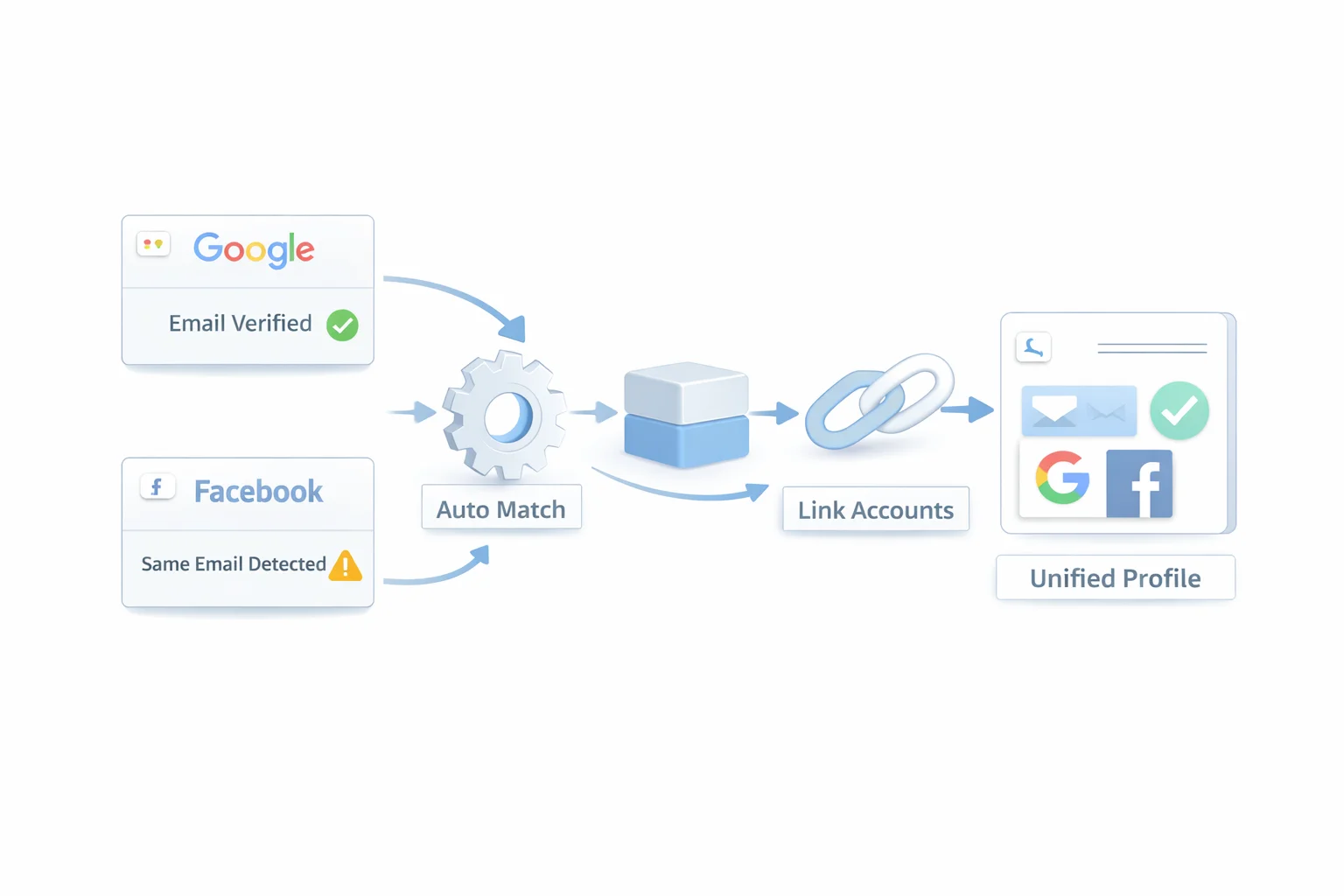
But security lives in the details. If your system only checks whether the email strings match, you may introduce risk. Did the second provider verify that email? Has it recently changed? Is it flagged as unverified in the token? Are you trusting a claim without validating its assurance level?
Automatic account linking works well when strict verification checks are enforced. Without them, it becomes a convenience feature attackers might test for weaknesses.
2️. Consumer-Initiated Identity Linking
This model shifts control to the user.
Instead of linking accounts automatically, the system requires the user to authenticate first and then explicitly choose to link another social identity provider from within their account settings.
The flow looks like this:
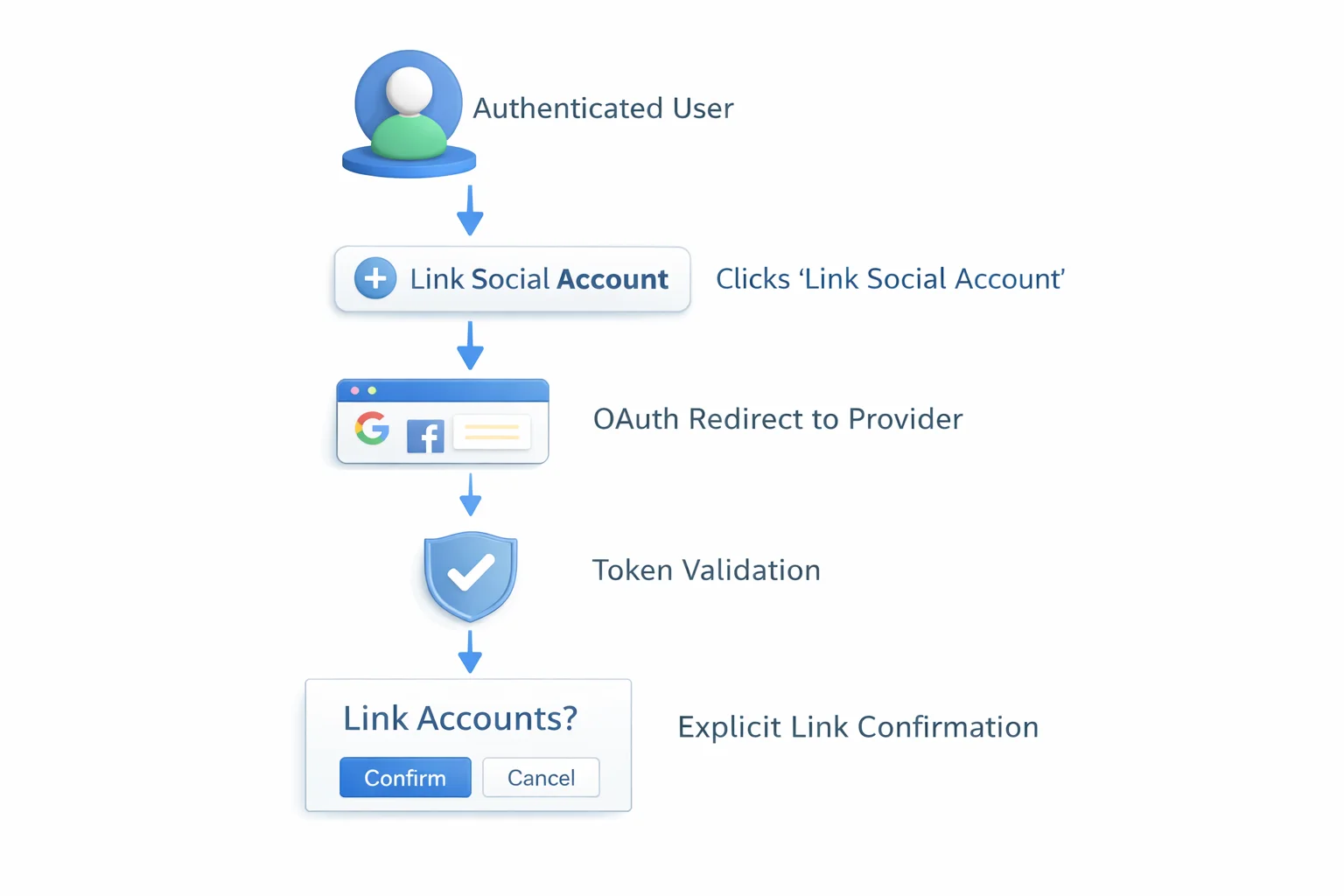
This approach dramatically reduces takeover risk. Because the user must already have an active authenticated session, the system can verify identity before allowing linking. It also ensures intent. The user knowingly connects their identities, rather than the system assuming it should.
From a security standpoint, this is typically the safest default model for social authentication environments. From a UX standpoint, it adds one additional step but it’s contextual and usually accepted.
3. API-Based Account Linking (Developer-Controlled Logic)
The most flexible and most powerful approach is API-based account linking.
In this model, developers define the linking logic programmatically. Instead of relying purely on email matching or user-initiated actions, linking decisions can incorporate additional signals such as device fingerprinting, risk scores, IP reputation, or adaptive authentication triggers.
This approach allows you to:
-
Require step-up MFA before linking.
-
Prevent linking from suspicious geolocations.
-
Apply business rules for regulated environments.
-
Log detailed audit trails.
-
Customize linking workflows per tenant or user segment.
API-driven identity linking transforms linking from a simple profile association into a controlled security event.
However, with flexibility comes responsibility. If the validation logic is poorly implemented, you’re effectively building your own attack surface. Choosing the right approach depends on your application’s risk tolerance, regulatory environment, and user expectations. In most modern CIAM architectures, a combination of these approaches is used, balancing seamless UX with controlled identity trust boundaries.
How Account Linking Prevents Account Takeovers
When designed with structured validation controls, account linking becomes a defensive layer rather than a vulnerability.
-
The first safeguard is verified email enforcement. Before linking identities based on email similarity, your system must confirm that the email claim is marked as verified by the social identity provider. Ignoring verification flags introduces unnecessary risk. Email equality alone is not proof of ownership.
-
Re-authentication before linking adds another layer of protection. Linking a new authentication method modifies how a user can access an account. That makes it a sensitive operation. If a session has aged or risk signals have changed, requiring fresh authentication reduces the chance of session hijacking, leading to unauthorized linking.
-
Adaptive step-up authentication further strengthens protection. When contextual signals such as unfamiliar devices or abnormal geolocation indicate elevated risk, additional verification should be triggered before linking completes. This ensures friction is proportional to risk rather than uniformly applied.
-
Comprehensive token validation is equally critical. ID tokens must be verified for signature integrity, correct issuer, appropriate audience, expiration, and nonce consistency. Proper validation prevents replay attacks and token manipulation during the linking flow.
-
Finally, audit logging and unlink capabilities provide traceability and reversibility. Every linking event should be recorded with contextual metadata. Users should be able to remove linked social identities if needed. This transparency reduces long-term exposure and improves response readiness.
When these controls operate together, account linking consolidates identity without weakening security boundaries. It reduces duplicate accounts, enforces structured trust decisions, and limits the pathways attackers can exploit.
Social authentication broadens access options. Proper identity linking ensures those options remain securely governed.
How to Link an Account Securely (Step-by-Step Framework)
If you’re implementing account linking, the goal is simple: extend authentication options without weakening identity assurance. That requires structured validation at every stage.
Begin with an authenticated session.
Linking should only occur after the user has already established a trusted session through a verified login method. This creates a baseline identity before introducing additional credentials.
Next, initiate the OAuth flow properly.
Redirect the user to the selected social identity provider using secure parameters. Validate the state parameter and use PKCE where applicable. These controls prevent CSRF and token interception during the linking process.
Then perform full token validation.
Do not rely on simple decoding. Verify the token signature against the provider’s public keys. Confirm the issuer and audience claims match your application. Validate expiration and nonce values to guard against replay or misuse.
Evaluate the email claim with caution.
If your logic depends on email matching, ensure the provider marks the email as verified. If verification status is missing or false, require additional validation within your system before linking. Email similarity alone is insufficient proof of ownership.
Incorporate contextual risk evaluation.
Assess device familiarity, IP reputation, and behavioral consistency. If anomalies are detected, trigger step-up authentication. Linking a new login method alters how an account can be accessed, so it should not proceed blindly under elevated risk.
Require clear user confirmation.
Even in low-risk scenarios, confirm intent before associating identities. This prevents accidental linking and protects against edge cases involving compromised sessions.
Log the event thoroughly.
Record provider details, timestamp, device data, and authentication context. Linking actions should be auditable for future investigations.
Finally, support unlinking.
Users must retain control over which social logins remain associated with their account. Reversibility strengthens long-term security and trust.
When implemented with these controls, identity linking becomes structured and defensible rather than a silent background automation.
UX Without Compromise: Making Account Linking Feel Invisible
Security controls should not feel like obstacles. Account linking works best when users barely notice it happening but still understand what’s occurring.
Start with contextual messaging.
If a returning user attempts to sign in with a social identity that matches an existing profile, avoid alarmist warnings. Use clear, calm prompts that explain what’s happening. Inform, don’t intimidate.
Avoid unnecessary interruption.
In low-risk environments, linking can occur seamlessly or with minimal confirmation. Not every scenario requires heavy friction. Overloading users with prompts undermines the simplicity social logins are meant to provide.
Apply adaptive friction instead of fixed friction.
If risk signals remain consistent with normal behavior, keep the experience smooth. If anomalies arise, introduce additional verification. Users accept friction when it clearly aligns with protecting their account.
Provide visibility and control.
A transparent account dashboard should display all linked social identity providers. Users should see when each was connected and have the option to remove them. Visibility reinforces trust and reduces confusion.
Design for clarity.
When duplicate accounts are prevented quietly and consistently, users never question the system. When identity linking fails or behaves unpredictably, support volume increases and trust declines.
The objective is straightforward: preserve the simplicity of social authentication while maintaining structured identity governance behind the scenes.
Common Account Linking Mistakes That Lead to Breaches
Most vulnerabilities related to social authentication stem from flawed linking logic rather than broken OAuth flows.
Relying solely on email equality
Matching email strings without confirming verification status creates a false sense of certainty. Providers differ in how they validate emails, and ignoring those nuances introduces unnecessary exposure.
Incomplete token validation
Failing to verify signature integrity, issuer, audience, or expiration undermines the trustworthiness of the authentication process. Token validation must be comprehensive, especially during linking operations.
Linking without re-authentication
If a session has aged or shows unusual behavior, allowing immediate linking can enable attackers who have hijacked active sessions to attach additional credentials. Treat linking as a sensitive modification, not a routine update.
Ignoring contextual signals
Unusual geolocation, new devices, or suspicious IP addresses should influence linking decisions. Processing all requests identically eliminates the benefit of adaptive security controls.
Lack of audit logging
Without detailed records of linking events, investigating incidents becomes difficult. Traceability is essential for understanding how identities were associated over time.
Relay Edge Case
A common architectural trap is assuming you can always match emails. Features like Sign in with Apple allow users to hide their true email address, returning an anonymous proxy address instead. If a user registers with Google (user@example.com) and later tries to log in with Apple using a private relay, automatic email matching will fail. In these instances, you must fallback to Consumer-Initiated Account Linking via an authenticated settings panel to securely bind the distinct identifiers.
Finally, removing unlink capabilities locks users into potentially compromised associations. Security must include mechanisms for correction, not just prevention.
Each of these issues stems from minimizing the significance of account linking. Connecting identities alters the trust model of an account. That change deserves the same validation rigor applied to primary authentication flows.
When linking logic is disciplined, it strengthens identity integrity. When it is careless, it creates the very pathways attackers seek.
Risk-Based Account Linking Architecture
As applications scale, static linking rules stop being sufficient. Matching emails and verifying tokens are foundational, but modern threat landscapes demand contextual intelligence.
This is where risk-based account linking architecture becomes essential.
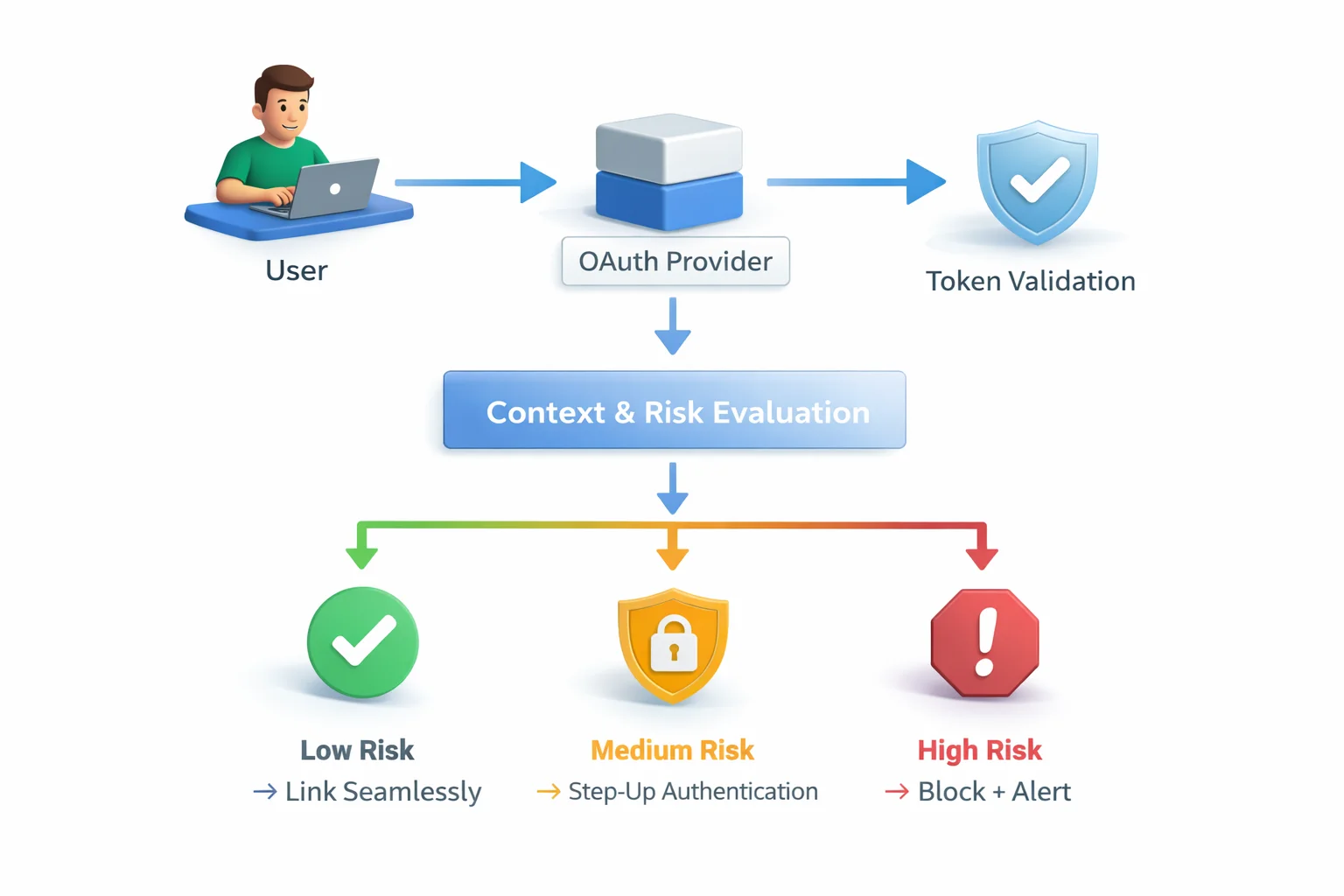
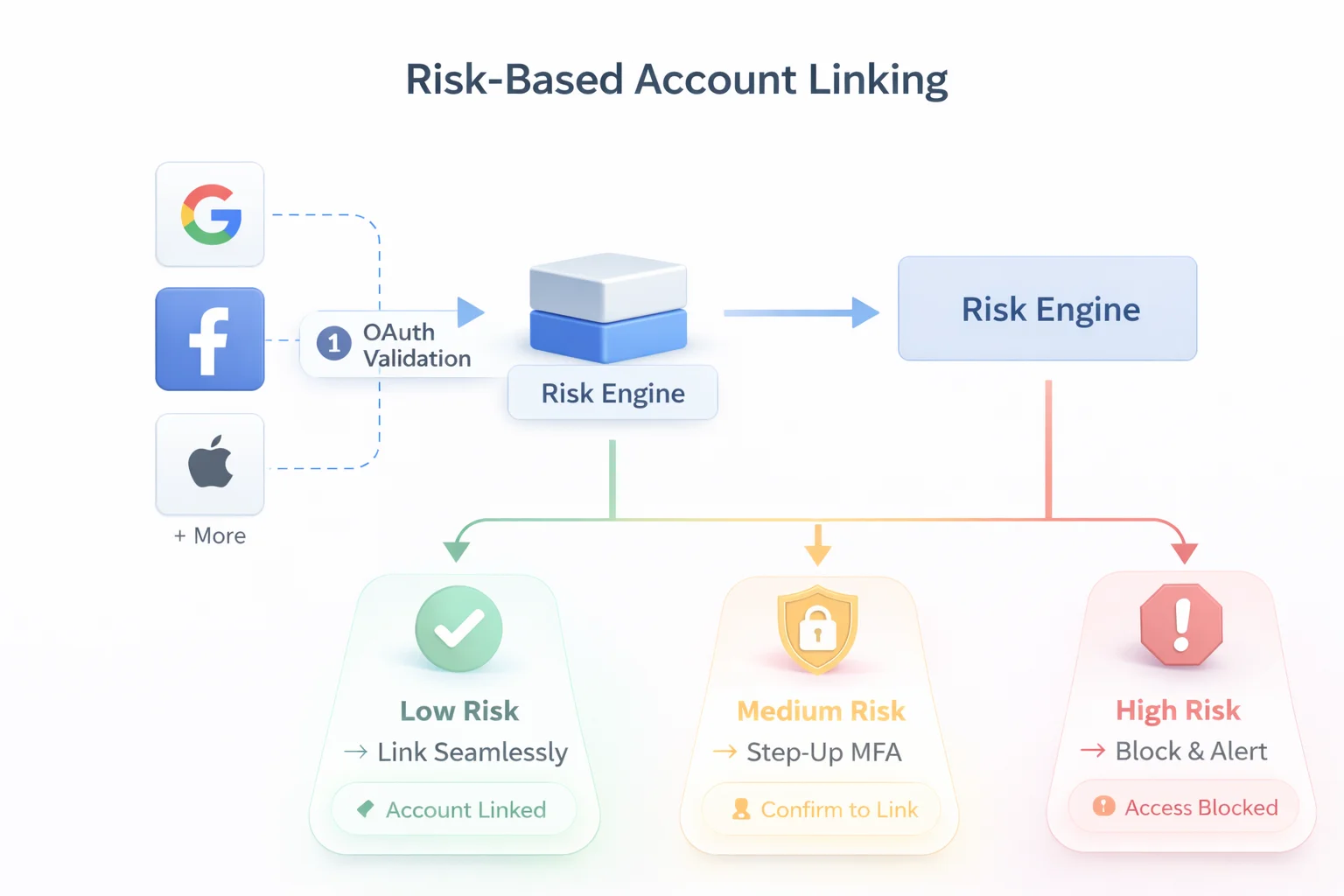
Instead of treating every linking attempt the same, the system evaluates contextual signals before deciding whether to proceed, challenge, or block. Identity linking becomes a controlled security event, not a background automation.
Here’s what a structured flow looks like:
The first layer remains technical validation.
Verify the ID token signature. Confirm issuer and audience. Check expiration. Ensure the nonce matches. This prevents replay and token forgery attacks. Without this layer, no risk engine can compensate.
The second layer introduces contextual intelligence.
Device fingerprint consistency helps determine whether the linking attempt originates from a familiar environment. IP reputation analysis flags suspicious networks. Geo-velocity detection identifies impossible travel scenarios. Behavioral signals such as login timing patterns add another dimension of confidence.
If the signals align with normal behavior, the linking process can remain smooth. The user experiences minimal friction. Social authentication retains its convenience.
If the signals diverge from baseline expectations, adaptive authentication activates. Step-up MFA, biometric confirmation, or re-authentication ensures that linking proceeds only after additional proof of identity.
In high-risk scenarios, the safest response is rejection and alerting. Blocking a suspicious linking attempt protects the unified user profile from becoming an attacker’s pivot point.
This architecture shifts identity linking from static logic to dynamic decision-making.
It recognizes that not all authentication contexts are equal. A user linking a GitHub account from their regular device during normal hours does not present the same risk as a linking attempt from an unfamiliar country minutes after a password reset.
By integrating account linking with a risk engine, organizations maintain the promise of seamless social logins while strengthening account takeover defenses.
The result is controlled flexibility.
Users enjoy multi-provider authentication. Security teams maintain trust and integrity. And the system evolves from reactive validation to proactive risk mitigation.
Account linking, in this model, becomes part of adaptive identity orchestration rather than a simple database association.
Where Account Linking Fits in Modern CIAM Architecture
Account linking is not a surface-level login feature. It sits at the core of modern CIAM architecture, directly impacting authentication, profile management, and risk enforcement.
When multiple social identity providers are supported, each login method becomes an additional access path. Without structured identity linking, those paths generate fragmented user records. That fragmentation weakens data integrity, complicates authorization decisions, and introduces inconsistencies in behavioral analytics.
In a mature CIAM model, the user profile is the primary identity object. Authentication methods whether email/password, passkeys, or social logins are simply mechanisms used to access that object. Account linking ensures those mechanisms connect to a single, authoritative profile rather than creating parallel identities. This has operational consequences.
Permissions remain consistent because roles are attached to one profile. Analytics remain accurate because activity is consolidated. Support workflows improve because there is a single source of truth. Identity coherence strengthens both user experience and governance.
From a security perspective, linking is a trust-boundary decision.
When a new social credential is associated with an account, the number of authentication entry points expands. That expansion must inherit the same risk controls, logging requirements, and adaptive authentication policies as primary login methods. Otherwise, identity integrity becomes uneven.
Modern CIAM systems operate through orchestration. Authentication triggers risk evaluation. Risk influences adaptive controls. Those controls protect the unified identity object. Account linking belongs within this orchestration layer, not just inside a login interface.
Social authentication increases convenience. Identity linking preserves structure. In modern architectures, structured identity is foundational to both security and scalability.
Conclusion
Social authentication reduces friction. It improved signup conversions and removed password fatigue. But convenience alone does not create a secure identity system.
Without proper account linking, each social login can produce duplicate records, fragmented profiles, and weakened trust boundaries. Over time, those inconsistencies erode both security posture and operational clarity.
Account linking resolves this by consolidating authentication methods under a single, governed identity.
When implemented correctly, it enforces token validation, respects verification signals, evaluates contextual risk, and maintains audit visibility. It connects credentials without blindly trusting them. It expands access options without expanding vulnerability. The balance is intentional.
Over-automation can introduce silent takeover risks. Excessive friction damages user experience. Effective identity linking sits between those extremes, applying intelligence where trust must be validated and remaining seamless where risk is low.
In modern CIAM environments, identity continuity matters more than login convenience alone. Social logins provide flexibility. Account linking ensures that flexibility does not compromise coherence. If authentication opens the door, account linking defines how many keys exist and who controls them. When designed carefully, convenience and security reinforce each other rather than compete.
Ready to build secure, scalable social authentication without fragmented identities? Explore how LoginRadius CIAM Platform helps enterprises unify social login, account linking, adaptive authentication, and identity governance into a single secure customer identity architecture.
FAQs
Q: What is account linking in social login?
A: Account linking connects multiple authentication methods (Google, Facebook, email/password) to one unified user profile.
Q: Is social login secure without account linking?
A: Without proper account linking, duplicate accounts and weak email matching can increase account takeover risk.
Q: How does account linking prevent account takeovers?
A: It enforces verified identity checks, token validation, and contextual risk controls before associating new login methods.
Q: Can users unlink social identities from their account?
A: Yes, secure systems allow users to remove linked social providers to maintain control and reduce exposure.
Q: What happens if two social providers return different emails?
A: The system should avoid automatic linking and require verification or user confirmation before associating identities.