What Is SMART on FHIR?

SMART on FHIR combines FHIR APIs with OAuth 2.0 and OpenID Connect to let healthcare apps securely access EHR data through standardized workflows. In this guide, you’ll learn how SMART on FHIR works, why identity and security are critical, and how it powers a new generation of plug-and-play healthcare applications.
profile
Kundan SinghFirst published: 2025-12-04Last updated: 2025-12-04
what-is-smart-on-fhir
Table of Contents

Key Takeaways / Introduction Summary

Key Takeaways / Introduction Summary

Healthcare is shifting from isolated, vendor-locked systems to open, interoperable data exchange. SMART on FHIR bridges these gaps by combining modern FHIR technology with standardized authentication and authorization workflows.

This guide explains:

  • What is SMART on FHIR and why it matters

  • How the FHIR protocol structures and exchanges healthcare data

  • How developers build SMART on FHIR apps that plug into EHRs seamlessly

By the end, you’ll understand how SMART on FHIR improves interoperability, enhances security, and enables a new generation of reusable, plug-and-play healthcare applications.

SMART on FHIR is an interoperability standard that layers secure OAuth 2.0 and OpenID Connect authorization on top of the FHIR protocol, allowing third-party apps to safely access EHR data through standardized APIs. It enables portable, reusable healthcare apps that work across different systems without custom integrations.

In a nutshell, SMART FHIR helps to view the intersection of two major healthcare innovations: data interoperability and secure access control. SMART stands for Substitutable Medical Applications and Reusable Technologies.

When paired with FHIR technology, it creates an open framework that enables apps to securely access patient data stored in electronic health records (EHRs) via standardized API calls.

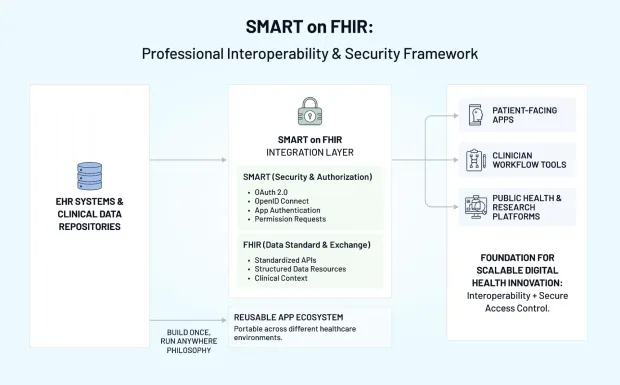
SMART on FHIR interoperability diagram linking EHR systems through a SMART on FHIR integration layer. Shows secure APIs enabling reusable apps for patients, clinicians, and public health/research platforms.

While FHIR defines how data is structured and exchanged, SMART defines how apps authenticate, request permissions, and receive clinical context. This combination makes SMART on FHIR the glue that holds modern healthcare app ecosystems together.

SMART on FHIR is designed to be reusable. A developer can build a SMART on FHIR app once and deploy it in multiple healthcare environments without rebuilding the integration each time. This “build once, run anywhere” philosophy dramatically reduces integration friction and enables a thriving marketplace of apps that serve clinicians, patients, payers, and public health agencies.

From a conceptual standpoint, Smart FHIR represents a shift from closed platforms to a more open, modular ecosystem—one where software innovation is encouraged rather than restricted.

As your understanding deepens, SMART on FHIR becomes more than just a technical specification—it’s a foundation for scalable digital health innovation, patient empowerment, and consistent security across diverse healthcare systems.

FHIR Technology and the FHIR Protocol

If SMART on FHIR is the engine for app interoperability, then FHIR technology is the fuel. FHIR—Fast Healthcare Interoperability Resources—introduced a modern, web-friendly approach to representing and retrieving healthcare data.

It uses REST APIs, JSON or XML formats, and well-defined resource models for entities like Patient, Observation, Encounter, Condition, or MedicationRequest. The FHIR protocol outlines how systems search, read, write, and interact with these resources, creating predictable patterns that every SMART on FHIR app depends on.

Before FHIR, integrating systems required custom HL7 messaging, proprietary interfaces, or manual exports. FHIR technology changed that by adopting industry standards used in mainstream software development. The result is an API-driven environment that makes health data far more accessible and easier to integrate.

But the FHIR protocol alone doesn’t solve authentication, user identity, permissions, or authorization. That’s where SMART comes in. The SMART layer sits on top of FHIR, defining how apps should authenticate using OAuth 2.0, request scopes, and receive information about which patient chart or clinical encounter is active.

Together, SMART on FHIR and the underlying FHIR protocol create a complete framework that supports secure, context-aware health data exchange.

How SMART on FHIR Works

SMART on FHIR works by combining FHIR APIs with OAuth 2.0 and OpenID Connect to create a secure, standardized way for apps to access EHR data. An app discovers the FHIR server’s capabilities, redirects the user for authentication, receives an access token with SMART scopes, and then uses that token to call FHIR resources with patient or encounter context.

Although SMART on FHIR includes multiple layers, the way it operates is surprisingly intuitive once broken down. At the highest level, SMART on FHIR establishes a secure handshake between three actors: the application, the FHIR server, and the authorization server.

The process begins when a SMART on FHIR app queries the FHIR server’s well-known metadata endpoint. This endpoint provides critical information such as OAuth URLs, supported SMART scopes, launch parameters, token formats, and available API capabilities.
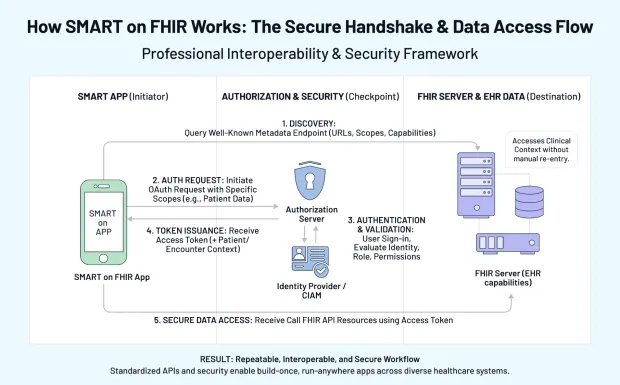
SMART on FHIR handshake diagram showing a SMART app authenticating via an authorization server and identity provider. Access token is issued and used to securely retrieve clinical data from a FHIR server/EHR.

Once the app understands the server’s configuration, it initiates an OAuth authorization request asking for access to specific FHIR resources. This request includes scopes that define what the app wants to read or write—such as patient data, clinical observations, or medications.

When the user signs in—typically through the healthcare organization’s identity provider or a CIAM platform—the authorization server evaluates their identity, role, permissions, and the app’s requested scopes. Only after validating all of this does it issue an access token and optionally an ID token.

The SMART on FHIR app then uses the access token to make secure calls to the FHIR protocol endpoints. Because the token includes patient or encounter context (when applicable), the app opens directly in the correct segment of the clinician or patient workflow. This context ensures efficiency and removes the need for repeated navigation or manual data entry.

Together, these steps create a repeatable, interoperable, and secure workflow. By standardizing how apps launch, authenticate, authorize, and access data, SMART on FHIR enables developers to build reusable apps that work across any SMART-enabled FHIR server with minimal customization—driving large-scale interoperability and better digital health experiences.

Components of SMART on FHIR

The SMART on FHIR ecosystem is built around three tightly integrated components that work together to support secure, standards-based healthcare app functionality.

The first layer is FHIR technology, which defines the data structure and interaction rules. This ensures that SMART on FHIR apps can reliably request and interpret patient data using the FHIR protocol. Without this uniform data standard, interoperability would collapse under inconsistent schemas and incompatible formats.

The second layer is the security framework. SMART leverages OAuth 2.0 and OpenID Connect to authenticate users and authorize apps. This allows precise control over who can access which FHIR resources. SMART-specific scopes—such as patient/Observation.read or user/*.read—make it possible to enforce least-privilege access. Identity proofing, authentication, MFA, and session management can be handled by enterprise IAM or CIAM platforms.

The final component is the launch and context framework. SMART defines how apps are launched from inside an EHR or launched independently, and how patient or encounter context is passed securely. This eliminates guesswork for app developers and ensures clinicians see relevant information immediately, without navigating or searching manually.

Together, these layers create a complete, unified system that makes SMART on FHIR one of the most powerful interoperability models in healthcare.

SMART on FHIR Apps: What They Are and How They Work

At a practical level, SMART on FHIR apps are applications built using the SMART standards so they can integrate easily with EHR systems and FHIR servers. These apps serve many different roles across healthcare. Some are clinician-facing decision support tools that display labs, vitals, and predictive insights pulled directly through the FHIR protocol. When launched inside an EHR, the app receives patient context so the user doesn’t need to re-enter identifiers or navigate multiple screens.

Other SMART on FHIR apps are patient-facing. These apps aggregate medical records from various providers, allowing individuals to view their appointments, medications, allergies, and care plans in one unified interface. The rise of patient portals and mobile health technologies has made this use case even more important, especially as consumers expect more control over their health data.

There are also administrative, payer, and analytics-oriented SMART on FHIR apps that leverage FHIR technology for care coordination, operational planning, utilization management, and population health studies. Because SMART on FHIR follows standard protocols for data access and context sharing, these apps can be reused across different EHRs and care settings, reducing development time and improving scalability.

This flexibility is the core strength of Smart FHIR: developers build once, and healthcare organizations deploy anywhere.

Why SMART on FHIR Matters for Security & Identity

Security and identity management are essential in healthcare, and SMART on FHIR is designed with both in mind. Because it is built on OAuth 2.0 and OpenID Connect, SMART ensures that only authenticated, authorized users and applications can access sensitive health data.

Each access token reflects the user’s identity, permissions, and the specific FHIR resources they’re allowed to read or modify. This mapping between identity and access scope is central to modern healthcare compliance.

From an IAM standpoint, SMART on FHIR fits naturally into identity ecosystems where strong authentication, MFA, passwordless access, or biometric verification already exist. CIAM platforms like LoginRadius can unify patient identity, clinician identity, and consumer app access into a single authorization framework. Once a user is authenticated, the identity platform issues an OIDC token that the SMART layer uses to generate FHIR-scoped access.

By integrating identity, access control, consent, and audit logs into the flow, SMART on FHIR helps organizations meet strict regulatory frameworks such as HIPAA, GDPR, and CMS interoperability rules. This tight coupling of health data and identity is one of the reasons SMART has become a preferred model in modern healthcare architectures.

How Developers Build SMART on FHIR Apps

Developing SMART on FHIR apps involves a predictable pattern that makes the process easier than building one-off integrations. Developers register their app with the SMART authorization server, define redirect URIs, and request appropriate SMART scopes.

They then implement the OAuth authorization code flow, handle token responses, and integrate with the FHIR protocol using secure HTTP requests.
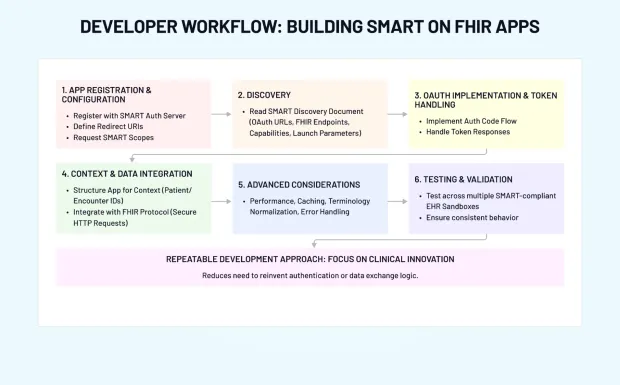
Flowchart titled “Developer Workflow: Building SMART on FHIR Apps” outlining six steps from app registration, discovery, and OAuth implementation to context/data integration, advanced considerations, and testing. Emphasizes a repeatable development approach that lets developers focus on clinical innovation rather than reinventing auth or data exchange.

A key step is reading the server’s SMART discovery document, which reveals everything the app needs to operate—OAuth URLs, FHIR endpoints, supported capabilities, and required launch parameters. Developers then structure their app to receive context such as patient or encounter IDs, ensuring the app opens with relevant data in a clinical setting.

Beyond authentication, developers must also consider performance, caching, terminology normalization, and error handling. Since SMART on FHIR apps read live clinical data, the user experience must accommodate different data availability patterns and formats. Testing across multiple SMART-compliant EHR sandboxes ensures the app behaves consistently regardless of deployment site.

This repeatable development approach is what makes SMART on FHIR so attractive. It allows teams to focus on clinical innovation instead of reinventing authentication or data exchange logic.

Use Cases and Benefits of SMART on FHIR

SMART on FHIR unlocks a wide range of real-world use cases. Clinicians benefit from decision-support tools embedded directly within their workflow, reducing manual chart review and improving diagnostic accuracy.

Patients gain mobile apps that consolidate data across providers, improving engagement and continuity of care. Public health agencies and researchers access standardized data models through the FHIR protocol, supporting cohort analysis, case surveillance, and population health insights.

On the organizational side, SMART on FHIR reduces the need for custom interfaces, resulting in shorter development cycles, lower integration costs, and smoother onboarding for new tools. Because SMART uses modern web standards, it improves security and compliance without forcing teams to rely on dated infrastructure.

Ultimately, SMART on FHIR enhances interoperability by turning EHR data into a secure, open, and accessible resource that supports a vibrant ecosystem of reusable apps.

Challenges and Best Practices

Even with its strengths, SMART on FHIR introduces several practical and architectural challenges—especially for organizations transitioning from legacy systems or heterogeneous EHR environments.

Teams must be fluent in FHIR resource modeling, understand the nuances of OAuth 2.0 and OpenID Connect flows, and navigate the complexity of assigning SMART scopes to clinical roles. Data quality is another recurring issue: even when systems use the FHIR protocol, clinical codes, vocabularies, and resource completeness can differ widely. This inconsistency often forces teams to invest in data normalization, terminology mapping, and semantic validation.

Regulated environments add further layers of responsibility. Organizations must ensure that governance controls, consent frameworks, access logging, and audit trails are implemented with precision. Any misalignment can introduce compliance risks, especially when PHI moves between multiple SMART on FHIR apps and services.

Moreover, user adoption challenges—particularly among clinicians already burdened with overloaded workflows—must be addressed early to avoid resistance to new digital tools.

Best Practices for SMART on FHIR Success

To overcome these challenges, organizations benefit from adopting a staged, strategic approach. Starting with focused pilot applications—such as a clinician-facing decision support tool or a patient-facing medication tracker—helps refine implementation patterns without overwhelming the team. This allows identity, FHIR, and app teams to validate workflows, confirm scope permissions, and refine how context is passed before broad rollout.

A mature, compliant FHIR server is non-negotiable. Ensuring the server adheres strictly to SMART on FHIR specifications reduces fragmentation and prevents custom, one-off integrations from creeping into the architecture. Teams should document and centrally manage scope definitions, align access policies with clinical roles, and test authorization flows continuously.

Clinician engagement is critical. Bringing clinicians into the design and validation phases ensures that SMART on FHIR apps actually support real-world workflows, reduce cognitive burden, and enhance usability. Their feedback is essential to shaping workflows that feel intuitive rather than disruptive. Combined with clear communication and training, this increases adoption and generates valuable insights that guide iterative improvements.

When these best practices are followed, SMART on FHIR evolves from a technical integration to a scalable, secure, and clinically meaningful interoperability strategy—one that can support long-term digital transformation across the healthcare system.

Enhancing SMART on FHIR Deployments with LoginRadius CIAM

Identity is the backbone of SMART on FHIR. While SMART defines how apps authenticate, authorize, and receive context, organizations still need a robust identity layer to ensure that the right users get the right access at the right time. This is where a CIAM platform like LoginRadius strengthens the entire architecture.
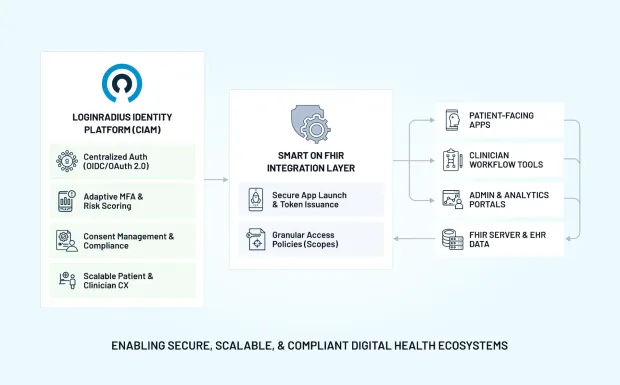
Diagram linking the LoginRadius Identity Platform (centralized auth, MFA, consent, scalable CX) to a SMART on FHIR integration layer for secure app launch and granular access. Shows patient apps, clinician tools, admin portals, and FHIR server/EHR data, captioned as enabling secure, scalable, compliant digital health ecosystems.

How LoginRadius Supports SMART on FHIR Success

1. Centralized Authentication Across Clinicians, Patients & Admins

LoginRadius offers unified identity management across all user types—patients, clinicians, caregivers, administrators—ensuring consistent, secure login experiences for every SMART on FHIR app. A single identity layer simplifies user management while supporting multi-tenant healthcare environments.

2. Secure OAuth 2.0 & OpenID Connect Foundation

SMART on FHIR depends on OAuth and OIDC. LoginRadius acts as a highly scalable, standards-compliant identity provider that issues OIDC tokens, enforces MFA, supports passwordless login, and integrates seamlessly into SMART authorization flows.

3. Granular Access Policies and Adaptive MFA

LoginRadius allows organizations to enforce role-based access tied to SMART scopes. Adaptive MFA, risk scoring, and device intelligence help ensure that sensitive PHI is accessed appropriately without adding friction to clinical workflows.

4. Consent Management & Compliance Readiness

LoginRadius’ built-in consent tracking and audit trails make it easier to align SMART on FHIR workflows with regulatory obligations such as HIPAA, GDPR, and CMS interoperability rules. This reduces operational and legal risk.

5. Scalable Identity Experience for Patient-Facing SMART Apps

Patient-facing SMART on FHIR apps benefit from LoginRadius’ capabilities like progressive profiling, passwordless flows, social login, and account recovery—all essential for reducing patient login friction.

6. Streamlined Integration with SMART App Launch

Because LoginRadius can serve as the OIDC identity provider, it integrates smoothly with SMART’s app-launch flows, making it easier to authenticate users, issue tokens, and manage sessions across multiple FHIR resources and apps.

By pairing SMART on FHIR with a modern CIAM platform like LoginRadius, healthcare organizations enhance security, streamline onboarding, ensure compliance, and deliver consistent, scalable access experiences across their entire digital ecosystem.

Conclusion

As healthcare continues to move toward open, data-driven ecosystems, SMART on FHIR provides the common language that lets innovators safely plug into EHR data. By standardizing data models, authorization flows, and clinical context it gives developers a repeatable pattern and gives organizations confidence that every app request is authenticated, authorized, and auditable.

Pairing SMART on FHIR with a CIAM platform like LoginRadius extends that foundation with centralized identity, adaptive MFA, and consent management at scale. Together, they turn interoperability from a compliance checkbox into a strategic advantage—powering secure, patient-centric digital experiences across the healthcare continuum today and in the future.

FAQs

1. What is SMART on FHIR?

SMART on FHIR is a standard that combines FHIR technology with OAuth 2.0 security to allow apps to securely access healthcare data from EHR systems.

2. What are SMART on FHIR apps?

They are applications built using SMART standards that can securely read and write FHIR data across different hospital systems without custom integrations.

3. How does the FHIR protocol support SMART on FHIR?

The FHIR protocol provides the data model and API structure, while the SMART layer provides authentication, authorization, and context.

4. Why is identity important for SMART on FHIR?

SMART relies on OAuth and OpenID Connect, so secure authentication and user identity directly determine what data an app can access.

book-a-free-demo-loginradius

Kundan Singh
By Kundan SinghDirector of Product Development @ LoginRadius.
Featured Posts

What Is Biometric Security?

What Is Device ID?

What Is Dynamic Access Control?

What Is 2FA and How It Works: Guide to Modern Authentication

What Is SMART on FHIR?

2FA in 2025: How Leading Providers Keep Digital Identities Safe

What Is a YubiKey?

Biometric Authentication Methods: How They Work & When to Use Them

Compliance Management: Processes, Systems & Best Practices

RBAC and Access Management: The Foundation of Secure IAM

How Does SAML Authentication Work?

ID Token vs. Access Token: Understand the Difference

AI-Driven Fraud Detection: The Future of Digital Trust

OIDC Authentication: How Modern Apps Verify Identity

A Complete Guide to 2FA Authentication in 2025: Methods, Risks, and Modern Best Practices

Cybersecurity Awareness Month 2025: Why Businesses Can’t Afford to Look Away

Secure Customer Experiences with Phone Authentication: Why Mobile Matters

Best Descope CIAM Alternatives in 2025

Passwordless Login: Technical Workflows, Business ROI, and Regional Adoption

Top 10 Frontegg Alternatives to Consider in 2025

Identity and Access Management in Banking: Why It’s Crucial for Security and Customer Experience

Top 10 FusionAuth Alternatives in 2025

Unlocking Secure Digital Experiences with Authorization as a Service

CIAM Platform Integrations: The Key to a Strong Customer Identity Strategy

Email is Hacked! 7 Immediate Steps to Follow

Data Governance in Healthcare: Best Practices & Future Trends

Why Social Login is a Game-Changer for eCommerce Login

Top WordPress Social Plugin Picks for Seamless Logins

Why Privacy-First Companies Choose Canada for Data Storage

Top Auth0 Alternatives for 2025: Simpler, Faster, and More Flexible CIAM Options

What Are Digital Certificates and How Do They Secure the Web

Why Hosting Your CIAM Solution in a Canadian Data Center Gives You the Edge

B2B IAM vs Workforce IAM: What Enterprises Must Know

Access Control in Security: What It Is and Why It Matters

The Making of The Power of Digital Identity: A Candid Interview with Rakesh Soni

What is Certificate-Based Authentication and Why It’s Used

6 Key Ecommerce Challenges in 2025 (And How CIAM Solves Them)

B2B vs B2C Authentication- A Quick Guide

Password Best Practices for Stronger Security

Building Community Beyond Borders: Our Thailand Story

1FA vs 2FA vs MFA: Which Method Secures You Best?

B2B IAM Best Practices and Architecture Guide

Adding Partner IAM With LoginRadius: A Complete Guide to B2B Identity Management

What is User Authentication, and Why is it Important?

What is Partner IAM / B2B IAM - A Complete Guide

Still Bending Workforce IAM for Your B2B Networks? Introducing LoginRadius Partner IAM—Built from the Ground Up

What is Biometric Authentication and How It's Changing Login

Location-Based Data Residency Boosts Trust and Conversions

The Impact of AI on Cybersecurity

PINs vs Passwords: Which is More Secure?

Why Global Businesses Trust Canada for Data Hosting Services

Passkeys vs Passwords: The Upgrade Your Security Needs

What is the Best Way to Authenticate Users?

Canada as a Global Hub for Privacy-First CIAM Platforms

How to Choose a Strong Password- A Quick Guide

A Complete Guide to Device Authentication Methods

What is a One-Time Password (OTP) ? – A Complete Guide

A Quick Guide to Username and Password Authentication

Types of Authentication and Identity Verification

What is Strong Authentication in Cybersecurity?

Top 9 User Authentication Methods to Stay Secure in 2025

Authentication vs Authorization: Key Differences, Real Examples & Best Practices

Guide to Authentication Methods & Choosing the Right One

Identification and Authentication: A Quick Comparison

Understanding Authentication, Authorization, and Encryption

Introducing the LoginRadius Trust Center: Always Up-to-Date and at Your Fingertips

What is Token Authentication and How Does It Work?

What is OTP Authentication and How Does it Work?

What is Role-Based Access Control (RBAC)?

LoginRadius Launches Next-Generation CIAM Console: Self-Serve, No-Code, and Built for Speed

Quick Guide to Single-factor, Two-factor, and Multi-factor Authentication

Democratizing Authentication: Introducing LoginRadius' Free Forever Developer Plan

Mobile Authentication: Everything You Need to Know

What is Push Notification Authentication and How It Works?

Code Less, Build More: Unveiling LoginRadius' AI-Powered Developer Documentation

Types of Multi Factor Authentication & How to Pick the Best

Risk-Based Authentication vs. MFA: Key Differences Explained

Revamped & Ready: Introducing the New Developer-First LoginRadius Website

What is SCIM? A Developer's Guide to Understanding and Using SCIM

RBAC vs ABAC: A Developer’s Guide to Choosing the Right Fit

CISOs’ Top Cybersecurity Threats 2025: Scattered Spider, Deepfakes, and More

LoginRadius 2024: A Year of CIAM Innovations

What is Passkey Authentication - A Complete Guide

How AI-Enabled Cybersecurity Solutions Are Strengthening Our Online Security

What is Identity Orchestration

LoginRadius Releases 2024 Consumer Identity Report, Highlights the Shifting Trends in Consumer Preferences

Celebrating 8th Year Milestone: How Our Collaboration with a Leading Healthcare Company Transformed Millions of Lives

Unlock Your Digital Freedom: How Automating Passwordless Authentication Can Transform Your Security

How To Secure GenAI by Implementing RBAC In The Enterprise

The Hidden Pitfalls: Why Most CIAM Systems Fail Under Pressure

No More Login Hassles: Effortless Migration to LoginRadius Awaits

How Cookie Management Supports GDPR and CCPA Compliance

LoginRadius Launches Identity Orchestration for Seamless Identity Workflows

Passkeys: Unlocking Benefits for a Better Online Shopping Experience

AI and the Changing Face of Enterprise Security Threats

Leading the Charge in Customer IAM: LoginRadius Recognized as an Overall Leader by KuppingerCole

Gearing Up for Better Customer Experiences? Choose No-Code Identity Orchestration

Announcement - LoginRadius Launches PassKeys to Redefine Authentication Security and User Experience

Decoding the Rise of Zero-Trust Adoption in Government Sector

Say Goodbye to Passwords: How Passkeys Are Reinventing Online Security

Announcement - LoginRadius Unveils the Future of Authentication with Push Notification MFA

Is Your CIAM Adapting to Global Needs? 6 Key Areas to Win Privacy-Concerned Customers

The Growing Threat of Identity-Based Attacks and the Need for an Advanced Identity Security Approach

How AI Is Changing the Game in User Authentication

eIDAS 2.0: The Digital Revolution Is Here – Is Your Business Ready to Comply?

A Quick Guide To Choosing The Right Zero Trust Vendor

Cloud Security Governance: Protecting Assets in the Digital Frontier

What is Silver SAML Vulnerability and How Can We Protect Our Digital Identities?

Identity Security for Device Trust: Navigating 2024 & Beyond

Exciting Leadership Updates Amid Strategic Growth at LoginRadius

From Past to Present: User Authentication's Evolution and Challenges

How Does Multi-Tenancy in Customer IAM Solutions Boost Security?

How No/Low Code CIAM Balances Security and User Engagement?

Beyond Passwords: Navigating Tomorrow's Authentication Landscape

How does identity management address the top 5 security challenges in B2B SaaS?

Reinforcing Security with Advanced Risk-Based Authentication in 2024 & Beyond

2FA vs MFA: Understanding the Differences

Okta Token Theft Implicated in Cloudflare's Security Breach

Voice OTP by LoginRadius: Revolutionizing Secure and Seamless User Authentication

Which is Safer: Biometric or Password?

7 Reasons to Use Biometric Authentication for Multi-Factor Authentication

Exploring Digital Identity Verification with Effective Crucial Data Checks

5 Reasons Why LoginRadius Leads the Way in the CIAM Landscape in 2024 & Beyond

Above the Horizon: Exploring the Power of a Strong Cloud Identity Platform

Streamlining Authentication: Elevate User Experience with LoginRadius AutoLookup

A Journey Through Our Top 10 Blogs from 2023

Now and Beyond- Staying Ahead with the 10 Key Cybersecurity Trends of 2024

B2B SaaS SSO Login: Exploring Enterprise Considerations in 2024

Securing Corporate Applications: A Comprehensive Guide to Enterprise Application Security

Strengthening Security Measures: The Role of Two-Factor Authentication (2FA)

Securing the Throne: Privileged Access Management (PAM) Best Practices Unveiled

7 Common Authentication Vulnerabilities to Steer Clear of

What is Identity Lifecycle Management?

Strengthening Security and Compliance: The Role of Identity Governance

Understanding the Okta Hack: Breach in Customer Support and Lessons for Organizations

Managing Generative AI Security Risks in the Enterprise- A Quick Guide

Empowering Your Security: Exploring the Advantages of Time-Based One-Time Passwords (TOTP)

The Future of Personalization: Embracing Zero-Party Data

Comprehensive Guide to Flexible CIAM Deployment Options with LoginRadius

Small Steps, Big Shields: Navigating Cybersecurity Awareness Month 2023 Safely

Streamlining Access with Converged Identity Platforms

How Retailers Can Balance Privacy While Foiling Thieves

The Power of No-code Customer IAM in Reducing Churn

CIAM: Enhancing Security & Building Consumer Trust-All At Once

Maintaining Trust: Customer Identity Verification Challenges & Best Practices

Unlocking Smartphone Security: How to Hackproof Your Smartphone

Phishing-Resistant MFA Login for Mobile Applications: Strategies and Challenges

True Passwordless Authentication: Stronger Defense Against Cyberattacks

Identity Governance vs. Identity Management: Navigating the Differences

Navigating Identity Verification Challenges in Regulated Industries: 7 Effective Solutions

Enhancing Security: Leveraging 5 Real-Time Techniques to Detect Phishing Attacks

A Comprehensive Guide to the Five A's of Cloud Identity Management

Understanding the Difference Between Identity Access Management On-Premise and Cloud

Learn the Impact of Identity Theft on Businesses in 2023

LDAP Authentication: Meaning and How it Works?

7 Things Your Security Team Need To Know Before Creating A CIAM Strategy

Choosing Between Self-Managed and Service-Based SSO Solutions: A Comprehensive Comparison

What is Cloud Identity and its Benefits?

The Legal Implications of SSO: Privacy, Security, and Compliance

Data Privacy Laws for 2023: A Closer Look at 9 Key Regulations

4 Reasons Why SSO Integrations Are a Must-Have For Online Businesses

Consumer vs. Enterprise: Navigating the Dual Nature of Digital Identity

LoginRadius Releases Consumer Identity Trend Report 2023, Highlights The Future of Customer Identity

What is a Password Vault and How Does it Work?

How a Culture of Identity Governance Empowers Digital Transformation?

Securing the Digital Frontier: The Power of AI in Next-Gen CIAM

Replatforming 101: Everything You Need to Know

Best Practices for Username and Password Authentication

The Ultimate Guide to Choosing the Right CIAM Solution

How to Use Identity Management at Every Stage of the Customer Journey?

Protecting Your Cloud Data: The Power of SaaS Security and IAM Governance

The Rise of Account Creation Fraud: What You Need to Know

Why Direct-to-Consumer (D2C) Businesses Must Take A Strategic Approach To CIAM?

What are Self-Sovereign Identities?

7 Uncommon Cyber Attacks in 2023: Why Your Organization Needs To Be Ready For The Worst-Case Scenarios

Identity Modernization: What Is It & Why Should You Care?

A Lot Can Happen In The Cloud: Multi-Cloud Environment and its Optimization Challenges

Can Security and User Experience Co-Exist in the Authenticating and Authorizing Space?

Business On The Move: How Just-in-Time Migrations Are Making Smooth CIAM Transitions

3 Digital Onboarding Trends To Watch In 2023 (And What You Can Do About It Now)

6 Tips to Prevent Accidental Data Exposure Within Your Company

Top Priorities for Customer IAM Leaders in 2023 and How to Prepare

Electronic Theatre Controls: A LoginRadius Customer Success Story

Distributed Multi-Cloud Identity Management and Its Endless Business Benefits

How The Age Of Smart Credentials Is Rewriting The Rules For Physical Verification?

Incident Response Vs. Disaster Recovery: What’s The Difference and Which Do You Need?

The Customer Experience is About to Get Even Better With Passive Authentication

What is Dynamic Authorization & Why Does it Matter?

What’s the Difference Between Attack Surface and Attack Vector?

How Identity-Based Access Ensures Robust Infrastructure Security Amidst the Growing Identity Crisis?

2FA Bypass Attacks- Everything You Should Know

IAM vs. Customer IAM: Understanding the Role of CIAM in Accelerating Business Growth

Why MFA Fatigue Attacks May Soon Be Your Worst Nightmare?

InfoSec Director, Alok Patidar Answers Your Most Difficult Questions on Cybersecurity

Understanding MITRE ATT&CK Framework?

Identity Fabric vs. Zero Trust: Is One a Better Alternative Than The Other?

The Role of Customer Identity Management in IoT Security: How It's a Must!

Securing Centralized Access Without Compromising User Experience

User Authentication in the Metaverse: What’s Changing?

LoginRadius Pledges To Raise Awareness This Cybersecurity Month

Public Cloud Risks - Is Your Organization Prepared for Cloud Threats?

What Brands Need to Know for Building the Future of Data Compliance?

Okta Identity Credentials on the Radar of Oktapus Phishing Campaign

BC Municipality Digitizes its Citizen Services. LoginRadius Brings Identity to the Table.

The Role of Customer Authentication in Paving the Way for Digital Agility

What Brands Need to Know for Building the Future of Data Compliance?

6 Alternative Authentication Methods For Your Online Customers

Implementing Zero Trust? Make Sure You're Doing It Correctly

What is Federated SSO (Single Sign-On)?

MFA Prompt Bombing: Is it a New Threat Vector to Worry About?

Privacy-Centric Enhancements: CEO Rakesh Soni Shares His Thoughts on Shifting Data Strategies

The Role of Identity Management in Securing Your Citizen’s Data

Why is Data Privacy an Immediate Enterprise Priority?

What is Out-of-Band Authentication?

How Can Enterprises Use SSO to Boost Data Collection?

Why Your Business Needs A Simple Passwordless Experience (Minus the User Friction)

Will Apple’s ‘Lockdown Mode’ Reduce State-Sponsored Attacks?

Authentication, Identity Verification, and Identification: What's the Difference

IoT Botnet Attacks: Are They the Next Big Threat to Enterprises?

Skiperformance - a LoginRadius Customer Success Story

Cross-Device Authentication and Tracking: The Opportunities and Underlying Privacy Risks

How Identity Modernization Will Thrive Business Success in 2022 and Beyond

The Pros & Cons of Reusable Digital Identity: What You Need To Know

What is Cloud Security and How it Works?

Age of No-Code Technologies: Identification and Authentication

SSO vs. Social Login: What’s the Difference? [Infographic]

Planning a Digital Makeover For Your Business? LoginRadius CIAM Can Help!

What is Cloud Computing?

Authentication vs Login - What’s the Difference?

How a Simple Password Reset Can Ruin Your Customer's Experience

GovTech is On The Rise: How Can This Technology Improve Government Services?

5 Access Management Best Practices and Benefits For Businesses

LoginRadius Releases Consumer Identity Trend Report 2022, Key Login Methods Highlighted

BITB Attacks: The New Destructive Phishing Technique

5 Reasons Why You Need to Strengthen Your Identity Authentication

What is the Difference Between MFA vs. SSO?

What is Login Authentication?

5 Ways to Improve Your Customer Verification Process

5 Myths About Phishing You Should Know

4 Common Security Issues Found In Password-Based Login

Personal Information and PII - What’s the Difference?

OTT Platforms and CIAM: How Identity Management Ensures Millions of Viewers to Scale with Ease

Is the Rise of Machine Identity Posing a Threat to Enterprise Security?

LoginRadius Integrates Search in Navigation for Better Customer Experience

5 Privacy Threats in Social Media You Should Know in 2022

Importance of Multi-factor Authentication for SSO

How LoginRadius Creates a Perfect Harmony of UX and Security

Smart Cities and Cyber Security Trends to Watch Out in 2022

Harry Rosen, a LoginRadius Customer Success Story

Top 7 Security Tips from LoginRadius’ Cybersecurity Expert to Follow in 2023

Top 7 Security Tips from LoginRadius’ Cybersecurity Expert to Follow in 2023

This Is How Scammers Get Your Email Address & How to Stop Them

Will Decentralized Auth Change the Perception of Consumer Identities in 2022?

Emerging Threat of Deepfakes: How To Identify And Prepare Against It

Everything You Need to Know Before Buying Cyber Insurance in 2022

5 Challenges for Government Adoption of Citizens’ Access Control

Are You Thinking of Token Management for Your API Product? Think about JWT!

LoginRadius Launches M2M Authorization for Seamless Business Operations

LoginRadius Offers PerfectMind Integration for a Seamless UX

Take Control of Your CIAM Environment with LoginRadius' Private Cloud

10 Tips From CIAM Experts to Reduce the Attack Surface of User Authentication

How LoginRadius Webhook Allows You to Sync Your Data in Real-Time

Federated Identity Management vs. SSO: What's The Difference?

How to Evaluate the Quality of Your User Authentication System

How LoginRadius Offers Customer-Centric Capabilities that Drive ROI

3 Best Stages of IT Security for Implementing Gartner's CARTA

How to Choose the Right User Authentication Option for your Product

An Introduction to Financial-Grade API (FAPI) for Open Banking

Why is PKI The Future of Secure Communications

How to Find the Right SSO Strategy that Fits Your Business

Cybersecurity Best Practices for Businesses in 2023 & Beyond [Infographic]

SSO Integration: How to Secure the Customer Experience on Loyalty Platforms

The Top 5 Trends in CIAM We’ve Watched in 2021

The Major Challenges of Customer Identification in the Retail Industry

Cybersecurity Awareness Month: Predicting the Deadliest Cyber Attacks in 2022

LoginRadius Delivers a Seamless User Experience that Increases Conversions through Enhanced Progressive Profiling

Avoid these Common Mistakes When Dealing with Data Breaches

Tiroler Tageszeitung (TT), a LoginRadius Customer Success Story

What are Security Keys? What are its Advantages?

Everything You Need to Know About OAuth and How it Works

Decentralized Authentication: What Is It And How It Is Changing the Industry

Getting Started with OpenID Connect

Discover the Benefits of Re-Authentication for Enhanced Security

Stand Out from the Crowd: Improve Your Customer Support with CIAM

Why Should You be Customizing Your Identity System to Your Needs

SMS Authentication — Can it Really Protect Your Business?

How Poor Login Concurrency can Impact OTT Platforms' Business

A Comprehensive Guide to Privileged Access Management (PAM)

How Cities Can Improve Civilians’ Digital Experience with Unified Identity

Refresh Tokens: When to Use Them and How They Interact with JWTs

How Progressive Disclosure Makes Your User's Onboarding Easy

What is Digital Identity Verification and Why is it Necessary?

How OTT Services can Simplify Authentication on Various Devices

A Beginner's Guide to Zero Trust Security Model

What is Identity Security?

What is a Token? What are its Pros and Cons?

How to Scale Your Business Quickly with Identity Management

How to Manage Situation After a Data Breach

How to Strike the Right Balance Between Security and Consumer Experience

How NIST is Changing Password Creation in 2021

COVID-19 and Beyond: 5 Risk Management Essentials for Your Enterprise

How WebAuth Secures Your Users’ Login

Adaptive Authentication- Is it the Next Breakthrough in Customer Authentication?

The Rise of BYOI (Bring your own Identity)

Understanding PII Compliance: A Key to Enterprise Data Security

Cyber Security Round-Up: What Happened in June 2021

How Businesses are Experiencing Digital Transformation with Consumer IAM

What is SAML SSO?

LoginRadius Offers Additional Security Layer through Newly-Enhanced Step-up Authentication Feature

Why Big Merchants Need to Deliver a Unified Consumer Experience?

All About Google One Tap Login—Explained!

What to Do if Someone Steals Your JSON Web Token?

What is Web SSO

Working With Industry Authorization: A Beginner's Guide to OAuth 2.0

Password History, Expiration, and Complexity: Explained!

SAML vs OIDC: How to Choose the Right SSO Protocol for Your Business

10 Reasons For Businesses to Implement SASE with a Zero Trust Strategy

Move beyond Traditional Risk Management with Holistic APIs

Identity Providers Explained: How IdPs Power SSO, SAML, and OIDC

What is User Session Management?

How Entertainment Companies Use the LoginRadius CIAM platform

Consumer Data Protection: How to Handle Data Breaches in Your Business

Top 5 User Provisioning Mistakes Enterprises Should Avoid in 2021

How Secure is Two-Factor Authentication (2FA)?

The Changing Role of Identity Management in Enterprise Decision-Making

5 Reasons Why Cloud Governance Matters For Your Business

Implementing Effective Social Authentication Solution with LoginRadius

The Future of Authentication is Passwordless With Magic links

Handling Scalability and Enhancing Security with LoginRadius

Maintaining Quality Data Security Practices

Introduction to Mobile Biometric Authentication

Data Security in Hospitality: Best Practices for Operating In a Post-COVID Era

The Role of Identity management in the media industry

A Detailed Guide on How UX/UI Affects Registration

What Is a Salt and How Does It Boost Security?

Login Using Microsoft Account

A Detail Guide to Consent Management and Processing Data

Workflow Automation- What is it and Why Do You Need It?

How Companies can Enable Account security for their Consumers

What is Progressive Profiling and How it Works?

Password Spraying: What Is It And How To Prevent It?

5 Tips to Prevent OAuth Authentication Vulnerabilities

Calculating ROI, Build vs Buy (Part 1)

Identity Theft Frauds- Staying Ahead in 2021

What is privacy compliance and why is it so important?

Authentication Explained: What it is, How it Works, and Why it Matters in Cybersecurity

What are Federated Identity Providers?

Login with Google Apps

What is Passwordless Login?

What is Standard Login

IoT authentication in the airline industry

Announcement - Authentication API Analytics to Evaluate the Performance of LoginRadius APIs for Your Applications

Multi-Factor Authentication - A Beginner’s Guide

Single Sign-On- A Beginner’s Guide

Top 10 Cybersecurity Predictions for 2021 That SMBs Must Know

How to Put Yourself In Control of Your Data by Leveraging LoginRadius' SSO

What Is User Management?

How CIAM Will Address The 5 Most Popular Issues In The Utility Industry

CIAM Continues to Draw Attention as Okta acquires Auth0

Protecting a Unified Cloud Platform through Cloud Security Management

What is Continuous Authentication

What is Brute Force Attack

What is Identity Authentication: How It Works and What’s Ahead

What is the Power of PIN Authentication Security?

What is Risk-Based Authentication (RBA)?

SaaS IAM for B2B: The Key to Secure, Scalable Partner Access

Understanding the Difference Between Single-Tenant and Multi-Tenant Cloud [Infographic]

What is Phone Login

Why Organizations Must Use API-Driven CIAM for Digital Agility

Why Do Consumers Prefer Social Login [Infographic]

5 Best Practices of Implementing Business Resilience during a Data Breach

What is Broken Authentication Vulnerability and How to Prevent It?

Announcement - LoginRadius Introduces Convenient and Secure Biometric Authentication for Mobile Apps

6 Strategies to Secure Your Cloud Operations Against Today's Cyber Threats

Announcement - LoginRadius Introduces Password Policy to Ensure Best Practices for Businesses and Consumers

How Is New Age Ciam Revolutionizing Consumer Experience?

What is Federated Identity Management

7 Common Web Application Security Threats

Identity Management in Cloud Computing

What is Identity and Access Management (IAM)?

Announcement - LoginRadius Announces Identity Brokering To Establish Trust Between Identity and Service Providers

5 Ways User Onboarding Software Can Revamp Your Application

How to secure an email address on your website

What is Formjacking

DNS Cache Poisoning: Why Is It Dangerous for Your Business

How to Set Up Two-factor Authentication on All Your Online Accounts?

What is Digital Transformation

The Do's and Don'ts of Choosing a Secure Password

How To Secure Your Contact Form From Bot Attacks

What is Identity Proofing and Why is it Important?

What is Identity Governance & Administration?

Announcement: LoginRadius Embraces Privacy Policy Management Amid Heightened Regulatory Updates

Login Security: 7 Best Practice to Keep Your Online Accounts Secure

9 Data Security Best Practices For your Business

How To Make Sure Your Phone Isn’t Hacked

Safe Data Act: A New Privacy Law in the Town

Email is Hacked!: 7 Immediate Steps To Follow

Announcement - LoginRadius Smart and IoT Authentication to Offer Hassle-Free Login for Input-Constrained Devices

Announcement - LoginRadius Announces Authentication and SSO for Native Mobile Apps

9 Identity and Access Management Best Practices for 2021

E-commerce Security: 5 Ways to Enhance Data Protection During the Shopping Season

Identity Management in Healthcare: Analyzing the Industry Needs

Identity Management for Developers: Why it's required more than ever

Announcement - LoginRadius Launches Passwordless Login with Magic Link or OTP, Keeps Barriers Low During Registration and Login

Announcement - LoginRadius Simplifies the Implementation of Federated SSO With Federated Identity Management

Best IDaaS Provider - Why Loginradius is Considered as the Best IDaaS Solution

Social Engineering Attacks: Prevention and Best Practices [Infographic]

Announcement – LoginRadius Announces the Availability of User Management

Consumer Identity Management for the CMO, CISO, and CIO

Announcement - LoginRadius Delivers Exceptional Authentication With The Launch Of Identity Experience Framework

Best SSO Provider: Why LoginRadius Is Considered As The Best SSO Solution

Single-Page Applications: Building A Secure Login Pathway with LoginRadius

LoginRadius Releases Consumer Digital Identity Trend Report 2020

Securing Enterprise Mobile Apps with LoginRadius

Data Governance Best Practices for Enterprises

Top 10 Benefits of Multi-Factor Authentication (MFA)

Build vs Buy: Securing Customer Identity with Loginradius

LoginRadius Identity Import Manager, An Automated Feature for Seamless Data Migration

Why Identity Management for Education Sector has Become Crucial

LoginRadius Approves Consumer Audit Trail for In-Depth Data Analysis and Risk Assessment

Online Casino and Gambling Industry Is Gaining Momentum, So Is the Cyber Threat

How LoginRadius Future-Proofs Consumer Data Privacy and Security

Authentication and Authorization Defined: What's the Difference? [Infographic]

LoginRadius Launches Consent Management to Support the EU's GDPR Compliance

Streaming Applications: How to Secure Your Customer Data

Protecting Organization From Cyber-Threats: Business at Risk During COVID-19

Announcement - LoginRadius China CIAM for Businesses to Benefit From Its Lucrative Market

Why Financial Industry Needs an Identity Management System Now More Than Ever

Announcement - LoginRadius Now Supports PIN Login with Enhanced Features

Corporate Account Takeover Attacks: Detecting and Preventing it

Marriott Data Breach 2020: 5.2 Million Guest Records Were Stolen

How LoginRadius Help Retail and E-commerce Industry to Manage Customer Identities

Announcing New Look of LoginRadius

LoginRadius Announces Its Business Continuity Plan to Fight COVID-19 Outbreak

Unlock the Future of Smart Cities

How LoginRadius Helps Enterprises Stay CCPA Compliant in 2020

Social Login Explained: How “Login with Social Media” Boosts Conversions

Identity as a Service (IDAAS): Managing Digital Identities (Updated)

The Worst Passwords of 2019

Digital Privacy: Securing Consumer Privacy with LoginRadius

One World Identity Report Names LoginRadius a Customer Identity and Access Management (CIAM) Industry Leader

Benefits of Single Sign-On: Advantages, Security, and ROI Explained

Cloud Security Challenges Today: Expert Advice on Keeping your Business Safe

The Role of Passwordless Authentication in Securing Digital Identity

LoginRadius presents at KuppingerCole Consumer Identity World

Digital Identity Management: 5 Ways to Win Customer Trust

CCPA vs GDPR: Global Compliance Guide [Infographic]

Credential Stuffing: How To Detect And Prevent It

A History of Human Identity in Pictures Part 3

A History of Human Identity in Pictures Part 2

A History of Human Identity in Pictures - Part 1

What is Multi Factor Authentication (MFA) and How does it Work?

Why LoginRadius is the Best Akamai Identity Cloud (Janrain) Alternative

5 Reasons To Know Why B2C Enterprises Should Use Single Sign-On

8 Key Components of a Perfect CIAM Platform

What is Customer Identity and Access Management(CIAM)?

What is Single Sign-On (SSO) and How it Works?

California's CCPA 2.0 Passed: Everything You Need to Know About the New CPRA

IAM vs. CIAM: Which Solution is Right For You?

Looking for a Gigya Alternative? Try LoginRadius, a Superior and Modern Identity Platform

Presenting: Progressive Profiling from LoginRadius

Best Practices for Choosing Good Security Questions

How Do I Know If My Email Has Been Leaked in a Data Breach?

The Death of Passwords [Infographic]

How to Use Multi-Factor Authentication When You Don’t Have Cell Phone Access

The Customer Identity Infrastructure that Cruise Line Passengers Don’t See

Why Your Enterprise Needs a Digital Business Transformation Strategy

Reconsidering Social Login from a Security and Privacy Angle

Improving Customer Experience in the Public Sector

Customer Spotlight - Hydro Ottawa

Digital Transformation: Safeguarding the Customer Experience

Rede Gazeta, a LoginRadius Customer Success Story

4 Barriers to Building a Digital Business and How to Overcome Them

LoginRadius Announces $17M Series A Funding from ForgePoint and Microsoft

BroadcastMed, a LoginRadius Customer Success Story

Why Municipalities Are Investing in Citizen Engagement

Customer Experience is Driving Digital Transformation

Identity Fraud Hits All-Time High in 2017

Phishing Attacks: How to Identify & Avoid Phishing Scams

IFMA, a LoginRadius Customer Success Story

Canada To Fine Companies For Not Reporting Data Breaches

Mapegy, a LoginRadius Customer Success Story

Aurora WDC, a LoginRadius Customer Success Story

IOM X, a LoginRadius Customer Success Story

Customer Identity Preference Trends Q2 2016

Customer Identity Preference Trends Q1 2016

Share On:
Share on TwitterShare on LinkedIn