Modern enterprises no longer just work within themselves, they collaborate with partners, vendors, agencies, and external teams worldwide. This dynamic ecosystem enables faster innovation, broader reach, and more agile operations.
Connecting with these external groups opens up huge revenue opportunities. However, it also creates a major headache for IT and security teams: How do you give hundreds of external companies fast, secure access to your software without leaking access into your internal systems or drowning your support team in access requests?
Historically, organizations attempted to solve this by stretching traditional Workforce IAM systems. But those systems were built specifically for internal employees. Some organizations even attempted adapting Business-to-Consumer CIAM tools designed for single-user accounts. Both these approaches break down quickly under enterprise conditions:
-
Workforce IAM treats every client or vendor like a direct employee. This clogs your internal systems and forces manual account setups. It also creates massive security risks when external workers leave.
-
B2C CIAM treats every user as an isolated individual. They lack the company structures, client-level security rules. Some of them even lack enterprise Single Sign-On (SSO) that corporate buyers demand.
This gap is why modern software companies use B2B Identity Management (B2B IAM) or Partner IAM (PIAM).
B2B IAM provides the architectural foundation necessary to enforce enterprise-grade security, automate cross-organizational onboarding, delegate administrative burdens, and deliver seamless, brand-aligned digital experiences across multi-tenant partner networks. And by extending these capabilities through specialized Partner IAM, organizations turn complex partner portals and reseller channels into frictionless, high-converting revenue engines.
Whether you are a B2B SaaS platform scaling to serve Fortune 500 clients, an industrial manufacturer managing global supply chain portals, or a franchisor governing thousands of regional outlets, this definitive guide explores everything you need to know about B2B IAM and Partner IAM - from architectural mechanics and core benefits to market vendor comparisons and deployment roadmaps.
What is B2B Identity Management?
B2B Identity Management, also frequently referred to as B2B Customer Identity or Multi-Tenant IAM - is an enterprise security framework and technical architecture designed to govern, authenticate, authorize, and manage the digital identities of external business entities and their associated users.
In a B2B environment, a user does not exist in a vacuum. A user is an employee, contractor, or representative of a specific partner, client, vendor, or distributor organization.
Consequently, B2B Identity Management must simultaneously manage:
-
Organizational Entities (Tenants): Defining company profiles, domain associations, security policies, identity federations, and global access scopes.
-
User Identities (Members): Authenticating individual identities through enterprise Identity Providers (IdPs) like Okta, Azure AD (Entra ID), Ping, or PingFederate, or via traditional directory credentials.
-
Scoped Contextual Roles: Enforcing fine-grained access permissions that ensure a user from Company A can never view, alter, or interact with data, applications, or infrastructure belonging to Company B.
The Core Paradigm Shift: Multi-Tenancy & Delegated Administration
Through Native Multi-Tenancy Architecture, B2B IAM partitions the platform into isolated organizational spaces. Within each partition, the host platform grants Delegated Administration rights to designated managers at the partner or customer organization.
These external customer administrators can independently onboard team members, assign fine-grained roles, enforce regional security rules, and manage lifecycle events (such as offboarding departed employees) without opening a single IT support ticket with the host vendor.
Are B2B and B2B2X Identities Difficult to Manage?
Yes—managing business identities is much harder than managing employee or consumer accounts. The main reason is that business relationships are rarely a simple, straight line.
-
In consumer apps (B2C), identity is 1-to-1: One user = One account.
-
In workforce apps (B2E), identity stays inside one company: One employer = Many internal employees.
-
In B2B and complex B2B2X (Business-to-Business-to-X) environments, identity becomes a multi-layered web.
What Makes B2B2X Identities So Complex?
-
Multi-Tiered Hierarchies (Parent-Child Tenants): Enterprise channels rarely feature a single layer of users. A global manufacturer deals with a Master Distributor, who manages Regional Wholesalers, who in turn manage Local Delivery Agencies. Users at the top need oversight of lower-tier accounts without seeing data from competing distributors.
-
Context Switching (Users with Multiple Roles): An external consultant might manage marketing for Company A and financial audits for Company B. A robust b2b iam engine lets this user log in once and switch between company profiles seamlessly without logging out or creating separate email accounts.
-
Varied Security Rules: One enterprise client might demand strict SAML SSO via Okta with hardware MFA. A smaller vendor might just want simple email link logins. Your platform must handle all these different security rules side-by-side without requiring custom backend code.
How does B2B IAM work?
B2B IAM operates through a coordinated layer of identity protocols, multi-tenant directory structures, automated provisioning flows, and policy engines.
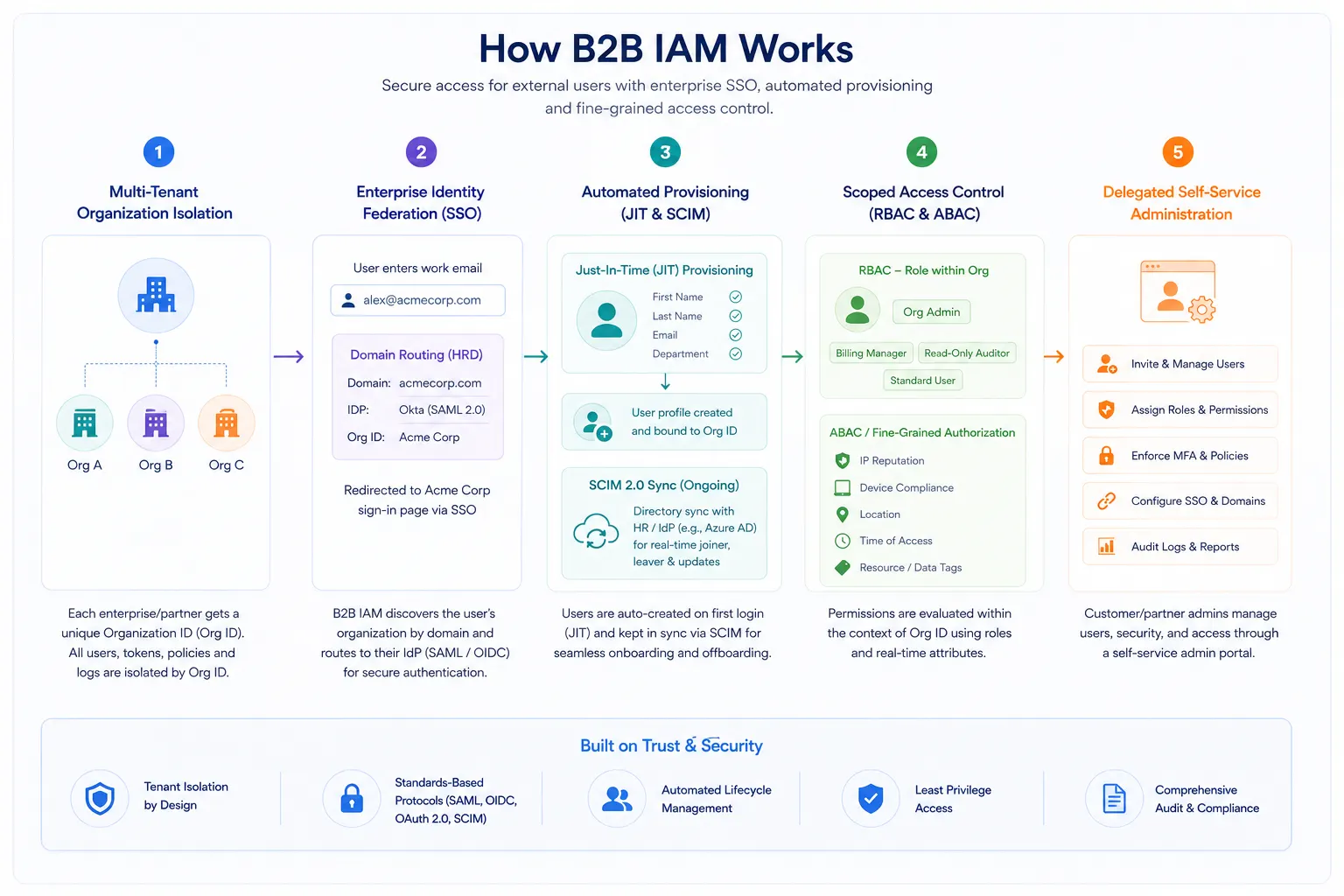
To understand how B2B IAM works under the hood, let's trace the mechanics thoroughly.
1. Multi-Tenant Organization Isolation
The baseline requirement of any B2B IAM engine is the ability to construct logical data and identity boundaries. When an enterprise client or partner signs up, the platform instantiates a unique Organization ID (Org ID) within the identity directory.
Every user, authentication log, access token, permission policy, and configuration setting is hard-bound to this Org ID. This multi-tenant mapping ensures strict tenant isolation—preventing cross-tenant data leaks at the identity layer before requests ever reach application databases.
2. Enterprise Identity Federation (SSO & Domain Routing)
Enterprise B2B clients rarely want their employees to create and remember new usernames and passwords for every third-party vendor tool or partner portal. They demand Bring-Your-Own-Identity (BYOI) via Single Sign-On (SSO).
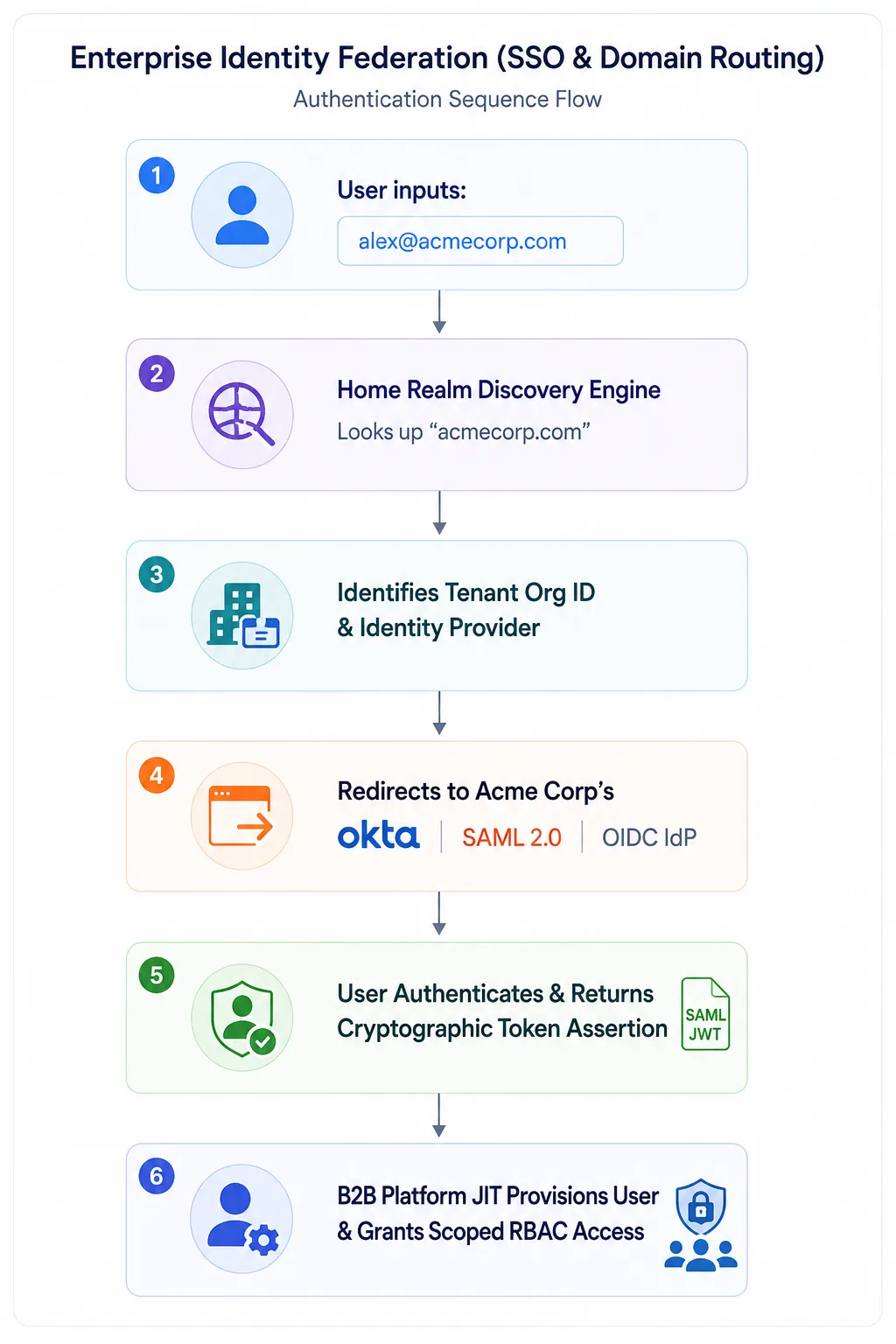
B2B IAM enables cross-organizational Single Sign-On using open federation standards:
-
SAML 2.0 (Security Assertion Markup Language): The enterprise standard for XML-based identity exchange.
-
OIDC (OpenID Connect) & OAuth 2.0: Modern, JSON/REST-based protocol stacks widely used for modern web applications and API security.
-
The Home Realm Discovery (HRD) Mechanism: When an external user attempts to sign into a B2B platform, the B2B IAM engine uses
Domain-Based Authentication Mapping:
-
The user enters their work email address (e.g., alex@acmecorp.com) into a universal login interface.
-
The B2B IAM engine analyzes the domain (acmecorp.com), looks up the associated Org ID, and identifies that Acme Corp uses a custom Okta instance via SAML 2.0.
-
The platform instantly routes alex@acmecorp.com to Acme Corp’s internal sign-in page without prompting for a local password.
-
Upon successful login at Acme Corp, the Identity Provider generates a signed cryptographic token assertion and redirects Alex back to the B2B application.
3. Automated Provisioning: JIT and SCIM
Once an external user authenticates via their home IdP, how does the hosting B2B platform know who they are and what they can access? B2B IAM leverages two automated provisioning mechanisms:
-
Just-In-Time (JIT) Provisioning: Instead of requiring manual account pre-creation, the B2B IAM engine extracts identity attributes (first name, last name, email, department) from the SAML assertion or OIDC token during the very first login event. The platform dynamically creates the local user profile, binds it to the user's Org ID, and assigns default organizational roles on the fly.
-
SCIM (System for Cross-domain Identity Management): For deeper directory synchronization, SCIM 2.0 protocols maintain a continuous REST API sync between the partner’s HR/Directory software (e.g., Azure AD) and the B2B IAM system. If an employee leaves Acme Corp, their account is automatically de-provisioned in Acme’s internal system, instantly revoking their access across all connected B2B partner platforms without manual intervention.
4. Scoped Fine-Grained Access Control (RBAC & ABAC)
Authenticating who a user is represents only half the equation; authorizing what they can do within an enterprise portal is equally vital. B2B IAM implements Scoped Access Controls:
-
Role-Based Access Control (RBAC): Users are assigned roles (e.g., Org Admin, Billing Manager, Read-Only Auditor, Standard User) that contain specific granular permissions. Crucially, these roles are evaluated within the context of the Org ID. A user might be an Admin for Organization A, but have zero access rights to Organization B.
-
Attribute-Based Access Control (ABAC) & Fine-Grained Authorization (FGA): Beyond simple roles, advanced B2B IAM models evaluate contextual variables in real time—such as user IP reputation, device compliance, geographical location, time of access, or specific resource tags—before granting authorization.
5. Delegated Self-Service Administration
Rather than routing administrative requests through the host vendor’s support team, B2B IAM delivers an out-of-the-box Delegated Admin Portal. Authorized customer/partner admins can log into a self-service management interface to:
-
Send email invitations to new team members.
-
Assign or revoke user permissions and custom roles.
-
Enforce organizational Multi-Factor Authentication (MFA) or password policies.
-
Self-configure SAML/OIDC enterprise SSO connections and domain mappings.
-
Audit real-time login activity and security logs for their specific organization.
Branded Self-Service Portals in B2B IAM
Often Partners engage through branded UIs and invitation flows that feel native. Password reset options, profile editing, and invite management are all available without raising tickets for IT teams.
These capabilities combine to deliver:
-
Onboarding - Admin sends a branded invite → Partner logs in via their IdP or email link → JIT provisioning creates an account automatically.
-
Authentication - Federated login captures identity → RBAC assigns permissions → MFA is prompted based on risk profiles.
-
Access & Management - Partners use scoped access; admins can review roles, revoke access, and audit all actions.
-
Multi-Tenant Architecture - Support multiple partner organizations under a single parent tenant - each with isolated access policies, roles, and management controls.
-
Branding Flexibility - Configure custom login pages, email domains, and portal colors per partner—creating a professional, trustworthy experience for all collaborators.
-
Low-Code Orchestration - Visual builders allow drag-and-drop assembly of invitation, provisioning, authentication, MFA, and onboarding flows—no need for custom backend scripts.
-
Comprehensive APIs & SDKs - REST APIs encompass invitations, organization creation, domain mapping, role and permission management, and user-role provisioning, providing developers with full control and integration flexibility.
-
Security Standards Support - Expect SSO, SAML, OIDC, JIT provisioning, RBAC, adaptive MFA, domain restrictions, and audit logging—all aligned with B2B security requirements.
-
Scalable Collaboration - Quickly invite entire partner organizations, manage federation, provision hundreds of users per partner, and monitor access—all while maintaining a simple architecture.
Best Practices:
-
Use JIT provisioning to align account creation with actual usage.
-
Enforce SSO + MFA for all external access.
-
Regularly recertify partner roles and remove permissions no longer needed.
-
Customize branding and domain restrictions per partner organization.
-
Integrate logs into SIEM and implement anomaly detection per partner session.
Read our B2B IAM Best Practices blog for details.
Introducing Partner IAM - What Is It and Who Is It For?
Partner IAM solution is a specialized B2B IAM system specifically tailored to handle external users like partners, vendors, contractors, and third-party collaborators. Partner IAM recognizes that external collaborators require secure onboarding, federated login, scoped permissions, and offboarding workflows distinct from internal user flows.
Key Characteristics:
-
Federated authentication through external identity providers (SAML, OIDC).
-
Invitation-based onboarding, allowing secure access without sharing passwords.
-
JIT provisioning, where accounts are created dynamically at first login.
-
Multi-organization support, enabling separate policies per partner group.
-
Multi-branded login portals, aligning with partner domains and corporate identity.
-
Fine-grained RBAC, mapping each external user to the exact resources they need.
Who Needs B2B IAM / Partner IAM?
B2B and Partner IAM is versatile and spans multiple industries, each with unique collaboration patterns:
1. SaaS Platforms and B2B Services
SaaS platforms serving enterprise clients often interact with external agencies, freelancers, or partner teams who need access to project data, dashboards, or customer environments. Without proper IAM, this usually means manual account creation, credential sharing, and messy permission management.
Partner IAM allows SaaS providers to offer invitation-based onboarding, SSO via partner IdPs, and role-based access scoped to only the relevant data.
For instance, a client’s marketing agency can securely log in, manage campaign settings, and view analytics—without accessing other clients' data. When the agency is replaced or rotates staff, access can be revoked instantly. This not only improves security but also enhances the partner experience and reduces operational overhead for IT teams.
2. Supply Chain Networks
Supply chains encompass a wide ecosystem, including shipping carriers, warehouses, customs agents, and logistics vendors, all of which require real-time access to internal systems. Traditional access management often leads to shared credentials, audit gaps, or unauthorized access.
Partner IAM enables companies to create secure, auditable login flows for each external party, ensuring seamless access and authentication. Each vendor gets scoped access via their own custom identity provider or a custom-branded login portal, depending on role.
A warehouse team may upload delivery receipts, while a shipping carrier only sees tracking dashboards. When contracts expire or partnerships end, their access can be automatically revoked. This ensures compliance, prevents data sprawl, and provides full visibility into third-party activity, critical in highly regulated or globally distributed operations.
3. Consulting Firms
Consulting firms working with regulated industries need temporary, precise access to internal systems, without compromising sensitive data. Traditional IAM often involves over-provisioned roles or delayed offboarding, both of which are security liabilities.
Partner IAM enables internal teams to assign limited-time, role-based access tied to a specific consulting engagement. Analysts or auditors sign in via their firm’s Single Sign-On (SSO), receive read-only or scoped access to dashboards, and have all activity logged for audit trails.
Moreover, MFA ensures secure entry, while just-in-time provisioning creates accounts only when needed. Once the engagement ends, access is automatically revoked. This protects compliance integrity while empowering consultants to deliver insights efficiently and securely.
4. Retailers
Retailers rely on sellers, resellers, service providers, and merchants to interact with their internal systems, such as uploading products, communicating with customers, and updating inventory.
Each partner has different access needs, which traditional Identity and Access Management (IAM) systems aren’t equipped to handle. Partner IAM enables self-service onboarding, SSO, and role-based permissions that match the user’s function.
A reseller can log in securely, manage their storefront, and view sales metrics, without seeing other vendor data or platform configurations. Branded login portals offer a familiar experience, and federated identity support removes the need for duplicate credentials. As partnerships evolve, access updates are automatically applied, ensuring the ecosystem remains clean, secure, and scalable.
These scenarios underscore why Workforce IAM isn’t enough: internal systems are designed for hierarchical, always-on employees—not for segmented, temporary, or multi-org access needs.
5. Media and Entertainment Platforms
Media and Entertainment Platforms rely on Partner IAM to manage secure access for global users and partners across digital properties. One global broadcaster leveraged LoginRadius to unify authentication, strengthen security, and deliver seamless login experiences across regions. If you're looking to modernize identity infrastructure across your media platforms, explore the A+E Networks case study and see how Partner IAM can power your strategy.
6. Healthcare B2B Networks
Managed care platforms often need to share sensitive patient or referral data with hospitals, pharmacies, and labs, all while maintaining strict regulatory compliance. Partner IAM plays a crucial role by enforcing HIPAA-level security, supporting adaptive MFA, and applying scoped role permissions—such as view-only for lab access or modify rights for care providers.
Every action is logged for audit purposes, helping organizations pass compliance reviews while safeguarding patient privacy. A real-world example of this can be seen in how Health Vision streamlined secure data sharing across its healthcare network using LoginRadius. Read the case study.
7. Manufacturing Ecosystems
A manufacturing company interfaces with machinery vendors, maintenance teams, quality auditors, and parts suppliers. Each partner uses a branded portal, signs in via their Identity Provider (IdP), interacts only with specific operational modules, and is automatically offboarded when contracts end. Partner IAM solves complex workflows across multi-vendor environments.
These real-world workflows highlight the breadth of business scenarios where Partner IAM supports secure and coordinated collaboration—empowering external users while keeping internal systems safe and audit-ready.
Key Benefits of B2B IAM
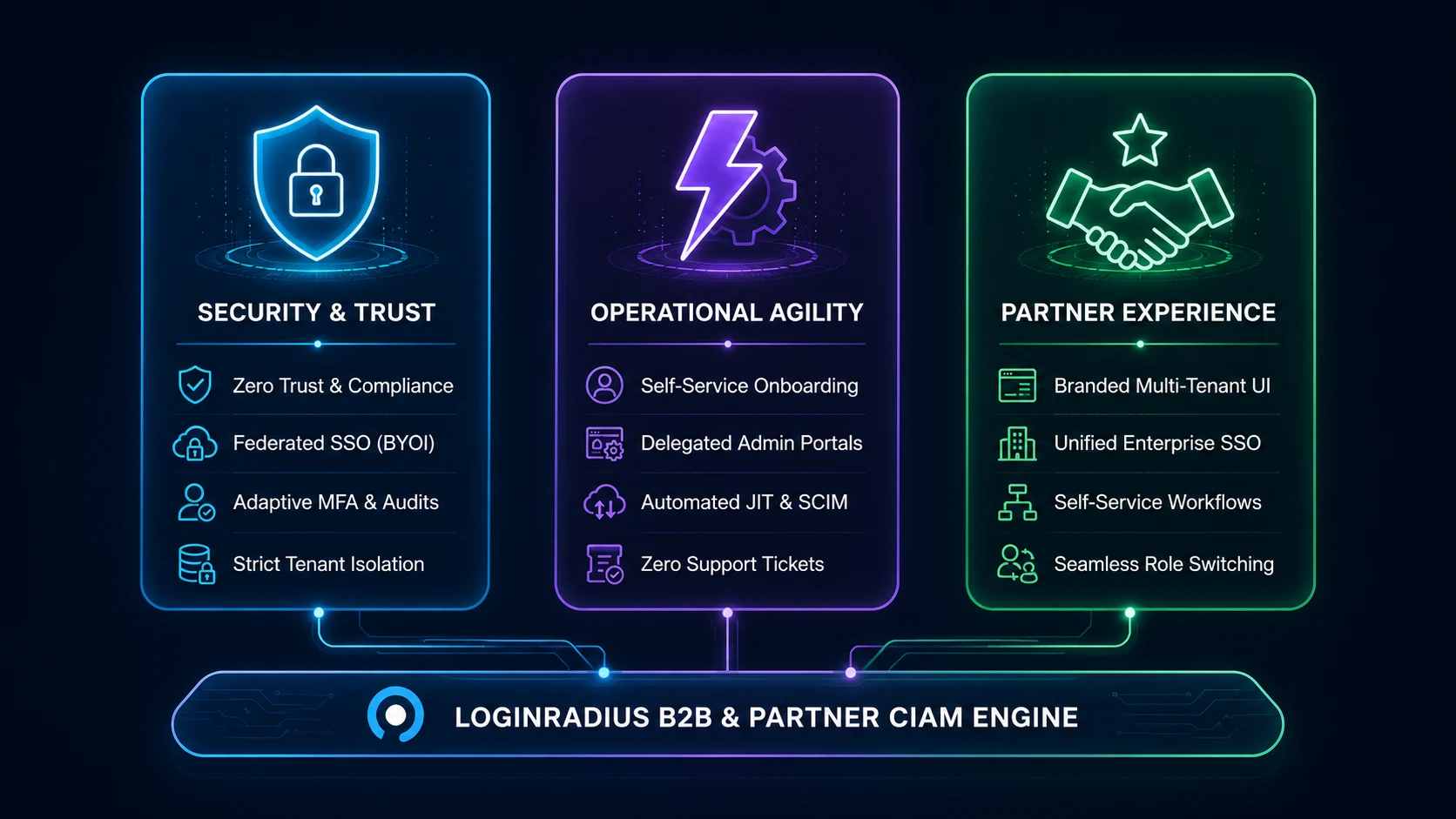
There are three compelling reasons to invest in a B2B Identity Management System: security and trust, operational agility, and partner experience. Let’s understand:
1. Security and Trust
Uncontrolled external access can expose businesses to risks such as shared credentials and orphaned accounts. By offering invitation-only access, automatic deactivation, and audit logs, Partner IAM solves these issues decisively. Security teams regain visibility and control, knowing who accessed what and when—even if users belong to different companies.
2. Operational Agility
Manual onboarding processes are time-consuming and error-prone. Setting up external access often involves sending credentials, programming roles, and reacting when users leave.
Partner IAM automates these steps: send an invite, partner completes sign-up, JIT provisioning handles user creation, and users log in—all without IT involvement. This decimates onboarding time and lets technical teams focus on core projects rather than admin tasks.
3. Better Partner Experience
Partners expect modern SaaS-level experiences. With Partner IAM, they enjoy branded login portals, Single Sign-On (SSO) with their corporate IdP, MFA prompts where needed, and self-service options.
A secure invitation that respects their corporate identity fosters trust and professionalism. When multiple brands are involved—like platforms serving many vendors—Partner IAM supports multi-brand customization under a single identity infrastructure.
Together, these benefits make Partner IAM not only a security tool, but also a business enabler. It builds stronger external relationships, accelerates setup, and ensures governance—all while delivering polished partner-facing experiences.
Read More - 5 Tips to Enhance Consumer Experience in B2B SaaS
Top 5 Security Challenges for B2B brands and How B2B Identity Management Helps
Security is a big concern in the dynamic Business-to-Business (B2B) Software as a Service (SaaS) landscape. As cyber threats become increasingly sophisticated, enterprises must adopt cutting-edge technologies and tools to lay a robust foundation for security.
However, when discussing protection against the latest threat vectors, one often overlooked yet essential aspect is identity management.
Yes, digital identity management is pivotal in reinforcing data security for businesses and customers without compromising user experience. Moreover, today’s robust identity management solutions can easily handle modern threats and sophisticated attacks.
Let’s explore the top 5 security challenges faced by B2B SaaS providers and explore how Identity Management emerges as the beacon of protection, offering insights and strategies to fortify digital defenses.
1. Data Breaches: The Ominous Threat
Data breaches haunt every industry, and B2B SaaS is no exception. These breaches can lead to severe financial losses and irreparable damage to reputation.
Identity Management steps in, ensuring that only authorized users access sensitive data. Multi-factor authentication, role-based access controls, and robust encryption become the armor against unauthorized intrusions.
2. Insider Threats
While external threats often steal the spotlight, insider threats can be equally devastating. Employees, intentionally or unintentionally, pose risks to sensitive data.
Identity Management provides visibility into user activities, flagging suspicious behavior before it escalates. Granular access controls limit employees' access to data they don't need, reducing the likelihood of internal breaches.
3. Compliance Quagmire
B2B SaaS companies must comply with various data protection regulations, from GDPR to CCPA.
However, identity management solutions offer a streamlined approach to compliance, automating processes such as user consent management and data access audits. By aligning with these regulations, companies avoid hefty fines and gain trust and credibility among clients.
4. Scalability Struggles: Balancing Growth with Security
As B2B SaaS businesses scale, so do their security challenges. Identity Management scales alongside the company, providing centralized control across diverse applications and platforms.
Single Sign-On (SSO) solutions simplify user access management, ensuring seamless scalability without compromising security.
5. Password Woes
Weak passwords remain a gaping vulnerability in B2B SaaS environments. Identity Management introduces Password Management features such as password policies, self-service password resets, and single sign-on capabilities.
These measures not only bolster security but also enhance user convenience, striking a balance between protection and usability.
B2B IAM vs Workforce IAM vs B2C CIAM: What’s the Difference?
A common mistake businesses make when building digital services is treating all identity tools as if they do the same job. While every system verifies logins, using the wrong identity framework for a B2B project creates major friction for your clients and head-flapping complexity for your engineering team.
To choose the right technology, you need to understand how B2B IAM differs from Workforce IAM and B2C Consumer CIAM.
1. Workforce IAM (Business-to-Employee / B2E)
-
Target Audience: Your direct employees, full-time contractors, and internal staff.
-
Primary Objective: Protect corporate assets and enforce internal security compliance.
-
How it Works: Managed directly by your internal HR and IT teams using tools like Microsoft Entra ID (Azure AD) or Okta Workforce. When a worker joins your company, HR creates their account. When they leave, HR disables it.
-
Why it fails for B2B: Workforce tools are built around a single internal directory. Forcing external business partners or software clients into your internal employee directory causes massive security risks, licensing overhead, and endless IT tickets.
2. B2C Customer Identity (Consumer CIAM)
-
Target Audience: Individual consumers purchasing products or using consumer apps (e.g., e-commerce shoppers, streaming subscribers).
-
Primary Objective: Deliver a fast, frictionless sign-up experience to boost app registration and user conversion.
-
How it Works: Users sign up on their own using social logins (like Google, Apple, or Facebook) or simple email passkeys. Every account represents a single, independent person.
-
Why it fails for B2B: Consumer identity platforms treat every user as an isolated individual. They lack company-level boundaries, multi-tenant isolation, enterprise Single Sign-On (SAML/OIDC), and delegated administration for corporate client managers.
3. B2B Identity Management & Partner IAM
-
Target Audience: Enterprise clients, B2B SaaS buyers, channel partners, distributors, suppliers, and franchisees.
-
Primary Objective: Accelerate corporate onboarding, automate partner access, and secure multi-tenant business applications.
-
How it Works: Combines Native Multi-Tenancy (company data isolation) with Delegated Administration (allowing client managers to manage their own staff logins) and Enterprise SSO Federation (BYOI).
-
Why it wins for B2B: A dedicated b2b customer identity platform bridges the gap. It provides the strict security enforcement of enterprise IAM alongside the seamless onboarding experience of modern consumer software.
Comparison Matrix: Side-by-Side Breakdown
| Feature / Aspect | Workforce IAM (B2E) | B2C Consumer CIAM | B2B IAM & Partner IAM |
|---|---|---|---|
| Primary User | Internal Employees & Staff | Individual Consumers | Corporate Clients & Channel Partners |
| Directory Model | Single Flat Enterprise Directory | Massive Flat User Store | Native Multi-Tenant Directory Network |
| Primary Sign-In Method | Corporate Password & MFA | Social Login, Passwordless, One-Time Code | Enterprise SSO (SAML 2.0 / OIDC) & BYOI |
| Account Creation | IT / HR Provisioning (e.g., Workday) | Self-Service Registration | Delegated Invites, JIT, & SCIM Sync |
| Admin Control | Internal IT Department | Product Development Team | External Client & Partner Admins |
| Access Rights Model | Job Role-Based (RBAC) | Basic Personal Profile Permissions | Tenant-Scoped Fine-Grained Roles (RBAC / ABAC) |
| Primary Metric | Internal Security & Risk Reduction | User Conversion & App Retention | Fast Client Onboarding & Channel Growth |
Core Difference in One Sentence
While Workforce IAM protects internal company software and B2C CIAM powers consumer app sign-ups, B2B IAM manages business accounts, partner networks, and organizational access at scale.
Read More - B2B IAM vs Workforce IAM
Selecting a B2B IAM Platform: Difference Between Vendor Direct and Partner Channel
Understanding the difference between vendor direct and partner channel access models is crucial when selecting an identity architecture for your ecosystem.
| Axis | Vendor Direct Access Model | Partner Channel Access Model |
|---|---|---|
| Relationship Structure | Direct 1-to-1 connection between your business and a single vendor. | Complex 1-to-Many and Many-to-Many network relationships. |
| User Hierarchy | Single-layer (Flat) access to specific apps or data buckets. | Multi-tier (Hierarchical) parent-child relationships. |
| Identity Control | Internal IT directly provisions and oversees vendor accounts. | Delegated Admin lets external partners manage their own staff. |
| Authentication Flow | Simple username/password or static vendor portal logins. | Federated SSO (SAML/OIDC) tied to partner enterprise directories. |
| Primary Goal | Operational access control and security risk reduction. | Channel enablement, friction removal, and revenue acceleration. |
What Features Must B2B IAM and PIAM Solutions Offer?
To support enterprise clients and partner networks at scale, modern piam solutions must deliver a core set of identity features:
-
Native Multi-Tenant Directory: Hard data boundaries around every client organization, ensuring zero data leakage across accounts.
-
Enterprise Federation & BYOI: Native support for SAML 2.0, OpenID Connect (OIDC), and OAuth 2.0, allowing business clients to bring their own Identity Providers (IdPs).
-
Domain-Based Login Routing: Automatic routing of users to their specific company login screen based on their email domain (@company.com).
-
Delegated Administration Portals: Out-of-the-box self-service management interfaces for customer and partner admins.
-
Dynamic Provisioning (JIT & SCIM 2.0): Automatic account creation on first login, paired with continuous directory synchronization for real-time de-provisioning.
-
Scoped Access Control (RBAC & ABAC): Fine-grained permission assignment locked strictly to specific Organization IDs.
-
White-Labeling & Multi-Branding: Tailored login screens, custom web domains, and branded email templates per partner or client organization.
Read More - B2B IAM Onboarding Checklist
Build vs. Buy: The Hidden Costs of In-House B2B IAM
Engineering teams often underestimate the complexity of building multi-tenant identity systems internally:
| Dimension | Custom In-House Build | Purpose-Built Partner IAM (SaaS) |
|---|---|---|
| Time-to-Market | 6–12 months of core engineering time | 1–3 weeks via SDKs & Turnkey Admin UIs |
| Maintenance Burden | Constant updates for enterprise SAML/OIDC edges | Fully managed identity infrastructure |
| Security Risk | High risk of cross-tenant data leaks in custom DB queries | Hardened, isolated multi-tenant architecture |
| Ongoing Engineering Tax | 2–3 full-time engineers dedicated to IAM maintenance | Zero engineering overhead after setup |
Top PIAM Solutions in 2026
When evaluating PIAM solutions and B2B customer identity platforms, enterprise buyers typically evaluate three main categories:
1. Dedicated B2B & Partner IAM Platforms (e.g., LoginRadius)
-
Best For: Purpose-built B2B customer access, multi-tenant partner portals, enterprise SSO, and delegated administration.
-
Key Strengths: Turnkey multi-tenancy, out-of-the-box self-service partner admin management, low-code orchestration, custom white-label branding, and developer-friendly REST APIs.
-
Consideration: Built specifically for customer and partner facing ecosystems, not internal workforce HR management.
2. Legacy Enterprise Identity Providers (e.g., Ping Identity, Thales)
-
Best For: Traditional enterprise infrastructure, heavy hardware security module (HSM) compliance, and complex on-premises environments.
-
Key Strengths: Strong government and financial compliance certifications; deep legacy infrastructure support.
-
Consideration: Can be developer-heavy, requiring significant custom engineering to build modern multi-tenant SaaS or partner portal user experiences.
3. Developer-First Identity Frameworks (e.g., Descope, Auth0)
-
Best For: Engineering teams building custom B2B SaaS apps from scratch using raw SDKs.
-
Key Strengths: Flexible API primitives and workflow builders for early-stage software projects.
-
Consideration: Requires developers to write and maintain custom front-end portals for delegated admin and partner management features.
B2B & Partner IAM Feature Comparison Matrix
| Feature / Architectural Axis | LoginRadius Partner IAM | Legacy Enterprise IdPs (Ping, Thales) | Developer-First Frameworks (Auth0, Descope) | In-House Custom Build |
|---|---|---|---|---|
| Primary Architecture Focus | Purpose-built B2B & Partner IAM | Workforce & Enterprise Security | Consumer & Single-Tenant B2B | Application-Specific Logic |
| Native Multi-Tenancy | Out-of-the-Box (Parent-Child & Sub-Orgs) | Complex / Requires Custom Setup | Limited / API Config Needed | Custom DB Tables & Maintenance |
| Delegated Admin Portal | Turnkey Self-Service UI Included | Heavy Customization Required | Requires Building Custom UI | Built & Maintained from Scratch |
| Enterprise SSO (SAML/OIDC) | Zero-Code Self-Service Setup | Complex XML/IdP Configuration | Developer API Integration | Manual Engineering per Client |
| Multi-Brand & White-Labeling | Dynamic per Partner/Org | Limited / Global Templates | Code-Level Customization | Custom CSS / Complex Frontend |
| Implementation Speed | Days to Weeks | Months (Enterprise Professional Services) | Weeks to Months (Eng-heavy) | Months to Years (High Cost) |
| Maintenance Burden | Zero (Fully Managed SaaS Platform) | High (Requires IAM Experts) | Medium (Code-level updates) | Extreme (Ongoing Dev Tax) |
LoginRadius Partner IAM – Purpose-Built for B2B
LoginRadius Partner IAM is engineered specifically to eliminate the friction of external identity management. Instead of forcing teams to build complex multi-tenant logic from scratch or shoehorn employee tools into client portals, LoginRadius delivers an end-to-end B2B customer identity platform.
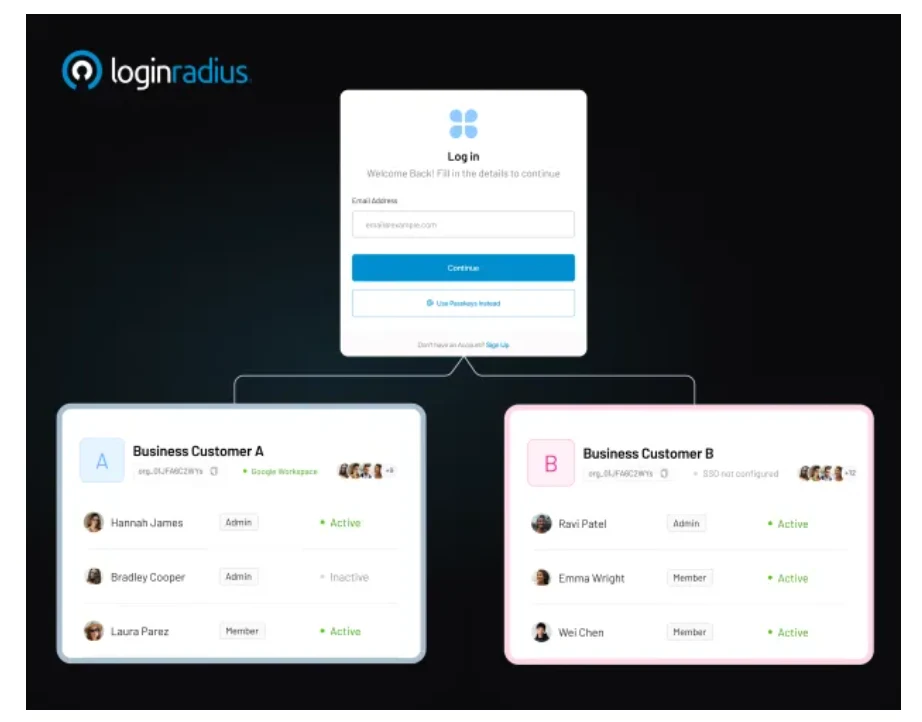
By providing a pre-built delegated admin interface, automated SAML/OIDC federation, and complete multi-tenant tenant isolation out of the box, LoginRadius allows software vendors and enterprise platforms to onboard enterprise clients 10x faster while saving thousands of engineering hours.
Technical Migration: Moving Legacy B2B Tenants Without Downtime
-
Directory Export & Org Mapping: Extract legacy user accounts and map them to isolated Organization IDs (Org IDs).
-
Federation First Strategy: Enable SAML/OIDC SSO for enterprise clients before password migrations to convert top tenants instantly.
-
Lazy Migration (Dual-Write Authentication): On initial sign-in, validate legacy passwords against existing hashes, then seamlessly create new multi-tenant directory entries.
-
Deprecate Flat Accounts: Phase out unmapped individual accounts and require delegated admin invites for new team additions.
B2B Partner IAM Implementation Roadmap
Rolling out a B2B or Partner IAM system across an enterprise ecosystem requires a structured phase-by-phase approach:
Phase 1: Identity Federation
Begin by integrating external IdPs using SAML or OIDC. Configure metadata exchanges, trust certificates, and test partner logins. Federation enables secure SSO without managing passwords.
Phase 2: Role & Permission Modeling
Define partner roles and map permissions aligned with actual workflows. Roles may include Support, Reseller Admin, or Data Viewer. This planning ensures access is scoped and compliant.
Phase 3: Invitation & Branding
Use invitation APIs to send branded emails with partner-specific URLs. Incorporate corporate logos, color schemes, language preferences, and link the portal to the partner domain.
Phase 4: JIT Provisioning and Onboarding
Set JIT provisioning, so partner accounts auto-generate at first login, removing manual account setup. Combined with invitation links, this minimizes idle accounts and streamlines access.
Phase 5: Enforce Security Policies
Configure adaptive/risk-based authentication by risk rule or profile. Use domain restrictions, session timeouts, IP filters, then test SSO works while MFA triggers on new device or network. Learn more about adaptive/ risk-based authentication:
Phase 6: Testing & Audit
Simulate the full lifecycle: invitation, login, access review, role changes, offboarding. Pull audit logs, search SIEM pipeline, confirm compliance data and log retention meet audit standards.
Phase 7: Pilot & Monitoring
Roll out to pilot partners and monitor sign-in success, access patterns, support response. Capture metrics (provisioning time, login frequency, role change requests) and refine roles or flows accordingly.
Phase 8: Full Launch & Reviews
Launch across partner core and schedule recurring access reviews and audit verifications. Decommission stale accounts and refresh roles based on business changes.
LoginRadius enhances this entire roadmap with a drag-and-drop orchestration builder and full partner API suite—automating invites, organization mapping, role assignments, JIT provisioning, and offboarding flows.
Read More - Partner IAM Implementation Guide
Security and Compliance in B2B and Partner IAM
Security and compliance are not optional—they are foundational when external parties connect to internal systems within B2B/ partner IAM space. Modern CIAM solutions like LoginRadius, are designed with regulatory frameworks and security best practices in mind:
Regulatory Alignment
-
GDPR : Data residency, consent logging, and right-to-be-forgotten features.
-
SOC 2 : Access logging, monitoring, and alerting to support audit evidence.
-
HIPAA : Data encryption in transit and at rest, role-level privacy access.
| Regulatory Standard | Primary B2B CIAM Architectural Requirement | Platform Enforcement Feature |
|---|---|---|
| SOC 2 Type II | Continuous access logging and tenant boundary validation | Immutable event audit trails sent to SIEM (Splunk/Datadog) |
| GDPR | Data residency and right-to-be-forgotten across external users | Multi-region tenant database hosting and tenant-scoped user deletion APIs |
| HIPAA | Strict role isolation for Protected Health Information (PHI) | Fine-grained ABAC permissions limiting external vendor view rights |
| ISO 27001 | Periodic user access recertification and least-privilege control | Delegated admin quarterly access reviews and automatic offboarding |
Governance Controls
-
Audit Trails : Every invitation, login, permission change, or offboarding is recorded.
-
Access Revocation : Administrator can revoke partner roles instantly, and automated processes remove access after expiration or exit.
-
Adaptive MFA & SSO : Enforce strong authentication using federated IdPs with adaptive MFA for high-risk access.
-
Policy Enforcement : Set domain restrictions, session lifetimes, passwordless or OTP-only options based on compliance needs.
Encryption and Infrastructure
All identity data is encrypted at rest and in transit. Multi-region data centers allow for geo-compliance flexibility. Domain and email controls prevent impersonation or phishing risks.
Monitoring & Incident Response
-
Real-time monitoring and alerts flag suspicious behavior like repeated failed logins or logins from unusual geolocations.
-
Integration with SIEM allows external login activity to feed corporate or cloud-based security dashboards.
-
Periodic Access Reviews align with internal compliance audits and partner renewal cycles.
By combining strict access policies, lifecycle automation, federated authentication with MFA, and full audit trail visibility, Partner IAM ensures that external collaboration never introduces unmanaged risk. Platforms like LoginRadius enable organizations to safely expand digital ecosystems while meeting regulatory demands.
Geo‑Focused Applications & Localization
Partner IAM plays a key role in global business expansion, offering localization and compliance-by-region:
-
Europe : GDPR compliance baked in—cookie banners, EU data centers, right-to-be-forgotten support, and consent tracking across international partners.
-
USA/Canada : SOC 2 audit-ready logs, HIPAA options for healthcare data exchange, FedRAMP readiness for government-facing portals.
LoginRadius’s global architecture supports regional data centers, customizable UI language, and compliant data workflows . By enabling localization, businesses ensure partner comfort, secure collaboration, and reduced regulatory friction across borders.
Conclusion
Managing external digital identity is no longer just an IT operational task. In a world driven by SaaS applications, supply chains, and indirect sales channels, b2b identity management is a core business strategy.
Relying on legacy workforce IAM or basic consumer login tools leaves your enterprise vulnerable to data breaches, high support costs, and painful customer onboarding delays.
By implementing a modern b2b customer identity platform equipped with Partner IAM, you give your business the exact capabilities it needs to scale: strict tenant isolation, seamless enterprise SSO, and self-service delegated administration. You protect your corporate assets while giving your clients and partners the fast, frictionless experience they expect—turning partner identity into a powerful driver of long-term revenue growth.
FAQs
1. What is Partner IAM?
A. Partner IAM secures external relationships—vendors, agencies, resellers—by enabling invitation-based access, federated login, and scoped provisioning. It’s distinct from employee IAM and focuses on cross-organizational security.
2. How does partner identity management work?
A. Admin sends invitation → partner accepts via branded portal → login through partner IdP → account created on first use (JIT provisioning) → scoped role permissions assigned → MFA applied if risky → access is logged and approved.
3. Why use Partner IAM for B2B?
A. It enables secure collaboration while automating tasks and improving partner satisfaction. Rather than sharing generic credentials, organizations govern access, offer seamless experiences, and maintain auditability—all critical in B2B ecosystems.
4. What common challenges arise with Partner IAM?
A. Challenges include handling diverse IdP integrations, maintaining role-to-permission mapping, coordinating onboarding/offboarding workflows with partners, achieving regulatory readiness, and delivering a consistent experience across organizations.
5. How to secure partner access with IAM?
A. Best practices include: implementing SSO with partner IdPs, enforcing adaptive MFA, using JIT provisioning, fine-grained RBAC, regularly reviewing access, maintaining audit trail, and integrating logs into corporate SIEM. Automate offboarding and use branded portals to reduce phishing and increase partner confidence.