Introduction
Not all identity management systems are created equal. And yet, in far too many organizations, a workforce identity system meant to manage internal staff logins is stretched to cover a growing network of external partners, vendors, resellers, and B2B users.
The result? Friction-filled onboarding. Poor user experience. Security loopholes. And a constant tug-of-war between IT control and business agility.
Here’s the reality: Workforce Identity and Access Management (Traditional IAM) was never designed to handle the complexities of B2B ecosystems. It’s built for HR-driven processes, static user roles, and internal-facing applications. But today’s businesses operate in dynamic partner environments that demand secure, flexible, and scalable identity management without sacrificing user experience or brand control.
That’s where B2B IAM (Business-to-Business Identity and Access Management) comes in. Purpose-built for external identity challenges, it empowers you to deliver seamless access for partner organizations while maintaining centralized governance, security policies, and compliance.
In this blog, we’ll unpack the key differences between workforce identity management and B2B IAM, explore the features that matter most in modern partner environments, and show you why workforce solutions simply aren’t enough in today’s hyperconnected digital world.
What is Workforce IAM?
Workforce Identity and Access Management (IAM) is the backbone of how companies control and secure employee access to internal systems. It ensures that every staff member from a junior developer to the CEO, has the right access to the right tools at the right time.
At its core, workforce identity management focuses on streamlining how employees authenticate into company resources like email, CRMs, code repositories, or HR platforms. It supports processes such as onboarding and offboarding, role-based access control, password policies, and integrating identity into Single Sign-On (SSO) environments.
Technologies in the workforce identity cloud are optimized for internal use cases, meaning they’re deeply tied to HR-driven events—think new hire provisioning or employee role changes.
From a security workforce management perspective, these platforms also help enforce compliance through access logs, audit trails, and user lifecycle automation. And while many workforce IAM tools now offer Multi-Factor Authentication (MFA) and passwordless login options for workforce authentication, they’re still fundamentally built for centralized IT control over known, internal users.
In short, workforce IAM is essential for managing your managed workforce but it's not built to support the more complex, distributed, and independent access patterns of external users like partners or vendors.
What is B2B Identity and Access Management (IAM)?
B2B Identity and Access Management (IAM) is a purpose-built solution for managing external identities. Instead of focusing on employees, B2B IAM is designed for the ecosystem around your business: your partners, vendors, your customers (business users only), resellers, agencies, and even third-party developers.

While workforce IAM is optimized for internal control, B2B IAM focuses on secure collaboration across organizational boundaries. It empowers external users to access your services and platforms while giving you full visibility, security, and control over how that access is granted, used, and revoked.
B2B IAM systems introduce concepts that traditional IAM systems struggle with, such as:
-
Managing multiple organizations or partner accounts independently
-
Allowing delegated administration, where external teams manage their own users
-
Supporting federated identity, enabling partners to use their own IdPs (identity providers)
-
Enabling multi-tenant architecture, so every partner gets a securely isolated environment
-
Offering API-first integration, so developers can build seamless authentication experiences directly into their platforms
B2B IAM also plays a major role in maintaining B2B trust between your organization and your extended network. It provides secure and customizable onboarding flows, lets you enforce partner-specific security policies, and ensures compliance across jurisdictions and industries.
In the context of digital transformation, B2B IAM has become essential not optional. Whether you're a SaaS provider onboarding enterprise clients, a manufacturer working with supply chain vendors, or a fintech platform integrating third-party developers, B2B IAM is the backbone of scalable, secure, and efficient identity operations.
And importantly, it’s not about replacing workforce IAM it’s about recognizing that your external users have completely different needs. B2B IAM complements your internal IAM strategy by expanding secure identity practices to the broader business ecosystem.
Key Components of B2B IAM
What makes B2B Identity and Access Management different from traditional IAM isn’t just who it serves but how it’s architected. A true B2B IAM solution is built from the ground up to handle external identities at scale, across multiple organizations, with the flexibility, autonomy, and security those relationships demand.
Let’s walk through the key components that define an enterprise-grade B2B IAM platform:
Multi-Tenant Architecture
This is a cornerstone feature for any serious B2B IAM solution. Multi-tenancy enables you to onboard and manage multiple partner organizations in a way that keeps their data, configurations, and user experiences completely isolated.
Each “tenant” (or organization) can have its own login experience, user directory, policies, and branding. This is especially crucial when dealing with sensitive sectors like healthcare or finance, where data isolation is not just a preference—it’s a legal requirement.
Federated Identity Management
In the B2B world, your partners often already have their own identity providers think Azure AD, Okta, Google Workspace, or even custom SAML/OIDC systems. Rather than forcing them to create new accounts, B2B IAM enables federated identity, allowing external users to sign in using their existing credentials.
This approach reduces friction, enhances security by offloading authentication to trusted sources, and supports both inbound federation (partner users logging into your system) and outbound federation (your users accessing third-party tools via SSO). It’s a must-have for modern B2B authentication flows and a key driver of B2B trust. Learn more about federated identity management by downloading the insightful resource:
Delegated Administration
Managing users from dozens or even hundreds of partner organizations can become a logistical nightmare if all changes flow through your internal IT team. B2B IAM solves this through delegated administration, which allows you to assign admin roles to your partner organizations.
With this, each partner can self-manage their own users, roles, and credentials—freeing up your internal resources while maintaining a clear chain of control. It’s about decentralizing management without compromising on visibility or governance.
Granular Access Control
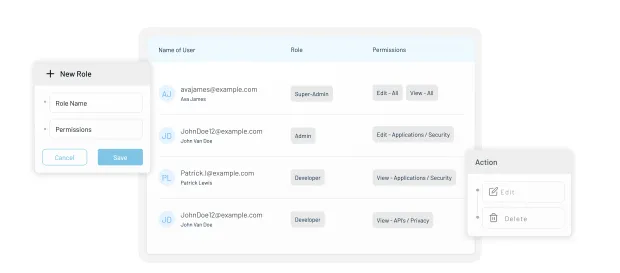
Not every partner should see or do everything. B2B IAM provides fine-grained access control so you can tailor permissions down to the API level, feature level, or even data object level.
You can implement role-based access control (RBAC) or attribute-based access control (ABAC) to define exactly who gets access to what—and when. Whether you're onboarding a fintech partner to access only financial APIs, or giving a supply chain partner access to just their orders, granular control ensures that security is enforced with precision. Here’s how it looks like in the LoginRadius admin console :
API-First Integration
Modern B2B platforms aren’t static—they’re programmable. That’s why API-first architecture is a non-negotiable in today’s IAM landscape.
With robust APIs, developers can integrate authentication, user management, and organizational controls directly into their apps, dashboards, or workflows. Whether you’re automating partner onboarding, syncing user roles with CRM systems, or dynamically provisioning users based on business logic, an API-first B2B IAM system makes it all possible.
Together, these five pillars ensure that B2B IAM isn't just a bolt-on to workforce identity systems it’s a purpose-built infrastructure layer for the partner ecosystem. And as your business scales, these components give you the flexibility, security, and control to scale with confidence.
B2B IAM vs Workforce IAM: The Core Differences
At first glance, Workforce IAM and B2B IAM may appear to serve similar goals—they both authenticate users, manage access, and secure systems. But under the hood, their design principles, architecture, and use cases are vastly different.
Workforce IAM is focused on managing employees and internal teams. B2B IAM is purpose-built for external entities like partners, vendors, resellers, and client organizations, each with unique requirements around autonomy, branding, and multi-tenancy.
Here’s a side-by-side comparison of the key differences:
| Feature | Workforce IAM | B2B IAM |
|---|---|---|
| Primary Users | Internal staff, employees | External organizations, partners, clients |
| User Lifecycle | Tied to HR events (hire/fire/transfer) | Tied to partner relationships and contracts |
| Authentication Focus | Centralized authentication (usually via employee SSO) | Federated, decentralized authentication (support for external IdPs) |
| Delegated Admin | Central IT manages all users | Partner orgs manage their own users |
| Multi-Tenancy Support | Often unsupported or limited | Built-in multi-org isolation and control |
| Brand Customization | Generic or company-branded only | Fully white-label per partner org |
| Scalability | Optimized for internal headcount | Optimized for large partner ecosystems |
| Integration Flexibility | Enterprise tools (email, payroll, HR systems) | APIs, partner portals, external-facing apps |
| Security Policies | Uniform across the org | Configurable per partner or organization |
| Use Case Fit | Employee login, workforce management | B2B onboarding, partner access, client platform login |
Key Takeaway
Using workforce IAM to manage partners is like using a company badge system to secure public events. It might work in a limited way, but it’s not designed for scale, branding, or autonomy.
For modern enterprises, especially those offering SaaS platforms, B2B services, or partner portals, B2B IAM is the only architecture built to handle the complexity of external relationships without compromising security or user experience.
How Can B2B IAM Empower Your Business?
At its core, B2B IAM isn’t just a security solution—it’s a business enabler. B2B IAM steps in as the bridge between trust and scalability. Here’s how it empowers your business:
1. Accelerates Partner Onboarding
Time-to-access is business-critical. When a new partner signs up, they expect to be onboarded fast ideally, self-served within minutes. B2B IAM makes that possible by offering automated provisioning, federated login, and customizable registration workflows tailored to the partner's needs.
You eliminate weeks of back-and-forth with IT and deliver instant value, increasing partner satisfaction and accelerating go-to-market timelines.
2. Enhances Security Without Sacrificing Experience
Security shouldn’t come at the cost of usability. B2B IAM helps you strike the perfect balance by enforcing strong authentication (MFA, device fingerprinting, IP policies) while giving partners a frictionless login experience whether through social login, enterprise SSO, or passwordless methods.
With granular policies and real-time monitoring, you get centralized visibility over who’s accessing what, and from where without getting in the way of productivity.
3. Reduces IT Burden and Admin Overhead
Without B2B IAM, your internal IT teams become bottlenecks handling access requests, password resets, and role changes across every external org. That’s not scalable.
Delegated administration shifts day-to-day identity management to your partners while still maintaining your governance controls. This not only reduces workload but also improves operational agility.
4. Strengthens Compliance and Audit Readiness
Need to meet GDPR, HIPAA, SOC 2, or ISO 27001? B2B IAM helps enforce compliance by centralizing identity data, enforcing least-privilege access, and maintaining detailed logs of all user activity. It makes audits faster, easier, and less stressful especially when dealing with external entities.
5. Drives Long-Term Ecosystem Growth
As your partner ecosystem grows, so do the risks of identity sprawl, inconsistent access, and trust erosion. B2B IAM gives you the infrastructure to scale securely with isolated environments, customizable access flows, and full lifecycle controls.
It’s not just about access management. It’s about building a platform that your entire partner network can rely on today, and in the future.
Benefits of Using a B2B IAM Solution like LoginRadius
When managing partner access becomes more than just a security requirement—and starts to impact the speed, scale, and success of your business—it’s time to move beyond patchwork solutions. That’s where LoginRadius steps in with a purpose-built B2B IAM platform designed to solve the unique identity challenges of partner ecosystems.
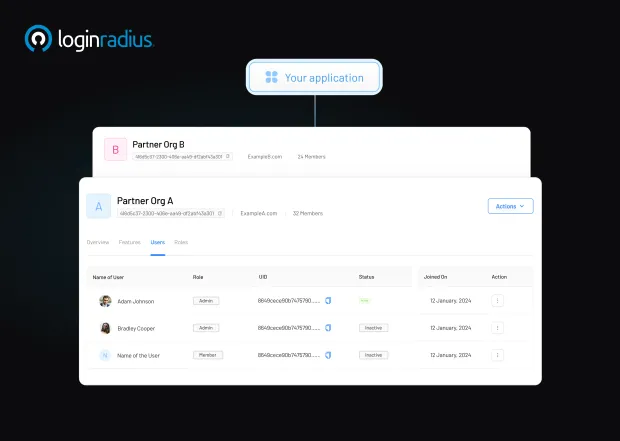
Unlike repurposed workforce IAM tools that focus primarily on internal staff, LoginRadius offers a flexible, API-driven, and scalable B2B IAM solution that’s tailored for external identity needs. Let’s look at the key benefits it brings to enterprise environments:
Enhanced Partner Experience
First impressions matter, and for your partners, the login and onboarding process is often their first direct interaction with your product or platform.
LoginRadius helps you deliver a seamless and fully branded experience, whether partners are logging in through SSO, registering via a custom form, or accessing your APIs. You can offer personalized login journeys per organization, support multiple authentication methods, and even localize the interface all while keeping the experience unified and consistent.
A smooth, intuitive access experience builds B2B trust, reduces support tickets, and increases overall partner satisfaction.
Reduced IT Burden
Without B2B IAM, your internal IT or DevOps team ends up managing every single partner account manually, creating users, assigning roles, troubleshooting logins, and handling password resets.
LoginRadius eliminates this overhead by enabling delegated administration. You can empower partner organizations to manage their own users, roles, and settings within the boundaries you define. This reduces support load, improves response time, and frees up your IT team to focus on more strategic work.
It’s workforce authentication flipped: external users are managed externally, without compromising your internal governance.
Stronger Security
With security threats growing in scale and complexity, relying on manual provisioning or shared credentials is no longer acceptable.
LoginRadius offers enterprise-grade security baked into every part of the B2B identity lifecycle:
-
Enforce adaptive MFA across partner orgs
-
Enable login risk scoring and anomaly detection
-
Apply scoped access via RBAC or ABAC
-
Monitor sessions in real-time
With detailed audit logs and compliance-ready reporting, you get visibility and control across your entire ecosystem without relying on external ticketing.
Customization & Integration
Every enterprise has its own stack. And LoginRadius understands that identity shouldn’t be a one-size-fits-all solution.
With API-first architecture, pre-built SDKs, and a customizable schema, LoginRadius lets you design identity flows that match your exact use case. You can:
-
Build custom registration journeys
-
Integrate with your CRM, ERP, or internal APIs
-
Sync data in real-time across systems
-
White-label hosted login pages per partner org
And because everything’s modular, your developers can plug in only what they need—no bloated code or forced workflows.
Enterprise-Grade Scalability
B2B ecosystems can grow fast, and your identity solution needs to keep up. Whether you're supporting ten partner organizations or ten thousand, LoginRadius offers a multi-tenant architecture that scales horizontally and securely.
Each partner org can be isolated with its own policies, user base, and login experience. Thanks to a globally distributed cloud infrastructure, LoginRadius ensures high availability, low latency, and regional compliance (including Canadian data residency options).
Scalability isn’t just about numbers; it’s about managing growth without adding friction.
Together, these benefits make LoginRadius not just a B2B IAM solution but a long-term identity strategy for modern enterprises that depend on complex, fast-moving partner networks.
Examples of B2B IAM Use Cases
B2B IAM is not limited to one industry or business model it’s a critical infrastructure layer for any organization that provides services, platforms, or data access to external organizations.
Let’s explore some common and high-impact use cases where B2B IAM becomes a game-changer:
SaaS Platforms
If you’re a SaaS provider, you’re likely onboarding entire client organizations and not individual users. Each client organization wants its own login experience, user management capabilities, and access controls.
How B2B IAM helps:
-
Supports multi-tenant onboarding
-
Lets clients administer their own users and roles
-
Provides API access control and per-org customization
-
Enables SSO for enterprise clients using their IdP
Example: A project management SaaS company uses B2B IAM to let each corporate client customize their login portal, assign roles to employees, and integrate with their internal SSO.
Supply Chains
Manufacturers, logistics firms, and retailers work with a complex web of suppliers and distributors who need access to shared systems for inventory, orders, and delivery tracking.
How B2B IAM helps:
-
Enables federated login for vendors and resellers
-
Grants role-specific access to order management tools
-
Tracks partner activity for security and compliance
Example: A global electronics brand uses B2B IAM to allow regional distributors to access real-time product inventory with scoped access to only their geographic regions.
Fintech & APIs
Fintech platforms often serve B2B clients who integrate APIs for payments, lending, accounting, or banking services. These clients may have multiple developers, environments, and roles.
How B2B IAM helps:
-
Provides API key management and role-based access
-
Enables sandbox vs production environment isolation
-
Supports OAuth flows for secure third-party integrations
Example: A fintech startup uses B2B IAM to allow external dev teams to securely register apps, obtain client credentials, and access APIs with fine-grained scopes.
Healthcare Ecosystems
In healthcare, providers collaborate with labs, insurers, clinics, and specialists—each needing controlled access to patient data and systems, all while maintaining HIPAA compliance.
How B2B IAM helps:
-
Offers tenant-level access control and audit logging
-
Supports identity federation with hospital systems
-
Enforces MFA and role-based data access
Example: A health data platform uses B2B IAM to allow clinics and labs to log in through their existing healthcare ID systems, access patient records securely, and comply with strict data regulations.
Whether you’re managing partners in SaaS, vendors in supply chains, clients in fintech, or providers in healthcare, B2B IAM gives you the flexibility, visibility, and control needed to manage external identities securely and efficiently.
Summary
In today’s interconnected digital world, managing identities goes far beyond employees. While workforce IAM has its place in securing internal systems and staff access, it simply wasn’t built to handle the complex needs of external users—partners, vendors, resellers, and B2B clients.
This is where B2B IAM stands apart. It’s not a subset of identity management; it’s a strategic foundation for building secure, scalable, and user-friendly ecosystems across organizational boundaries.
A modern B2B IAM platform like LoginRadius empowers enterprises to:
-
Onboard partner organizations at scale
-
Enable delegated user management
-
Customize login experiences per partner
-
Enforce strong and consistent security policies
-
Prove compliance through audit-ready logs and reporting
As your business grows, so does your network of external users, and managing them with workforce tools is like building a skyscraper on residential blueprints.
If you’re serious about partner experience, security, and long-term scalability, it’s time to stop bending workforce IAM for B2B needs and start using a solution purpose-built for it.
FAQs
1. What is the difference between workforce IAM and B2B IAM?
A: Workforce IAM is designed for managing internal employee identities, focused on HR-driven onboarding, internal app access, and centralized IT control. B2B IAM, on the other hand, is built for managing external partner organizations, offering multi-tenant support, delegated administration, and flexible authentication across organizational boundaries.
2. Why can’t I use my workforce IAM solution for partners and vendors?
A: Workforce IAM tools lack the flexibility needed for external ecosystems. They typically don’t support multi-tenancy, delegated administration, or per-organization customization, making them unsuitable for managing dynamic partner access at scale.
3. What is delegated administration in B2B IAM?
A: Delegated administration allows external organizations (such as partners or vendors) to manage their own users, roles, and access within the boundaries set by your central IT or security team. This reduces IT workload while maintaining governance and control.
4. How does B2B IAM improve security and compliance?
A: B2B IAM enforces consistent access policies, multi-factor authentication, and audit logging across all partner organizations. It helps enterprises reduce identity sprawl, detect anomalies, and stay compliant with data protection laws like GDPR, HIPAA, and SOC 2.
5. What are common use cases for B2B IAM?
A: B2B IAM is used in SaaS platforms onboarding enterprise clients, supply chain networks managing vendor access, fintech companies securing API access for clients, and healthcare ecosystems enabling federated login across clinics and labs.
6. Can I customize partner onboarding flows with LoginRadius APIs?
A: Yes, LoginRadius provides full control over partner onboarding through its Partner IAM APIs. You can automate user provisioning, assign roles, configure branding, and create org-level login journeys all via RESTful endpoints.