Introduction
For years, “secure login” mostly meant a password field, a few composition rules, and maybe an OTP bolted on later. That used to feel responsible. Now it feels optimistic.
Attackers are not guessing one password at a time anymore. They automate credential stuffing, clone login pages, replay stolen sessions, and test weak authentication flows at scale. A login box is no longer just a sign-in screen. It is a target.
Here’s where teams usually go wrong. They treat login like a UI component instead of a security system. If the password works, access is granted, and everyone moves on. But modern authentication does not work that way anymore. Or at least it should not.
A secure login system in 2026 has to do more than verify credentials. It needs to evaluate context, recognize risky behavior, and decide whether this login attempt looks normal, suspicious, or outright hostile. Same user, same password, very different outcome depending on the signals around it.
And then there is the user side of it. People want fast sign-ins, social login, passkeys, fewer passwords, and less friction. Fair enough. Nobody wakes up excited to reset credentials before coffee. But convenience without protection is how weak authentication survives longer than it should.
A surprising pattern we’ve seen across modern applications is this: the strongest login systems are not always the ones asking users to do more. They are the ones making smarter decisions in the background. Low-risk users move through quickly. Suspicious attempts get challenged. Bad ones get blocked. Simple for users. Much harder for attackers.
That shift is what this blog is really about. Secure login is no longer just an access checkpoint. It is an active security layer that protects accounts, APIs, business systems, and trust.
This checklist for 2026 is built around that reality. Strong authentication, adaptive verification, passwordless options, session protection, and risk-aware access decisions all belong in the same conversation now. Because the old version of “secure login” still exists. It is just not enough anymore.
What Is a Secure Login System?
A secure login system is designed to verify user identity while protecting applications from unauthorized access. Instead of relying on a single credential, modern authentication systems use multiple security layers to ensure that only legitimate users can access an account.
The first layer of secure login is identity verification. This step confirms that the user attempting to sign in actually owns the account. Traditionally, this relied on passwords, but modern systems increasingly use stronger methods such as passkeys, one-time passwords, or biometric authentication.
The second layer is authentication validation. The system checks whether the credentials or authentication factors provided by the user are valid. In many applications, this includes multi-factor authentication, where users must provide an additional verification factor before access is granted.
Modern secure login systems also incorporate contextual security checks. These checks evaluate signals such as device information, login location, IP address reputation, and user behavior patterns. If a login attempt appears unusual, the system may require additional verification before granting access.
Another important component is authorization and access control. Even after a user successfully logs in, the system determines what actions they are allowed to perform. This ensures that authenticated users only access resources that match their permissions.
Secure session management completes the process. Once authentication is successful, the system creates a protected session that represents the user’s identity during their interaction with the application. Proper session handling prevents attackers from hijacking authenticated sessions.
Together, these components form the foundation of a secure system login architecture. Instead of trusting a single credential, modern authentication systems rely on layered verification, risk evaluation, and session protection to maintain strong security.
The Biggest Login Security Threats Applications Face Today
| Modern Login Threat | How the Attack Works | Required Core Safeguard |
|---|---|---|
| Credential Stuffing | Automated testing of leaked username/password combos across forms. | Rate limiting, bot detection, breach database cross-referencing. |
| Phishing & Spoofing | Cloning identical login pages to harvest credentials or bypass weak MFA. | FIDO2 Passkeys / Cryptographic Passwordless methods. |
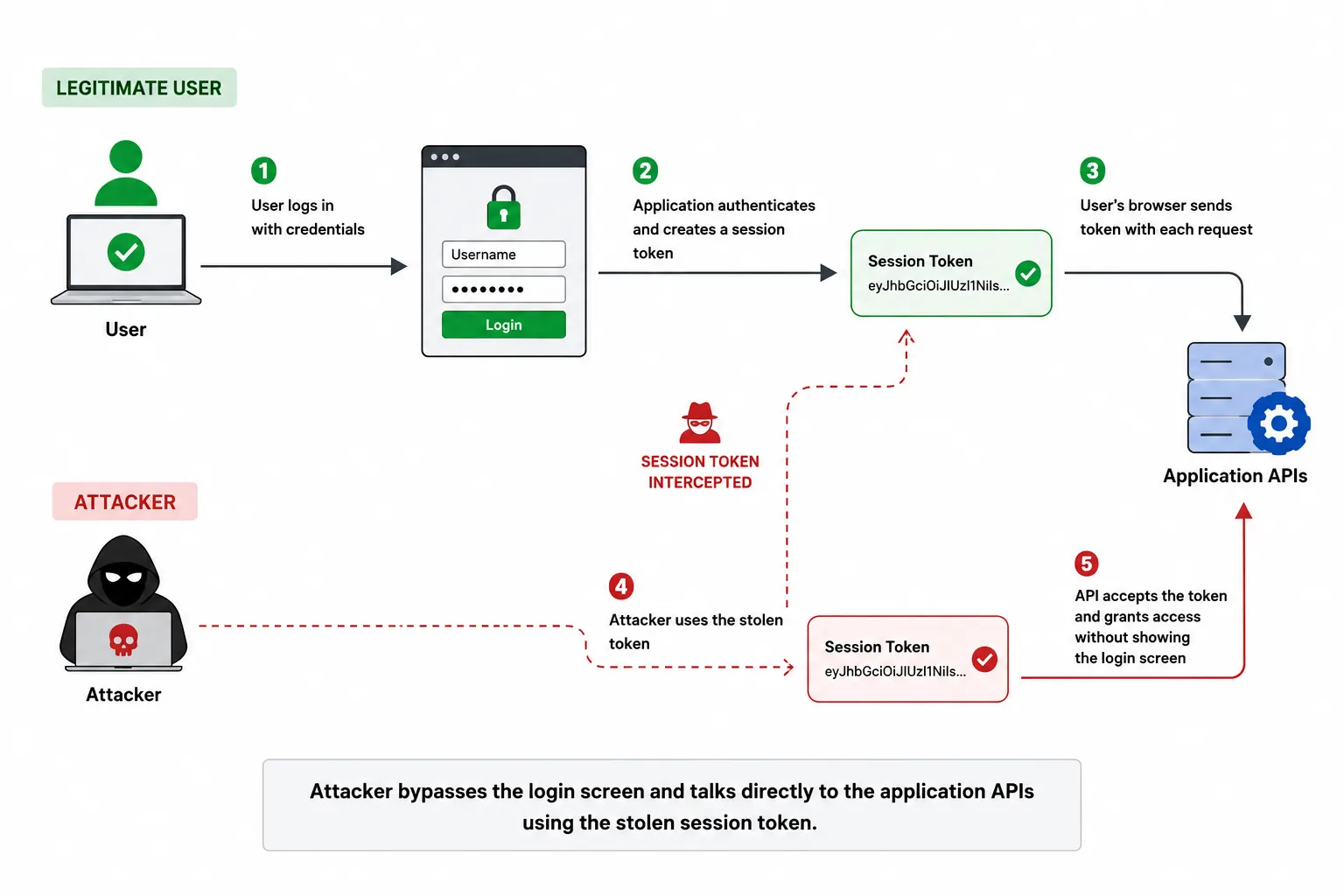
| Session Hijacking | Stealing valid active session tokens to bypass authentication. | Encrypted cookies, strict expiration, continuous behavior tracking. |
| Brute-Force Attacks | Automated software cycling through thousands of password variations. | Global account lockout policies and IP-based rate limits. |
Before building a secure login system, it is important to understand the threats that target authentication systems. Attackers rarely start by breaking into databases or exploiting complex vulnerabilities. Instead, they focus on login systems because compromising user accounts is often the fastest way to gain access.
One of the most common threats is credential stuffing. Attackers use databases of leaked usernames and passwords from previous data breaches and automatically test them against login forms. Because many users reuse passwords across multiple platforms, attackers only need a small success rate to compromise thousands of accounts.
Another major threat is phishing attacks. Attackers create fake login pages that look almost identical to legitimate websites. When users enter their credentials, the information is captured and later used to access the real application. Even well-trained users can fall victim to sophisticated phishing campaigns.
Brute-force attacks also remain a persistent risk. In these attacks, automated tools attempt a large number of password combinations until the correct one is found. Without safeguards such as rate limiting and account lockout mechanisms, login systems can become vulnerable to these automated attempts.
Modern applications also face session hijacking attacks. Instead of stealing passwords, attackers attempt to capture active session tokens. If a session token is compromised, an attacker may be able to bypass authentication entirely and operate within the system as a legitimate user.
Another growing challenge is automated bot activity targeting authentication endpoints. Bots can continuously probe login forms, test credentials, and identify weak authentication flows without human intervention.
These threats highlight why login systems must be designed with multiple security layers. A strong, secure login architecture does more than validate credentials; it actively detects suspicious behavior, blocks automated attacks, and protects user sessions throughout the authentication process.
The Secure Login Checklist for 2026
A modern application cannot rely on a single security mechanism to protect user accounts. Attackers use automated tools, stolen credentials, and phishing campaigns to exploit weak authentication systems. This is why secure login today requires a combination of layered security controls working together.
The secure login checklist for 2026 focuses on building an authentication system that verifies identity, evaluates risk, and protects user sessions. Instead of trusting a single login attempt, modern systems continuously validate whether access should be granted.
The first element of a secure login system is strong credential protection. Applications should enforce secure password policies, prevent password reuse, and check credentials against known breach databases. This reduces the likelihood that attackers can compromise accounts using leaked passwords.
The next essential layer is multi-factor authentication (MFA). MFA requires users to provide an additional verification factor, such as a one-time password, authentication app approval, or biometric verification. Even if an attacker obtains a user’s password, they cannot access the account without the second factor.
Another critical component is passwordless authentication. Technologies such as passkeys and device-based authentication remove the need for passwords entirely. By relying on cryptographic authentication tied to trusted devices, organizations can reduce phishing risks and improve login security.
Secure login systems must also include adaptive authentication. Instead of applying the same security checks to every login attempt, adaptive systems analyze contextual signals such as device type, location, and behavior patterns. Based on the risk level, the system can allow seamless access, require step-up authentication, or block suspicious attempts.
Organizations should also implement credential stuffing protection. Techniques such as rate limiting, bot detection, and login anomaly monitoring help prevent automated tools from repeatedly testing stolen credentials against authentication endpoints.
Finally, secure session management ensures that authentication remains trustworthy even after login. Systems must protect session tokens, enforce session expiration policies, and monitor active sessions for suspicious activity.
Together, these elements form the foundation of a modern secure login architecture. By combining credential security, adaptive authentication, and session protection, organizations can significantly reduce the risk of account compromise while maintaining a smooth login experience for legitimate users.
Multi-Factor and Passwordless Authentication: Strengthening Secure Login
Passwords alone are no longer enough to protect modern applications. Data breaches, phishing attacks, and credential stuffing campaigns have made it easier than ever for attackers to obtain stolen credentials. Even strong passwords can eventually be compromised if they are reused across multiple services or captured through phishing.
This is why modern authentication systems rely on multi-factor authentication (MFA) to strengthen secure login security. MFA requires users to verify their identity using two or more authentication factors before access is granted. These factors typically fall into three categories: something the user knows, something the user has, and something the user is.
The most common MFA implementation involves a password combined with a one-time password (OTP) generated through an authenticator app, SMS, or email. When a user enters their password, the system prompts them to enter a temporary code that expires after a short time. Even if attackers obtain the password, they cannot log in without the second verification factor.
Another popular MFA method involves push authentication. Instead of entering a code, users receive a notification on their mobile device asking them to approve the login attempt. This approach improves usability while still maintaining strong authentication protection.
While MFA significantly improves login security, many organizations are now moving toward passwordless authentication. Passwordless login eliminates traditional passwords and replaces them with device-based authentication methods such as passkeys, biometrics, or secure device tokens.
Passkeys are one of the most promising passwordless technologies. They rely on public-key cryptography and are tied to a trusted device such as a smartphone or laptop. When users attempt to sign in, the device verifies their identity through biometrics or a device PIN and then signs an authentication challenge using a private key stored securely on the device.
This approach dramatically reduces the risk of phishing and credential theft because there is no password that attackers can steal. It also simplifies the login experience for users, allowing them to authenticate with a fingerprint, facial recognition, or device verification.
Combining multi-factor authentication with passwordless login methods creates a much stronger secure login environment. MFA protects accounts from credential compromise, while passwordless authentication removes many of the vulnerabilities associated with traditional passwords.
Together, these technologies represent a major step forward in modern secure system login architecture, helping organizations protect user identities while delivering faster and more secure login experiences.
Social Login and Identity Federation: Expanding Secure Login Without Weakening Security
Users increasingly expect flexible login options. Many prefer signing in with existing accounts such as Google, Apple, or Microsoft instead of creating new credentials for every application. This approach, commonly called social login, simplifies onboarding and reduces the need to manage multiple passwords.
From a security perspective, social login can actually strengthen a secure login system when implemented correctly. Instead of storing passwords internally, applications rely on trusted identity providers that already maintain advanced authentication protections such as multi-factor authentication, device verification, and anomaly detection.
Social login typically operates through industry-standard protocols like OAuth 2.0 and OpenID Connect. These protocols allow applications to delegate authentication to external identity providers while receiving a verified identity token once the user successfully signs in.
When a user chooses to log in with a social provider, the application redirects them to the provider’s authentication page. After successful authentication, the provider sends an authorization token back to the application, confirming the user’s identity without exposing their password.
However, secure implementation requires proper token validation and identity verification. Applications must verify the authenticity of the token, check its expiration, and ensure it was issued by a trusted provider. Without these checks, attackers could attempt to reuse or manipulate tokens to gain unauthorized access.
Another important aspect is identity federation and account linking. Users may log in through different methods over time email and password, social providers, or passwordless authentication. Identity federation ensures that these authentication methods connect to the same user profile rather than creating duplicate accounts.
Account linking helps maintain a unified identity across authentication methods, improving both user experience and security visibility. When all login methods are associated with a single identity, organizations can monitor login behavior more effectively and detect suspicious activity.
By combining secure token validation, identity federation, and account linking, organizations can safely support social authentication while maintaining a strong secure login architecture that protects both user accounts and application systems.
Architect's Note: When delegating authentication via OIDC/OAuth 2.0, ensure your system enforces strict state parameter checking and cryptographically validates JWT (JSON Web Tokens) signatures using the Identity Provider's JWKS endpoint.
Adaptive Authentication and Risk-Based Login Decisions
Traditional authentication systems apply the same login checks to every user. If the correct credentials are entered, access is granted. While this approach is simple, it does not account for the varying levels of risk associated with different login attempts.
Adaptive authentication introduces intelligence into the secure login process by evaluating contextual signals before granting access. Instead of relying solely on credentials, the system analyzes factors such as device type, location, network reputation, and behavioral patterns to determine whether a login attempt appears legitimate.
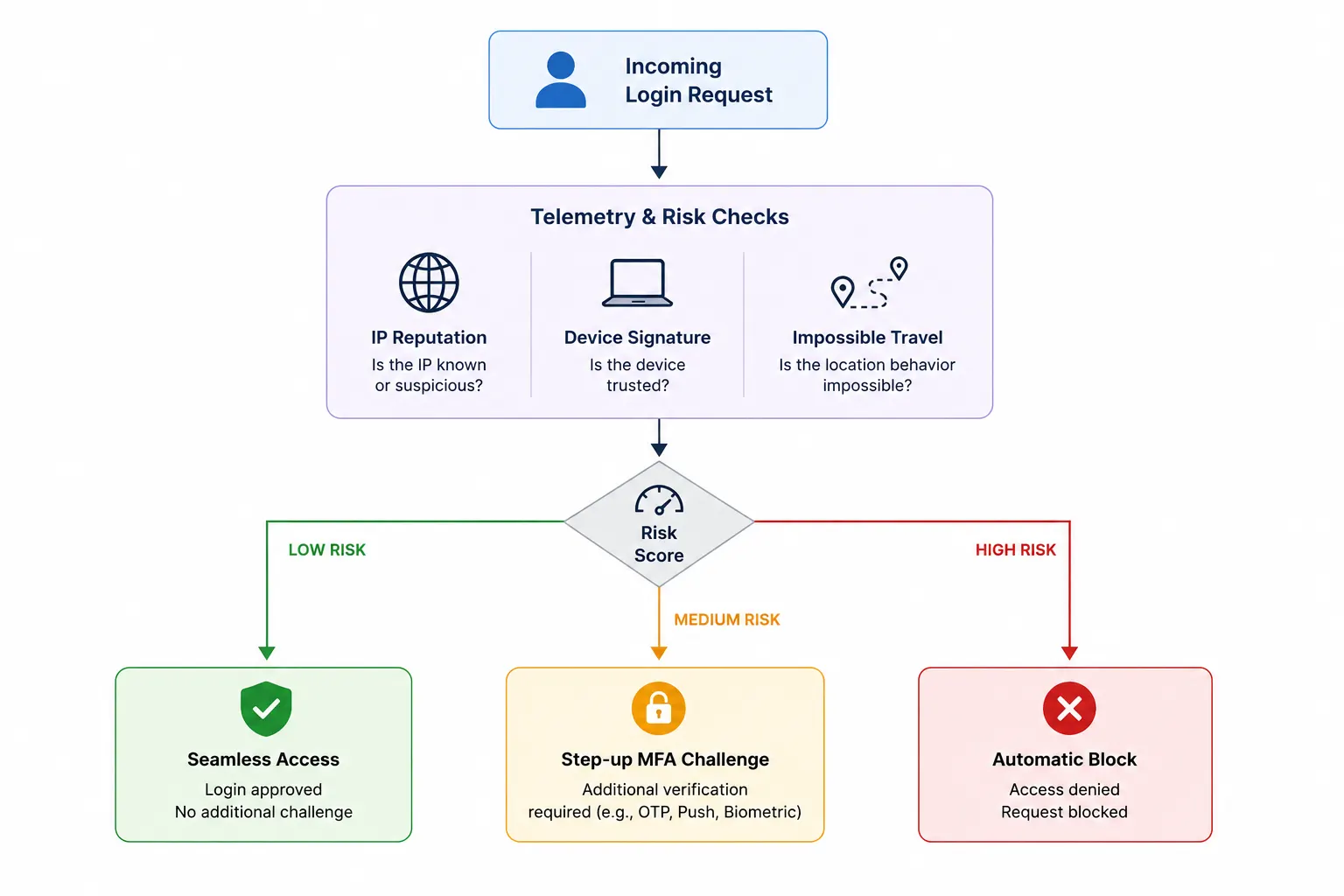
Device recognition is one of the most commonly used signals. If a user consistently logs in from the same laptop or smartphone, the system can treat the device as trusted. When the same account attempts to log in from a new or unfamiliar device, additional verification steps may be required.
Location analysis also plays a significant role in risk evaluation. If a login attempt occurs from a region where the user normally signs in, the risk level remains low. However, if the system detects a sudden login from a distant country, it may flag the attempt as suspicious.
Another important technique is impossible travel detection. This occurs when a system identifies two login attempts from geographically distant locations within a time frame that would be impossible for a user to travel. In such cases, the system can block the login or require step-up authentication.
Behavioral signals further strengthen adaptive authentication. Systems can analyze how users typically interact with applications, including login frequency, device usage patterns, and session activity. When a login attempt deviates significantly from normal behavior, the risk score increases.
Based on the evaluated risk level, the authentication system can make dynamic decisions. Low-risk logins may proceed without interruption, medium-risk attempts may trigger multi-factor authentication, and high-risk attempts may be blocked entirely.
This approach allows organizations to maintain strong security without adding unnecessary friction for legitimate users. By combining contextual analysis with dynamic verification, adaptive authentication becomes a critical component of a modern secure system login architecture.
Secure Login Architecture for Modern Applications
A secure login system is not built around a single authentication step. It is supported by an architecture that connects identity verification, authentication services, risk evaluation, and session management into a unified security framework. Without this structure, authentication controls remain isolated and attackers can exploit gaps between different components.
At the center of this architecture is the identity provider (IdP). The identity provider manages user identities and handles authentication requests. When a user attempts to log in, the IdP validates credentials or authentication factors and issues identity tokens that represent the authenticated user.
The next layer involves the authentication gateway. This gateway processes login requests before they reach application services. It can enforce rate limits, detect automated login attempts, and filter suspicious traffic. By controlling the entry point for authentication, the system reduces the risk of automated attacks targeting login endpoints.
Modern authentication systems also include a risk evaluation engine. This component analyzes contextual signals such as device fingerprints, IP reputation, and behavioral patterns. Based on these signals, the system determines whether the login attempt should proceed normally or require additional verification.
After successful authentication, the system generates security tokens that represent the user’s identity. These tokens are used to authorize requests across applications and APIs. Instead of repeatedly asking users to log in, applications verify these tokens to confirm that the user has already been authenticated.
Secure session management completes the architecture. Sessions must be protected with encrypted cookies or tokens, strict expiration policies, and monitoring mechanisms that detect suspicious activity during active sessions. These controls prevent attackers from hijacking authenticated sessions.
Together, these components form a layered secure system login architecture that protects applications from credential-based attacks, automated login attempts, and session abuse.
By integrating identity verification, risk analysis, token management, and session monitoring, organizations can maintain a strong and reliable authentication framework for modern applications.
The 2026 Secure Login Architecture Checklist
-
Credential Protection: Enforce entropy-based rules, prohibit reuse, and intercept compromised strings against live breach databases.
-
Phishing-Resistant MFA: Require step-up validation via TOTP apps, push notifications, or platform biometrics rather than relying on insecure SMS.
-
Passwordless Infrastructure: Implement public-key cryptography (WebAuthn/Passkeys) bound natively to consumer devices.
-
Adaptive Policy Engine: Track contextual telemetries (IP risk profile, device signatures, impossible travel velocity).
-
Inbound Edge Protection: Stand up an authentication gateway to throttle malicious bots and continuous automated probing.
-
Cryptographic Session Control: Issue short-lived tokens, enforce sliding session expirations, and securely store session variables.
Building a Future-Proof Secure Login Strategy
Implementing a secure login system is not a one-time task. Authentication threats continue to evolve as attackers adopt automation, AI-driven phishing, and large-scale credential abuse. Organizations must treat login security as an ongoing strategy rather than a single implementation milestone.
The first step in building a future-proof, secure login approach is layered authentication. Systems should combine multiple security controls such as multi-factor authentication, passwordless login, risk evaluation, and secure session management. When one layer is challenged, the remaining layers continue to protect the account.
Another important factor is continuous identity verification. Authentication should not stop after the user signs in. Monitoring user behavior, device signals, and session activity helps detect suspicious actions during active sessions and reduces the risk of account takeover.
Organizations should also prioritize user-friendly authentication methods. Technologies like passkeys, biometrics, and trusted-device authentication provide stronger security while reducing login friction. When authentication becomes both secure and convenient, users are less likely to bypass security practices.
Scalability is another key consideration. Modern applications operate across web platforms, mobile apps, APIs, and partner ecosystems. A future-ready secure login strategy must support authentication across all these environments while maintaining consistent security policies.
Finally, organizations should rely on modern identity platforms that support industry standards such as OAuth, OpenID Connect, and token-based authentication. These systems simplify identity management while ensuring authentication mechanisms remain aligned with evolving security practices.
A well-designed secure login strategy protects more than user accounts. It safeguards application infrastructure, strengthens trust with customers, and ensures that identity security keeps pace with modern digital ecosystems.
Compliance Blueprint: From Checklist to Audit Readiness:
Implementing a modern authentication system isn't just about security it's a requirement for global regulatory frameworks:
-
PCI-DSS 4.0: Mandates multi-factor authentication (MFA) for all administrative and user access environments.
-
SOC 2 (Trust Services Criteria): Requires rigorous system entry logging, active anomaly monitoring, and contextual authentication tracking.
-
GDPR: Dictates secure storage profiles, pseudonymous identities via account federation, and minimized parameter collection via progressive profiling.
Conclusion
Login security has evolved far beyond validating a username and password. Modern applications operate in an environment where automated attacks, credential leaks, and phishing campaigns constantly target authentication systems. If the login layer is weak, attackers can bypass other defenses simply by accessing legitimate user accounts.
A strong, secure login system relies on multiple layers working together. Identity verification, multi-factor authentication, passwordless login, adaptive risk analysis, and secure session management all contribute to protecting user access. When these controls are integrated into a unified authentication architecture, they create a resilient defense against modern identity-based threats.
At the same time, authentication must remain user-friendly. Secure login systems should reduce friction for legitimate users while introducing stronger verification only when risk signals appear. This balance between security and usability is essential for modern digital experiences.
Organizations that treat login security as a strategic priority are better prepared to protect their applications, APIs, and user data. By implementing the secure login checklist for 2026, businesses can strengthen identity protection while delivering safer and more seamless authentication experiences for their users.
Strengthen Your Secure Login with LoginRadius
Modern applications cannot rely on outdated authentication methods. To protect users and prevent account takeovers, organizations need a secure login system built on adaptive authentication, passwordless technology, and strong identity management.
LoginRadius provides a developer-friendly Customer Identity and Access Management (CIAM) platform that helps you implement enterprise-grade authentication without building everything from scratch. Build a secure login experience your users can trust.
Explore LoginRadius CIAM to strengthen your authentication security today.
FAQs
Q: What is a secure login system?
A: A secure login system verifies user identity using multiple security layers such as passwords, MFA, passkeys, and risk-based authentication to prevent unauthorized access.
Q: Why is multi-factor authentication important for secure login?
A: Multi-factor authentication adds an additional verification layer beyond passwords, ensuring attackers cannot access accounts even if credentials are stolen.
Q: Is social login secure for applications?
A: Yes, when implemented using standards like OAuth and OpenID Connect with proper token validation, social login can improve both convenience and security.
Q: What is adaptive authentication in secure login systems?
A: Adaptive authentication evaluates signals like device, location, and behavior to determine login risk and applies additional verification when needed.
Q: What is the future of secure login?
A: The future of secure login includes passwordless authentication, passkeys, adaptive risk analysis, and continuous identity monitoring to protect accounts against evolving threats.