Introduction
Passwordless authentication is no longer a future concept. It is becoming the default direction that modern identity teams are moving toward, driven by passkeys, phishing-resistant MFA, and the need to remove passwords without weakening security.
For years, teams have been compromising and using passwords as the default login. Users forgot them, attackers exploited them, and support teams spent time resetting them. MFA improved security, but evolving threats like phishing, SIM swaps, and fatigue attacks continue to expose its limitations.
Passwordless authentication is not just about removing passwords. It changes how identity is verified across applications, shifting from “what you know” to signals like device trust, biometrics, and login context.
That is why methods like passkeys, biometrics, and magic links are now part of a broader identity strategy. Businesses are evaluating how authentication impacts conversion, user experience, operational costs, and long-term security.
Don’t make the mistake of treating passwordless as a quick login upgrade. That approach falls short. The method you choose, fallback flows, MFA layers, and recovery design all influence how effective the system becomes.
This guide explores passwordless authentication with a 2026 perspective covering its evolution, business impact, and what organizations should consider when building a future-ready identity strategy.
The Shift Has Already Started (And Most Teams Are Playing Catch-up)
If you look at how authentication has changed over the last few years, one thing becomes clear: this isn’t a gradual evolution anymore. It’s a shift. Quiet at first, then suddenly everywhere.
Big platforms are already pushing users toward passwordless login. Passkeys are showing up across devices. Browsers are supporting them by default. Even security agencies are recommending phishing-resistant authentication over traditional passwords and OTP-based MFA.
And yet, a large number of organizations are still operating with a model built around passwords first, MFA second. Here’s the disconnect.
Users expect faster, smoother access. Security teams expect stronger protection against modern attacks. Product teams want higher conversion rates. Passwords struggle to satisfy any of these consistently. Add MFA, and you reduce risk but often at the cost of friction. That trade-off is exactly what passwordless authentication is trying to eliminate.
Although both MFA and passwordless approaches aim to improve security, the way they handle risk is very different. MFA adds layers on top of a weak foundation. Passwordless removes that foundation entirely and replaces it with stronger, context-aware signals like device ownership, biometrics, and cryptographic keys. Sadly, the attackers have adapted faster than most systems.
Phishing kits today can intercept OTPs in real time. Push notification fatigue attacks trick users into approving fraudulent logins. SIM swap fraud bypasses SMS-based authentication. These are not edge cases anymore; they are operational tactics.
That’s why relying on legacy MFA methods alone is starting to feel like patchwork. Moving away from passwords feels risky. It requires changes in infrastructure, user flows, and sometimes even mindset. But staying where you are has its own cost, rising support tickets, increasing attack surface, and slower user experiences.
In contrast, organizations that are leaning into passwordless authentication are seeing a different outcome. Reduced dependency on passwords altogether and, more importantly, a security model that aligns with how users actually interact with modern applications.
This shift is already underway. We are seeing this first hand and close to 40% of all of our customers have adopted passwordless options. In specific industries like media and retail, the adoption percentages are much higher (into the 80s).
The question is not whether passwordless authentication will replace passwords. It’s how quickly teams can adapt their identity strategy before passwords become the bottleneck.
What Is Passwordless Authentication (And What It Is Not)
Passwordless authentication sounds straightforward: no passwords, just login. But in practice, it’s often misunderstood. Some teams think it’s just replacing passwords with OTPs. Others assume magic links or biometrics alone qualify as “passwordless.” That confusion leads to weak implementations.
Passwordless authentication is a method of verifying a user’s identity without requiring a stored, reusable secret like a password. Instead, it relies on something the user has (a device), is (biometrics), or a secure cryptographic key that proves identity without exposing credentials.
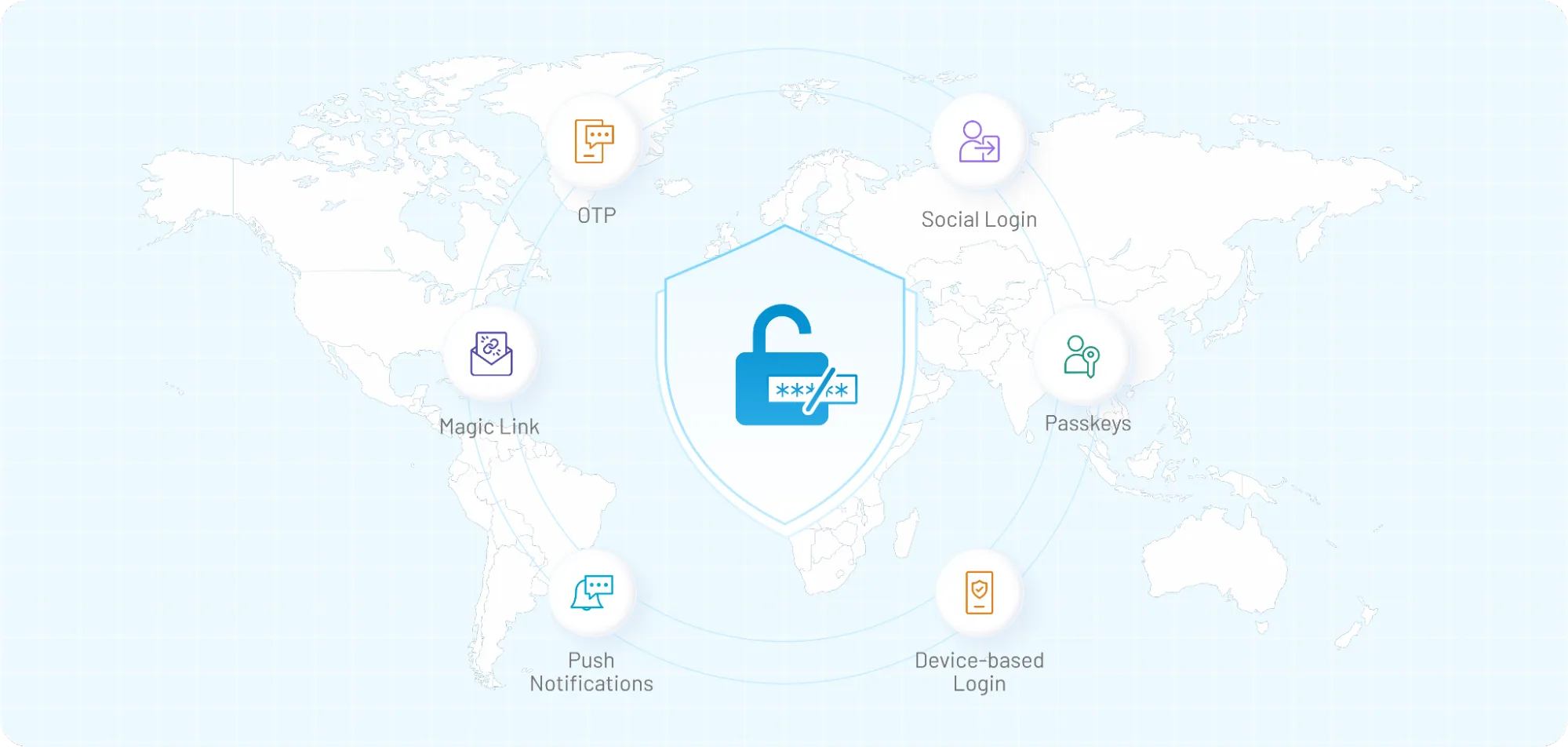
Here’s how it actually works. When a user logs in, the system validates identity using secure factors such as a biometric prompt tied to a device, a one-time, device-bound authentication request, and a cryptographic key pair (as seen in passkeys). There’s no password to remember. More importantly, there’s no password to steal. Not everything labeled as “passwordless” is equally secure:
-
A magic link sent over email removes the password but still depends on email security. An OTP sent via SMS avoids passwords but can be intercepted or redirected. These approaches reduce friction, yes. But they don’t fully eliminate risk.
-
In contrast, modern passwordless methods like passkeys use public-key cryptography. The private key never leaves the user’s device. That means there’s nothing stored on the server that attackers can steal or reuse. It’s a very different security model.
Teams implement one passwordless method, assume the job is done, and overlook edge cases, such as device loss, account recovery, and cross-device login. These gaps don’t show up in demos. They show up in production.
So, passwordless authentication is not just about removing passwords. It’s about removing shared secrets and replacing them with stronger, context-aware identity signals.
That distinction matters. It’s the difference between improving login experience… and actually transforming identity security.
| Feature | Legacy MFA (SMS/OTP) | Modern Passwordless (Passkeys) |
|---|---|---|
| Phishing Resistance | Low (Vulnerable to AiTM) | Extreme (Origin-bound) |
| User Friction | High (Context Switching) | Zero (Biometric/Device) |
| Recovery Method | Manual/Support heavy | Automated/Cloud-synced |
| Compliance | NIST AAL1/2 | NIST AAL3 (Phishing-resistant) |
The Evolution of Authentication From Passwords to MFA to Passwordless
Authentication didn’t move to passwordless overnight. It evolved through layers of fixes, each addressing existing gaps while introducing new challenges.
Passwords were simple and widely adopted, but weak. Users reused them, forgot them, and attackers exploited them through breaches and brute-force attacks. Over time, passwords became more about managing risk than ensuring security. That led to the rise of MFA.
Adding a second factor improved protection. OTPs, SMS codes, and push notifications reduced risk, but also added friction. For a while, this balance worked. Then attackers adapted.
Phishing began capturing OTPs in real time. Push fatigue attacks tricked users into approvals. SIM swaps exposed SMS-based authentication. MFA didn’t fail; it just wasn’t built for these evolving threats. That’s where the shift begins.
Instead of adding more layers, the focus moved to removing the root problem passwords themselves. Passwordless authentication replaces shared secrets with stronger signals like device trust, biometrics, and cryptographic keys.
-
There’s no password to steal.
-
No database of credentials.
-
No code moving across channels.
-
The attack surface changes significantly.
Many organizations are still trying to optimize MFA, while others are redesigning authentication around phishing-resistant and Zero Trust models. That’s the real evolution.
Passwords led to layered defenses with limited gains. Passwordless introduces a redesigned foundation built for long-term security, better user experience, and modern digital systems.
Passwordless vs MFA vs Passkeys: What Actually Matters in 2026
This is where most confusion happens. Passwordless authentication, MFA, and passkeys are often treated as the same thing, but they solve different problems.
MFA was designed to strengthen password-based systems. It adds a second factor to reduce risk. That works until the first factor is compromised. At that point, the second factor becomes the last defense, and attackers are getting better at bypassing it through phishing, fatigue attacks, and SIM swaps.
Passwordless authentication takes a different approach. It removes passwords entirely and replaces them with device trust, biometrics, or secure tokens. This reduces reliance on shared secrets and simplifies the login experience.
Passkeys go a step further. Built on public-key cryptography, they use a key pair where the private key stays on the user’s device, and the public key is stored on the server. Nothing reusable is exposed, making them highly resistant to phishing and interception.
Although both MFA and passwordless improve security, passkeys eliminate many of the weaknesses found in OTPs and approval-based flows. Authentication becomes tied to the device and origin, making impersonation far more difficult.
In practice, these approaches work together. MFA remains useful for step-up authentication and recovery. Passwordless improves usability and reduces password dependency. Passkeys provide stronger, phishing-resistant security.
Teams often try to replace everything at once or treat passkeys as a quick fix. That rarely works. Most organizations move gradually, starting with passwordless login, adding risk-based MFA, and introducing passkeys for higher-security access.
What matters is not choosing one over the other, but aligning them within a strategy that balances security, user experience, and long-term scalability. Explore this article for a complete breakdown of Passkeys vs Passwordless Authentication vs MFA.
Passwordless Authentication Methods Explained With Real-World Use Cases
Passwordless authentication isn’t a single method. It includes multiple approaches that remove passwords from login, each suited to different use cases and risk levels.
-
Biometric authentication is the most familiar. Users log in with fingerprints or facial recognition, with data stored securely on the device. It’s fast and works well for mobile apps, banking, and healthcare platforms.
-
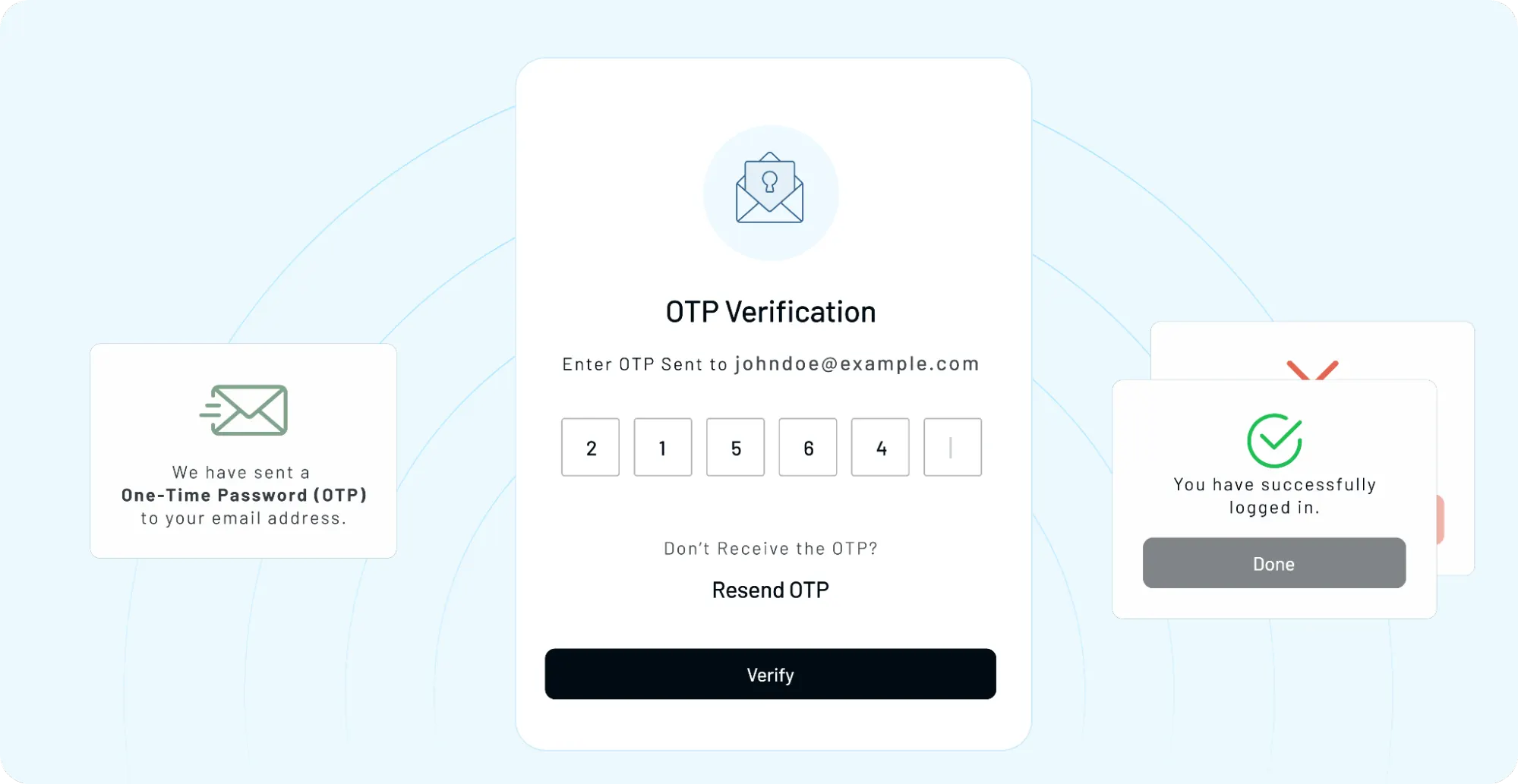
Magic links offer a simple alternative. Users receive a login link via email and access their account instantly. This works well for low-risk scenarios but depends on email security.
-
OTP-based login reduces password reliance but varies in strength. SMS and email OTPs can be intercepted, while authenticator apps offer better protection but add friction.
-
Passkeys provide the strongest option. They use cryptographic key pairs, with the private key stored on the user’s device. This removes reusable credentials and improves resistance to phishing.
The right method depends on context, user journey, risk level, and device environment. A lightweight app may rely on magic links, while enterprise systems require stronger options like passkeys with fallback flows.
Most systems combine methods rather than relying on one. That flexibility ensures both security and usability across different scenarios.
Why Passwordless Is a Competitive Advantage (Not Just a Security Upgrade)
Most teams approach authentication as a security requirement. Something you implement, configure, and move on from. That mindset misses a bigger opportunity.
Authentication sits at the very first interaction a user has with your product. If that moment feels slow, confusing, or risky, everything that follows is already working against you. Passwordless authentication changes that dynamic.
Users don’t have to remember anything. No reset flows. No failed attempts. No switching between apps to fetch codes. Access becomes immediate, and that directly affects how quickly someone can start using your product. For SaaS platforms, the first successful login often decides whether a user explores further or drops off.
Reducing friction at login doesn’t just improve the user experience; it improves conversion. Signup completion rates increase when users aren’t forced into password creation rules. Return visits become smoother because there’s no mental overhead. Even small improvements at this stage can compound into measurable growth.
There’s also an operational angle most teams underestimate. Password resets are not just annoying, they are expensive. Support tickets, account recovery workflows, and lockouts all add overhead. Removing passwords reduces that entire category of issues. Less time spent fixing access problems means more time focused on product value.
In contrast, stronger authentication methods also build trust. Users are becoming more aware of security risks. They recognize when a login experience feels outdated or risky. Passwordless flows, especially those using biometrics or device-based authentication, signal a higher standard. It’s subtle, but it shapes perception.
Here’s a pattern that shows up often. Companies invest heavily in marketing, onboarding, and product features, but overlook authentication as part of the growth strategy. Meanwhile, competitors offering faster, cleaner access quietly win users over.
Passwordless authentication sits at the intersection of security, experience, and business performance. It reduces risk, improves usability, and lowers costs at the same time. That combination is rare. And that’s why it’s no longer just a technical upgrade; it’s a competitive advantage.
Enterprise Passwordless Authentication: What Changes at Scale
What works in a demo often breaks at scale. Enterprise identity is rarely simple. You’re dealing with multiple organizations, roles, partners, shared environments, and access policies. Authentication becomes less about basic login and more about control, visibility, and consistency.
In B2C, the focus is often speed and convenience. In enterprise and B2B, the requirements expand. You need policy enforcement, tenant isolation, audit logs, compliance support, and integration with existing identity systems. Passwordless at this level is not just a login change. It must fit into the broader identity architecture.
In a multi-tenant SaaS platform, one user may belong to several organizations with different permissions. That user may authenticate through a corporate identity provider, access shared resources, and switch between workspaces. Passwordless authentication has to work across those layers without disrupting access.
That is why standards like OpenID Connect and SAML remain important. Many enterprises already rely on them for SSO and federation. Passwordless methods must integrate with these systems so organizations can maintain centralized control while improving user experience.
Compliance adds another layer. Regulations such as GDPR and HIPAA require secure handling of identity data, access logs, and recovery processes. Passwordless flows must support auditability and strong verification without creating weak fallback paths.
Teams often underestimate edge cases device loss, account recovery, admin overrides, and cross-device access. At enterprise scale, these are not rare exceptions. They are everyday scenarios.
Organizations that handle passwordless well usually plan fallback methods early, align authentication with access control, and ensure consistent experiences across web, mobile, and enterprise integrations.
Enterprise passwordless is not just about removing passwords. It is about designing an identity system that can scale without adding friction.
How to Implement Passwordless Authentication (Without Breaking UX)
Rolling out passwordless sounds straightforward: pick a method, replace the password field, and you’re done. That’s usually where things start to go wrong.
Authentication is tightly connected to onboarding, session management, device trust, and recovery. Change one piece without thinking through the rest, and friction shows up in places you didn’t expect. Start with clarity, not tools.
Decide what you’re optimizing for first. Faster onboarding? Stronger protection against phishing? Lower support overhead? The answer shapes everything that follows your method, your fallback, and even how you design the first login experience. Here’s how it typically works in practice.
Instead of forcing a full switch, many teams begin with a hybrid rollout. New users are introduced to passwordless options during signup. Existing users are gradually nudged toward it through prompts or incentives. This reduces disruption and gives space to monitor behavior before scaling further. Then comes method selection.
High-risk environments lean toward passkeys or device-based authentication. Consumer apps may prioritize biometrics for convenience. Low-risk flows sometimes use magic links to keep things simple. The key is aligning the method with user context, not applying one approach everywhere. First-time login and returning login behave differently.
A passkey works seamlessly for a returning user on a trusted device. The same flow can feel confusing during initial signup, especially if the user doesn’t understand what’s happening. Clear prompts and progressive onboarding make a difference here. Recovery flows need equal attention.
Users change devices. They lose access. They switch browsers. If recovery depends on weak fallback methods, you reintroduce the same risks you were trying to eliminate. Strong recovery design often includes a mix of verified email, secondary devices, or step-up authentication based on risk signals.
This is where platforms like LoginRadius simplify the rollout process. Instead of building passwordless flows from scratch, teams can implement methods like passkeys, magic links, social login, biometrics, and OTP authentication through configurable APIs and pre-built workflows.
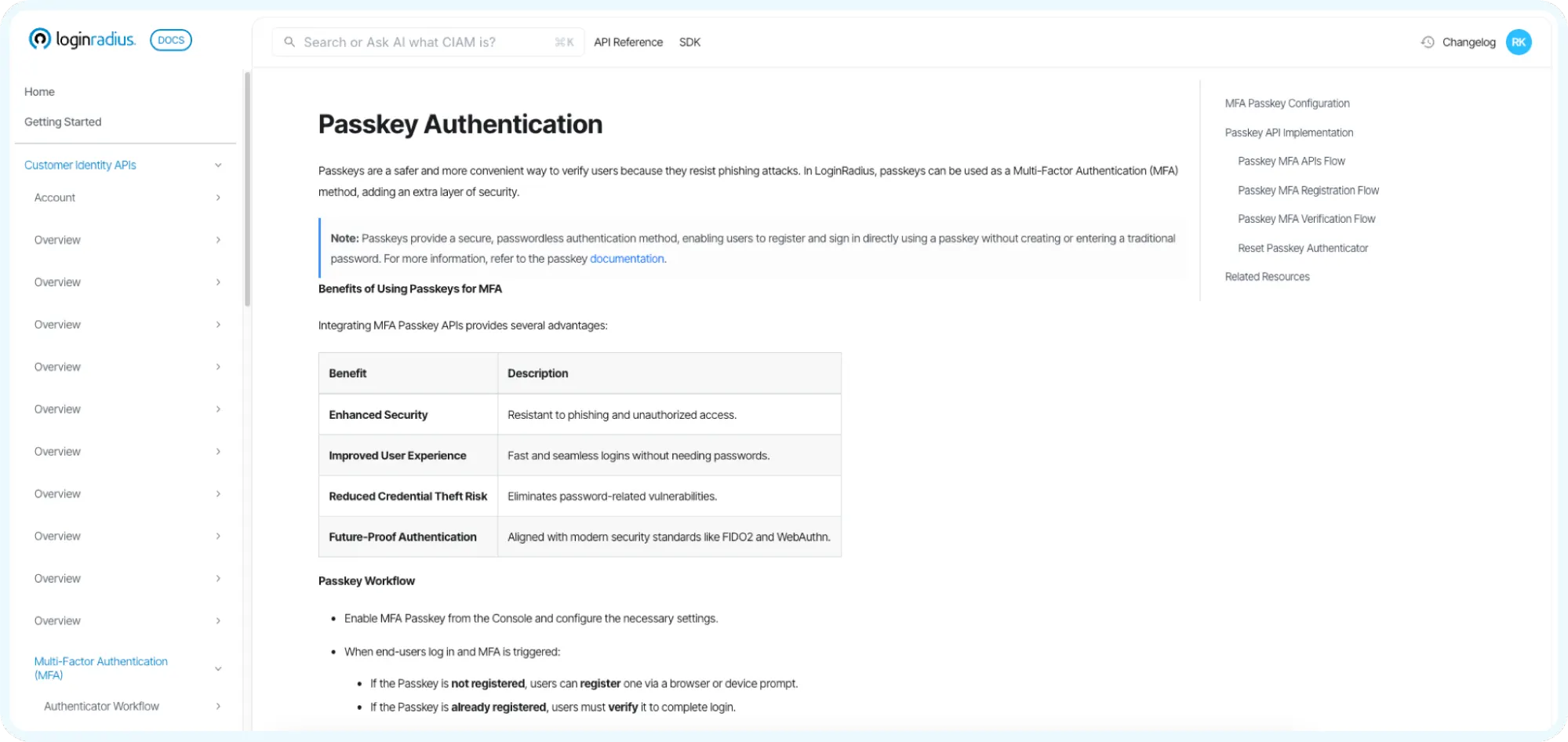
LoginRadius also supports onboarding customization, fallback recovery flows, adaptive authentication, and device trust management, helping teams roll out passwordless authentication without disrupting user experience. For example, developers can explore the LoginRadius Passkeys Authentication Documentation to understand how passkey registration, authentication, and recovery are implemented in real-world applications.
Teams end up over-optimizing for the “happy path” and they ignore edge cases. But in real-world usage, those edge cases show up frequently, and they shape how reliable the system feels. Monitoring is the final piece.
Track login success rates, drop-offs, and recovery attempts. Watch where users hesitate. Small signals here often reveal bigger issues in flow design. Iteration matters more than a perfect first launch.
Passwordless implementation works best when it’s treated as an evolving system, not a one-time deployment. When done right, it reduces friction, strengthens security, and feels almost invisible to the user. That balance is what makes it effective.
The Future of Identity: Where Passwordless Is Headed Next
The future of passwordless authentication is not only about faster login. It is about smarter identity verification. Passkeys will continue to lead this shift because they remove reusable credentials and reduce phishing risk. As users become more familiar with them, password creation may start to feel outdated.
But the bigger change is happening behind the scenes. Authentication is becoming more context-aware. Systems are beginning to evaluate device health, location, behavior, session activity, and risk signals before granting or extending access.
That means identity is moving from a one-time login event to a continuous trust model. A user logging in from a known device and normal location may pass with minimal friction. A suspicious login attempt may trigger step-up verification. This aligns closely with Zero Trust principles, where access is continuously evaluated instead of assumed.
AI and risk-based systems will also shape the future. Behavioral analytics, anomaly detection, and adaptive authentication can help identify unusual activity before it turns into a breach.
Passwordless becomes the foundation for this next stage. Once passwords are removed, organizations can build stronger, more flexible identity systems around device trust, risk signals, and continuous verification.
For users, the experience becomes simpler. For businesses, the security model becomes stronger. That is where passwordless authentication is headed.
Conclusion: Passwordless Is Not the End, It’s the Starting Point
Passwords carried identity systems for decades. They were easy to deploy, easy to understand, and easy to break. Adding layers helped for a while, but the model has been stretched thin. What we’re seeing now is not a minor upgrade. It’s a reset.
Passwordless authentication shifts identity from something users manage to something systems verify intelligently. That changes how security works, how users interact with products, and how organizations plan for the future. It touches onboarding, access control, compliance, and even revenue. Here’s the part many teams underestimate.
This is not just about choosing a login method. It’s about deciding how identity will evolve inside your product over the next few years. The choices you make now, methods, recovery flows, and integration approach shape how adaptable your system will be when new standards, threats, and user expectations emerge.
Some organizations will keep refining passwords and traditional MFA. Others will move toward passwordless-first strategies, gradually reducing dependency on outdated models. The gap between the two will become more visible over time in security posture, user experience, and operational efficiency.
Ready to Eliminate Passwords Without Breaking Your Login Experience?
Passwords are slowing you down, hurting conversions, increasing support costs, and exposing users to avoidable risks. Passwordless authentication fixes that, but only when it’s implemented the right way.
If you’re serious about modernizing your identity stack, now is the time to act. LoginRadius helps you deploy passwordless authentication fast, secure, and built for scale. From passkeys and biometrics to adaptive MFA and enterprise-ready integrations, you get everything you need to create a seamless and phishing-resistant login experience.
Start your passwordless journey today. Explore LoginRadius, request a demo, or launch a free trial and see how modern authentication should actually work.
FAQs
Q: What is passwordless authentication?
A: Passwordless authentication is a login approach that verifies users without requiring a password. Instead, it relies on device-based signals, biometrics, or cryptographic keys to confirm identity. This reduces the risk of credential theft since there’s no stored password to compromise. It also makes login faster and more user-friendly.
Q: Is passwordless authentication more secure than MFA?
A: It depends on the method used. Traditional MFA still relies on passwords, which can be phished or leaked. Passwordless methods, especially passkeys, remove shared secrets entirely, making them more resistant to phishing and credential attacks. In many cases, a well-implemented passwordless system can offer stronger protection than basic MFA.
Q: What are passkeys, and how do they work?
A: Passkeys are a modern authentication method based on public-key cryptography. A private key is stored securely on the user’s device, while the server holds a corresponding public key. During login, the device proves ownership without sharing sensitive data. This makes passkeys highly resistant to phishing and replay attacks.
Q: How does passwordless login work?
A: Passwordless login verifies identity using factors like biometrics, one-time links, or device-based authentication. The user initiates login, confirms identity through a secure method, and gains access without entering a password. The system validates the request using trusted signals instead of stored credentials.
Q: What are the most common passwordless authentication methods?
A: Common methods include biometrics (fingerprint or facial recognition), magic links sent via email, one-time passcodes, and passkeys. Each method offers a different balance of security and user experience. Many systems combine multiple methods to handle different risk levels and scenarios.
Q: What are the challenges of passwordless authentication?
A: Passwordless systems can introduce challenges like device dependency, account recovery complexity, and user adoption hesitation. Users switching devices or losing access may encounter friction if fallback options aren’t well-designed. Proper planning around recovery and cross-device access is essential for long-term success.
Q: Can passwordless authentication replace passwords completely?
A: In many cases, yes, but not instantly. Most organizations adopt a phased approach, where passwordless methods coexist with passwords during transition. Over time, as users adopt newer methods like passkeys, passwords become less central and may eventually be removed from primary login flows.
Q: Is passwordless authentication suitable for enterprise and SaaS platforms?
A: Yes, but it requires careful implementation. Enterprise environments need support for multi-tenant access, compliance, and integration with existing identity systems. When planned properly, passwordless authentication can improve both security and user experience across SaaS and enterprise applications.