Introduction
Customers no longer interact with businesses through a single channel. They might discover your brand on social media, browse products on a laptop, complete a purchase from a mobile app, and later contact customer support through a web portal or call center. To the customer, it's one continuous relationship. Behind the scenes, however, many organizations see several different identities.
That disconnect creates bigger problems than most businesses realize. The same customer may have multiple accounts, inconsistent profile information, different authentication methods, and fragmented records spread across websites, mobile apps, CRM platforms, support systems, and loyalty programs. As a result, customers are often asked to sign in repeatedly, update the same information across channels, or receive inconsistent experiences that erode trust.
These fragmented identities don't just affect customer experience. They reduce personalization accuracy, make analytics less reliable, increase duplicate accounts, complicate consent management, and create security risks when businesses can't confidently recognize who they're interacting with.
This is where omnichannel customer experience becomes much more than connecting communication channels. A successful omnichannel strategy ensures customers are recognized consistently, authenticated securely, and served with the same trusted identity across every digital touchpoint.
In this guide, you'll learn what omnichannel customer experience is, why many initiatives fall short, how Customer Identity and Access Management (CIAM) helps solve the identity challenges behind disconnected customer journeys, and the best practices for delivering secure, personalized, and privacy-aware experiences at every stage of the customer lifecycle.
Omnichannel experiences depend on one critical capability: recognizing the same customer everywhere.
Omnichannel Customer Experience at a Glance
If you're short on time, here's the quick version.
| Topic | Summary |
|---|---|
| What is omnichannel customer experience? | Omnichannel customer experience delivers consistent, connected, and personalized interactions across every digital and physical customer touchpoint. |
| Why do omnichannel experiences fail? | Most organizations struggle because they cannot consistently recognize the same customer across websites, mobile apps, support channels, stores, and partner platforms. |
| What enables successful omnichannel experiences? | Trusted customer identities managed through Customer Identity and Access Management (CIAM) provide the foundation for consistent customer recognition across every channel. |
| Core identity capabilities | Customer registration, authentication, profile management, account linking, consent management, identity resolution, and progressive profiling work together to create connected customer journeys. |
| Authentication methods | Passwords, Multi-Factor Authentication (MFA), passkeys, passwordless authentication, Social Login, and Enterprise Single Sign-On (SSO) help balance security with customer convenience. |
| Business outcomes | Consistent customer recognition, unified customer identities, secure authentication, trusted personalization, improved fraud prevention, centralized consent management, and privacy-aware customer experiences. |
Omnichannel customer experience succeeds when every interaction is built on one trusted customer identity rather than multiple disconnected customer accounts.
What Is Omnichannel Customer Experience?
Omnichannel customer experience is a business strategy that delivers consistent, connected, and personalized interactions across every customer touchpoint. Whether customers engage through a website, mobile app, customer portal, physical store, call center, social media, or partner application, they should experience one continuous relationship with the brand instead of a series of disconnected interactions.
Achieving that consistency requires more than integrating communication channels. A true omnichannel customer experience ensures customers are recognized, authenticated, and served consistently across every website, mobile app, portal, kiosk, call center, and partner application.
Regardless of where or how they engage, their identity, profile information, preferences, and previous interactions remain connected.
Consider a customer who discovers a product on a mobile app, adds it to their cart on a laptop, completes the purchase through a website, and later contacts customer support. They shouldn't have to create another account, sign in differently, repeat personal information, or explain their purchase history each time they switch channels. Every interaction should build on the last because the business recognizes them as the same customer.
This consistent recognition depends on trusted customer identities. Authentication, profile management, account linking, consent management, and identity resolution work together to ensure businesses interact with one verified customer identity rather than multiple fragmented records. That trusted identity becomes the foundation for secure authentication, accurate personalization, privacy-aware experiences, and seamless customer journeys across every channel.
Simply put, omnichannel customer experience isn't just about connecting channels; it's about consistently recognizing the customer behind every interaction.
Why Omnichannel Customer Experiences Often Fall Short
Most organizations don't struggle because they lack customer channels. They struggle because those channels don't consistently recognize the same customer.
A customer may browse your website anonymously, create an account through your mobile app, sign in later with Google, contact customer support by phone, and make an in-store purchase using a loyalty card. If those interactions aren't connected to one trusted identity, every system sees only part of the customer's journey.
The result is a fragmented experience. Customers may be asked to register multiple times, verify their identity repeatedly, update the same profile information across different applications, or receive recommendations that don't reflect their previous interactions. Behind the scenes, support teams lack context, marketing works with duplicate profiles, and security teams struggle to distinguish legitimate users from suspicious activity.
Here are some of the most common identity challenges that prevent organizations from delivering a truly omnichannel customer experience.
| Identity Bottleneck | Impact on Customer Experience | When Fixed: Positive Impact on Business |
|---|---|---|
| Duplicate Accounts | Frustration from re-entering credentials and losing purchase history. | Better personalization, accurate analytics, and reduced wasted ad spend. |
| Inconsistent Authentication | Sudden friction when switching between the app, website, or kiosk. | Reduced password-reset support costs and higher session retention. |
| Siloed Profiles | Customers must repeatedly update addresses and phone numbers across multiple portals. | Service agents and marketing teams gain real-time customer context. |
| Unsynchronized Consent | Customers receive marketing communications even after unsubscribing. | Improved regulatory compliance and reduced risk of GDPR/CCPA penalties. |
| Anonymous Customer Journeys | Loss of saved carts, preferences, and context after account creation or device switching. | Higher conversion rates through progressive profiling, better attribution modeling, and continuous first-party data capture across devices. |
The Financial Impact of Identity-Driven CX
-
Lower Drop-off: Social logins and passwordless passkeys reduce checkout friction, lifting conversion rates by up to 20–30%.
-
Reduced Support Overhead: Centralized SSO and self-service account recovery reduce password-related helpdesk tickets by 40–60%.
-
Mitigated Fraud: Multi-Factor Authentication (MFA) and account linking lower Account Takeover (ATO) risks by over 90%.
Why Customer Identity Is the Foundation of Omnichannel Customer Experience
Every omnichannel interaction begins long before a customer clicks "Buy Now" or contacts customer support. It begins with identity.
Whether someone creates a new account, signs in from another device, updates their profile, accepts a privacy policy, redeems loyalty points, or accesses a partner portal, the business must first recognize who that customer is. Without that recognition, every system operates with only a partial view of the customer, leading to fragmented experiences, duplicate accounts, inconsistent authentication, and disconnected customer journeys.
This is why successful omnichannel strategies are built on trusted customer identities rather than isolated customer data. A Customer Identity and Access Management (CIAM) platform helps organizations establish that trusted identity by managing how customers register, authenticate, manage their profiles, control their privacy preferences, and interact across every digital touchpoint.
Simply put, every seamless customer experience starts with a trusted customer identity.
Customer Registration Creates the First Trusted Identity
Every customer journey starts somewhere, and for many businesses, that first interaction is registration. Whether customers sign up using an email address, social login, passkey, or enterprise identity provider, registration establishes the initial relationship between the customer and the business.
A well-designed registration experience collects only the information needed to create a trusted identity while minimizing friction. Instead of asking customers to complete lengthy forms, organizations increasingly adopt progressive profiling, collecting additional information over time as trust grows.
The result is more than a new account. It is the creation of a verified customer identity that every future interaction can build upon.
Authentication Confirms the Customer at Every Touchpoint
Creating an account is only the beginning. Customers continue moving between websites, mobile apps, self-service portals, retail kiosks, customer support channels, and partner applications throughout their relationship with a business.
Each interaction requires the organization to answer the same question: Is this really the same customer?
Authentication provides that confidence. Whether customers sign in using passwords, Multi-Factor Authentication (MFA), passkeys, social login, passwordless authentication, or Single Sign-On (SSO), every successful authentication event strengthens identity confidence while allowing businesses to deliver secure, uninterrupted experiences across channels.
When authentication remains consistent across every touchpoint, customers spend less time proving who they are and more time completing the tasks that matter.
Centralized Profile Management Keeps Customer Information Consistent
Customers expect their information to stay current regardless of where they interact.
If they update their phone number in a mobile app, change their email address through a customer portal, or modify their communication preferences after contacting support, those changes should be reflected everywhere.
Without centralized profile management, different systems often maintain conflicting versions of the same customer. Marketing platforms, CRM systems, support applications, and loyalty programs gradually drift out of sync, creating inconsistent experiences for both customers and employees.
Managing customer profiles from a trusted identity source ensures every application works from the same accurate information, reducing duplication while improving personalization, customer service, and operational efficiency.
Account Linking Connects Multiple Login Methods to One Customer
Modern customers rarely rely on a single authentication method throughout their relationship with a business.
Someone might register with an email address, later choose Google Sign-In, adopt passkeys for passwordless authentication, or access a partner application through enterprise Single Sign-On. Without account linking, each authentication method can create another customer account instead of strengthening an existing one.
Account linking solves this challenge by connecting multiple authentication methods to one verified customer identity. Rather than managing separate accounts for each login option, customers enjoy greater flexibility while organizations maintain a single, trusted customer profile across every channel.
This not only reduces duplicate accounts but also improves customer recognition, simplifies account recovery, and strengthens identity resolution across digital experiences.
Consent and Privacy Preferences Must Follow the Customer
Privacy preferences should never become disconnected from the customer they belong to.
When customers update their communication preferences, withdraw marketing consent, or request changes to how their personal information is used, those choices should remain consistent across every website, application, support channel, and business system.
Managing consent alongside customer identity helps organizations respect customer preferences while supporting privacy regulations and reducing the risk of inconsistent communications or unauthorized data use.
As privacy expectations continue to grow, synchronizing consent across the customer lifecycle has become an essential part of delivering trusted omnichannel experiences.
Identity Resolution Connects Every Customer Interaction
Customers rarely complete their journey in a single session or on a single device.
They browse anonymously, create accounts later, switch between mobile devices and laptops, contact customer support, join loyalty programs, and return repeatedly over months or even years.
Identity resolution connects these interactions by determining which records belong to the same customer. Combined with trusted identities managed through a CIAM platform, it creates unified customer profiles that reflect the customer's complete relationship with the business rather than isolated interactions stored in separate systems.
The result is more accurate personalization, stronger fraud detection, cleaner analytics, better customer support, and more consistent experiences across every digital touchpoint.
Customer identity isn't just another component of an omnichannel strategy it's the foundation that makes every connected experience possible. Registration establishes trusted identities, authentication verifies them, profile management keeps them current, account linking prevents fragmentation, consent preserves customer trust, and identity resolution connects interactions across channels.
Together, these capabilities allow organizations to recognize customers consistently, protect their accounts, and deliver seamless, personalized experiences wherever the customer chooses to engage.
How CIAM Enables Omnichannel Customer Experience
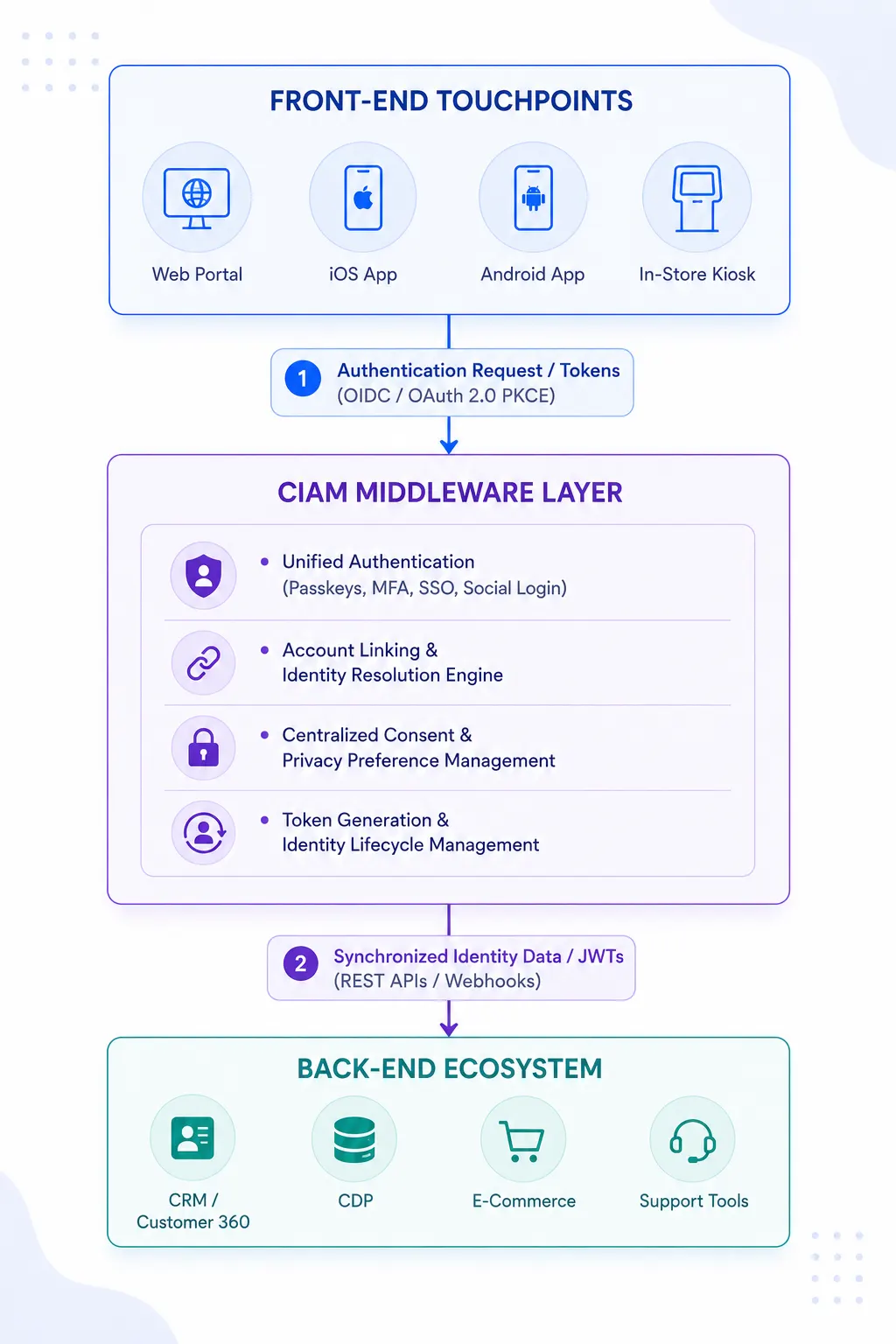
Delivering a consistent customer experience across every digital touchpoint requires more than integrating business systems. Organizations also need a reliable way to recognize customers, authenticate them securely, maintain accurate profiles, and respect their preferences wherever they interact.
This is where Customer Identity and Access Management (CIAM) plays a central role. Rather than treating identity as a standalone login function, CIAM manages the entire customer identity lifecycle from registration and authentication to profile management, consent, and account recovery.
By providing a single, trusted identity across every application and channel, CIAM helps businesses deliver secure, personalized, and connected omnichannel experiences.
Unified Customer Identity Across Channels
Customers move constantly between websites, mobile apps, customer portals, physical stores, support channels, partner applications, and connected devices. Without a shared identity, every interaction risks creating another isolated customer record.
CIAM establishes a unified customer identity that follows the customer across every touchpoint. Instead of maintaining separate identities for each application, organizations work from a single trusted profile that keeps customer information, authentication history, preferences, and account relationships connected. This consistent identity allows every system to recognize the same customer, regardless of how they choose to engage.
Consistent Authentication Experiences
Authentication is often one of the first interactions customers have with a digital service. If every application requires a different sign-in experience, customers quickly encounter unnecessary friction.
CIAM centralizes authentication so customers experience consistent, secure access across websites, mobile applications, self-service portals, partner ecosystems, and other digital channels. Organizations can support multiple authentication methods including passwords, Multi-Factor Authentication (MFA), passkeys, passwordless authentication, social login, and Single Sign-On (SSO) while enforcing consistent security policies across every touchpoint.
The result is a smoother login experience for customers and stronger identity assurance for the business.
Account Linking Across Multiple Login Methods
Customers increasingly expect the flexibility to choose how they authenticate. Someone may register with an email address, later sign in with Google, adopt passkeys for passwordless authentication, or access a B2B portal through enterprise Single Sign-On.
Without account linking, each authentication method can generate another customer account, creating duplicate identities and fragmented customer journeys.
CIAM solves this by linking multiple authentication methods to a single customer account. Customers gain flexibility without sacrificing convenience, while businesses maintain one trusted identity that supports consistent recognition, simpler account recovery, cleaner analytics, and more accurate personalization.
Centralized Customer Profile Management
Customer information changes continuously. Email addresses, phone numbers, shipping addresses, communication preferences, and profile details evolve throughout the customer relationship.
When profile management is spread across disconnected applications, inconsistent information quickly becomes a problem. Customers may update their information in one application only to discover outdated details elsewhere.
CIAM centralizes profile management so customer information remains accurate across every connected system. Updates made through one trusted identity are reflected consistently across websites, mobile apps, customer portals, support platforms, and other digital services, reducing duplicate records while improving customer service and operational efficiency.
Consent and Preference Synchronization
Trust extends beyond authentication. Customers also expect organizations to respect how their personal information is collected, stored, and used.
CIAM helps synchronize customer consent, communication preferences, and privacy settings across every channel. Whether a customer updates marketing preferences through a mobile app, withdraws consent through a customer portal, or changes notification settings on a website, those choices remain connected to the same trusted identity.
Keeping consent synchronized across systems not only supports regulatory compliance but also reinforces customer confidence that their preferences will be respected throughout every interaction.
Identity Resolution Improves Customer Recognition
Recognizing customers consistently requires more than authentication alone.
Customers browse anonymously, return from different devices, contact customer support, participate in loyalty programs, and interact through multiple digital channels before and after signing in.
CIAM strengthens identity resolution by providing verified first-party identity signals such as authenticated customer IDs, verified email addresses, linked accounts, and trusted authentication events. Identity resolution combines those verified signals with additional matching rules to connect fragmented interactions into unified customer profiles.
Together, CIAM and identity resolution help organizations recognize returning customers more accurately, reduce duplicate identities, improve personalization, strengthen fraud detection, and provide every team with a more complete understanding of the customer journey.
Progressive Profiling Across the Customer Journey
Customers rarely want to complete lengthy registration forms during their first interaction with a brand.
Progressive profiling allows organizations to collect customer information gradually as the relationship develops. Instead of requesting every detail upfront, businesses gather additional profile attributes, preferences, and contextual information over time through trusted interactions.
CIAM supports this incremental approach while maintaining a single customer identity throughout the lifecycle. As profiles become richer, organizations gain better customer insights without increasing registration friction, making personalization, customer support, and engagement more effective over time.
Customer expectations continue to evolve, but one requirement remains constant: businesses must recognize customers consistently wherever they interact. CIAM makes that possible by managing trusted customer identities across registration, authentication, profile management, account linking, consent, and identity resolution.
These capabilities work together to eliminate fragmented customer journeys and create the secure, personalized, and connected experiences that define successful omnichannel customer engagement.
CIAM vs. CRM vs. CDP: Which Technology Enables Omnichannel Customer Experience?
Organizations building omnichannel customer experiences often invest in multiple customer technologies, including Customer Relationship Management (CRM) systems, Customer Data Platforms (CDPs), Customer Identity and Access Management (CIAM) platforms, Customer 360 initiatives, and identity resolution solutions.
Because these technologies all manage customer information in different ways, it's easy to assume they solve the same problem. In reality, each serves a distinct purpose, and understanding those differences helps organizations build a stronger omnichannel architecture.
| Technology | Primary Role | Contribution to Omnichannel Customer Experience |
|---|---|---|
| Customer Identity and Access Management (CIAM) | Registers, authenticates, and manages customer identities | Recognizes customers consistently across every channel while managing authentication, profiles, consent, and account access. |
| Customer Relationship Management (CRM) | Stores customer relationship and sales information | Provides customer history, sales interactions, and service records that support customer engagement. |
| Customer Data Platform (CDP) | Collects, unifies, and activates customer data | Creates audience segments, powers personalization, marketing campaigns, and customer analytics. |
| Customer 360 | Creates a shared business view of the customer | Combines customer information from multiple systems to provide consistent visibility across teams. |
| Identity Resolution | Connects fragmented customer identities across systems | Links customer interactions into unified customer profiles, improving recognition, personalization, and analytics. |
Why CIAM Plays a Unique Role
CRM platforms store customer relationships. CDPs activate customer data for marketing. Customer 360 initiatives bring information together for business teams, while identity resolution connects customer interactions across systems.
CIAM serves a different purpose.
It establishes the trusted customer identity that allows every other system to recognize the same individual consistently. Through customer registration, authentication, profile management, account linking, consent management, and secure access, CIAM provides verified first-party identity data that improves the effectiveness of CRM systems, CDPs, Customer 360 initiatives, and identity resolution platforms.
Without that trusted identity foundation, organizations often struggle with duplicate customer accounts, inconsistent authentication, fragmented customer profiles, and disconnected omnichannel experiences.
Rather than competing with CRM or CDP platforms, CIAM complements them by ensuring every downstream system works from the same verified customer identity. Together, these technologies create the connected customer experiences that modern businesses strive to deliver across websites, mobile apps, customer portals, support channels, retail locations, and partner ecosystems.
Authentication Across Omnichannel Customer Journeys
Every omnichannel experience depends on one simple question: Can the business recognize and securely authenticate the customer wherever they interact?
Authentication is often viewed as a security requirement, but it also plays a significant role in customer experience. Every login represents a moment where customers either continue their journey seamlessly or encounter unnecessary friction. When authentication is inconsistent across channels, customers may be forced to sign in repeatedly, recover forgotten passwords, verify their identity multiple times, or create duplicate accounts before completing even simple tasks.
A modern omnichannel strategy balances strong security with a smooth customer experience by supporting authentication methods that match customer expectations while maintaining a trusted identity across every digital touchpoint.
Password Authentication
Passwords remain one of the most widely used authentication methods, particularly for existing customer accounts. While familiar, they often create friction through forgotten credentials, password resets, and inconsistent sign-in experiences across applications.
For omnichannel experiences, password authentication works best when customers can use the same trusted identity across websites, mobile apps, customer portals, and other digital services instead of maintaining separate credentials for each channel.
Multi-Factor Authentication (MFA)
Certain customer interactions require stronger identity verification than a password alone. Updating account information, accessing sensitive personal data, completing high-value transactions, or managing financial information are common examples.
Multi-Factor Authentication (MFA) adds an additional verification step, helping organizations reduce account takeover risks while increasing confidence that the legitimate customer is signing in. When implemented using adaptive or risk-based policies, MFA can provide stronger security without interrupting every customer session, creating a better balance between protection and convenience.
Passkeys and Passwordless Authentication
Customers increasingly expect authentication to be fast, secure, and effortless.
Passkeys replace traditional passwords with device-bound cryptographic credentials that allow customers to sign in using biometrics or device authentication. Instead of remembering passwords or entering one-time codes, customers can authenticate with a fingerprint, facial recognition, or device PIN.
For omnichannel experiences, passkeys reduce login friction, minimize password resets, improve account security, and create a more consistent authentication experience across supported devices and applications.
Social Login
Many customers prefer signing in with existing identities from providers such as Google, Apple, Facebook, or LinkedIn rather than creating another username and password.
Social Login simplifies registration, reduces onboarding friction, and accelerates account creation while allowing businesses to establish trusted customer identities more quickly.
When combined with account linking, customers can continue using their preferred authentication method without creating duplicate accounts, preserving a single customer identity across multiple channels.
Enterprise Single Sign-On (SSO) for B2B Experiences
Omnichannel customer experiences are not limited to consumer applications. B2B organizations often provide customer portals, partner ecosystems, supplier platforms, and self-service applications accessed by business users.
Enterprise Single Sign-On (SSO) allows customers to authenticate using their organization's existing identity provider, eliminating the need to manage additional credentials while simplifying access across multiple business applications.
For organizations serving enterprise customers, SSO improves both security and user experience by reducing login friction, supporting centralized identity policies, and providing consistent authentication across partner-facing digital services.
Choosing the Right Authentication Approach
No single authentication method is appropriate for every interaction.
Routine customer activities may only require a familiar sign-in experience, while high-risk actions benefit from stronger identity verification. Many organizations therefore combine multiple authentication methods, including passwords, MFA, passkeys, Social Login, and Enterprise SSO to meet different customer needs without sacrificing usability.
The objective isn't simply to authenticate customers. It's to recognize them consistently, protect their accounts, and allow them to move seamlessly between every digital touchpoint with the confidence that they are interacting with the same trusted identity throughout their journey.

How Identity Resolution Powers Omnichannel Customer Experience
Delivering a seamless omnichannel customer experience depends on more than connecting digital channels. Businesses must also recognize that every interaction belongs to the same customer, even when it occurs across different devices, applications, authentication methods, or points in time.
This is where identity resolution becomes essential.
While a Customer Identity and Access Management (CIAM) platform establishes trusted customer identities through registration, authentication, profile management, and consent, identity resolution connects those trusted identities with customer interactions occurring across the broader digital ecosystem. Together, they enable organizations to recognize customers consistently throughout their entire journey.
The relationship looks like this:
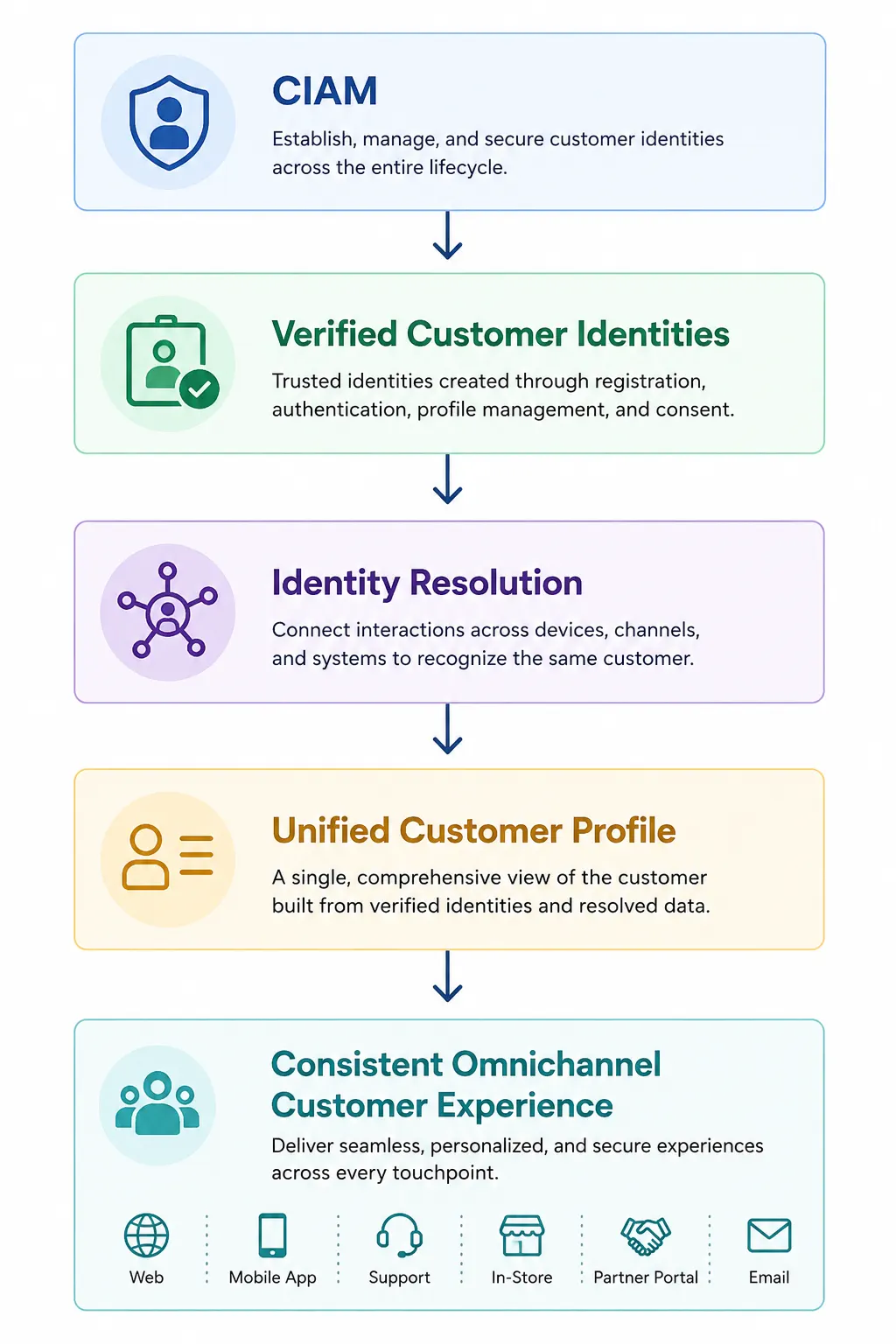
Each layer builds on the one before it.
CIAM creates trusted first-party identities by verifying who customers are when they register, authenticate, update their profiles, or link multiple login methods. These verified identity signals, including customer IDs, verified email addresses, linked accounts, consent records, and authentication history provide reliable data that identity resolution can use with much greater confidence than anonymous behavioral signals alone.
Identity resolution then connects customer interactions across websites, mobile apps, CRM systems, customer support platforms, loyalty programs, marketing tools, and other digital touchpoints. Instead of creating separate records for every interaction, it determines which activities belong to the same individual and continuously builds a unified customer profile.
That unified profile becomes the foundation for a true omnichannel customer experience.
Imagine a customer who discovers your brand through a social media campaign, researches products on a laptop, signs up using Google, later enables passkeys on their mobile device, contacts customer support through a self-service portal, and eventually makes an in-store purchase using a loyalty membership.
Without identity resolution, every system may treat these as unrelated interactions. Marketing sees one customer, support sees another, the loyalty platform creates a third profile, and analytics cannot accurately reconstruct the customer journey.
With identity resolution built on verified identities managed through CIAM, every interaction contributes to the same trusted customer profile. Marketing understands previous engagement, support has complete context, loyalty benefits remain synchronized, authentication stays consistent across channels, and personalization reflects the customer's entire relationship with the business rather than isolated events.
This unified approach delivers benefits that extend across the organization:
-
More accurate customer recognition across channels and devices.
-
Fewer duplicate customer accounts and fragmented profiles.
-
Stronger personalization based on complete customer journeys.
-
Better analytics and AI driven by trusted identity data.
-
Improved fraud detection through verified first-party identities.
-
Consistent consent, privacy preferences, and communication settings.
-
Seamless transitions between websites, mobile apps, customer portals, and physical locations.
Identity resolution doesn't replace CIAM, and CIAM doesn't replace identity resolution. They solve different challenges while strengthening each other. CIAM establishes trusted customer identities, and identity resolution connects those identities across systems and interactions. Together, they create the unified customer profiles that modern omnichannel customer experiences depend on.
How a Trusted Customer Identity Enables Omnichannel Journeys
Customers don't think in terms of channels. They simply expect every interaction with a business to build on the previous one.
A customer might register through a website, continue browsing from a mobile app, contact customer support, visit a physical store, and later return through a partner portal. Although each interaction happens in a different place, customers expect the business to recognize them without asking them to start over.
That continuity is only possible when every interaction is connected to the same verified customer identity.
A typical omnichannel journey looks like this:
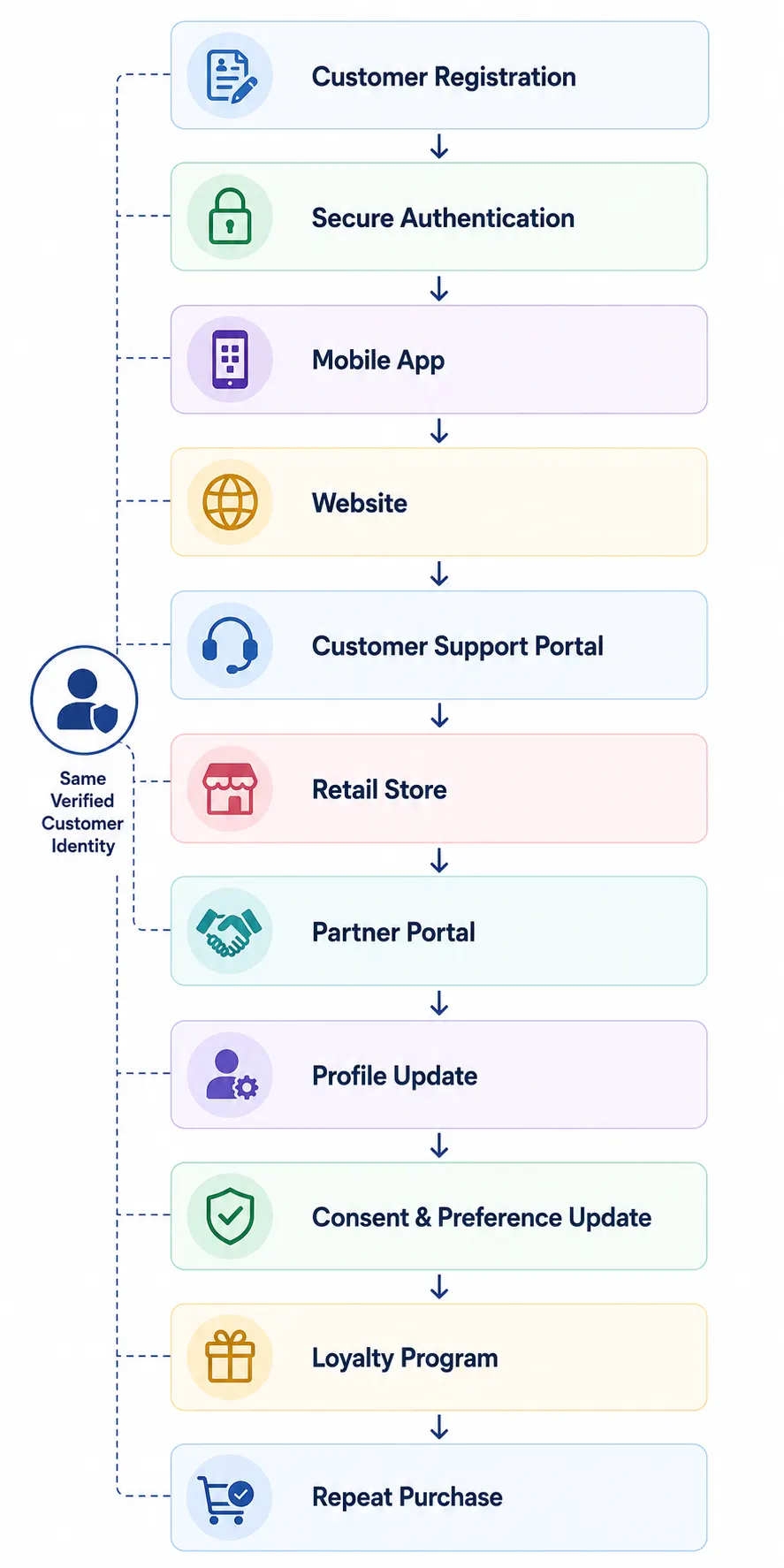
At every stage, the customer remains the same verified identity.
During registration, the organization establishes the customer's initial identity. Authentication confirms that identity whenever the customer returns, regardless of the device or channel they use. As customers move between mobile applications, websites, physical locations, and customer support channels, the same trusted identity allows every system to recognize them consistently.
Profile updates, communication preferences, and consent choices remain synchronized because they are attached to one customer identity rather than multiple disconnected accounts. Loyalty rewards, purchase history, and previous interactions also stay connected, allowing every department to work from the same customer context.
Without this shared identity, each interaction risks becoming an isolated event. Customers may need to create multiple accounts, repeat authentication, re-enter personal information, or explain their history every time they switch channels. Marketing platforms lose visibility into complete customer journeys, support teams lack important context, and personalization becomes inconsistent because every system sees a different version of the customer.
When a trusted identity connects every touchpoint, the experience changes completely. Customers move naturally between channels without interruption, authentication remains consistent, customer preferences follow them across interactions, and every engagement contributes to a richer understanding of their relationship with the business.
The result is more than a seamless customer journey. It is a connected digital experience built on one verified customer identity that remains consistent throughout the entire customer lifecycle.
How CIAM Improves Omnichannel Customer Experience
Organizations invest in omnichannel strategies to create connected customer journeys, but those journeys can only succeed when every interaction is built on a unified customer identity. By establishing, managing, and protecting customer identities throughout the customer lifecycle, Customer Identity and Access Management (CIAM) enables businesses to deliver experiences that are not only seamless but also secure, personalized, and privacy-aware.
The benefits extend well beyond authentication. They influence every interaction customers have with a brand.
Consistent Customer Recognition Across Every Channel
Customers expect businesses to remember them regardless of whether they interact through a website, mobile app, customer portal, retail location, or customer support channel.
CIAM provides a connected customer identity that remains consistent across every touchpoint, allowing organizations to recognize returning customers without forcing them to repeatedly register, authenticate, or provide the same information. This continuity creates smoother customer journeys and strengthens long-term customer relationships.
Unified Customer Identities Reduce Fragmentation
Duplicate customer accounts are one of the biggest barriers to delivering connected digital experiences.
By managing a single trusted identity across multiple channels and authentication methods, CIAM helps eliminate fragmented customer profiles. Every department works from the same customer identity, resulting in cleaner customer data, more accurate reporting, and a more complete understanding of each customer's relationship with the business.
Fewer Duplicate Accounts Through Account Linking
Customers increasingly switch between email and password, Social Login, passkeys, and Enterprise Single Sign-On (SSO). Without account linking, these authentication methods can create separate customer accounts for the same individual.
CIAM links multiple authentication methods to one verified customer identity, reducing duplicate accounts while simplifying account recovery, improving customer recognition, and supporting consistent experiences across every digital channel.
Secure Authentication Without Unnecessary Friction
Customers expect authentication to protect their accounts without slowing them down.
CIAM supports modern authentication methods such as Multi-Factor Authentication (MFA), passkeys, passwordless authentication, Social Login, and Enterprise SSO, allowing organizations to apply appropriate security based on customer context and risk. This approach strengthens account security while minimizing unnecessary login interruptions across customer journeys.
Centralized Consent and Preference Management
Privacy preferences should remain consistent wherever customers interact.
CIAM centralizes consent, communication preferences, and privacy settings so they stay connected to the customer's identity rather than individual applications. Whether customers update their preferences through a mobile app, website, or customer portal, every connected system reflects the same choices, helping organizations build trust while supporting regulatory compliance.
Trusted Personalization Built on Verified Customer Identities
Personalization is only effective when businesses can confidently recognize the customer behind every interaction.
Rather than relying solely on anonymous behavioral signals, CIAM provides verified first-party identities that improve customer recognition across channels. Combined with identity resolution, organizations can deliver more relevant recommendations, consistent messaging, and personalized experiences based on a unified customer profile instead of fragmented customer records.
Improved Fraud Prevention and Identity Protection
As digital channels expand, organizations must protect customer accounts without creating excessive friction.
CIAM strengthens fraud prevention by combining secure authentication, adaptive security policies, account protection, and verified customer identities. Recognizing legitimate customers more accurately helps reduce account takeover attempts, suspicious login activity, and identity-related fraud while maintaining a seamless customer experience for trusted users.
Privacy-Aware Customer Experiences
Modern customers expect organizations to protect their personal information as carefully as they protect their own.
CIAM helps businesses deliver privacy-aware experiences by managing customer identities alongside consent, authentication, profile management, and access controls. Customers gain greater transparency and control over their personal information, while organizations can provide consistent experiences that respect privacy preferences across every digital touchpoint.
Ultimately, successful omnichannel customer experiences depend on more than connecting channels. They depend on recognizing the same customer consistently, protecting their identity, respecting their preferences, and enabling every interaction to build on the last. CIAM provides that trusted identity foundation, allowing organizations to deliver connected experiences that strengthen customer trust, improve operational efficiency, and support long-term business growth.
How Trusted Customer Identities Improve AI-Powered Customer Experiences
Artificial intelligence is becoming an integral part of modern omnichannel customer experiences. AI-powered product recommendations, virtual assistants, customer service chatbots, predictive analytics, and intelligent customer engagement all rely on one critical requirement: accurately recognizing the customer behind every interaction.
🤖 Contextual AI Chatbots: Feed unified session history to LLMs so support bots never ask "What is your order number?" twice.
🎯 Hyper-Personalized Recommendation Engines: Connect guest browsing data to authenticated purchase histories across physical/digital storefronts.
🛡️ Real-time AI Fraud Prevention: Detect anomalous logins by matching behavioral biometric signals against a verified unified identity profile.
As AI becomes more deeply embedded in digital experiences, organizations that invest in trusted customer identities will be better positioned to deliver intelligent, secure, and privacy-aware omnichannel customer experiences.
Omnichannel Customer Experience Across Industries
Every industry delivers omnichannel experiences differently, but the underlying challenge remains the same: recognizing customers consistently while protecting their identities across every interaction.
Whether the goal is improving retail personalization, securing online banking, simplifying patient access, or supporting enterprise customers, successful omnichannel experiences begin with an authenticated customer identity. Registration, authentication, profile management, account linking, consent management, and identity resolution work together to ensure every interaction builds on the previous one.
The following examples illustrate how different industries use Customer Identity and Access Management (CIAM) to create secure, connected, and personalized customer journeys.
| Industry | How CIAM Enables Omnichannel Customer Experience |
|---|---|
| Retail & E-commerce | Customer Registration → Loyalty Program → Account Linking → Personalized Shopping Across Web, Mobile, and In-Store Experiences |
| Healthcare | Patient Registration → Patient Portal Authentication → Consent Management → Secure Access to Medical Records Across Digital Channels |
| Banking & Financial Services | Digital Banking Login → Multi-Factor Authentication (MFA) → Mobile Banking → Branch Services → Fraud Detection and Account Protection |
| B2B SaaS | Enterprise Single Sign-On (SSO) → Tenant Recognition → Delegated Administrator Access → Unified Customer Portal Across Products |
| Travel & Hospitality | Customer Registration → Loyalty Membership → Mobile Check-In → Hotel Services → Personalized Travel Experiences Across Every Touchpoint |
| Telecommunications | Subscriber Registration → Secure Self-Service Portal → Mobile App → Retail Store → Consistent Account Management and Customer Support |
| Insurance | Policyholder Registration → Secure Customer Portal → Claims Management → Consent Updates → Connected Customer Service Across Channels |
| Media & Streaming | Subscriber Registration → Social Login or Passkeys → Cross-Device Recognition → Personalized Content Recommendations → Subscription Management |
Although these customer journeys differ by industry, they all rely on the same identity foundation. Customers expect to register once, authenticate securely, move effortlessly between digital and physical channels, maintain one profile, preserve their privacy preferences, and receive consistent experiences throughout their relationship with the business.
Organizations that build omnichannel strategies on trusted customer identities are better equipped to reduce duplicate accounts, simplify authentication, improve personalization, strengthen fraud prevention, and deliver seamless experiences regardless of where customers choose to engage.
While these examples apply across many industries, B2B SaaS presents additional identity challenges. Customers from different organizations often access the same application through separate identity providers, authentication policies, and access models. In multi-tenant SaaS environments, CIAM helps route users to the correct tenant while maintaining consistent authentication and authorization across customer organizations.
When combined with Enterprise Single Sign-On (SSO), delegated administration, and organization-aware authentication, this ensures that every business customer receives secure, seamless access while preserving tenant isolation and a consistent omnichannel experience.
Best Practices for Delivering Omnichannel Customer Experiences
Building an omnichannel customer experience isn't about adding more channels. It's about ensuring every interaction is connected through a unified customer identity. Organizations that recognize customers consistently across websites, mobile apps, customer portals, support systems, and physical locations are far better positioned to deliver secure, personalized, and privacy-aware experiences.
The following best practices help establish that identity-first foundation.
| Best Practice | Why It Matters |
|---|---|
| Build on verified first-party identities | Creates trusted customer recognition across channels. |
| Centralize authentication | Delivers consistent, secure sign-in experiences. |
| Synchronize consent | Keeps customer preferences consistent across every touchpoint. |
| Use account linking | Prevents duplicate customer accounts and fragmented identities. |
| Enable progressive profiling | Improves customer data without increasing registration friction. |
| Integrate identity resolution | Connects customer interactions into unified profiles. |
| Support passwordless authentication | Reduces login friction while strengthening security. |
| Continuously govern customer identities | Maintains trusted customer identities as they evolve. |
Organizations often focus on connecting channels, but the most successful omnichannel strategies focus on connecting identities. When trusted customer identities become the foundation of every interaction, businesses can deliver consistent experiences, stronger security, accurate personalization, and lasting customer trust across the entire customer lifecycle.
Conclusion
Customers don't think about channels. They simply expect every interaction with a business to feel connected, whether they're browsing on a website, signing in through a mobile app, contacting customer support, visiting a retail location, or accessing a partner portal. Delivering that level of consistency requires more than integrating technology; it requires recognizing the same customer at every touchpoint.
Organizations that rely on fragmented customer accounts, disconnected authentication systems, and inconsistent profile data will continue to struggle with broken customer journeys, duplicate identities, and missed opportunities for personalization. In contrast, businesses that build omnichannel strategies on trusted customer identities can create experiences that are secure, connected, and consistent throughout the customer lifecycle.
As digital ecosystems continue to expand and AI-powered experiences become more common, trusted customer identities will become even more valuable. They provide the foundation for accurate personalization, stronger fraud prevention, privacy-aware customer experiences, and seamless interactions across every channel.
An omnichannel customer experience is only as seamless as the identity behind it. Organizations that invest in trusted customer identities through CIAM are better equipped to recognize customers consistently, protect their accounts, respect their privacy preferences, and deliver personalized experiences across every digital touchpoint.
Build Trusted Omnichannel Customer Experiences with LoginRadius
Delivering seamless omnichannel customer experiences starts with trusted customer identities. LoginRadius helps organizations manage customer registration, authentication, profile management, consent, account linking, and identity lifecycle management through a secure Customer Identity and Access Management (CIAM) platform.
With LoginRadius, businesses can reduce duplicate customer accounts, centralize authentication, synchronize customer profiles and consent across channels, strengthen account security, and create connected customer journeys that span websites, mobile apps, customer portals, partner ecosystems, and other digital touchpoints.
Ready to build secure, personalized, and privacy-aware omnichannel experiences? Book a demo to see how LoginRadius can help you create a trusted identity foundation for every customer interaction.