Introduction
Imagine this for a moment. A customer discovers your brand on their phone, returns later from a laptop, signs up with an email address, makes a purchase using another account, and contacts customer support from their mobile device.
To the customer, it's one continuous relationship. To your systems, it may look like several different people. That creates familiar business problems. Marketing struggles with duplicate audiences, customer support lacks complete context, analytics become less reliable, and personalization starts missing the mark.
These expectations aren't just anecdotal. According to Salesforce's State of the Connected Customer report, customers increasingly expect businesses to recognize them across channels and interactions while delivering consistent, personalized experiences. Meeting those expectations starts with having an accurate understanding of who the customer is.
Identity resolution helps solve this by determining which interactions belong to the same individual and connecting them into a unified customer profile. As businesses rely more heavily on AI, omnichannel experiences, and first-party customer data, recognizing customers accurately has become a core digital capability.
This guide explains how identity resolution works, the technologies behind it, the business value it delivers, and the best practices for implementing it successfully.
Identity Resolution at a Glance
If you're short on time, here's the quick version.
| Topic | Summary |
|---|---|
| What is identity resolution? | Identity resolution connects customer records across systems, devices, and channels to determine which interactions belong to the same person. |
| Why does it matter? | It helps eliminate fragmented customer data, improving personalization, analytics, marketing, fraud detection, and customer experiences. |
| How does it work? | It collects customer identifiers, compares records using trusted matching rules, and builds unified customer profiles that update as new interactions occur. |
| Key technologies | Deterministic and probabilistic matching, identity graphs, Customer Identity and Access Management (CIAM), Customer Data Platforms (CDPs), and Customer 360 initiatives. |
| Business benefits | Better customer insights, more accurate marketing, stronger identity security, improved data quality, seamless omnichannel experiences, and more reliable AI and analytics. |
Identity resolution helps organizations replace fragmented customer records with trusted, unified identities, enabling more accurate decisions across marketing, customer experience, security, and privacy.
What Is Identity Resolution?
Identity resolution is the process of connecting customer data from multiple systems, devices, and channels to determine which records belong to the same individual. By linking fragmented identifiers, organizations create a unified customer profile that improves personalization, analytics, security, and customer experiences.
A single customer might:
-
Browse anonymously on a mobile device
-
Subscribe to a newsletter
-
Purchase using a different email address
-
Contact support by phone
-
Sign in with Google or another identity provider
-
Use a loyalty account in a physical store
Customers no longer interact with businesses through a single channel. Every interaction should not create a new identifier, making it difficult to recognize the same customer across systems. Although these interactions belong to one person, they often exist as separate records across CRM platforms, marketing tools, e-commerce applications, customer support systems, analytics platforms, and identity services. Without identity resolution, every system sees only part of the customer journey.
Identity resolution solves this by evaluating trusted identifiers and matching signals to determine which records belong together. It considers multiple types of identifiers, including:
-
Account identifiers: Customer IDs, loyalty IDs, and account numbers
-
Contact identifiers: Verified email addresses and phone numbers
-
Digital identifiers: Device IDs, browser or cookie IDs, and social login identities
Rather than simply removing duplicate records, identity resolution creates a more accurate and complete view of the customer that evolves as new interactions occur.
Identity resolution is sometimes referred to as identity stitching, particularly in marketing and customer data platforms, because it connects customer identifiers from multiple sources into a unified customer profile.
How Identity Resolution Works
Identity resolution isn't a one-time database cleanup exercise. It's a continuous process that connects customer data as new interactions happen across websites, mobile apps, CRM platforms, support systems, and other digital touchpoints.
The objective is simple: determine which records belong to the same customer while avoiding incorrect matches. Although implementation varies across platforms, most identity resolution workflows follow the same six stages.
1. Collect Customer Identifiers
Identity resolution begins by collecting identity signals from every customer interaction. These identifiers may originate from websites, mobile apps, CRM platforms, customer support systems, e-commerce applications, and other business systems.
The most reliable identity signals, however, come from verified first-party identities managed by a Customer Identity and Access Management (CIAM) platform. Because these identifiers have been authenticated or verified, they provide a stronger foundation for accurately connecting customer records.
Common verified customer identifiers include:
-
Customer IDs
-
Verified email addresses
-
Verified phone numbers
-
Linked social login accounts (Google, Apple, Facebook, etc.)
-
Passkey-backed customer accounts
-
Linked authentication methods through account linking
-
Loyalty or membership IDs
These trusted identity signals establish a high-confidence starting point for identity resolution before additional contextual or behavioral signals are evaluated.
2. Standardize and Validate Customer Identity Data
Customer data is rarely consistent. Names may be misspelled, phone numbers formatted differently, or email addresses entered with errors.
Before records can be compared, the data is cleaned, standardized, and validated to improve matching accuracy.
3. Compare Identity Signals
The system compares verified customer identifiers first before evaluating additional contextual or behavioral identity signals. This identity matching process combines trusted first-party identities with predefined matching rules to determine whether records belong to the same individual.
4. Apply Matching Rules
Matching rules evaluate the confidence of each potential match. Records supported by authenticated customer identities generally receive a higher confidence score than those based only on inferred or anonymous signals.
5. Build a Unified Customer Profile
Once trusted matches are confirmed, identity resolution creates a unified customer profile that combines verified identity attributes, authentication history, consent preferences, account relationships, and customer interactions into a single view.
Instead of maintaining multiple disconnected records, every team works from a more complete view of the customer.
6. Update Profiles Continuously
Customer identities evolve over time. People replace devices, update email addresses, create new accounts, and change communication preferences.
Identity resolution continuously evaluates new information to keep customer profiles accurate as those changes occur. Modern identity resolution platforms increasingly perform these updates in near real time, allowing organizations to recognize customers consistently as new interactions occur across websites, mobile apps, and other digital channels.
As customers register new devices, link additional sign-in methods, update their profiles, or modify consent preferences through the CIAM platform, identity resolution continuously refreshes the unified customer profile to reflect the latest trusted identity information.
Deterministic vs. Probabilistic Identity Resolution
Not every customer interaction provides the same level of certainty.
Sometimes identifying the customer is straightforward. A verified customer ID or authenticated email address clearly links the interaction to an existing profile.
Other situations are less obvious. An anonymous visitor may browse from a new device, use a different browser, or switch networks. The system has signals, but no confirmed identity.
That's why modern identity resolution uses different matching approaches depending on the confidence available.
| Feature / Dimension | Deterministic Matching | Probabilistic Matching |
|---|---|---|
| Primary Data Inputs | Verified IDs (Email, Phone, Customer ID, Passkeys) | Behavioral/Contextual (IP, Device fingerprint, Geo) |
| Accuracy Level | High (Near 100%) | Moderate to High (Statistical likelihood) |
| Primary Use Cases | Authentication, Billing, Security, Regulatory Compliance | Anonymous journey tracking, Ad targeting, Audience building |
| Risk Factor | Low coverage if the user is unauthenticated | False positives on shared networks or family devices |
Deterministic Identity Resolution
Deterministic identity resolution connects records using verified identifiers that uniquely identify a customer. Common examples include customer IDs, verified email addresses, phone numbers, loyalty IDs, and federated login identities. Because these identifiers are trusted, deterministic matching delivers a high level of accuracy.
It is commonly used for authentication, consent management, financial services, healthcare, and other scenarios where incorrect matches could have serious consequences. The limitation is straightforward. If trusted identifiers are unavailable, deterministic matching cannot confidently connect the records.
Probabilistic Identity Resolution
Probabilistic identity resolution estimates whether records belong to the same person by evaluating multiple signals together. These signals may include: device information, browser or cookie IDs, IP address, geographic location, browsing behavior, login patterns, maybe even their purchase history.
Instead of relying on one verified identifier, the system calculates the likelihood that two interactions belong to the same individual. This approach helps organizations understand anonymous customer journeys and improve marketing insights before a customer authenticates. The trade-off is confidence.
Shared devices, office networks, or family accounts can increase the risk of incorrect matches, making probabilistic matching less suitable for authentication or privacy-sensitive decisions.
1-- Example: Deterministic Matching Rule Set in SQL
2SELECT
3    a.user_id AS profile_a_id,
4    b.user_id AS profile_b_id,
5    'DETERMINISTIC_EMAIL_MATCH' AS match_reason,
6    1.0 AS confidence_score
7FROM stg_customer_records a
8JOIN stg_customer_records b
9    ON a.verified_email = b.verified_email
10   AND a.user_id <> b.user_id
11WHERE a.email_verified = TRUE;
Hybrid Identity Resolution
Most modern identity resolution platforms combine both approaches.
A customer may first be recognized through probabilistic signals while browsing anonymously. Later, after creating an account or signing in, deterministic identifiers confirm the relationship and strengthen the customer profile.
This hybrid approach balances broader visibility with higher confidence, making it the preferred model for many enterprise identity strategies.
Comparison at a Glance
| Approach | Matching Method | Best Used For | Primary Limitation |
|---|---|---|---|
| Deterministic | Verified identifiers | Authentication, consent, regulated industries | Requires trusted identifiers |
| Probabilistic | Behavioral and contextual signals | Anonymous journeys, analytics, marketing | Higher risk of false matches |
| Hybrid | Combination of verified and inferred signals | Omnichannel customer identity | Requires well-defined governance |
What Is an Identity Graph?
An identity graph is a structure that stores the relationships between customer identifiers, accounts, devices, and interactions.
Identity resolution determines whether records belong to the same person. The identity graph preserves those connections as the customer continues interacting across channels. These identifiers may exist in separate systems. An identity graph connects them to the same customer when matching rules provide enough confidence.
What Does an Identity Graph Contain?
An identity graph commonly stores relationships between:
-
Account identifiers: Customer IDs, loyalty IDs, and linked accounts
-
Contact identifiers: Email addresses and phone numbers
-
Digital identifiers: Devices, browsers, cookies, and social login identities
-
Customer interactions: Registrations, logins, purchases, and support activity
The graph can add new relationships as verified information becomes available. It may also separate identifiers when a previous match is found to be incorrect.
Identity Graph Example
| Customer Interaction | Identifier Connected |
|---|---|
| Website registration | Customer ID |
| Newsletter signup | Email address |
| Mobile app login | Device ID |
| Store purchase | Loyalty ID |
| Support call | Verified phone number |
| Social login | Google or Apple identifier |
Connected together, these identifiers create a more complete view of the customer than any single system could provide.
Identity Graph vs. Customer Profile
A customer profile contains information about an individual, such as contact details, preferences, purchase history, and consent choices.
An identity graph records the relationships that connect those details and identifiers to the same person.
Put simply: Identity resolution makes the match. The identity graph maintains the connection.
Architectural Overview: Where Does Identity Resolution Actually Run?
A common point of confusion for engineering and data teams is determining where identity resolution actually takes place within the modern technology stack.
Depending on your business requirements, identity resolution operates across two primary architectural layers: Real-Time at the Edge and Batch/Near-Real-Time in the Data Layer. Most mature enterprise architectures combine both.
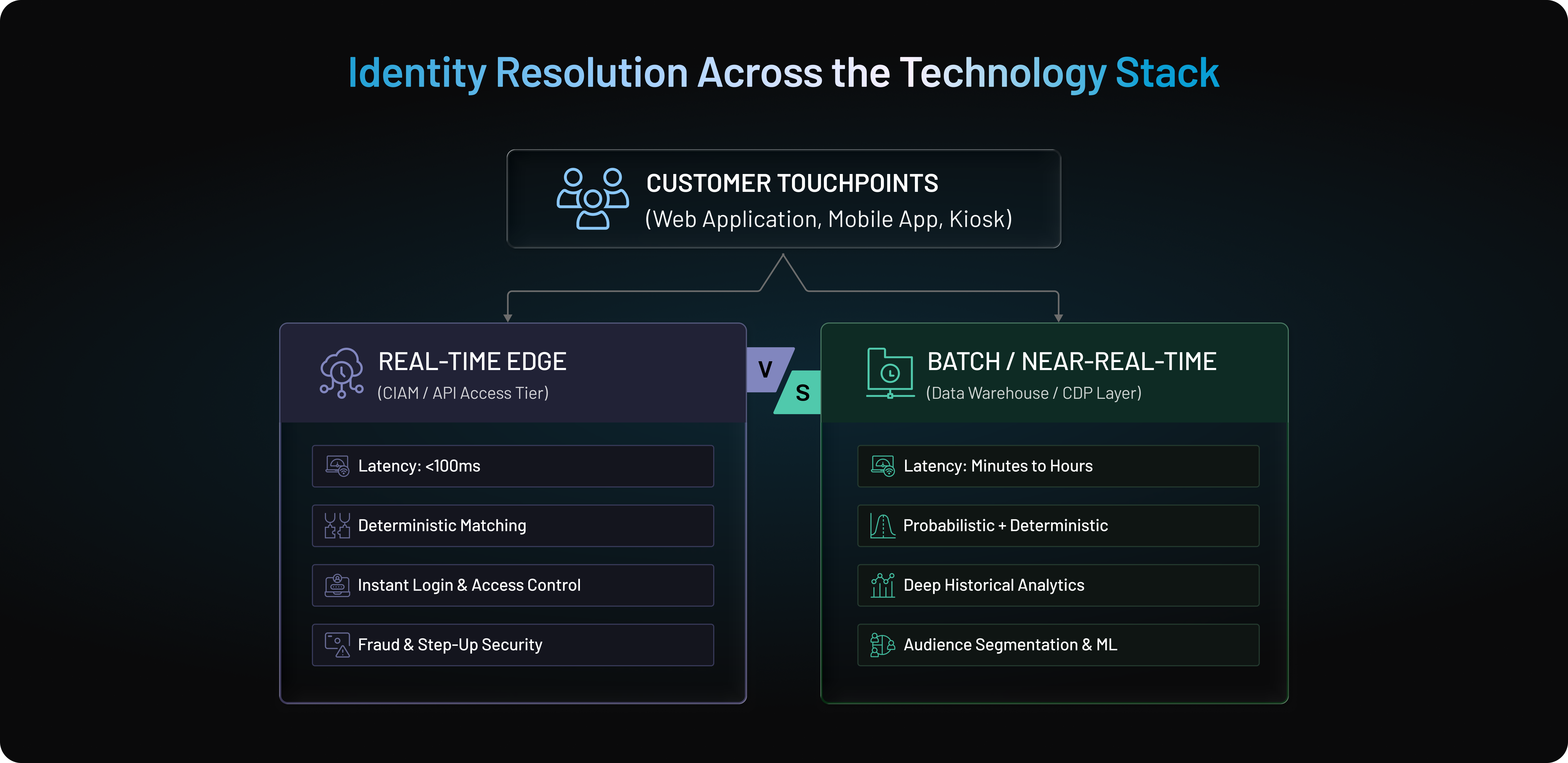
Real-Time Edge Resolution (Authentication Tier)
-
Where It Runs: Inside your Customer Identity and Access Management (CIAM) platform or API gateway at the application edge.
-
Latency: Sub-second (typically $<100\text{ ms}$).
-
Primary Matching Method: Deterministic.
-
How It Works: As a user logs in, completes a passkey challenge, or links a social account, the edge tier immediately matches these verified credentials against existing account records.
-
Core Use Cases
-
Instantly granting or revoking user access.
-
Triggering step-up authentication or Multi-Factor Authentication (MFA) when suspicious login signals appear.
-
Retrieving real-time consent choices before rendering user sessions.
Batch & Near-Real-Time Resolution (Data Tier)
-
Where It Runs: Inside cloud Data Warehouses (e.g., Snowflake, Google BigQuery, Databricks) or Customer Data Platforms (CDPs).
-
Latency: Minutes to hours (scheduled ETL/ELT pipelines or streaming ingestion).
-
Primary Matching Method: Hybrid (combining deterministic rules with probabilistic ML models).
-
How It Works: The data warehouse aggregates massive volumes of historical event data, behavioral logs, device fingerprints, and offline records to resolve identities asynchronously at scale.
-
Core Use Cases
-
Cross-channel marketing attribution and campaign performance tracking.
-
Training machine learning models for predictive churn or recommendation engines.
-
Building complex audience segments for downstream activation across ad platforms.
Identity Resolution vs. CIAM vs. CDP vs. Customer 360
Identity resolution is often mentioned alongside Customer Identity and Access Management (CIAM), Customer Data Platforms (CDPs), and Customer 360 initiatives.
Although these technologies work together, they solve different problems.
Understanding those differences makes it easier to choose the right architecture for your business.
| Technology | Primary Purpose | Typical Outcome |
|---|---|---|
| Identity Resolution | Connects customer records across systems | Unified customer identity |
| CIAM | Manages customer registration, authentication, profiles, consent, and access | Secure customer identity lifecycle |
| CDP | Collects, segments, and activates customer data | Marketing insights and personalization |
| Customer 360 | Provides a complete business view of the customer | Shared customer context across teams |
| Account Linking | Connects multiple login methods to one account | Simplified sign-in and fewer duplicate accounts |
Identity Resolution vs. CIAM
Identity resolution answers: "Do these records belong to the same customer?"
CIAM answers: "How does this customer register, authenticate, manage their profile, and securely access digital services?"
CIAM also provides trusted first-party identity data such as verified email addresses, customer IDs, and linked accounts, which improves the accuracy of identity resolution.
Identity Resolution vs. CDP
Identity resolution connects fragmented customer identities.
A CDP uses those unified profiles for audience segmentation, personalization, analytics, and campaign activation.
Without accurate identity resolution, a CDP may still contain duplicate customer profiles and incomplete customer journeys.
Identity Resolution vs. Customer 360
Customer 360 is the business outcome.
Identity resolution is one of the capabilities that helps make it possible.
By connecting records across systems, identity resolution provides the reliable customer view that Customer 360 initiatives depend on.
Identity Resolution vs. Account Linking
Account linking allows customers to connect multiple login methods—such as email, Google, or Apple to a single account.
Identity resolution goes further by recognizing the same customer across different systems, devices, and channels, even when those relationships were not created manually.
Identity Resolution vs. Master Data Management (MDM)
Master Data Management (MDM) governs critical business data across domains such as customers, products, suppliers, and locations.
Identity resolution has a narrower focus. It specializes in connecting customer identities across channels to create trusted, unified customer profiles.
How These Technologies Work Together
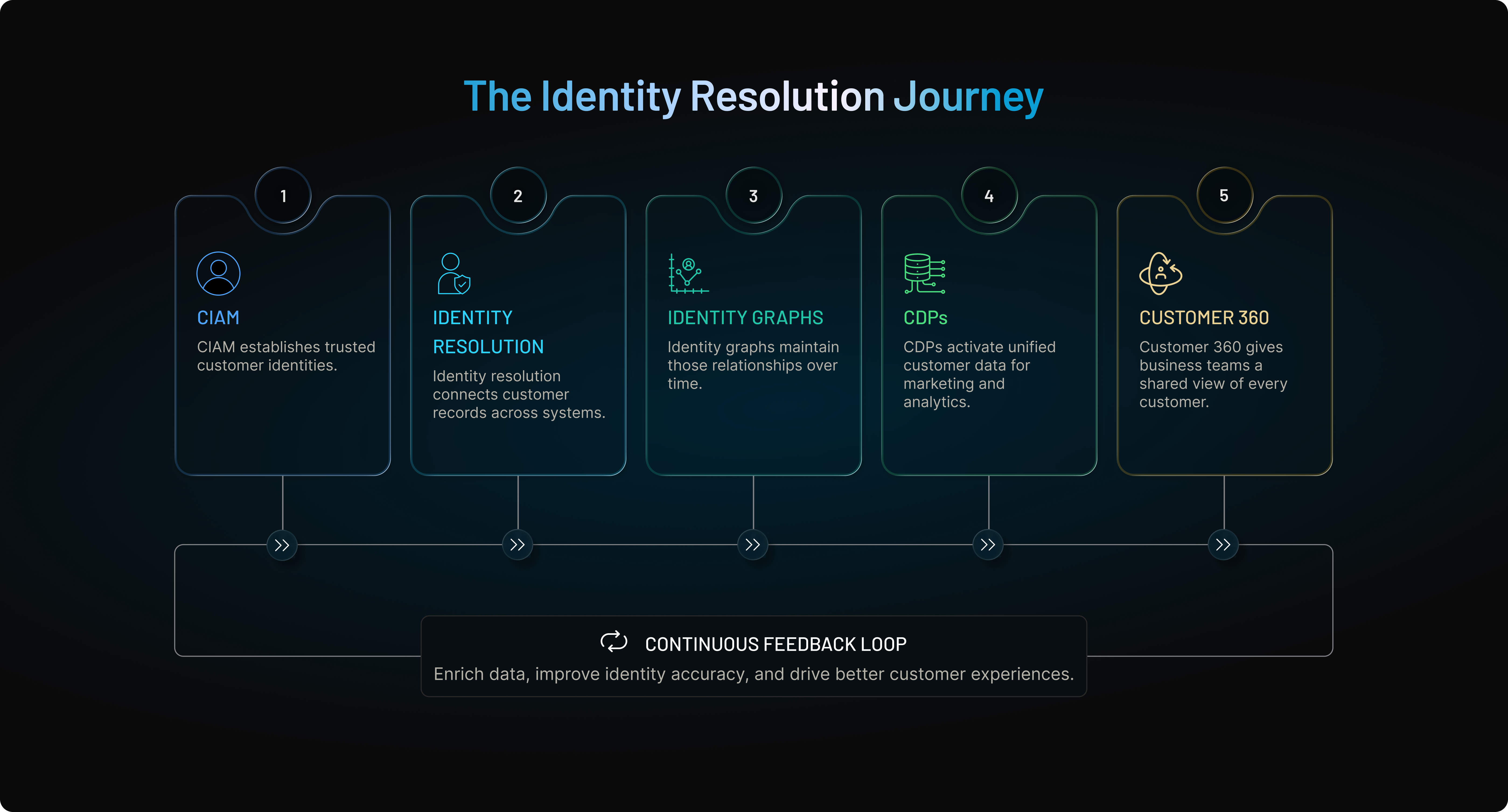
Modern customer identity architectures rarely rely on a single platform.
A typical workflow looks like this:
-
CIAM establishes trusted customer identities.
-
Identity resolution connects customer records across systems.
-
Identity graphs maintain those relationships over time.
-
CDPs activate unified customer data for marketing and analytics.
-
Customer 360 gives business teams a shared view of every customer.
Each technology plays a different role, but together they help organizations deliver secure, personalized, and consistent customer experiences across every digital touchpoint.
Why Identity Resolution Matters
Identity resolution helps every team work from the same trusted customer identity instead of fragmented records spread across disconnected systems. When organizations combine identity resolution with verified first-party identities from a CIAM platform, they gain more reliable customer data that improves security, personalization, analytics, and operational efficiency.
Verified Customer Identities Enable Better Personalization
Personalization is only effective when businesses can accurately recognize returning customers. Verified customer identities reduce duplicate accounts, incomplete profiles, and disconnected customer journeys, allowing organizations to deliver more relevant recommendations, consistent omnichannel experiences, and tailored communications based on a unified customer profile.
Secure Authentication Improves Identity Confidence
Every successful authentication strengthens identity confidence. Verified login events generated through passwords, Multi-Factor Authentication (MFA), passkeys, social login, or enterprise Single Sign-On (SSO) provide trusted first-party identity signals that improve identity matching accuracy while reducing the risk of incorrect profile associations.
Trusted Identity Data Improves Analytics and AI
Analytics platforms and AI models are only as reliable as the customer identities behind them. When identity resolution is built on verified customer identities, organizations gain cleaner customer data, more accurate attribution, stronger audience insights, and better predictive models for personalization and business decision-making.
Unified Customer Profiles Improve Customer Experiences
Customers expect businesses to recognize them regardless of which device, application, or channel they use. Identity resolution connects those interactions into a unified customer profile, giving marketing, customer support, sales, and digital teams a shared understanding of every customer's relationship with the business.
Stronger Identity Foundations Support Privacy and Security
Identity resolution should strengthen trust, not introduce new risks. Combining unified customer profiles with verified identities, consent management, account linking, and strong authentication helps organizations reduce duplicate accounts, detect suspicious identity activity, enforce customer preferences consistently, and support privacy-aware digital experiences.
How CIAM Strengthens Identity Resolution
Identity resolution becomes much more reliable when it is built on trusted customer identities rather than anonymous or inferred data alone. While identity resolution connects customer records across systems, a Customer Identity and Access Management (CIAM) platform provides the verified identity signals that make those connections more accurate and trustworthy.
Instead of relying solely on behavioral or contextual signals, organizations can use authenticated customer identities to build unified profiles with greater confidence. The result is better personalization, stronger security, improved analytics, and more consistent customer experiences.
Trusted First-Party Identities Improve Match Accuracy
Identity resolution is only as accurate as the data it receives. Verified first-party identifiers provide the strongest foundation for connecting customer records because they represent identities the customer has authenticated or confirmed.
Authentication Creates Higher-Confidence Identity Signals
Every successful authentication event provides another trusted signal that identity resolution can use. The CIAM platform verifies the customer's identity before generating authenticated identity data. These verified events provide a much stronger basis for identity matching than anonymous browsing activity alone.
Consent and Customer Preferences Stay Connected
Identity resolution should connect more than customer records. It should also preserve the customer's consent choices, communication preferences, and privacy settings.
When consent information remains linked to the correct identity, organizations can honor customer preferences consistently across websites, mobile apps, customer support systems, marketing platforms, and other digital channels. This helps improve compliance while building customer trust.
Account Linking Creates One Trusted Customer Identity
Customers rarely use just one sign-in method. The same person may register with an email address, later sign in with Google or Apple, and eventually access the same account through another authentication method.
CIAM platforms support account linking by connecting multiple login methods to a single customer account. This reduces duplicate accounts while giving identity resolution a more accurate view of the customer across authentication methods and digital channels.
Progressive Profiling Improves Identity Quality Over Time
Customer profiles rarely become complete during registration.
CIAM platforms support progressive profiling by collecting additional customer information over time as trust grows. New profile attributes, preferences, communication choices, and verified identifiers gradually enrich the customer record without creating unnecessary friction during sign-up.
As profile quality improves, identity resolution can connect customer records with greater confidence and accuracy.
Identity Resolution Depends on the Customer Identity Lifecycle
Identity resolution is not a single event. It improves continuously as customer identities evolve throughout their lifecycle.
A CIAM platform supports that lifecycle by managing:
-
Customer registration
-
Authentication
-
Profile management
-
Consent management
-
Account recovery
-
Account deletion
Every stage generates trusted first-party identity signals that help identity resolution maintain accurate, privacy-aware customer profiles over time.
Simply put, identity resolution determines which records belong together. CIAM provides the trusted identity foundation that makes those decisions more accurate.
Identity Resolution Improves Marketing Performance
One of the biggest business benefits of identity resolution is better marketing performance.
Without a unified customer identity, marketing platforms often treat the same person as multiple customers, reducing attribution accuracy, personalization, and campaign performance. Identity resolution connects those interactions into a single customer profile, giving marketing teams a more complete understanding of the customer journey and more reliable campaign insights.
Campaign performance becomes easier to measure, customer segmentation improves, and personalization can reflect the customer's complete relationship with the business rather than isolated interactions.
Reliable identity data also improves AI outcomes by reducing duplicate identities and giving machine learning models cleaner, more consistent customer data. Better identity data leads to more accurate predictions, personalization, and customer insights.
When every department works from trusted customer identities instead of fragmented records, organizations can deliver more consistent experiences, make better business decisions, and build stronger long-term customer relationships.
From Anonymous Visitor to Known Customer
One challenge for digital businesses is recognizing that an anonymous website visitor and a returning customer are often the same person.
A customer may browse products anonymously, subscribe to a newsletter, create an account days later, complete a purchase from another device, and eventually contact customer support. Without identity resolution, each interaction may be treated as a separate customer journey.
Identity resolution connects those touchpoints into a single timeline, allowing businesses to understand how customers discover, evaluate, purchase, and continue engaging with the brand over time.
Identity Resolution Across Industries
Identity resolution supports different business goals across industries, but the underlying objective remains the same: recognize customers consistently, maintain trusted identities, and deliver secure, personalized digital experiences. When combined with a CIAM platform, organizations can use verified customer identities to improve every stage of the customer lifecycle.
| Industry | How Identity Resolution Supports CIAM |
|---|---|
| Retail & E-commerce | Connect customer registration, loyalty accounts, account linking, online and in-store interactions, and personalized shopping experiences into a unified customer profile. |
| Banking & Financial Services | Unify verified customer identities across digital banking, mobile apps, branch services, and fraud prevention systems while strengthening authentication and regulatory compliance. |
| Healthcare | Connect patient registrations, patient portals, verified identities, appointment history, and consent records to improve care coordination and reduce duplicate patient identities. |
| B2B SaaS | Recognize customer users across multiple products, tenant environments, enterprise SSO providers, account hierarchies, and delegated administrator accounts while maintaining secure access controls. |
| Travel & Hospitality | Connect customer accounts, loyalty memberships, mobile applications, booking history, and support interactions to deliver personalized experiences throughout the traveler journey. |
| Telecommunications | Unify customer registrations, subscriber identities, self-service portals, retail stores, billing platforms, and support channels to provide consistent customer experiences across every touchpoint. |
| Media & Streaming | Connect subscriber accounts, household profiles, authentication methods, viewing preferences, and subscription history to deliver personalized content while reducing duplicate accounts. |
| Insurance | Link policyholder registrations, digital self-service accounts, claims portals, agent interactions, and consent records to improve customer service and identity verification. |
Across every industry, identity resolution becomes significantly more reliable when it is built on verified customer identities managed through a CIAM platform. Registration, authentication, account linking, consent management, and profile management provide trusted first-party identity signals that improve identity matching accuracy and help organizations deliver secure, privacy-aware customer experiences.
Marketing Use Case: Cross-Channel Customer Recognition
Consider a retail customer who discovers a product through a social media advertisement, researches it on a laptop, completes the purchase using a mobile app, and later contacts customer support.
Without identity resolution, these interactions may be distributed across multiple systems with no reliable way to connect them.
By recognizing the customer across channels and devices, businesses can improve attribution, reduce duplicate marketing, personalize future interactions, and create a more consistent customer experience.
This approach is valuable across retail, financial services, travel, telecommunications, and B2B SaaS environments where customers regularly switch between devices and digital channels.
Although the use cases vary, the objective remains the same: connect fragmented customer data into trusted identities that support better experiences, stronger security, and more informed business decisions.
How Identity Resolution Improves Marketing Results
Identity resolution gives marketing teams a clearer view of customer behavior across channels, devices, and stages of the buying journey.
| Without Identity Resolution | With Identity Resolution |
|---|---|
| Duplicate customer audiences | Unified customer profiles |
| Limited personalization | Context-aware personalization |
| Fragmented customer journeys | Connected omnichannel journeys |
| Inaccurate attribution | Better campaign attribution |
| Duplicate marketing messages | Coordinated customer engagement |
| Incomplete analytics | More reliable customer insights |
Marketing is only one application, but it shows the wider value clearly: accurate customer identities support better decisions across customer experience, analytics, security, and operations.
Read more - How To Leverage Customer Identity Resolution for Better Marketing Outcomes
Common Identity Resolution Challenges and How to Overcome Them
Identity resolution sounds simple: connect customer records and build a unified profile. The difficult part is deciding which records genuinely belong together.
Most organizations already have enough customer data. The problem is that it sits across disconnected systems, uses inconsistent identifiers, and changes over time. If matching rules are too strict, duplicate profiles remain. If they are too loose, different accounts might get mistakenly merged into one.
Here are the challenges that matter most.
| Challenges | Description | Solution |
|---|---|---|
| Fragmented Customer Data | Customer information is spread across platforms such as CRM, mobile apps, e-commerce systems, loyalty programs, and marketing platforms. | Standardize key schemas using CIAM before data ingestion. |
| False Matches | Matching accuracy depends heavily on matching rules. Conservative rules may reduce match coverage, while aggressive rules can lower accuracy. The goal is to achieve high-confidence matches. | Set higher confidence thresholds for security-sensitive actions. |
| Changing Customer Identifiers | Identity resolution requires continuous validation and updates as customer information changes frequently. It should not be treated as a one-time data-cleaning project. | Implement automated profile decay and real-time updates. |
| Data Quality | Poor input data, such as misspelled names or inconsistent phone number formats, can reduce matching accuracy. | Standardize data using CIAM, verify customer information, and continuously monitor for duplicates and resolve them with customer input. |
| Privacy and Governance | Connecting more customer data increases privacy, security, and compliance responsibilities. | Implement strong access controls, audit logs, confidence thresholds, and merge-reversal processes. |
| Legacy Systems and Integration Gaps | Older systems often use different customer IDs, data structures, and formats, making full replacement impractical. | Modernize gradually through APIs and identity services. |
Identity Resolution Best Practices
Identity resolution delivers the best results when it is built on trusted customer identities rather than disconnected records or anonymous signals alone. As customer identities evolve, organizations need consistent governance, verified identity data, and clear matching rules to maintain accurate, privacy-aware customer profiles.
| Best Practices |
|---|
| 1. Build on verified first-party identities |
| 2. Define risk-based identity matching rules |
| 3. Maintain high-quality identity data |
| 4. Prioritize match confidence over match volume |
| 5. Preserve consent and privacy across customer identities |
| 6. Support the entire customer identity lifecycle |
| 7. Expand incrementally across systems |
| 8. Continuously review identity governance |
Handling the "Right to be Forgotten" in Identity Graphs
When a customer issues a GDPR data erasure request, resolving their identity across 10+ systems can be complex. Your identity resolution system must support graph-aware deletion—removing specific nodes (email/device) while maintaining non-PII historical analytics where legally permitted.
Conclusion
Every digital interaction adds another piece to the customer's story. Identity resolution brings those fragmented interactions together into a trusted, unified customer profile, giving organizations a more complete understanding of the people they serve.
But connecting records is only part of the challenge. The real value comes from ensuring those connections are accurate, privacy-aware, and built on trusted identity signals. Incorrect matches can undermine personalization, analytics, security, and customer trust just as easily as fragmented data can.
As organizations continue investing in AI, omnichannel experiences, and first-party data strategies, identity resolution is becoming a foundational capability for delivering consistent, secure, and intelligent digital experiences.
Identity resolution is only as reliable as the identities behind it. Organizations that invest in trusted customer identities through CIAM are better positioned to deliver accurate personalization, stronger security, responsible AI, and privacy-aware digital experiences.
Key Metrics to Measure Success
For all of your identity resolution projects, here are the key metrics to measure:
-
Deterministic Match Rate (%)
-
Merge Reversal Rate (measures false positives)
-
Profile Identity Decay Rate
-
Time-to-Resolution (Real-time latency vs. batch latency)
Build a Trusted Identity Foundation with LoginRadius
Successful identity resolution depends on trusted customer identities. Without reliable first-party identity data, even the most advanced matching strategies become less accurate.
LoginRadius helps businesses manage customer registration, authentication, profiles, consent, and account linking through a unified Customer Identity and Access Management platform. These verified identity signals can improve the quality of customer records used across CDPs, analytics platforms, marketing systems, and other business applications.
With LoginRadius, organizations can strengthen authentication, reduce fragmented customer accounts, centralize profile and consent management, and deliver consistent experiences across web, mobile, and partner applications.
Looking to build more reliable customer profiles? Explore how LoginRadius can help create a secure identity foundation for accurate, privacy-aware identity resolution at scale.
FAQs
Q: What is identity resolution?
A: Identity resolution is the process of connecting customer records across multiple systems, devices, and channels to determine which interactions belong to the same individual. It creates a unified customer profile for more accurate personalization, analytics, security, and customer experiences.
Q: Why is identity resolution important?
A: Without identity resolution, the same customer may appear as multiple disconnected profiles, leading to inaccurate analytics, duplicate marketing, inconsistent customer experiences, and poor business decisions. It helps organizations build a trusted, complete view of every customer.
Q: How does identity resolution work?
A: Identity resolution collects customer identifiers, standardizes the data, compares records using predefined matching rules, and connects trusted relationships into a unified customer profile that updates continuously as new interactions occur.
Q: What is the difference between deterministic and probabilistic identity resolution?
A: Deterministic identity resolution matches records using verified identifiers like customer IDs or authenticated email addresses, while probabilistic identity resolution uses behavioral and contextual signals to estimate whether records belong to the same person. Many organizations combine both through a hybrid approach.
Q: What is an identity graph?
A: An identity graph is a structure that stores relationships between customer identifiers, such as email addresses, device IDs, phone numbers, and login accounts. It helps organizations recognize customers consistently across channels as their identities evolve over time.
Q: How is identity resolution different from a Customer Data Platform (CDP)?
A: Identity resolution determines which records belong to the same customer, while a CDP uses those unified profiles to create audience segments, personalize experiences, and activate customer data across marketing channels. Identity resolution is often one capability within a CDP.
Q: How does CIAM support identity resolution?
A: Customer Identity and Access Management (CIAM) provides trusted first-party identity data through secure registration, authentication, profile management, and consent management. These verified identifiers improve the accuracy and reliability of identity resolution.
Q: What are the biggest challenges in identity resolution?
A: Common challenges include fragmented customer data, inconsistent identifiers, incorrect profile matching, poor data quality, privacy concerns, and integrating legacy systems. Strong governance and trusted identity data help overcome these issues.
Q: What are the benefits of identity resolution?
A: Identity resolution helps organizations create unified customer profiles, improve personalization, strengthen identity security, enhance marketing attribution, support AI and analytics, deliver consistent omnichannel experiences, and improve customer data quality across systems.