Introduction
SSO security has become a default expectation in modern applications. One login, multiple systems, seamless access. It works so well that most teams stop questioning it.
The real question isn’t whether single sign-on authentication works. It’s whether every assertion being trusted should actually be trusted. And that’s exactly why the question “is our SSO truly secure?” keeps showing up in audits, architecture reviews, and post-incident reports.
SAML-based security single sign-on doesn’t enforce strict validation by default; it enables it. Signing, audience checks, time validation, replay protection… all of these exist, but none of them protect you unless they’re implemented with intent. When even one of these checks is loosely enforced, single sign-on security starts to drift from controlled trust to assumed trust. And assumed trust doesn’t fail loudly. It fails quietly while everything still appears to be working.
In our migration experiences, we observed: some SSO security issues were not arising from breaking SAML. They came from incomplete validation like accepting signed assertions without verifying what was signed, trusting tokens without enforcing audience boundaries, or allowing assertions to be reused beyond their intended lifecycle.
This blog focuses on what actually strengthens SSO security in real-world systems. The true controls like signing enforcement, key rotation, audience restriction, and replay defense. These are the controls that decide whether your application should trust a SAML response in the first place. SSO security is all about making sure every access decision is earned and not assumed.
How Single Sign-On Authentication Actually Works?
Before we harden SSO security, we need to understand what is actually happening under the hood during single sign-on authentication. Because most vulnerabilities don’t come from SAML itself. They come from assumptions about how it works.
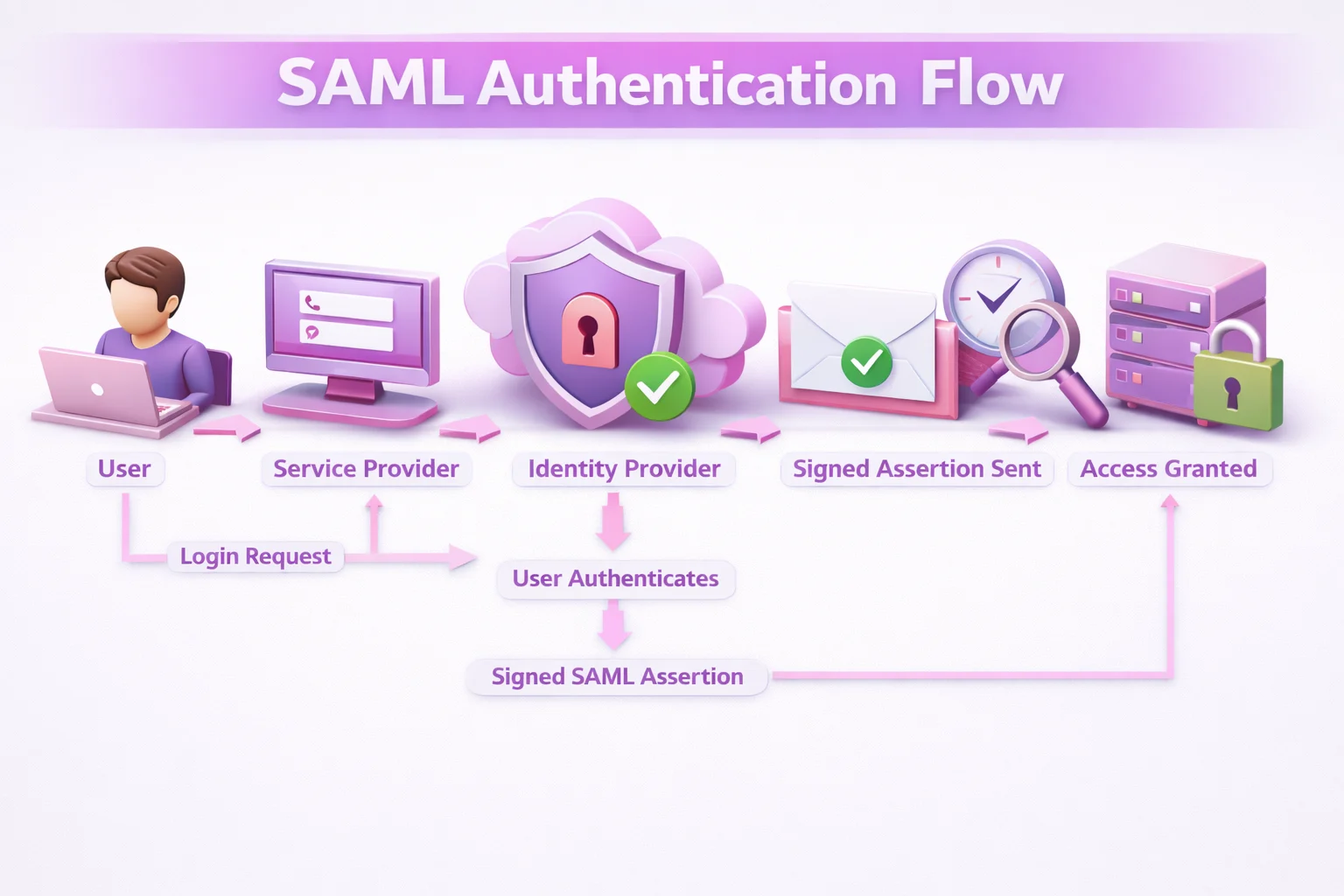
In a typical SAML-based single sign-on (SSO) flow, a user attempts to access a Service Provider (SP). The SP redirects the user to an Identity Provider (IdP). The IdP authenticates the user and issues a SAML assertion, essentially a digitally signed XML document stating, “This user has been authenticated.” That assertion is sent back to the SP, which validates it and grants access.
At a high level, it looks simple. Redirect. Authenticate. Return. Grant access. But the real SSO security controls live inside that SAML assertion.
The assertion contains cryptographic signatures, timestamps, audience restrictions, and identifiers that tie the authentication event to a specific service. If the Service Provider properly validates each of these elements, single sign-on security remains intact. If it skips even one of them, trust becomes guesswork.
This is where many implementations go wrong. Some systems validate the signature but ignore the audience. Others check timestamps but don’t enforce short expiration windows. Some rely on outdated certificates. In production, those “minor” shortcuts become structural risks.
To understand where hardening is required, it helps to visualize the trust flow.
SAML Authentication Flow
Why SSO Security Breaks in Real Environments
On paper, SAML-based SSO security is strong. It relies on digital signatures, time-bound assertions, and defined trust relationships. In production, failures usually stem from relaxed validation rather than flaws in the protocol itself.
A common issue is incomplete signature validation. Some Service Providers check that a signature exists but fail to verify what was actually signed. In worse cases, unsigned assertions are temporarily allowed during testing and mistakenly enabled in production. When validation is partial, trust becomes conditional.
Certificate management is another frequent weakness. Teams hard-code an IdP certificate and never automate metadata refresh. The system works until the certificate expires, triggering outages or rushed manual updates. Poor key management turns a stable SSO deployment into an operational risk.
Audience validation is often misunderstood. If a Service Provider does not strictly enforce the intended audience, an assertion issued for one application may be accepted by another. That collapses trust boundaries.
Time validation can also weaken security. Assertions include NotBefore and NotOnOrAfter constraints, but overly generous clock skew or long validity windows increase replay risk. Without replay detection, reused assertions may still be accepted within their validity period.
SSO security rarely fails due to dramatic exploits. It fails because validation steps are skipped or softened. Strong SAML configuration requires strict, consistent enforcement at every trust boundary.
SAML Signing: The Foundation of SSO Security
SAML signing is the core control behind SSO security. Without a validated digital signature, a SAML assertion is simply structured data claiming that a user authenticated successfully. With proper signature verification, it becomes cryptographic proof.
The Identity Provider signs the assertion using its private key. The Service Provider verifies it using the corresponding public certificate shared via metadata. If signature validation fails, access must be denied.
Signing can occur at the Response level, the Assertion level, or both. Validating the signed assertion is critical because it contains identity attributes and authentication statements. Accepting unsigned assertions even temporarily removes the primary security control in single sign-on authentication.
Signature validation must go beyond checking that a signature exists. The Service Provider must verify the correct reference URI, enforce strong hashing algorithms such as SHA-256, and reject deprecated options like SHA-1. Failure to validate these elements can expose systems to XML signature wrapping attacks.
Certificate trust must also be managed carefully. Public keys should be sourced from trusted metadata endpoints and monitored for unexpected changes. SSO security is only as strong as the key validation behind it.
The principle is simple: no valid signature, no access. Everything else is a layered defense. But signing is the gatekeeper.
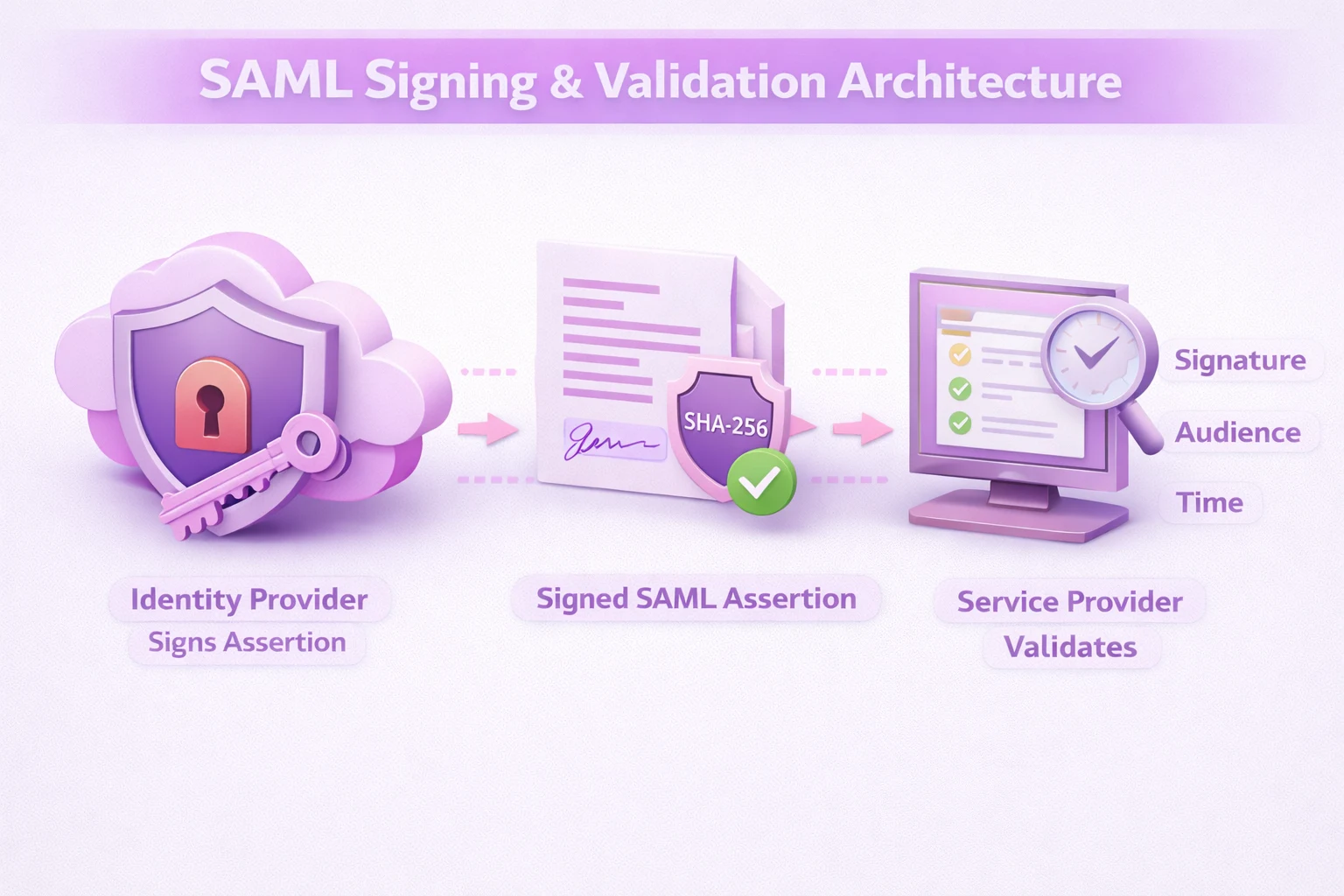
How an XML Signature Wrapping (XSW) Attack Works
In an XSW attack, an adversary doesn't break the cryptographic signature. Instead, they exploit how XML parsers process documents. The attacker intercepts a valid SAML assertion and copies its legitimate signature block into a mutated XML structure. Because naive verification logic simply checks that a valid signature element exists somewhere in the document, it validates the signature while executing malicious user attributes hidden in an unsigned portion of the payload. To mitigate this, your Service Provider must validate strict canonicalization and enforce absolute reference URI matching.
Certificate & Key Rotation: The Quiet Time Bomb in SSO Security
Digital signatures are the backbone of SSO security. Digital signatures depend on trusted certificates, and certificates expire. Every SAML integration relies on X.509 certificates to validate assertions. When a certificate expires without proper rotation, authentication fails immediately.
In many deployments, certificates configured during initial integration are never revisited. When expiration arrives, production incidents follow. Under pressure, teams may manually update certificates without full verification, increasing risk.
Effective SSO best practices treat key rotation as an ongoing process. Identity Providers typically publish new certificates in metadata before expiration. Service Providers should automatically refresh trusted metadata and support overlapping certificate validity to prevent downtime.
A controlled rotation model includes a dual-validation window where both old and new certificates are trusted during transition. Once systems confirm the new certificate is active, the old one is retired.
Monitoring is essential. Expiration alerts and metadata change tracking prevent last-minute fixes. Certificate management is not just operational hygiene — it is foundational to maintaining single sign-on security over time.
SSO security does not fail because certificates expire. It fails because rotation was not planned and automated.
Audience Restriction: The Control That Prevents “Single Sign Everywhere”
SAML assertions are not universal access passes. They are issued for a specific Service Provider, for a specific authentication event, at a defined point in time. Audience restriction enforces that boundary within single sign-on authentication.
Each SAML assertion includes an <AudienceRestriction> element that specifies the intended recipient, typically identified by the Service Provider’s entity ID. When the SP receives the assertion, it must verify that its own entity ID exactly matches the audience value. If it does not match, the assertion should be rejected.
Although this validation appears straightforward, it is often implemented loosely. Some systems allow partial matching or shared entity IDs across multiple environments. In multi-tenant SaaS architectures, entity identifiers may be reused for convenience, which weakens isolation.
Consider a scenario where an assertion is issued for Application A. If Application B does not enforce strict audience validation, it could accept that assertion despite not being the intended recipient. From a user perspective, nothing seems wrong. From a security perspective, trust boundaries have dissolved.
Strict audience enforcement is a core SSO best practice. Entity IDs should be unique per environment, and matching must be exact. Production and staging systems should never share identifiers. Any mismatch between the assertion’s intended audience and the receiving service must result in immediate rejection.
Signing proves who issued the assertion. Audience restriction proves where it is allowed to be used. Both controls are essential to maintaining scoped, controlled single sign-on security.
Replay Defense: Because Assertions Are Not Meant to Be Reused
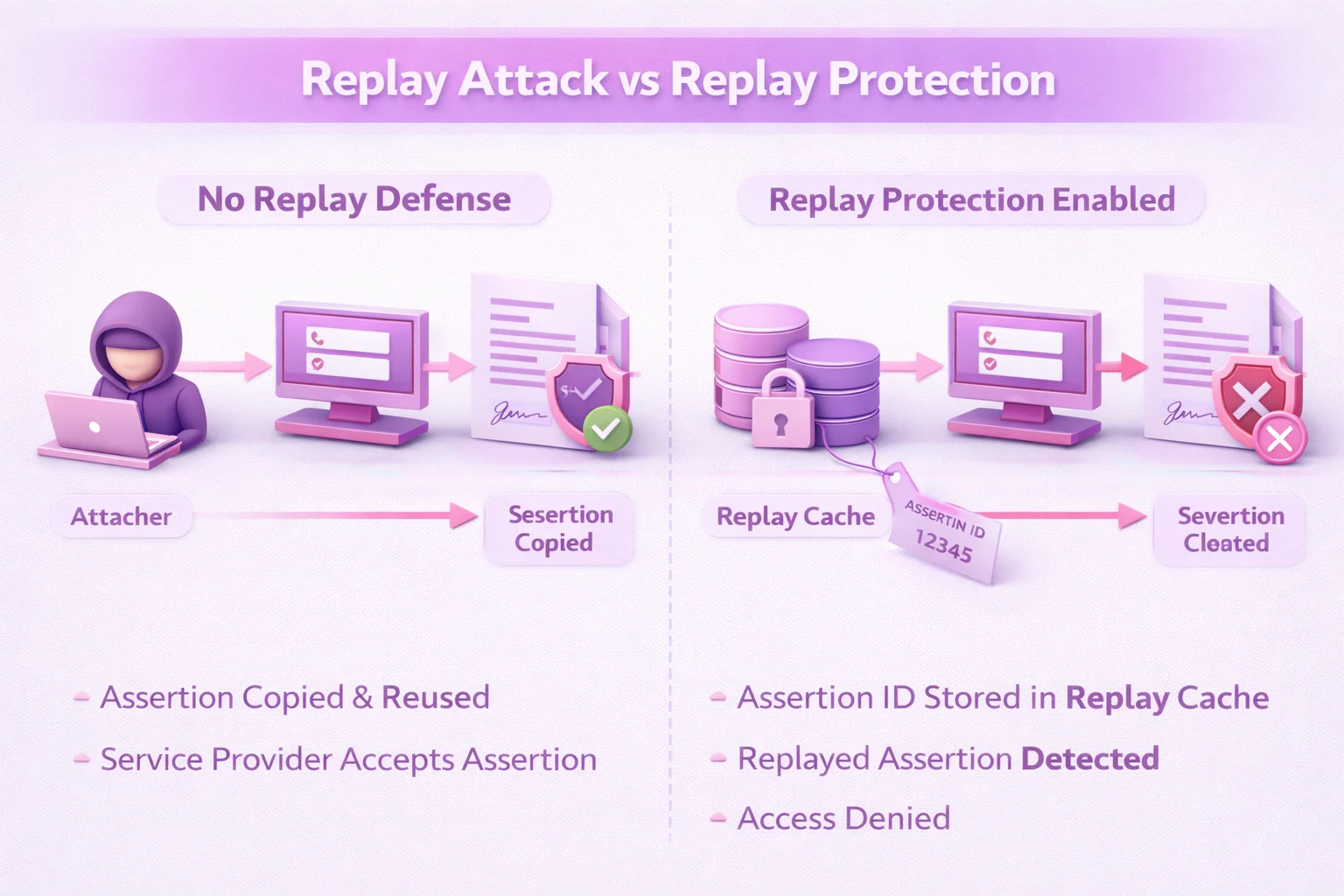
A SAML assertion represents a single authentication event. It is not designed to function as a reusable access credential. Without replay protection, however, it can effectively become one.
During single sign-on authentication, the Identity Provider sends a signed assertion to the Service Provider through the user’s browser. The assertion contains a unique identifier and time constraints such as NotBefore and NotOnOrAfter. If intercepted and resent within its validity window, the assertion may still appear legitimate unless replay detection is enforced.
If the Service Provider validates only the signature and timestamp but does not track assertion IDs, a reused assertion can be accepted. The cryptographic signature remains valid, and the timestamps are still within range. Without replay defense, the system assumes the assertion will only be presented once.
Effective replay protection requires storing assertion IDs in a cache and rejecting duplicates during their validity period. This ensures that even if an assertion is intercepted, it cannot be reused successfully.
Time constraints also play a critical role. Assertions should have short lifetimes to minimize exposure. Allowing generous clock skew or extended validity windows increases the opportunity for reuse. Tight time validation reduces that risk significantly.
Some architectures add an additional safeguard by exchanging the SAML assertion for a short-lived internal token immediately after validation. The assertion is processed once, and subsequent authorization relies on controlled session tokens rather than the original SAML response.
Replay defense reinforces a simple principle: authentication assertions are one-time events. Signed once, validated once, accepted once. Enforcing that rule is fundamental to maintaining strong single sign-on security.
Advanced SSO Security Best Practices
Basic validation is no longer sufficient. Modern SSO security must align with zero-trust principles and evolving threat models. That means every assertion, redirect, and identity attribute should be verified rigorously before access is granted.
Signing ensures integrity, but encryption adds confidentiality. While many deployments rely only on signed assertions, encrypting SAML assertions reduces exposure in complex federated environments, especially where assertions traverse multiple systems.
Authentication strength at the Identity Provider also matters. If the IdP uses weak credential policies, the entire single sign-on authentication chain inherits that weakness. Enforcing strong or phishing-resistant MFA at the IdP significantly improves overall SSO security.
Restricting IdP-initiated flows is another important control. IdP-initiated SSO bypasses certain contextual validations at the Service Provider level. Many organizations limit or carefully control these flows to reduce misuse.
To align with modern zero-trust frameworks, the industry standard best practice is to completely disable IdP-initiated login flows. Forcing an SP-initiated flow guarantees that the Service Provider can issue an anti-forgery InResponseTo token and validate the specific context of the original client redirect, closing a massive target vector for credential misuse.
Strong cryptographic standards are essential. Deprecated algorithms such as SHA-1 should be fully disabled, and validation should enforce SHA-256 or stronger. XML parsing and canonicalization must be handled carefully to prevent signature wrapping vulnerabilities.
If you are currently executing a cryptographic migration from legacy SHA-1 configurations, this enforcement must be configured symmetrically. Both the Identity Provider must be updated to sign assertions with SHA-256, and your Service Provider's validation libraries must be explicitly configured to drop and reject connections utilizing deprecated SHA-1 algorithms.
Monitoring completes the security posture. Failed signature checks, audience mismatches, replay attempts, and metadata changes should be logged and reviewed. SSO security is not just about configuration; it also requires visibility into abnormal behavior.
In distributed systems, SAML is often used at the perimeter and exchanged for short-lived internal tokens. This layered model allows strict validation at the edge while enabling controlled session management internally.
Advanced SSO security is ultimately about discipline: enforce strong cryptography, minimize trust windows, and verify every authentication boundary consistently.
SSO Security in Cloud and SaaS Architectures
Single sign-on authentication now operates across cloud platforms, SaaS products, and microservice environments. This architectural shift increases both convenience and impact. If validation at the entry point is weak, the weakness propagates across multiple services.
In traditional deployments, one Service Provider validated SAML assertions. In modern SaaS systems, a single SSO integration can grant access to multiple internal services. That expands the blast radius of any validation flaw.
A common pattern is to validate the SAML assertion at the perimeter and immediately exchange it for a short-lived internal token, such as a JWT. This approach confines SAML handling to a controlled boundary and reduces dependency on raw assertions across microservices.
Multi-tenant SaaS introduces additional complexity. Each tenant may have its own Identity Provider, certificate, and entity ID configuration. Audience validation and certificate trust must remain tenant-specific. Shared identifiers or improperly scoped trust anchors weaken isolation.
Cloud-native systems also require automated metadata management. Manual certificate updates do not scale in environments with many tenant integrations. Automated refresh, monitoring of metadata changes, and structured onboarding workflows are essential SSO best practices.
Hybrid identity models that support both SAML and OpenID Connect should apply the same strict validation principles. Protocol differences do not change the requirement for signature verification, scoped audience enforcement, short validity windows, and replay detection.
Navigating Hybrid Environments: SAML vs. OIDC
When enterprise architectures scale, teams frequently struggle with supporting legacy SAML alongside modern OpenID Connect (OIDC) federations. While OIDC relies on JSON Web Tokens (JWTs) and lightweight REST endpoints, and SAML relies on robust XML assertion payloads, your security posture must treat them identically. Protocol differences do not change the core requirement for scoped audience enforcement, strict signature verification, and automated key lifecycle tracking at the perimeter.
In cloud and SaaS architectures, SSO security must be treated as a hardened perimeter control. Centralized authentication increases efficiency, but it must not increase exposure.
Implementation Checklist: Practical SSO Security Hardening
Concepts become effective only when enforced consistently. Practical SSO security hardening requires translating principles into clear, verifiable controls.
-
Every SAML assertion must be signed, and signature validation must be strict. The Service Provider should verify the correct reference URI, enforce strong hashing algorithms, and reject unsigned or partially signed responses.
-
Certificate management must be automated. Public signing certificates should be sourced from trusted metadata endpoints, refreshed automatically, and monitored for expiration or unexpected changes. Supporting overlapping certificates during rotation prevents downtime.
-
Audience validation should require exact entity ID matching. Shared or wildcard identifiers across environments should be avoided. Each application and deployment stage must maintain distinct boundaries.
-
Replay protection must be implemented using assertion ID tracking. Duplicate IDs within the validity window should be rejected. Assertion lifetimes should remain short, and clock skew allowances should be tightly controlled.
-
Time constraints such as
NotBeforeandNotOnOrAftermust be enforced strictly. Assertions outside the defined window should never be accepted. -
Logging and monitoring should cover failed validations, metadata updates, replay attempts, and configuration changes. Visibility ensures that single sign-on security remains actively governed rather than passively assumed.
-
Ensure your authentication logs map directly to enterprise compliance trails (SOC 2). Your system must generate immutable log entries for baseline configuration drift, metadata change anomalies, clock-skew rejections, and failed cryptographic handshakes.
-
Deprecated cryptographic algorithms must be disabled, and XML parsing must be hardened to prevent manipulation. Configuration changes to SAML validation logic should be treated as security-sensitive events.
Shown below is a tabular version for your quick reference:
| Security Vector | Common Vulnerability / Laziness | Modern Hardened Standard |
|---|---|---|
| SAML Signing | Validating the signature exists without verifying the explicit reference URI. | Enforce SHA-256; strict canonicalization validation to block XSW attacks. |
| Key Rotation | Hard-coding IdP certificates; manual emergency updates upon expiration. | Automated metadata endpoints with a dual-validation overlapping window. |
| Audience Control | Environment-wide wildcards or shared Entity IDs across staging/prod. | Exact string matching of Entity ID; unique IDs per tenant environment. |
| Replay Defense | Relying purely on short timestamps without tracking token uniqueness. | Store unique Assertion IDs in a fast cache (e.g., Redis) and reject duplicates. |
SSO security hardening is not defined by whether login works. It is defined by whether every trust decision is validated, enforced, and observable.
Is SSO Secure? A Realistic Final Answer
After discussing signing, key rotation, audience validation, and replay defense, the question remains: Is SSO secure? The answer is not philosophical, it is architectural.
When organizations ask whether SSO is secure, the real question is whether validation is strict, automated, and continuously monitored. Single sign-on authentication is often marketed as a productivity upgrade: one login with seamless access and centralized identity. All of these are true. But secure single sign-on is not defined by how smoothly users log in. It is defined by how rigorously every assertion is verified. If assertions are accepted loosely, certificates are unmanaged, and trust boundaries are broad, single sign-on security becomes fragile.
To evaluate your system's maturity, ask these critical architectural questions:
-
Are the cryptographic signatures strictly enforced using modern algorithms like SHA-256 to eliminate unsigned or partially signed responses?
-
Are transitioning certificates predictably tracked by monitoring metadata to prevent authentication outages?
-
Are strict audience restrictions in place to ensure entity IDs match precisely? Without these you cannot maintain strict tenant and environment isolation boundaries.
-
Can your systems actively cache unique assertion IDs to guarantee authentication statements remain strictly one-time events?
If validation is disciplined and enforced consistently, SSO becomes one of the strongest pillars in a modern identity architecture. Hardening SSO security is not about adding complexity. It is about removing assumptions.
-
No unsigned assertions.
-
No expired certificates.
-
No relaxed audience checks.
-
No reusable assertions.
Every trust decision must be explicit and verifiable.
Here are the key takeaways:
-
SSO simplifies and centralizes authentication. This centralization is a double-edged sword.
-
It reduces password fatigue, improves user experience, and strengthens identity governance when implemented correctly.
-
But centralization also concentrates risk. If the validation layer is flawed, the flaw affects every SSO integration.
-
-
SSO itself is not the risk. Misconfigured trust is.
-
Single sign-on security is strong when every SAML assertion is cryptographically verified, strictly scoped, time-bound, and protected against reuse.
-
It is weak when validation logic is relaxed, certificates are unmanaged, or trust assumptions replace verification.
-
FAQs
Q: Is SSO secure by default?
A: No. SSO is secure only when signature validation, audience restriction, certificate rotation, and replay protection are properly enforced. The protocol is strong, but misconfiguration quickly weakens single sign-on security.
Q: What is the biggest risk in SAML-based SSO security?
A: The most common risks are relaxed signature validation and missing replay defense. If assertions are not strictly verified or can be reused, SSO security becomes vulnerable despite using a secure protocol.
Q: How often should SAML certificates be rotated?
A: Typically, every 1–3 years, depending on the certificate policy. However, automated metadata refresh and proactive monitoring are essential to prevent outages or rushed updates that weaken single sign-on authentication.
Q: What is audience restriction in single sign-on authentication?
A: Audience restriction ensures that a SAML assertion is valid only for a specific Service Provider entity ID. If audience validation is not enforced strictly, assertions intended for one application may be accepted by another.
Q: What are the most important SSO best practices in 2026?
A: Require signed assertions, enforce strong cryptographic algorithms, automate certificate rotation, implement replay detection, restrict IdP-initiated flows, and monitor all SAML validation failures. SSO security today must align with zero trust principles, not just legacy federation standards.